


 Скачать презентацию Distance functions and IE 4 William W
fe234ac1d2061e8c9ac307be89e425dd.ppt
- Количество слайдов: 52
 Distance functions and IE – 4? William W. Cohen CALD
 Announcements • Current statistics: – days with unscheduled student talks: 6 – students with unscheduled student talks: 4 – Projects are due: 4/28 (last day of class) – Additional requirement: draft (for comments) no later than 4/21
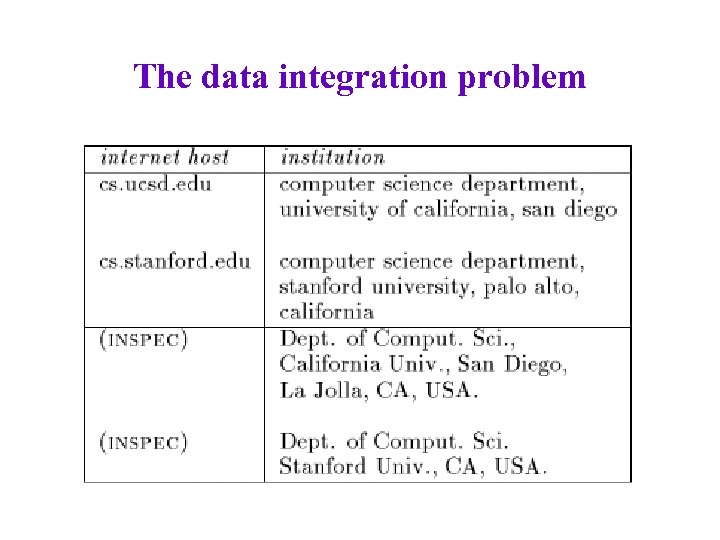 The data integration problem
 String distance metrics so far. . . • Term-based (e. g. TF/IDF as in WHIRL) – Distance depends on set of words contained in both s and t – so sensitive to spelling errors. – Usually weight words to account for “importance” – Fast comparison: O(n log n) for |s|+|t|=n • Edit-distance metrics – Distance is shortest sequence of edit commands that transform s to t. – No notion of word importance – More expensive: O(n 2) • Other metrics – Jaro metric & variants – Monge-Elkan’s recursive string matching – etc? • Which metrics work best, for which problems?
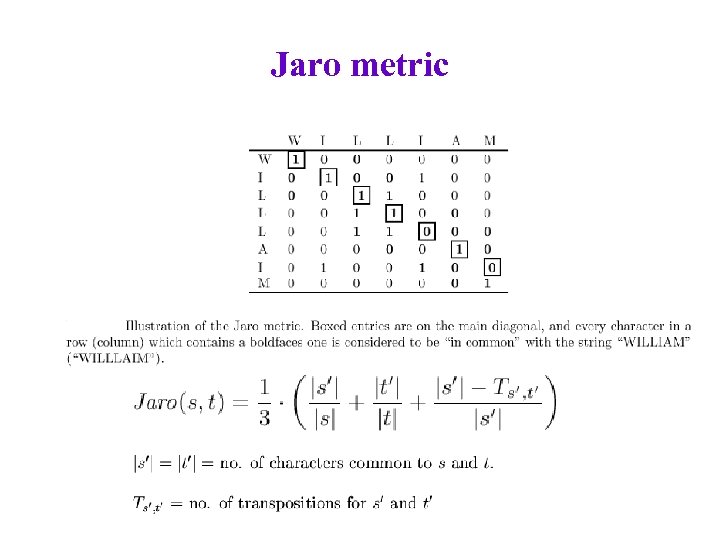 Jaro metric
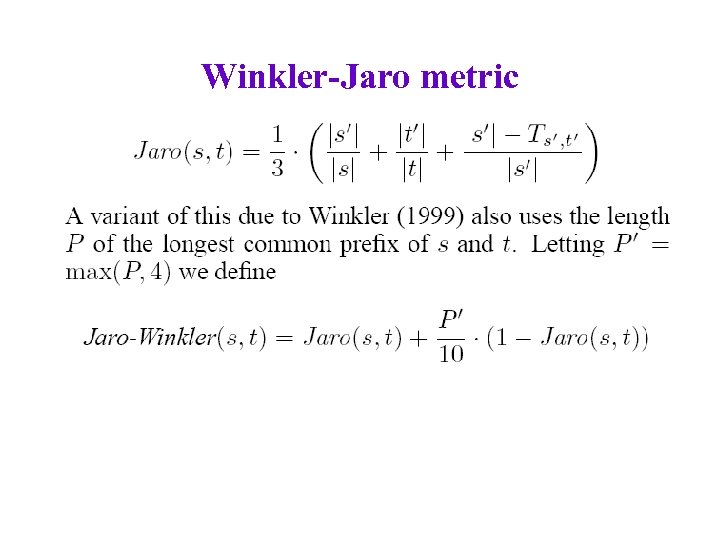 Winkler-Jaro metric
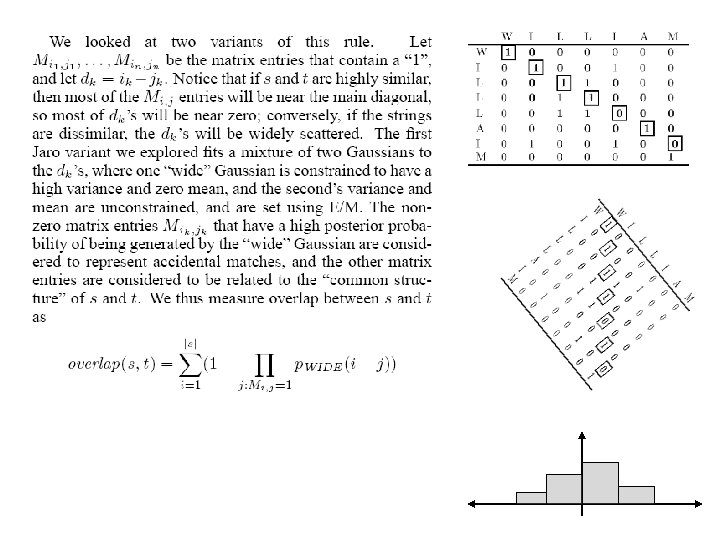
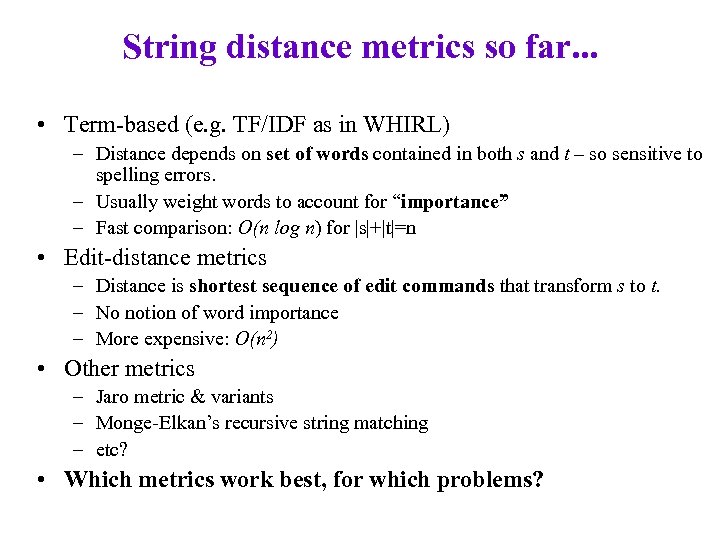 String distance metrics so far. . . • Term-based (e. g. TF/IDF as in WHIRL) – Distance depends on set of words contained in both s and t – so sensitive to spelling errors. – Usually weight words to account for “importance” – Fast comparison: O(n log n) for |s|+|t|=n • Edit-distance metrics – Distance is shortest sequence of edit commands that transform s to t. – No notion of word importance – More expensive: O(n 2) • Other metrics – Jaro metric & variants – Monge-Elkan’s recursive string matching – etc? • Which metrics work best, for which problems?
 So which metric should you use? Second. String (Cohen, Ravikumar, Fienberg): • Java toolkit of string-matching methods from AI, Statistics, IR and DB communities • Tools for evaluating performance on test data • Exploratory tool for adding, testing, combining string distances – e. g. Second. String implements a generic “Winkler rescorer” which can rescale any distance function with range of [0, 1] • URL – http: //secondstring. sourceforge. net • Distribution also includes several sample matching problems.
 Second. String distance functions • Edit-distance like: – Levenshtein – unit costs – untuned Smith-Waterman – Monge-Elkan (tuned Smith-Waterman) – Jaro and Jaro-Winkler
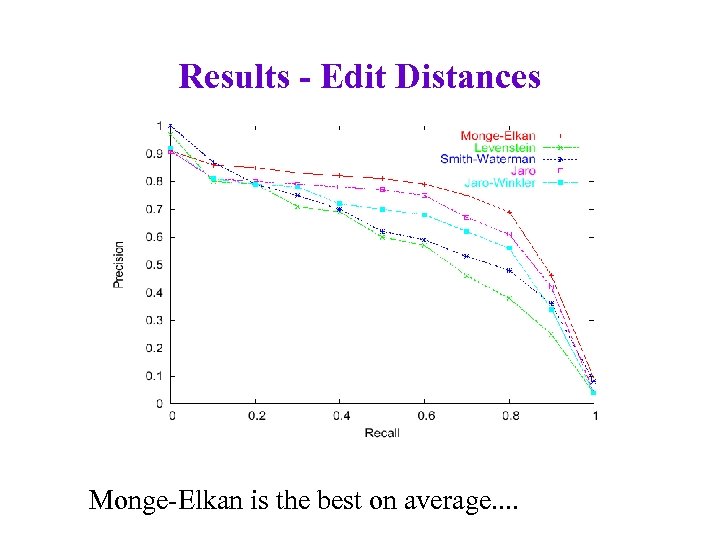 Results - Edit Distances Monge-Elkan is the best on average. .
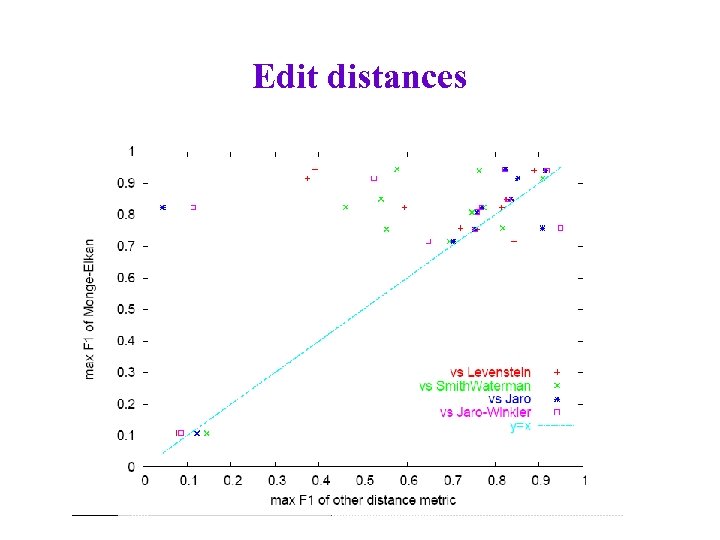 Edit distances
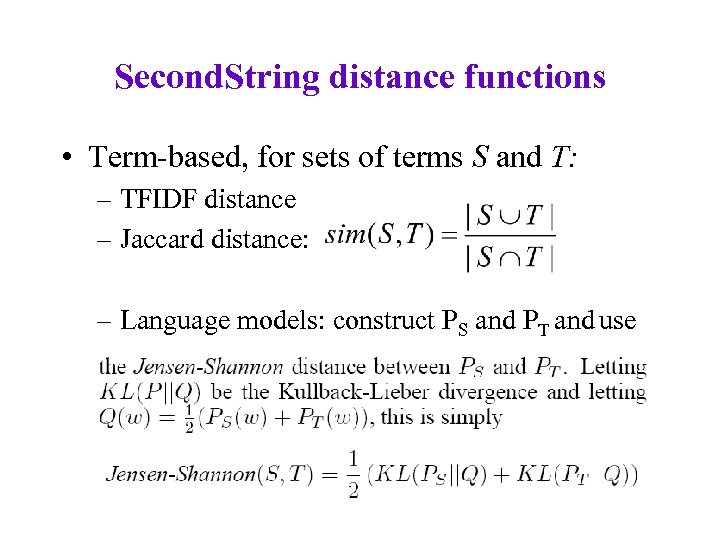 Second. String distance functions • Term-based, for sets of terms S and T: – TFIDF distance – Jaccard distance: – Language models: construct PS and PT and use
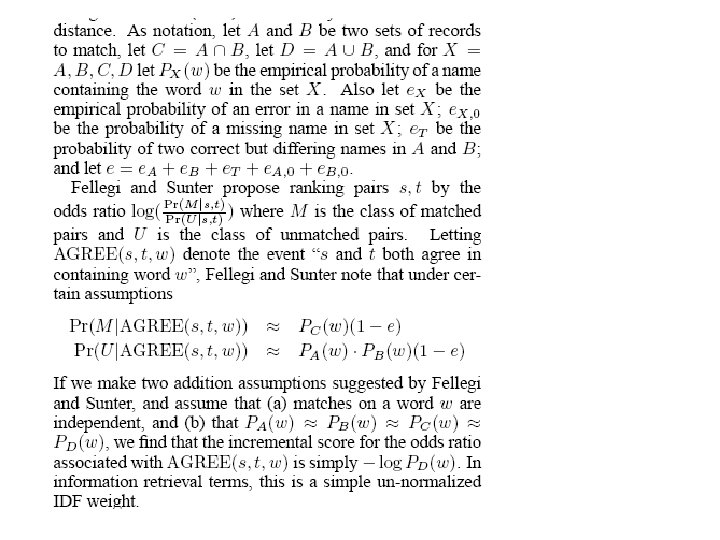
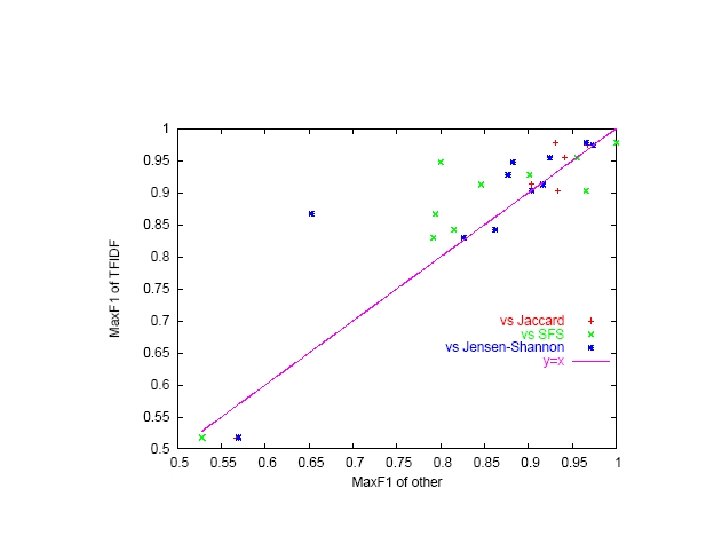
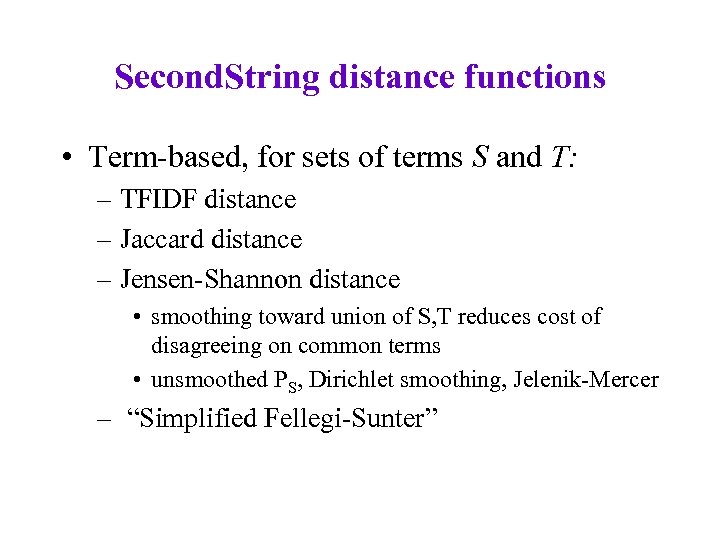 Second. String distance functions • Term-based, for sets of terms S and T: – TFIDF distance – Jaccard distance – Jensen-Shannon distance • smoothing toward union of S, T reduces cost of disagreeing on common terms • unsmoothed PS, Dirichlet smoothing, Jelenik-Mercer – “Simplified Fellegi-Sunter”
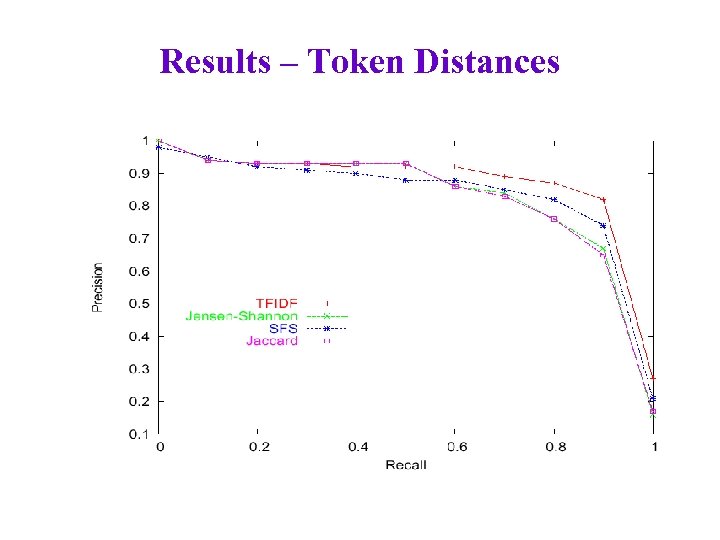 Results – Token Distances
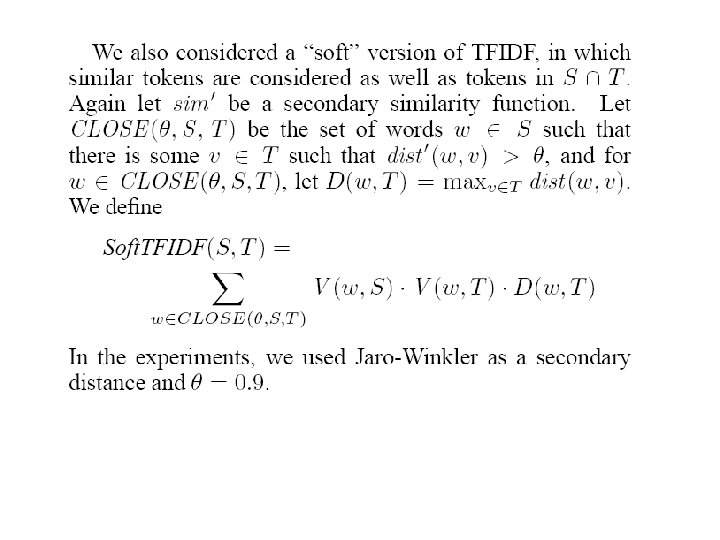
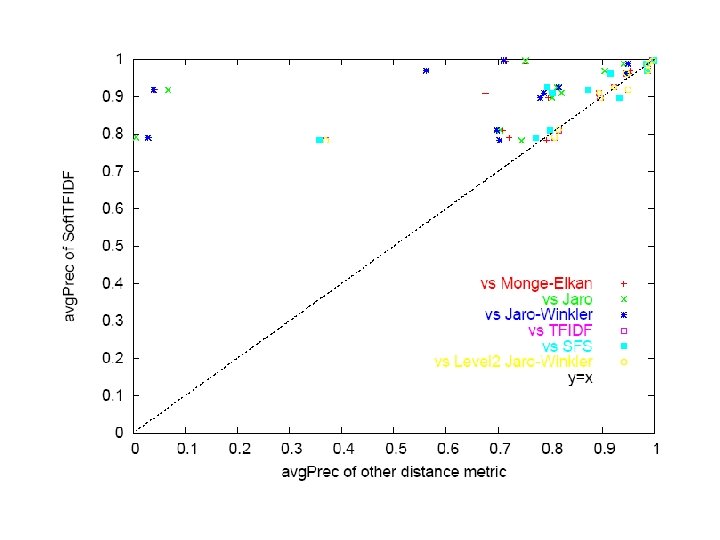
 Second. String distance functions • Hybrid term-based & edit-distance based: – Monge-Elkan’s “recursive matching scheme”, segmenting strings at token boundaries (rather than separators like commas) – Soft. TFIDF • Like TFIDF but consider not just tokens in both S and T, but tokens in S “close to” something in T (“close to” relative to some distance metric) • Downweight close tokens slightly
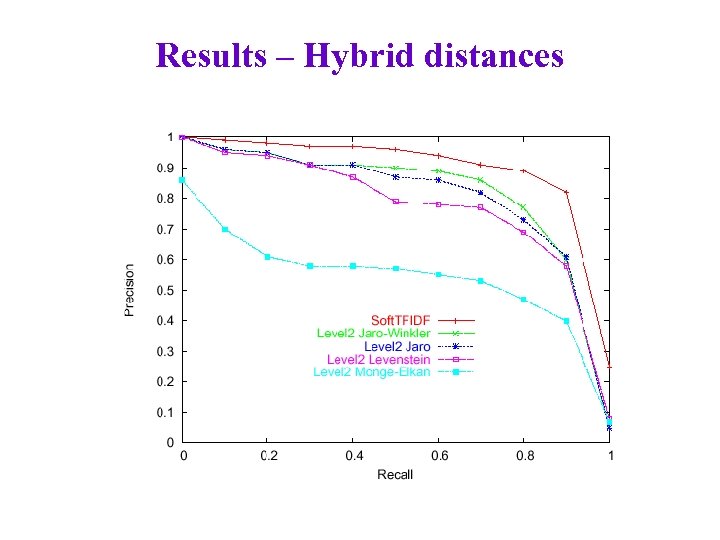 Results – Hybrid distances
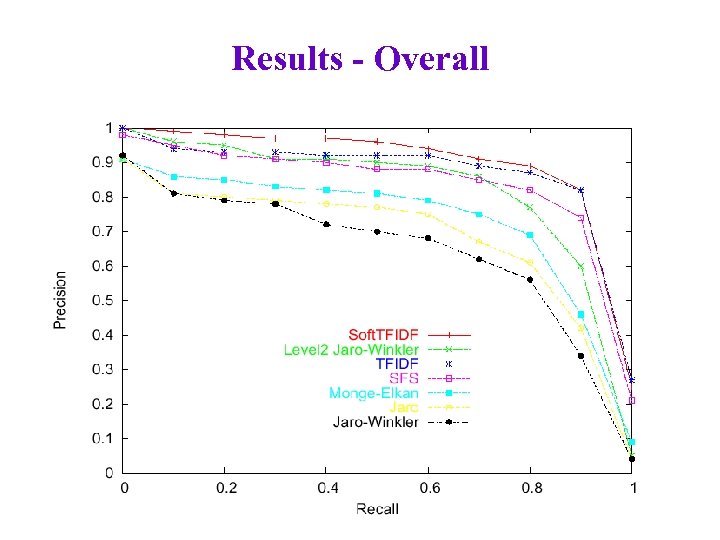 Results - Overall
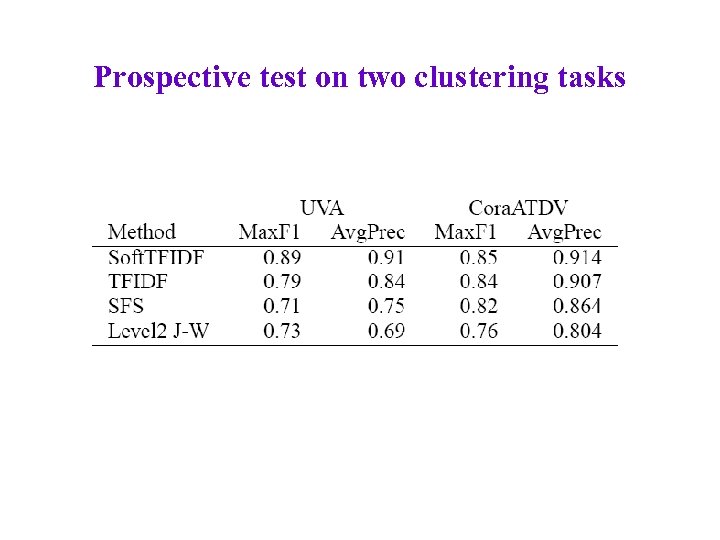 Prospective test on two clustering tasks
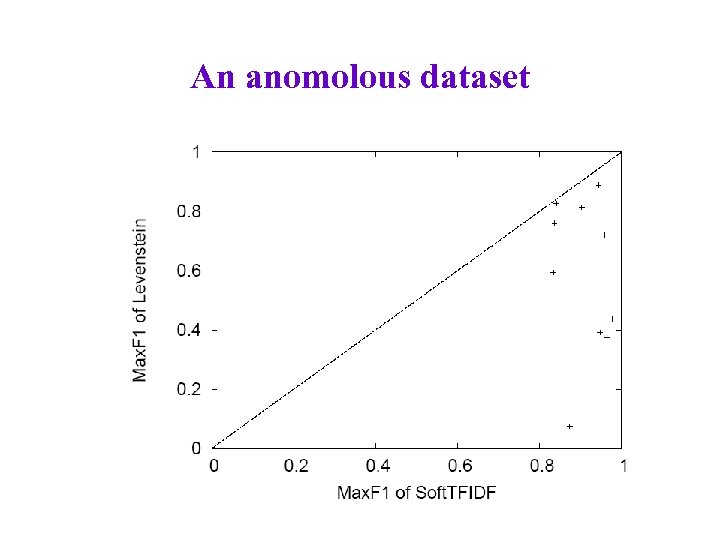 An anomolous dataset
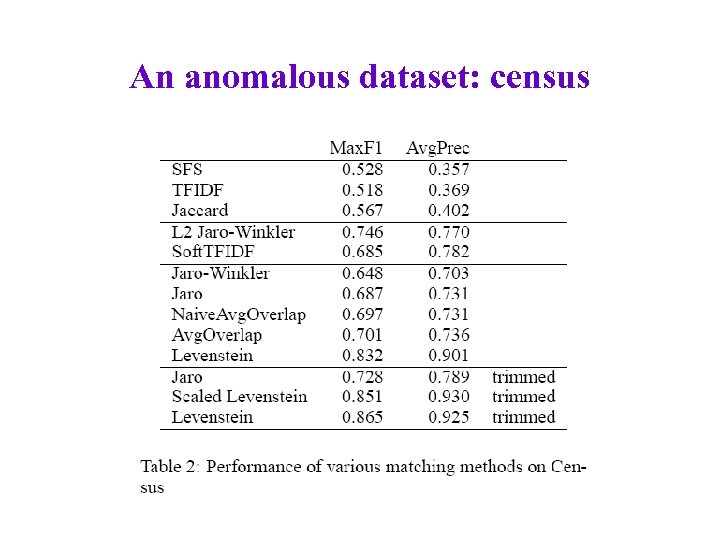 An anomalous dataset: census
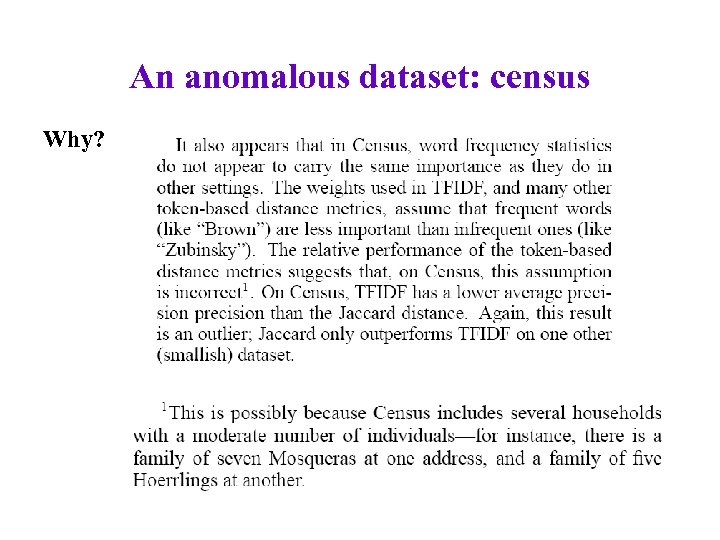 An anomalous dataset: census Why?
 Other results with Second. String • Distance functions over structured data records (first name, last name, street, house number) • Learning to combine distance functions • Unsupervised/semi-supervised training for distance functions over structured data
 Combining Information Extraction and Similarity Computations 2) Krauthammer et al 1) Bunescu et al
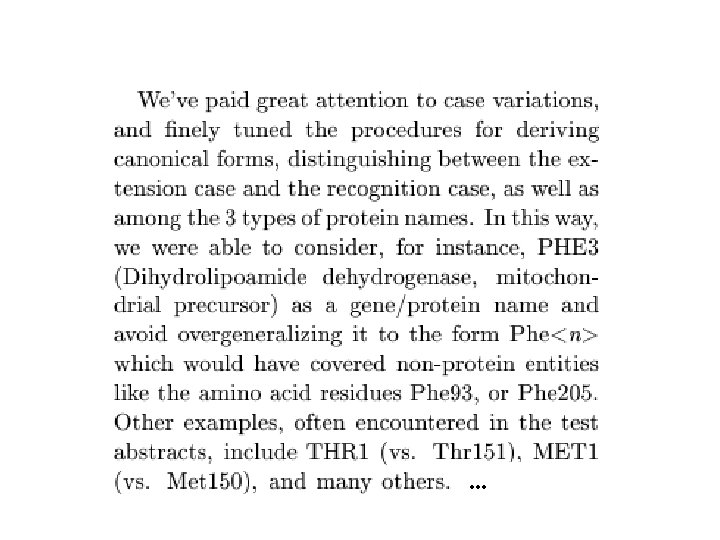
 Experiments • Hand-tagged 50 abstracts for gene/protein entities (pre-selected to be about human genes) • Collected dictionary of 40, 000+ protein names from on-line sources – not complete – example matching is not sufficient • Approach: use hand-coded heuristics to propose likely generalizations of existing dictionary entries. – not hand-coded or off-the-shelf similarity metrics
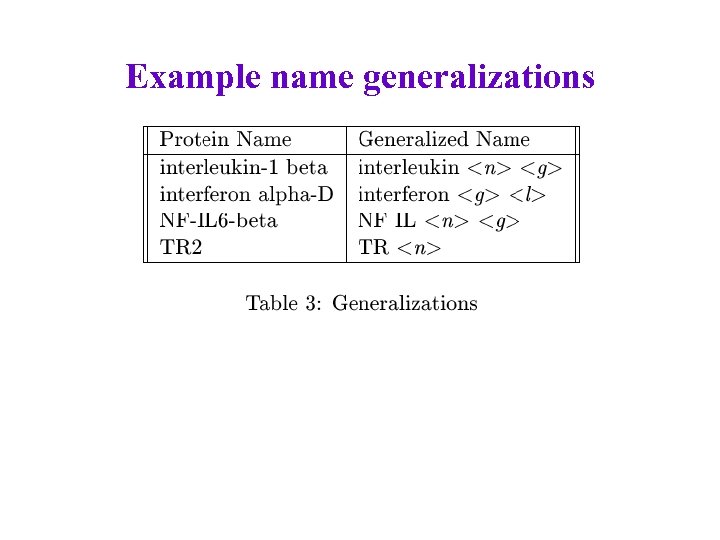 Example name generalizations
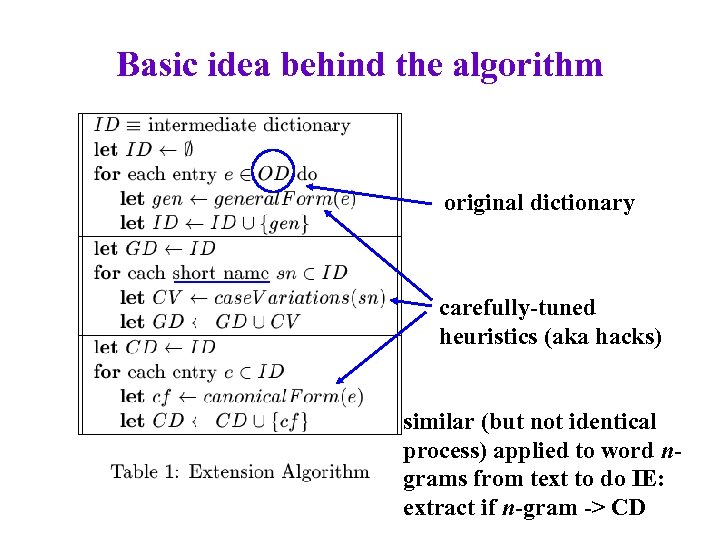 Basic idea behind the algorithm original dictionary carefully-tuned heuristics (aka hacks) similar (but not identical process) applied to word ngrams from text to do IE: extract if n-gram -> CD
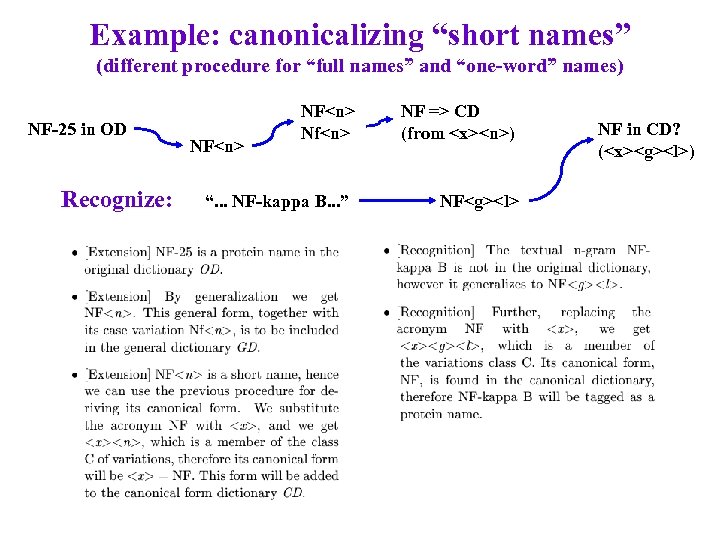
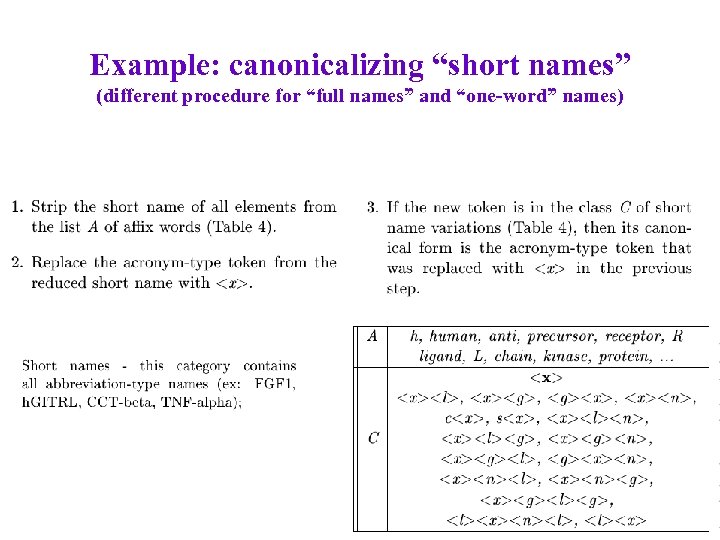 Example: canonicalizing “short names” (different procedure for “full names” and “one-word” names)
 Example: canonicalizing “short names” (different procedure for “full names” and “one-word” names) NF-25 in OD Recognize: NF
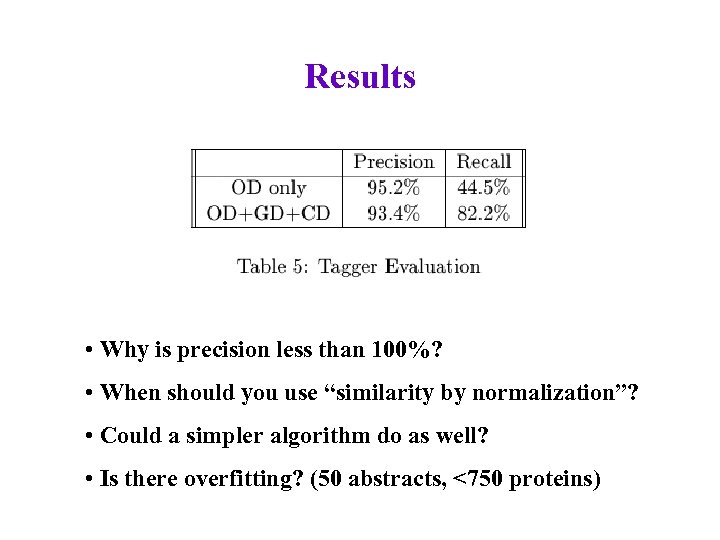 Results • Why is precision less than 100%? • When should you use “similarity by normalization”? • Could a simpler algorithm do as well? • Is there overfitting? (50 abstracts, <750 proteins)
 . . .
. . .
 Combining Information Extraction and Similarity Computations 2) Krauthammer et al 1) Bunescu et al
 Background • Common task in proteomics/genomics: – look for (soft) matches to a query sequence in a large “database” of sequences. – want to find subsequences (genes) that are highly similar (and hence probably related) – want to ignore “accidental” matches – possible technique is Smith-Waterman (local alignment) • want char-char “reward” for alignment to reflect confidence that the alignment is not due to chance
 Background • Common task in proteomics/genomics: – look for (soft) matches to a query sequence in a large “database” of sequences. – want to find subsequences (genes) that are highly similar (and hence probably related) – want to ignore “accidental” matches – possible technique is Smith-Waterman (local alignment) • want char-char “reward” for alignment to reflect confidence that the alignment is not due to chance
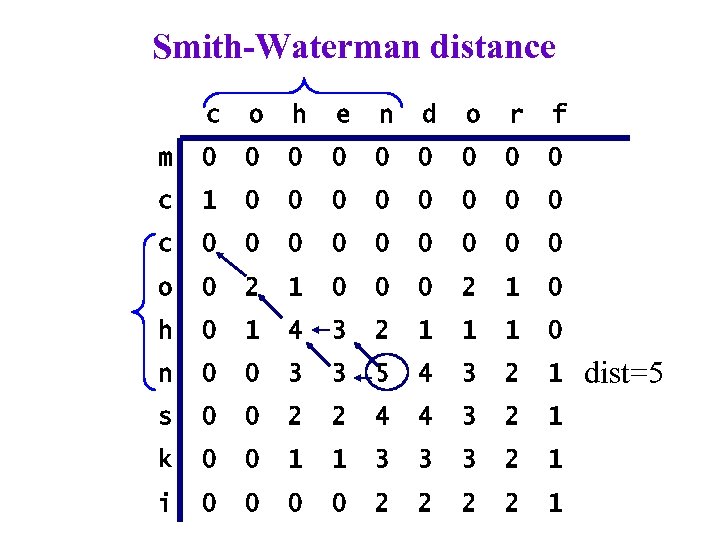 Smith-Waterman distance c o h e n d o r f m 0 0 0 0 0 c 1 0 0 0 0 c 0 0 0 0 0 o 0 2 1 0 0 0 2 1 0 h 0 1 4 3 2 1 1 1 0 n 0 0 3 3 5 4 3 2 1 s 0 0 2 2 4 4 3 2 1 k 0 0 1 1 3 3 3 2 1 i 0 0 2 2 1 dist=5
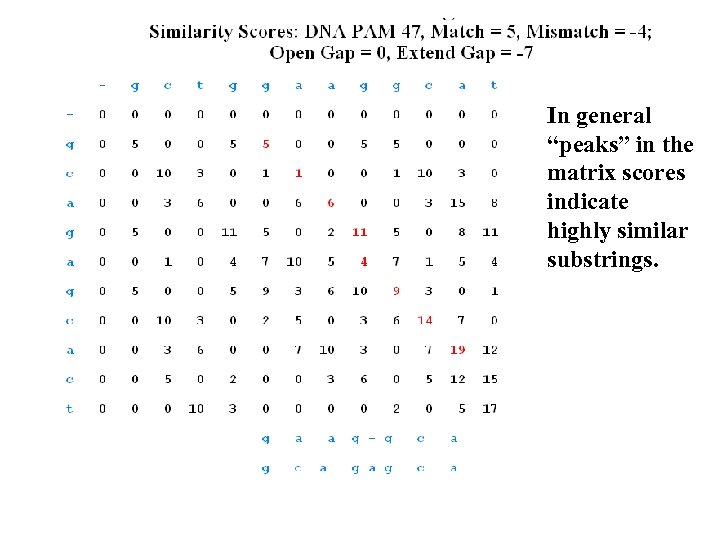 In general “peaks” in the matrix scores indicate highly similar substrings.
 Background • Common task in proteomics/genomics: – look for (soft) matches to a query sequence in a large “database” of sequences. – possible technique is Smith-Waterman (local alignment) • want char-char “reward” for alignment to reflect confidence that the alignment is not due to chance • based on substitutability theory for amino acids – doesn’t scale well • BLAST and FASTA: fast approximate S-W
 BLAST/FASTA ideas • Find all char n-grams (“words”) in the query string. • FASTA: – Use inverted indices to find out where these words appear in the DB sequence – Use S-W only near DB sections that contain some of these words
 BLAST/FASTA ideas • Find all char n-grams (“words”) in the query string. • BLAST: – Generate variations of these words by looking for changes that would lead to strong similarities – Discard “low IDF” words (where accidental matches are likely) – Use expanded set of n-grams to focus search
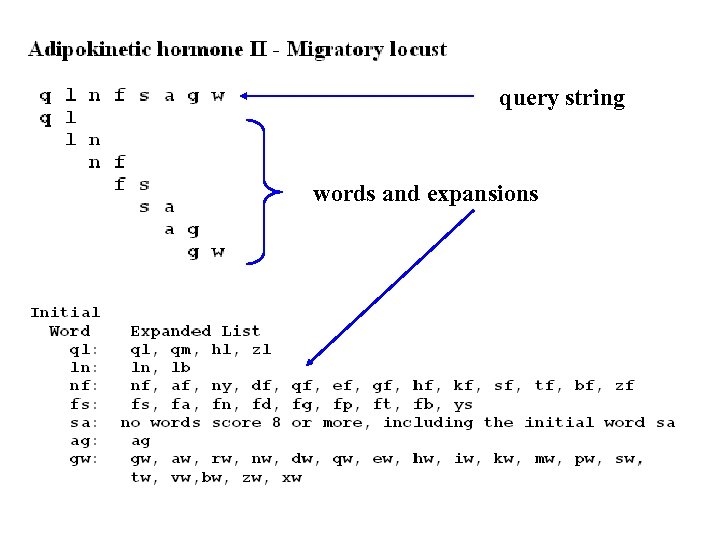 query string words and expansions
 BLAST/FASTA ideas • Find all char n-grams (“words”) in the query string. • BLAST: – Generate variations of these words by looking for changes that would lead to strong similarities – Discard “low IDF” words (where accidental matches are likely) – Use expanded set of n-grams to focus search • The BLAST program: – – Widely used, Fast implementation, Supports asking multiple queries against a database at once. . . Can one use it find soft matches of protein names (from a dictionary) in text?
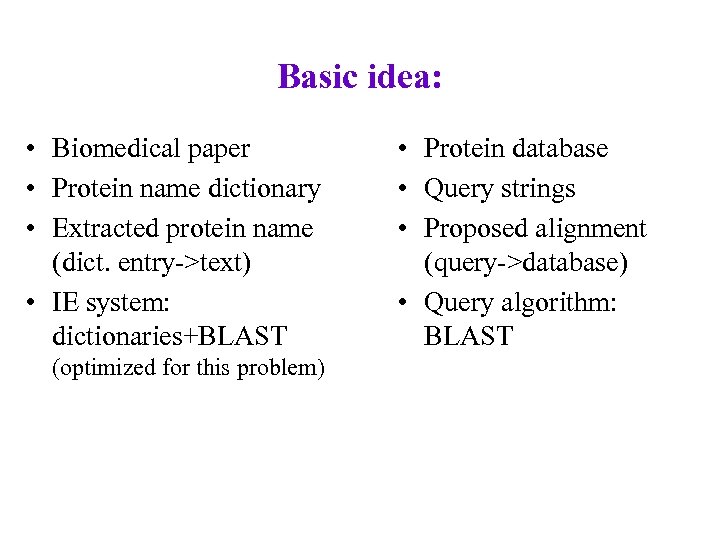 Basic idea: • Biomedical paper • Protein name dictionary • Extracted protein name (dict. entry->text) • IE system: dictionaries+BLAST (optimized for this problem) • Protein database • Query strings • Proposed alignment (query->database) • Query algorithm: BLAST
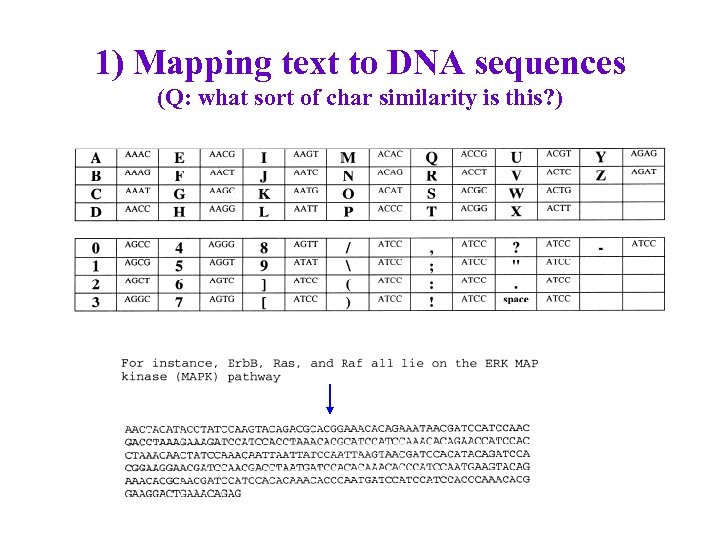 1) Mapping text to DNA sequences (Q: what sort of char similarity is this? )
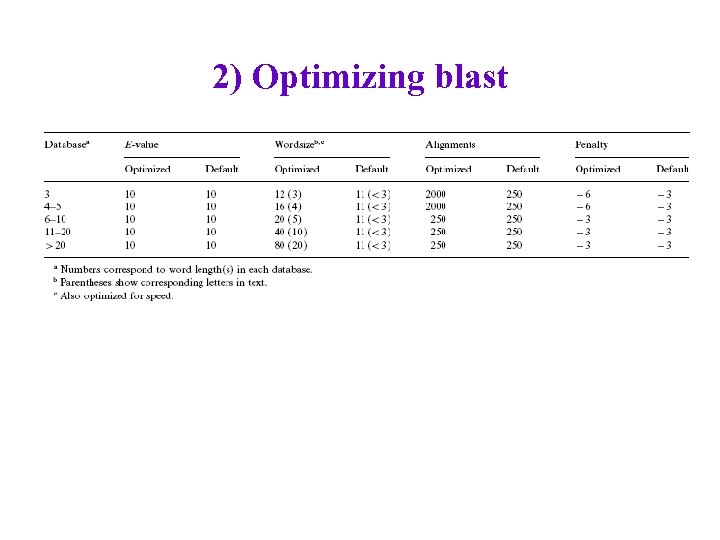
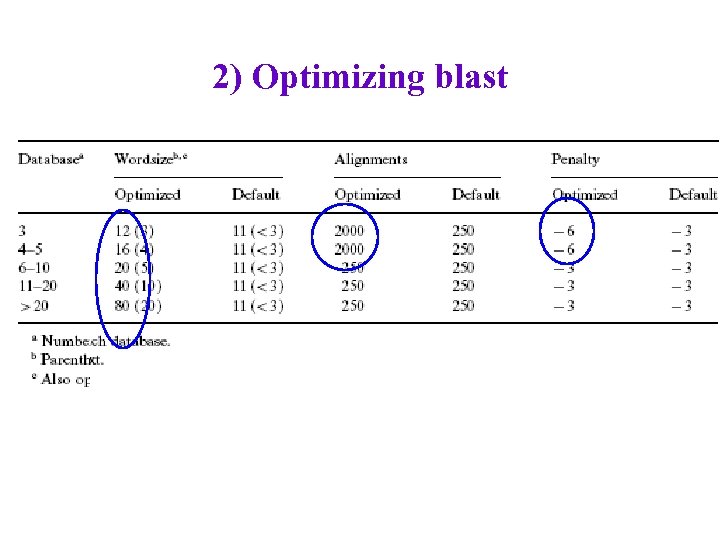
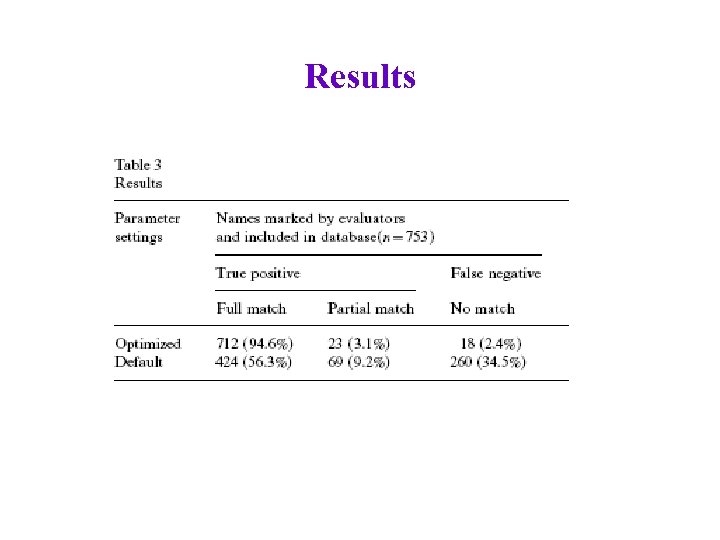
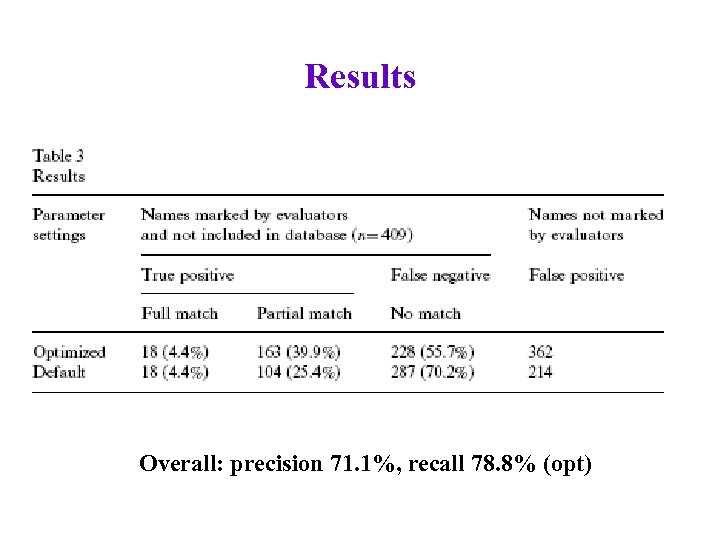
 2) Optimizing blast • Split protein-name database into several parts (for short, medium-length, long protein names) • Require space chars before and after “short” protein names. • Manually search (grid search? ) for better settings for certain key parameters for each protein-name subdatabase – With what data? • Evaluate on one review article, 1162 protein names – inter-annotator agreement not great (70 -85%)
 2) Optimizing blast
 2) Optimizing blast
 Results
 Results Overall: precision 71. 1%, recall 78. 8% (opt)