


 Скачать презентацию Distance and Information Asymmetries in Lending Decisions Sumit
8c1386492143e1a51b73464d91d80929.ppt
- Количество слайдов: 19
 Distance and Information Asymmetries in Lending Decisions Sumit Agarwal Federal Reserve Bank of Chicago Robert Hauswald American University FDIC-CFR Fall Workshop Washington, DC, October 2006 The views do not represent those of the Federal Reserve Bank of Chicago.
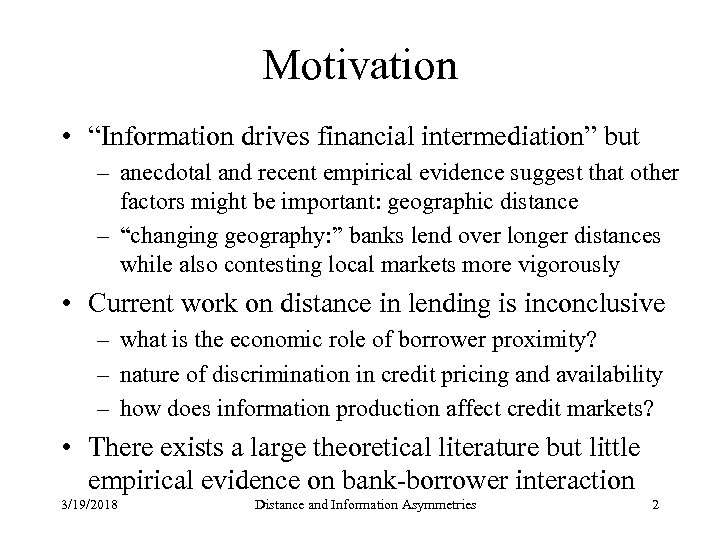 Motivation • “Information drives financial intermediation” but – anecdotal and recent empirical evidence suggest that other factors might be important: geographic distance – “changing geography: ” banks lend over longer distances while also contesting local markets more vigorously • Current work on distance in lending is inconclusive – what is the economic role of borrower proximity? – nature of discrimination in credit pricing and availability – how does information production affect credit markets? • There exists a large theoretical literature but little empirical evidence on bank-borrower interaction 3/19/2018 Distance and Information Asymmetries 2
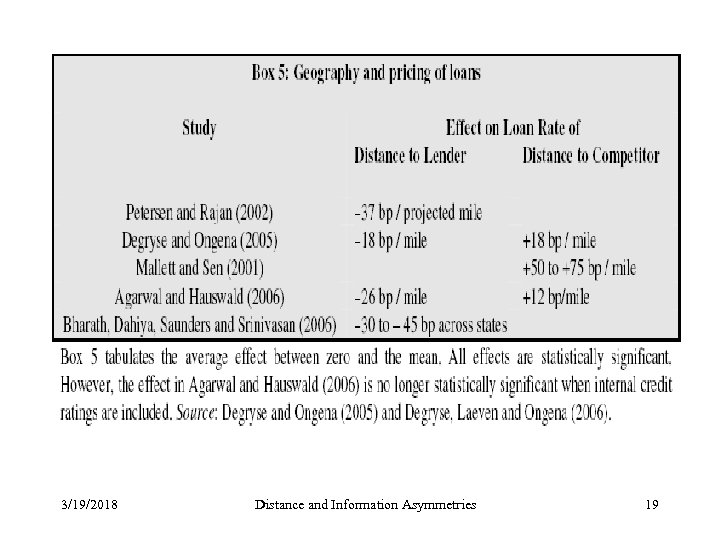
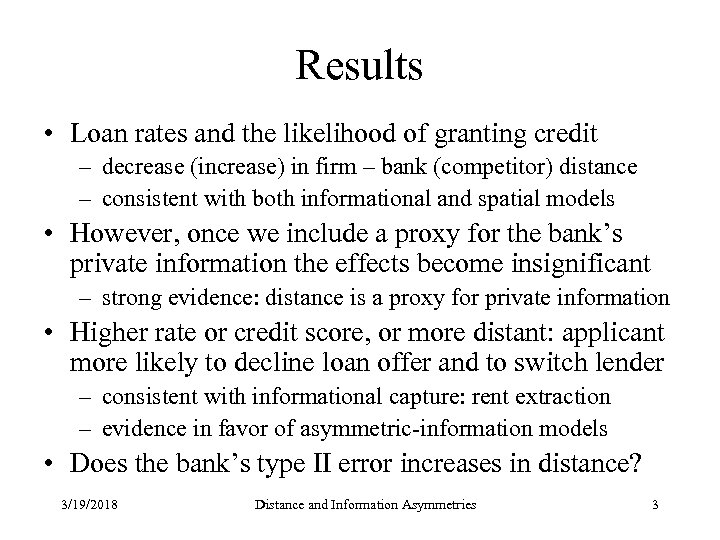 Results • Loan rates and the likelihood of granting credit – decrease (increase) in firm – bank (competitor) distance – consistent with both informational and spatial models • However, once we include a proxy for the bank’s private information the effects become insignificant – strong evidence: distance is a proxy for private information • Higher rate or credit score, or more distant: applicant more likely to decline loan offer and to switch lender – consistent with informational capture: rent extraction – evidence in favor of asymmetric-information models • Does the bank’s type II error increases in distance? 3/19/2018 Distance and Information Asymmetries 3
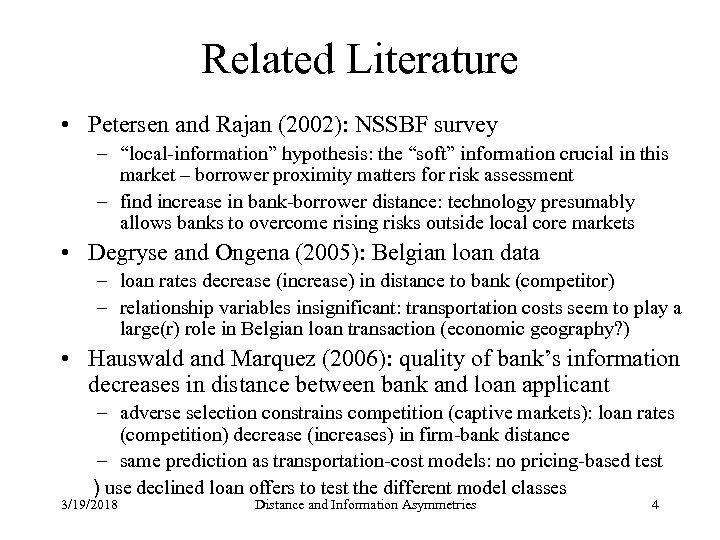 Related Literature • Petersen and Rajan (2002): NSSBF survey – “local-information” hypothesis: the “soft” information crucial in this market – borrower proximity matters for risk assessment – find increase in bank-borrower distance: technology presumably allows banks to overcome rising risks outside local core markets • Degryse and Ongena (2005): Belgian loan data – loan rates decrease (increase) in distance to bank (competitor) – relationship variables insignificant: transportation costs seem to play a large(r) role in Belgian loan transaction (economic geography? ) • Hauswald and Marquez (2006): quality of bank’s information decreases in distance between bank and loan applicant – adverse selection constrains competition (captive markets): loan rates (competition) decrease (increases) in firm-bank distance – same prediction as transportation-cost models: no pricing-based test ) use declined loan offers to test the different model classes 3/19/2018 Distance and Information Asymmetries 4
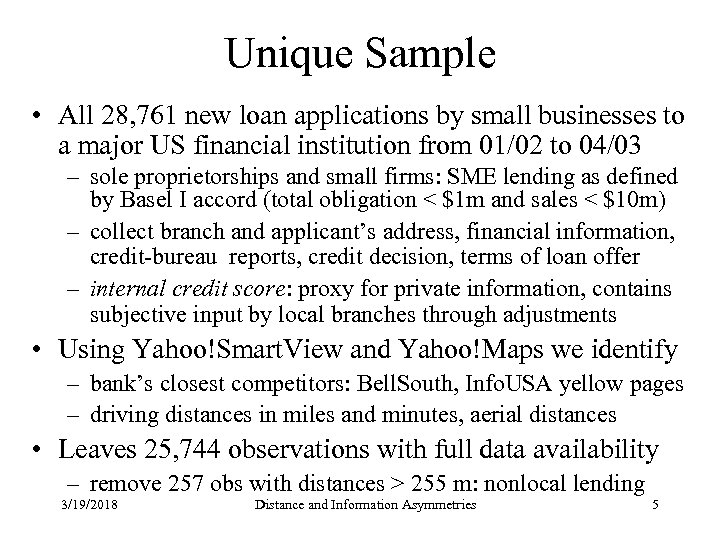 Unique Sample • All 28, 761 new loan applications by small businesses to a major US financial institution from 01/02 to 04/03 – sole proprietorships and small firms: SME lending as defined by Basel I accord (total obligation < $1 m and sales < $10 m) – collect branch and applicant’s address, financial information, credit-bureau reports, credit decision, terms of loan offer – internal credit score: proxy for private information, contains subjective input by local branches through adjustments • Using Yahoo!Smart. View and Yahoo!Maps we identify – bank’s closest competitors: Bell. South, Info. USA yellow pages – driving distances in miles and minutes, aerial distances • Leaves 25, 744 observations with full data availability – remove 257 obs with distances > 255 m: nonlocal lending 3/19/2018 Distance and Information Asymmetries 5
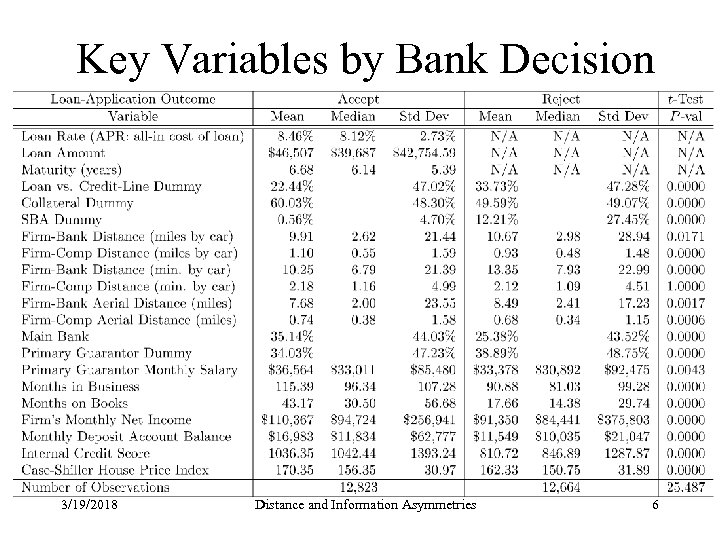 Key Variables by Bank Decision 3/19/2018 Distance and Information Asymmetries 6
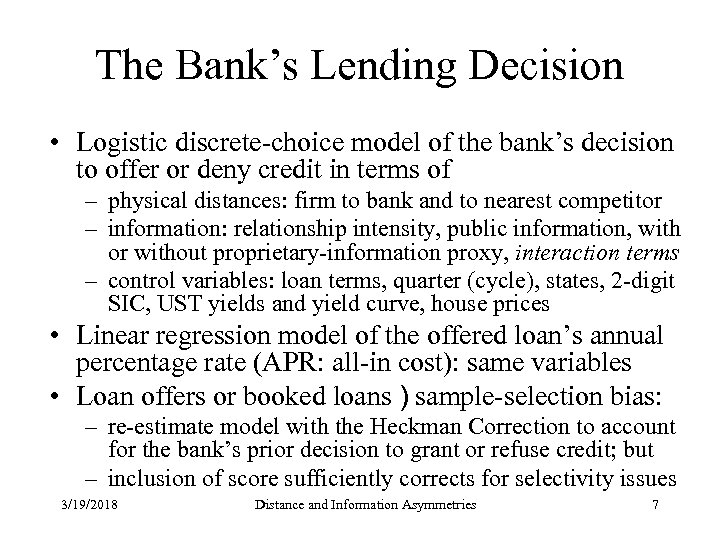 The Bank’s Lending Decision • Logistic discrete-choice model of the bank’s decision to offer or deny credit in terms of – physical distances: firm to bank and to nearest competitor – information: relationship intensity, public information, with or without proprietary-information proxy, interaction terms – control variables: loan terms, quarter (cycle), states, 2 -digit SIC, UST yields and yield curve, house prices • Linear regression model of the offered loan’s annual percentage rate (APR: all-in cost): same variables • Loan offers or booked loans ) sample-selection bias: – re-estimate model with the Heckman Correction to account for the bank’s prior decision to grant or refuse credit; but – inclusion of score sufficiently corrects for selectivity issues 3/19/2018 Distance and Information Asymmetries 7
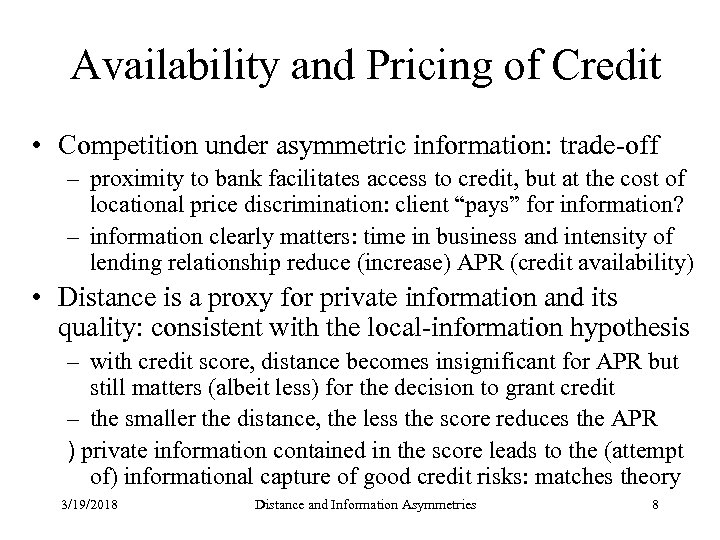 Availability and Pricing of Credit • Competition under asymmetric information: trade-off – proximity to bank facilitates access to credit, but at the cost of locational price discrimination: client “pays” for information? – information clearly matters: time in business and intensity of lending relationship reduce (increase) APR (credit availability) • Distance is a proxy for private information and its quality: consistent with the local-information hypothesis – with credit score, distance becomes insignificant for APR but still matters (albeit less) for the decision to grant credit – the smaller the distance, the less the score reduces the APR ) private information contained in the score leads to the (attempt of) informational capture of good credit risks: matches theory 3/19/2018 Distance and Information Asymmetries 8
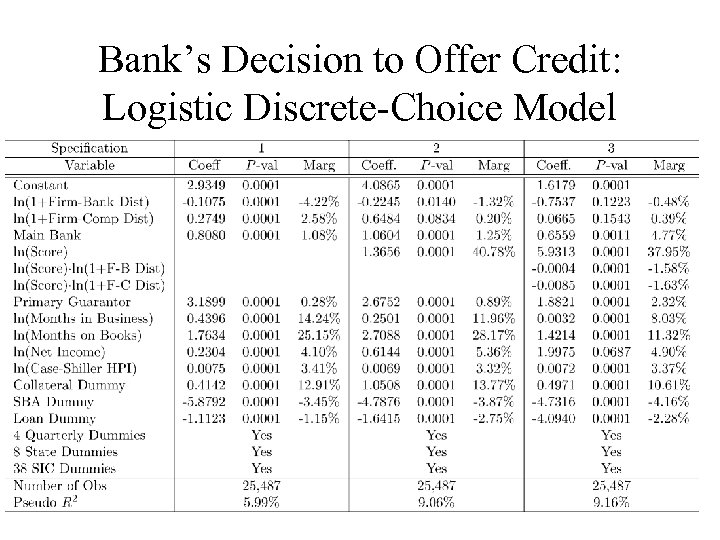 Bank’s Decision to Offer Credit: Logistic Discrete-Choice Model 3/19/2018 Distance and Information Asymmetries 9
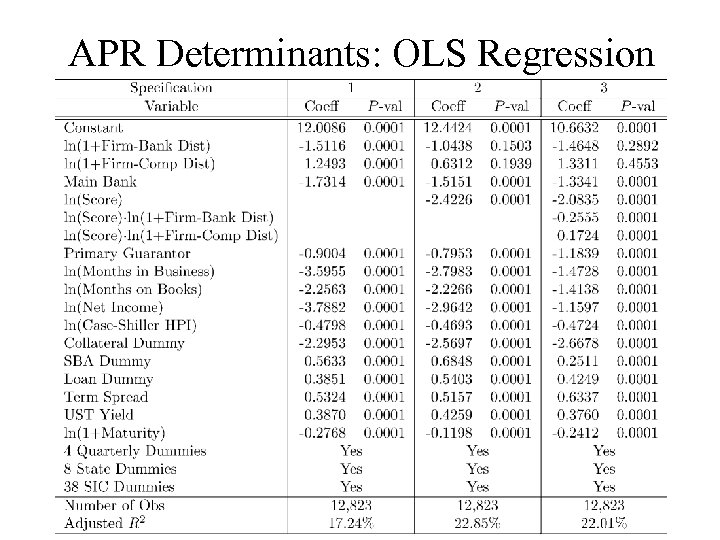 APR Determinants: OLS Regression 3/19/2018 Distance and Information Asymmetries 10
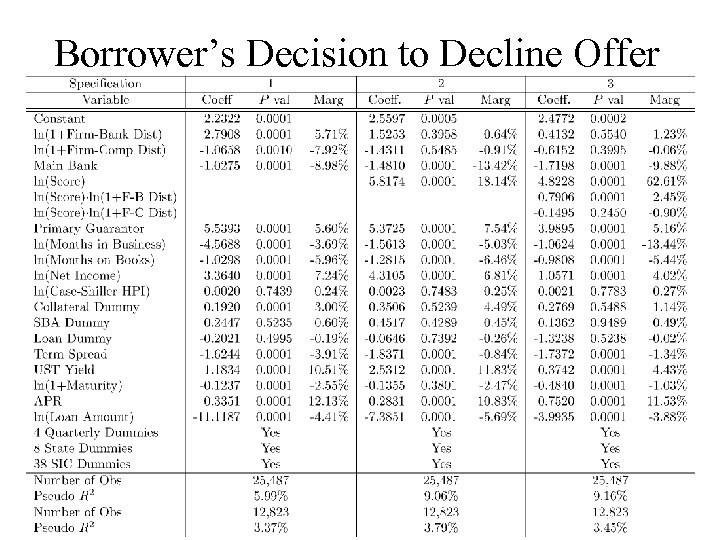
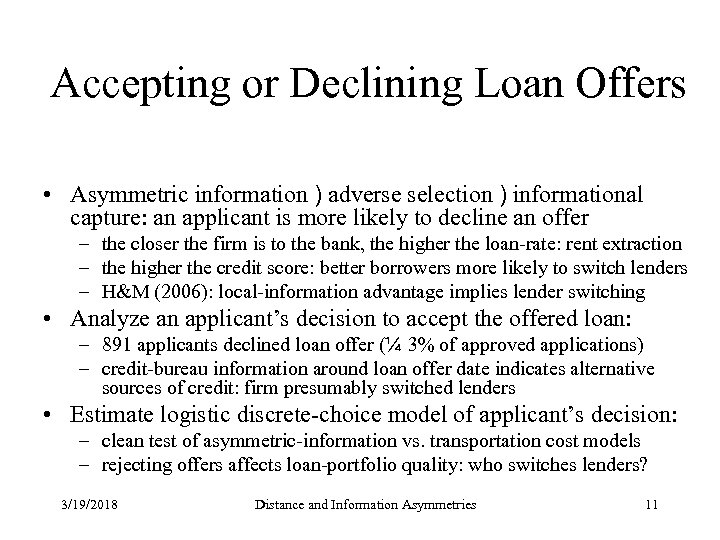 Accepting or Declining Loan Offers • Asymmetric information ) adverse selection ) informational capture: an applicant is more likely to decline an offer – the closer the firm is to the bank, the higher the loan-rate: rent extraction – the higher the credit score: better borrowers more likely to switch lenders – H&M (2006): local-information advantage implies lender switching • Analyze an applicant’s decision to accept the offered loan: – 891 applicants declined loan offer (¼ 3% of approved applications) – credit-bureau information around loan offer date indicates alternative sources of credit: firm presumably switched lenders • Estimate logistic discrete-choice model of applicant’s decision: – clean test of asymmetric-information vs. transportation cost models – rejecting offers affects loan-portfolio quality: who switches lenders? 3/19/2018 Distance and Information Asymmetries 11
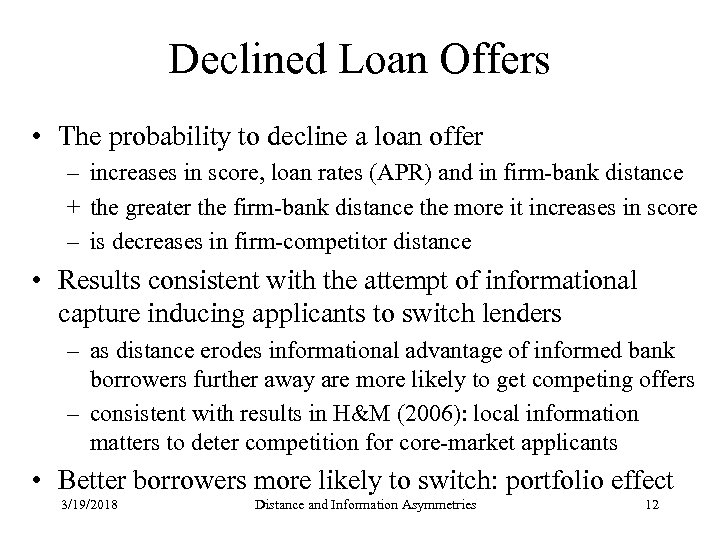 Declined Loan Offers • The probability to decline a loan offer – increases in score, loan rates (APR) and in firm-bank distance + the greater the firm-bank distance the more it increases in score – is decreases in firm-competitor distance • Results consistent with the attempt of informational capture inducing applicants to switch lenders – as distance erodes informational advantage of informed bank borrowers further away are more likely to get competing offers – consistent with results in H&M (2006): local information matters to deter competition for core-market applicants • Better borrowers more likely to switch: portfolio effect 3/19/2018 Distance and Information Asymmetries 12
 Borrower’s Decision to Decline Offer 3/19/2018 Distance and Information Asymmetries 13
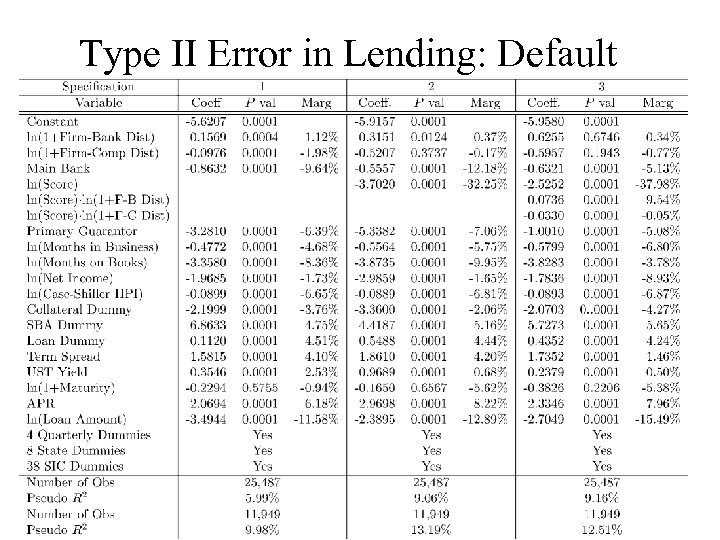
 The Local-Information Hypothesis • If relevant (soft) borrower information is truly local – the bank’s information advantage should diminish with firm-bank distance; firm-competitor distance irrelevant – empirical prediction: errors in lending (type II error) should increase with distance ceteris paribus • To test this hypothesis we specify a logistic model of credit delinquency in terms of our usual variables – 322 loans 60 days overdue (out of 12, 005 booked loans: ¼ 2. 7% default rate) within 18 M of origination – internal definition of defaulted loan requiring action: over 90% of such loans eventually experience default 3/19/2018 Distance and Information Asymmetries 14
 Type II Error in Lending • The further away the borrower, the more likely credit delinquency (i. e. , default) becomes (De Young et. al. find similar results - SBA loans). – private and public information variables reduce likelihood of loan becoming nonperforming: value of information • Unsurprisingly, the internal credit score is the most important variable for predicting credit delinquency – shows how technology can overcome distance problems – the further away, the less a high score reduces default probability: information discounted in terms of distance • Results provide strong evidence for – the local nature of “soft” information on loan applicants – screening specification in H&M (2006): screening quality 3/19/2018 (type II error. Distance and Information Asymmetries with distance 15 of in) lending falls (rises)
 Type II Error in Lending: Default 3/19/2018 Distance and Information Asymmetries 16
 The Nature of Soft Information and the Effect of Competition • Relationship content of credit assessments: interact the score and lending-relationship variables – relationship variables increase the score’s marginal effect in all specifications: improvement in risk assessment – soft information is (i) local, (ii) gathered over time – partial hardening of soft information through technology • The incidence of industry structure: number of branches or competitors, HHI for deposit shares – more competition reduces both loan offers and rates – again, trade-off between pricing and availability of credit 3/19/2018 Distance and Information Asymmetries 17
 Conclusion • We investigate the dual hypotheses that – private information is local and implies an – informational advantage to deter competition • Technology increases the reach of local information: banks “harden” soft proprietary information + to extend the geographic reach of their markets by overcoming threats of adverse selection due to distance • Hence, distance still limits the size of local markets – bank discounts own intelligence in function of distance that acts as a proxy for the quality of information 3/19/2018 Distance and Information Asymmetries 18
 3/19/2018 Distance and Information Asymmetries 19