


 Скачать презентацию Disruptive Middleware Past Present and Future Lucy Cherkasova
599a0ff79a1a30b08983f7d3cff96f73.ppt
- Количество слайдов: 39
 Disruptive Middleware: Past, Present, and Future Lucy Cherkasova Hewlett-Packard Labs
 From Internet Data Centers to Data Centers in the Cloud • Data Centers Evolution − Internet Data Centers Performance and − Enterprise Data Centers − Web 2. 0 Mega Data Centers 2 Modeling Challenges
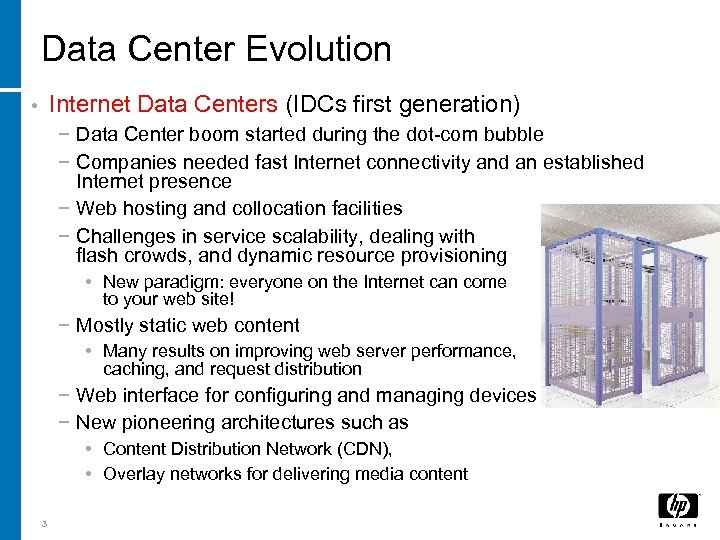 Data Center Evolution Internet Data Centers (IDCs first generation) • − Data Center boom started during the dot-com bubble − Companies needed fast Internet connectivity and an established Internet presence − Web hosting and collocation facilities − Challenges in service scalability, dealing with flash crowds, and dynamic resource provisioning • New paradigm: everyone on the Internet can come to your web site! − Mostly static web content • Many results on improving web server performance, caching, and request distribution − Web interface for configuring and managing devices − New pioneering architectures such as • Content Distribution Network (CDN), • Overlay networks for delivering media content 3 web
 Content Delivery Network (CDN) High availability and responsiveness are key factors for business Web sites • “Flash Crowd” problem • Main goal of CDN’s solution is • − overcome server overload problem for popular sites, − minimize the network impact in the content delivery path. • CDN: large-scale distributed network of servers, − Surrogate servers (proxy caches) are located closer to the edges of the Internet. • Akamai is one of the largest CDNs − 56, 000 servers in 950 networks in 70 countries − Deliver 20% of all Web traffic 4
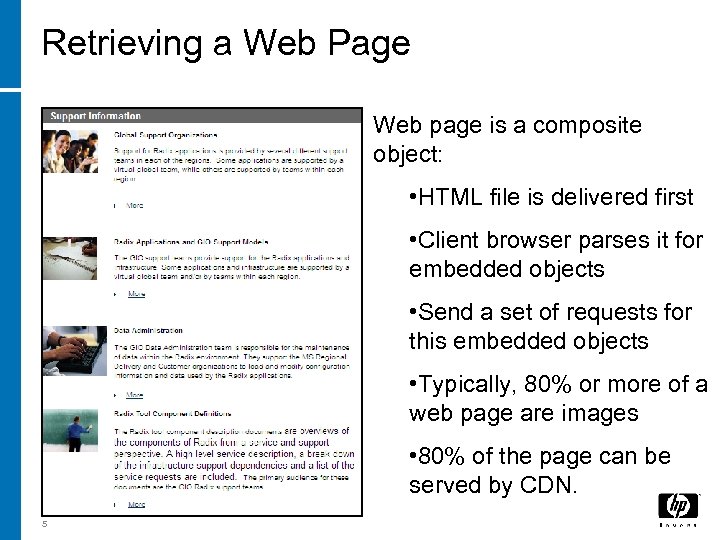 Retrieving a Web Page Web page is a composite object: • HTML file is delivered first • Client browser parses it for embedded objects • Send a set of requests for this embedded objects • Typically, 80% or more of a web page are images • 80% of the page can be served by CDN. 5
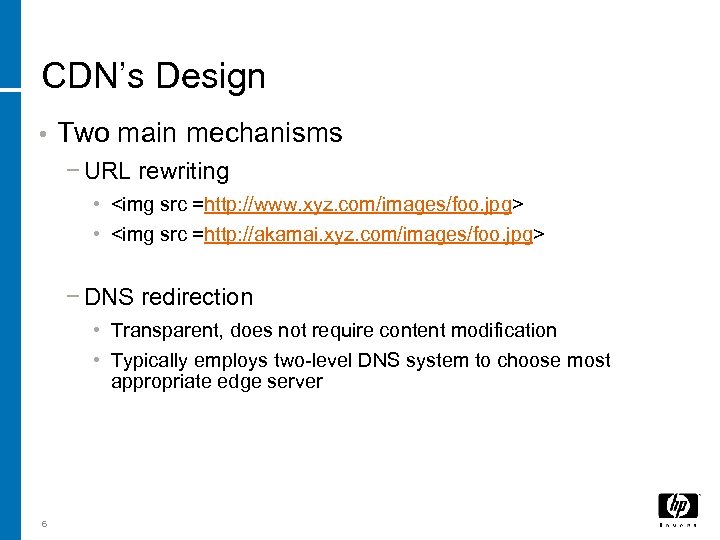 CDN’s Design • Two main mechanisms − URL rewriting •
 •
− DNS redirection • Transparent, does not require content modification • Typically employs two-level DNS system to choose most appropriate edge server 6
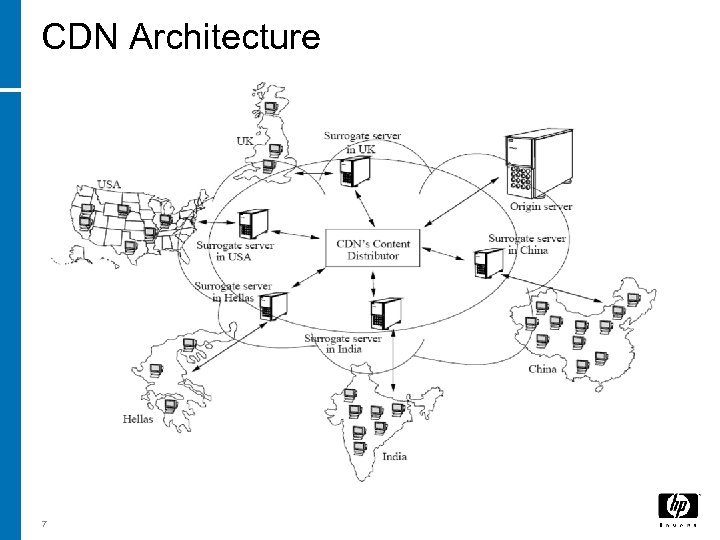 CDN Architecture 7
 Research Problems • Efficient large-scale content distribution − large files, video on demand, streaming media • Fast. Replica for CDNs • Bit. Torrent (general purpose) • Split. Stream (multicast, video streaming) 8
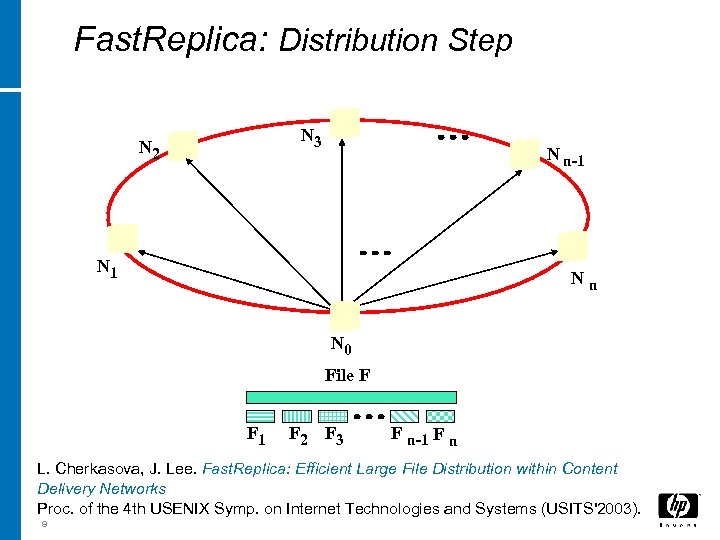 Fast. Replica: Distribution Step N 3 N 2 N n-1 N 1 Nn N 0 File F F 1 F 2 F 3 F n-1 F n L. Cherkasova, J. Lee. Fast. Replica: Efficient Large File Distribution within Content Delivery Networks Proc. of the 4 th USENIX Symp. on Internet Technologies and Systems (USITS'2003). 9
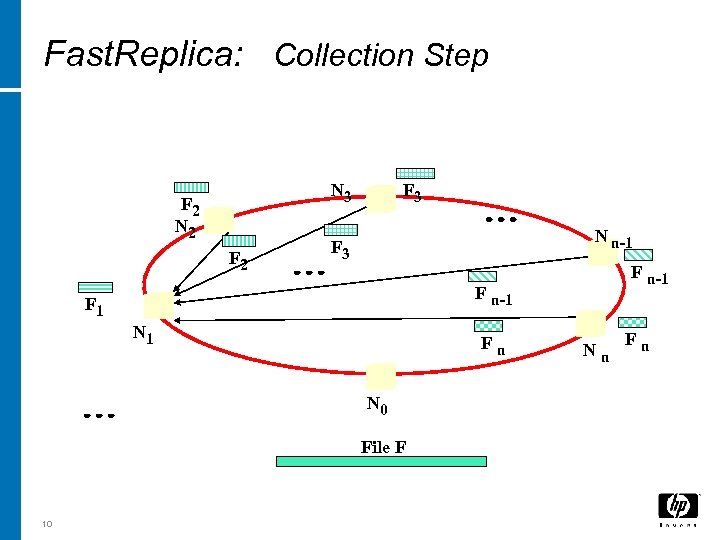 Fast. Replica: Collection Step N 3 F 2 N 2 F 3 N n-1 F 3 F n-1 F 1 N 1 Fn N 0 File F 10 F n-1 Nn Fn
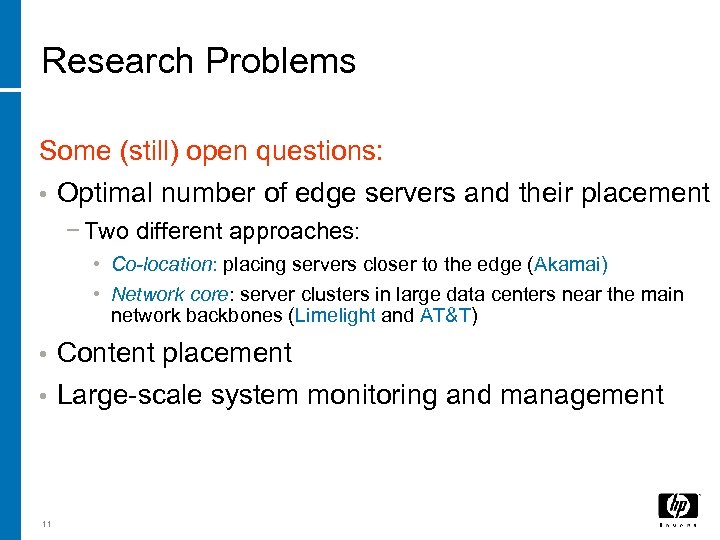 Research Problems Some (still) open questions: • Optimal number of edge servers and their placement − Two different approaches: • Co-location: placing servers closer to the edge (Akamai) • Network core: server clusters in large data centers near the main network backbones (Limelight and AT&T) • Content placement • Large-scale system monitoring and management 11
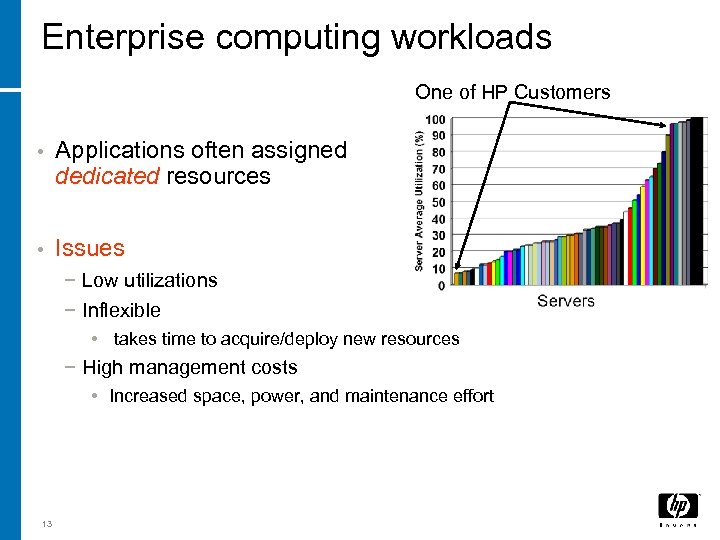
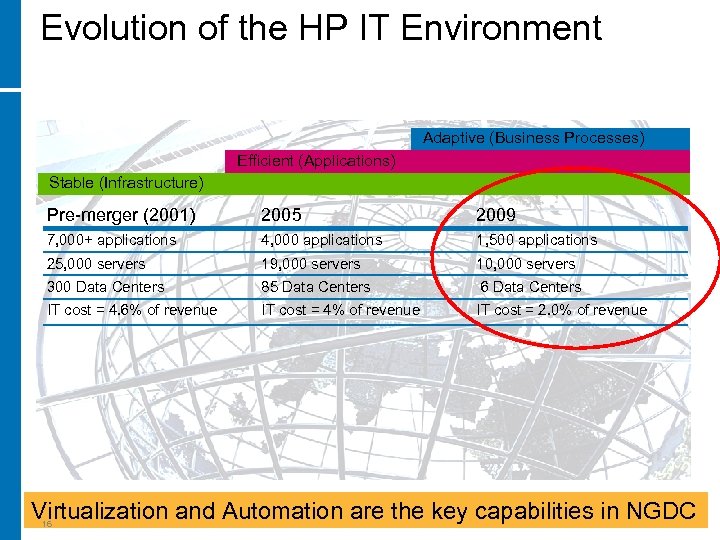
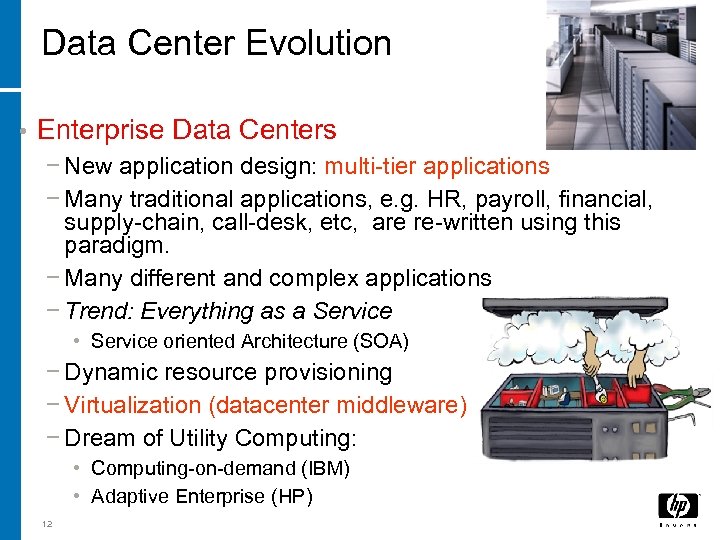 Data Center Evolution • Enterprise Data Centers − New application design: multi-tier applications − Many traditional applications, e. g. HR, payroll, financial, supply-chain, call-desk, etc, are re-written using this paradigm. − Many different and complex applications − Trend: Everything as a Service • Service oriented Architecture (SOA) − Dynamic resource provisioning − Virtualization (datacenter middleware) − Dream of Utility Computing: • Computing-on-demand (IBM) • Adaptive Enterprise (HP) 12
 Enterprise computing workloads One of HP Customers • Applications often assigned dedicated resources • Issues − Low utilizations − Inflexible • takes time to acquire/deploy new resources − High management costs • Increased space, power, and maintenance effort 13
 14 Source: IDC, 2008
 VM 3 VM 2 VM 1 Server Consolidation via Virtualization App 4 App 5 App 6 5% 10% 5 Traditional Servers 15 VM 6 App 4 App 5 5% 10% VM 5 App 1 App 2 App 3 5% 10% 5% VM 4 App 1 App 2 App 3 5% 10% 5% Virtualized Server 35% Loaded 45% Loaded Shared virtualized server pool: utilization and power optimization
 Evolution of the HP IT Environment Adaptive (Business Processes) Efficient (Applications) Stable (Infrastructure) Pre-merger (2001) 2005 2009 7, 000+ applications 4, 000 applications 1, 500 applications 25, 000 servers 19, 000 servers 10, 000 servers 300 Data Centers 85 Data Centers 6 Data Centers IT cost = 4. 6% of revenue IT cost = 4% of revenue IT cost = 2. 0% of revenue Virtualization and Automation are the key capabilities in NGDC 16
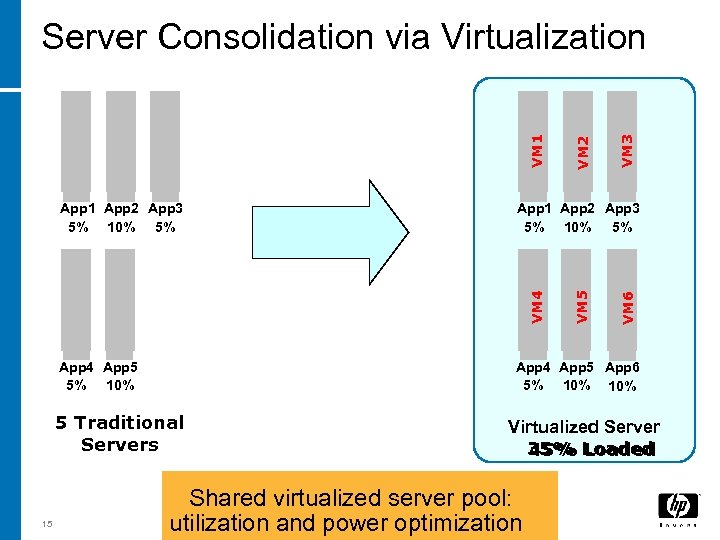
 Virtualized Data Centers • Benefits − Fault and performance isolation − Optimized utilization and power − Live VM migration for management • Challenges − Efficient capacity planning and management for server consolidation • Apps are characterized by a collection of resource usage traces in native environment • Effects of consolidating multiple VMs to one host • Virtualization overheads 17
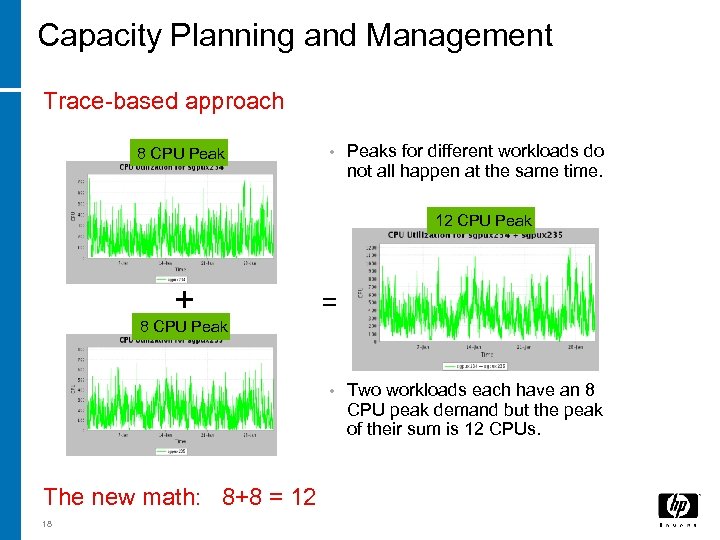 Capacity Planning and Management Trace-based approach 8 CPU Peak • Peaks for different workloads do not all happen at the same time. 12 CPU Peak + 8 CPU Peak = • The new math: 8+8 = 12 18 Two workloads each have an 8 CPU peak demand but the peak of their sum is 12 CPUs.
 Application Virtualization Overhead • Many research papers measure virtualization overhead but do not predict it in a general way: − A particular hardware platform − A particular app/benchmark, e. g. , netperf, Spec or Spec. Web, disk benchmarks − Max throughput/latency/performance is X% worse − Showing Y% increase in CPU resources • How do we translate these measurements in “what is a virtualization overhead for a given application”? New performance models are needed 19
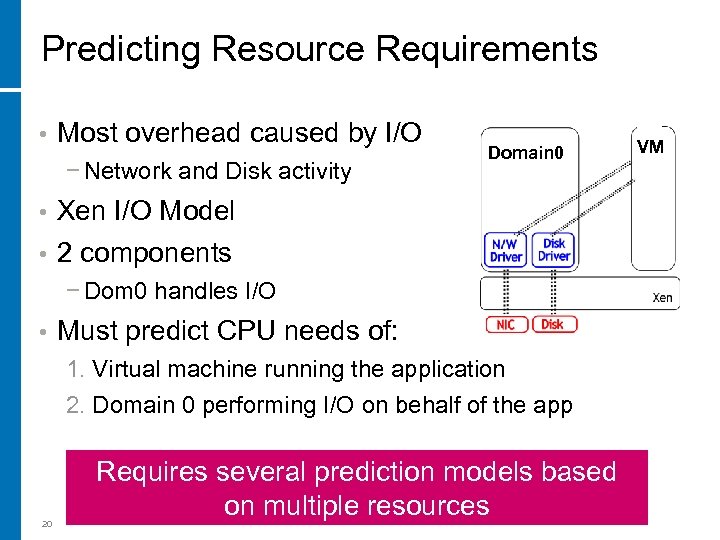 Predicting Resource Requirements • Most overhead caused by I/O − Network and Disk activity Domain 0 Xen I/O Model • 2 components • − Dom 0 handles I/O • Must predict CPU needs of: 1. Virtual machine running the application 2. Domain 0 performing I/O on behalf of the app 20 Requires several prediction models based on multiple resources VM
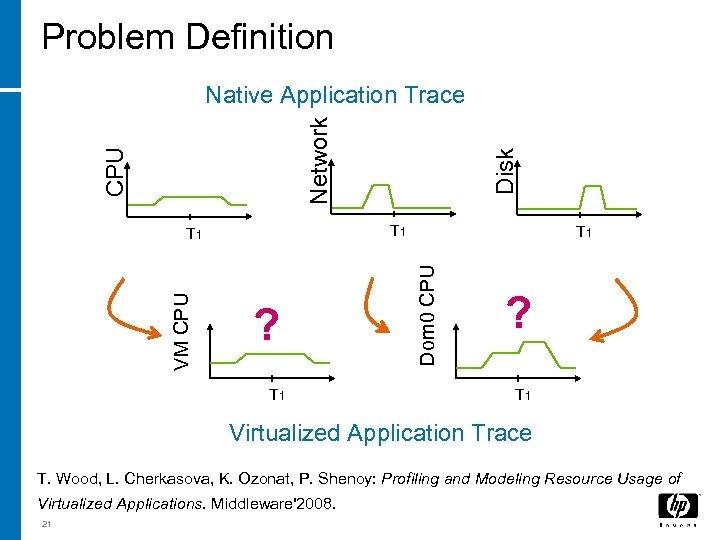 Problem Definition T 1 ? T 1 Dom 0 CPU T 1 VM CPU Disk CPU Network Native Application Trace ? T 1 Virtualized Application Trace T. Wood, L. Cherkasova, K. Ozonat, P. Shenoy: Profiling and Modeling Resource Usage of Virtualized Applications. Middleware'2008. 21
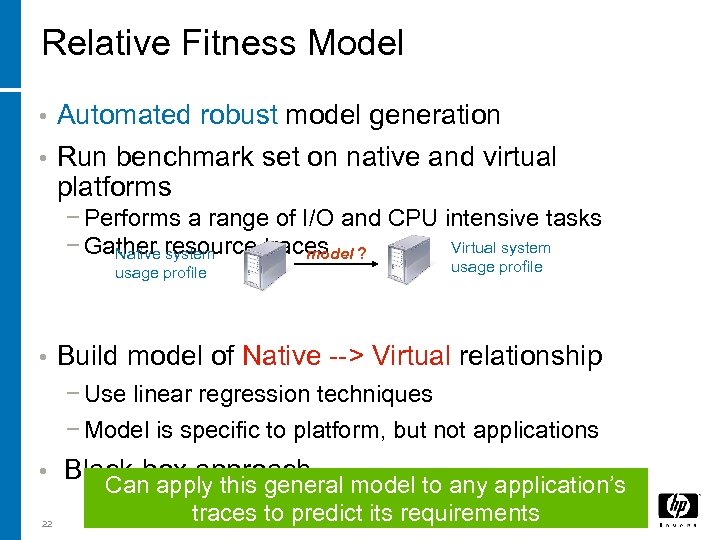 Relative Fitness Model • Automated robust model generation • Run benchmark set on native and virtual platforms − Performs a range of I/O and CPU intensive tasks Virtual system − Gather resource traces ? Native system model usage profile • usage profile Build model of Native --> Virtual relationship − Use linear regression techniques − Model is specific to platform, but not applications • 22 Black-box approach model to any application’s Can apply this general traces to predict its requirements
 Multi-tier Applications: Motivation • Wayne Greene’s story: − Large-scale systems: 400 servers, 36 applications − Rapidly evolving system over time • Questions from service provider on current system: − How many additional clients can we support? − Anomaly detection or cause of performance problems: workload or software “bugs” ? • Traditional capacity planning (pre-sizing): − Benchmarks − Synthetic workloads based on typical client behavior • 23 New models are needed
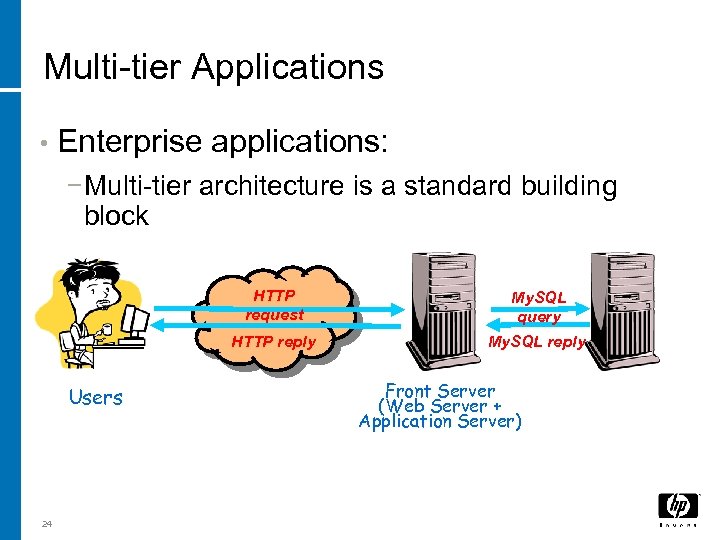 Multi-tier Applications • Enterprise applications: − Multi-tier architecture is a standard building block HTTP request HTTP reply Users 24 My. SQL query My. SQL reply Front Server (Web Server + Application Server)
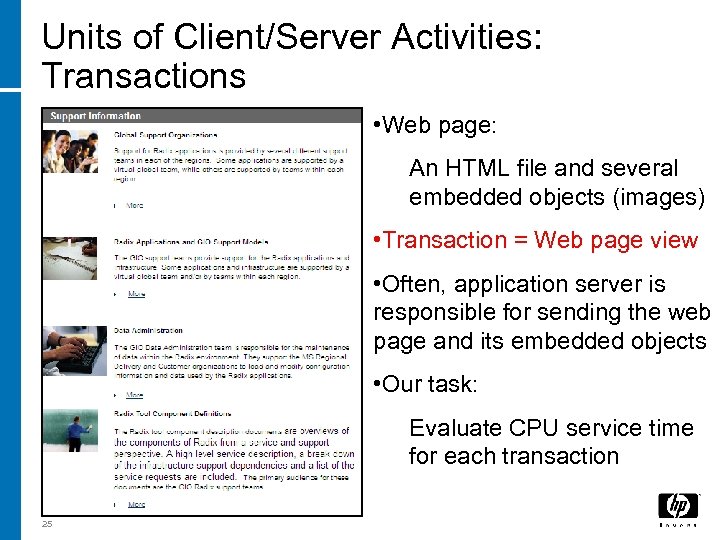 Units of Client/Server Activities: Transactions • Web page: An HTML file and several embedded objects (images) • Transaction = Web page view • Often, application server is responsible for sending the web page and its embedded objects • Our task: Evaluate CPU service time for each transaction 25
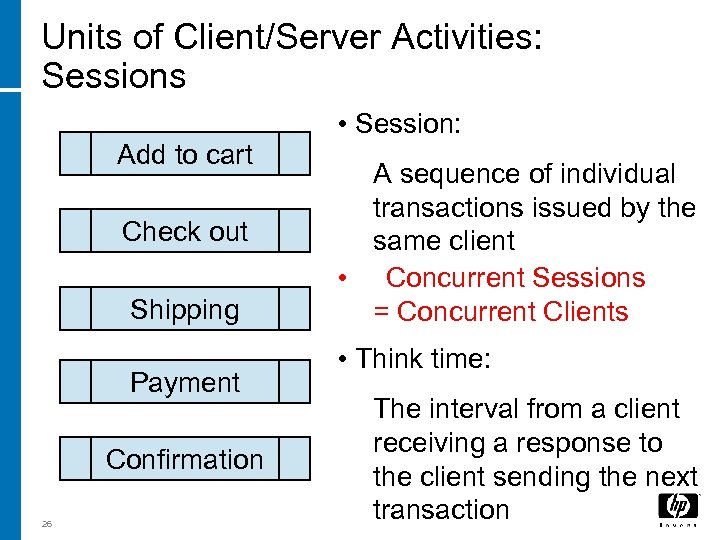 Units of Client/Server Activities: Sessions Add to cart Check out Shipping Payment Confirmation 26 • Session: A sequence of individual transactions issued by the same client • Concurrent Sessions = Concurrent Clients • Think time: The interval from a client receiving a response to the client sending the next transaction
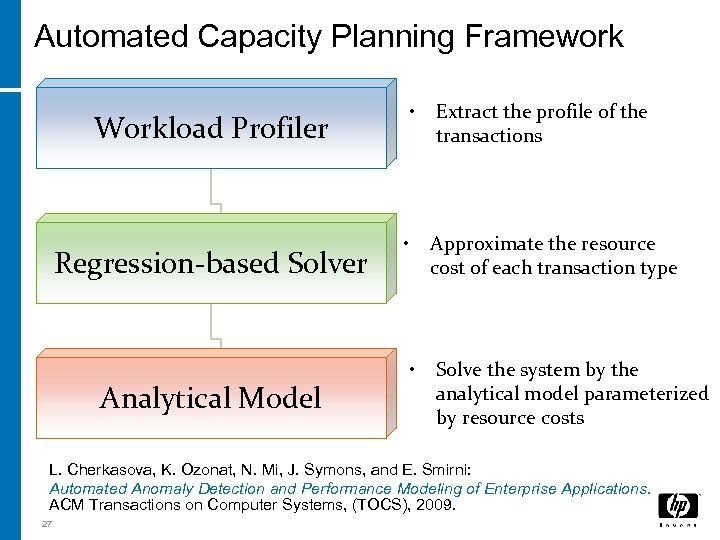 Automated Capacity Planning Framework Workload Profiler Regression-based Solver Analytical Model • Extract the profile of the transactions • Approximate the resource cost of each transaction type • Solve the system by the analytical model parameterized by resource costs L. Cherkasova, K. Ozonat, N. Mi, J. Symons, and E. Smirni: Automated Anomaly Detection and Performance Modeling of Enterprise Applications. ACM Transactions on Computer Systems, (TOCS), 2009. 27
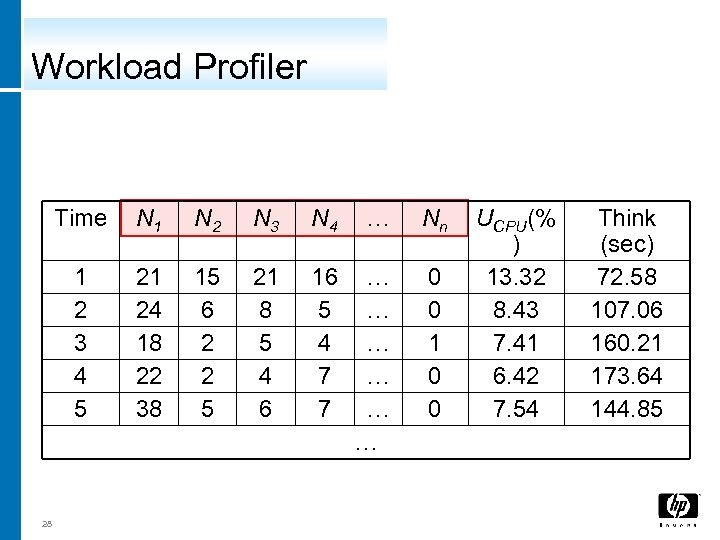 Workload Profiler Time N 2 N 3 N 4 … Nn 1 2 3 4 5 28 N 1 21 24 18 22 38 15 6 2 2 5 21 8 5 4 6 16 5 4 7 7 … … … 0 0 1 0 0 UCPU(% ) 13. 32 8. 43 7. 41 6. 42 7. 54 Think (sec) 72. 58 107. 06 160. 21 173. 64 144. 85
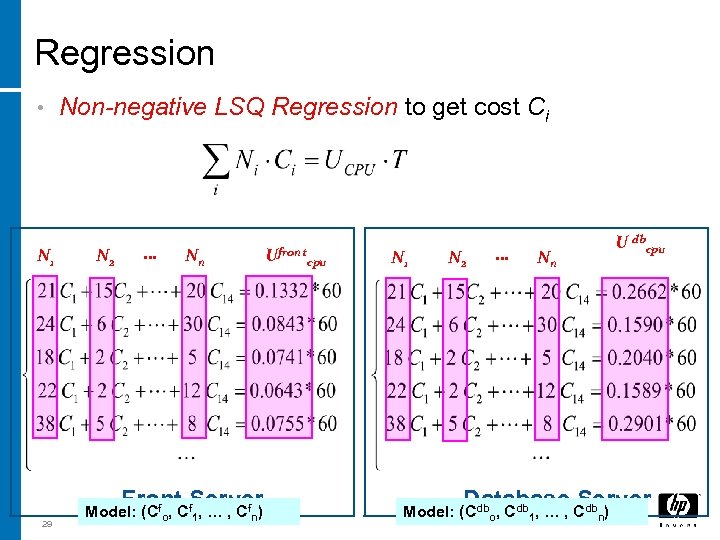 Regression • N 1 Non-negative LSQ Regression to get cost Ci N 2 … Nn Front Server 29 Model: (Cfo, Cf 1, … , Cfn) Ufront cpu N 1 N 2 … Nn U dbcpu Database Server Model: (Cdbo, Cdb 1, … , Cdbn)
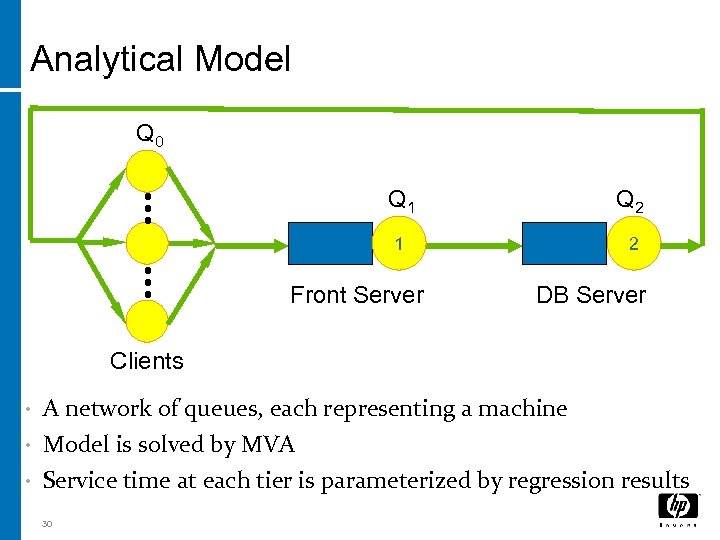 Analytical Model Q 0 Q 1 Q 2 1 2 Front Server DB Server Clients • A network of queues, each representing a machine • Model is solved by MVA • Service time at each tier is parameterized by regression results 30
 Scaling Performance with memcached • • • 31 memcahed – distributed memory object caching system for speeding up dynamic web applications by alleviating database load Cache the results of popular (or expensive) database queries memcahed is an in-memory key-value store for small chunks of arbitrary data (strings, objects) where key is 250 bytes, value is up to 1 MB. Used by Facebook, You. Tube, Live. Journal, Wikipedia, Amazon. com, etc. For example, Facebook use more than 800 memcached servers supplying over 28 terabytes of memory Scalability and performance are still the most challenging issues for large-scale Internet applications.
 Data Growth • Unprecedented data growth: − The amount of managed data by today’s Data centers quadruple every 18 months New York Stock Exchange generates about 1 TB of new trade data each day. • Facebook hosts ~10 billion photos (1 PB of storage). • The Internet Archive stores around 2 PB, and it is growing at 20 TB per month • The Large Hadron Collider (CERN) will produce ~15 PB of data per year. • 32
 Big Data • IDC estimate the size of “digital universe” : − 0. 18 zettabytes in 2006; − 1. 8 zettabytes in 2011 (10 times growth); • A zettabyte is 1021 bytes, i. e. , − 1, 000 exabytes or − 1, 000 petabytes • Big Data is here − Machine logs, RFID readers, sensors networks, retail and enterprise transactions − Rich media − Publicly available data from different sources • New challenges for storing, managing, and processing large-scale data in the enterprise (information and content management) − Performance modeling of new applications 33
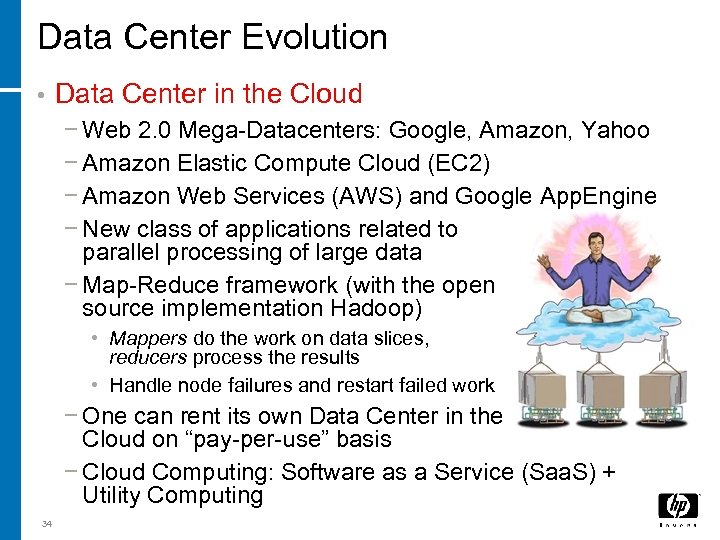 Data Center Evolution • Data Center in the Cloud − Web 2. 0 Mega-Datacenters: Google, Amazon, Yahoo − Amazon Elastic Compute Cloud (EC 2) − Amazon Web Services (AWS) and Google App. Engine − New class of applications related to parallel processing of large data − Map-Reduce framework (with the open source implementation Hadoop) • Mappers do the work on data slices, reducers process the results • Handle node failures and restart failed work − One can rent its own Data Center in the Cloud on “pay-per-use” basis − Cloud Computing: Software as a Service (Saa. S) + Utility Computing 34
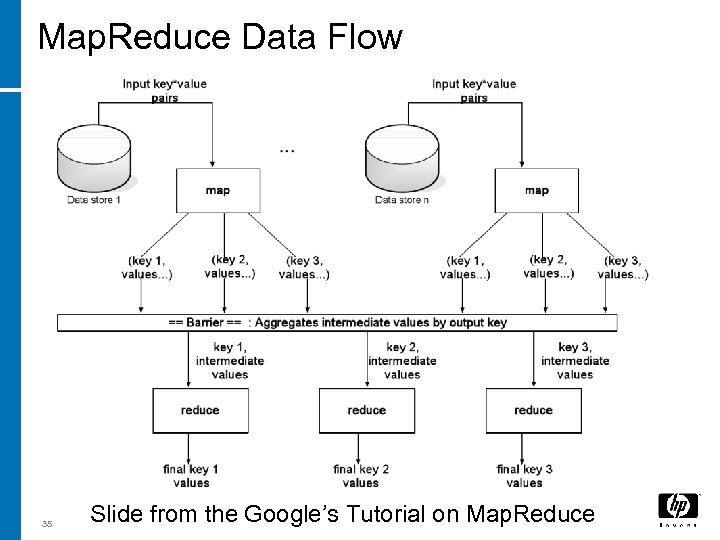 Map. Reduce Data Flow 35 Slide from the Google’s Tutorial on Map. Reduce
 Map. Reduce • • • A simple programming model that applies to many largescale data/computing problems Automatic parallelization of computing tasks Load balancing Automated handling of machine failures Observation: for large enough problems, it is more about disk & network than CPU & DRAM Challenges: − Automated bottleneck analysis of parallel dataflow programs and systems − Where to apply optimizations efforts: network? disks per node? map function? Inter-rack data exchange? . . . − Automated model building for improving efficiency and better utilization of hardware resources 36
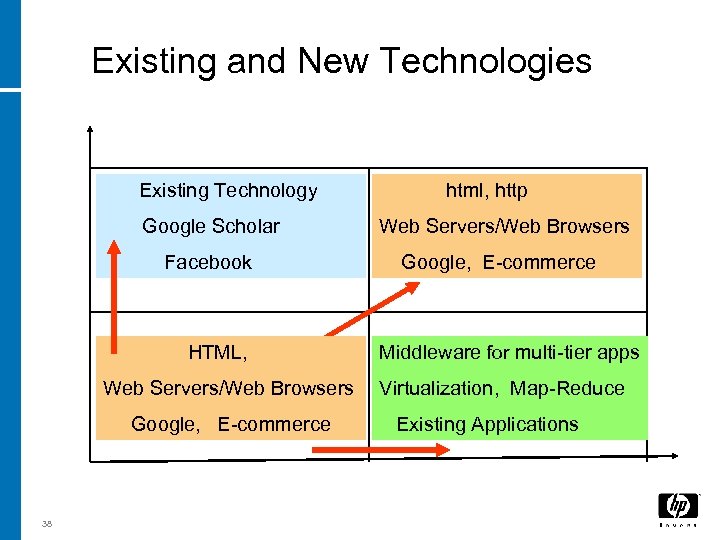 Existing and New Technologies Existing Technology Google Scholar New. Facebook Applications html, http New Technology Web Servers/Web Browsers New Applications Google, E-commerce HTML, Existing Technology Middleware for multi-tier apps Web Servers/Web Browsers Virtualization, Map-Reduce New Technology Existing Applications Google, E-commerce Existing Applications 38
 Summary and Conclusions • Large-scale systems require new middleware support − memcached and Map. Reduce are prime examples Monitoring of large-scale systems is still a challenge • Automated decision making (based on imprecise information) is an open problem • Do not underestimate the “role of a person” in the automated solution • − “It is impossible to make anything foolproof because fools are so ingenious” -- Arthur Bloch 39
 Thank you! Questions? 40