


 Скачать презентацию Disruptive Commercial Technologies 2008 Naval Research Advisory Committee
7d0f4ba9aff17a51b1a436c97db247fc.ppt
- Количество слайдов: 31
 Disruptive Commercial Technologies 2008 Naval Research Advisory Committee Study 1
 “…Irregular warfare and all aspects of it will be with us…for the next couple of decades…so we need to invest in that and we need to make sure we get that right” —Admiral Michael Mullen Chairman, JCS 12 June 2008 National Press Club 2
 Outline • TOR & Fact Finding • Bottom Line Up Front • The Landscape • Red Cell Experiment • Findings • Recommendations • Actions 3
 Terms of Reference • Problem: Threats to Marine Corps Expeditionary Forces include globally available commercial products that may be “weaponized” • Tasking: – Study potentially disruptive nature of current/near future technologies – Identify technologies and products that pose immediate asymmetrical counter to Marine Forces – Establish threats & timelines – Identify indicators to aid in recognizing deployed DCTs – Propose countermeasures – Propose investment strategy to counter DCTs – Focus study on 3 - 7 years 4
 Fact-Finding • • Marine Corps/Navy CG, MCCDC (Study Sponsor) Strategic Vision Group Marine Corps Intelligence Activity Capabilities Development Division, MCCDC Center for Emerging Threats and Opportunities Office of the Vice Chief of Naval Research ONR Code 30 ONR Global • • Defense University/National Lab • National Defense University • Naval Postgraduate School • Sandia National Laboratories • • • Other DOD and Agencies ODDR&E Senior Office of Director of National Intelligence alumnus Defense Intelligence Agency, Defense Warning Office Senior DARPA alumni Central Intelligence Agency CIA, Weapons, Intelligence, Nonproliferation, and Arms Control Center (WINPAC) Others National Research Council Study Panel (DIA-sponsored) CISCO In-Q-Tel Synthesis Partners, Inc. Opportunity International Global Fairness Initiative Strategic News Service 5
 Observations and Guidance • Many efforts identify lists of potential disruptive threats – – – Capabilities Surprise (DSB Summer Study) 2008 (underway) Future Warfare Technologies (CIA) 2008 Ahead of the Curve (Monitor Group) 2007 Global Strategic Trends Programme (DCDC) 2006 Avoiding Surprise in an Era of Global Technology Advances (NRC/National Academies) 2005 – Global Technology Revolution (RAND) 2001 – Technology Acquisition by Terrorist Groups (RAND) 2001 • Sponsor follow-on guidance – Real contribution—recommendations for a process to anticipate, identify, and counter commercial technologies disruptive to Marine Corps tactical operations • The Study will recommend how the Marine Corps can prepare for commercial technology threats 6
 What we learned early • It’s about anything that attacks key capabilities or gaps – It’s not limited to “disruptive technologies” • It’s about the power of unconventional and unconstrained imagination – It’s not about “technology surprise” • It’s about anticipating threats – It’s not about merely reacting • It’s about operating in a much wider orbit outside the domain of intelligence – It’s not about functioning within it • It’s about how they see the world and process information – It’s not about how we do 7
 Bottom Line Up Front • Another list created by an advisory committee is not the solution • Small groups easily connecting to the web will increasingly disrupt Marine Corps operations • USMC has no means of proactively anticipating unconventional commercial threats and responding • Key actions – Bring in creative unconventional outsiders to anticipate new threats. . . a “Commercial Hunter” – Accelerate ability to neutralize and defeat threats – Educate and train against commercial technology threats 8
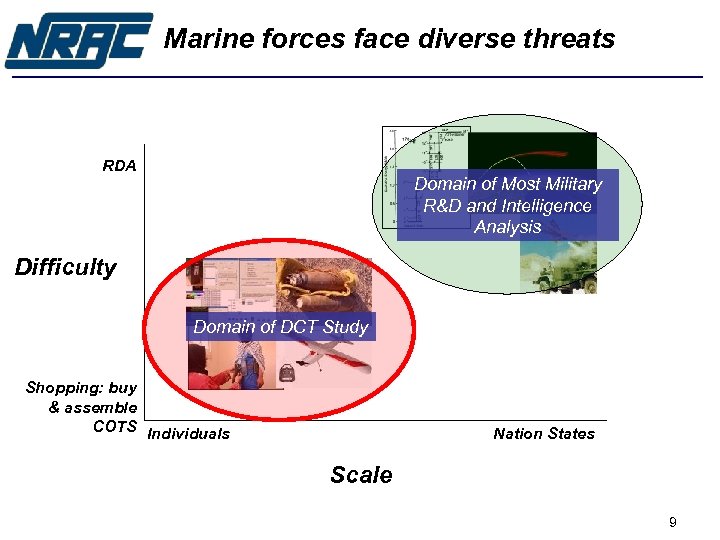 Marine forces face diverse threats RDA Domain of Most Military R&D and Intelligence Analysis Difficulty Domain of DCT Study Shopping: buy & assemble COTS Individuals Nation States Scale 9
 The Landscape: Diverse Threats • Conventional adversaries (not this Study’s focus) – Nation states with conventional forces – Characterized by significant resources applied over extended periods (long cycle times) – Mostly observable and understood, thus reasonably predictable • Irregular adversaries (this Study’s focus) – Generally stateless, yet transnational – Characterized by adequate resources applied to immediate tasks (extremely short cycle times) – Difficult to observe, penetrate, and predict 10
 The Landscape: The Irregular Adversary • Young, intelligent, culturally savvy, and flexible • Naturally comfortable with today’s technology tools • Nonlinear thinking and uninhibited methods— not rule-bound 11
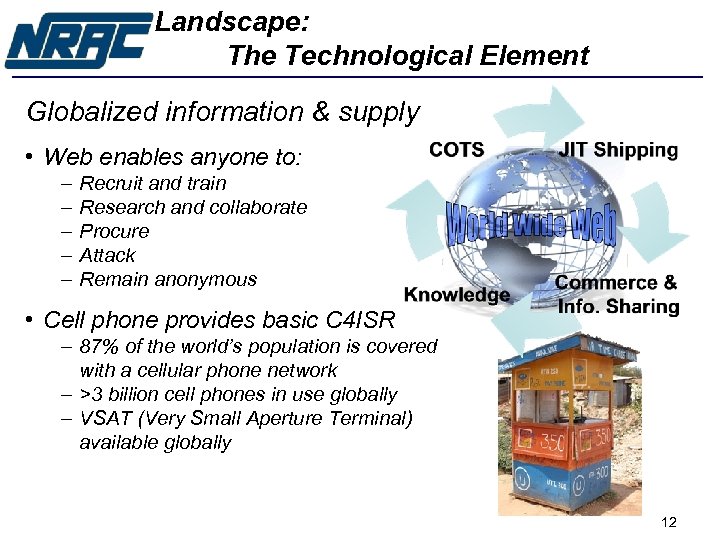 Landscape: The Technological Element Globalized information & supply • Web enables anyone to: – – – Recruit and train Research and collaborate Procure Attack Remain anonymous • Cell phone provides basic C 4 ISR – 87% of the world’s population is covered with a cellular phone network – >3 billion cell phones in use globally – VSAT (Very Small Aperture Terminal) available globally 12
 If we only see the problem through our eyes…we lose • Experiment: Can creative people having internet access develop concepts to threaten key USMC capabilities? • Approach: – Recruit tech-savvy creative people w/o military expertise – Use Expeditionary Warfare School Tactical Decision Game – Specify USMC targeted capabilities – Shop for off-the-shelf products via the Internet • Process: – NRAC panel member recruited, created experiment format and ran session 13
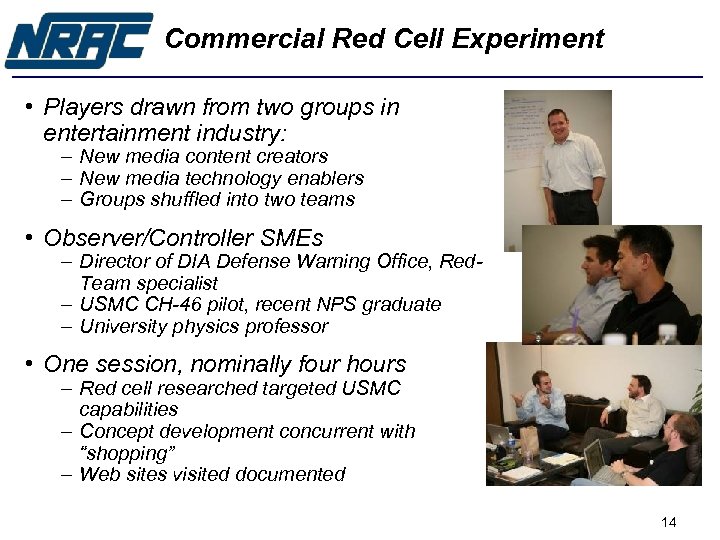 Commercial Red Cell Experiment • Players drawn from two groups in entertainment industry: – New media content creators – New media technology enablers – Groups shuffled into two teams • Observer/Controller SMEs – Director of DIA Defense Warning Office, Red. Team specialist – USMC CH-46 pilot, recent NPS graduate – University physics professor • One session, nominally four hours – Red cell researched targeted USMC capabilities – Concept development concurrent with “shopping” – Web sites visited documented 14
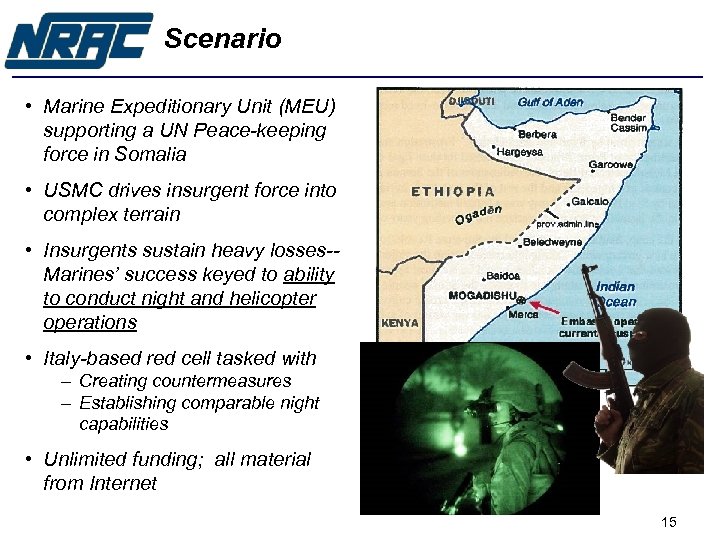 Scenario • Marine Expeditionary Unit (MEU) supporting a UN Peace-keeping force in Somalia • USMC drives insurgent force into complex terrain • Insurgents sustain heavy losses-Marines’ success keyed to ability to conduct night and helicopter operations • Italy-based red cell tasked with – Creating countermeasures – Establishing comparable night capabilities • Unlimited funding; all material from Internet 15
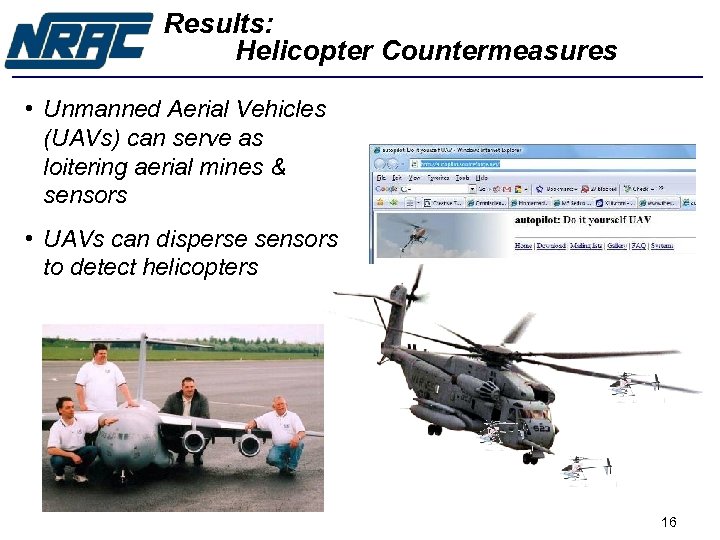 Results: Helicopter Countermeasures • Unmanned Aerial Vehicles (UAVs) can serve as loitering aerial mines & sensors • UAVs can disperse sensors to detect helicopters 16
 Hobbyist UAVs Draft—not for release 17
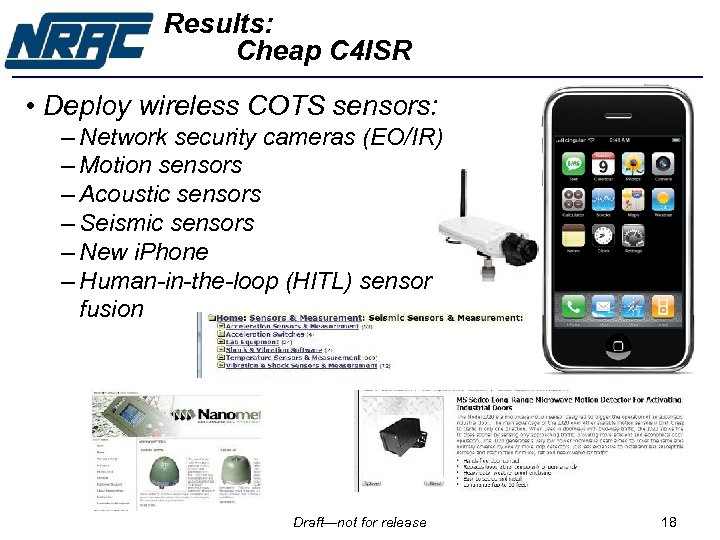 Results: Cheap C 4 ISR • Deploy wireless COTS sensors: – Network security cameras (EO/IR) – Motion sensors – Acoustic sensors – Seismic sensors – New i. Phone – Human-in-the-loop (HITL) sensor fusion Draft—not for release 18
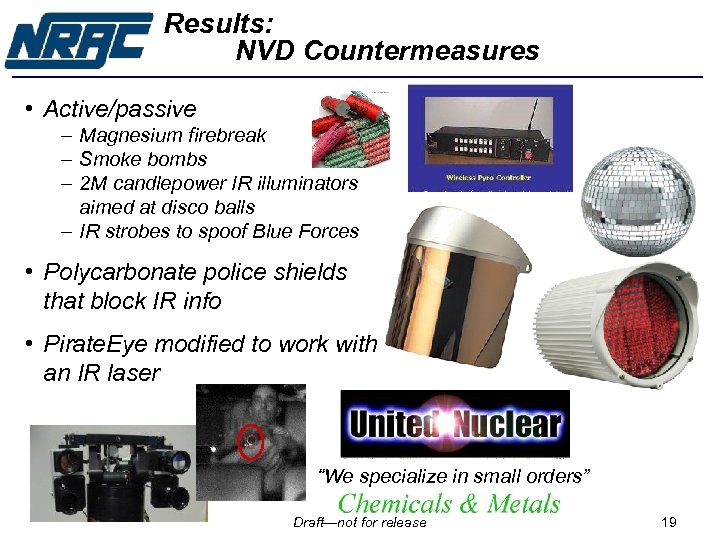 Results: NVD Countermeasures • Active/passive – Magnesium firebreak – Smoke bombs – 2 M candlepower IR illuminators aimed at disco balls – IR strobes to spoof Blue Forces • Polycarbonate police shields that block IR info • Pirate. Eye modified to work with an IR laser “We specialize in small orders” Draft—not for release 19
 Implications of Experiment • Creative people + target + web + global supply = credible threat • Threats developed at two levels—each has value in anticipation: – Conceptual (airborne loitering minefields) – Material (specific applications of products) • Two independent groups produced similar results, and looked at many of the same web sites – Convergence worth looking for, therefore… – Need multiple groups producing concepts • Both groups heavily influenced by same-day announcement of new i. Phone – Different result if exercise were a day earlier, therefore… – Need continuing process 20
 Commercial Hunter. . . the rationale • Combat Hunter used professional big-game hunters, trackers, and cops on the beat to modify tactics against irregular forces • “Commercial Hunter” would use outside experts to anticipate, identify, and defeat commercial technology threats 21
 Commercial Hunter Cell. . . the idea • Anticipate threats via opposing force exercises using teams of smart, young, web-savvy people, from diverse backgrounds • Identify and prioritize threats • Buy from internet; integrate prototype to prove technical feasibility • Provoke action 22
 Commercial Hunter Cell. . . Characteristics • People – Small standing core group with creative leadership, admin, engineers & technicians from several disciplines – Teams of creative outsiders who come and go on timelines consistent with the nature of the task • Facilities: – Minimal facility with rapid prototyping capability, equipment where needed, located off base • Time & money: – Ability to go from idea to demo in days or weeks not months or years – Budget, contracting, and purchasing authority 23
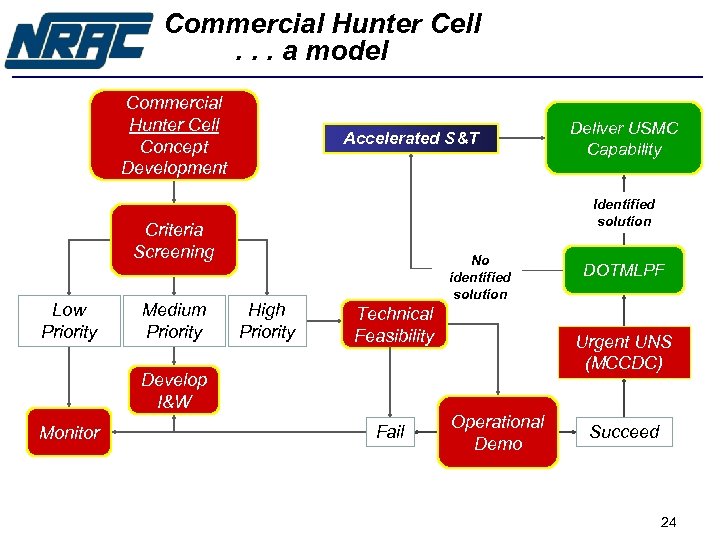 Commercial Hunter Cell. . . a model Commercial Hunter Cell Concept Development Accelerated S&T Identified solution Criteria Screening Low Priority Medium Priority High Priority No identified solution Technical Feasibility Fail DOTMLPF Urgent UNS (MCCDC) Develop I&W Monitor Deliver USMC Capability Operational Demo Succeed 24
 Urgent UNS Response Gap? • In support of urgent needs with identifiable solutions, Do. N has processes for – rapid acquisition of known products – rapid prototyping of developmental systems > TRL 6 • However, for challenges with no immediately identifiable remedy, or solution < TRL 6 – the panel could not find an accelerated S&T process 25
 Implications: Training & Education • An introduction & reminder at all levels of formal education for this new challenge – Commercial technology threat is real, already exists, and will grow • Need to instruct Marines what to look for during all phases of operation (I&W) • Need to realistically equip unconventional OPFOR as seriously as we do conventional OPFOR • Need to introduce these types of challenges to our capabilities at all levels of wargames (EWS, C&S) • Commercial Hunter Cell’s additional duty is to support all of the above 26
 Findings • Credible threats to Marine capabilities… – Can be developed from imaginative combinations of commercial products – Can be acquired via the Web and distributed by the global supply network • The Marine Corps has no effective methods for anticipating these unconventional threats – Nor access to a proactive and rapid system for threats without identifiable solutions 27
 Recommendations • Create an accelerated S&T approach to address potential solutions below TRL 6 for Urgent Universal Needs Statement (UUNS) requirements • Authorize CG, MCCDC, to create UUNS • Establish Commercial Hunter 28
 Actions • ASN (RDA) – Direct CNR to develop an accelerated S&T approach for UUNS that have no mature solution to achieve prototypes • CMC – Authorize CG, MCCDC, to create Urgent UNS • CG, MCCDC – Establish Commercial Hunter – Incorporate training and education for commercial threats 29
 DCT Panel Membership Study Panel Members Study Sponsor • BGen James M. Feigley, USMC (Ret. ) - Chair • Lt. Gen James F. Amos, USMC – NRAC Associate • Dr. A. Michael Andrews, II – Co-Chair – L-3 Communications • Dr. Regina E. Dugan – Red. XDefense • Maj. Gen Paul Fratarangelo, USMC (Ret. ) – NRAC Consultant • Mr. Gilbert V. Herrera – Sandia National Laboratories • Mr. James H. Korris – Creative Technologies Inc. • Maj. Gen Leo V. Williams, USMCR (Ret. ) – Medifast, Inc • Professor Walt Williamson – Texas Christian University • Professor Patrick H. Winston – Massachusetts Institute of Technology • Dr. Helena S. Wisniewski – Stevens Institute of Technology • Mr. James L. Wolbarsht – DEFCON® Inc. – Panel Sponsor – CG, MCCDC – DC CDI Executive Secretariat • Mr. Robert Mc. Kinney – Executive Secretary – MCWL (OSTI) • Mr. B. Greg Kesselring – Asst. Executive Sec. – MCWL (OSTI) • Mr. E. William Powers – Asst. Executive Sec. – MCWL (CETO) In memoriam • Mr. Jack Bachkosky – Study panel member, long-serving NRAC member 30
 “…Irregular warfare and all aspects of it will be with us…for the next couple of decades…so we need to invest in that and we need to make sure we get that right” —Admiral Michael Mullen Chairman, JCS 12 June 2008 National Press Club 31