


 Скачать презентацию Dispatches from Washington Upcoming Nutrition and Food Safety
3b05930b8fbcd5f1aa09c43861b57a05.ppt
- Количество слайдов: 79
 Dispatches from Washington: Upcoming Nutrition and Food Safety Legislation That Will Impact Your Business Miriam Miller Director of Membership United Fresh Produce Association March 25, 2010 NAPMM Conference
 Brief Overview of United Fresh • Formed by 16 wholesalers in Chicago back in 1904, with our first official lobbying trip to Washington in 1905! • “Uniting the Industry” has been goal since 1937 merger of shippers and receivers • International Fresh-cut Produce Association joined the team in 2006 2010 NAPMM Conference
 Brief Overview of United Fresh • 1, 200 corporate members in 30 countries – 7, 000 individual members • Commitment to serve total produce supply chain – Strong representation from each industry segment – Grower-Shipper, Fresh-Cut, Wholesaler-Distributor, Retail-Foodservice Boards – Over 100 commodity, regional associations – Led by 40 -member consolidated Board of Directors 2010 NAPMM Conference
 Keys to Legislative Success • Increase public confidence in the fresh produce industry • Increase overall consumption of fresh produce • Growing sales and profitability for the entire industry 2010 NAPMM Conference
 Key Legislative and Industry Topics • Food Safety • Produce Traceability Initiative • Federal Nutrition Programs 2010 NAPMM Conference
 Why Food Safety? • Overall government and public concern about food safety across all industries and commodities • Potential for negative financial effect on our industry • Bi-partisan issue gaining momentum in Washington 2010 NAPMM Conference
 2010 NAPMM Conference
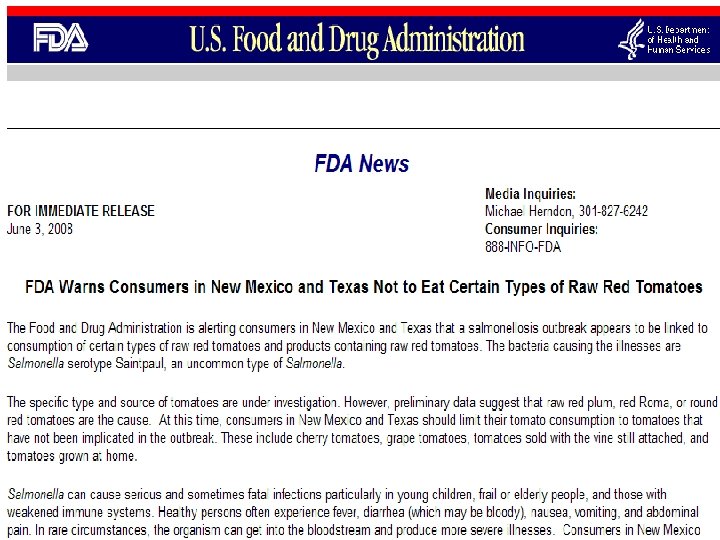
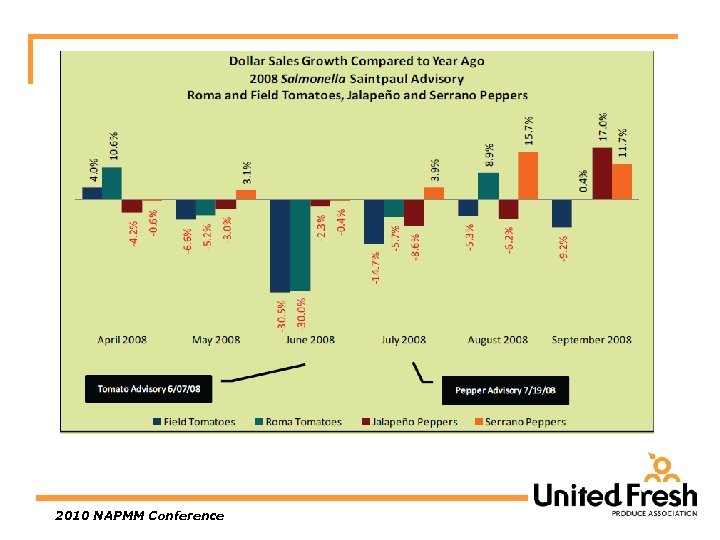
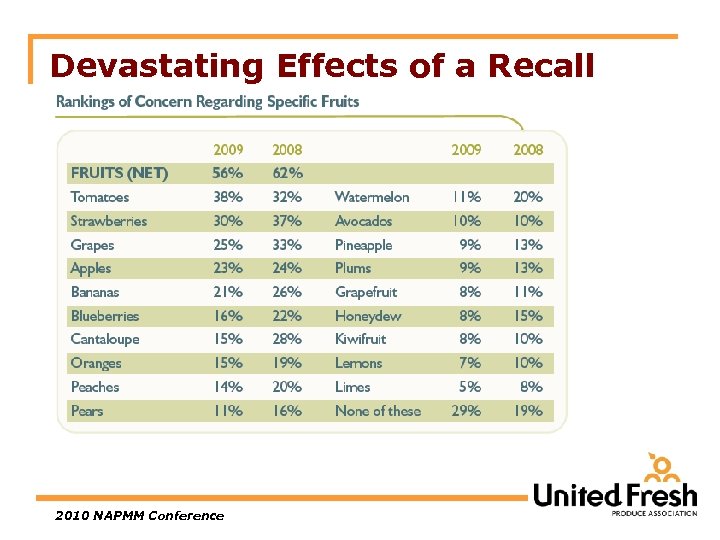
 Devastating Effects of a Recall • The FDA Salmonella Saintpaul advisory issued June 3, 2008 • Expanded nationally June 7, 2008 • Sales of field and Roma tomatoes plummeted 30. 5 percent and 30 percent respectively • Ultimately – tomatoes not even the source of the outbreak 2010 NAPMM Conference
 2010 NAPMM Conference
 Devastating Effects of a Recall 2010 NAPMM Conference
 2010 NAPMM Conference
 Consumer Crisis of Confidence 2010 NAPMM Conference
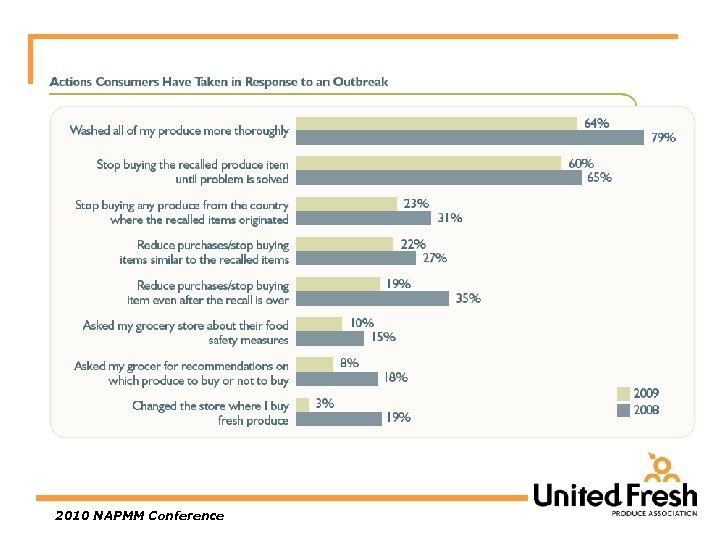
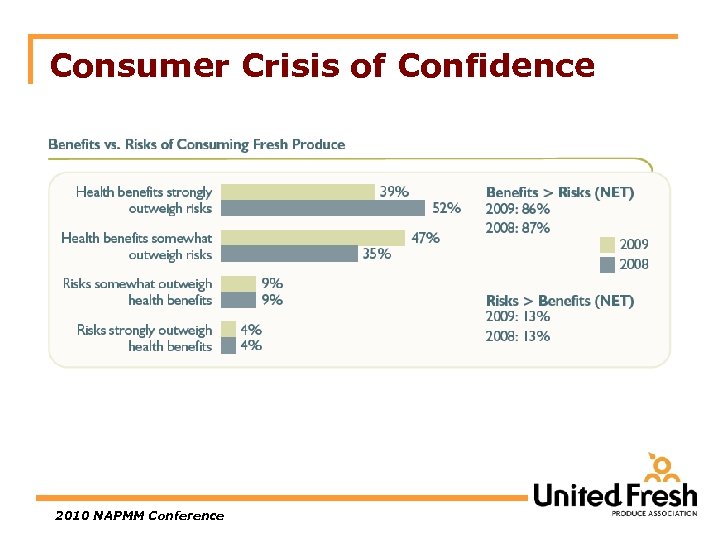
 Consumer Crisis of Confidence • Actively thinking about safety • Recognize the benefits of fresh produce, but anxiety exists • act on their fears, take what they believe to be “appropriate actions” • Significant market impact—immediately and lingering concerns “Long-term, this concern over produce safety —whether warranted by the facts or not— may be the greatest threat to increasing consumption of fresh produce. ” 2010 NAPMM Conference
 Regulatory Bodies’ Concerns Related to Food Safety “Of 110 recent outbreaks, 35% were associated with fresh fruits and vegetables. ” - CDC, August 2005 “Fresh produce is responsible for more illnesses, by far, than any other commodity we regulate. ” – FDA, April 2006 2010 NAPMM Conference
 General Observations on Food Safety • Was a major focus of our public policy efforts in 2009 • Produce is an extraordinarily safe and healthy food – Over 1 billion servings of produce are consumed daily in the U. S. , without issue • Ensure public trust in a system of food protection that can deal with rare problems without destroying public confidence 2010 NAPMM Conference
 What’s Coming: Food Safety Legislation and Regulation • Action in Congress and White House – Prepare most comprehensive overhaul of food safety laws in 70 years • Regulatory action more aggressive – GAPs in spotlight has driven industry development of guidance documents on leafy greens, melons and tomatoes – Traceability programs will be a fundamental part of any food safety legislation • Industry must work together and not have competing and conflicting views 2010 NAPMM Conference
 Food Safety Principles • Commodity Specific • Science and Risk-Based Approach • Recognize currently effective internal traceability practices • “Gold Standards” vs. “Minimum Standards” at the federal regulatory level • Import programs that recognize perishable nature of fresh produce • Encourage adoption through entire supply chain 2010 NAPMM Conference
 Food Safety Enhancement Act (FSEA, H. R. 2749) • Sponsored by John Dingell (D-MI) • Introduced June 2009, fast-tracked and passed in House by voice vote in July • Specifically affects FDA-regulated facilities 2010 NAPMM Conference
 Food Safety Enhancement Act Facility Registration • Food is misbranded if manufactured, processed, packed, or held in a facility that is not registered • Requires annual registration of food facilities • Directs the Secretary to collect an annual fee for registration • Suspend the registration of any food facility for a violation that could result in serious adverse health consequences or death to humans or animals 2010 NAPMM Conference
 Food Safety Enhancement Act Food Safety Plan • Requires the owner, operator, or agent of a food facility to: – (1) conduct a hazard analysis – (2) identify and implement effective preventive controls – (3) monitor preventive controls – (4) institute corrective actions as necessary – (5) conduct verification activities – (6) maintain records 2010 NAPMM Conference
 Food Safety Enhancement Act Food Safety Plan • Authorizes the Secretary to require the submission of finished product test results • Requires the facility to implement a food defense plan 2010 NAPMM Conference
 Food Safety Enhancement Act • Establish scientific and risk-based food safety standards for fresh produce: – Fruit, vegetable, nut or fungus – Standards are reasonably necessary to minimize the risk of serious adverse health consequences or death to humans or animals 2010 NAPMM Conference
 Food Safety Enhancement Act Traceability • Establish a tracing system that enables the Secretary to quickly identify each person who grows, produces, manufactures, processes, packs, transports, holds or sells such food • Refusal of admission of articles that have not complied with the requirements of the food tracing system 2010 NAPMM Conference
 Food Safety Enhancement Act Recall Penalties • Assess fees on each food facility in a fiscal year that – Commits a violation of the Federal Food Drug and Cosmetic Act relating to food or – Has been subject to a food recall 2010 NAPMM Conference
 Federal Food Safety Policy Summary of FSEA…. . The Good • Strengthened commodity-specific approach to produce • Ensured that FDA would work with USDA, state departments of agriculture • Enhanced the ability of fresh processors to develop individual HACCP programs without rigid one-size fits -all mandates • Exempted produce from any duplicative requirements for country of origin labeling • Assured equal treatment of imported and domestic produce in food safety standards 2010 NAPMM Conference
 Federal Food Safety Policy Summary of FSEA …. . Needs work Ensured tighter control of potential FDA geographic quarantine authority, requiring an imminent threat to take such action and coordination with USDA • Capped registration fees for both facilities and importers • Does not mandate FDA to establish “Fast-Lane” requirement for imports 2010 NAPMM Conference
 Federal Food Safety Policy Summary of FSEA …. . The Ugly Registration fees need to be targeted to specific FDA activities related to food safety Developing in law “categories of risk” is dangerous with trading allies and consumer confidence Finished Product Testing Provision Need a stronger outbreak management structure within FDA and throughout government Geographic Quarantine provision is overkill 2010 NAPMM Conference
 Federal Food Safety Policy • FDA Food Safety Modernization Act (S. 510) – Sponsored by Richard Durbin [D-IL] o Co-sponsored by Saxby Chambliss [R-GA], John Isakson [R-GA] and 12 other Senators – Introduced March 2009, recommended by Health, Education, Labor and Pensions (HELP) Committee in November for full Senate consideration – Specifically affects FDA-regulated facilities 2010 NAPMM Conference
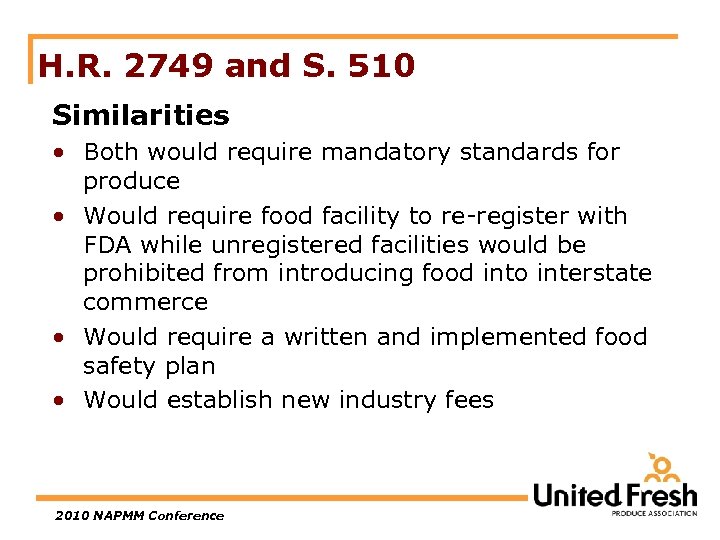 H. R. 2749 and S. 510 Similarities • Both would require mandatory standards for produce • Would require food facility to re-register with FDA while unregistered facilities would be prohibited from introducing food into interstate commerce • Would require a written and implemented food safety plan • Would establish new industry fees 2010 NAPMM Conference
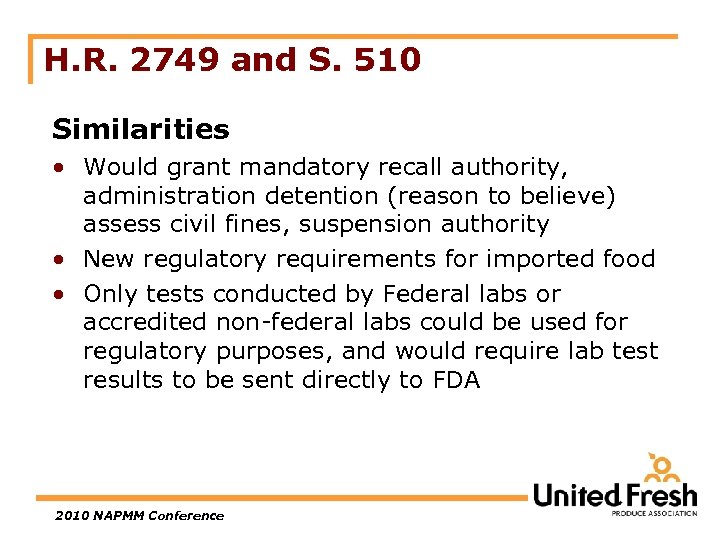 H. R. 2749 and S. 510 Similarities • Would grant mandatory recall authority, administration detention (reason to believe) assess civil fines, suspension authority • New regulatory requirements for imported food • Only tests conducted by Federal labs or accredited non-federal labs could be used for regulatory purposes, and would require lab test results to be sent directly to FDA 2010 NAPMM Conference
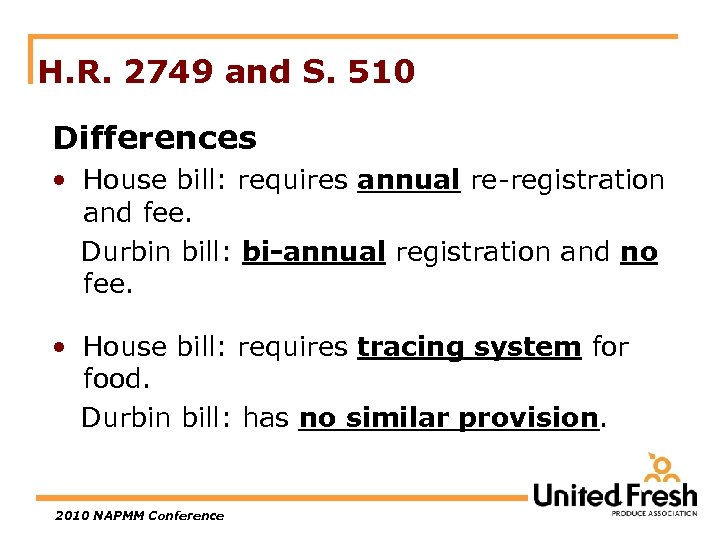 H. R. 2749 and S. 510 Differences • House bill: requires annual re-registration and fee. Durbin bill: bi-annual registration and no fee. • House bill: requires tracing system for food. Durbin bill: has no similar provision. 2010 NAPMM Conference
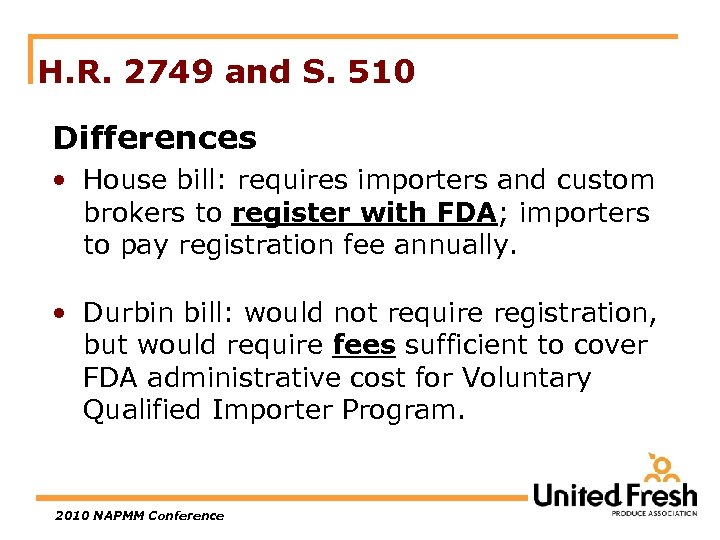 H. R. 2749 and S. 510 Differences • House bill: requires importers and custom brokers to register with FDA; importers to pay registration fee annually. • Durbin bill: would not require registration, but would require fees sufficient to cover FDA administrative cost for Voluntary Qualified Importer Program. 2010 NAPMM Conference
 H. R. 2749 and S. 510 Differences • House bill: authorizes Geographic Quarantine Program. Durbin bill: does not have this provision. • House bill: assesses civil penalties for each prohibited act Durbin bill: authorizes FDA to assess civil fines only for failure to comply with recall order 2010 NAPMM Conference
 Federal Food Safety Policy • Senate is up next – Passage out of the Senate HELP committee – Floor time was dictated by health care debate – this is the next major issue • Key policy areas to consider in Senate bill – – Produce Specific Requirements Traceability Outbreak Investigation and Recovery Hot Button issues: Quarantine Authority, Finished Product Testing, Small farm exemptions 2010 NAPMM Conference
 Food Safety – What Your Business Needs to Know • Increased regulation is coming • Winning the battle of “one size does not fit all. ” • Plan on scaleability, rather than exemptions – “We are only as strong as our weakest link. ” – All companies should plan on having a food safety plan • Opportunity to instill confidence in our consumers 2010 NAPMM Conference
 Food Safety Action Plan – Continue Positive Momentum • Bring the industry directly before Congress • Harmonization of GAP Audit Food Safety Standards – Global Conference on Produce Safety Standards – Ultimately bring lower cost to industry audit expenditures • FDA Town Hall Meetings • Leadership from United Fresh Food Safety & Technology and Government Relations Councils • Provide industry with support through education training, recall, FDA inspection and crisis communication support 2010 NAPMM Conference
 Produce Traceability Initiative 2010 NAPMM Conference
 Traceability in Produce Today • Industry handles an estimated 6 billion cases of produce in the United States each year • “One step forward and one step back” requirements of the U. S. Bioterrorism Act of 2002 • Since 1930 U. S. produce companies required to retain records under PACA 2010 NAPMM Conference
 Why PTI? • Enhance overall supply chain traceability in speed and efficiency • Significantly enhance our ability to narrow the impact of potential recalls or similar problems • Build better transparency • Common framework and nomenclature to identify produce cases • Streamlined connectivity across the supply chain 2010 NAPMM Conference
 Why PTI? • Most companies have “internal” traceability programs, but not “external” traceability programs. – Internal Traceability = confidential or proprietary data and processes companies use within their own span of operations to track/trace product. – External Traceability = the data exchange and business processes that take place between trading partners to track/trace product. • Whole-Chain Traceability = Internal + External traceability. 2010 NAPMM Conference
 Produce Traceability Initiative Mission • Adopt an effective whole chain traceability program – Incorporating the use of common standards – Linkage between current internal traceability programs • Intended to work with established standards 2010 NAPMM Conference
 Produce Traceability Initiative Leadership • Sponsored by United Fresh Produce Association, CPMA and PMA • Steering Committee comprised of 54 organizations including: – Foodservice and Retailers – Distributors, Terminal Markets, Brokers, and Processors – Growers/Packers/Shippers – Industry Trade Associations 2010 NAPMM Conference
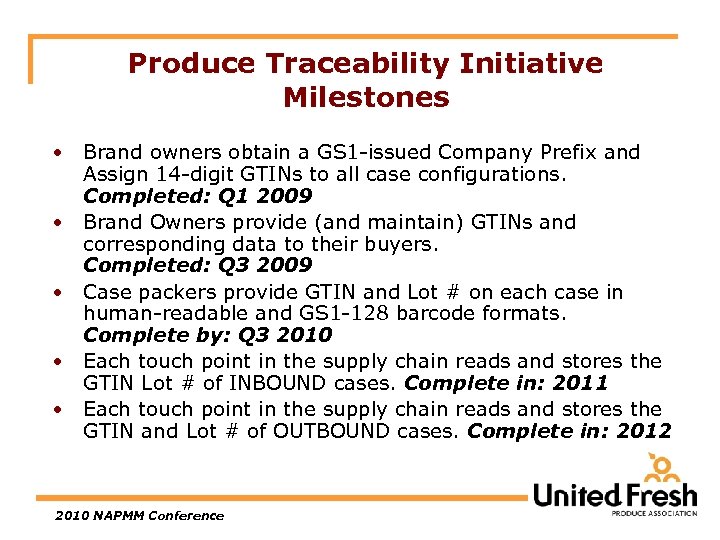 Produce Traceability Initiative Milestones • Brand owners obtain a GS 1 -issued Company Prefix and Assign 14 -digit GTINs to all case configurations. Completed: Q 1 2009 • Brand Owners provide (and maintain) GTINs and corresponding data to their buyers. Completed: Q 3 2009 • Case packers provide GTIN and Lot # on each case in human-readable and GS 1 -128 barcode formats. Complete by: Q 3 2010 • Each touch point in the supply chain reads and stores the GTIN Lot # of INBOUND cases. Complete in: 2011 • Each touch point in the supply chain reads and stores the GTIN and Lot # of OUTBOUND cases. Complete in: 2012 2010 NAPMM Conference
 PTI – What Your Business Needs to Know • Traceability is coming – will the industry set the standard or will the standard be set for us? • Constant communication between steering committee and industry to make sure we’re on the right track • You are not alone: www. producetraceability. org 2010 NAPMM Conference
 Federal Nutrition Programs • The Need for Drastic Change • Victories Won • Battles Still Being Fought 2010 NAPMM Conference
 The Need for Drastic Change • Obesity has been increasing to epidemic proportions over the past 25 years • Today’s children may be the first generation with a shorter life expectancy than their parents • Health care costs related to obesity top $150 billion every year • Increasing produce consumption is no longer a business goal; it’s survival – For kids and national economy 2010 NAPMM Conference
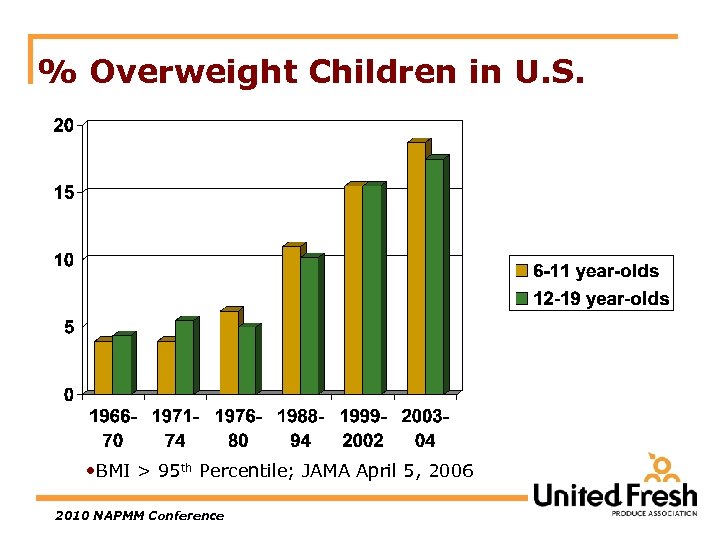 % Overweight Children in U. S. • BMI > 95 th Percentile; JAMA April 5, 2006 2010 NAPMM Conference
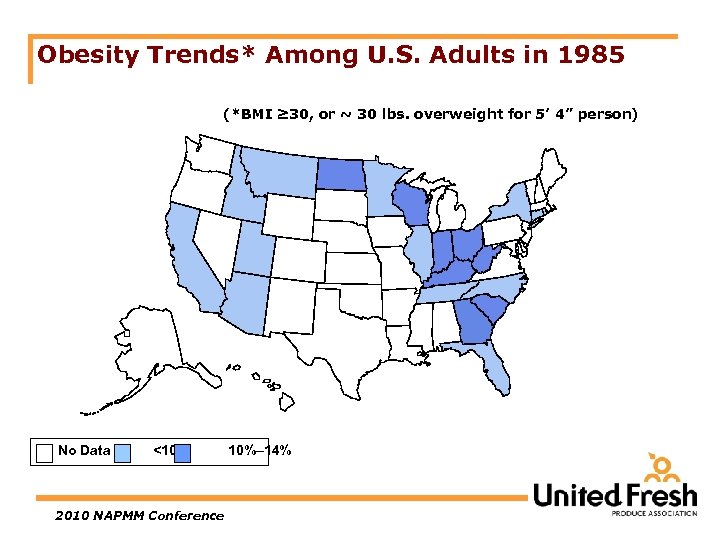 Obesity Trends* Among U. S. Adults in 1985 (*BMI ≥ 30, or ~ 30 lbs. overweight for 5’ 4” person) No Data <10% 2010 NAPMM Conference 10%– 14%
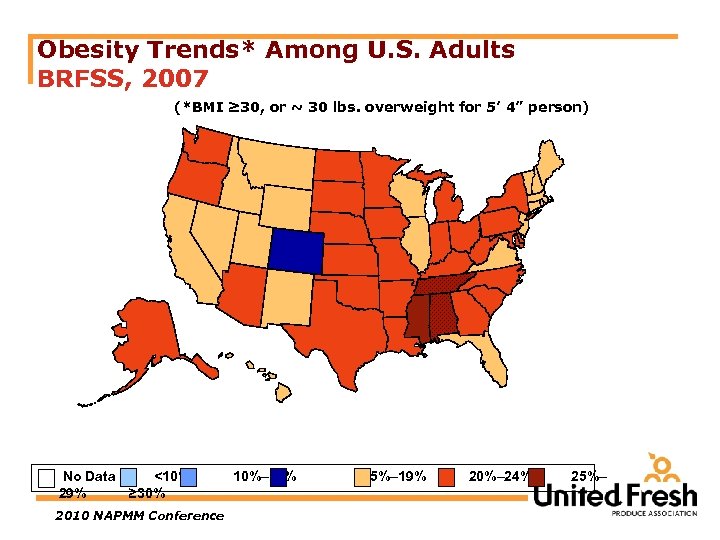 Obesity Trends* Among U. S. Adults BRFSS, 2007 (*BMI ≥ 30, or ~ 30 lbs. overweight for 5’ 4” person) No Data <10% 29% ≥ 30% 2010 NAPMM Conference 10%– 14% 15%– 19% 20%– 24% 25%–
 Changing Food Policy • Increasing childhood fruit and vegetable consumption is key to the future – Prevalence of childhood obesity – Access and availability – Schools as primary intervention point 2010 NAPMM Conference
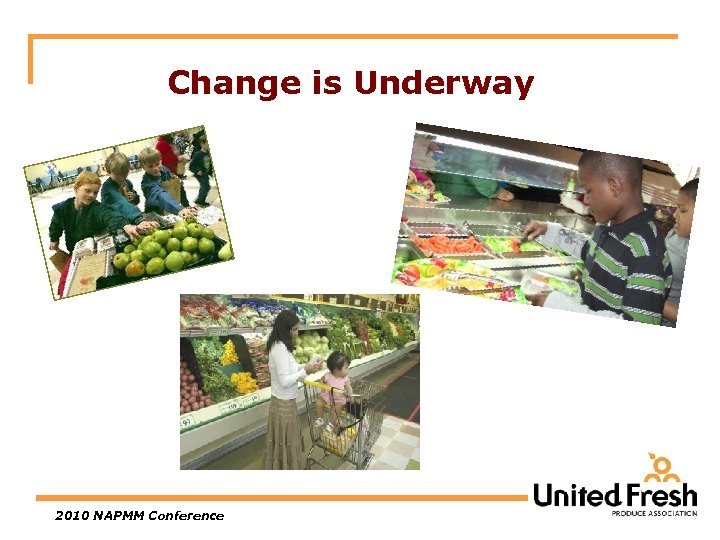 Change is Underway 2010 NAPMM Conference
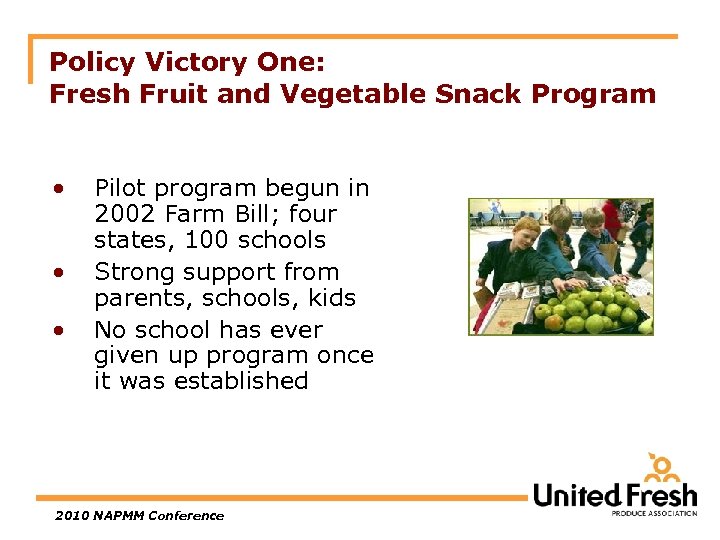 Policy Victory One: Fresh Fruit and Vegetable Snack Program • • • Pilot program begun in 2002 Farm Bill; four states, 100 schools Strong support from parents, schools, kids No school has ever given up program once it was established 2010 NAPMM Conference
 Fresh Fruit & Vegetable Snack Program • Children receive fresh fruit or vegetable snack every day • Schools choose how and where to purchase fresh produce items • Program has become integral part of school culture and overall student health • $1. 1 Billion in funding over the next decade 2010 NAPMM Conference
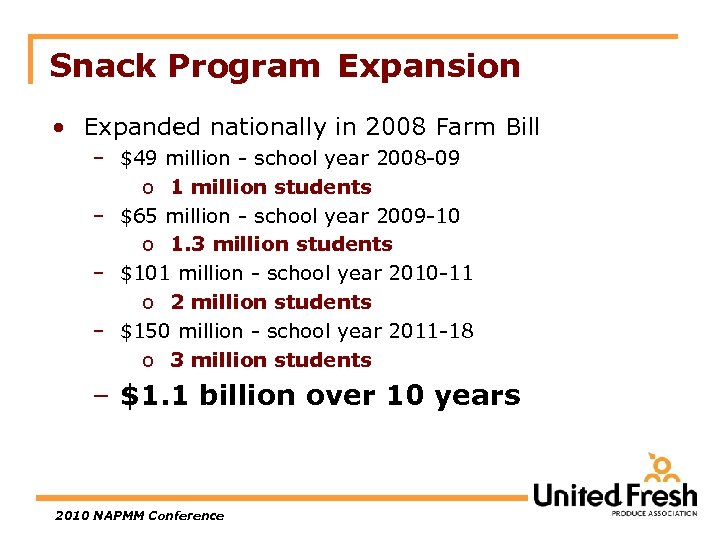 Snack Program Expansion • Expanded nationally in 2008 Farm Bill – $49 million - school year 2008 -09 o 1 million students – $65 million - school year 2009 -10 o 1. 3 million students – $101 million - school year 2010 -11 o 2 million students – $150 million - school year 2011 -18 o 3 million students – $1. 1 billion over 10 years 2010 NAPMM Conference
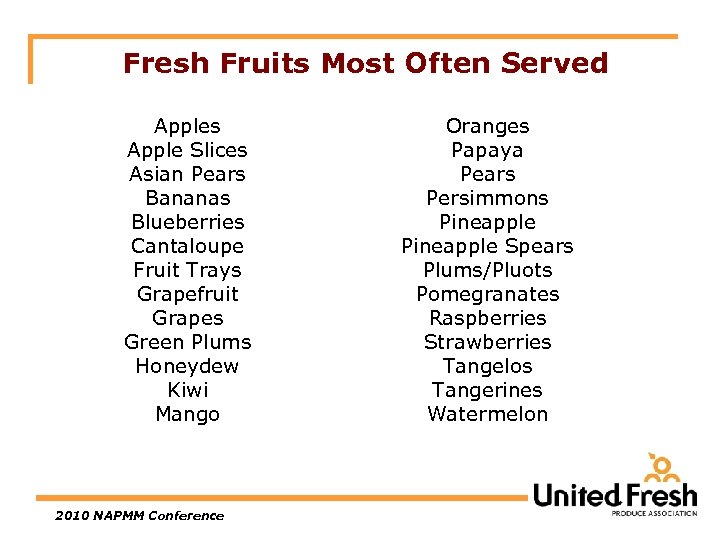 Fresh Fruits Most Often Served Apples Apple Slices Asian Pears Bananas Blueberries Cantaloupe Fruit Trays Grapefruit Grapes Green Plums Honeydew Kiwi Mango 2010 NAPMM Conference Oranges Papaya Pears Persimmons Pineapple Spears Plums/Pluots Pomegranates Raspberries Strawberries Tangelos Tangerines Watermelon
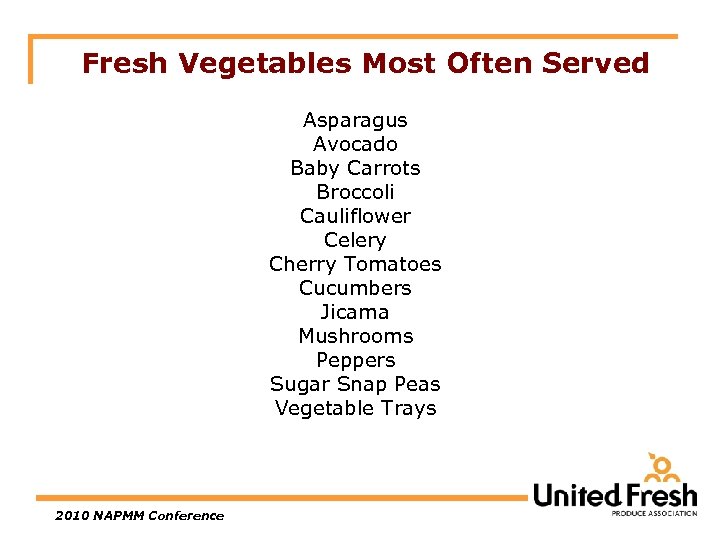 Fresh Vegetables Most Often Served Asparagus Avocado Baby Carrots Broccoli Cauliflower Celery Cherry Tomatoes Cucumbers Jicama Mushrooms Peppers Sugar Snap Peas Vegetable Trays 2010 NAPMM Conference
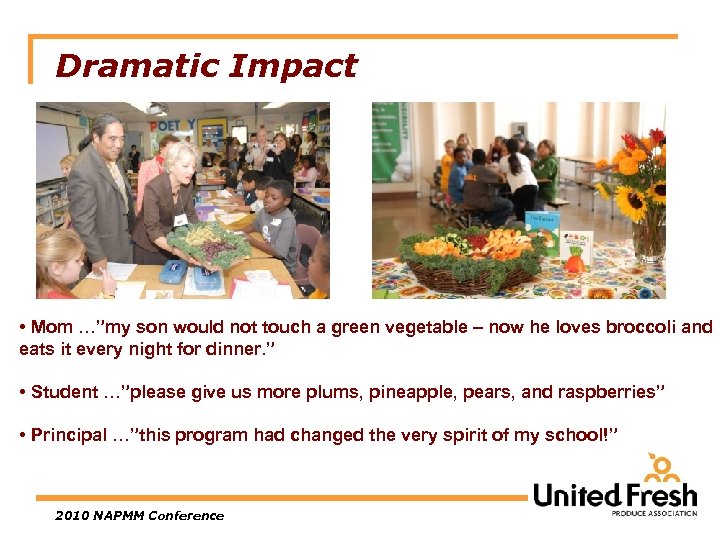 Dramatic Impact • Mom …”my son would not touch a green vegetable – now he loves broccoli and eats it every night for dinner. ” • Student …”please give us more plums, pineapple, pears, and raspberries” • Principal …”this program had changed the very spirit of my school!” 2010 NAPMM Conference
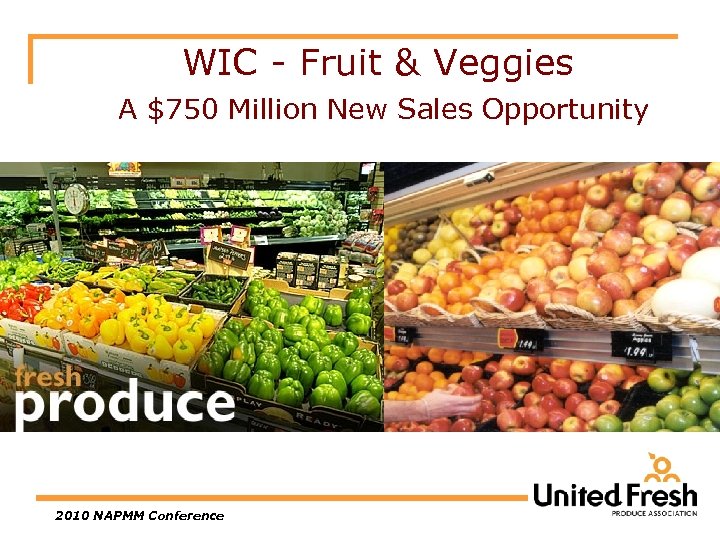 WIC - Fruit & Veggies A $750 Million New Sales Opportunity 2010 NAPMM Conference
 Policy Victory #2 • Women, Infants and Children’s (WIC) supplemental feeding program – Reaches 9 million low-income moms and children to age 7 o 50% of babies born in America today – Historically provided for foods such as milk, eggs, cheese o Did not include fresh fruits and vegetables – After 10 -year fight, WIC added vouchers/ coupons for free fruits and vegetables o $8 -$10 per month 2010 NAPMM Conference
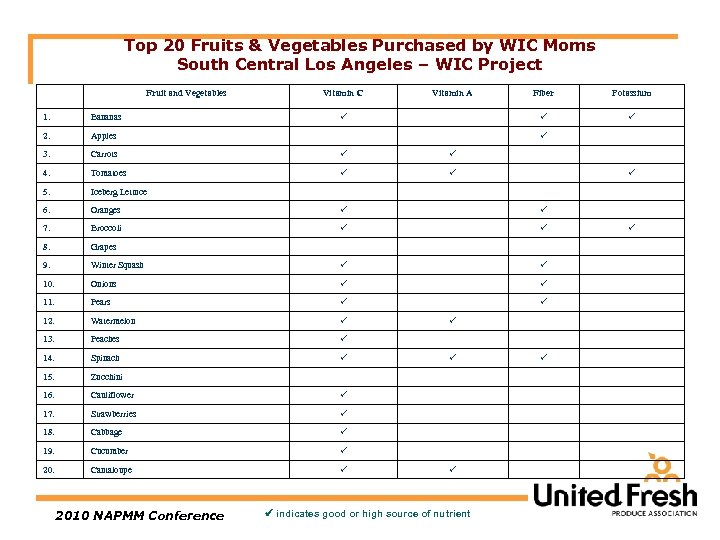 Top 20 Fruits & Vegetables Purchased by WIC Moms South Central Los Angeles – WIC Project Fruit and Vegetables Vitamin C Vitamin A Potassium Fiber 1. Bananas 2. Apples 3. Carrots 4. Tomatoes 5. Iceberg Lettuce 6. Oranges 7. Broccoli 8. Grapes 9. Winter Squash 10. Onions 11. Pears 12. Watermelon 13. Peaches 14. Spinach 15. Zucchini 16. Cauliflower 17. Strawberries 18. Cabbage 19. Cucumber 20. Cantaloupe 2010 NAPMM Conference indicates good or high source of nutrient
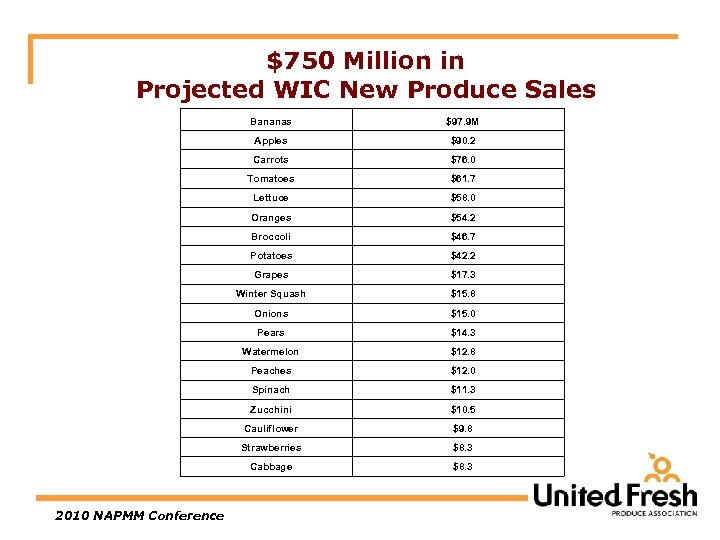 $750 Million in Projected WIC New Produce Sales Bananas Apples $90. 2 Carrots $76. 0 Tomatoes $61. 7 Lettuce $58. 0 Oranges $54. 2 Broccoli $46. 7 Potatoes $42. 2 Grapes $17. 3 Winter Squash $15. 8 Onions $15. 0 Pears $14. 3 Watermelon $12. 8 Peaches $12. 0 Spinach $11. 3 Zucchini $10. 5 Cauliflower $9. 8 Strawberries $8. 3 Cabbage 2010 NAPMM Conference $97. 9 M $8. 3
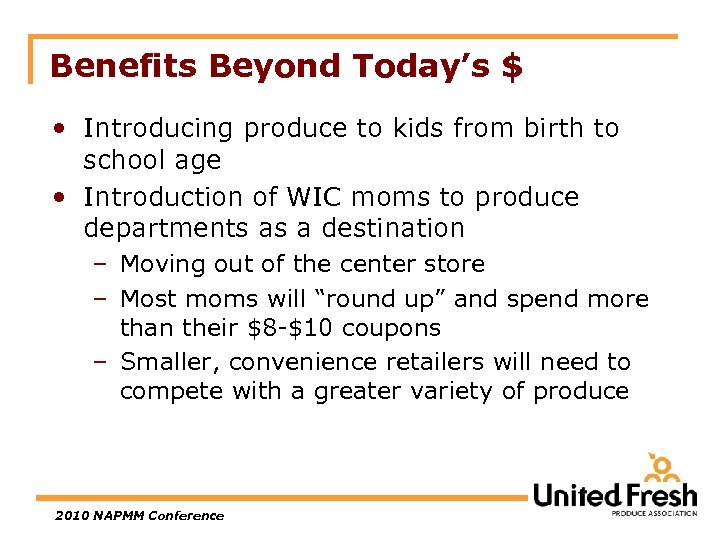 Benefits Beyond Today’s $ • Introducing produce to kids from birth to school age • Introduction of WIC moms to produce departments as a destination – Moving out of the center store – Most moms will “round up” and spend more than their $8 -$10 coupons – Smaller, convenience retailers will need to compete with a greater variety of produce 2010 NAPMM Conference
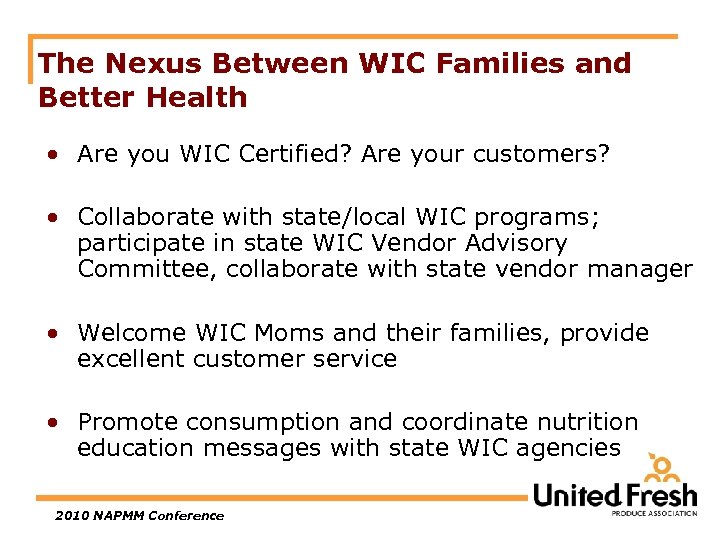 The Nexus Between WIC Families and Better Health • Are you WIC Certified? Are your customers? • Collaborate with state/local WIC programs; participate in state WIC Vendor Advisory Committee, collaborate with state vendor manager • Welcome WIC Moms and their families, provide excellent customer service • Promote consumption and coordinate nutrition education messages with state WIC agencies 2010 NAPMM Conference
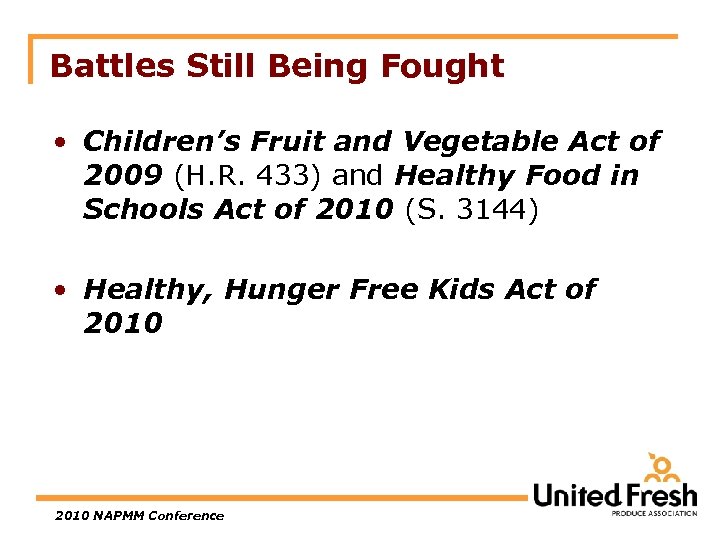 Battles Still Being Fought • Children’s Fruit and Vegetable Act of 2009 (H. R. 433) and Healthy Food in Schools Act of 2010 (S. 3144) • Healthy, Hunger Free Kids Act of 2010 NAPMM Conference
 H. R. 4333 – The Children’s Fruit and Vegetable Act of 2009 • Introduced by Congressmen Sam Farr (D-CA) and Adam Putnam (R-FL) • Creates a national salad bar policy • Increases the amount and variety of fresh fruits and vegetables in school meals • Provides for infrastructure and training • Sets the stage for priorities, Senate discussion 2010 NAPMM Conference
 Healthy Food in Schools Act of 2010 (S. 3144) • Companion Bill to the Farr/Putnam Bill • Introduced by Senator Barbara Boxer (D-CA), co-sponsored by Sen. Kay Hagan (D-NC) • Senate will reference bill this when looking at Childhood Nutrition Reauthorization • Salad bars also a key part of this bill 2010 NAPMM Conference
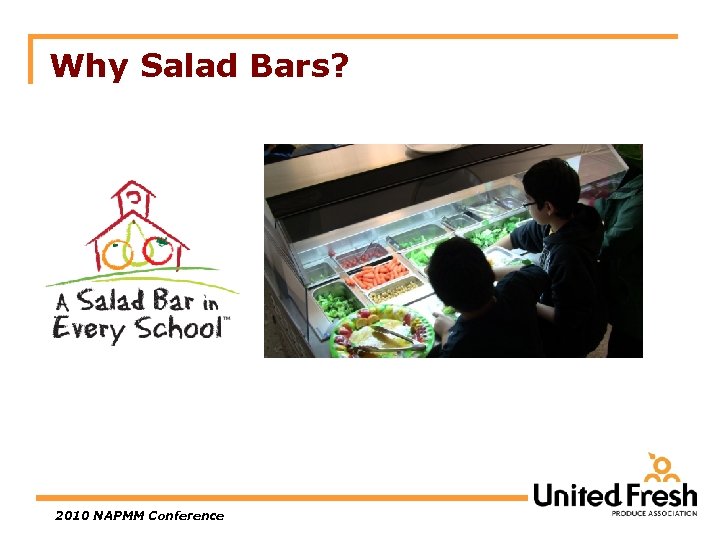 Why Salad Bars? 2010 NAPMM Conference
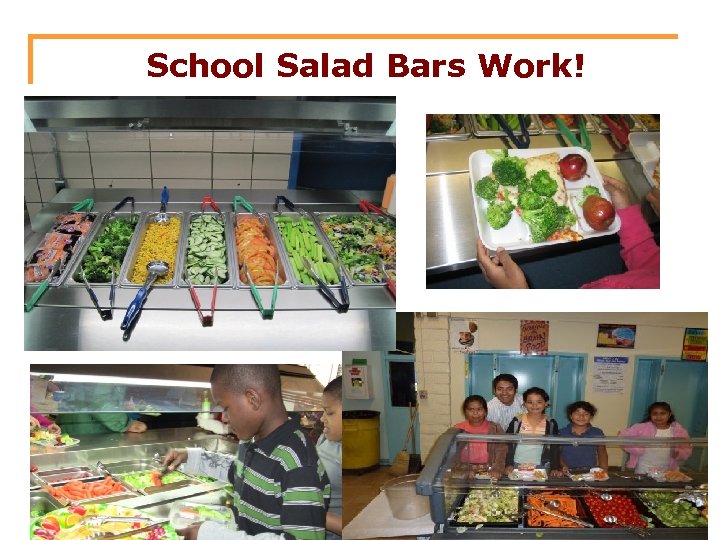 School Salad Bars Work! 2010 NAPMM Conference
 Research, Experience, Success • Personal choice increases consumption – Kids ate an extra serving per day (Up 25%!) – Key was variety of fruit and vegetables • Kids learn to make decisions for life – They must choose produce first, even after school at the C-store, restaurant, retailer 2010 NAPMM Conference
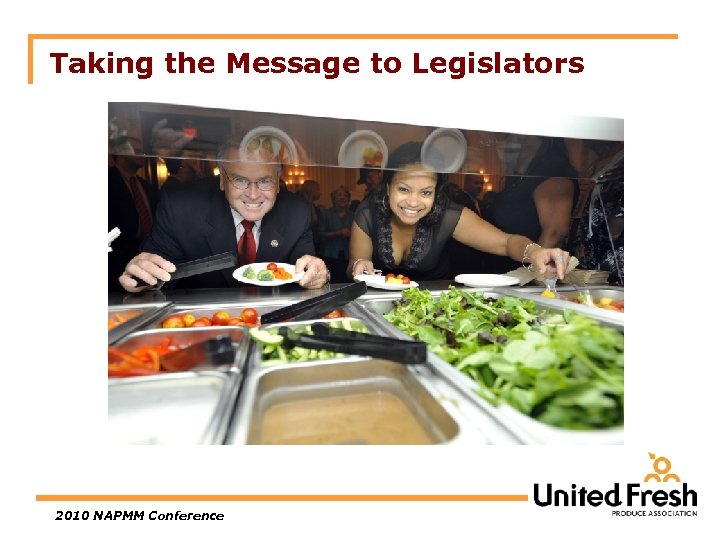 Taking the Message to Legislators 2010 NAPMM Conference
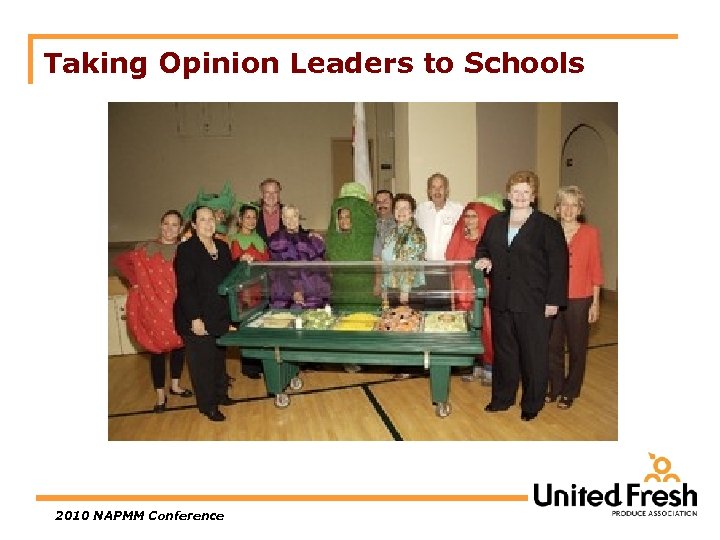 Taking Opinion Leaders to Schools 2010 NAPMM Conference
 Healthy, Hunger Free Kids Act of 2010 • Introduced by Senator Blanche Lincoln, Chair of the Senate Agricultural Committee • $4. 5 billion in new child nutrition program funding over ten years • Guiding Principles: – Expand program access to reduce childhood hunger – Improve nutritional quality to promote health and address childhood obesity 2010 NAPMM Conference
 Healthy, Hunger Free Kids Act of 2010 • Help schools improve the nutritional quality of school meals • Performance-based increase in the federal reimbursement rate for school lunches – 6 cents per meal – Help schools meet new meal standards to provide children with healthier school meals. • National Nutrition Standards for All Foods Sold in Schools – Authority to establish national nutrition standards for all foods sold on school campus throughout the school day 2010 NAPMM Conference
 Healthy, Hunger Free Kids Act of 2010 • Connecting more children to healthy local produce through farm-to-school programs • Provides mandatory funding for schools to establish school gardens and to source local foods into school cafeterias 2010 NAPMM Conference
 Opportunities for Our Industry • Build strong community relationships with local schools, including children and parents • Immediate sales growth through increased overall consumption • Regional food systems to make local produce sourcing more efficient • Long-term sales growth once produce consumption is entrenched 2010 NAPMM Conference
 Nutrition Reauthorization Priorities for the Industry • National School Salad Bar Policy • Increase reimbursement rates • Significantly expand fresh fruit & vegetable purchases • Update school meal nutrition standards 2010 NAPMM Conference
 Keys to Overall Success • Your voice matters – make it heard! – Contact your members of Congress on industry issues – Take part in public policy events in your area and in Washington – Comment on regulatory matters that effect your business 2010 NAPMM Conference
 Questions My email: mmiller@unitedfresh. org United Fresh Website: www. unitedfresh. org 2010 NAPMM Conference
 Dispatches from Washington: Upcoming Nutrition and Food Safety Legislation That Will Impact Your Business Miriam Miller Director of Membership United Fresh Produce Association March 25, 2010 NAPMM Conference