


 Скачать презентацию Diseases of the Spinal Cord Stacy Rudnicki MD
spinal disease.ppt
- Количество слайдов: 23
 Diseases of the Spinal Cord Stacy Rudnicki, MD Department of Neurology
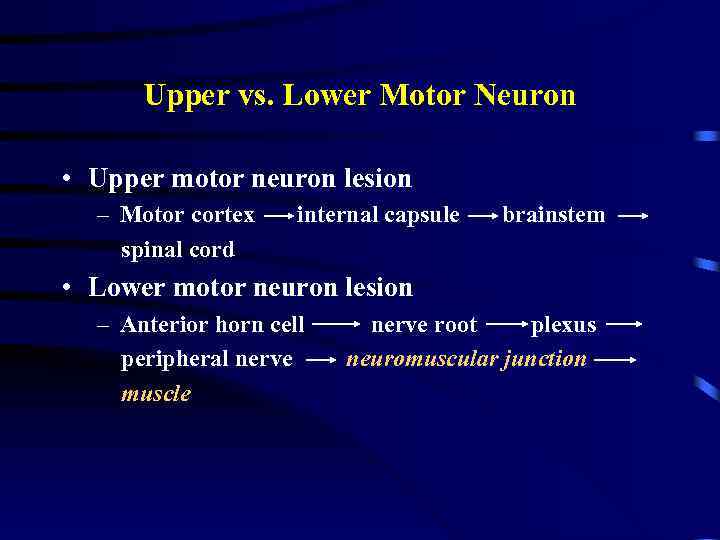 Upper vs. Lower Motor Neuron • Upper motor neuron lesion – Motor cortex spinal cord internal capsule brainstem • Lower motor neuron lesion – Anterior horn cell peripheral nerve muscle nerve root plexus neuromuscular junction
 Basic Features of Spinal Cord Disease • UMN findings below the lesion – Hyperreflexia and Babinski’s • Sensory and motor involvement that localizes to a spinal cord level • Bowel and Bladder dysfunction common • Remember that the spinal cord ends at about T 12 -L 1
 History • Onset – Acute, subacute, chronic • Symptoms – – Pain Weakness Sensory Autonomic • Past history • Family history
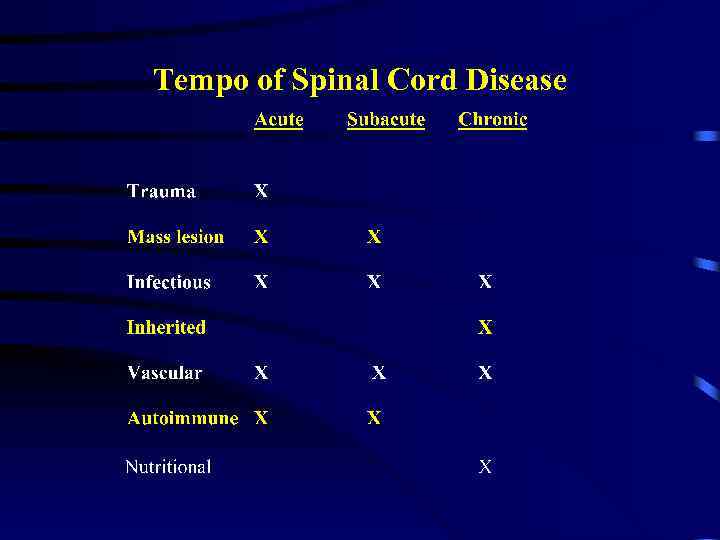 Tempo of Spinal Cord Disease
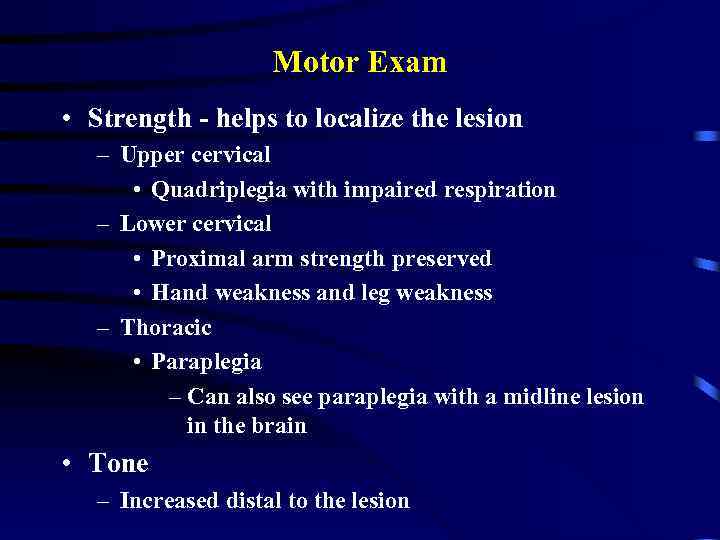 Motor Exam • Strength - helps to localize the lesion – Upper cervical • Quadriplegia with impaired respiration – Lower cervical • Proximal arm strength preserved • Hand weakness and leg weakness – Thoracic • Paraplegia – Can also see paraplegia with a midline lesion in the brain • Tone – Increased distal to the lesion
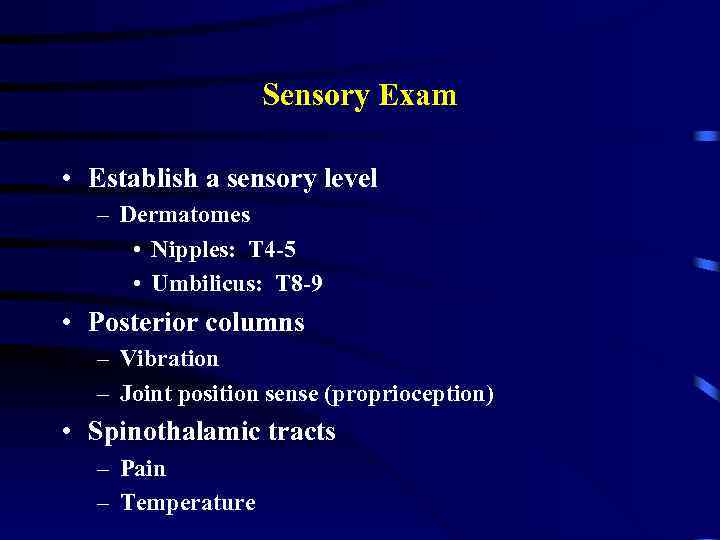 Sensory Exam • Establish a sensory level – Dermatomes • Nipples: T 4 -5 • Umbilicus: T 8 -9 • Posterior columns – Vibration – Joint position sense (proprioception) • Spinothalamic tracts – Pain – Temperature
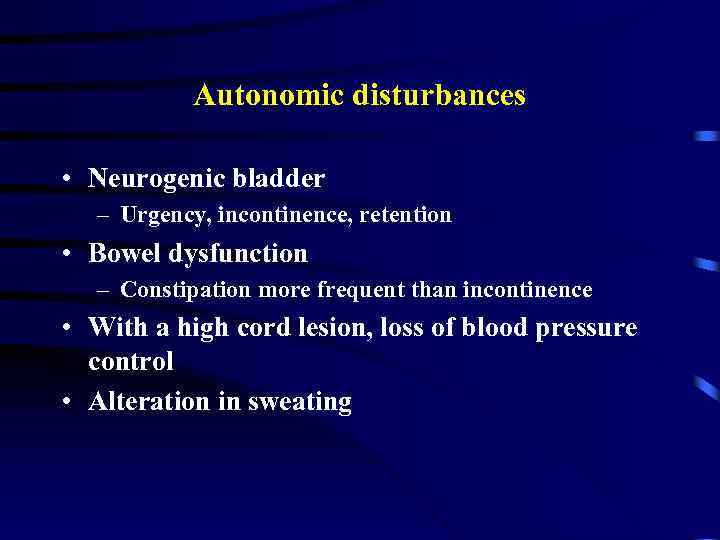 Autonomic disturbances • Neurogenic bladder – Urgency, incontinence, retention • Bowel dysfunction – Constipation more frequent than incontinence • With a high cord lesion, loss of blood pressure control • Alteration in sweating
 Investigation of Spinal Cord Disease • Radiographic exams – – Plain films Myelography CT scan with myelography MRI • Spinal tap – If you suspect: inflammation, MS, rupture of a vascular malformation
 Etiology of Spinal Cord Disease
 Traumatic Spinal Cord Disease • • 10, 000 new spinal cord injuries per year MVA, sports injuries the most common Victims under 30 yrs old, male>>females Fx/dislocation of vertabrae most likely to occur at: – C 5, 6 – T 12, L 1 – C 1, 2
 Tumors • Metastatic or primary • Extramedullary – Extradural - most common • Bony - breast, prostate – Intradural - very rare • Meninges - meningioma • Nerve root - schwannoma – Intramedullary - very rare • Metastatic • Primary - astrocytoma or ependymoma
 B 12 Deficiency • Subacute combined degeneration of the cord • B 12 deficiency – malabsorption of B 12 secondary to pernicious anemia or surgery – insufficient dietary intake - vegan • Posterior columns and CST involvement with a superimposed peripheral neuropathy
 Transverse myelitis • Inflammation of the spinal cord – Post-infectious – Post-vaccinial – Multiple sclerosis • Pain at level of lesion may preceed onset of weakness/sensory change/b&b disturbance • Spinal tap may help with diagnosis
 Infections Involving the Spinal Cord • Polio – only the anterior horn cells are infected • Tabes dorsalis – dorsal root ganglia and dorsal columns are involved – tertiary syphillis – sensory ataxia, “lightening pains” • HIV myelopathy – mimics B 12 deficiency • HTLV-1 myelopathy – tropical spastic paraparesis
 Multiple Sclerosis • Demyelination is the underlying pathology • Cord disease can be presenting feature of MS or occur at any time during the course of the disease • Lesion can be at any level of the cord – Patchy – Transverse • Devic’s syndrome or myelitis optica – Transverse myelitis with optic neuritis
 Vascular Diseases of the Spinal Cord • Infarcts – Anterior spinal artery infarct • from atherosclerosis, during surgery in which the aorta is clamped, dissecting aortic aneurysm – less often, chronic meningitis or following trauma • posterior columns preserved (JPS, vib) • weakness (CST) and pain/temperature loss (spinothalamic tracts) – Artery of Adamkiewicz at T 10 -11 – Watershed area • upper thoracic
 Vascular Diseases of the Spinal Cord, cont • Arteriovenous malformation (AVM) and venous angiomas – Both occur in primarily the thoracic cord – May present either acutely, subacutely or chronically (act as a compressive lesion) – Can cause recurrent symptoms – If they bleed • Associated with pain and bloody CSF – Notoriously difficult to diagnose • Hematoma - trauma, occasionally tumor
 Other Disease of the Spinal Cord • Hereditary spastic paraparesis – Usually autosomal dominant • Infectious process of the vertabrae – TB, bacterial • Herniated disc with cord compression – Most herniated discs are lateral and only compress a nerve root • Degenerative disease of the vertabrae – Cervical spondylosis with a myelopathy – Spinal stenosis
 Classical spinal cord syndromes • • Anterior spinal artery infarct Brown Sequard syndrome Syringomyelia Conus medullaris/caude equina lesions
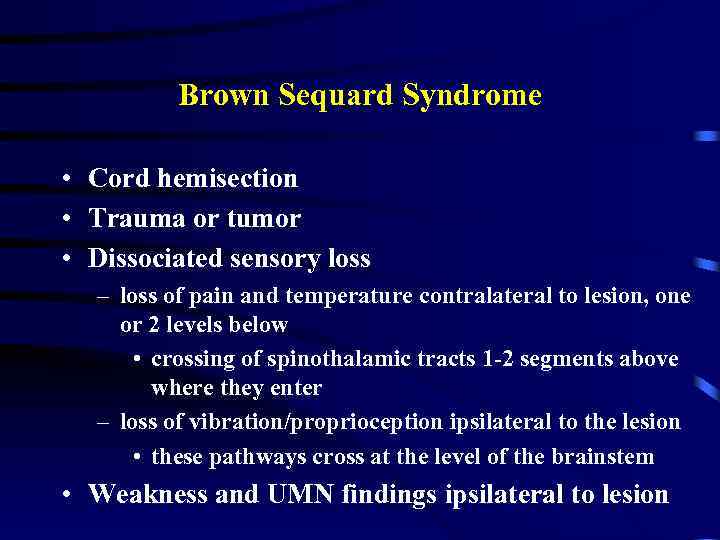 Brown Sequard Syndrome • Cord hemisection • Trauma or tumor • Dissociated sensory loss – loss of pain and temperature contralateral to lesion, one or 2 levels below • crossing of spinothalamic tracts 1 -2 segments above where they enter – loss of vibration/proprioception ipsilateral to the lesion • these pathways cross at the level of the brainstem • Weakness and UMN findings ipsilateral to lesion
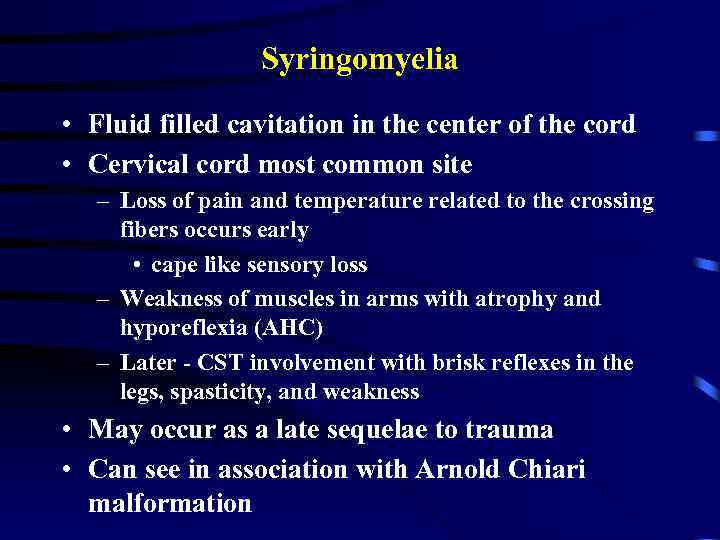 Syringomyelia • Fluid filled cavitation in the center of the cord • Cervical cord most common site – Loss of pain and temperature related to the crossing fibers occurs early • cape like sensory loss – Weakness of muscles in arms with atrophy and hyporeflexia (AHC) – Later - CST involvement with brisk reflexes in the legs, spasticity, and weakness • May occur as a late sequelae to trauma • Can see in association with Arnold Chiari malformation
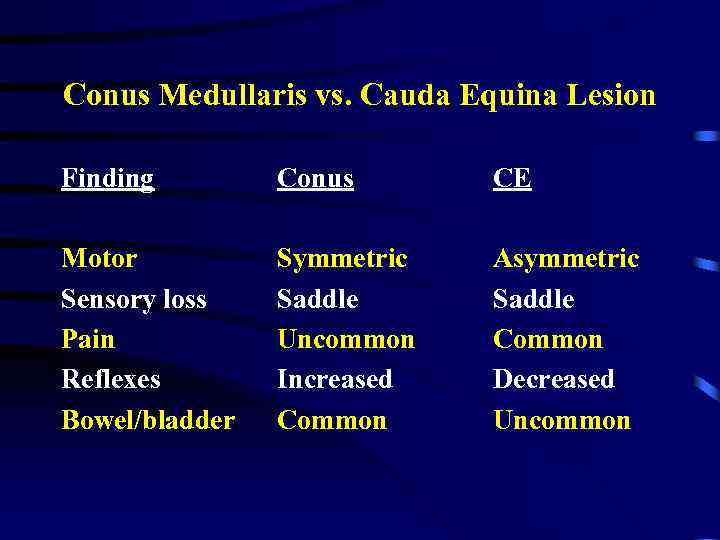 Conus Medullaris vs. Cauda Equina Lesion Finding Conus CE Motor Sensory loss Pain Reflexes Bowel/bladder Symmetric Saddle Uncommon Increased Common Asymmetric Saddle Common Decreased Uncommon