 Скачать презентацию Discussion boards a constructivist approach and a means
26a8cef4112483ce0b7b3474b3da7f26.ppt
- Количество слайдов: 27




Discussion boards: a constructivist approach and a means of consolidating writing skills for advanced learners of business Russian Olga Helly, Lecturer in Business Russian
Charles Mingus, an American jazz bassist and a composer: “Making the simple complicated is commonplace; making the complicated simple, awesomely simple, that's creativity” Charles Mingus, an American jazz bassist and composer – quotation taken from B. Lamb (2004) “Wide Spaces: Wikis, Ready or Not”) 2
The objectivist model of learning versus the constructivist one “Objectivism argues that there is an objective reality, and that the goal of learning is to understand this reality and change behaviour accordingly. On the other hand, constructivism is founded on the notion that the only important reality is in the learner’s mind, and the goal of learning is to construct in the learner’s mind its own, unique conception of events” (Carswell, 2001, p. 2). 3
Why do Discussion Boards encourage active participation by the learner in the learning process? Because they provide: • problem-based, learner-centred and collaborative learning • previous-experience-based learning • cognitive skills-based learning • cognitive tools-facilitated learning 4
Von Glasersfeld, the founder of radical constructivism: "From the constructivist perspective, learning is not a stimulus-response phenomenon. It requires self-regulation and the building of conceptual structures through reflection and abstraction” E. von Glasersfeld (1995), A constructivist approach to teaching in E. Murphy (1998) Constructivism: From Philosophy to Practice”, p. 8 5
Julie Carwile: “Using constructivist principles, a teacher may develop discussion topics that are open-ended enough to allow the individual learner to incorporate individual experiences, interpretations, reactions, and opinions into discussion responses. ” (J. Carwile, p. 5) 6
Steve Pavlina: Discussion Boards help to provide: § Intellectual exchange § Learning new ideas and refining old ones § Enjoying community membership § Influencing the forum's evolution § Contributing to others § Making new friends and contacts § New business leads § Keeping up with current events § Learning about new opportunities S. Pavlina, p. 45 7
A. KNOWLEDGE AND UNDERSTANDING: At the end of the module, learners will be expected to: § A 13: be able to demonstrate critical knowledge and understanding of the contemporary economic, socio-political, and cultural dynamics of the country or countries where the foreign language is spoken, and their relation to wider international developments 8
B. COGNITIVE SKILLS: At the end of the module, learners will be expected to: § B 13: be able to critically analyse and evaluate models and concepts within international business § B 15: be able to integrate and evaluate complex information and data from a variety of sources 9
C. PRACTICAL AND PROFESSIONAL SKILLS: At the end of the module, learners will be expected to: § C 14: be able to use the target language(s) competently and effectively as a medium for understanding, expression and communication in professional and social situations 10
D. Key Transferable skills: At the end of the module, learners will be expected to: § D 13: be able to show evidence of learner autonomy, continuing professional development and commitment to lifelong learning in a selfreflective manner 11
A list of Level 6 students’ deficiencies: § They have not properly understood the more complex grammatical phenomena and are unable to use complex grammatical constructions with participles, gerunds or numerals; § They have failed to acquire a political or business vocabulary to enable them to write business reports or to express their opinion in writing on the current political events in Russia and worldwide; § They generally lack motivation to achieve a genuine advanced level in writing in the Russian language; § They have no effective learning strategies to enable them to strengthen their writing skills; § Their cognitive skills appear to be very weak, especially for the purpose of academic and business writing in Russian, meaning that they can’t analyse, compare, criticise or argue their point properly. 12
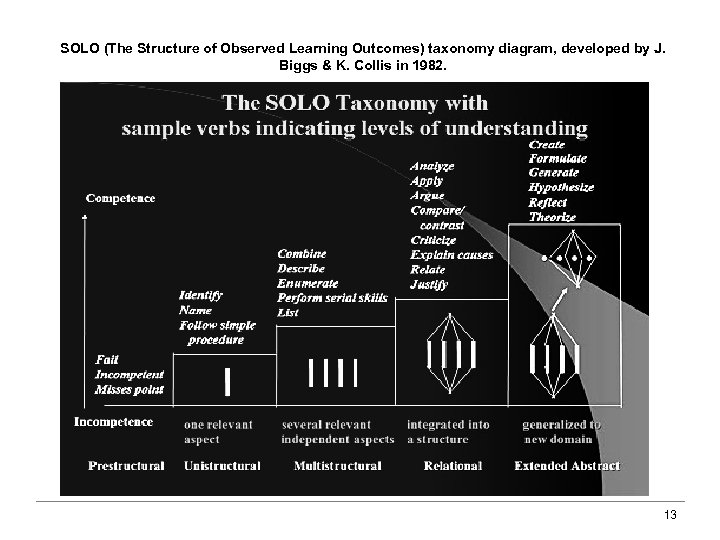
SOLO (The Structure of Observed Learning Outcomes) taxonomy diagram, developed by J. Biggs & K. Collis in 1982. 13
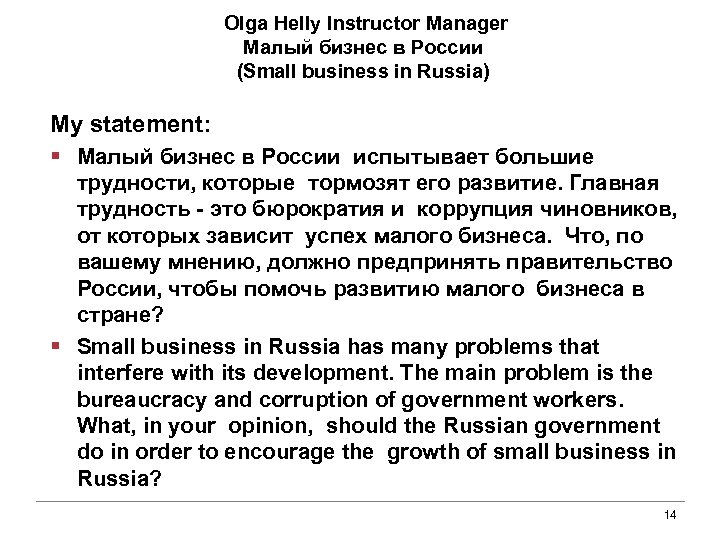
Olga Helly Instructor Manager Малый бизнес в России (Small business in Russia) My statement: § Малый бизнес в России испытывает большие трудности, которые тормозят его развитие. Главная трудность - это бюрократия и коррупция чиновников, от которых зависит успех малого бизнеса. Что, по вашему мнению, должно предпринять правительство России, чтобы помочь развитию малого бизнеса в стране? § Small business in Russia has many problems that interfere with its development. The main problem is the bureaucracy and corruption of government workers. What, in your opinion, should the Russian government do in order to encourage the growth of small business in Russia? 14
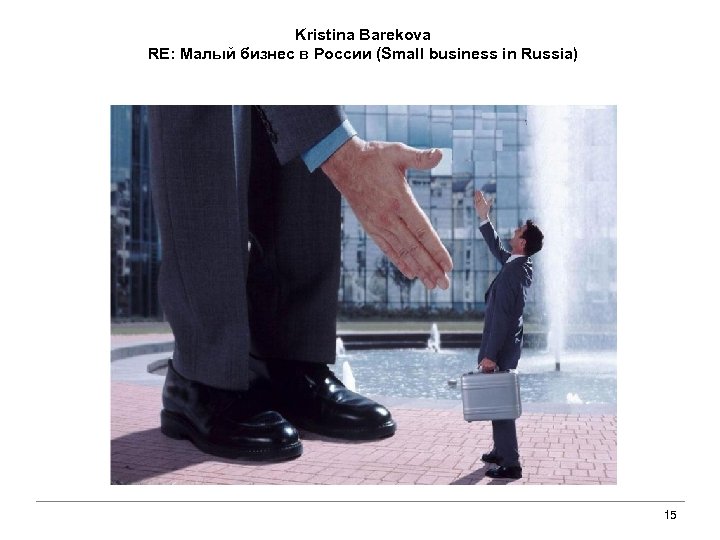
Kristina Barekova RE: Малый бизнес в России (Small business in Russia) 15
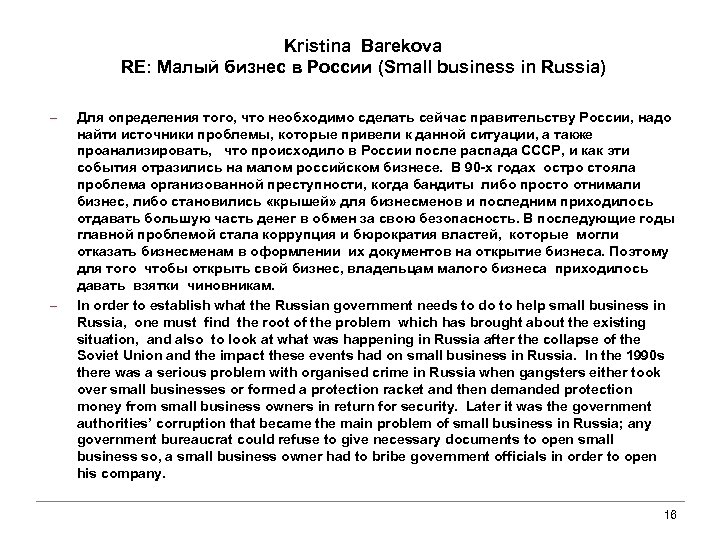
Kristina Barekova RE: Малый бизнес в России (Small business in Russia) ‒ ‒ Для определения того, что необходимо сделать сейчас правительству России, надо найти источники проблемы, которые привели к данной ситуации, а также проанализировать, что происходило в России после распада СССР, и как эти события отразились на малом российском бизнесе. В 90 -х годах остро стояла проблема организованной преступности, когда бандиты либо просто отнимали бизнес, либо становились «крышей» для бизнесменов и последним приходилось отдавать большую часть денег в обмен за свою безопасность. В последующие годы главной проблемой стала коррупция и бюрократия властей, которые могли отказать бизнесменам в оформлении их документов на открытие бизнеса. Поэтому для того чтобы открыть свой бизнес, владельцам малого бизнеса приходилось давать взятки чиновникам. In order to establish what the Russian government needs to do to help small business in Russia, one must find the root of the problem which has brought about the existing situation, and also to look at what was happening in Russia after the collapse of the Soviet Union and the impact these events had on small business in Russia. In the 1990 s there was a serious problem with organised crime in Russia when gangsters either took over small businesses or formed a protection racket and then demanded protection money from small business owners in return for security. Later it was the government authorities’ corruption that became the main problem of small business in Russia; any government bureaucrat could refuse to give necessary documents to open small business so, a small business owner had to bribe government officials in order to open his company. 16
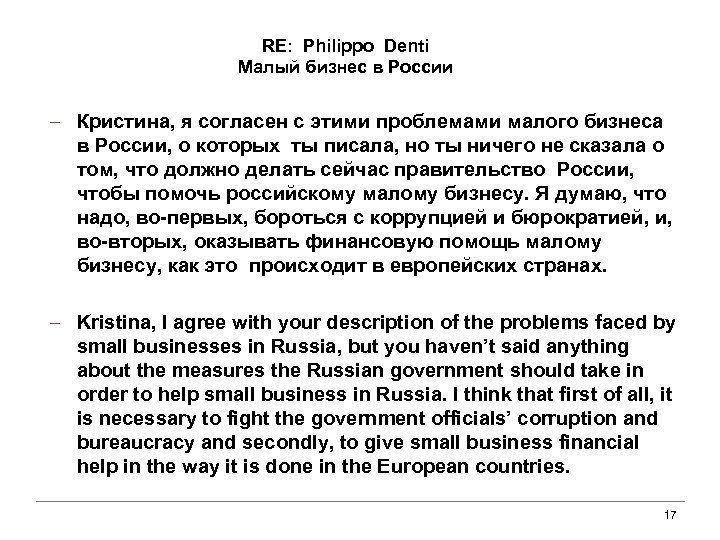
RE: Philippo Denti Малый бизнес в России ‒ Кристина, я согласен с этими проблемами малого бизнеса в России, о которых ты писала, но ты ничего не сказала о том, что должно делать сейчас правительство России, чтобы помочь российскому малому бизнесу. Я думаю, что надо, во-первых, бороться с коррупцией и бюрократией, и, во-вторых, оказывать финансовую помощь малому бизнесу, как это происходит в европейских странах. ‒ Kristina, I agree with your description of the problems faced by small businesses in Russia, but you haven’t said anything about the measures the Russian government should take in order to help small business in Russia. I think that first of all, it is necessary to fight the government officials’ corruption and bureaucracy and secondly, to give small business financial help in the way it is done in the European countries. 17
Olga Helly Instructor Manager Франчайзинг (Franchising) ‒Франчайзинг может существовать только при условии полного доверия франчайзера и франчайзи друг к другу. У обеих сторон есть свои права и обязанности, и они должны хорошо их понимать и стремиться к их выполнению. В противном случае, франчайзинг не будет работать и может обанкротиться уже в первый год своего существования. Как, по вашему мнению, можно добиться идеальных отношений между франчайзером и франчайзи? ‒Franchising can be successful only on the condition that there is a complete trust between the partners, the franchiser and the franchisee. Both partners have their own rights and responsibilities and they should understand them and be eager to fulfil them. Otherwise, franchising will not work and the business can suffer bankruptcy as soon as the first year of its existence. How is it possible, in your opinion, to establish ideal relationship between a franchiser and a franchisee? 18
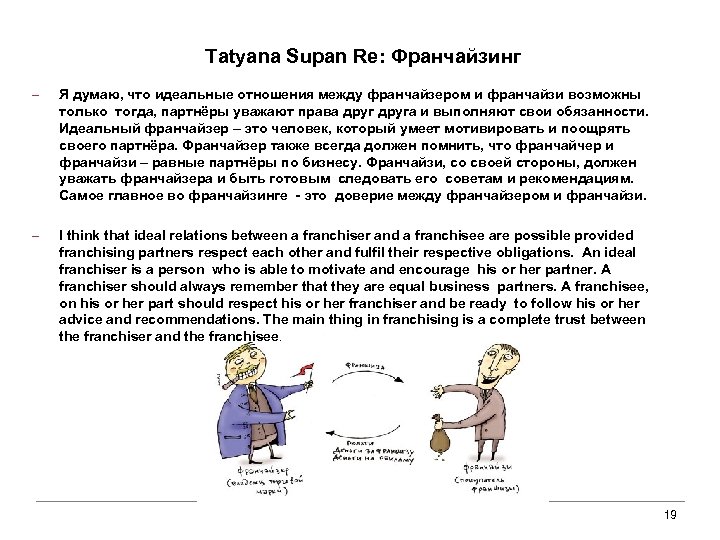
Tatyana Supan Re: Франчайзинг ‒ Я думаю, что идеальные отношения между франчайзером и франчайзи возможны только тогда, партнёры уважают права друга и выполняют свои обязанности. Идеальный франчайзер – это человек, который умеет мотивировать и поощрять своего партнёра. Франчайзер также всегда должен помнить, что франчайчер и франчайзи – равные партнёры по бизнесу. Франчайзи, со своей стороны, должен уважать франчайзера и быть готовым следовать его советам и рекомендациям. Самое главное во франчайзингe - это доверие между франчайзером и франчайзи. ‒ I think that ideal relations between a franchiser and a franchisee are possible provided franchising partners respect each other and fulfil their respective obligations. An ideal franchiser is a person who is able to motivate and encourage his or her partner. A franchiser should always remember that they are equal business partners. A franchisee, on his or her part should respect his or her franchiser and be ready to follow his or her advice and recommendations. The main thing in franchising is a complete trust between the franchiser and the franchisee. 19
Nikolai Dimitrov Re: Франчайзинг § Татьяна, ты правильно описала идеальные отношения между франчайзером и франчайзи, но к сожалению, такие отношения бывают очень редко. Часто франчайзеру и франчайзи трудно договориться, и тогда возникают трения и конфликты, но главное здесь – уметь их урегулировать, и я думаю, что это зависит от франчайзера. Я считаю, что умение решать спорные вопросы – главное качество идеального франчайзера. § Tatyana, your description of an ideal franchiser and an ideal franchisee is correct, but unfortunately, such relations happen very rarely. Often a franchiser and franchisee find it difficult to agree which can result in arguments and even conflicts. The most important thing here is to be able to find a compromise, and I think that this depends on the franchiser. I believe that the ability to find a solution is the main quality of an ideal franchiser. 20
What are cognitive tools? D. H. Jonassen: “Cognitive tools are both mental and computational devices that support, guide, and extend the thinking processes of their users" Wouter Van Joolingen: “Cognitive tools are instruments that are designed for supporting cognitive processes and thereby extending the limits of the human cognitive capacities” 21
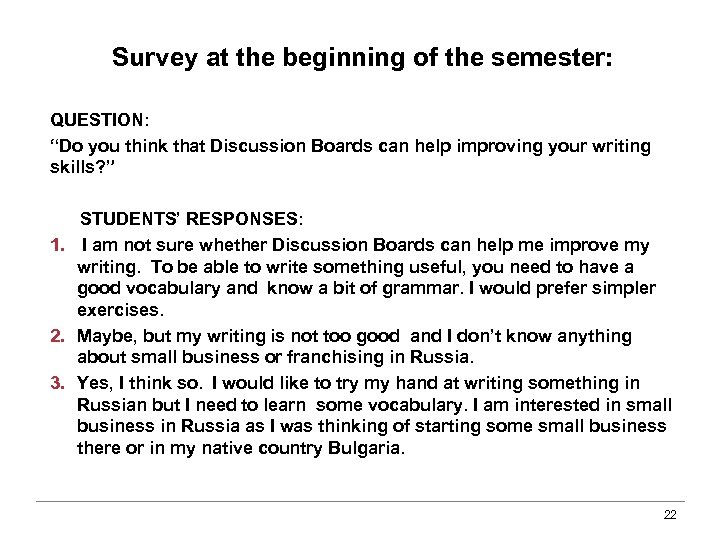
Survey at the beginning of the semester: QUESTION: “Do you think that Discussion Boards can help improving your writing skills? ” STUDENTS’ RESPONSES: 1. I am not sure whether Discussion Boards can help me improve my writing. To be able to write something useful, you need to have a good vocabulary and know a bit of grammar. I would prefer simpler exercises. 2. Maybe, but my writing is not too good and I don’t know anything about small business or franchising in Russia. 3. Yes, I think so. I would like to try my hand at writing something in Russian but I need to learn some vocabulary. I am interested in small business in Russia as I was thinking of starting some small business there or in my native country Bulgaria. 22
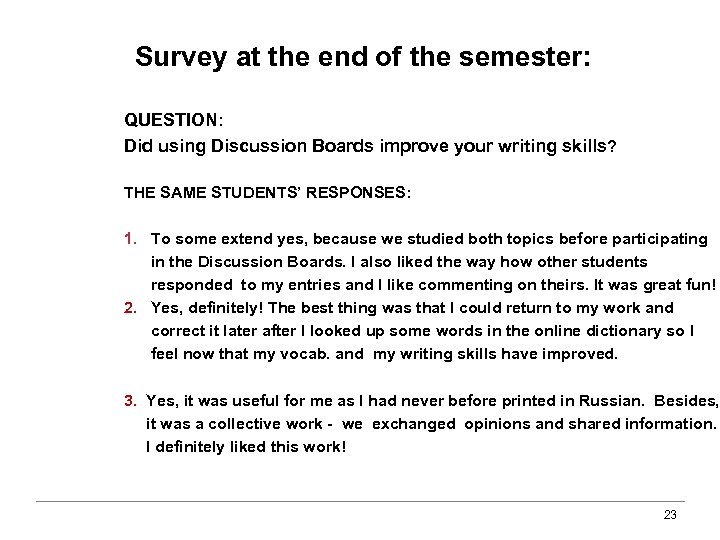
Survey at the end of the semester: QUESTION: Did using Discussion Boards improve your writing skills ? THE SAME STUDENTS’ RESPONSES: 1. To some extend yes, because we studied both topics before participating in the Discussion Boards. I also liked the way how other students responded to my entries and I like commenting on theirs. It was great fun! 2. Yes, definitely! The best thing was that I could return to my work and correct it later after I looked up some words in the online dictionary so I feel now that my vocab. and my writing skills have improved. 3. Yes, it was useful for me as I had never before printed in Russian. Besides, it was a collective work - we exchanged opinions and shared information. I definitely liked this work! 23
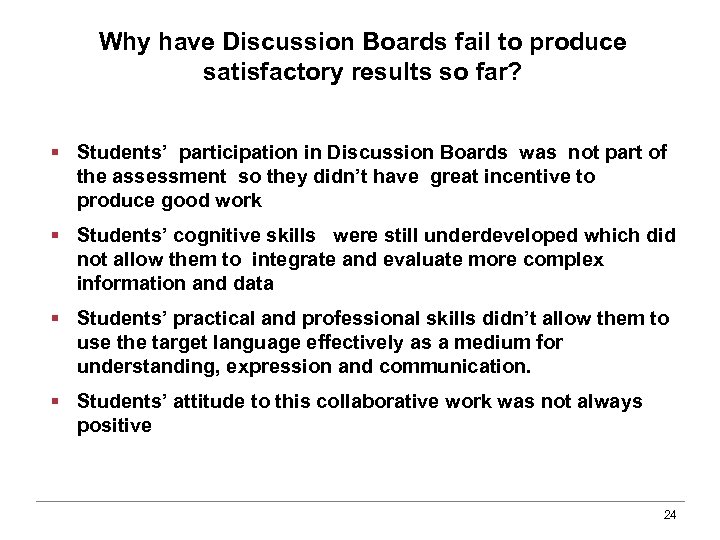
Why have Discussion Boards fail to produce satisfactory results so far? § Students’ participation in Discussion Boards was not part of the assessment so they didn’t have great incentive to produce good work § Students’ cognitive skills were still underdeveloped which did not allow them to integrate and evaluate more complex information and data § Students’ practical and professional skills didn’t allow them to use the target language effectively as a medium for understanding, expression and communication. § Students’ attitude to this collaborative work was not always positive 24
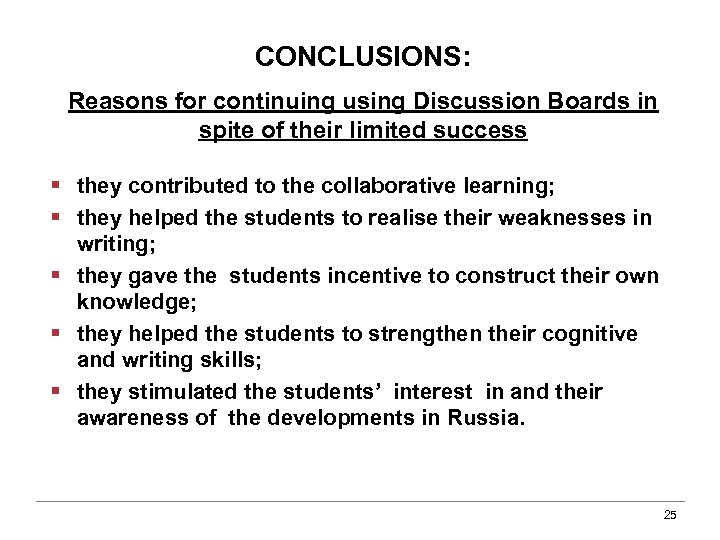
CONCLUSIONS: Reasons for continuing using Discussion Boards in spite of their limited success § they contributed to the collaborative learning; § they helped the students to realise their weaknesses in writing; § they gave the students incentive to construct their own knowledge; § they helped the students to strengthen their cognitive and writing skills; § they stimulated the students’ interest in and their awareness of the developments in Russia. 25
REFERENCES ‒ Adams, P. ICT and Pedagogy: Opportunities Missed, 2011 Education 3 -13: International Journal of Primary, Elementary and Early Years’ Education 39: 1, 21 -33 ‒ Biggs, J. & Collis, K. (1982) Evaluating the Quality of Learning: The SOLO taxonomy. New York: Academic Press. ‒ Carswell, A. D. (2001). Facilitating student learning in an asynchronous learning network. Dissertation Abstracts International, 62 (03), 1110. ‒ Carwile, J. ( 2007). Constructivist Approach to Online Teaching and Learning from Inquiry, Volume 12, Number 1, pp. 68 -73 Retrieved January, 2016 ‒ Doolittle, P. (1999). Constructivist pedagogy. Retrieved January 10, 2016 from http: //edpsychserver. ed. vt. edu/workshops/tohe 1999/pedagogy. html ‒ Duffy, T. M. , and Cunningham, D. J. (1996). Constructivism: Implications for the Design and Delivery of Instruction, In D. H. Jonassen, (Ed. ) Handbook of Research for Educational Communications and Technology, NY: Macmillan Library Reference USA ‒ Glaserfield E. (1995). Radical Constructivism. A way of Knowing and Learning. London: Routledge-Falmer ‒ Glasersfeld, E. (1995). A constructivist Approach to Teaching. In E. Murphy (1998) Constructivism: From Philosophy to Practice, p. 8 26
REFERENCES (CONTINUED) ‒ Holmes, A. Constructivist approaches and radical constructivism in teaching and learning in higher education undergraduate programmes. Retrieved January 2016 from http: //www. academia. edu/6082120 ‒ Holmes, K. Analysis of Asynchronous Online Discussion using the SOLO Taxonomy Australian Journal of Educational & Developmental Psychology Vol. 5, 2005, pp. 117 -127 ‒ Jonassen, D. H. (1994). Technology as cognitive tools: learners as designers. ITForum, paper #1. Online publications edited by Gene Wilkinson, Department of Instructional Technology, University of Georgia from: ‒ Lajoie S. & Derry S. (1993). Computers as cognitive tools. Hillsdale, NJ: Erlbaum ‒ Joolingen, W. V. (1998) Cognitive tools for discovery learning. International Journal of Artificial Intelligence in Education (IJAIED), 10, pp. 385 -397. <hal-00197349> ‒ Lamb, B. (2004) Wide Open Spaces: Wikis, Ready or Not. Retrieved January 2016 from EDUCAUSE Review, vol. 39, no. 5 pp. 36 – 48 ‒ Morrison, D. (2012). 3 Reasons Students Don’t Participate in Online Discussions ipark@hud. ac. uk ‒ Palina, S. (2008) Personal Development for Smart People, California: Hay House ‒ Seitzinger, J. (2006). Be constructive: Blogs, podcasts, and wikis as constructivist learning tools. Learning Solutions e-Magazine. Retrieved January, 2016 from ‒ http: //www. elearningguild. com/pdf/2/073106 DES. pdf 27
Скачать презентацию Discussion boards a constructivist approach and a means
26a8cef4112483ce0b7b3474b3da7f26.ppt