


 Скачать презентацию Discovering Psychology 12 Motivation Emotion Facial
f6d55912c411df37ea810c4f9dcd34bc.ppt
- Количество слайдов: 29
 Discovering Psychology #12 Motivation & Emotion
 Facial Feedback/ James-Lange Demonstration/Experiment
 Module 16 Emotion
 Explaining Emotions 2 Types of Theories • Peripheral Theories – Physiological changes in the body give rise to your emotional feelings • James-Lange Theory • Facial Feedback Theory • Cognitive Theories – Your interpretations/appraisals of situations give rise to your emotional feelings • Schachter-Singer Experiment
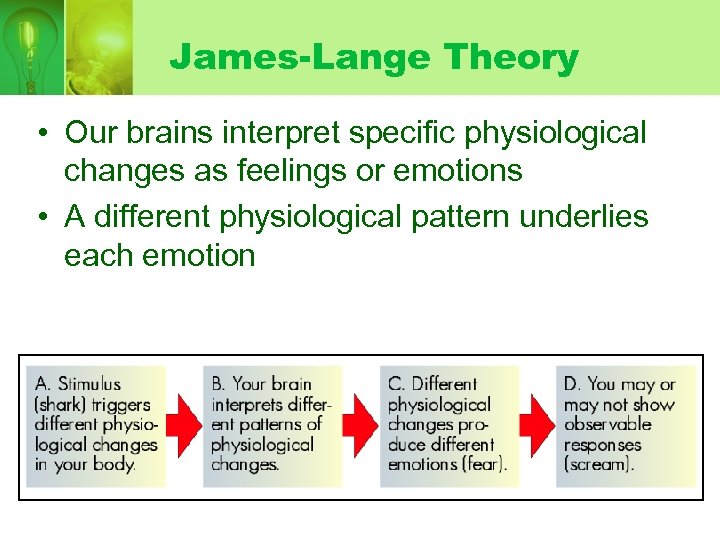 James-Lange Theory • Our brains interpret specific physiological changes as feelings or emotions • A different physiological pattern underlies each emotion
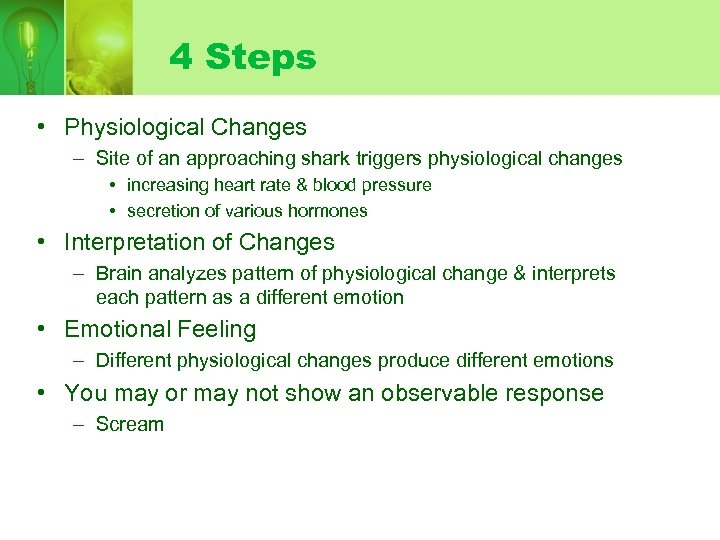 4 Steps • Physiological Changes – Site of an approaching shark triggers physiological changes • increasing heart rate & blood pressure • secretion of various hormones • Interpretation of Changes – Brain analyzes pattern of physiological change & interprets each pattern as a different emotion • Emotional Feeling – Different physiological changes produce different emotions • You may or may not show an observable response – Scream
 3 Criticisms of James. Lange Theory • Different emotions are not necessarily associated with different physiological response patterns – Anger, fear & sadness share similar physiological patterns • People whose spinal cords have been severed at the neck still experience emotions • Some complex emotions (e. g. , guilt, jealousy) may require a considerable interpretation/appraisal of the situation
 Facial Feedback Theory • Sensations/feedback from movement of facial muscles & skin are interpreted by the brain as different emotions • 4 Steps – – Stimulus triggers changes in facial muscles & skin Brain interprets feedback from facial muscles & skin Different facial feedback results in different emotions You may or may not show an observable response
 Criticisms of Facial Feedback Theory • Emotions can also be felt without any facial feedback – People whose facial muscles are completely paralyzed still experience emotions • Mood & Intensity – Feedback from facial muscles may intensify your emotional feeling
 Psych Sim Expressing Emotions
 Universal Emotions Interactivity
 Schachter-Singer Experiment • Physiological Arousal – Injected subjects with epinephrine that caused physiological arousal • Subjects were placed into 1 of 2 conditions – Happy Situation • Confederate was laughing & throwing paper airplanes – Angry Situation • Confederate complained about filling out a long questionnaire • Results: – Participants in happy situation often reported feeling happy – Observable behaviors = smiles – Participants in angry situation often reported feeling angry – Observable behaviors = angry facial expressions
 Schachter’s Two-Factors • The Two Factor Theory of Emotion: views emotion as having two components (factors): physiological arousal and cognition. According to theory, cognitions are used to interpret the meaning of physiological reactions to outside events.
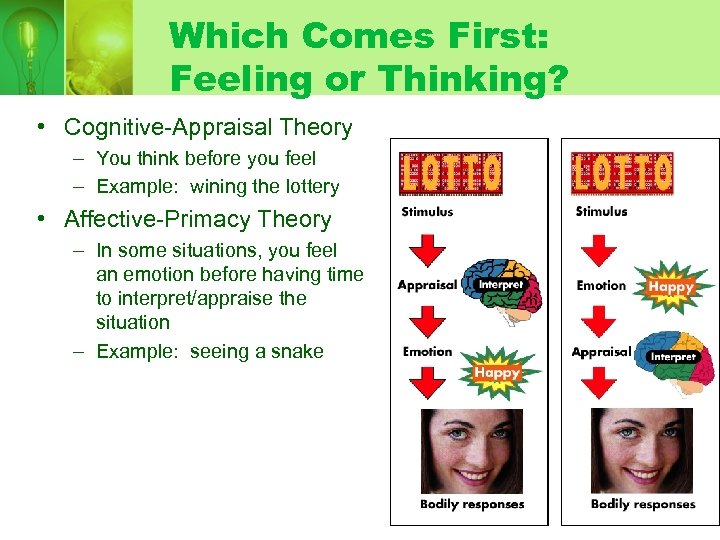 Which Comes First: Feeling or Thinking? • Cognitive-Appraisal Theory – You think before you feel – Example: wining the lottery • Affective-Primacy Theory – In some situations, you feel an emotion before having time to interpret/appraise the situation – Example: seeing a snake
 Universal Emotional Expressions • Refer to a number of specific inherited facial patterns or expressions that signal specific feelings – Example: A smile signals a happy state • Cross-Cultural Evidence • Genetic Evidence
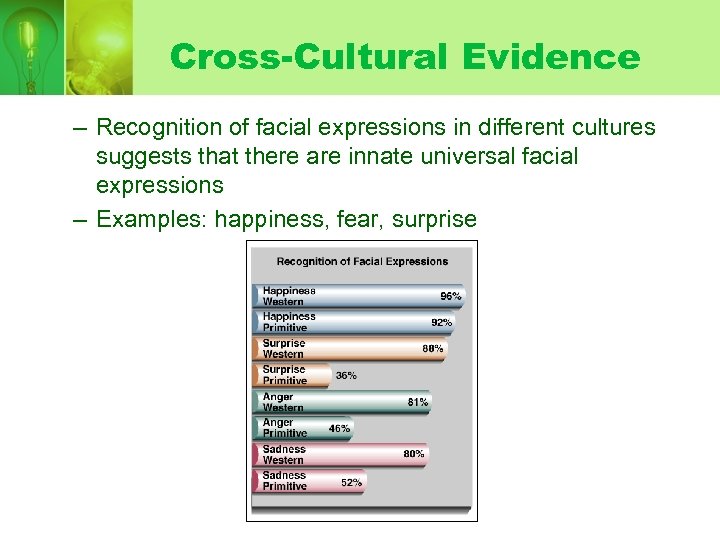 Cross-Cultural Evidence – Recognition of facial expressions in different cultures suggests that there are innate universal facial expressions – Examples: happiness, fear, surprise
 Genetic Evidence • Infants in all cultures develop facial expressions at about the same age • At 4 -6 weeks, babies smile • At 3 -4 months, babies show angry & sad facial expressions • At 5 -7 months, babies show fear
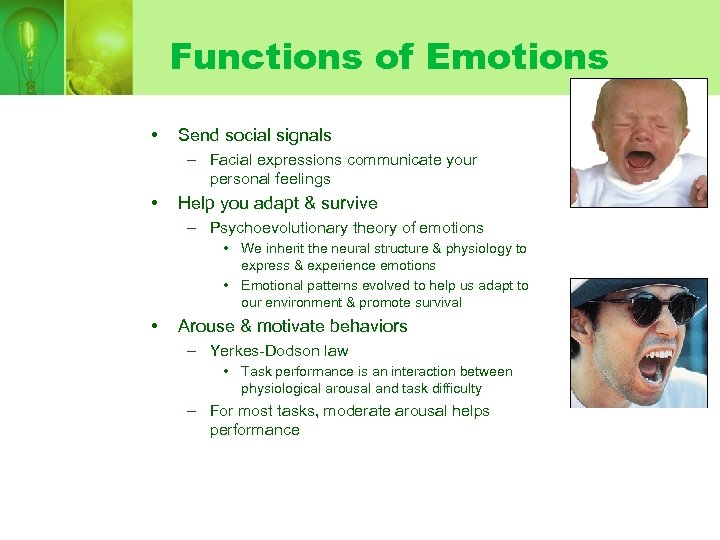 Functions of Emotions • Send social signals – Facial expressions communicate your personal feelings • Help you adapt & survive – Psychoevolutionary theory of emotions • We inherit the neural structure & physiology to express & experience emotions • Emotional patterns evolved to help us adapt to our environment & promote survival • Arouse & motivate behaviors – Yerkes-Dodson law • Task performance is an interaction between physiological arousal and task difficulty – For most tasks, moderate arousal helps performance
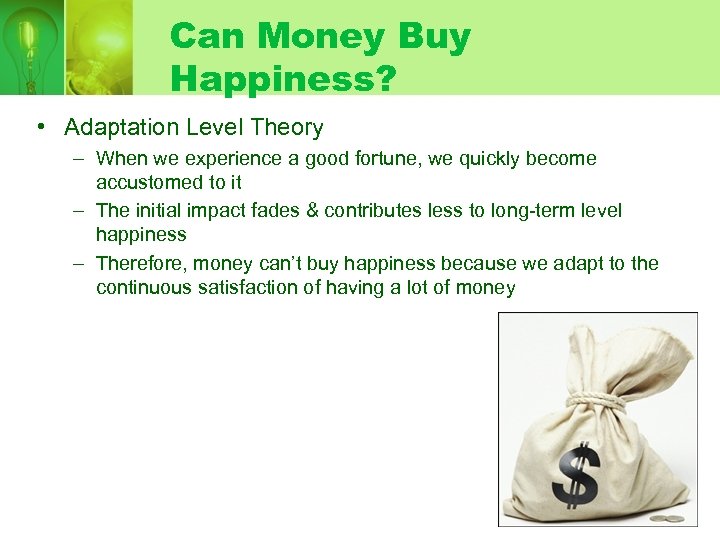 Can Money Buy Happiness? • Adaptation Level Theory – When we experience a good fortune, we quickly become accustomed to it – The initial impact fades & contributes less to long-term level happiness – Therefore, money can’t buy happiness because we adapt to the continuous satisfaction of having a lot of money
 Influences on Long-Term Happiness • Genetic Factors – About half your level of happiness comes from genetic influences • Identical twins reared together or apart showed sig. higher happiness correlations (. 44 to. 52) than fraternal twins reared together or apart (-. 02 to. 08) • Personal/Environmental factors – Long-term level of happiness is associated with: • enjoying simple daily pleasures • setting & achieving personal goals (purpose in life, network of friends)
 Psych Sim Helplessly Hoping & Optimism
 Showing Emotions: Why Don’t Men Cry? • Display Rules – Specific cultural norms that regulate how, when & where we should express emotion and how much emotion is appropriate – Example: • Japanese & Chinese have more difficulty identifying facial expressions of fear and anger compared to North Americans
 What is Emotional Intelligence? • Ability to perceive and express emotion, understand reason with emotion and regulate emotions in one’s self and others • Researchers are in the early stages of trying to define & measure emotional intelligence
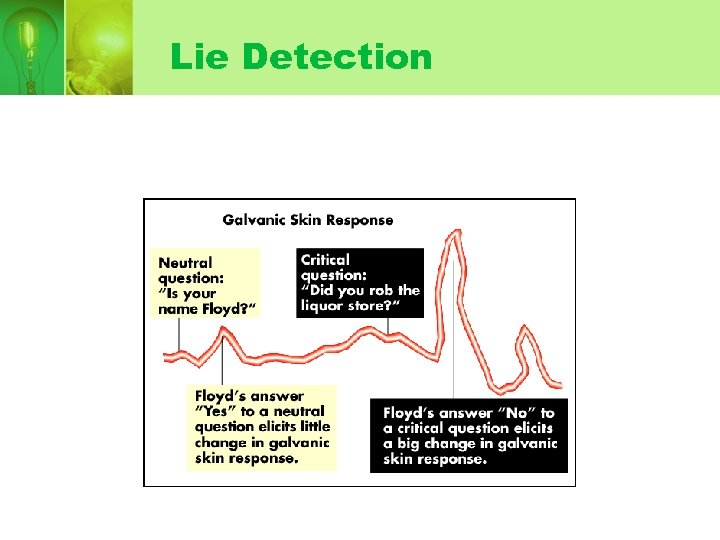
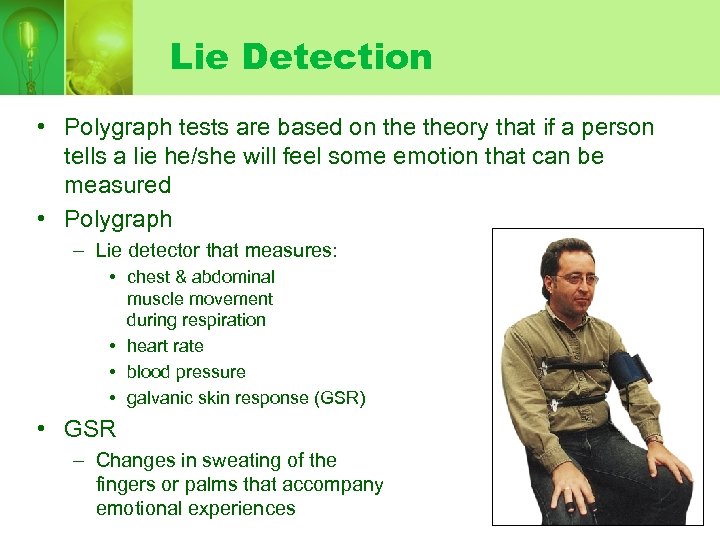 Lie Detection • Polygraph tests are based on theory that if a person tells a lie he/she will feel some emotion that can be measured • Polygraph – Lie detector that measures: • chest & abdominal muscle movement during respiration • heart rate • blood pressure • galvanic skin response (GSR) • GSR – Changes in sweating of the fingers or palms that accompany emotional experiences
 Lie Detection
 Control Question Technique • Lie detection technique in which the examiner asks 2 kinds of questions: – Neutral Questions • general questions that elicit little emotional response • “Is your name Floyd? ” – Critical Questions • specific questions about some particular crime that only the criminal would know • “Did you rob the liquor store on 5 th and Vine? ” • Examiner compares differences in physiological responses between neutral & critical questions
 How Accurate are Lie Detector Tests? • Researchers have been unable to identify a physiological response pattern that is specific to lying • It is estimated that lie detector tests are wrong 25 -75% of the time • Most state & federal courts prohibit the use of polygraph evidence • Federal law prohibits most employers from using polygraph tests to screen employees
 Emotional Intelligence Test Intrapersonal Activity
 Positive Psychology APA Unit Plan