


 Скачать презентацию Discovering and Tracking User Communities Myra Spiliopoulou 1
575c4aa37ee3efea576695e488a21a4a.ppt
- Количество слайдов: 170
 Discovering and Tracking User Communities Myra Spiliopoulou 1, Tanja Falkowski 1, Georgios Paliouras 2 1 Otto-von-Guericke University Magdeburg, Germany 2 National Center for Scientific Research "Demokritos"
 The Presenters Myra Spiliopoulou & Tanja Falkowski Work group KMD – Knowledge Management & Discovery Faculty of Computer Science Otto-von-Guericke-Universität Magdeburg, Germany http: //omen. cs. uni-magdeburg. de/itikmd Georgios Paliouras Software and Knowledge Engineering Lab. Institute of Informatics and Telecommunications National Center for Scientific Research “Demokritos“ Athens, Greece http: //www. iit. demokritos. gr/~paliourg © Falkowski, Pierrakos & Spiliopoulou – UM 2007 2
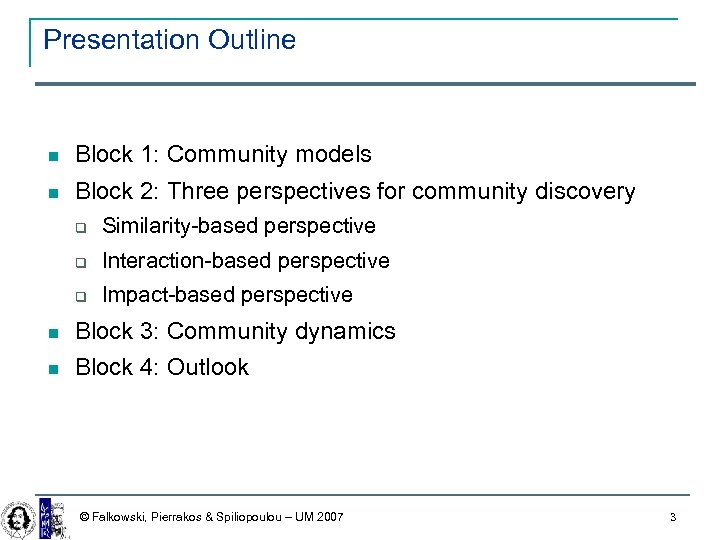 Presentation Outline Block 1: Community models Block 2: Three perspectives for community discovery Similarity-based perspective Interaction-based perspective Impact-based perspective Block 3: Community dynamics Block 4: Outlook © Falkowski, Pierrakos & Spiliopoulou – UM 2007 3
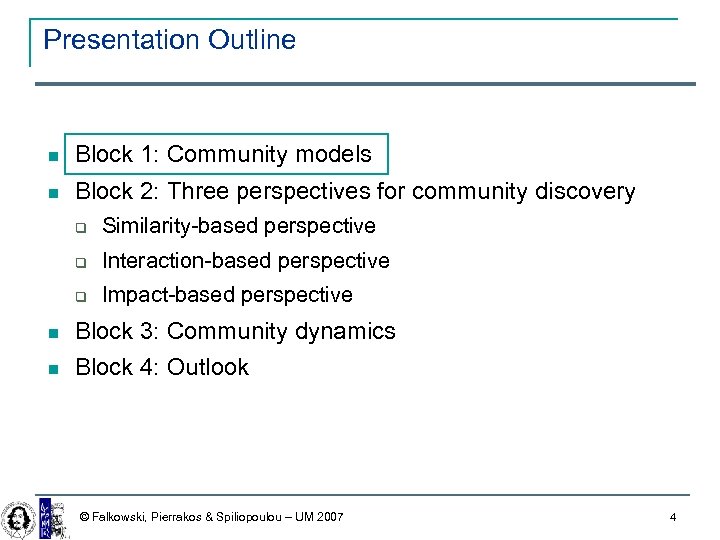 Presentation Outline Block 1: Community models Block 2: Three perspectives for community discovery Similarity-based perspective Interaction-based perspective Impact-based perspective Block 3: Community dynamics Block 4: Outlook © Falkowski, Pierrakos & Spiliopoulou – UM 2007 4
 Notions of Communities Frequent informal definition of a community: Subset of vertices that has high density of edges within the group and a lower density of edges between groups A Web community is generally described as a substructure (subset of vertices) of a graph with dense linkage between the members of the community and sparse density outside the community [Gib. Kle. Rag 98] A community corresponds to a group of users who exhibit common behaviour in their interaction with the system [Orwant 95] © Falkowski, Pierrakos & Spiliopoulou – UM 2007 5
 Communities in Different Research Areas Communities in Biology Communities in Social Sciences Compartments in food webs Functionally related genes Functional groups in protein-protein interaction networks (cohesive) subgroup of interacting individuals Communities in Computer Science Set of Web Pages Set of Servers Group of Users © Falkowski, Pierrakos & Spiliopoulou – UM 2007 6
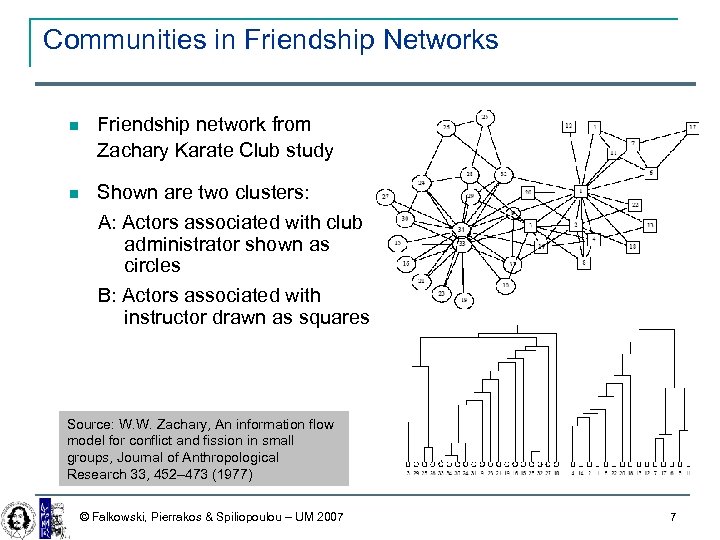 Communities in Friendship Networks Friendship network from Zachary Karate Club study Shown are two clusters: A: Actors associated with club administrator shown as circles B: Actors associated with instructor drawn as squares Source: W. W. Zachary, An information flow model for conflict and fission in small groups, Journal of Anthropological Research 33, 452– 473 (1977) © Falkowski, Pierrakos & Spiliopoulou – UM 2007 7
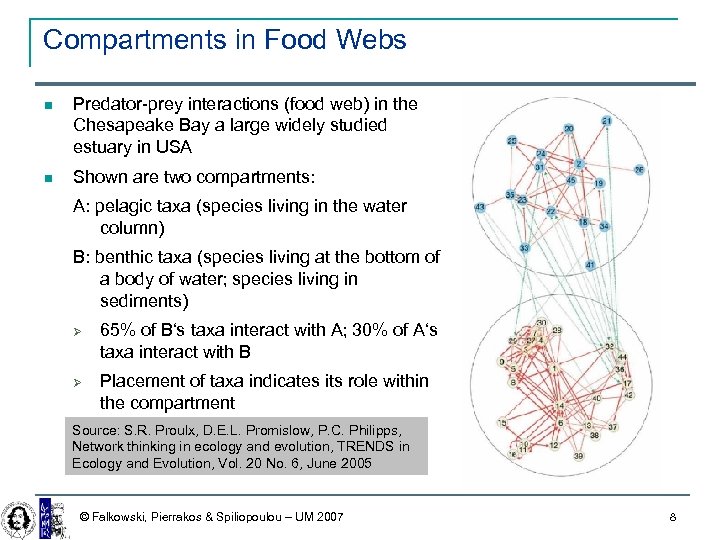 Compartments in Food Webs Predator-prey interactions (food web) in the Chesapeake Bay a large widely studied estuary in USA Shown are two compartments: A: pelagic taxa (species living in the water column) B: benthic taxa (species living at the bottom of a body of water; species living in sediments) Ø Ø 65% of B‘s taxa interact with A; 30% of A‘s taxa interact with B Placement of taxa indicates its role within the compartment Source: S. R. Proulx, D. E. L. Promislow, P. C. Philipps, Network thinking in ecology and evolution, TRENDS in Ecology and Evolution, Vol. 20 No. 6, June 2005 © Falkowski, Pierrakos & Spiliopoulou – UM 2007 8
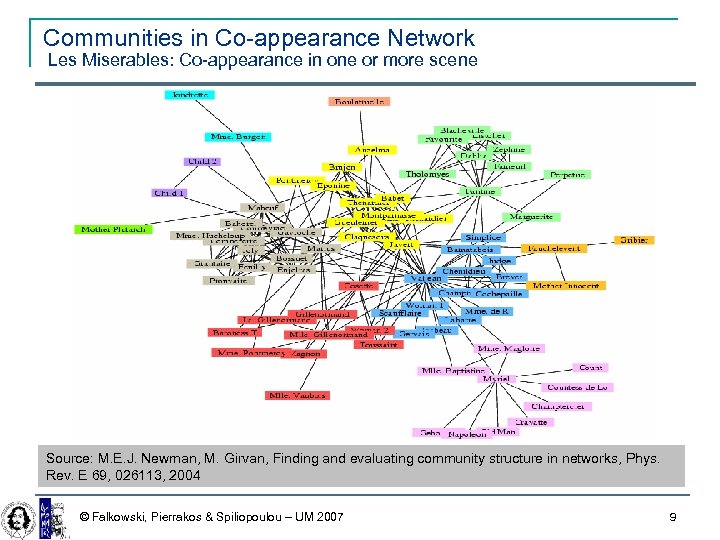 Communities in Co-appearance Network Les Miserables: Co-appearance in one or more scene Source: M. E. J. Newman, M. Girvan, Finding and evaluating community structure in networks, Phys. Rev. E 69, 026113, 2004 © Falkowski, Pierrakos & Spiliopoulou – UM 2007 9
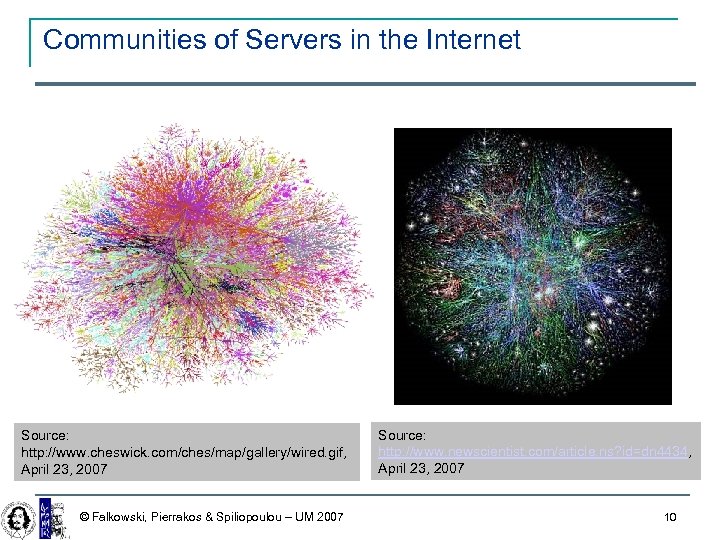 Communities of Servers in the Internet Source: http: //www. cheswick. com/ches/map/gallery/wired. gif, April 23, 2007 © Falkowski, Pierrakos & Spiliopoulou – UM 2007 Source: http: //www. newscientist. com/article. ns? id=dn 4434, April 23, 2007 10
 References (Block 1) D. Gibson, J. M. Kleinberg, and P. Raghavan, Inferring Web Communities from Link Topology. In Proc. of ACM International Conference on Hypertext and Hypermedia (HT'98), 225 -234, 1998 M. E. J. Newman, M. Girvan, Finding and evaluating community structure in networks, Phys. Rev. E 69, 026113, 2004 S. R. Proulx, D. E. L. Promislow, P. C. Philipps, Network thinking in ecology and evolution, TRENDS in Ecology and Evolution, Vol. 20 No. 6, June 2005 W. W. Zachary, An information flow model for conflict and fission in small groups, Journal of Anthropological Research 33, 452– 473, 1977 J. Orwant: Heterogeneous Learning in the Doppelgänger User Modeling System. User Modelling and User Adapted Interaction, 2, 107 -130, 1995 © Falkowski, Pierrakos & Spiliopoulou – UM 2007 11
 Presentation Outline Block 1: Community models Block 2: Three perspectives for community discovery Similarity-based perspective Interaction-based perspective Impact-based perspective Block 3: Community dynamics Block 4: Outlook © Falkowski, Pierrakos & Spiliopoulou – UM 2007 12
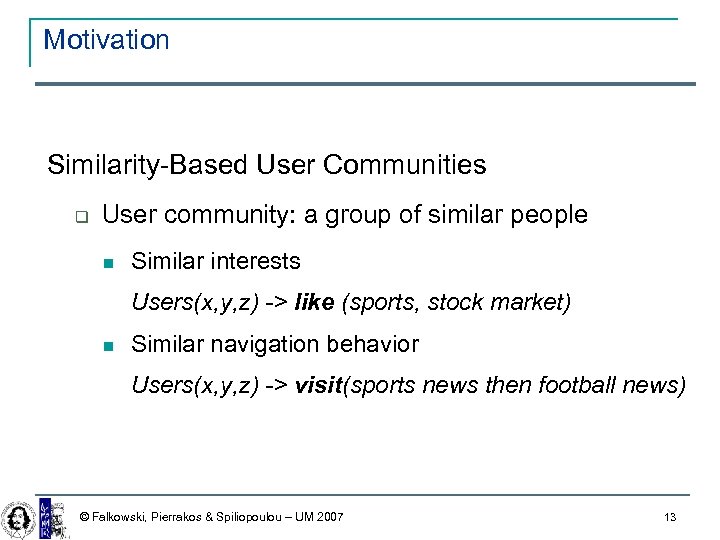 Motivation Similarity-Based User Communities User community: a group of similar people Similar interests Users(x, y, z) -> like (sports, stock market) Similar navigation behavior Users(x, y, z) -> visit(sports news then football news) © Falkowski, Pierrakos & Spiliopoulou – UM 2007 13
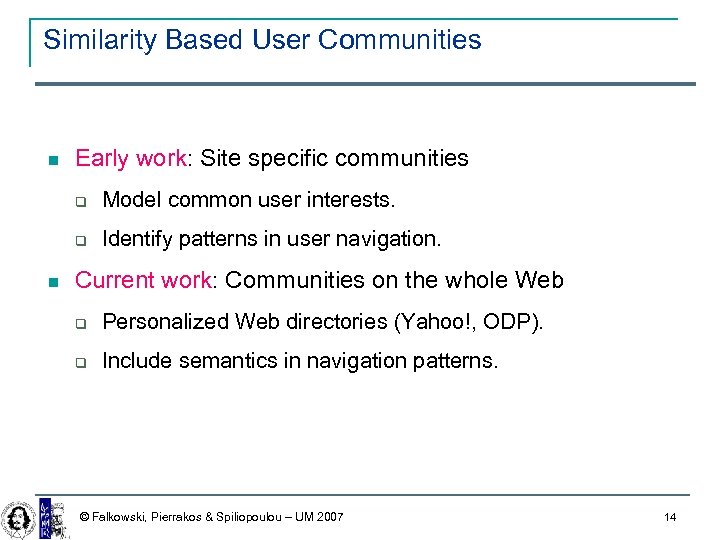 Similarity Based User Communities Early work: Site specific communities Model common user interests. Identify patterns in user navigation. Current work: Communities on the whole Web Personalized Web directories (Yahoo!, ODP). Include semantics in navigation patterns. © Falkowski, Pierrakos & Spiliopoulou – UM 2007 14
 Site specific communities Stereotypes Communities of common interests Communities of common navigation © Falkowski, Pierrakos & Spiliopoulou – UM 2007 15
 Site specific communities Stereotypes Communities of common interests Communities of common navigation © Falkowski, Pierrakos & Spiliopoulou – UM 2007 16
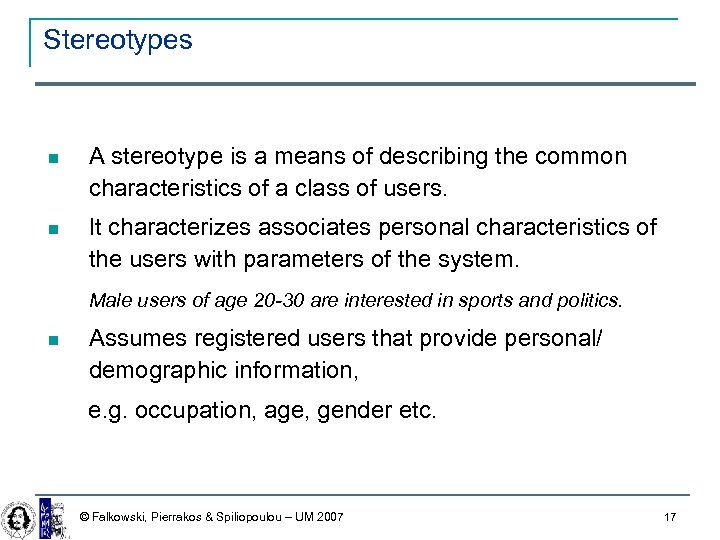 Stereotypes A stereotype is a means of describing the common characteristics of a class of users. It characterizes associates personal characteristics of the users with parameters of the system. Male users of age 20 -30 are interested in sports and politics. Assumes registered users that provide personal/ demographic information, e. g. occupation, age, gender etc. © Falkowski, Pierrakos & Spiliopoulou – UM 2007 17
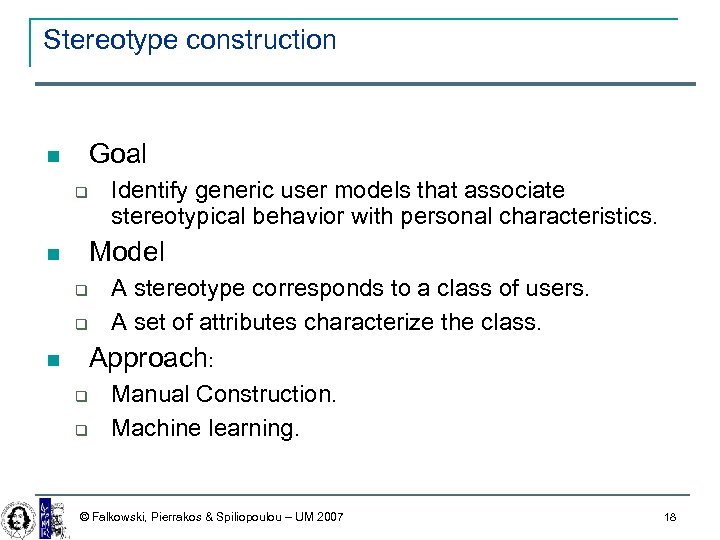 Stereotype construction Goal Identify generic user models that associate stereotypical behavior with personal characteristics. Model A stereotype corresponds to a class of users. A set of attributes characterize the class. Approach: Manual Construction. Machine learning. © Falkowski, Pierrakos & Spiliopoulou – UM 2007 18
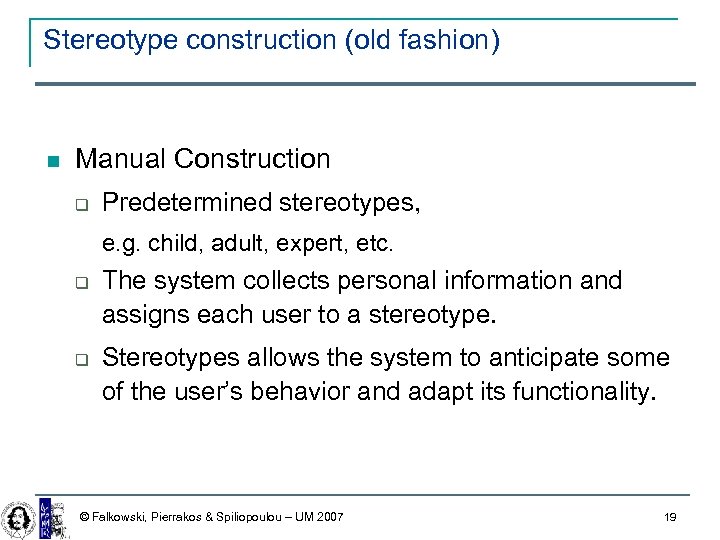 Stereotype construction (old fashion) Manual Construction Predetermined stereotypes, e. g. child, adult, expert, etc. The system collects personal information and assigns each user to a stereotype. Stereotypes allows the system to anticipate some of the user’s behavior and adapt its functionality. © Falkowski, Pierrakos & Spiliopoulou – UM 2007 19
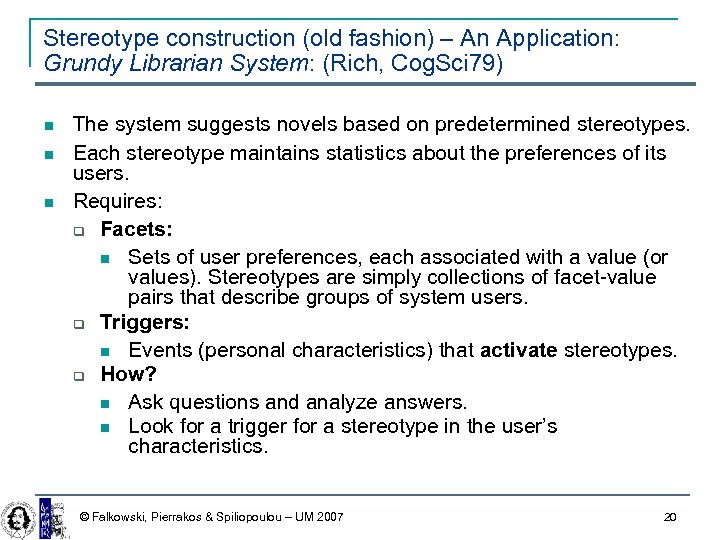 Stereotype construction (old fashion) – An Application: Grundy Librarian System: (Rich, Cog. Sci 79) The system suggests novels based on predetermined stereotypes. Each stereotype maintains statistics about the preferences of its users. Requires: Facets: Sets of user preferences, each associated with a value (or values). Stereotypes are simply collections of facet-value pairs that describe groups of system users. Triggers: Events (personal characteristics) that activate stereotypes. How? Ask questions and analyze answers. Look for a trigger for a stereotype in the user’s characteristics. © Falkowski, Pierrakos & Spiliopoulou – UM 2007 20
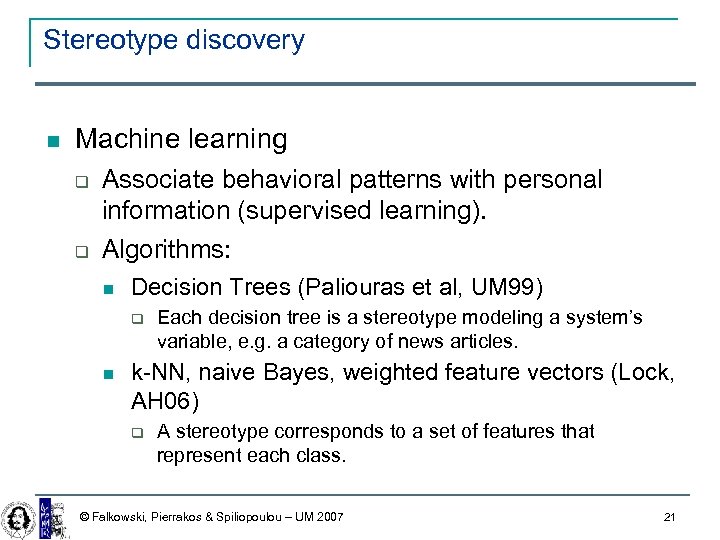 Stereotype discovery Machine learning Associate behavioral patterns with personal information (supervised learning). Algorithms: Decision Trees (Paliouras et al, UM 99) Each decision tree is a stereotype modeling a system’s variable, e. g. a category of news articles. k-NN, naive Bayes, weighted feature vectors (Lock, AH 06) A stereotype corresponds to a set of features that represent each class. © Falkowski, Pierrakos & Spiliopoulou – UM 2007 21
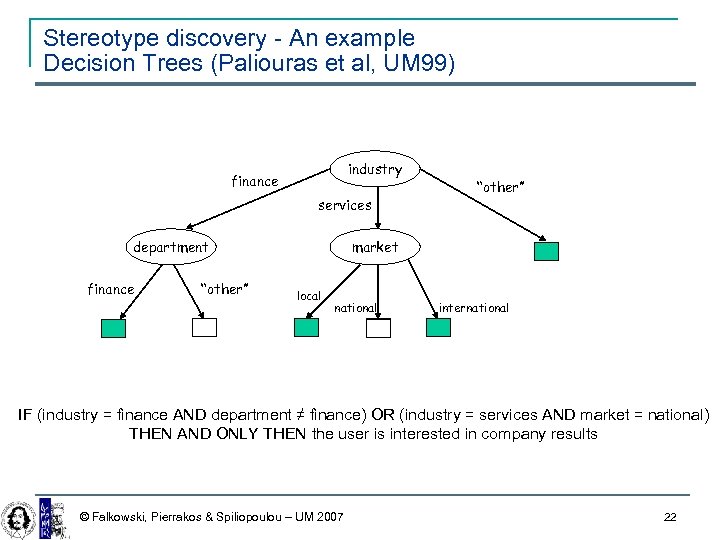 Stereotype discovery - An example Decision Trees (Paliouras et al, UM 99) industry finance services department finance “other” market local national international IF (industry = finance AND department ≠ finance) OR (industry = services AND market = national) THEN AND ONLY THEN the user is interested in company results © Falkowski, Pierrakos & Spiliopoulou – UM 2007 22
 Stereotypes Applications: News filtering and other IR tasks, digital libraries, electronic museums, etc. Problems Hard to acquire accurate personal information. Privacy issues. Solution: Restrict models to patterns in user behavior. We call these user communities. © Falkowski, Pierrakos & Spiliopoulou – UM 2007 23
 Site specific communities þ Stereotypes Communities of common interests Communities of common navigation © Falkowski, Pierrakos & Spiliopoulou – UM 2007 24
 Communities of common interests Goal Identify similar users, i. e. users that share common interests. Model Community models are clusters of users or clusters of common interests. Each user belongs to one (or more if overlaps are allowed) communities. Approach Collaborative Filtering. © Falkowski, Pierrakos & Spiliopoulou – UM 2007 25
 Collaborative filtering Goal: Match a new user visiting a particular domain to a group of users in that domain with similar interests. Model: A community is either a user-based or an item-based model of a group of users(x, y, z) -> sports, stock market (business news, stock market) - > user(x), user(z) Algorithms: memory-based learning, model-based clustering, item-based clustering. © Falkowski, Pierrakos & Spiliopoulou – UM 2007 26
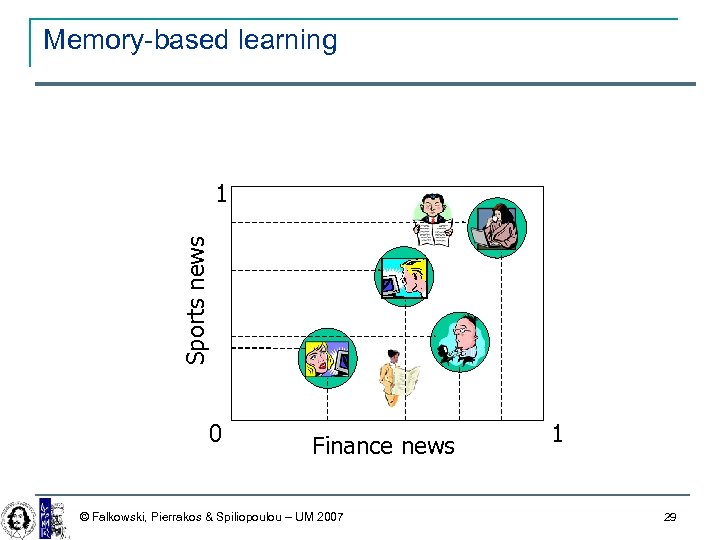
 Memory-based learning Assumption Algorithms Exploit the whole corpus of users in order to construct a finite number of nearest neighbors close to the examined user. Mainly k-nearest neighborhood approaches. Model The k-nearest neighbors correspond to an ad-hoc community. © Falkowski, Pierrakos & Spiliopoulou – UM 2007 27
 Memory-based learning - (Herlocker et al, SIGIR 99) Nearest-neighbor approach: Construct a model for each user, based on the user’s recorded preferences, e. g. item ratings. Index the users in the space of system parameters, e. g. item ratings. For each new user, index the user in the same space, and find the k closest neighbors. create an ad-hoc community. simple metrics to measure the similarity between users, e. g. Pearson correlation. Recommend the items that the new user has not seen and are popular among the neighbors. © Falkowski, Pierrakos & Spiliopoulou – UM 2007 28
 Memory-based learning Sports news 1 0 Finance news © Falkowski, Pierrakos & Spiliopoulou – UM 2007 1 29
 Model-based clustering Assumption Machine learning techniques are applied, in order to create the user communities and then use the models to make predictions. Model Community models: cluster descriptions. Community models are global, rather than adhoc. © Falkowski, Pierrakos & Spiliopoulou – UM 2007 30
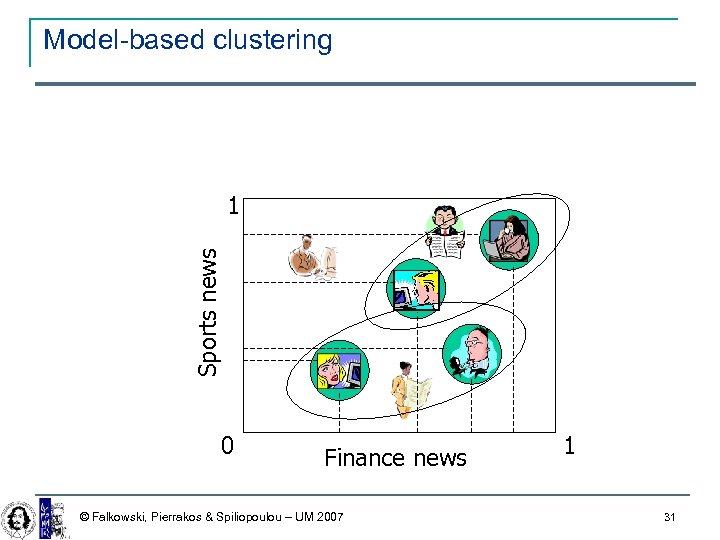 Model-based clustering Sports news 1 0 Finance news © Falkowski, Pierrakos & Spiliopoulou – UM 2007 1 31
 Model-based clustering Algorithms K-Means and its variants. Graph-Based clustering. Conceptual clustering (COBWEB). Statistical clustering (Autoclass). Neural Networks (Self-Organizing Maps). Model based clustering (EM-type). BIRCH. Fuzzy clustering. © Falkowski, Pierrakos & Spiliopoulou – UM 2007 32
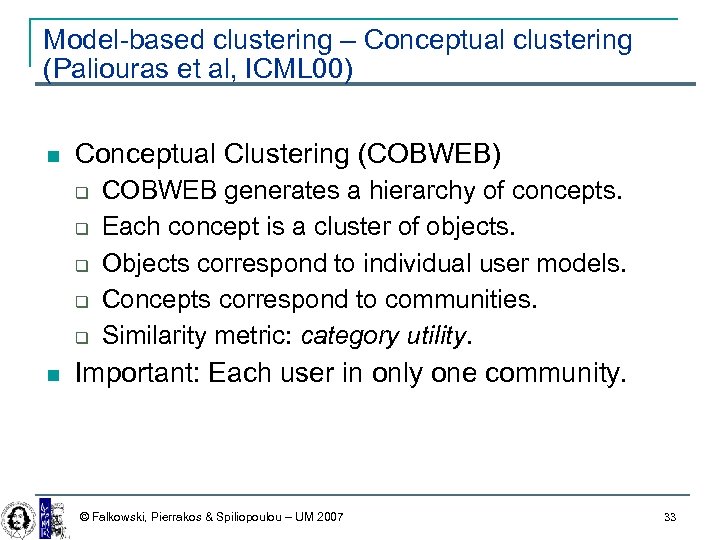 Model-based clustering – Conceptual clustering (Paliouras et al, ICML 00) Conceptual Clustering (COBWEB) COBWEB generates a hierarchy of concepts. Each concept is a cluster of objects. Objects correspond to individual user models. Concepts correspond to communities. Similarity metric: category utility. Important: Each user in only one community. © Falkowski, Pierrakos & Spiliopoulou – UM 2007 33
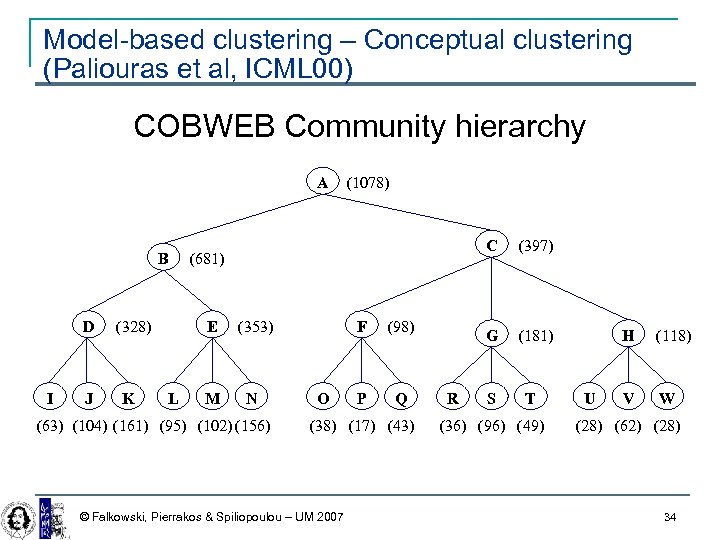 Model-based clustering – Conceptual clustering (Paliouras et al, ICML 00) COBWEB Community hierarchy A B D I J (328) K C (353) M N (63) (104) (161) (95) (102) (156) F O (98) P Q (38) (17) (43) © Falkowski, Pierrakos & Spiliopoulou – UM 2007 R (397) G (681) E L (1078) (181) S T (36) (96) (49) H U (118) V W (28) (62) (28) 34
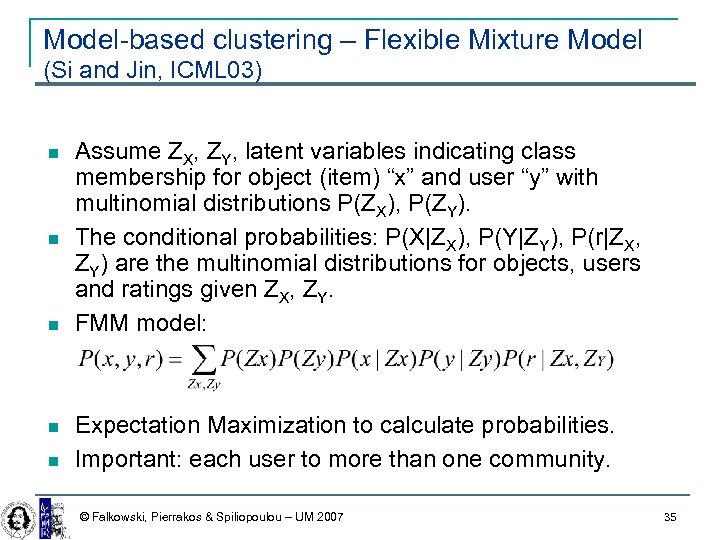 Model-based clustering – Flexible Mixture Model (Si and Jin, ICML 03) Assume ZX, ZY, latent variables indicating class membership for object (item) “x” and user “y” with multinomial distributions P(ZX), P(ZY). The conditional probabilities: P(X|ZX), P(Y|ZY), P(r|ZX, ZY) are the multinomial distributions for objects, users and ratings given ZX, ZY. FMM model: Expectation Maximization to calculate probabilities. Important: each user to more than one community. © Falkowski, Pierrakos & Spiliopoulou – UM 2007 35
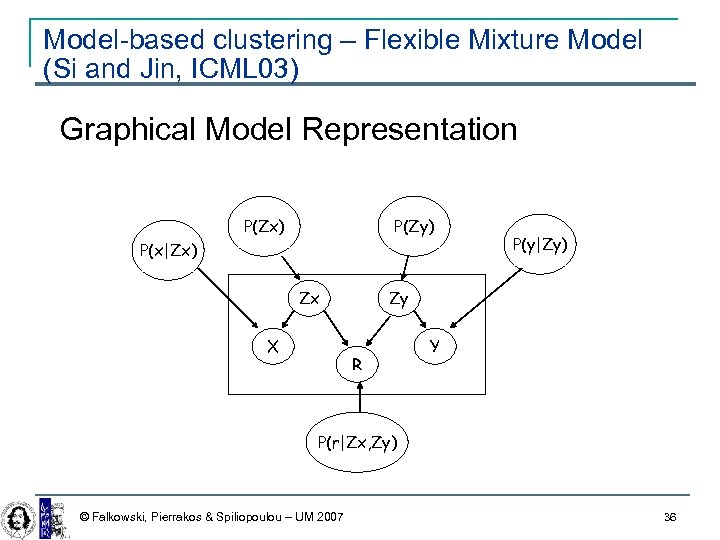 Model-based clustering – Flexible Mixture Model (Si and Jin, ICML 03) Graphical Model Representation P(Zx) P(Zy) P(x|Zx) Zx X P(y|Zy) Zy R Y P(r|Zx, Zy) © Falkowski, Pierrakos & Spiliopoulou – UM 2007 36
 Item-based clustering Goal Model Identify behavior patterns in usage data, rather than user clusters. Community models are clusters of items, e. g. Web pages. Each item and each user belongs to one (or more if overlaps are allowed) communities. Algorithms Similar to model-based clustering. © Falkowski, Pierrakos & Spiliopoulou – UM 2007 37
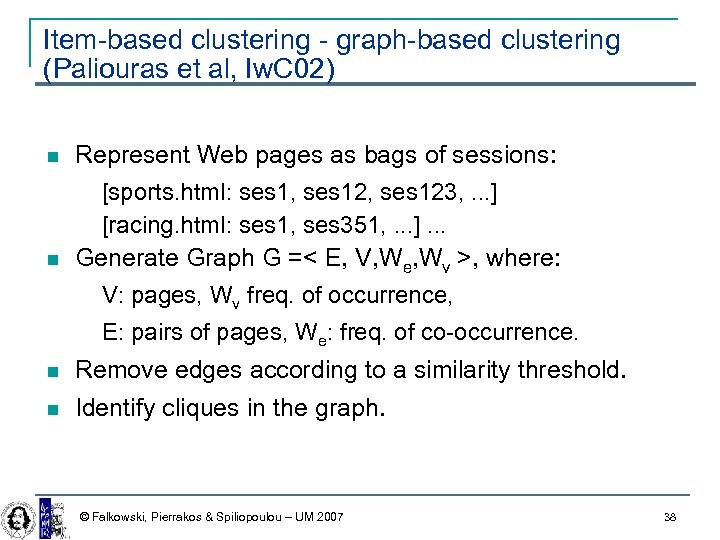 Item-based clustering - graph-based clustering (Paliouras et al, Iw. C 02) Represent Web pages as bags of sessions: [sports. html: ses 1, ses 123, . . . ] [racing. html: ses 1, ses 351, . . . ]. . . Generate Graph G =< E, V, We, Wv >, where: V: pages, Wv freq. of occurrence, E: pairs of pages, We: freq. of co-occurrence. Remove edges according to a similarity threshold. Identify cliques in the graph. © Falkowski, Pierrakos & Spiliopoulou – UM 2007 38
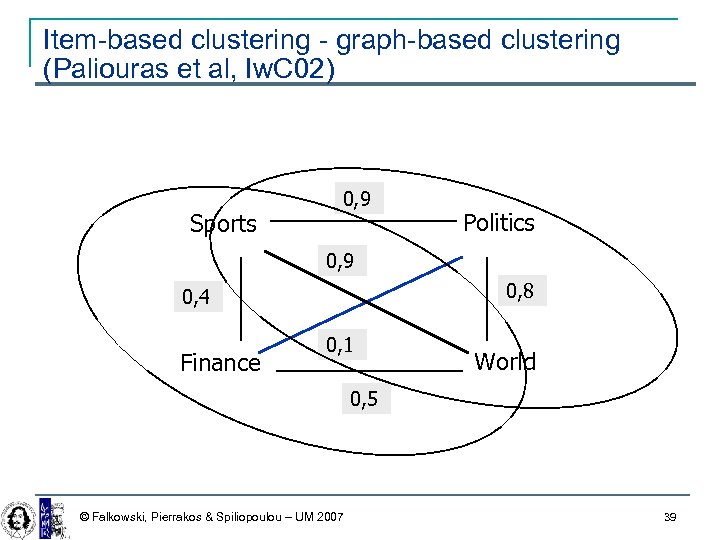 Item-based clustering - graph-based clustering (Paliouras et al, Iw. C 02) Sports 0, 9 Politics 0, 9 0, 8 0, 4 Finance 0, 1 World 0, 5 © Falkowski, Pierrakos & Spiliopoulou – UM 2007 39
 Communities of Common Interests Applications Query-based information retrieval. Profile-based information filtering. Adaptive Web sites. Site reconstruction. Recommendation. © Falkowski, Pierrakos & Spiliopoulou – UM 2007 40
 Site specific communities þ Stereotypes þ Communities of common interests Communities of common navigation © Falkowski, Pierrakos & Spiliopoulou – UM 2007 41
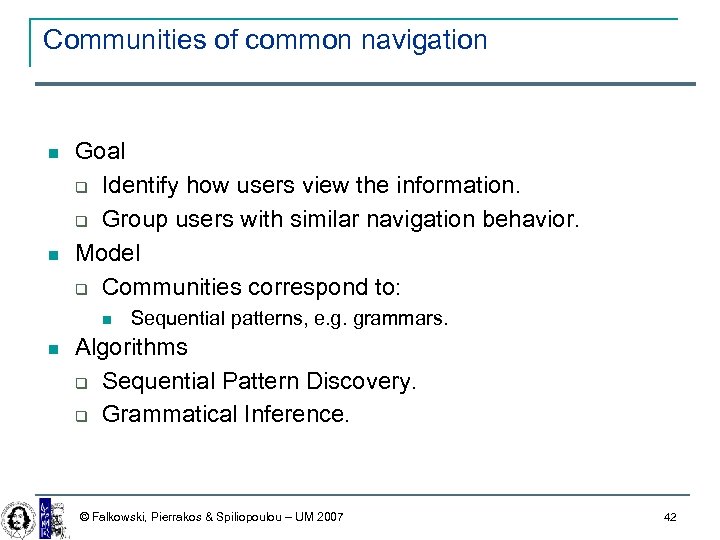 Communities of common navigation Goal Identify how users view the information. Group users with similar navigation behavior. Model Communities correspond to: Sequential patterns, e. g. grammars. Algorithms Sequential Pattern Discovery. Grammatical Inference. © Falkowski, Pierrakos & Spiliopoulou – UM 2007 42
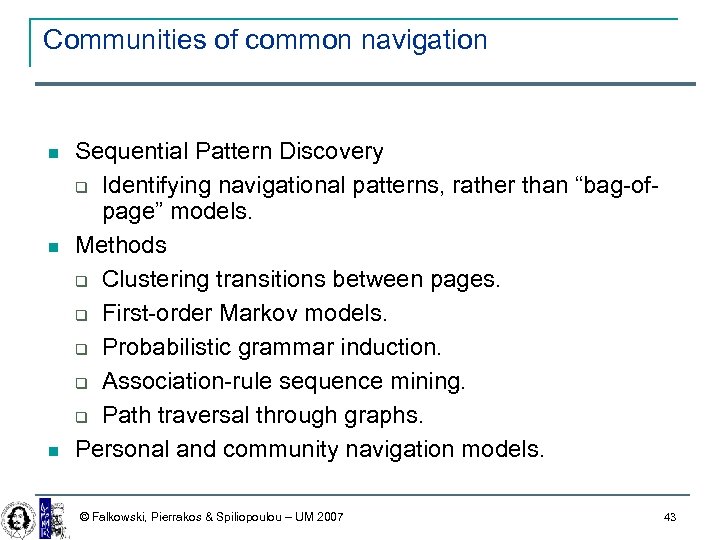 Communities of common navigation Sequential Pattern Discovery Identifying navigational patterns, rather than “bag-ofpage” models. Methods Clustering transitions between pages. First-order Markov models. Probabilistic grammar induction. Association-rule sequence mining. Path traversal through graphs. Personal and community navigation models. © Falkowski, Pierrakos & Spiliopoulou – UM 2007 43
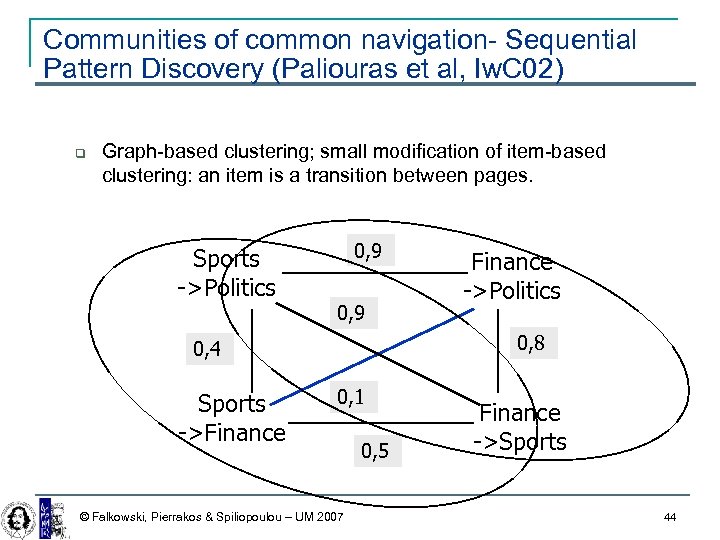 Communities of common navigation- Sequential Pattern Discovery (Paliouras et al, Iw. C 02) Graph-based clustering; small modification of item-based clustering: an item is a transition between pages. Sports ->Politics 0, 9 0, 8 0, 4 Sports ->Finance ->Politics 0, 1 © Falkowski, Pierrakos & Spiliopoulou – UM 2007 0, 5 Finance ->Sports 44
 Communities of common navigation - Discovering Grammatical Models (Karambatziakis et al, ICGI 04) Each Web page is a terminal symbol of a language L. Each user session is a string of the language. Assume strings are generated by an unknown grammar, modeled by a deterministic probabilistic Stochastic Finite Automaton (SFA). Use grammatical inference to discover the automaton. © Falkowski, Pierrakos & Spiliopoulou – UM 2007 45
 Communities of common navigation - Discovering Grammatical Models (Karambatziakis et al, ICGI 04) Discovering Grammatical Models Represent the data as a tree, in particular a PPTA: probabilistic prefix tree automaton. Iteratively merge compatible states, preserving determinism. Compatibility = similar outward transitions. Heuristic search of the space of compatible states. © Falkowski, Pierrakos & Spiliopoulou – UM 2007 46
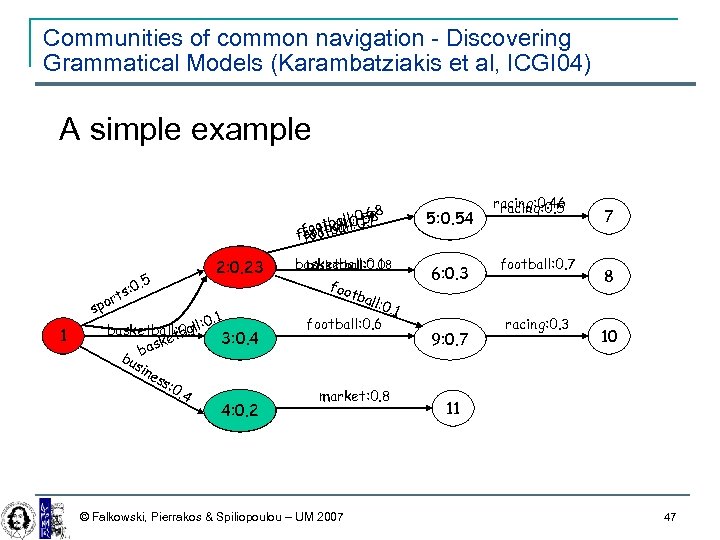 Communities of common navigation - Discovering Grammatical Models (Karambatziakis et al, ICGI 04) A simple example 8 : 0. 68 l ll 5 otball: l 00. 7 aa : . fo otb tb oo ffo r 0. ts: spo 1 5 basketball: 0. 1 l ba ket as bu b sin es s: 0. 4 2: 0. 23 1 l: 0. 3: 0. 4 4: 0. 2 basketball: 0. 1 basketball: 0. 08 foo tba ll : 0. 1 football: 0. 6 market: 0. 8 © Falkowski, Pierrakos & Spiliopoulou – UM 2007 5: 0. 54 5: 0. 5 6: 0. 3 9: 0. 7 racing: 0. 46 racing: 0. 5 football: 0. 7 racing: 0. 3 7 8 10 11 47
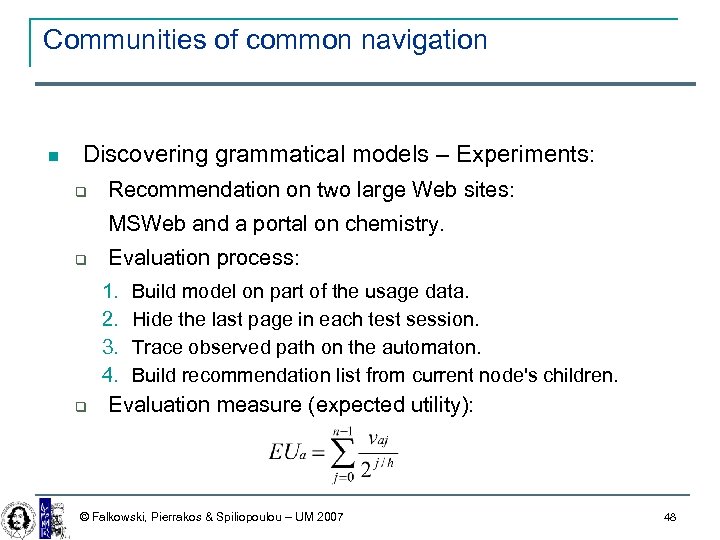 Communities of common navigation Discovering grammatical models – Experiments: Recommendation on two large Web sites: MSWeb and a portal on chemistry. Evaluation process: 1. 2. 3. 4. Build model on part of the usage data. Hide the last page in each test session. Trace observed path on the automaton. Build recommendation list from current node's children. Evaluation measure (expected utility): © Falkowski, Pierrakos & Spiliopoulou – UM 2007 48
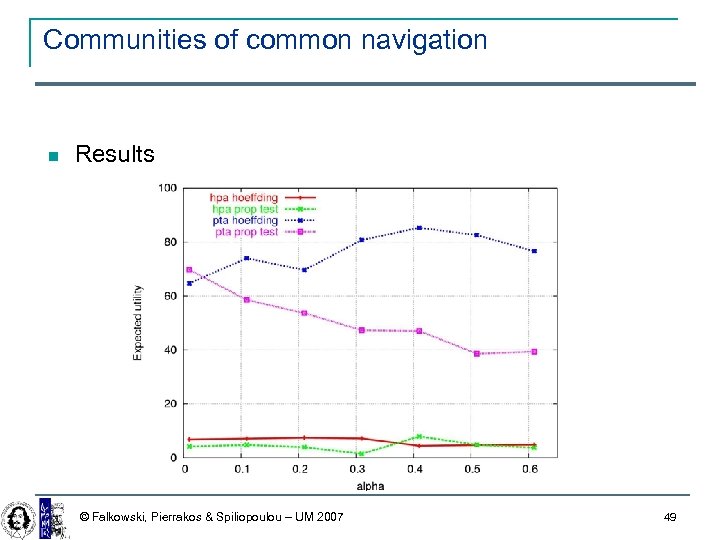 Communities of common navigation Results © Falkowski, Pierrakos & Spiliopoulou – UM 2007 49
 Communities on the whole Web Motivation: The challenge of acquiring user models on the Web. Usage data is voluminous. Web structure is unknown and complex. The users’ interests, knowledge and behavior is diverse. The thematic coverage of the data is very broad. © Falkowski, Pierrakos & Spiliopoulou – UM 2007 50
 Communities on the whole Web Model similar interests of Web users: Community Web directories (Yahoo!, ODP). Mode. I similar navigation behavior on the Web: Content-aware navigation user modeling with GI. © Falkowski, Pierrakos & Spiliopoulou – UM 2007 51
 Communities on the whole Web Community Web Directories Web Navigation Models © Falkowski, Pierrakos & Spiliopoulou – UM 2007 52
 Communities on the whole Web Community Web Directories Web Navigation Models © Falkowski, Pierrakos & Spiliopoulou – UM 2007 53
 Community Web directories Personalization of and with Web Directories Model: Analyzing usage data collected by the proxy servers of an Internet Service Provider (ISP). Construction of user community models. Construction of usable Web directories that correspond to the interests of user communities. Algorithms: Graph-Based Clustering. Probabilistic Latent Semantic Analysis (PLSA). © Falkowski, Pierrakos & Spiliopoulou – UM 2007 54
 Community Web directories Off-line user modeling: Map user sessions on the directory categories, i. e. each session becomes a small subdirectory. Create community Web directories. Prune non-representative branches. Remove redundant nodes, e. g. those without siblings. On-line use of community directories Personal Web directories constructed by assigning users to community directories and merging them. Personalized directories are small and provide quick access to interesting information. © Falkowski, Pierrakos & Spiliopoulou – UM 2007 55
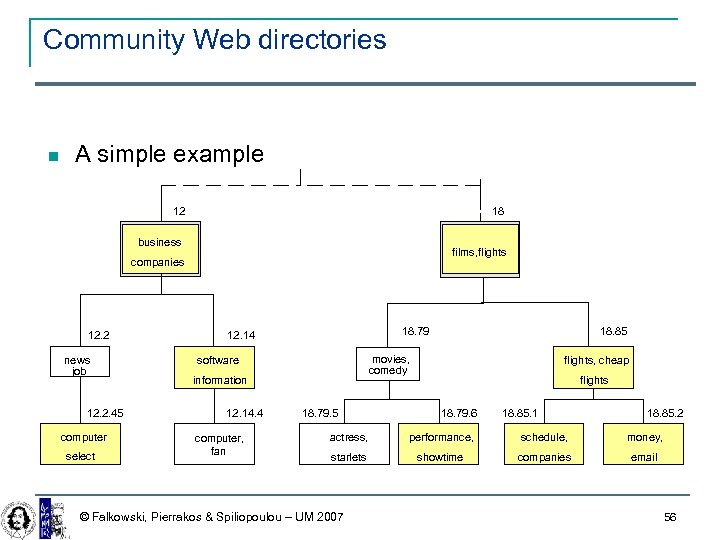 Community Web directories A simple example 12 18 business films, flights companies 12. 2 news job 12. 2. 45 computer select 18. 79 12. 14 movies, comedy software information 12. 14. 4 computer, fan 18. 85 18. 79. 5 flights, cheap flights 18. 79. 6 18. 85. 1 18. 85. 2 actress, performance, schedule, money, starlets showtime companies email © Falkowski, Pierrakos & Spiliopoulou – UM 2007 56
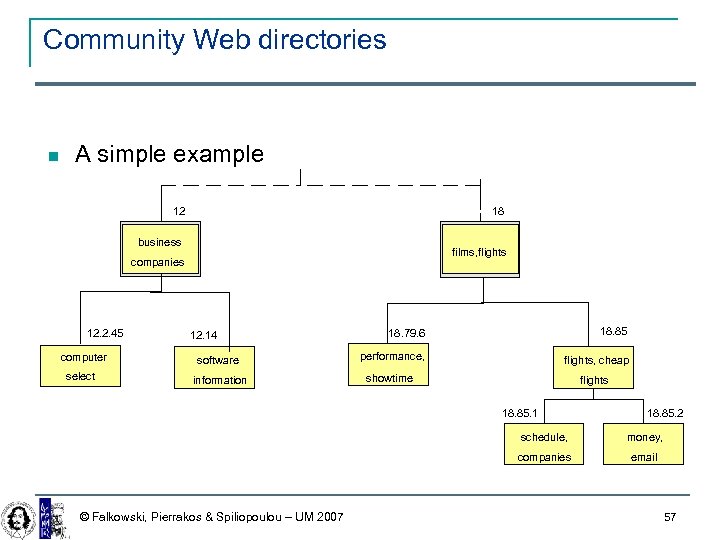 Community Web directories A simple example 12 18 business films, flights companies 12. 2. 45 computer select 18. 79. 6 18. 85 software performance, flights, cheap information showtime flights 12. 14 18. 85. 1 18. 85. 2 schedule, companies © Falkowski, Pierrakos & Spiliopoulou – UM 2007 money, email 57
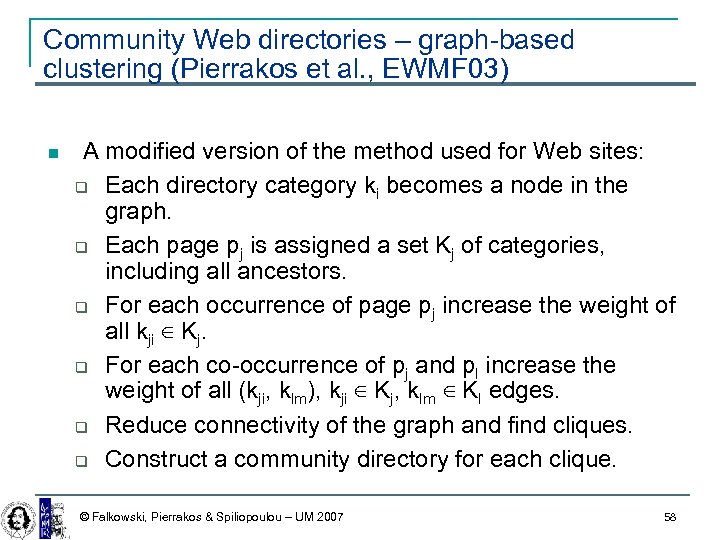 Community Web directories – graph-based clustering (Pierrakos et al. , EWMF 03) A modified version of the method used for Web sites: Each directory category ki becomes a node in the graph. Each page pj is assigned a set Kj of categories, including all ancestors. For each occurrence of page pj increase the weight of all kji ∈ Kj. For each co-occurrence of pj and pl increase the weight of all (kji, klm), kji ∈ Kj, klm ∈ Kl edges. Reduce connectivity of the graph and find cliques. Construct a community directory for each clique. © Falkowski, Pierrakos & Spiliopoulou – UM 2007 58
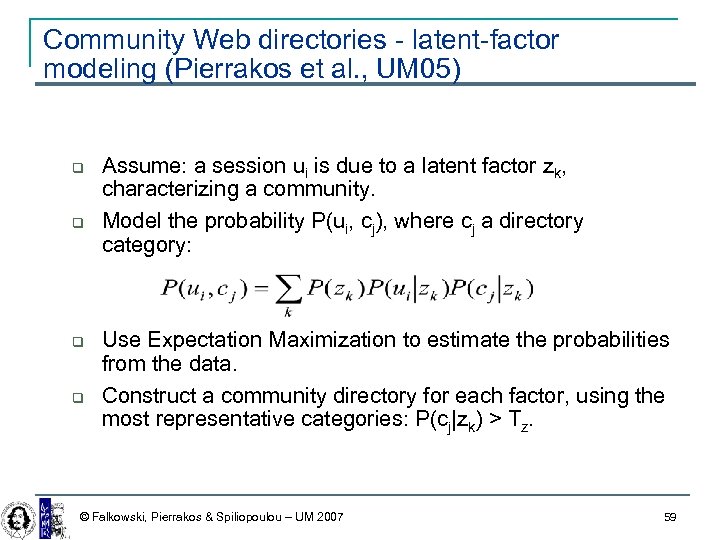 Community Web directories - latent-factor modeling (Pierrakos et al. , UM 05) Assume: a session ui is due to a latent factor zk, characterizing a community. Model the probability P(ui, cj), where cj a directory category: Use Expectation Maximization to estimate the probabilities from the data. Construct a community directory for each factor, using the most representative categories: P(cj|zk) > Tz. © Falkowski, Pierrakos & Spiliopoulou – UM 2007 59
 Community Web directories Evaluation 781, 069 records from ISP proxy server log. After cleaning and sessionization: 2, 253 sessions Initial Web directory constructed with agglomerative document clustering (998 nodes). Repeated split of the data for modeling and evaluation. Hide last page from each evaluation session. Use observed pages to construct personal directory. © Falkowski, Pierrakos & Spiliopoulou – UM 2007 60
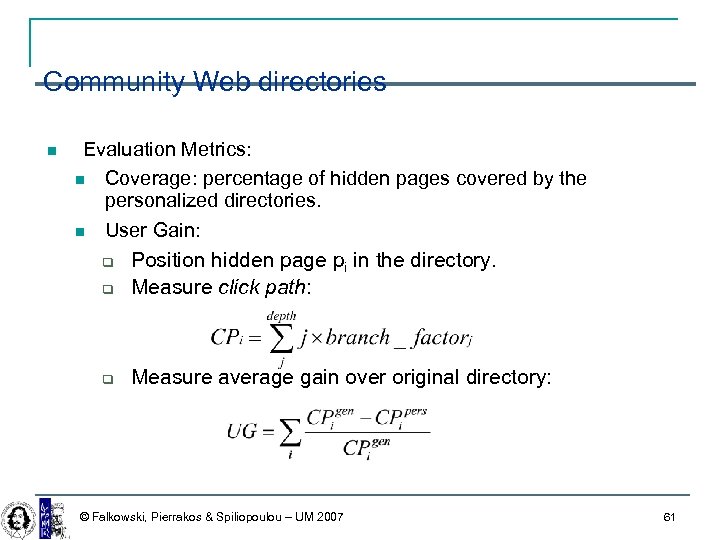 Community Web directories Evaluation Metrics: Coverage: percentage of hidden pages covered by the personalized directories. User Gain: Position hidden page pi in the directory. Measure click path: Measure average gain over original directory: © Falkowski, Pierrakos & Spiliopoulou – UM 2007 61
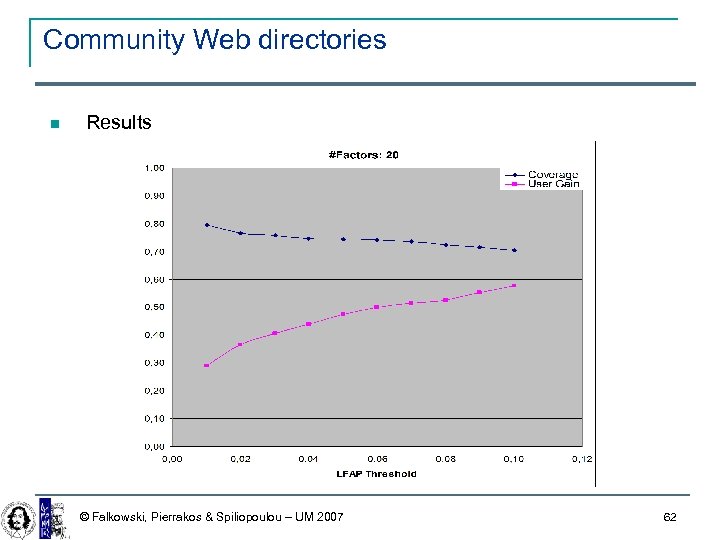 Community Web directories Results © Falkowski, Pierrakos & Spiliopoulou – UM 2007 62
 Communities on the whole Web þ Community Web Directories Web Navigation Models © Falkowski, Pierrakos & Spiliopoulou – UM 2007 63
 Modeling navigation on the Web Model how people navigate the Web. Acquire models from Web usage data, e. g. ISP. Can we apply the same methods as for a Web site? Statistics of Web page co-occurrence do not allow that. Approach: model also content-based page similarity. © Falkowski, Pierrakos & Spiliopoulou – UM 2007 64
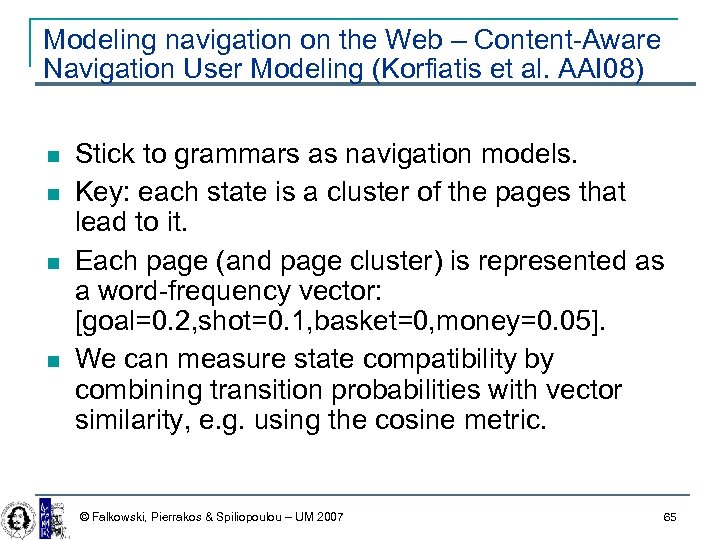 Modeling navigation on the Web – Content-Aware Navigation User Modeling (Korfiatis et al. AAI 08) Stick to grammars as navigation models. Key: each state is a cluster of the pages that lead to it. Each page (and page cluster) is represented as a word-frequency vector: [goal=0. 2, shot=0. 1, basket=0, money=0. 05]. We can measure state compatibility by combining transition probabilities with vector similarity, e. g. using the cosine metric. © Falkowski, Pierrakos & Spiliopoulou – UM 2007 65
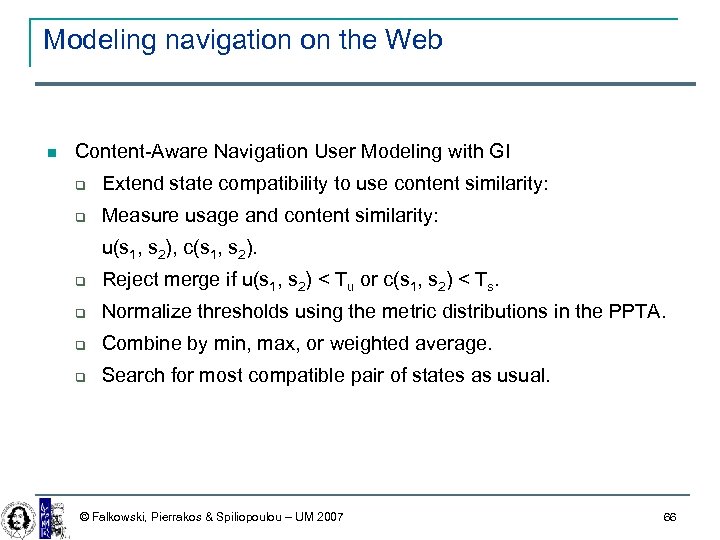 Modeling navigation on the Web Content-Aware Navigation User Modeling with GI Extend state compatibility to use content similarity: Measure usage and content similarity: u(s 1, s 2), c(s 1, s 2). Reject merge if u(s 1, s 2) < Tu or c(s 1, s 2) < Ts. Normalize thresholds using the metric distributions in the PPTA. Combine by min, max, or weighted average. Search for most compatible pair of states as usual. © Falkowski, Pierrakos & Spiliopoulou – UM 2007 66
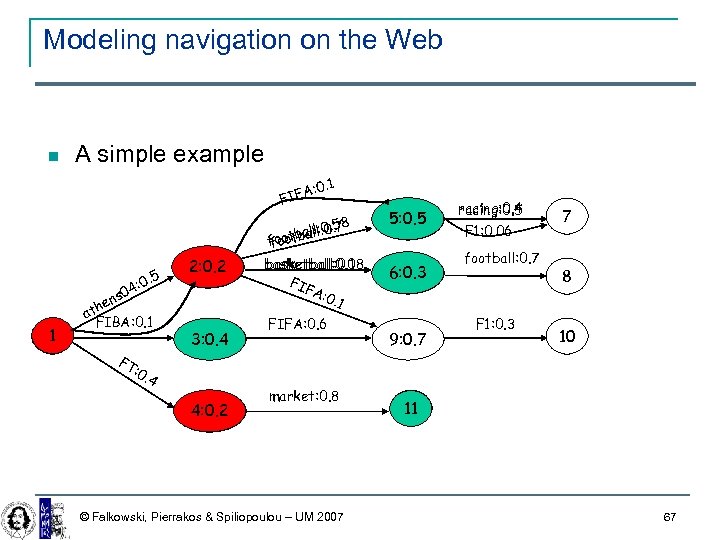 Modeling navigation on the Web A simple example A FIF : 0. 1 . 58 7 a l: 0 balll: 0. ot b t fo o fo 5 . 4: 0 1 s 0 en ath FIBA: 0. 1 2: 0. 2 3: 0. 4 basketball: 0. 08 basketball: 0. 1 FIF A: 0. 1 FIFA: 0. 6 5: 0. 5 6: 0. 3 9: 0. 7 racing: 0. 4 racing: 0. 5 F 1: 0. 06 football: 0. 7 F 1: 0. 3 7 8 10 FT : 0. 4 4: 0. 2 market: 0. 8 © Falkowski, Pierrakos & Spiliopoulou – UM 2007 11 67
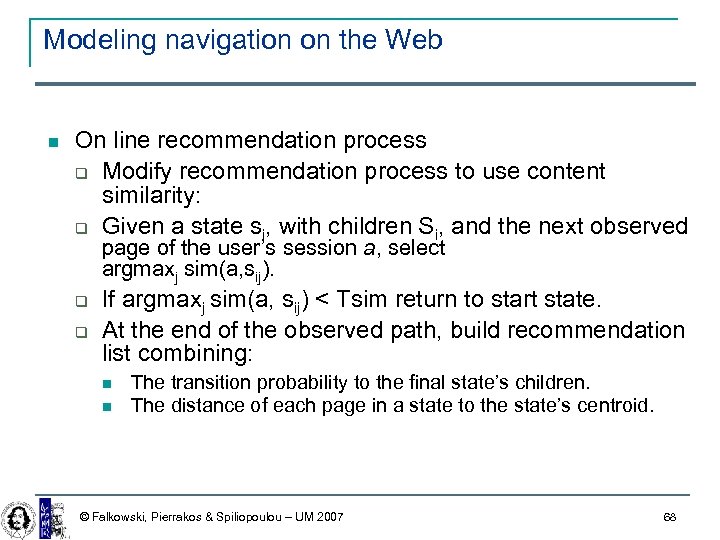 Modeling navigation on the Web On line recommendation process Modify recommendation process to use content similarity: Given a state si, with children Si, and the next observed page of the user’s session a, select argmaxj sim(a, sij). If argmaxj sim(a, sij) < Tsim return to start state. At the end of the observed path, build recommendation list combining: The transition probability to the final state’s children. The distance of each page in a state to the state’s centroid. © Falkowski, Pierrakos & Spiliopoulou – UM 2007 68
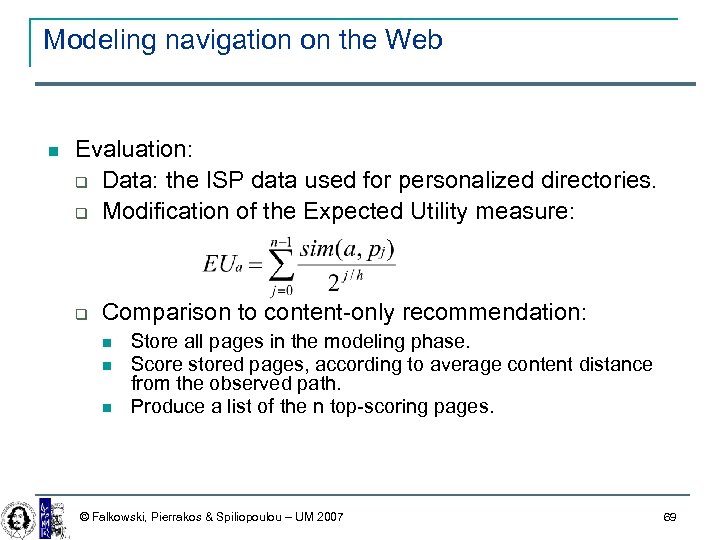 Modeling navigation on the Web Evaluation: Data: the ISP data used for personalized directories. Modification of the Expected Utility measure: Comparison to content-only recommendation: Store all pages in the modeling phase. Score stored pages, according to average content distance from the observed path. Produce a list of the n top-scoring pages. © Falkowski, Pierrakos & Spiliopoulou – UM 2007 69
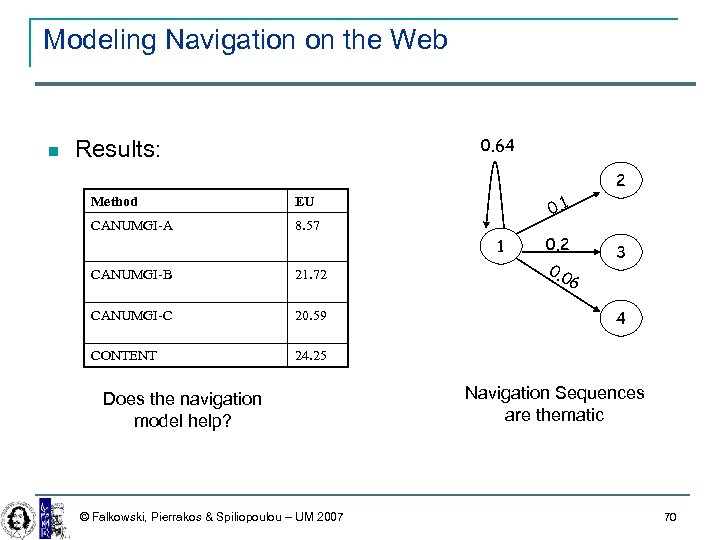 Modeling Navigation on the Web 0. 64 Results: 2 Method CANUMGI-A 0. 1 EU 8. 57 1 CANUMGI-B 21. 72 CANUMGI-C 20. 59 CONTENT 0. 2 0. 0 6 3 24. 25 Does the navigation model help? © Falkowski, Pierrakos & Spiliopoulou – UM 2007 4 Navigation Sequences are thematic 70
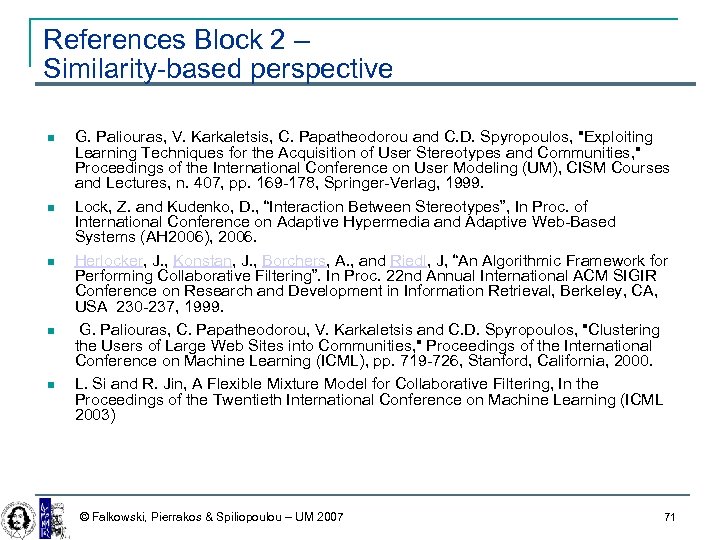 References Block 2 – Similarity-based perspective G. Paliouras, V. Karkaletsis, C. Papatheodorou and C. D. Spyropoulos, "Exploiting Learning Techniques for the Acquisition of User Stereotypes and Communities, " Proceedings of the International Conference on User Modeling (UM), CISM Courses and Lectures, n. 407, pp. 169 -178, Springer-Verlag, 1999. Lock, Z. and Kudenko, D. , “Interaction Between Stereotypes”, In Proc. of International Conference on Adaptive Hypermedia and Adaptive Web-Based Systems (AH 2006), 2006. Herlocker, J. , Konstan, J. , Borchers, A. , and Riedl, J, “An Algorithmic Framework for Performing Collaborative Filtering”. In Proc. 22 nd Annual International ACM SIGIR Conference on Research and Development in Information Retrieval, Berkeley, CA, USA 230 -237, 1999. G. Paliouras, C. Papatheodorou, V. Karkaletsis and C. D. Spyropoulos, "Clustering the Users of Large Web Sites into Communities, " Proceedings of the International Conference on Machine Learning (ICML), pp. 719 -726, Stanford, California, 2000. L. Si and R. Jin, A Flexible Mixture Model for Collaborative Filtering, In the Proceedings of the Twentieth International Conference on Machine Learning (ICML 2003) © Falkowski, Pierrakos & Spiliopoulou – UM 2007 71
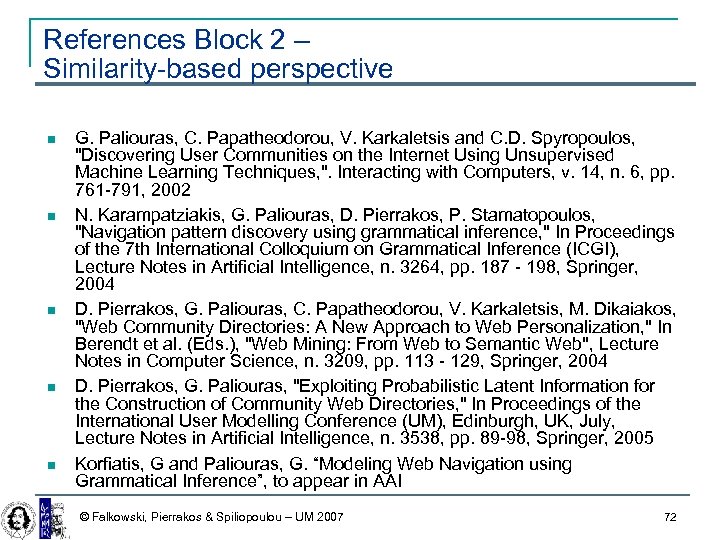 References Block 2 – Similarity-based perspective G. Paliouras, C. Papatheodorou, V. Karkaletsis and C. D. Spyropoulos, "Discovering User Communities on the Internet Using Unsupervised Machine Learning Techniques, ". Interacting with Computers, v. 14, n. 6, pp. 761 -791, 2002 N. Karampatziakis, G. Paliouras, D. Pierrakos, P. Stamatopoulos, "Navigation pattern discovery using grammatical inference, " In Proceedings of the 7 th International Colloquium on Grammatical Inference (ICGI), Lecture Notes in Artificial Intelligence, n. 3264, pp. 187 - 198, Springer, 2004 D. Pierrakos, G. Paliouras, C. Papatheodorou, V. Karkaletsis, M. Dikaiakos, "Web Community Directories: A New Approach to Web Personalization, " In Berendt et al. (Eds. ), "Web Mining: From Web to Semantic Web", Lecture Notes in Computer Science, n. 3209, pp. 113 - 129, Springer, 2004 D. Pierrakos, G. Paliouras, "Exploiting Probabilistic Latent Information for the Construction of Community Web Directories, " In Proceedings of the International User Modelling Conference (UM), Edinburgh, UK, July, Lecture Notes in Artificial Intelligence, n. 3538, pp. 89 -98, Springer, 2005 Korfiatis, G and Paliouras, G. “Modeling Web Navigation using Grammatical Inference”, to appear in AAI © Falkowski, Pierrakos & Spiliopoulou – UM 2007 72
 Presentation Outline Block 1: Community models Block 2: Three perspectives for community discovery þ Similarity-based perspective Interaction-based perspective Impact-based perspective Block 3: Community dynamics Block 4: Outlook © Falkowski, Pierrakos & Spiliopoulou – UM 2007 73
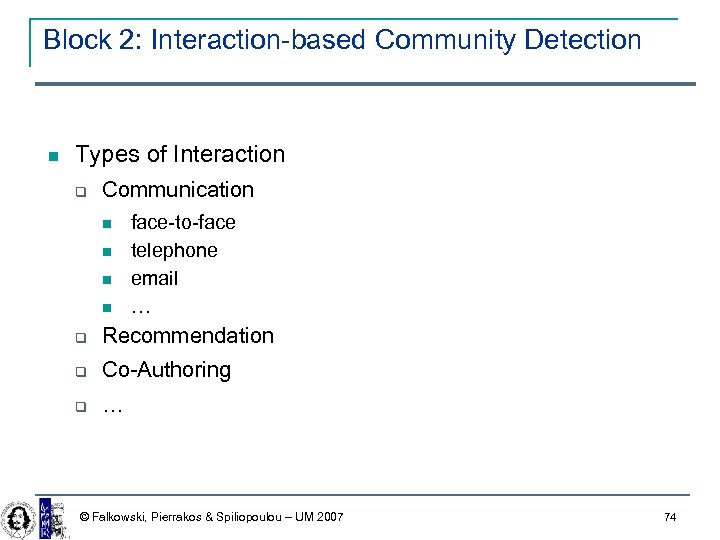 Block 2: Interaction-based Community Detection Types of Interaction Communication face-to-face telephone email … Recommendation Co-Authoring … © Falkowski, Pierrakos & Spiliopoulou – UM 2007 74
 Graph-Representation of Interaction Networks Possible representation of networks are graphs Graph G=(V, E) with vertices (nodes) V and edges (links) E Studying global characteristics of graphs (using statistical measures) Studying the topology of graphs, such as subgroups (subset of connected nodes) © Falkowski, Pierrakos & Spiliopoulou – UM 2007 75
 Cohesive Subgroups in Social Sciences Definition based on relative strength, frequency density or closeness of ties within the subgroup and relative weakness, infrequency, sparseness, or distance of ties from subgroup members to others 1. Methods based on properties of ties within the subgroup 2. Methods based on comparison of ties within the subgroups to ties outside the group © Falkowski, Pierrakos & Spiliopoulou – UM 2007 76
 Cohesive Subgroups in non-directed networks A cohesive subgroup is a subset of actors among whom there are relatively strong, direct, intense or frequent ties Subgroups based on complete mutuality: Cliques Maximal complete subgraph of three or more nodes (i. e. all nodes are adjacent to each other) Subgroups based on reachability and diameter: n-cliques Maximal subgraph in which the largest geodesic distance between any two nodes is no greater than n Subgroups based on nodal degree: k-plexes, k-cores A k-plex is maximal subgraph containing s nodes in which each node is adjacent to no fewer than s-k nodes in the subgraph A k-core is a subgraph in which each node is adjacent to at least k other nodes in the subgraph © Falkowski, Pierrakos & Spiliopoulou – UM 2007 77
 Community Detection Methods and Applications Based on Graphs of Interactions Maximum flow minimum cut Hierarchical divisive clustering Hyperlink-Induced Topic Search (HITS) and Page. Rank © Falkowski, Pierrakos & Spiliopoulou – UM 2007 78
 Maximum-flow minimum cut theory Algorithm: Idea Given a directed graph G=(V, E), with edge capacities c(u, v) Z+, and two vertices s, t V. Find the maximum flow that can be routed from the source s to the sink t that obeys all capacity constraints. A minimum cut of a network is a cut whose capacity is minimum over all cuts of the network Max-flow-min-cut theorem of Ford and Fulkerson (1956) proves that maximum flow of the network is identical to minimum cut that separates s and t. © Falkowski, Pierrakos & Spiliopoulou – UM 2007 79
 Maximum-flow minimum cut theory: Algorithm: Ford-Fulkerson Method to solve the maximum-flow problem Residual Capacity: Additional net flow we can push from u to v before exceeding the capacity c(u, v) cf(u, v) = c(u, v) – f(u, v) Augmenting path: Path from source s to sink t along which we can push more flow Repeatedly augmenting the flow until the maximum flow has been found A cut (S, T) of the flow network G is a partition of V into S and T = V-S such that s S and t T © Falkowski, Pierrakos & Spiliopoulou – UM 2007 80
 Maximum-flow minimum cut theory: Algorithm: Ford-Fulkerson Method Ford-Fulkerson(G, s, t) 1 for each edge (u, v) E[G] 2 do f[u, v] ← 0 3 f[v, u] ← 0 4 while there exists an augmenting path p from s to t in the residual network Gf 5 do cf(p) ← min{cf(u, v): (u, v) is in p} 6 for each edge (u, v) in p 7 do f[u, v] ← f[u, v] + cf(p) 8 f[v, u] ← -f[u, v] Lines 1 -3 initialize the flow While loop of lines 4 -8 repeatedly finds augmenting path p in Gf and augments flow f along p by the residual capacity cf(p) When no augmenting paths exits, the flow is maximum flow © Falkowski, Pierrakos & Spiliopoulou – UM 2007 81
![Application „Identification of Web Communities“ [Flake, Lawrence & Giles, 2000] Definition of Community: A](https://present5.com/presentation/575c4aa37ee3efea576695e488a21a4a/image-82.jpg "Application „Identification of Web Communities“ [Flake, Lawrence & Giles, 2000] Definition of Community: A") Application „Identification of Web Communities“ [Flake, Lawrence & Giles, 2000] Definition of Community: A Web community is a collection of Web pages in which each member page has more hyperlinks within the community than outside the community. Goal: Finding topologically related Web sites (e. g. to reduce the number of Web sites to index) Model: Two Web sites are connected via a directed edge if one site links to the other Algorithm: Focused-crawl based on max-flow analysis © Falkowski, Pierrakos & Spiliopoulou – UM 2007 82
Application „Identification of Web Communities“ [Flake, Lawrence & Giles, 2000] Definition of Community: A Web community is a collection of Web pages in which each member page has more hyperlinks within the community than outside the community. Goal: Finding topologically related Web sites (e. g. to reduce the number of Web sites to index) Model: Two Web sites are connected via a directed edge if one site links to the other Algorithm: Focused-crawl based on max-flow analysis © Falkowski, Pierrakos & Spiliopoulou – UM 2007 82
![Application „Identification of Web Communities“: Algorithm [Flake, Lawrence & Giles, 2000] FOCUSED-CRAWL(G, s, t)](https://present5.com/presentation/575c4aa37ee3efea576695e488a21a4a/image-83.jpg "Application „Identification of Web Communities“: Algorithm [Flake, Lawrence & Giles, 2000] FOCUSED-CRAWL(G, s, t)") Application „Identification of Web Communities“: Algorithm [Flake, Lawrence & Giles, 2000] FOCUSED-CRAWL(G, s, t) while # of iterations is less than desired do Perform maximum flow analysis of G, yielding community C. Identify non-seed vertex, v* C, with the highest indegree relative to G. for all v C with in-degree equal to v*, Add v to seed set Add edge (s, v) to E with infinite capacity end for Identify non-seed vertex, u*, with the highest outdegree relative to G for all u C with out-degree equal to u*, Add u to seed set Add edge (s, u) to E with infinite capacity end for Re-crawl so that G uses all seeds Let G reflect new information from the crawl end while © Falkowski, Pierrakos & Spiliopoulou – UM 2007 83
Application „Identification of Web Communities“: Algorithm [Flake, Lawrence & Giles, 2000] FOCUSED-CRAWL(G, s, t) while # of iterations is less than desired do Perform maximum flow analysis of G, yielding community C. Identify non-seed vertex, v* C, with the highest indegree relative to G. for all v C with in-degree equal to v*, Add v to seed set Add edge (s, v) to E with infinite capacity end for Identify non-seed vertex, u*, with the highest outdegree relative to G for all u C with out-degree equal to u*, Add u to seed set Add edge (s, u) to E with infinite capacity end for Re-crawl so that G uses all seeds Let G reflect new information from the crawl end while © Falkowski, Pierrakos & Spiliopoulou – UM 2007 83
![Application „Identification of Web Communities“: Results [Flake, Lawrence & Giles, 2000] The authors test](https://present5.com/presentation/575c4aa37ee3efea576695e488a21a4a/image-84.jpg "Application „Identification of Web Communities“: Results [Flake, Lawrence & Giles, 2000] The authors test") Application „Identification of Web Communities“: Results [Flake, Lawrence & Giles, 2000] The authors test their algorithm with three different groups of initial Web pages. Each retrieved community is closely related to the interested field: Support Vector Machine Community The Internet Archive Community Graph Size: 11, 000 Community Size: 252 Results: strongly related to SVM research Graph Size: 7, 000 Community Size: 289 Results: closely related to the mission of the Internet Archive The “Ronald Rivest” Community Graph Size: 38, 000 Community Size: 150 Results: closely related to Ronald Rivest’s research © Falkowski, Pierrakos & Spiliopoulou – UM 2007 84
Application „Identification of Web Communities“: Results [Flake, Lawrence & Giles, 2000] The authors test their algorithm with three different groups of initial Web pages. Each retrieved community is closely related to the interested field: Support Vector Machine Community The Internet Archive Community Graph Size: 11, 000 Community Size: 252 Results: strongly related to SVM research Graph Size: 7, 000 Community Size: 289 Results: closely related to the mission of the Internet Archive The “Ronald Rivest” Community Graph Size: 38, 000 Community Size: 150 Results: closely related to Ronald Rivest’s research © Falkowski, Pierrakos & Spiliopoulou – UM 2007 84
 Community Detection Methods and Applications þ Maximum flow minimum cut Hierarchical divisive clustering Hyperlink-Induced Topic Search (HITS) and Page. Rank © Falkowski, Pierrakos & Spiliopoulou – UM 2007 85
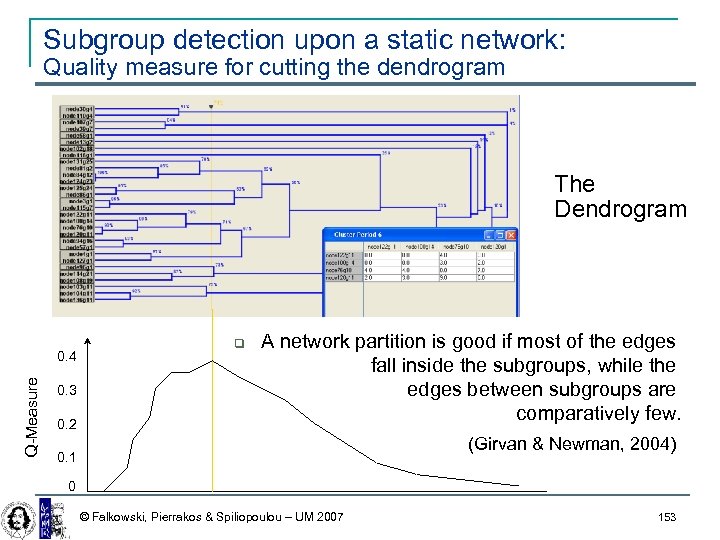
 Hierarchical Divisive Clustering Core idea: The network is partitioned into groups with hierarchical divisive clustering The partitioning is done by removing edges according to the edge betweenness criterion of (Girvan & Newman, 2002) The output of the clustering algorithm is a dendrogram The dendrogram is "cut" at some level. The clusters are the graph partitions at this level The cut is performed according to a quality measure of (Newman & Girvan, 2004) © Falkowski, Pierrakos & Spiliopoulou – UM 2007 86
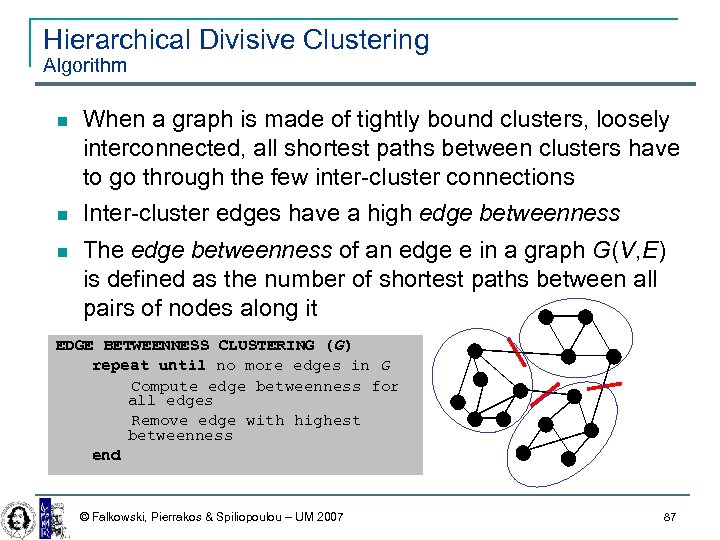 Hierarchical Divisive Clustering Algorithm When a graph is made of tightly bound clusters, loosely interconnected, all shortest paths between clusters have to go through the few inter-cluster connections Inter-cluster edges have a high edge betweenness The edge betweenness of an edge e in a graph G(V, E) is defined as the number of shortest paths between all pairs of nodes along it EDGE BETWEENNESS CLUSTERING (G) repeat until no more edges in G Compute edge betweenness for all edges Remove edge with highest betweenness end © Falkowski, Pierrakos & Spiliopoulou – UM 2007 87
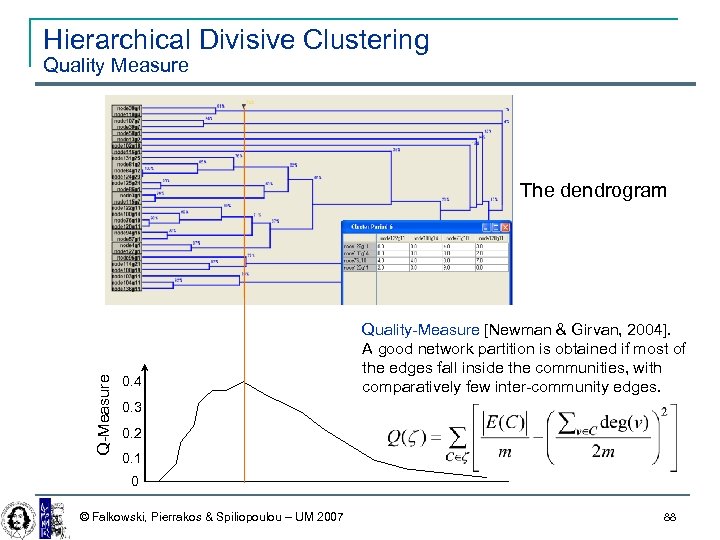 Hierarchical Divisive Clustering Quality Measure Q-Measure The dendrogram 0. 4 Quality-Measure [Newman & Girvan, 2004]. A good network partition is obtained if most of the edges fall inside the communities, with comparatively few inter-community edges. 0. 3 0. 2 0. 1 0 © Falkowski, Pierrakos & Spiliopoulou – UM 2007 88
![Application „Community Structures from Email“ [Tyler, Wilkinson, Huberman, 2003] Goal: Finding groups of people](https://present5.com/presentation/575c4aa37ee3efea576695e488a21a4a/image-89.jpg "Application „Community Structures from Email“ [Tyler, Wilkinson, Huberman, 2003] Goal: Finding groups of people") Application „Community Structures from Email“ [Tyler, Wilkinson, Huberman, 2003] Goal: Finding groups of people (communities of practice) interacting via email; draw inferences about the leadership of an organization from its communication data Model: Nodes represent users; two users are connected via a directed edge if they exchanged at least 30 emails and each user had sent at least 5 emails to the other Algorithm: Hierarchical divisive edge betweenness clustering with modifications © Falkowski, Pierrakos & Spiliopoulou – UM 2007 89
Application „Community Structures from Email“ [Tyler, Wilkinson, Huberman, 2003] Goal: Finding groups of people (communities of practice) interacting via email; draw inferences about the leadership of an organization from its communication data Model: Nodes represent users; two users are connected via a directed edge if they exchanged at least 30 emails and each user had sent at least 5 emails to the other Algorithm: Hierarchical divisive edge betweenness clustering with modifications © Falkowski, Pierrakos & Spiliopoulou – UM 2007 89
![Application „Community Structures from Email“: Data Set [Tyler, Wilkinson, Huberman, 2003] 185, 773 emails](https://present5.com/presentation/575c4aa37ee3efea576695e488a21a4a/image-90.jpg "Application „Community Structures from Email“: Data Set [Tyler, Wilkinson, Huberman, 2003] 185, 773 emails") Application „Community Structures from Email“: Data Set [Tyler, Wilkinson, Huberman, 2003] 185, 773 emails between 485 HP Labs employees (November 2002 – February 2003) Emails to or from external destinations are removed Messages sent to a list of more than 10 recipients have been removed (such as lab-wide announcements) Graph consisted of 367 nodes connected by 1110 edges 66 communities were detected; largest consisted of 57 individuals; mean community size 8. 4; σ = 5. 3 49 of 66 communities consisted of individuals entirely within one lab or unit © Falkowski, Pierrakos & Spiliopoulou – UM 2007 90
Application „Community Structures from Email“: Data Set [Tyler, Wilkinson, Huberman, 2003] 185, 773 emails between 485 HP Labs employees (November 2002 – February 2003) Emails to or from external destinations are removed Messages sent to a list of more than 10 recipients have been removed (such as lab-wide announcements) Graph consisted of 367 nodes connected by 1110 edges 66 communities were detected; largest consisted of 57 individuals; mean community size 8. 4; σ = 5. 3 49 of 66 communities consisted of individuals entirely within one lab or unit © Falkowski, Pierrakos & Spiliopoulou – UM 2007 90
![Application „Community Structures from Email“: Results [Tyler, Wilkinson, Huberman, 2003] Structure of email network](https://present5.com/presentation/575c4aa37ee3efea576695e488a21a4a/image-91.jpg "Application „Community Structures from Email“: Results [Tyler, Wilkinson, Huberman, 2003] Structure of email network") Application „Community Structures from Email“: Results [Tyler, Wilkinson, Huberman, 2003] Structure of email network bears resemblance with structure of organization Graph visualization shows that organizational leadership tends to end up in the center of the graph (red dots) Results were validated in interviews Communities reflect departments, project groups or discussion groups © Falkowski, Pierrakos & Spiliopoulou – UM 2007 91
Application „Community Structures from Email“: Results [Tyler, Wilkinson, Huberman, 2003] Structure of email network bears resemblance with structure of organization Graph visualization shows that organizational leadership tends to end up in the center of the graph (red dots) Results were validated in interviews Communities reflect departments, project groups or discussion groups © Falkowski, Pierrakos & Spiliopoulou – UM 2007 91
 Community Detection Methods and Applications þ Maximum flow minimum cut þ Hierarchical divisive clustering Hyperlink-Induced Topic Search (HITS) and Page. Rank © Falkowski, Pierrakos & Spiliopoulou – UM 2007 92
![HITS Algorithm [Kleinberg, 1999] Idea: Authorities are pages that are linked by many hubs.](https://present5.com/presentation/575c4aa37ee3efea576695e488a21a4a/image-93.jpg "HITS Algorithm [Kleinberg, 1999] Idea: Authorities are pages that are linked by many hubs.") HITS Algorithm [Kleinberg, 1999] Idea: Authorities are pages that are linked by many hubs. Hubs are pages that link to many authorities. HITS retrieves the bipartite core of a subgraph. Model: Collection V of hyperlinked pages as a directed graph G = (V, E): the nodes correspond to the pages, and a directed edge (p, q) indicates the presence of link from p to q. The authority score a and hub score h for a page p is calculated as follows Goal: Detecting clusters of (topically) related pages © Falkowski, Pierrakos & Spiliopoulou – UM 2007 93
HITS Algorithm [Kleinberg, 1999] Idea: Authorities are pages that are linked by many hubs. Hubs are pages that link to many authorities. HITS retrieves the bipartite core of a subgraph. Model: Collection V of hyperlinked pages as a directed graph G = (V, E): the nodes correspond to the pages, and a directed edge (p, q) indicates the presence of link from p to q. The authority score a and hub score h for a page p is calculated as follows Goal: Detecting clusters of (topically) related pages © Falkowski, Pierrakos & Spiliopoulou – UM 2007 93
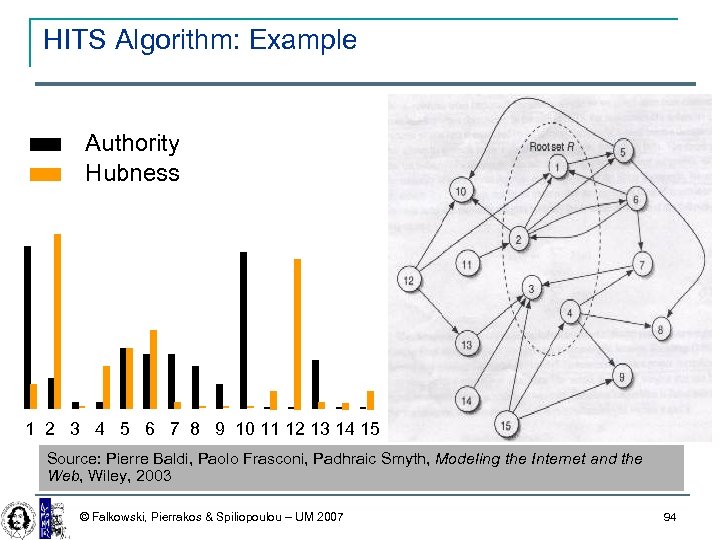 HITS Algorithm: Example Authority Hubness 1 2 3 4 5 6 7 8 9 10 11 12 13 14 15 Source: Pierre Baldi, Paolo Frasconi, Padhraic Smyth, Modeling the Internet and the Web, Wiley, 2003 © Falkowski, Pierrakos & Spiliopoulou – UM 2007 94
![Page Rank [Brin, Page, 1998] Idea: Assumptions: Link to page reflects “quality” and important](https://present5.com/presentation/575c4aa37ee3efea576695e488a21a4a/image-95.jpg "Page Rank [Brin, Page, 1998] Idea: Assumptions: Link to page reflects “quality” and important") Page Rank [Brin, Page, 1998] Idea: Assumptions: Link to page reflects “quality” and important pages link most likely to other important pages Model: Link analysis algorithm assigns numerical weight to each element of a hyperlinked set of documents such as the WWW Collection V of hyperlinked pages as a directed graph G = (V, E): the nodes correspond to the pages, and a directed edge (p, q) indicates the presence of link from p to q. Goal: Measure the relative importance of a page within the set Importance of page affects other pages and depends on the importance of them → recursively © Falkowski, Pierrakos & Spiliopoulou – UM 2007 95
Page Rank [Brin, Page, 1998] Idea: Assumptions: Link to page reflects “quality” and important pages link most likely to other important pages Model: Link analysis algorithm assigns numerical weight to each element of a hyperlinked set of documents such as the WWW Collection V of hyperlinked pages as a directed graph G = (V, E): the nodes correspond to the pages, and a directed edge (p, q) indicates the presence of link from p to q. Goal: Measure the relative importance of a page within the set Importance of page affects other pages and depends on the importance of them → recursively © Falkowski, Pierrakos & Spiliopoulou – UM 2007 95
![Calculation of Page Rank [Brin, Page, 1998] The Page. Rank-value PRi of page i](https://present5.com/presentation/575c4aa37ee3efea576695e488a21a4a/image-96.jpg "Calculation of Page Rank [Brin, Page, 1998] The Page. Rank-value PRi of page i") Calculation of Page Rank [Brin, Page, 1998] The Page. Rank-value PRi of page i is obtained from the weights of all pages that link to i. The Page. Rank of page j is divided among all the Cj outbound links. Thus, the Page. Rank of page i is calculated as follows: d=[0, 1] is the dampening factor that is subtracted from the weight (1 d) of each page and distributed equally to all pages. It is generally assumed that the damping factor will be set around 0. 85. © Falkowski, Pierrakos & Spiliopoulou – UM 2007 96
Calculation of Page Rank [Brin, Page, 1998] The Page. Rank-value PRi of page i is obtained from the weights of all pages that link to i. The Page. Rank of page j is divided among all the Cj outbound links. Thus, the Page. Rank of page i is calculated as follows: d=[0, 1] is the dampening factor that is subtracted from the weight (1 d) of each page and distributed equally to all pages. It is generally assumed that the damping factor will be set around 0. 85. © Falkowski, Pierrakos & Spiliopoulou – UM 2007 96
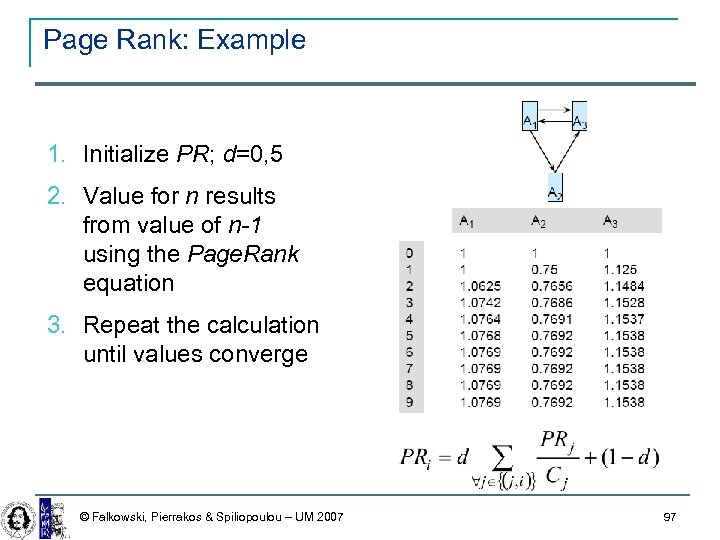 Page Rank: Example 1. Initialize PR; d=0, 5 2. Value for n results from value of n-1 using the Page. Rank equation 3. Repeat the calculation until values converge © Falkowski, Pierrakos & Spiliopoulou – UM 2007 97
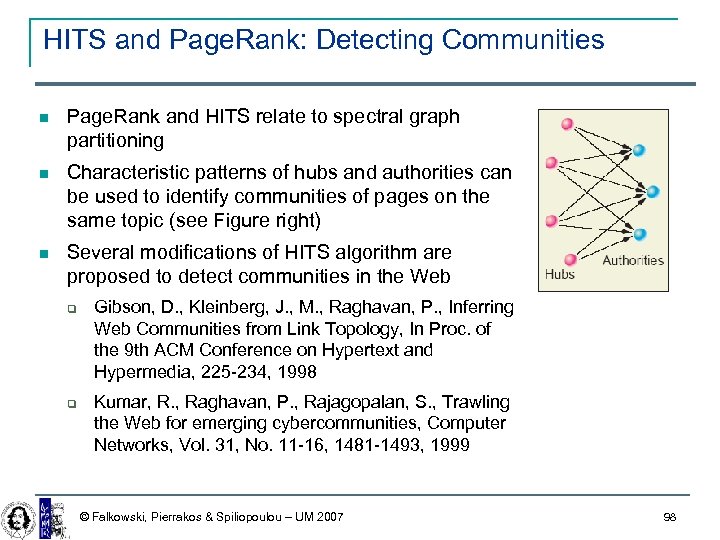 HITS and Page. Rank: Detecting Communities Page. Rank and HITS relate to spectral graph partitioning Characteristic patterns of hubs and authorities can be used to identify communities of pages on the same topic (see Figure right) Several modifications of HITS algorithm are proposed to detect communities in the Web Gibson, D. , Kleinberg, J. , M. , Raghavan, P. , Inferring Web Communities from Link Topology, In Proc. of the 9 th ACM Conference on Hypertext and Hypermedia, 225 -234, 1998 Kumar, R. , Raghavan, P. , Rajagopalan, S. , Trawling the Web for emerging cybercommunities, Computer Networks, Vol. 31, No. 11 -16, 1481 -1493, 1999 © Falkowski, Pierrakos & Spiliopoulou – UM 2007 98
 Community Detection Methods and Applications þ Maximum flow minimum cut þ Hierarchical divisive clustering þ Hyperlink-Induced Topic Search (HITS) and Page. Rank © Falkowski, Pierrakos & Spiliopoulou – UM 2007 99
 References (Block 2 Part 2) Brin, S. and Page L. , The anatomy of a large-scale hypertextual Web search engine". In. Proc. of 7 th Interntl. Conference on World Wide Web, 107 -117, 1998 Flake, G. W. , Lawrence, S. , and Giles, C. L. , Efficient Identification of Web Communities, In Proc. of Sixth ACM SIGKDD International Conference on Knowledge Discovery and Data Mining, 2000 Ford Jr. , L. R. and Fulkerson, D. R. , Maximal flow through a network. Canadian J. Math. , 8: 399– 404, 1956 Girvan, M. and Newman, M. E. , Community structure in social and biological networks, Proc. Natl. Acad. Sci. USA, 99, 7821 -7826, 2002 Kleinberg, J. Authoritative Sources in a Hyperlinked Environment, Journal of the ACM, 46, 5, 604 – 632, 1999 Kleinberg, J. and Lawrence, S. , The Structure of the Web, SCIENCE VOL 294, 184950, 2001 Leskovec, J. , Adamic, L. A. , Huberman, B. A. , The Dynamics of Viral Marketing, ACM Transactions on the Web, 1, 1, 2007 Newman, M. and Girvan, M. , Finding and evaluating community structure in networks, Physical Review E 69(026113), 2004 Tyler, J. R. , Wilkinson, D. M. and Huberman, B. A. , Email as spectroscopy: automated discovery of community structure within organizations, Kluwer, 81 -96, 2003 © Falkowski, Pierrakos & Spiliopoulou – UM 2007 100
 Presentation Outline Block 1: Community models Block 2: Three perspectives for community discovery þ Similarity-based perspective þ Interaction-based perspective ¨ Impact-based perspective Block 3: Community dynamics Block 4: Outlook © Falkowski, Pierrakos & Spiliopoulou – UM 2007 101
 An Impact-Oriented View upon Communities Tracing the influential members in a group of individuals Patterns of influence in a social network Being influenced to join a community © Falkowski, Pierrakos & Spiliopoulou – UM 2007 102
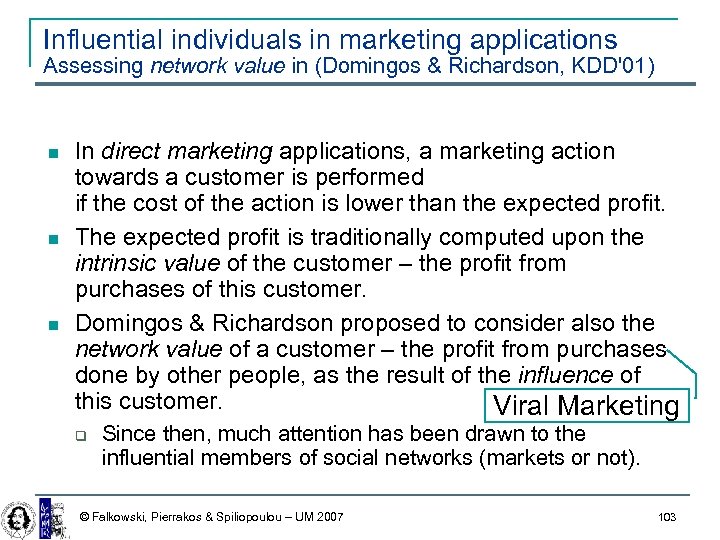 Influential individuals in marketing applications Assessing network value in (Domingos & Richardson, KDD'01) In direct marketing applications, a marketing action towards a customer is performed if the cost of the action is lower than the expected profit. The expected profit is traditionally computed upon the intrinsic value of the customer – the profit from purchases of this customer. Domingos & Richardson proposed to consider also the network value of a customer – the profit from purchases done by other people, as the result of the influence of this customer. Viral Marketing Since then, much attention has been drawn to the influential members of social networks (markets or not). © Falkowski, Pierrakos & Spiliopoulou – UM 2007 103
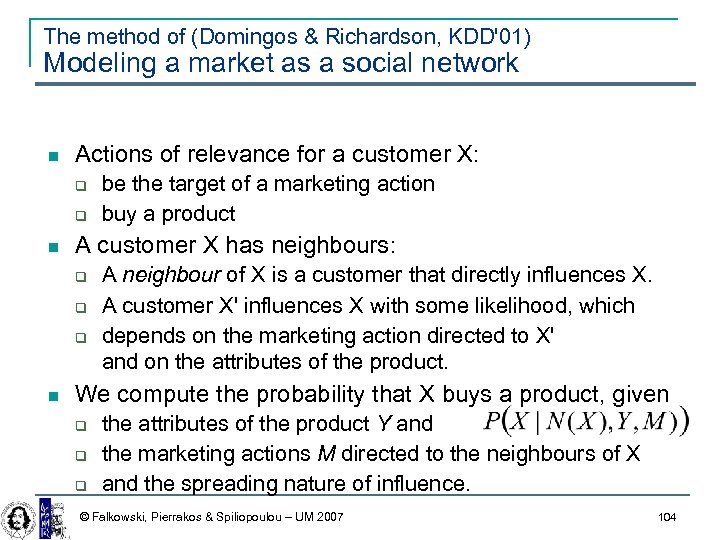 The method of (Domingos & Richardson, KDD'01) Modeling a market as a social network Actions of relevance for a customer X: A customer X has neighbours: be the target of a marketing action buy a product A neighbour of X is a customer that directly influences X. A customer X' influences X with some likelihood, which depends on the marketing action directed to X' and on the attributes of the product. We compute the probability that X buys a product, given the attributes of the product Y and the marketing actions M directed to the neighbours of X and the spreading nature of influence. © Falkowski, Pierrakos & Spiliopoulou – UM 2007 104
 The method of (Domingos & Richardson, KDD'01) Customer network value in a market The Intrinsic Value of a customer corresponds to the expected lift in profit achieved by directing a marketing action to this customer and ignoring the customer's influence upon others. The global lift in profit for a selection S of customers corresponds to their intrinsic values PLUS the expected lift in profit effected through their influence upon others. The Total Value of a customer is the difference between the global lift in profit when including vs excluding this customer from S. The Network Value of a customer is the difference between her Total Value and Intrinsic Value. © Falkowski, Pierrakos & Spiliopoulou – UM 2007 105
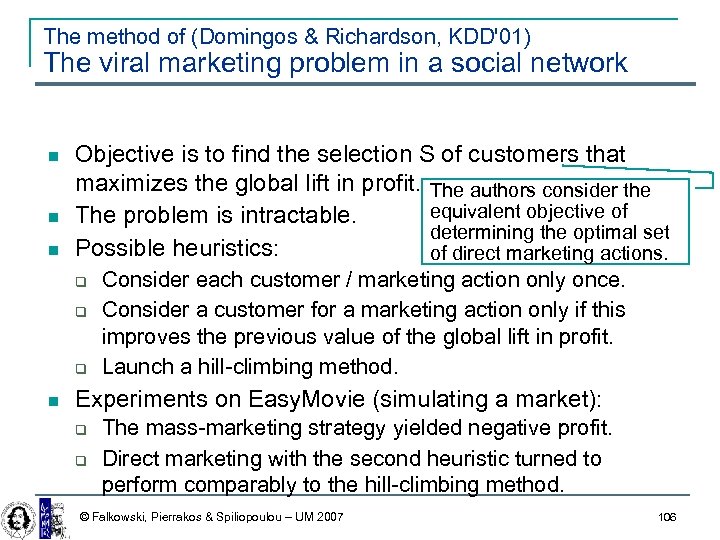 The method of (Domingos & Richardson, KDD'01) The viral marketing problem in a social network Objective is to find the selection S of customers that maximizes the global lift in profit. The authors consider the equivalent objective of The problem is intractable. determining the optimal set Possible heuristics: of direct marketing actions. Consider each customer / marketing action only once. Consider a customer for a marketing action only if this improves the previous value of the global lift in profit. Launch a hill-climbing method. Experiments on Easy. Movie (simulating a market): The mass-marketing strategy yielded negative profit. Direct marketing with the second heuristic turned to perform comparably to the hill-climbing method. © Falkowski, Pierrakos & Spiliopoulou – UM 2007 106
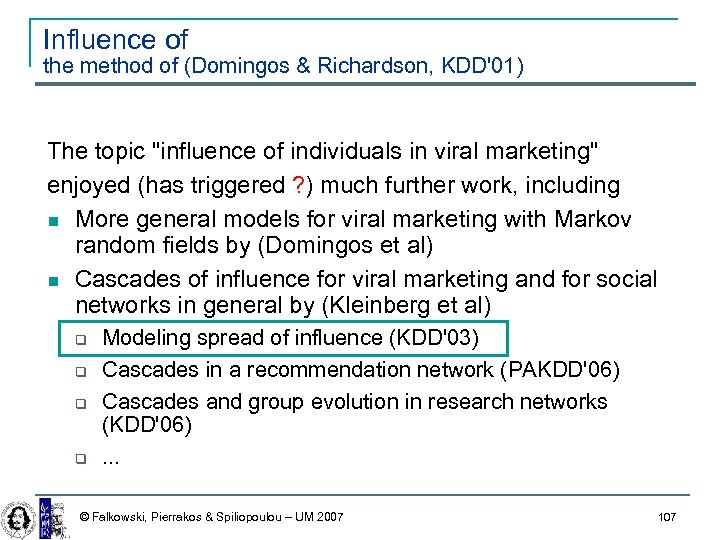 Influence of the method of (Domingos & Richardson, KDD'01) The topic "influence of individuals in viral marketing" enjoyed (has triggered ? ) much further work, including More general models for viral marketing with Markov random fields by (Domingos et al) Cascades of influence for viral marketing and for social networks in general by (Kleinberg et al) Modeling spread of influence (KDD'03) Cascades in a recommendation network (PAKDD'06) Cascades and group evolution in research networks (KDD'06). . . © Falkowski, Pierrakos & Spiliopoulou – UM 2007 107
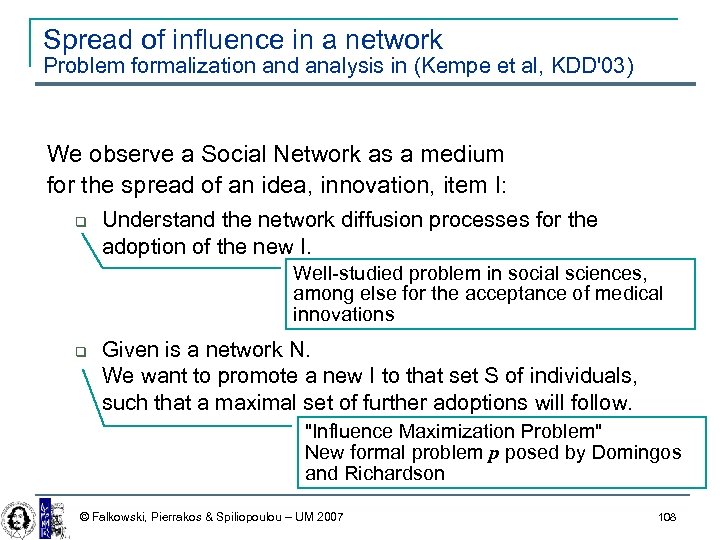 Spread of influence in a network Problem formalization and analysis in (Kempe et al, KDD'03) We observe a Social Network as a medium for the spread of an idea, innovation, item I: Understand the network diffusion processes for the adoption of the new I. Well-studied problem in social sciences, among else for the acceptance of medical innovations Given is a network N. We want to promote a new I to that set S of individuals, such that a maximal set of further adoptions will follow. "Influence Maximization Problem" New formal problem p posed by Domingos and Richardson © Falkowski, Pierrakos & Spiliopoulou – UM 2007 108
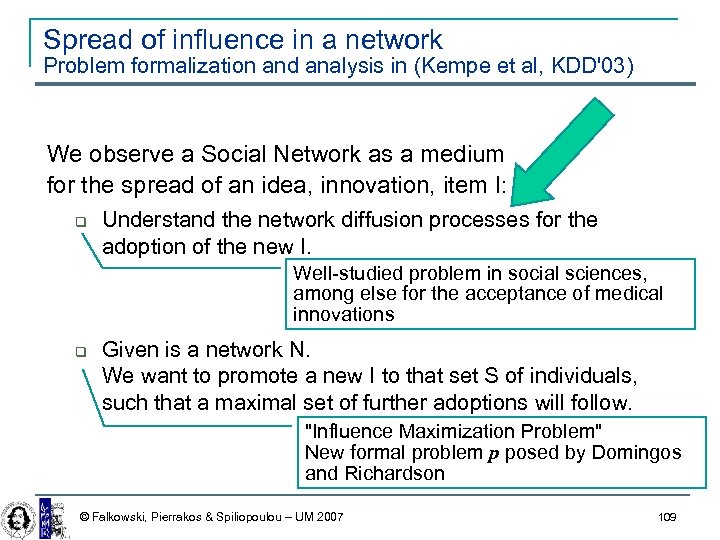 Spread of influence in a network Problem formalization and analysis in (Kempe et al, KDD'03) We observe a Social Network as a medium for the spread of an idea, innovation, item I: Understand the network diffusion processes for the adoption of the new I. Well-studied problem in social sciences, among else for the acceptance of medical innovations Given is a network N. We want to promote a new I to that set S of individuals, such that a maximal set of further adoptions will follow. "Influence Maximization Problem" New formal problem p posed by Domingos and Richardson © Falkowski, Pierrakos & Spiliopoulou – UM 2007 109
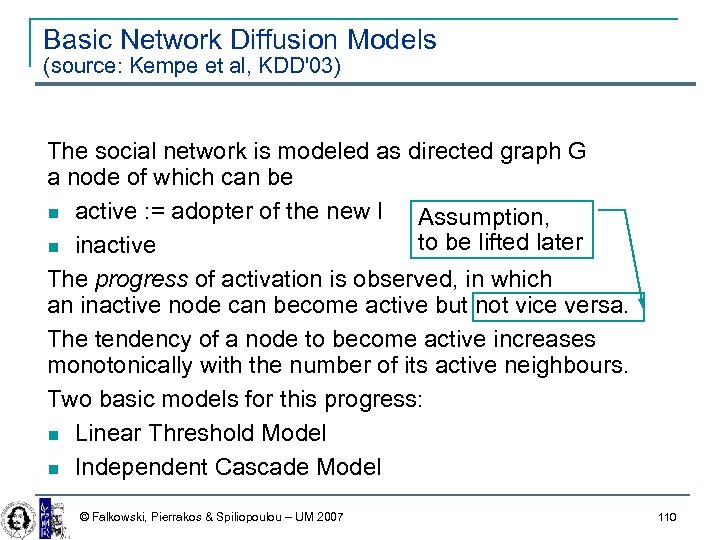 Basic Network Diffusion Models (source: Kempe et al, KDD'03) The social network is modeled as directed graph G a node of which can be active : = adopter of the new I Assumption, to be lifted later inactive The progress of activation is observed, in which an inactive node can become active but not vice versa. The tendency of a node to become active increases monotonically with the number of its active neighbours. Two basic models for this progress: Linear Threshold Model Independent Cascade Model © Falkowski, Pierrakos & Spiliopoulou – UM 2007 110
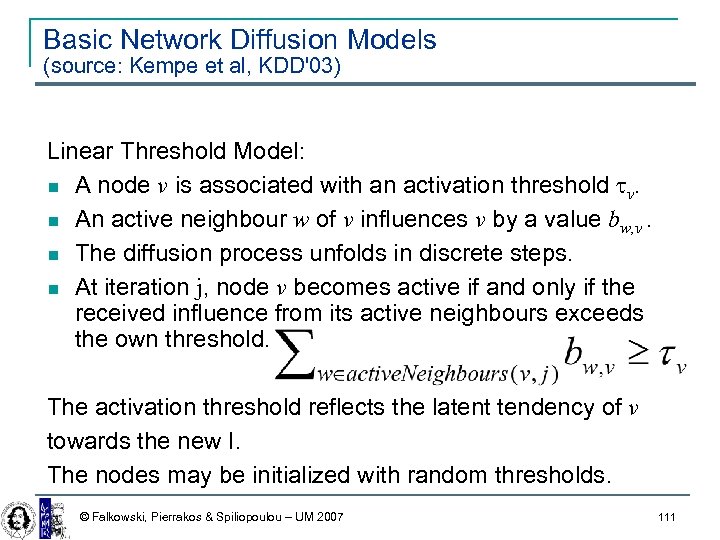 Basic Network Diffusion Models (source: Kempe et al, KDD'03) Linear Threshold Model: A node v is associated with an activation threshold tv. An active neighbour w of v influences v by a value bw, v. The diffusion process unfolds in discrete steps. At iteration j, node v becomes active if and only if the received influence from its active neighbours exceeds the own threshold. The activation threshold reflects the latent tendency of v towards the new I. The nodes may be initialized with random thresholds. © Falkowski, Pierrakos & Spiliopoulou – UM 2007 111
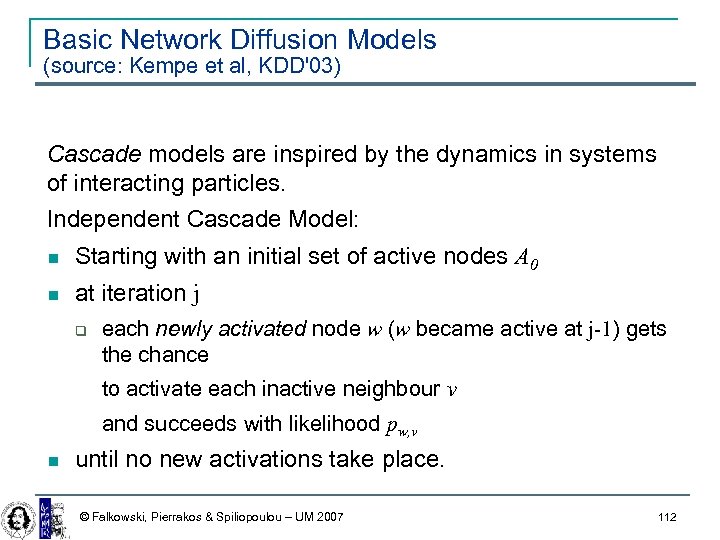 Basic Network Diffusion Models (source: Kempe et al, KDD'03) Cascade models are inspired by the dynamics in systems of interacting particles. Independent Cascade Model: Starting with an initial set of active nodes A 0 at iteration j each newly activated node w (w became active at j-1) gets the chance to activate each inactive neighbour v and succeeds with likelihood pw, v until no new activations take place. © Falkowski, Pierrakos & Spiliopoulou – UM 2007 112
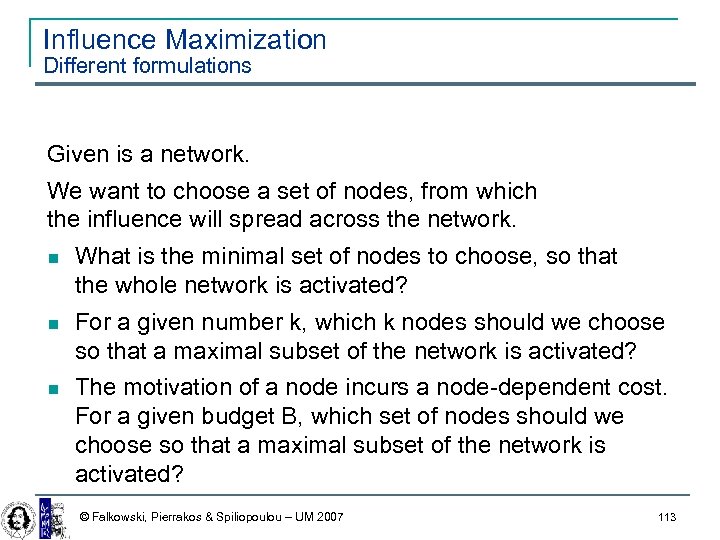 Influence Maximization Different formulations Given is a network. We want to choose a set of nodes, from which the influence will spread across the network. What is the minimal set of nodes to choose, so that the whole network is activated? For a given number k, which k nodes should we choose so that a maximal subset of the network is activated? The motivation of a node incurs a node-dependent cost. For a given budget B, which set of nodes should we choose so that a maximal subset of the network is activated? © Falkowski, Pierrakos & Spiliopoulou – UM 2007 113
 Influence Maximization Different formulations Given is a network. We want to choose a set of nodes, from which the influence will spread across the network. What is the minimal set of nodes to choose, so that the whole network is activated? Domingos & Richardson For a given number k, which k nodes should we choose so that a maximal subset of the network is activated? The motivation of a node incurs a node-dependent cost. For a given budget B, which set of nodes should we choose so that a maximal subset of the network is activated? © Falkowski, Pierrakos & Spiliopoulou – UM 2007 114
 Recall: Spread of influence in a network Problem formalization and analysis in (Kempe et al, KDD'03) We observe a Social Network as a medium for the spread of an idea, innovation, item I: Understand the network diffusion processes for the adoption of the new I. Well-studied problem in social sciences, among else for the acceptance of medical innovations Given is a network N. We want to promote a new I to that set S of individuals, such that a maximal set of further adoptions will follow. "Influence Maximization Problem" New formal problem p posed by Domingos and Richardson © Falkowski, Pierrakos & Spiliopoulou – UM 2007 115
 Spread of Influence in a Network The contribution of (Kempe et al, KDD'03) – 1 of 4 In their KDD'03 paper Maximizing the Spread of Influence through a Social Network David Kempe, Jon Kleinberg and Eva Tardos: formulate the Influence Maximization Problem as a new problem p position p into theory of diffusion models, which have been widely studied in the social sciences prove that p is NP-hard show that the linear threshold model and the independent cascade model deliver solutions that are within 63% (1 -1/e) of the optimal for p © Falkowski, Pierrakos & Spiliopoulou – UM 2007 116
 Spread of Influence in a Network The contribution of (Kempe et al, KDD'03) – 2 of 4 In their KDD'03 paper Maximizing the Spread of Influence through a Social Network David Kempe, Jon Kleinberg and Eva Tardos: þ formulate the Influence Maximization Problem as a new problem p propose a category of models for p by selecting influence functions from the family of submodular functions prove that this whole category of models achieves solutions within 63% of the optimal © Falkowski, Pierrakos & Spiliopoulou – UM 2007 117
 An Impact-Oriented View upon Communities þ Tracing the influential members in a group of individuals Patterns of influence in a social network Being influenced to join a community © Falkowski, Pierrakos & Spiliopoulou – UM 2007 121
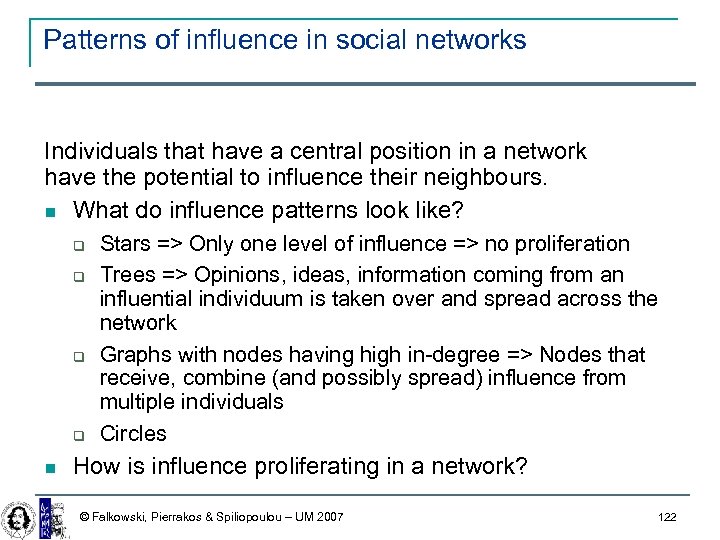 Patterns of influence in social networks Individuals that have a central position in a network have the potential to influence their neighbours. What do influence patterns look like? Stars => Only one level of influence => no proliferation Trees => Opinions, ideas, information coming from an influential individuum is taken over and spread across the network Graphs with nodes having high in-degree => Nodes that receive, combine (and possibly spread) influence from multiple individuals Circles How is influence proliferating in a network? © Falkowski, Pierrakos & Spiliopoulou – UM 2007 122
 "Cascades" in a recommendation network The method of (Leskovec, Singh & Kleinberg, PAKDD'06) . . . Information cascades are phenomena in which an action or idea becomes widely adopted due to influence by others. . . (Leskovec, Singh & Kleinberg, PAKDD'06) © Falkowski, Pierrakos & Spiliopoulou – UM 2007 123
 "Cascades" in a recommendation network The method of (Leskovec, Singh & Kleinberg, PAKDD'06) . . . Information cascades are phenomena in which an action or idea becomes widely adopted due to influence by others. . . (Leskovec, Singh & Kleinberg, PAKDD'06) An information cascade is more than information dissemination. © Falkowski, Pierrakos & Spiliopoulou – UM 2007 A cascade is a pattern of influence. 124
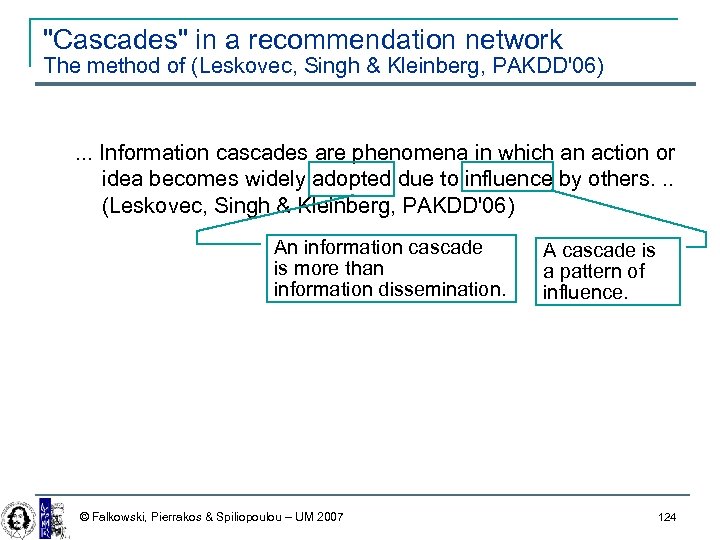
 "Cascades" in a recommendation network The method of (Leskovec, Singh & Kleinberg, PAKDD'06) . . . Information cascades are phenomena in which an action or idea becomes widely adopted due to influence by others. . . (Leskovec, Singh & Kleinberg, PAKDD'06) Objectives: Modeling influence in a recommendation network Discovering patterns of influence – cascades Understanding the structure of cascades Are they stars around a center, trees that reflect a spread of influence, or are they more complex? What is the interplay between the underlying network and the cascades we see in it? © Falkowski, Pierrakos & Spiliopoulou – UM 2007 125
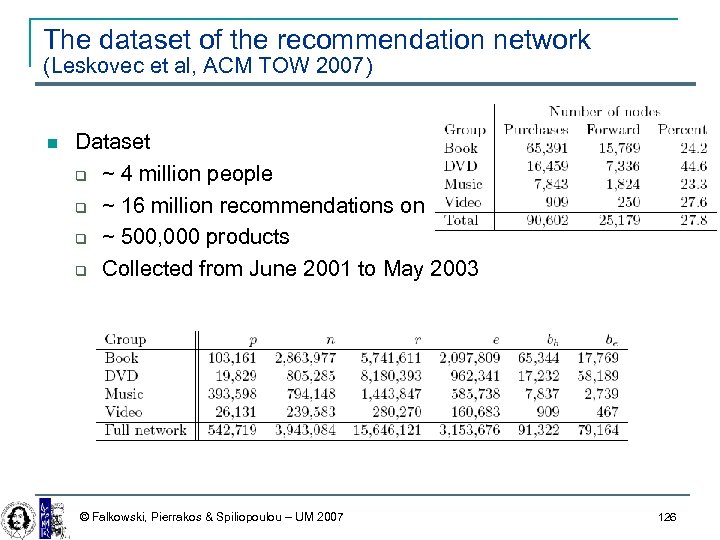 The dataset of the recommendation network (Leskovec et al, ACM TOW 2007) Dataset ~ 4 million people ~ 16 million recommendations on ~ 500, 000 products Collected from June 2001 to May 2003 © Falkowski, Pierrakos & Spiliopoulou – UM 2007 126
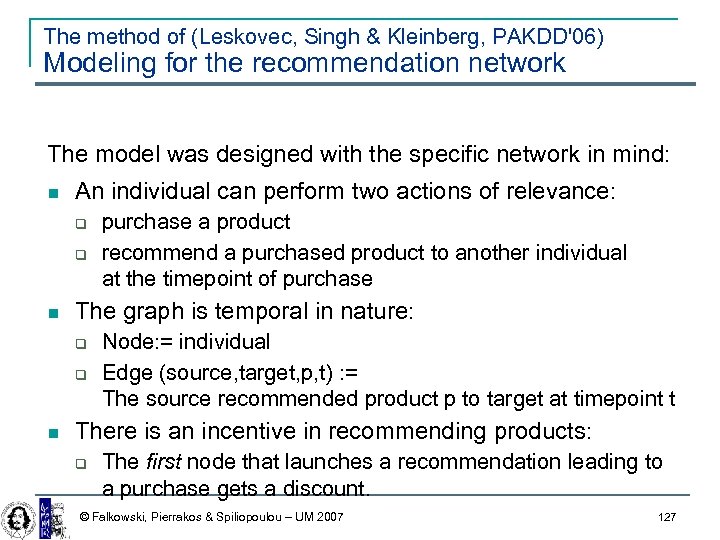 The method of (Leskovec, Singh & Kleinberg, PAKDD'06) Modeling for the recommendation network The model was designed with the specific network in mind: An individual can perform two actions of relevance: The graph is temporal in nature: purchase a product recommend a purchased product to another individual at the timepoint of purchase Node: = individual Edge (source, target, p, t) : = The source recommended product p to target at timepoint t There is an incentive in recommending products: The first node that launches a recommendation leading to a purchase gets a discount. © Falkowski, Pierrakos & Spiliopoulou – UM 2007 127
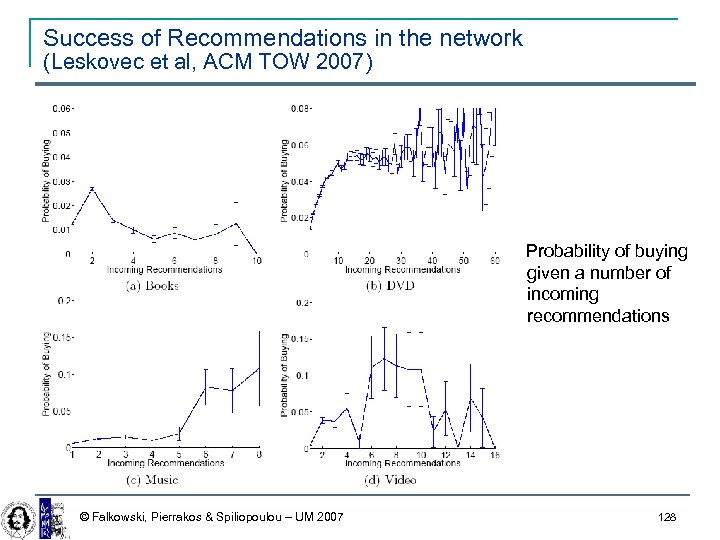 Success of Recommendations in the network (Leskovec et al, ACM TOW 2007) Probability of buying given a number of incoming recommendations © Falkowski, Pierrakos & Spiliopoulou – UM 2007 128
 The method of (Leskovec, Singh & Kleinberg, PAKDD'06) Challenges and assumption in modeling cascades Challenges posed by the specific network: Events that complicate the analysis: An individual may receive recommendations after having purchased a product. An individual may purchase the same product many times. Assumption: If a node receives a recommendation, buys the product and recommends it later on, then we have a cascade. ATTENTION: A person has no incentive to recommend a product already recommended to him/her. © Falkowski, Pierrakos & Spiliopoulou – UM 2007 129
 The method of (Leskovec, Singh & Kleinberg, PAKDD'06) Cleaning the graph and mining cascades Cleaning the graph: Recommendations that were delivered after the purchase were eliminated. Enumerating local cascades: Recommendations that did not lead to a purchase were eliminated. For each node v, only edges up to h hops away are considered (independently of direction). Subgraph matching: Small cascades are matched exactly (allowing for isomorphisms). Large cascades are matched approximately on their signatures. A signature encompasses number of nodes, number of edges, in-degree and out-degree of nodes. © Falkowski, Pierrakos & Spiliopoulou – UM 2007 130
 The method of (Leskovec, Singh & Kleinberg, PAKDD'06) Findings for four product categories Size distribution of cascades All cascades follow power-laws. Products of one category (DVDs) show a significantly different distribution – many large cascades. Structure of frequent cascades The majority of cascades is simple. Many cascades are one-level trees (stars), while there also cascades with common recipients of recommendations. The DVD product category exhibits larger and denser cascades. © Falkowski, Pierrakos & Spiliopoulou – UM 2007 131
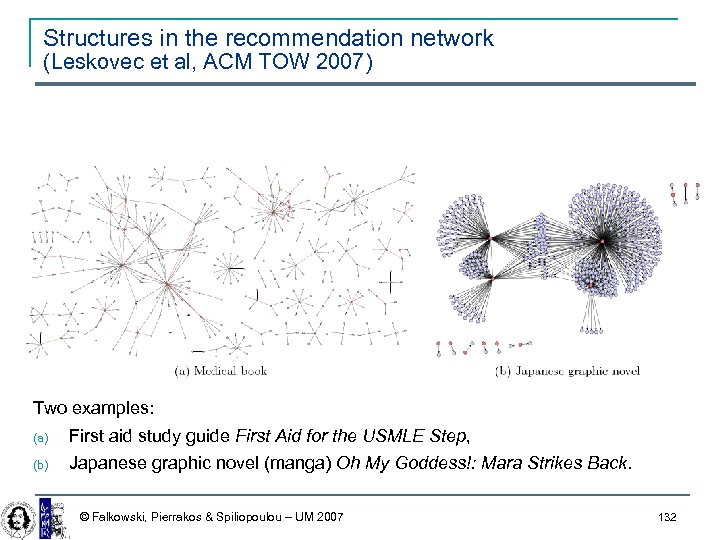 Structures in the recommendation network (Leskovec et al, ACM TOW 2007) Two examples: (a) First aid study guide First Aid for the USMLE Step, (b) Japanese graphic novel (manga) Oh My Goddess!: Mara Strikes Back. © Falkowski, Pierrakos & Spiliopoulou – UM 2007 132
 Rewind on the method of (Leskovec, Singh & Kleinberg, PAKDD'06) A case-driven contribution, using simple graph matching algorithms and a reasonable model of influence cascades and delivering insights for a very large recommendation network. Disregarding the incentive system of the network, there are many cascades, remarkably dense in one product category. What about. . . the role of the incentive system? the differences among the product categories? communities? © Falkowski, Pierrakos & Spiliopoulou – UM 2007 133
 An Impact-Oriented View upon Communities þ Tracing the influential members in a group of individuals þ Patterns of influence in a social network Being influenced to join a community © Falkowski, Pierrakos & Spiliopoulou – UM 2007 134
 Influence and community evolution What moves an individuum to join a community? Understanding the role of influential members on the participation decision Understanding the patterns of proliferating influence How does a community evolve with respect to its members? Modeling and tracing evolving communities Modeling the dynamic aspects of communities BLOCK 3: Community Dynamics © Falkowski, Pierrakos & Spiliopoulou – UM 2007 135
 References for Block 2 - An Impact-Oriented View upon Communities P. Domingos, M. Richardson "Mining the Network Value of Customers", Proc. of KDD'01, p. 57 -66 D. Kempe, J. Kleinberg, E. Tardos "Maximizing the Spread of Influence through a Social Network", Proc. of KDD'03, p. 137 -146 J. Leskovec, A. Singh, J. Kleinberg "Patterns of Influence in a Recommendation Network", Proc. of PAKDD'06 J. Leskovec, L. A. Adamic, B. A. Huberman. The Dynamics of Viral Marketing, ACM Trans. on the Web, (1)1, 2007 © Falkowski, Pierrakos & Spiliopoulou – UM 2007 136
 Block 2 is over. . . Thank you! Questions? © Falkowski, Pierrakos & Spiliopoulou – UM 2007 137
 Presentation Outline þ Block 1: Community models þ Block 2: Three perspectives for community discovery þ Similarity-based perspective þ Interaction-based perspective þ Impact-based perspective Block 3: Community dynamics Block 4: Outlook © Falkowski, Pierrakos & Spiliopoulou – UM 2007 138
 Influence and community evolution What moves an individuum to join a community? Understanding the role of influential members on the participation decision Understanding the patterns of proliferating influence How does a community evolve with respect to its members? Modeling and tracing evolving communities Modeling the dynamic aspects of communities © Falkowski, Pierrakos & Spiliopoulou – UM 2007 139
 What moves an individual to join a community? The influence of network structures (Backstrom et al, KDD'06) Objectives: Identifying structures that influence the decision of individuals in joining the community Understanding the evolution of a community and its interplay (overlap of members) with other communities Backstrom et al study known communities, defined explicitly by their members. Application 1: DBLP Community : = Authors of articles in a given conference Application 2: Live Journal Community: = Declared friends of a person in Live Journal © Falkowski, Pierrakos & Spiliopoulou – UM 2007 140
 Influence of a community on non-members (Backstrom et al, KDD'06) Hypothesis: The propensity of an individual to join a given community depends on the number of friends the individual has inside that community. © Falkowski, Pierrakos & Spiliopoulou – UM 2007 141
 Modeling a community and its fringe (Backstrom et al, KDD'06) Model: A community is a subgraph of interacting members. A community has a "fringe": It consists of individuals that interact with at least k community members but are not community members themselves. Approach: Identify the features that influence members of the fringe to move inside the community. Number of friends in the community Iintensity of interaction with those friends Intensity of interaction among the community friends, . . . © Falkowski, Pierrakos & Spiliopoulou – UM 2007 142
 Influence of a community on non-members (Backstrom et al, KDD'06) Hypothesis: The propensity of an individual to join a given community depends on the number of friends the individual has inside that community. Findings: The likelihood of joining a community increases with the number of friends already in it, but is very noisy for individuals with many friends. The existence of friendships among friends contributes to this likelihood. The two variables make a good predictor of membership propensity. © Falkowski, Pierrakos & Spiliopoulou – UM 2007 143
 Influence and community evolution What moves an individuum to join a community? Understanding the role of influential members on the participation decision Understanding the patterns of proliferating influence How does a community evolve with respect to its members? Modeling and tracing evolving communities Modeling the dynamic aspects of communities © Falkowski, Pierrakos & Spiliopoulou – UM 2007 144
 Capturing community evolution on a data stream Objectives: Detect and understand changes on a existing structures of the social network communities that vanish communities that merge or split Detect new structures – emerging communities Basic approach: The data stream is captured at timepoints t 1, . . . , tn. At each timepoint ti, the patterns of the previous timepoint are juxtaposed (? ) to the new data. © Falkowski, Pierrakos & Spiliopoulou – UM 2007 145
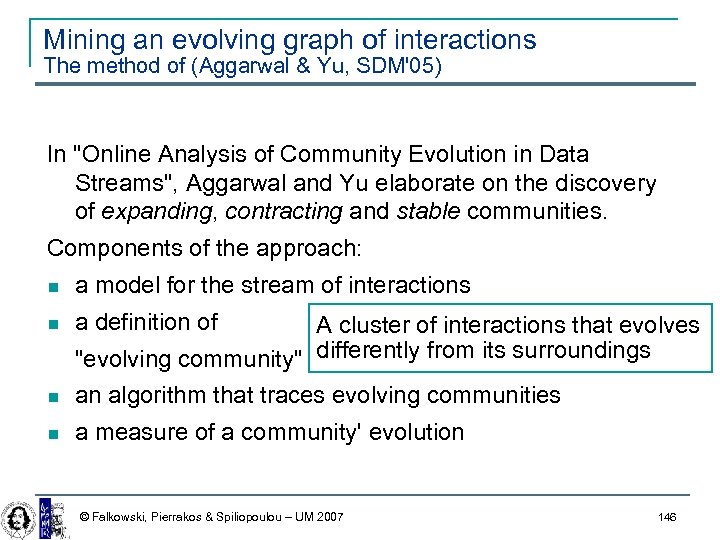 Mining an evolving graph of interactions The method of (Aggarwal & Yu, SDM'05) In "Online Analysis of Community Evolution in Data Streams", Aggarwal and Yu elaborate on the discovery of expanding, contracting and stable communities. Components of the approach: a model for the stream of interactions a definition of an algorithm that traces evolving communities a measure of a community' evolution A cluster of interactions that evolves "evolving community" differently from its surroundings © Falkowski, Pierrakos & Spiliopoulou – UM 2007 146
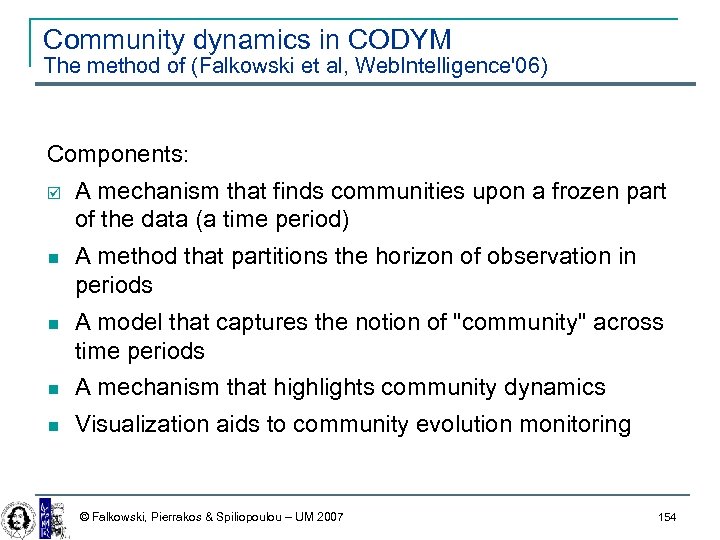
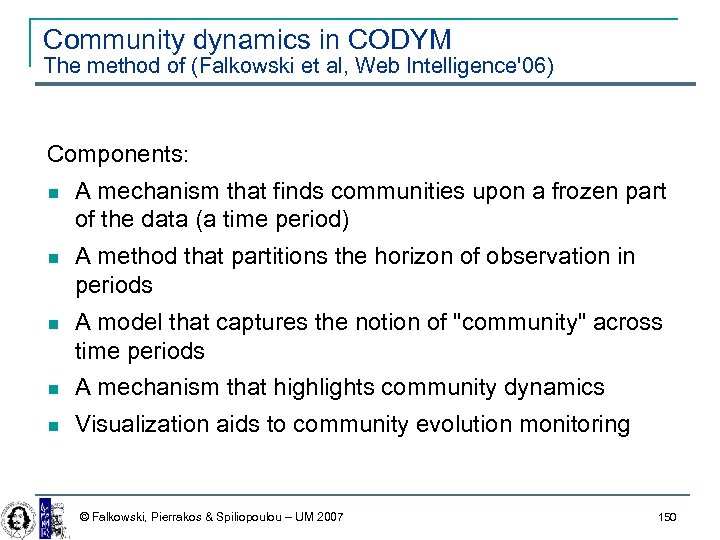 Community dynamics in CODYM The method of (Falkowski et al, Web Intelligence'06) Components: A mechanism that finds communities upon a frozen part of the data (a time period) A method that partitions the horizon of observation in periods A model that captures the notion of "community" across time periods A mechanism that highlights community dynamics Visualization aids to community evolution monitoring © Falkowski, Pierrakos & Spiliopoulou – UM 2007 150
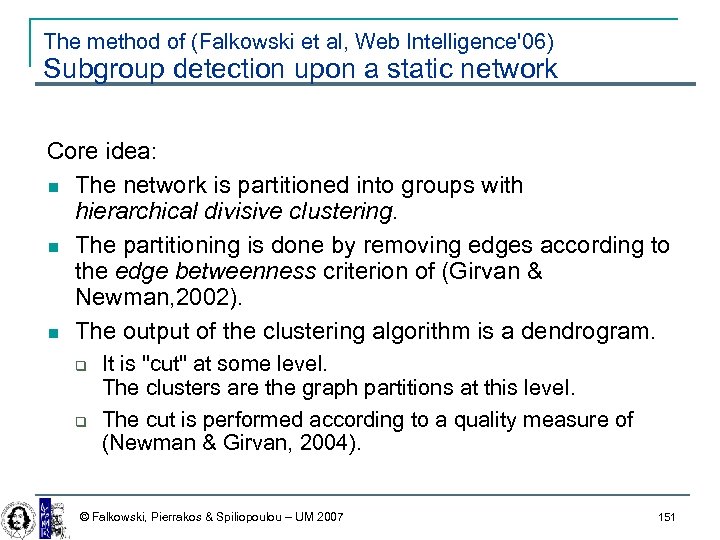 The method of (Falkowski et al, Web Intelligence'06) Subgroup detection upon a static network Core idea: The network is partitioned into groups with hierarchical divisive clustering. The partitioning is done by removing edges according to the edge betweenness criterion of (Girvan & Newman, 2002). The output of the clustering algorithm is a dendrogram. It is "cut" at some level. The clusters are the graph partitions at this level. The cut is performed according to a quality measure of (Newman & Girvan, 2004). © Falkowski, Pierrakos & Spiliopoulou – UM 2007 151
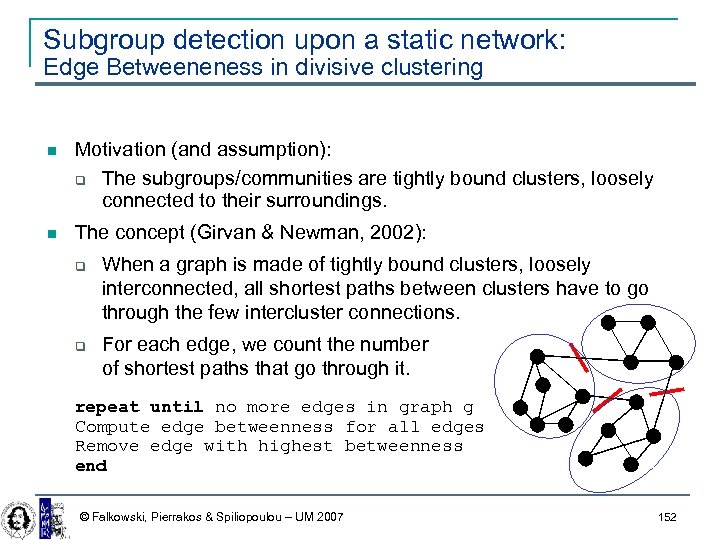 Subgroup detection upon a static network: Edge Betweeneness in divisive clustering Motivation (and assumption): The subgroups/communities are tightly bound clusters, loosely connected to their surroundings. The concept (Girvan & Newman, 2002): When a graph is made of tightly bound clusters, loosely interconnected, all shortest paths between clusters have to go through the few intercluster connections. For each edge, we count the number of shortest paths that go through it. repeat until no more edges in graph g Compute edge betweenness for all edges Remove edge with highest betweenness end © Falkowski, Pierrakos & Spiliopoulou – UM 2007 152
 Subgroup detection upon a static network: Quality measure for cutting the dendrogram The Dendrogram Q-Measure 0. 4 0. 3 0. 2 A network partition is good if most of the edges fall inside the subgroups, while the edges between subgroups are comparatively few. (Girvan & Newman, 2004) 0. 1 0 © Falkowski, Pierrakos & Spiliopoulou – UM 2007 153
 Community dynamics in CODYM The method of (Falkowski et al, Web. Intelligence'06) Components: þ A mechanism that finds communities upon a frozen part of the data (a time period) A method that partitions the horizon of observation in periods A model that captures the notion of "community" across time periods A mechanism that highlights community dynamics Visualization aids to community evolution monitoring © Falkowski, Pierrakos & Spiliopoulou – UM 2007 154
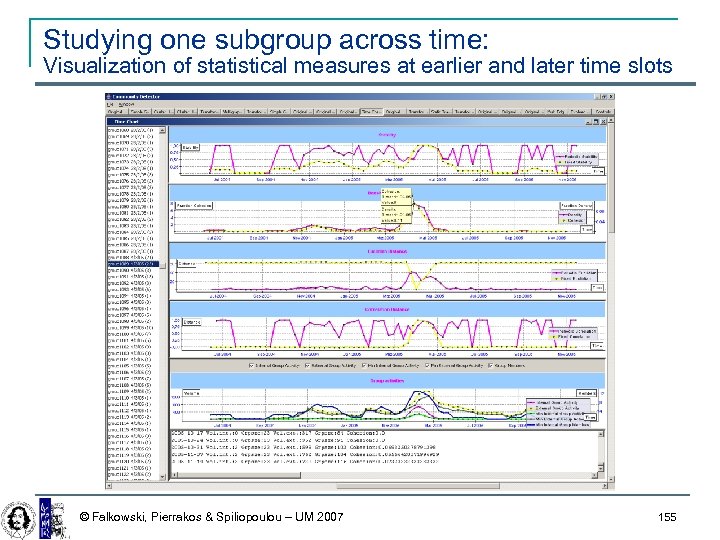 Studying one subgroup across time: Visualization of statistical measures at earlier and later time slots © Falkowski, Pierrakos & Spiliopoulou – UM 2007 155
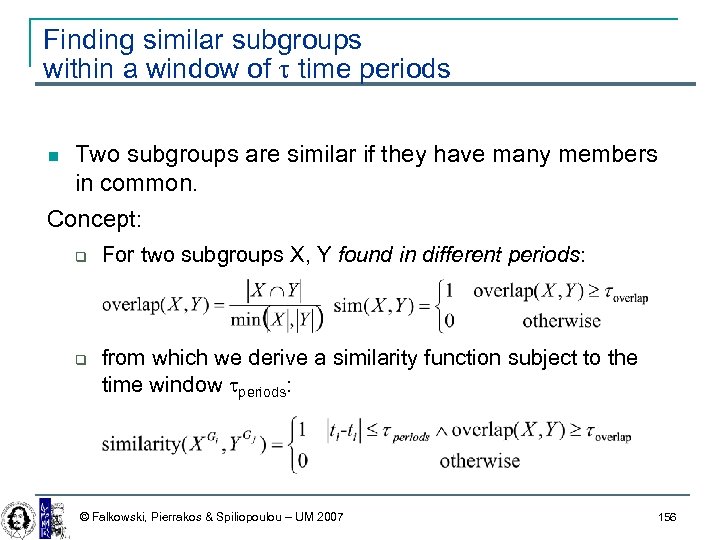 Finding similar subgroups within a window of t time periods Two subgroups are similar if they have many members in common. Concept: For two subgroups X, Y found in different periods: from which we derive a similarity function subject to the time window tperiods: © Falkowski, Pierrakos & Spiliopoulou – UM 2007 156
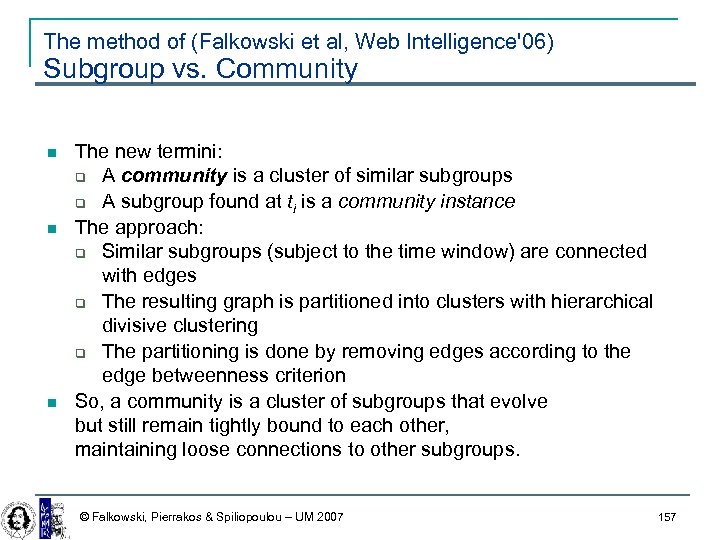 The method of (Falkowski et al, Web Intelligence'06) Subgroup vs. Community The new termini: A community is a cluster of similar subgroups A subgroup found at ti is a community instance The approach: Similar subgroups (subject to the time window) are connected with edges The resulting graph is partitioned into clusters with hierarchical divisive clustering The partitioning is done by removing edges according to the edge betweenness criterion So, a community is a cluster of subgroups that evolve but still remain tightly bound to each other, maintaining loose connections to other subgroups. © Falkowski, Pierrakos & Spiliopoulou – UM 2007 157
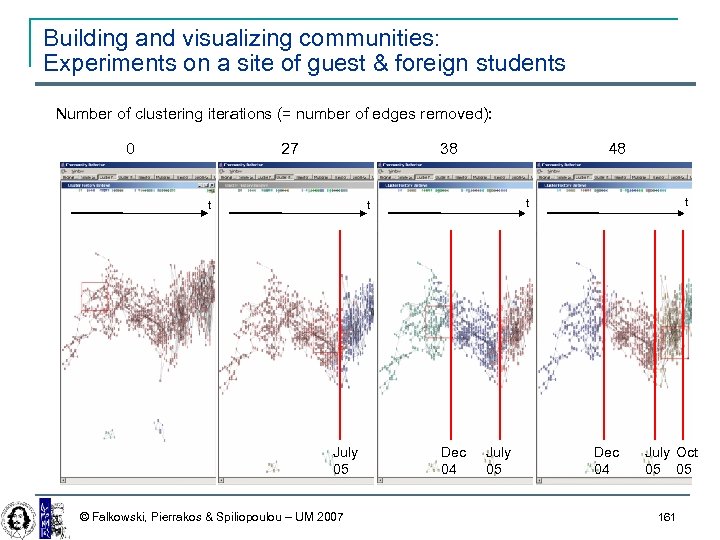
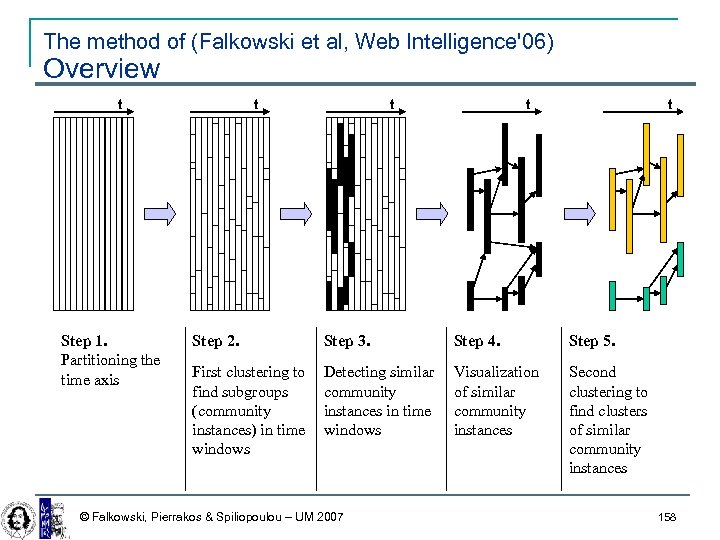 The method of (Falkowski et al, Web Intelligence'06) Overview t Step 1. Partitioning the time axis t t Step 2. Step 3. Step 4. Step 5. First clustering to find subgroups (community instances) in time windows Detecting similar community instances in time windows Visualization of similar community instances Second clustering to find clusters of similar community instances © Falkowski, Pierrakos & Spiliopoulou – UM 2007 158
 Data Set approx. 1, 000 actors 250, 000 interactions (guestbook entries) over a period of 18 months (June 2004 – November 2005, 75 weeks) Sliding Window Approach Window length of 14 days; step width of ½ of the window length © Falkowski, Pierrakos & Spiliopoulou – UM 2007 159
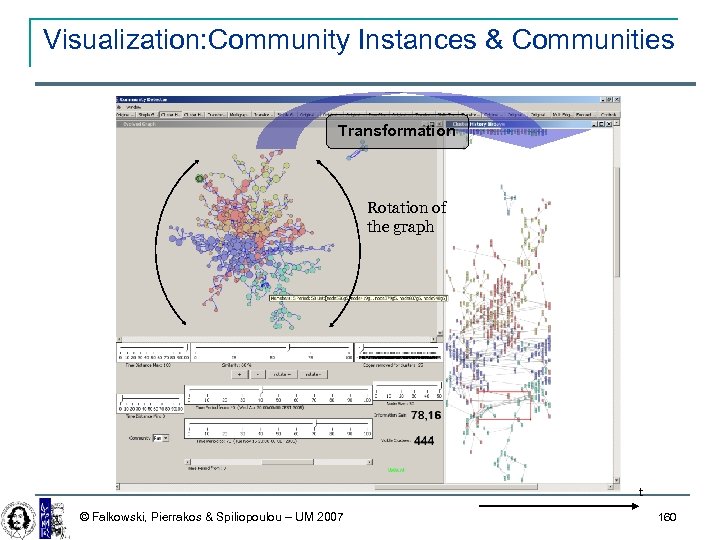 Visualization: Community Instances & Communities Transformation Rotation of the graph t © Falkowski, Pierrakos & Spiliopoulou – UM 2007 160
 Building and visualizing communities: Experiments on a site of guest & foreign students Number of clustering iterations (= number of edges removed): 0 27 38 t 48 July 05 © Falkowski, Pierrakos & Spiliopoulou – UM 2007 t t t Dec 04 July 05 Dec 04 July Oct 05 05 161
 Community dynamics in CODYM The method of (Falkowski et al, Web. Intelligence'06) Components: þ A mechanism that finds communities upon a frozen part of the data (a time period) A method that partitions the horizon of observation in periods þ A model that captures the notion of "community" across time periods þ A mechanism that highlights community dynamics þ Visualization aids to community evolution monitoring © Falkowski, Pierrakos & Spiliopoulou – UM 2007 162
 References for Block 3: Community Dynamics L. Backstrom, D. Huttenlocher, J. Kleinberg, X. Lan "Group Formation in Large Social Networks: Membership, Growth and Evolution", Proc. of KDD'06, p. 44 -54 Charu Aggarwal and Philip Yu "Online Analysis of Community Evolution in Data Streams", Proc. of SIAM Data Mining Conf. , 2005. T. Falkowski, J. Bartelheimer, M. Spiliopoulou "Mining and Visualizing the Evolution of Subgroups in Social Networks", Proc. of IEEE/WIC/ACM Int. Conf. on Web Intelligence (WI'06), Hong Kong, Dec. 2006 © Falkowski, Pierrakos & Spiliopoulou – UM 2007 163
 Presentation Outline þ Block 1: Community models þ Block 2: Three perspectives for community discovery þ Similarity-based perspective þ Interaction-based perspective þ Impact-based perspective þ Block 3: Community dynamics Block 4: Outlook © Falkowski, Pierrakos & Spiliopoulou – UM 2007 164
 Summarizing the landscape Communities are modeled and studied from different perspectives. Data mining is applied, among else, to: discover communities, i. e. groups of instances that adhere to an a priori defined model derive recommendations for a person on the basis of persons with similar interests persons that navigate in a similar way persons that interact persons that influence each other people most similar to her people with similar interests and preferences people of potential influence upon her (including people she trusts) study the dynamics of communities to understand how communities emerge, evolve and stagnate to gain insights on the role of individuals in a community © Falkowski, Pierrakos & Spiliopoulou – UM 2007 165
 Active user community discovery Discovery of Web user communities. Discovery of interest and navigation patterns. Analysis of usage data. Communities of content consumers. Discovery of Web communities. Analysis of Web structure. Discovery of graph patterns (linkage of pages). Communities of content creators. © Falkowski, Pierrakos & Spiliopoulou – UM 2007 166
 Active user community discovery Web users are increasingly becoming content creators and service providers. At the same time they remain content consumers and service users. Many new services support active users: Users as publishers, e. g. blogs, fora etc. Collaborative creation of content and knowledge, e. g. flickr, del. icio. us, Yahoo!Answers, Wikipedia, bibsonomy, etc. © Falkowski, Pierrakos & Spiliopoulou – UM 2007 167
 Active user community discovery Active user community discovery combines the existing approaches, taking into account: Usage: what the user has chosen to “consume“. Content: what the user has contributed Structure: links between content created by different users. Additionally it introduces a range of new issues: Consumption-creation pattern discovery. Separating characteristics between consumer and creator sub-communities. Active user community models combine this information into comprehensive generic user models. Discovery can also help evolve (manually created) communities. © Falkowski, Pierrakos & Spiliopoulou – UM 2007 168
 Community and environs Communities are at the visier of malefactors. How to protect a community from spam content? How to secure community property (including shared intellectual property and person-private information) against adversaries? Different types of solutions: Spam detection Security measures against intruders Privacy-preserving measures against adversaries A few words on Reputation mechanisms trust and Communities of trust © Falkowski, Pierrakos & Spiliopoulou – UM 2007 reputation 169
 Communities of Trust Figallo states: “Trust is the social lubricant that makes community possible. ”, in Figallo, Cliff. Hosting Web Communities (New York: John Wiley & Sons, Inc. ) 1998 Trust: Community members know with whom they ’re dealing and that it’s safe to do so. Without trust a community cannot function. Trust is basis for reputation. Key elements are: Letting members build trust over time. Posting clear policies regarding privacy and online actions and abiding by them. Allowing different levels of privacy so members can reveal more about themselves as they get to know each other. Providing experts with certifications and detailed profiles so members are able to trust that “experts” have the qualifications they claim. Allowing member verification of profiles. Hands-off management that garners more trust and encourages greater selfgovernance than interfering or policing management. © Falkowski, Pierrakos & Spiliopoulou – UM 2007 170
 Communities of Reputation: Reputation is what is generally said or believed about a person’s or thing’s character or standing. (Concise Oxford Dictionary) Reputation vs. Trust: “I trust you because of your good reputation. ” “I trust you despite your bad reputation. ” Trust is a personal and subjective phenomenon Reputation is a collective measure of trustworthiness Reputation lies at the juncture between identity and trust and influences behavior in several ways. Reputation measures give members a way to evaluate each other, so they know whom to trust, or whom not to trust. It helps people form the best alliances to get the desired information; and the desire to have a good reputation discourages bad behavior and encourages members to request feedback © Falkowski, Pierrakos & Spiliopoulou – UM 2007 171
 Reputation Network Architectures Centralized Reputation Systems A “reputation center” collects ratings for a given community member from other community members who know him. The reputation centre derives a reputation score for every participant, and makes all scores publicly available. The idea is that transactions with reputable participants are likely to result in more favorable outcomes than transactions with disreputable participants. Distributed Reputation Systems Distributed reputation stores instead of a single center. Ratings are submitted when members are interacting with each other. A community member who wants to interact with another member, must find the distributed stores or obtain ratings from as many community members as possible who have had interaction experience with the examined member. © Falkowski, Pierrakos & Spiliopoulou – UM 2007 172
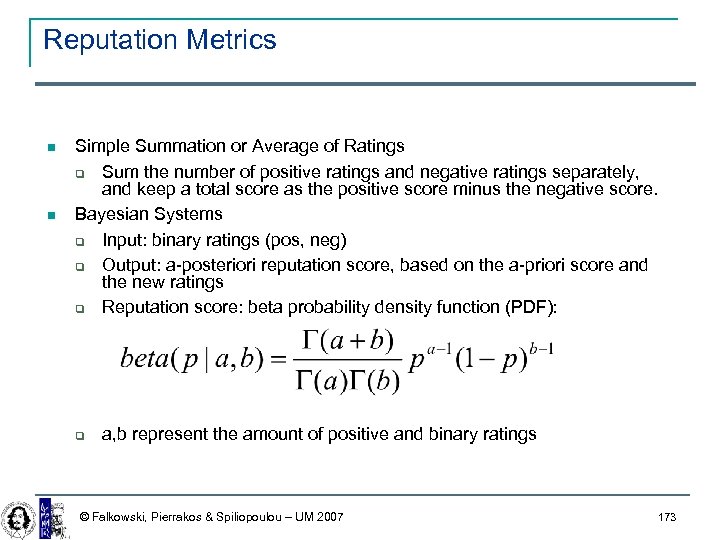 Reputation Metrics Simple Summation or Average of Ratings Sum the number of positive ratings and negative ratings separately, and keep a total score as the positive score minus the negative score. Bayesian Systems Input: binary ratings (pos, neg) Output: a-posteriori reputation score, based on the a-priori score and the new ratings Reputation score: beta probability density function (PDF): a, b represent the amount of positive and binary ratings © Falkowski, Pierrakos & Spiliopoulou – UM 2007 173
 Reputation Metrics Discrete Trust Models Use discrete statements not continuous measures, e. g. trustworthiness x can be referred as Very Trustworthy, Untrustworthy and Very Untrustworthy. Flow Models A participant's reputation increases as a function of incoming flow, and decreases as a function of outgoing flow. (e. g. Page. Rank) © Falkowski, Pierrakos & Spiliopoulou – UM 2007 174
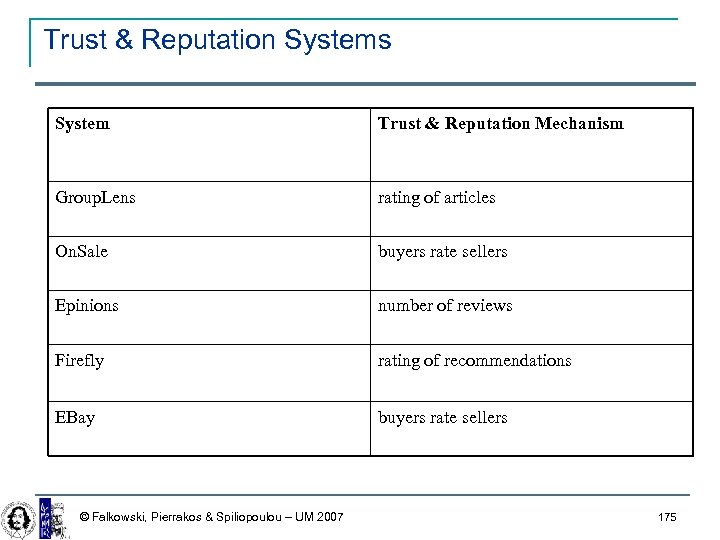 Trust & Reputation Systems System Trust & Reputation Mechanism Group. Lens rating of articles On. Sale buyers rate sellers Epinions number of reviews Firefly rating of recommendations EBay buyers rate sellers © Falkowski, Pierrakos & Spiliopoulou – UM 2007 175
 Modeling, Discovering and Using User Communities Thank you! Questions? © Falkowski, Pierrakos & Spiliopoulou – UM 2007 176