 Скачать презентацию Disclosure Limitation Methods and Information Loss for Tabular
e275b60fadbf8018f0b93b159283f171.ppt
- Количество слайдов: 32



Disclosure Limitation Methods and Information Loss for Tabular Data George T. Duncan, Stephen E. Fienberg, Ramayya Krishnan, Rema Padman and Stephen F. Roehrig Carnegie Mellon University
Focus of the Talk • Categorical data: – Compilations of surveys and other data gathering efforts – Tables of counts (e. g. , number of females in Metropolis with income > $200, 000) – Cf. microdata • Does the release of a table allow inference of a sensitive attribute value for an individual (e. g. , Lois Lane’s income)? – Exact value – Range of values – Probability distribution
Some Tough Questions • Exact, interval or probabilistic disclosure? • Should we analyze a data product in isolation? Or must we look at the suite of products released? • Longitudinal data can be especially revealing. How can we know next year’s data? • What about linkage with external data sources? Are we responsible for everything that’s out there?
The SDL Problem Disclosure Risk: Information About Confidential Items Original Data Maximum Tolerable Risk Released Data No Data Utility: Information About Legitimate Items
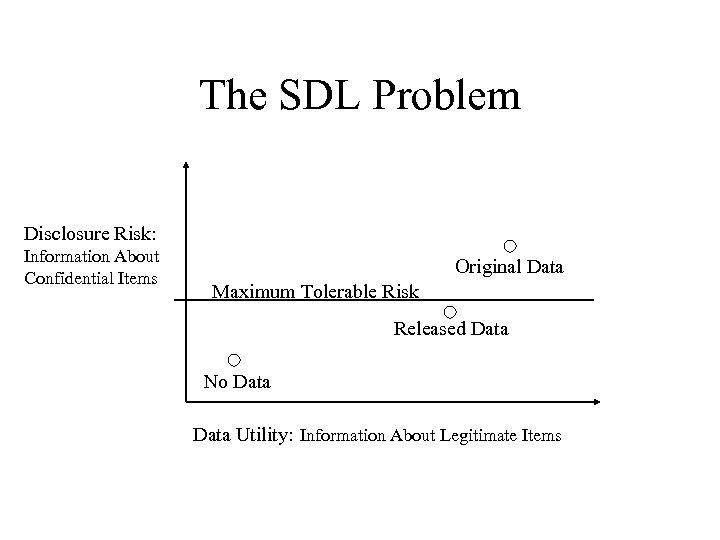
Risk and Utility • Disclosure risk depends on – The definition of disclosure, and – The ways disclosure could occur. • Data utility is – A measure of information loss, and – Maximal for the original data. • Often we can trade off disclosure risk and data utility
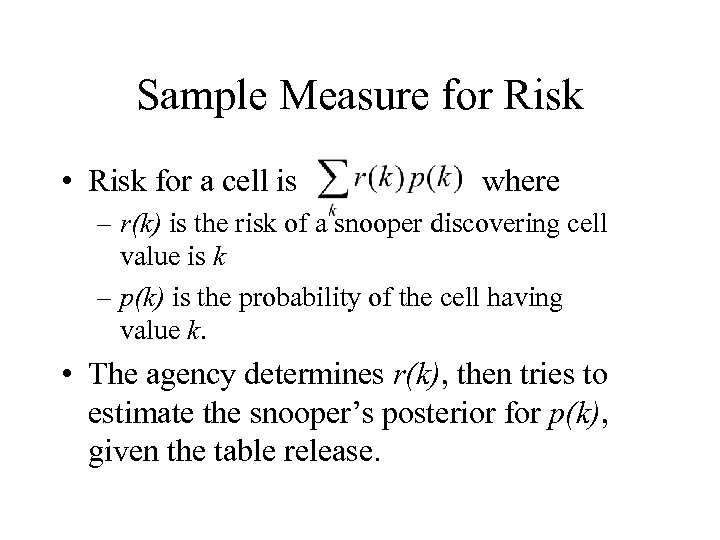
Sample Measure for Risk • Risk for a cell is where – r(k) is the risk of a snooper discovering cell value is k – p(k) is the probability of the cell having value k. • The agency determines r(k), then tries to estimate the snooper’s posterior for p(k), given the table release.
Sample Measures for Utility • Cell-oriented: mean square precision of the user’s posterior distribution for a cell. • Table-oriented: change in 2 for 2 -way tables, other (or multiple) measures of association for n-way tables.
Disclosure Auditing • “Traditional” risk assessment • A data disseminator follows these steps: – Audit a proposed release for disclosures – If potential disclosures exist , apply SDL – Audit the result to ensure protection – Repeat as necessary • Once more, what is a disclosure?
Disclosure Auditing (cont. ) • Disclosure may be a sensitive cell value known – with certainty, – to be in a narrow range, or – with high probability. • Let’s examine some SDL techniques, considering – – The various definitions of disclosure, The difficulty of applying and auditing them, The utility of the disclosure-limited results, and Whether they are useful for higher-dimensional tables.
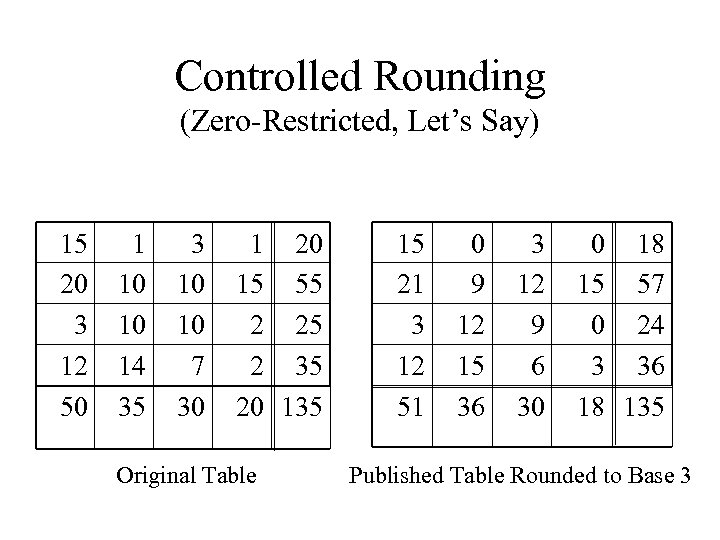
Controlled Rounding (Zero-Restricted, Let’s Say) 15 20 3 12 50 1 10 10 14 35 3 10 10 7 30 1 20 15 55 2 25 2 35 20 135 Original Table 15 21 3 12 51 0 9 12 15 36 3 12 9 6 30 0 18 15 57 0 24 3 36 18 135 Published Table Rounded to Base 3
Controlled Rounding (cont. ) • No exact disclosures can occur. • The “feasibility interval” of any cell is its published value ± (b-1), where b is the rounding base (except close to zero). • Finding a rounding is easy for 2 -way tables. • Finding a rounding is harder (and may not even exist) for higher-dimensional tables.
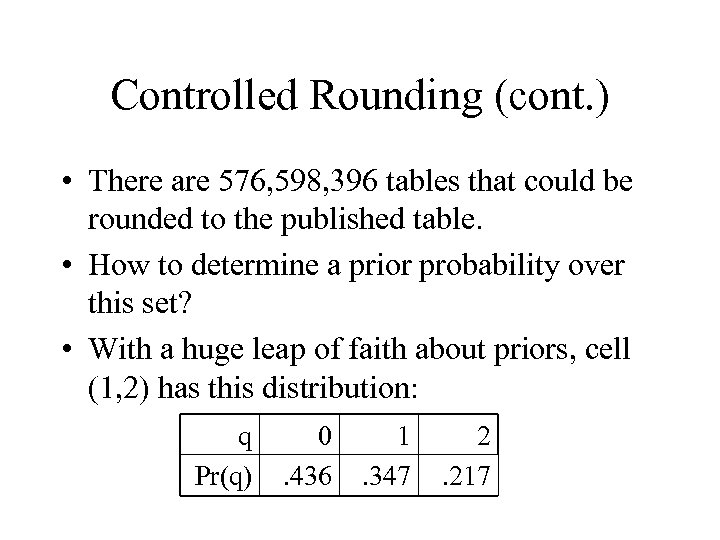
Controlled Rounding (cont. ) • There are 576, 598, 396 tables that could be rounded to the published table. • How to determine a prior probability over this set? • With a huge leap of faith about priors, cell (1, 2) has this distribution: q Pr(q) 0. 436 1. 347 2. 217
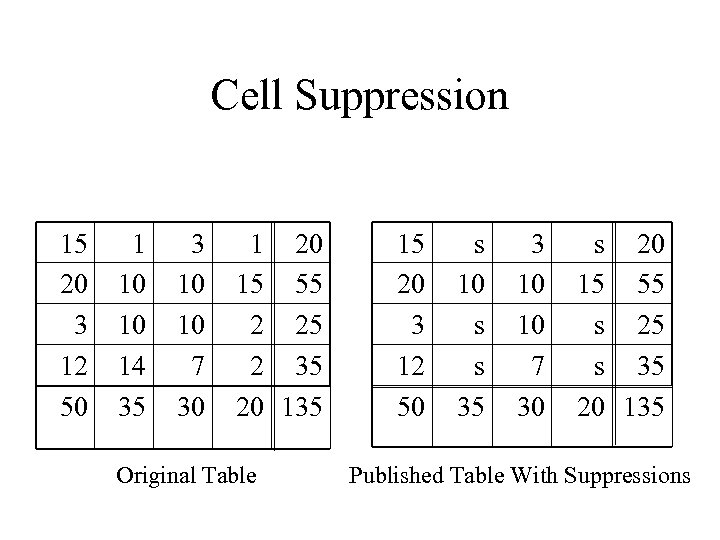
Cell Suppression 15 20 3 12 50 1 10 10 14 35 3 10 10 7 30 1 20 15 55 2 25 2 35 20 135 Original Table 15 20 3 12 50 s 10 s s 35 3 10 10 7 30 s 20 15 55 s 25 s 35 20 135 Published Table With Suppressions
Cell Suppression (cont. ) • Finding a suppression pattern can be hard computationally; heuristics may be untrustworthy. • Auditing is often done with linear programming (LP), finding upper and lower cell bounds. • In higher dimensions, LP may give fractional bounds---how to interpret? • How does an analyst use a table with suppressions?
Cell Suppression (cont. ) • Again, there are many possible true tables. – For 2 -way tables, they are easily enumerated. – For n-way tables, it’s quite hard. • Again, it’s difficult to specify priors (need to know the exact implementation of suppression algorithm). • Posterior distributions for suppressed cells can be had, but it’s a lot of work.
Publishing Only Some Margins of an N-Way Table • Think of the n-way “base table” as being fully suppressed. • The published marginal tables constrain the values in the base table. • Auditing characterizes cells in the base table and/or other unpublished margins. • Here’s an example:
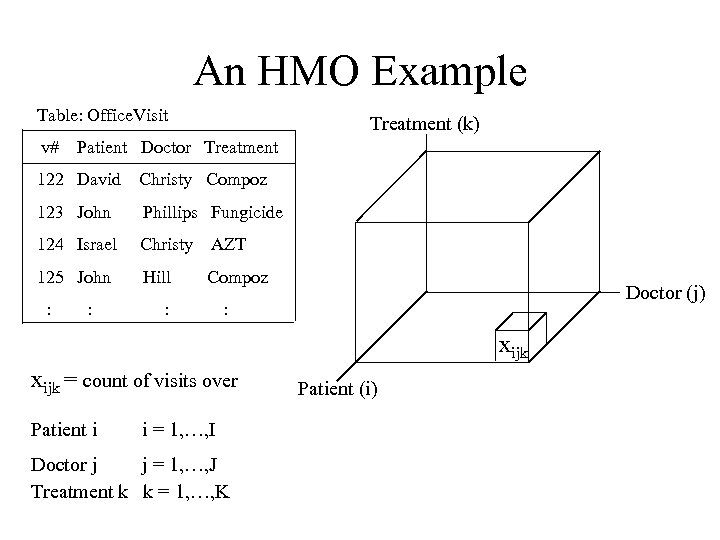
An HMO Example Table: Office. Visit v# Treatment (k) Patient Doctor Treatment 122 David Christy Compoz 123 John Phillips Fungicide 124 Israel Christy AZT 125 John Hill Compoz : : : Doctor (j) : xijk = count of visits over Patient i i = 1, …, I Doctor j j = 1, …, J Treatment k k = 1, …, K Patient (i)
The HMO Example (cont. ) • Obviously we don’t broadcast Patient-Doctor. Treatment. • The view Patient-Treatment is also sensitive. • But the Accounting Dept. has Patient-Doctor. • And the Physician Review Board has Doctor. Treatment. • Ted works in Accounting, his wife Alice is on the Physician Review Board, and Israel is an occasional babysitter for them.
More Generally • An n-way table of sensitive data. • Some collection of lower-dimensional marginal tables are proposed for publication. • How to find bounds, or better, distributions, for the sensitive cells? • Recall linear programming often gives fractional bounds.
Integer Linear Programming? • Many techniques, but generally very slow compared to continuous LP. • Empirically, “Gomory cuts” work well. • Some special problems have the “integer rounding property. ” • Much more to be done here.
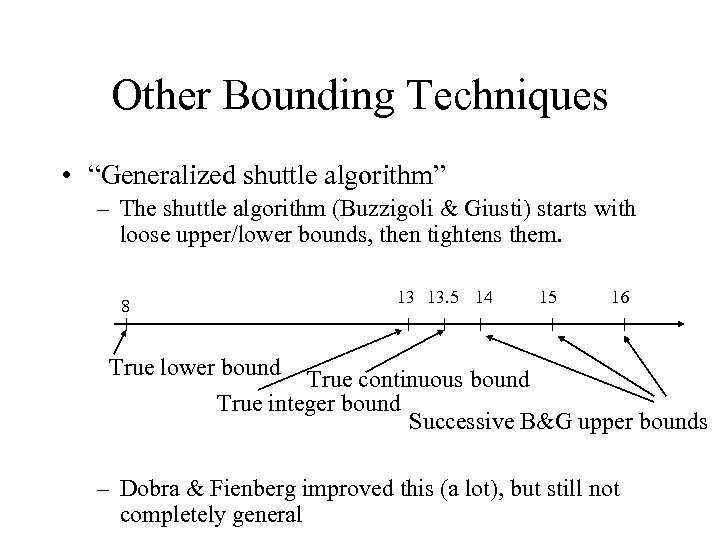
Other Bounding Techniques • “Generalized shuttle algorithm” – The shuttle algorithm (Buzzigoli & Giusti) starts with loose upper/lower bounds, then tightens them. 8 13 13. 5 14 15 16 True lower bound True continuous bound True integer bound Successive B&G upper bounds – Dobra & Fienberg improved this (a lot), but still not completely general
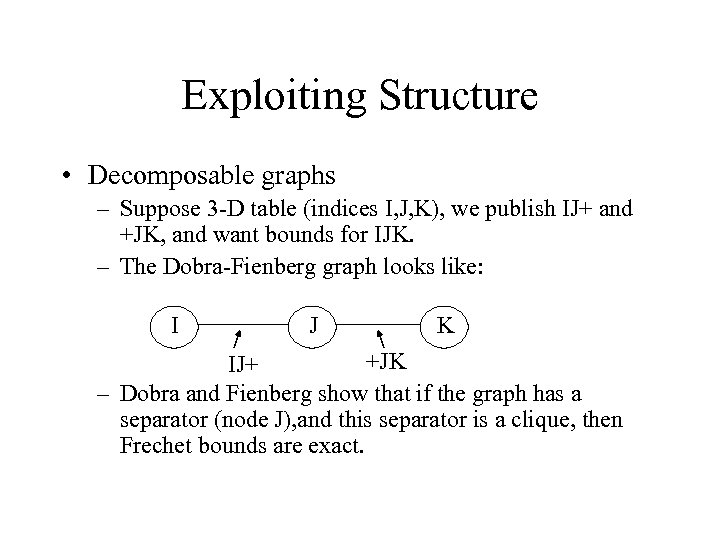
Exploiting Structure • Decomposable graphs – Suppose 3 -D table (indices I, J, K), we publish IJ+ and +JK, and want bounds for IJK. – The Dobra-Fienberg graph looks like: I J K +JK IJ+ – Dobra and Fienberg show that if the graph has a separator (node J), and this separator is a clique, then Frechet bounds are exact.
Probabilities of Cell Values • Diaconis and Sturmfels (1998) show to sample from the space of tables that agree with known marginals. • Not hard to extend to tables with suppressions. • They use results from commutative algebra to find a “Gröbner basis”, a list of moves that change a table but leave the margins fixed. • A random walk using these moves carries you uniformly thorough the space of tables. • Tally the proportion of time a sensitive cell takes on different values.
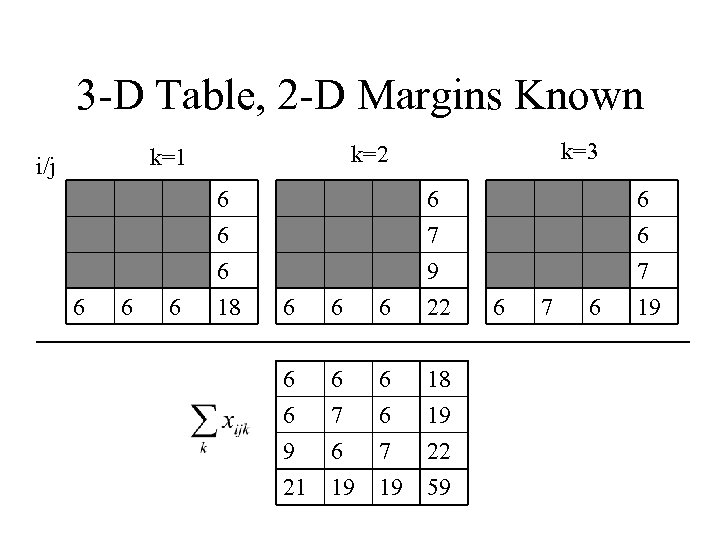
3 -D Table, 2 -D Margins Known i/j 6 6 6 k=3 k=2 k=1 6 6 6 18 6 6 7 9 22 6 6 9 21 6 7 6 19 6 6 7 19 18 19 22 59 6 7 6 6 6 7 19
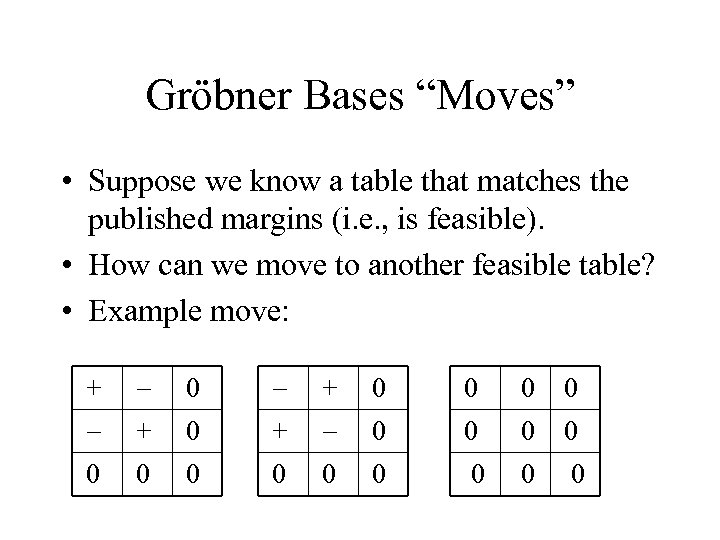
Gröbner Bases “Moves” • Suppose we know a table that matches the published margins (i. e. , is feasible). • How can we move to another feasible table? • Example move: + 0 + 0 0 0 0 0
Computing the Gröbner Basis • The general-purpose program Macauley can find the 3 3 3 basis in about 7 hours (300 MHz PC). • A specialized program does this in 25 m. S. • The 4 3 3 basis takes 20 minutes (628 moves) • The 5 3 3 basis takes 3 months (3236 moves)…
Exploiting Structure Again • If the independence graph of the released marginals is decomposable, the Gröbner basis is easily determined. • If the graph is “almost” decomposable, the basis can be obtained by piecing together bases for smaller problems. • Dobra demonstrates that these methods can be used to estimate sensitive cell distributions.
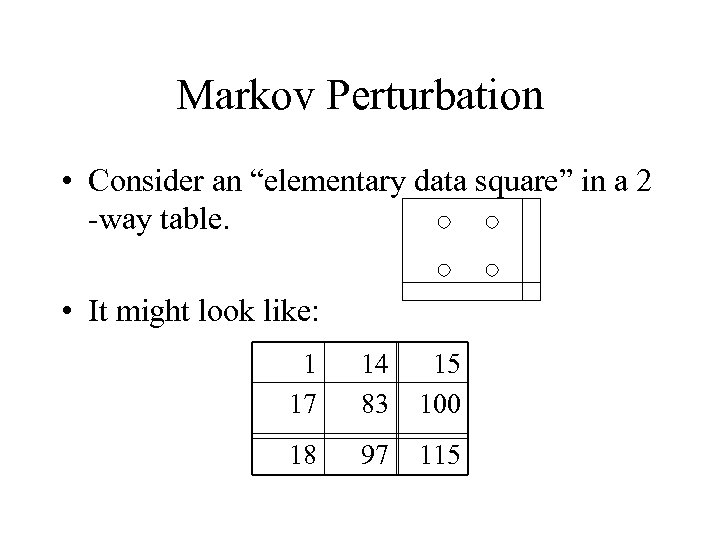
Markov Perturbation • Consider an “elementary data square” in a 2 -way table. • It might look like: 1 17 14 83 15 100 18 97 115
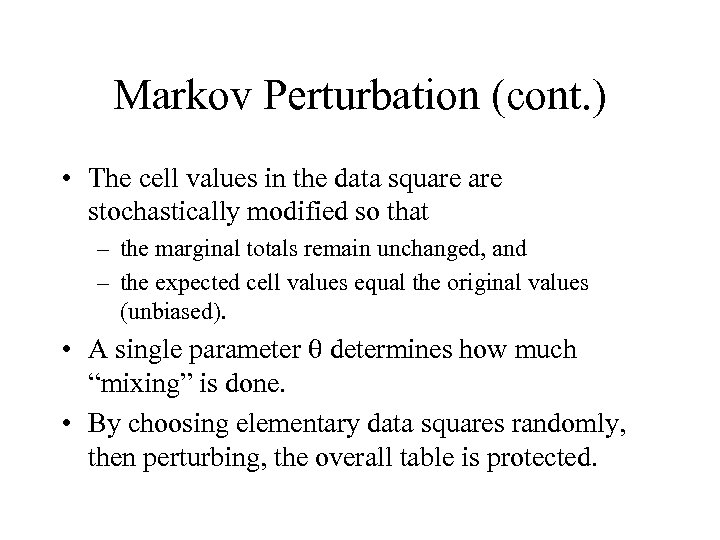
Markov Perturbation (cont. ) • The cell values in the data square stochastically modified so that – the marginal totals remain unchanged, and – the expected cell values equal the original values (unbiased). • A single parameter determines how much “mixing” is done. • By choosing elementary data squares randomly, then perturbing, the overall table is protected.
Markov Perturbation (cont. ) • In the book chapter, we show a Bayesian analysis comparing – Markov perturbation – Cell suppression, and – Rounding. • The resulting Risk-Utility Confidentiality Map shows some of the trade-offs in choosing a SDP method.
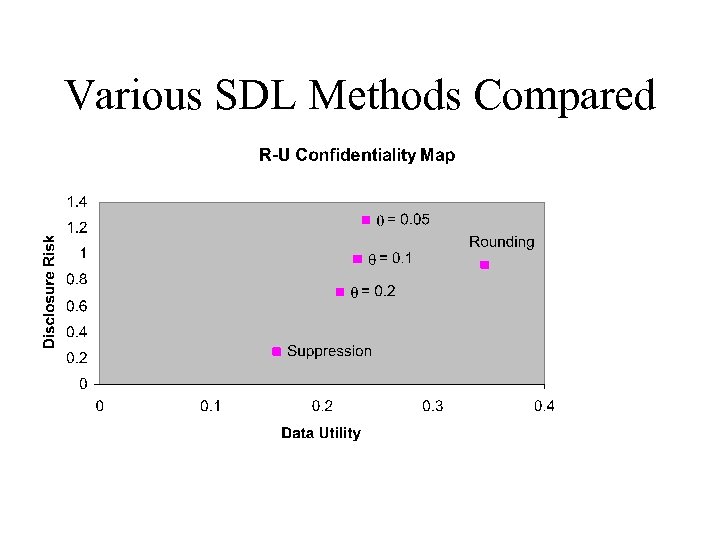
Various SDL Methods Compared
Directions for Research • Distributions of cell values in protected tables. • Examining the consequences of different user/intruder prior distributions on SDL method tradeoffs. • New procedures with increased data utility while maintaining low risk. • All of this for higher-dimensional tables.
Скачать презентацию Disclosure Limitation Methods and Information Loss for Tabular
e275b60fadbf8018f0b93b159283f171.ppt