


 Скачать презентацию Disc 2 The Civil War
c704edaf54fb37308c74e906ed3f27f5.ppt
- Количество слайдов: 38
 • Disc 2 • The Civil War • 46 minutes
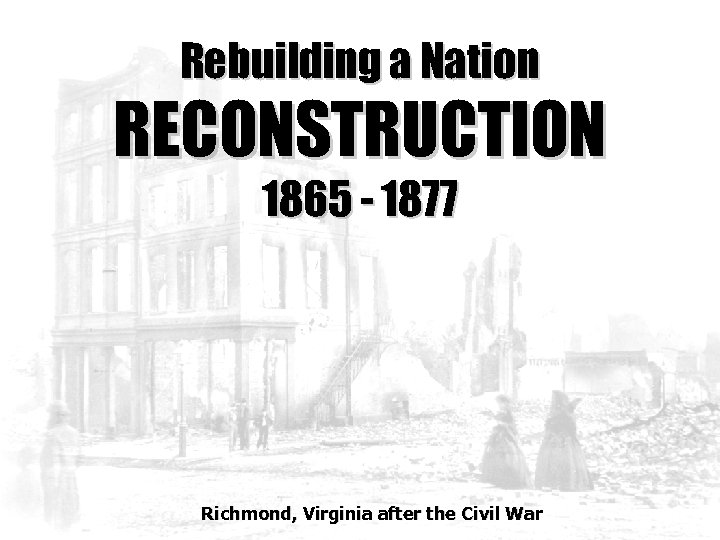 Rebuilding a Nation RECONSTRUCTION 1865 - 1877 Richmond, Virginia after the Civil War
 Words to Know Reconstruction (re-con-struck-shun): A term used to refer to the time period from 1865 to 1877 when the nation re-united and rebuilt after the Civil War ended.
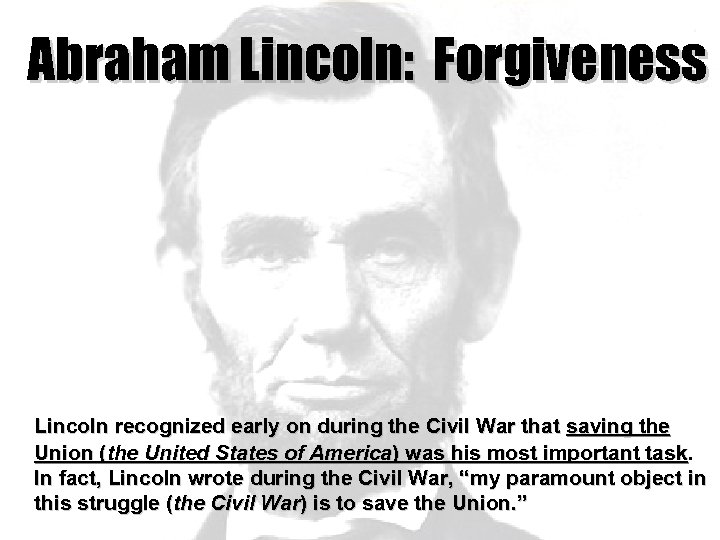 Abraham Lincoln: Forgiveness Lincoln recognized early on during the Civil War that saving the Union (the United States of America) was his most important task. In fact, Lincoln wrote during the Civil War, “my paramount object in this struggle (the Civil War) is to save the Union. ”
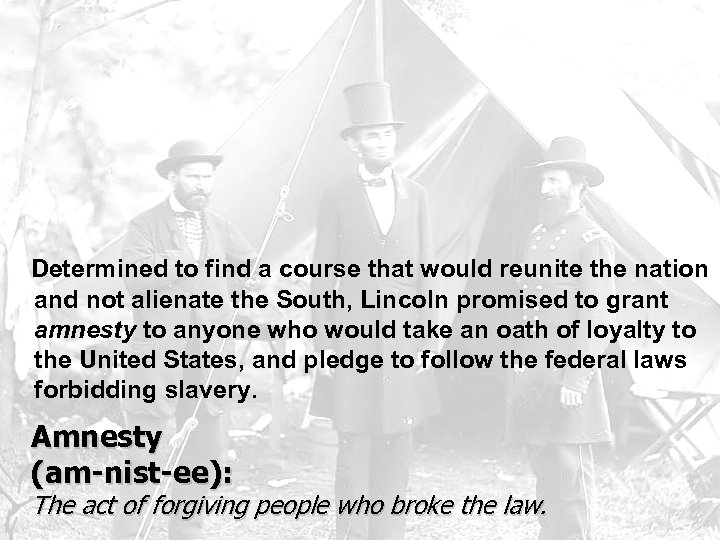 Determined to find a course that would reunite the nation and not alienate the South, Lincoln promised to grant amnesty to anyone who would take an oath of loyalty to the United States, and pledge to follow the federal laws forbidding slavery. Amnesty (am-nist-ee): The act of forgiving people who broke the law.
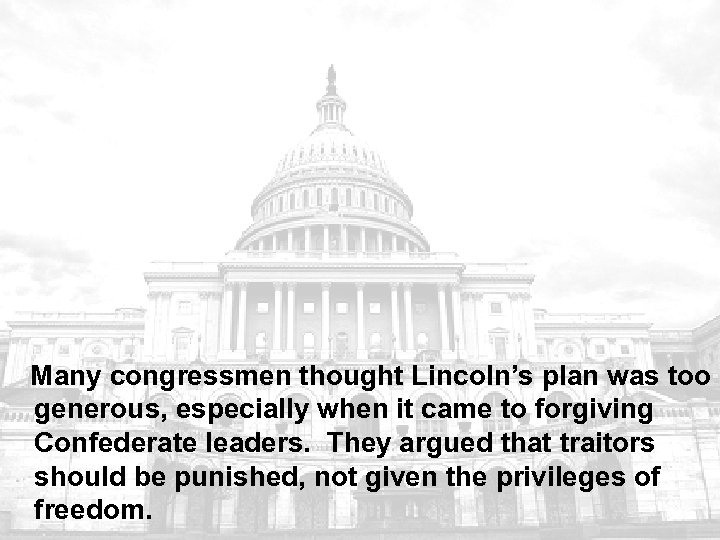 Many congressmen thought Lincoln’s plan was too generous, especially when it came to forgiving Confederate leaders. They argued that traitors should be punished, not given the privileges of freedom.
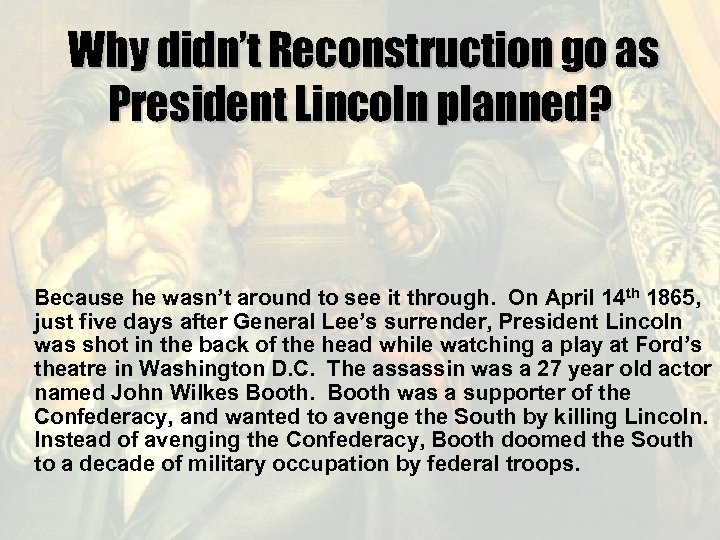 Why didn’t Reconstruction go as President Lincoln planned? Because he wasn’t around to see it through. On April 14 th 1865, just five days after General Lee’s surrender, President Lincoln was shot in the back of the head while watching a play at Ford’s theatre in Washington D. C. The assassin was a 27 year old actor named John Wilkes Booth was a supporter of the Confederacy, and wanted to avenge the South by killing Lincoln. Instead of avenging the Confederacy, Booth doomed the South to a decade of military occupation by federal troops.
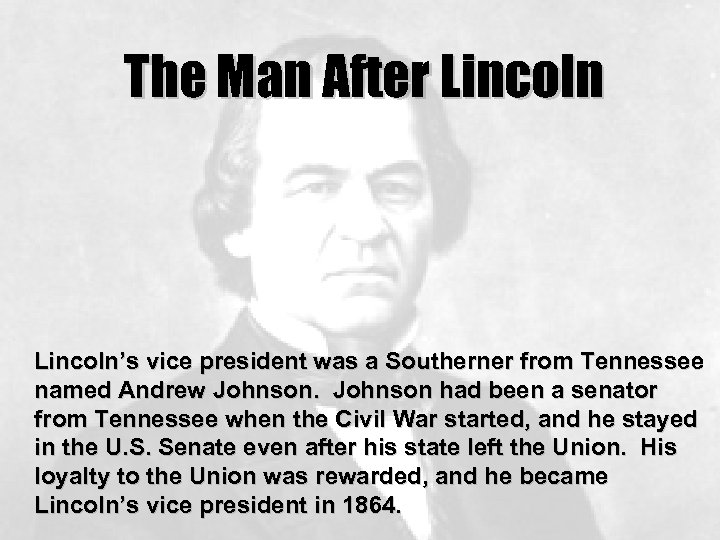 The Man After Lincoln’s vice president was a Southerner from Tennessee named Andrew Johnson had been a senator from Tennessee when the Civil War started, and he stayed in the U. S. Senate even after his state left the Union. His loyalty to the Union was rewarded, and he became Lincoln’s vice president in 1864.
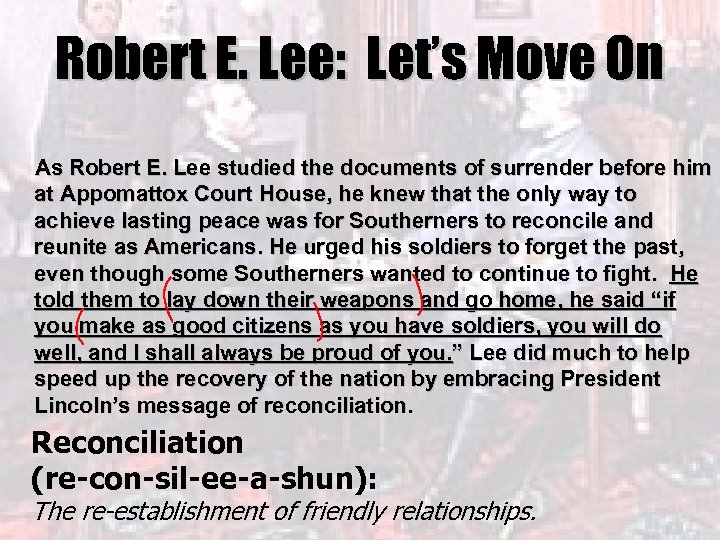 Robert E. Lee: Let’s Move On As Robert E. Lee studied the documents of surrender before him at Appomattox Court House, he knew that the only way to achieve lasting peace was for Southerners to reconcile and reunite as Americans. He urged his soldiers to forget the past, even though some Southerners wanted to continue to fight. He told them to lay down their weapons and go home, he said “if you make as good citizens as you have soldiers, you will do well, and I shall always be proud of you. ” Lee did much to help speed up the recovery of the nation by embracing President Lincoln’s message of reconciliation. Reconciliation (re-con-sil-ee-a-shun): The re-establishment of friendly relationships.
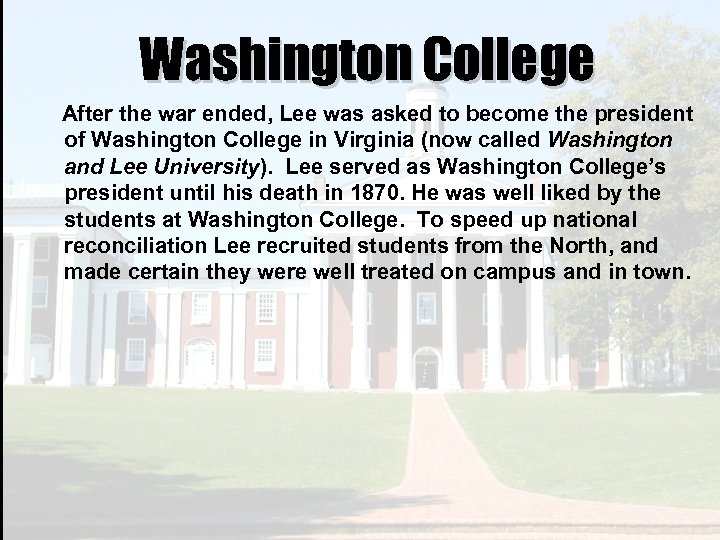 Washington College After the war ended, Lee was asked to become the president of Washington College in Virginia (now called Washington and Lee University). Lee served as Washington College’s president until his death in 1870. He was well liked by the students at Washington College. To speed up national reconciliation Lee recruited students from the North, and made certain they were well treated on campus and in town.
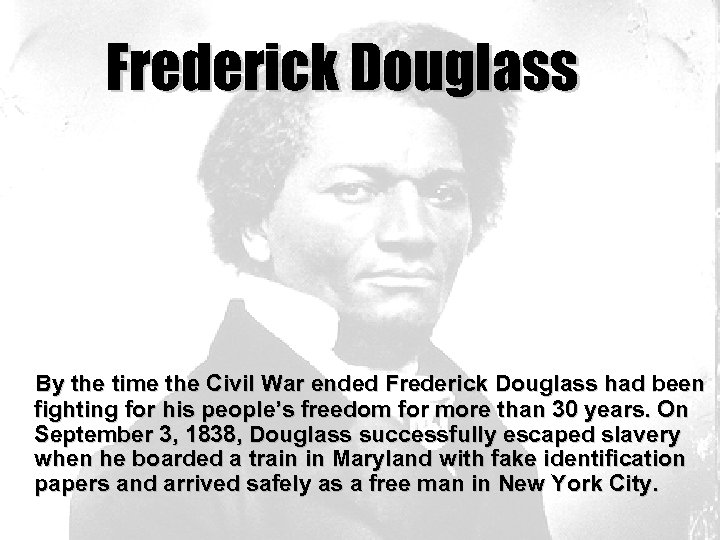 Frederick Douglass By the time the Civil War ended Frederick Douglass had been fighting for his people’s freedom for more than 30 years. On September 3, 1838, Douglass successfully escaped slavery when he boarded a train in Maryland with fake identification papers and arrived safely as a free man in New York City.
 • Disc 1: Division • Frederick Douglass & the institution of slavery • 20: 58 – 28: 28 (7 min 30 secs)
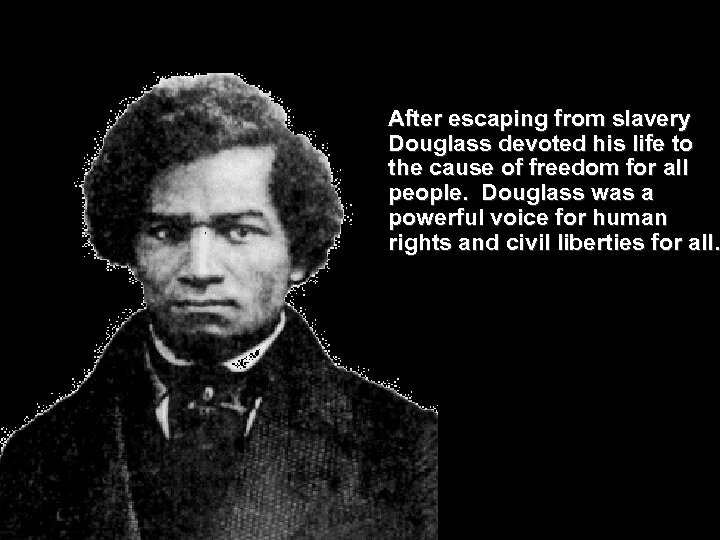 After escaping from slavery Douglass devoted his life to the cause of freedom for all people. Douglass was a powerful voice for human rights and civil liberties for all.
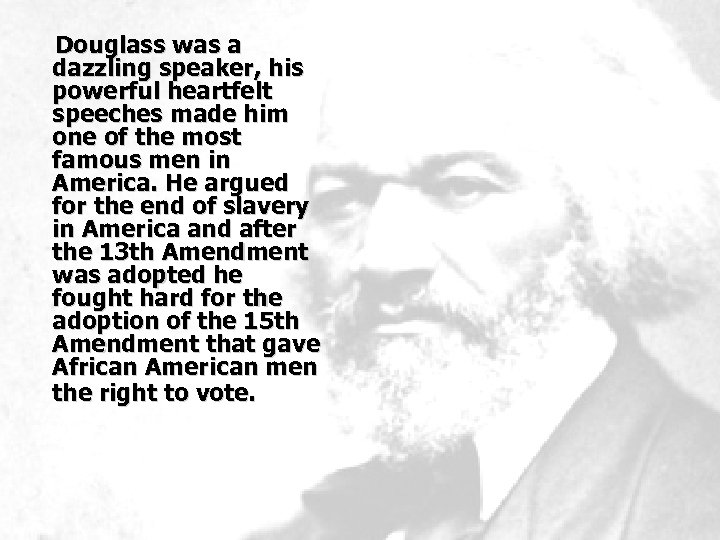 Douglass was a dazzling speaker, his powerful heartfelt speeches made him one of the most famous men in America. He argued for the end of slavery in America and after the 13 th Amendment was adopted he fought hard for the adoption of the 15 th Amendment that gave African American men the right to vote.
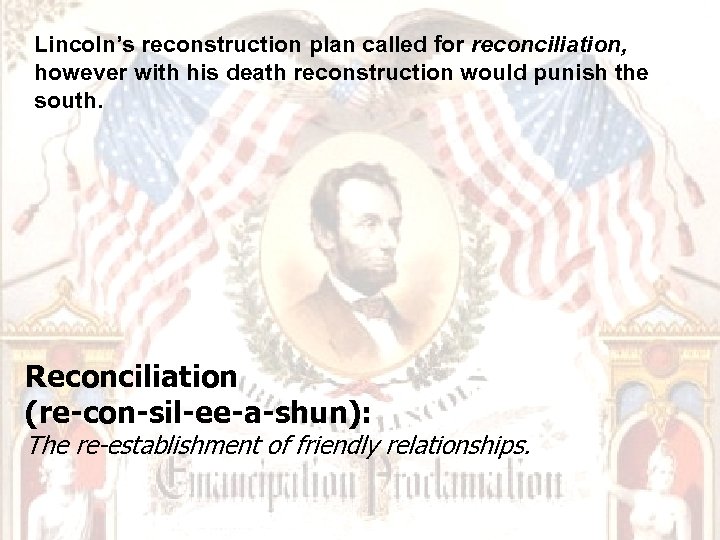 Lincoln’s reconstruction plan called for reconciliation, however with his death reconstruction would punish the south. Reconciliation (re-con-sil-ee-a-shun): The re-establishment of friendly relationships.
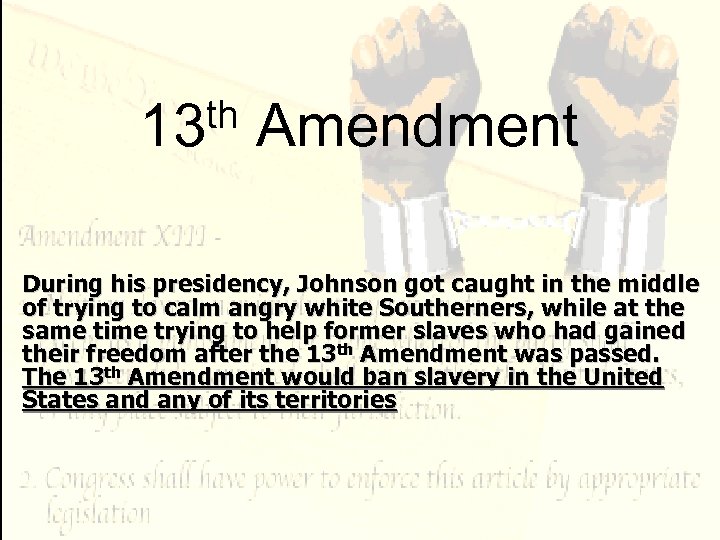 th 13 Amendment During his presidency, Johnson got caught in the middle of trying to calm angry white Southerners, while at the same time trying to help former slaves who had gained their freedom after the 13 th Amendment was passed. The 13 th Amendment would ban slavery in the United States and any of its territories
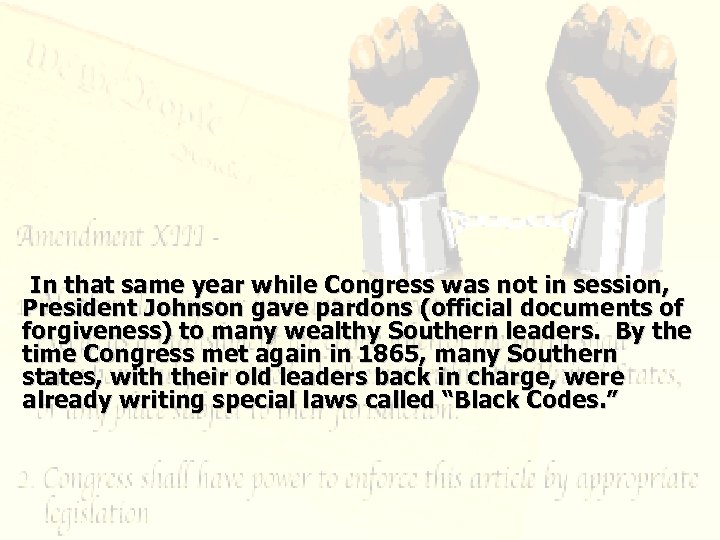 In that same year while Congress was not in session, President Johnson gave pardons (official documents of forgiveness) to many wealthy Southern leaders. By the time Congress met again in 1865, many Southern states, with their old leaders back in charge, were already writing special laws called “Black Codes. ”
 “Black codes” were written to limit the freedoms of African Americans after the 13 th Amendment was passed. These laws kept blacks from getting jobs other than field hands, prohibited them from voting, forbid them to sit on juries, limited their right to testify against white men in court, forbid them from owning guns, and did not allow them to attend schools with whites.
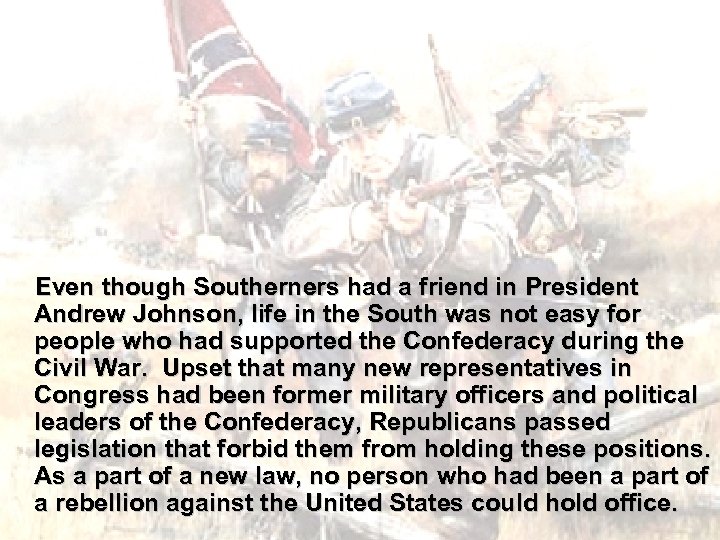 Even though Southerners had a friend in President Andrew Johnson, life in the South was not easy for people who had supported the Confederacy during the Civil War. Upset that many new representatives in Congress had been former military officers and political leaders of the Confederacy, Republicans passed legislation that forbid them from holding these positions. As a part of a new law, no person who had been a part of a rebellion against the United States could hold office.
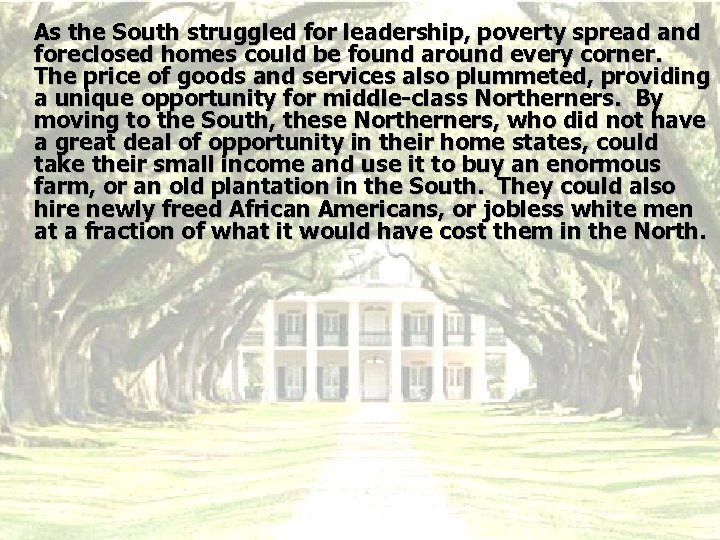 As the South struggled for leadership, poverty spread and foreclosed homes could be found around every corner. The price of goods and services also plummeted, providing a unique opportunity for middle-class Northerners. By moving to the South, these Northerners, who did not have a great deal of opportunity in their home states, could take their small income and use it to buy an enormous farm, or an old plantation in the South. They could also hire newly freed African Americans, or jobless white men at a fraction of what it would have cost them in the North.
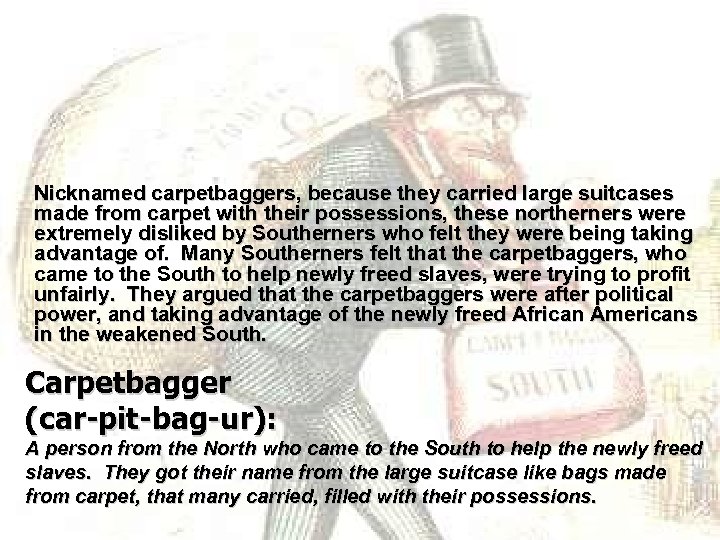 Nicknamed carpetbaggers, because they carried large suitcases made from carpet with their possessions, these northerners were extremely disliked by Southerners who felt they were being taking advantage of. Many Southerners felt that the carpetbaggers, who came to the South to help newly freed slaves, were trying to profit unfairly. They argued that the carpetbaggers were after political power, and taking advantage of the newly freed African Americans in the weakened South. Carpetbagger (car-pit-bag-ur): A person from the North who came to the South to help the newly freed slaves. They got their name from the large suitcase like bags made from carpet, that many carried, filled with their possessions.
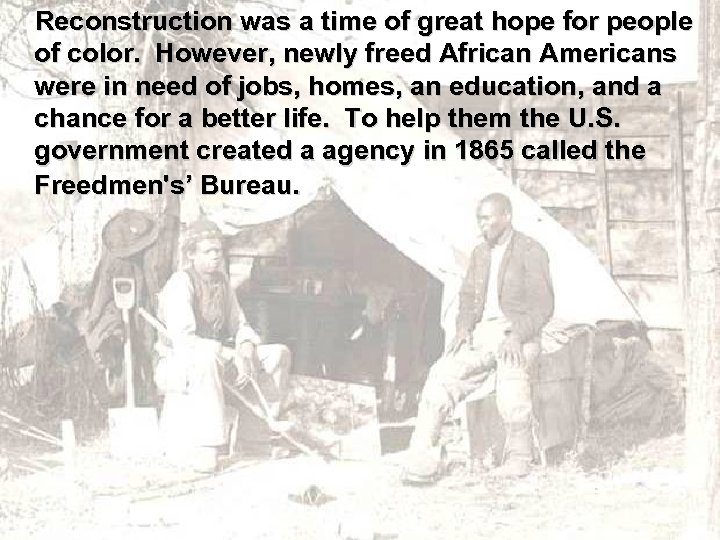 Reconstruction was a time of great hope for people of color. However, newly freed African Americans were in need of jobs, homes, an education, and a chance for a better life. To help them the U. S. government created a agency in 1865 called the Freedmen's’ Bureau.
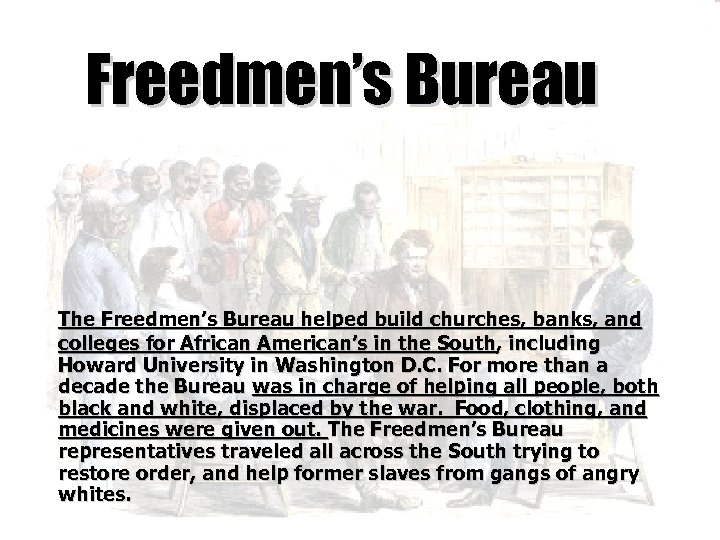 Freedmen’s Bureau The Freedmen’s Bureau helped build churches, banks, and colleges for African American’s in the South, including Howard University in Washington D. C. For more than a decade the Bureau was in charge of helping all people, both black and white, displaced by the war. Food, clothing, and medicines were given out. The Freedmen’s Bureau representatives traveled all across the South trying to restore order, and help former slaves from gangs of angry whites.
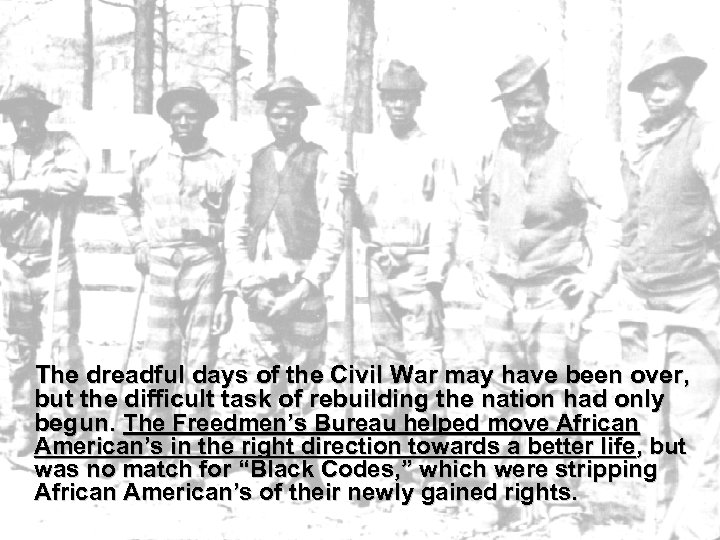 The dreadful days of the Civil War may have been over, but the difficult task of rebuilding the nation had only begun. The Freedmen’s Bureau helped move African American’s in the right direction towards a better life, but was no match for “Black Codes, ” which were stripping African American’s of their newly gained rights.
 In response to the cruel treatment African Americans were facing in the South with the passage of “Black Codes, ” Congress passed the Civil Rights Act of 1866. The law entitled African Americans born in the United States full citizenship. To back up the law, federal troops were authorized to protect their rights. Northern soldiers patrolled the South to make sure the Civil Rights Act was obeyed. The passage of the act overjoyed four million formerly enslaved African Americans.
 President Johnson vetoed the Civil Rights Act of 1866 arguing that Congress was overstepping its authority by passing the bill. He said that the Civil Rights Act was unconstitutional. Congress would override his veto. However, fearing that the Civil Rights Act might be overturned in Court, Congress passed a new Amendment to the Constitution in 1866, The Fourteenth Amendment
 th Amendment 14. The Fourteenth Amendment made all former slaves citizens of the United States, and granted them equal protection under the law. It was the equal protection of the law that was vitally important to freed slaves.
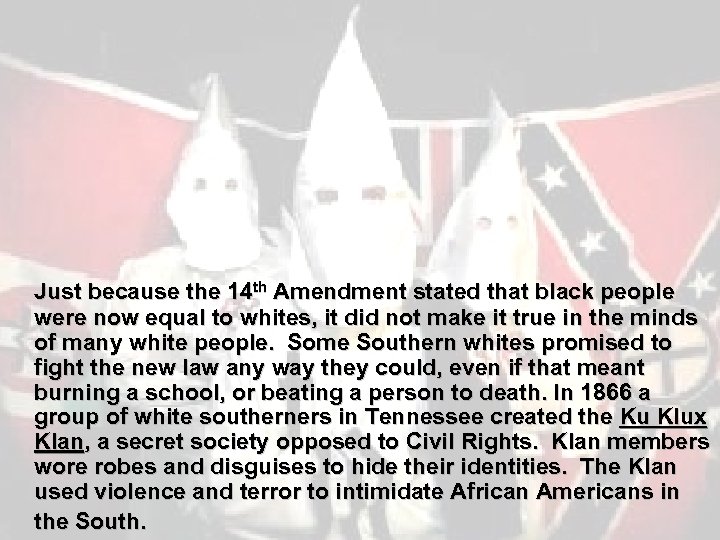 Just because the 14 th Amendment stated that black people were now equal to whites, it did not make it true in the minds of many white people. Some Southern whites promised to fight the new law any way they could, even if that meant burning a school, or beating a person to death. In 1866 a group of white southerners in Tennessee created the Ku Klux Klan, a secret society opposed to Civil Rights. Klan members wore robes and disguises to hide their identities. The Klan used violence and terror to intimidate African Americans in the South.
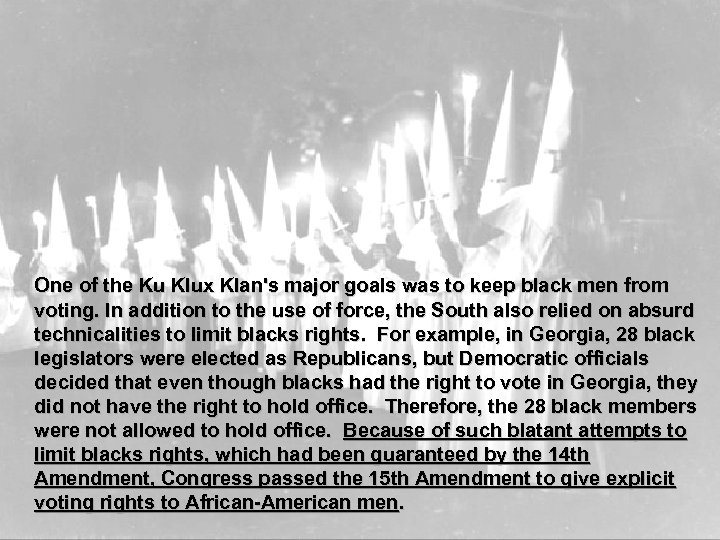 One of the Ku Klux Klan's major goals was to keep black men from voting. In addition to the use of force, the South also relied on absurd technicalities to limit blacks rights. For example, in Georgia, 28 black legislators were elected as Republicans, but Democratic officials decided that even though blacks had the right to vote in Georgia, they did not have the right to hold office. Therefore, the 28 black members were not allowed to hold office. Because of such blatant attempts to limit blacks rights, which had been guaranteed by the 14 th Amendment, Congress passed the 15 th Amendment to give explicit voting rights to African-American men.
 the 15 th Amendment to the Constitution ensures all male citizens the right to vote regardless of race or previous condition of servitude.
 As a result of the 15 th Amendment to the Constitution more than 600 African Americans were elected as representatives to state legislatures, including the United States Congress.
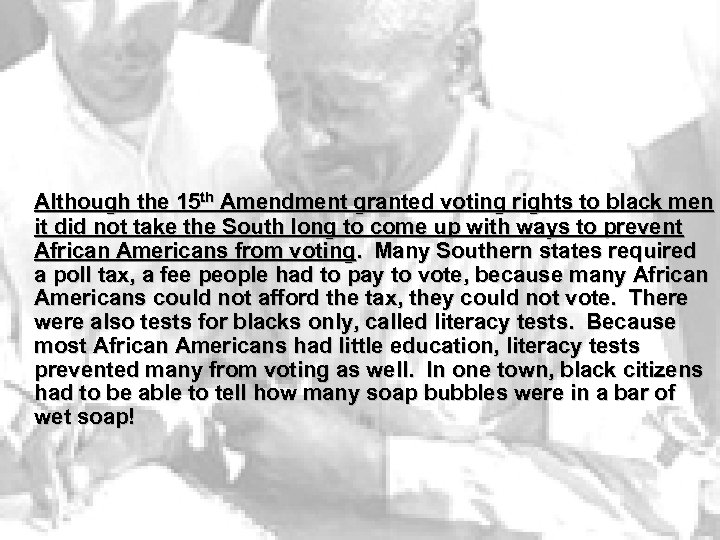 Although the 15 th Amendment granted voting rights to black men it did not take the South long to come up with ways to prevent African Americans from voting. Many Southern states required a poll tax, a fee people had to pay to vote, because many African Americans could not afford the tax, they could not vote. There were also tests for blacks only, called literacy tests. Because most African Americans had little education, literacy tests prevented many from voting as well. In one town, black citizens had to be able to tell how many soap bubbles were in a bar of wet soap!
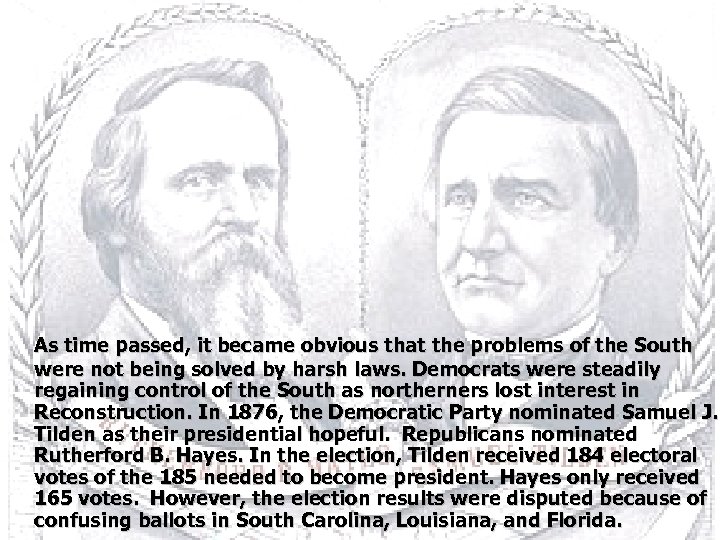 As time passed, it became obvious that the problems of the South were not being solved by harsh laws. Democrats were steadily regaining control of the South as northerners lost interest in Reconstruction. In 1876, the Democratic Party nominated Samuel J. Tilden as their presidential hopeful. Republicans nominated Rutherford B. Hayes. In the election, Tilden received 184 electoral votes of the 185 needed to become president. Hayes only received 165 votes. However, the election results were disputed because of confusing ballots in South Carolina, Louisiana, and Florida.
 Compromise of 1877 Congress developed a special committee to recount the votes in a fair and balanced way. The committee concluded by a margin of one vote that the Republican Hayes had won the disputed states and therefore was the new president. Democrats were outraged at first but quickly realized that the situation gave them the perfect opportunity to strike a bargain to achieve their political goals. The result was the Compromise of 1877, in which Democrats agreed to let Hayes become president in exchange for a complete withdrawal of federal troops from the South. Republicans agreed, and shortly after Hayes was sworn in as president and ordered the remaining federal troops to vacate the South.
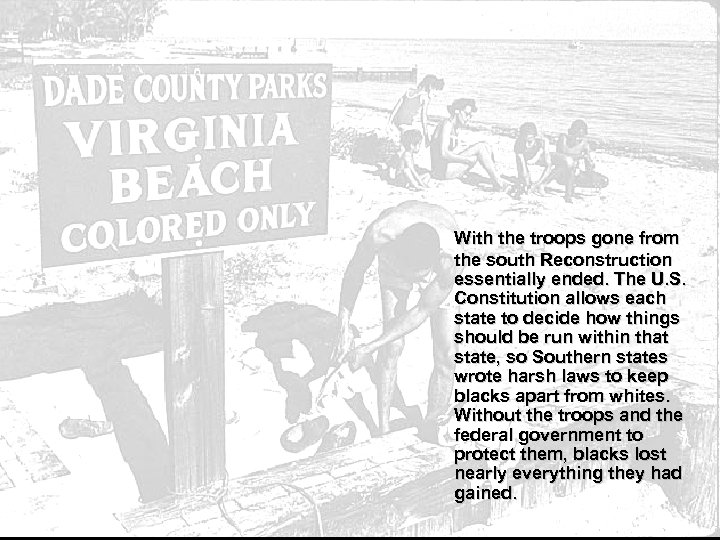 With the troops gone from the south Reconstruction essentially ended. The U. S. Constitution allows each state to decide how things should be run within that state, so Southern states wrote harsh laws to keep blacks apart from whites. Without the troops and the federal government to protect them, blacks lost nearly everything they had gained.
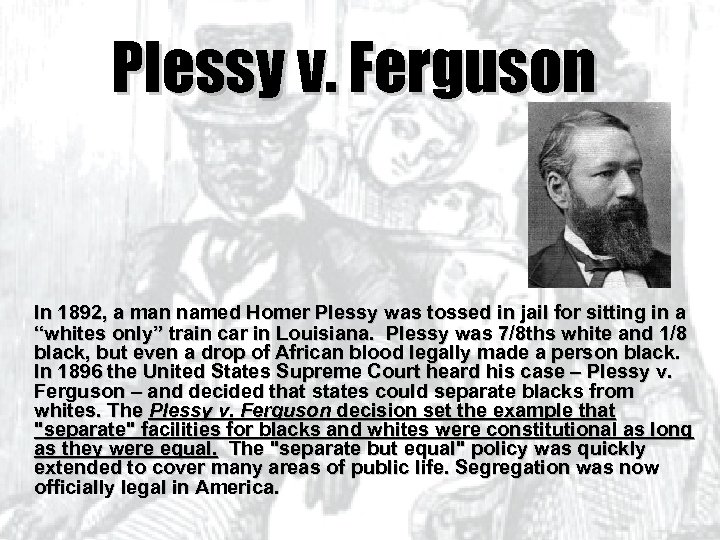 Plessy v. Ferguson In 1892, a man named Homer Plessy was tossed in jail for sitting in a “whites only” train car in Louisiana. Plessy was 7/8 ths white and 1/8 black, but even a drop of African blood legally made a person black. In 1896 the United States Supreme Court heard his case – Plessy v. Ferguson – and decided that states could separate blacks from whites. The Plessy v. Ferguson decision set the example that "separate" facilities for blacks and whites were constitutional as long as they were equal. The "separate but equal" policy was quickly extended to cover many areas of public life. Segregation was now officially legal in America.
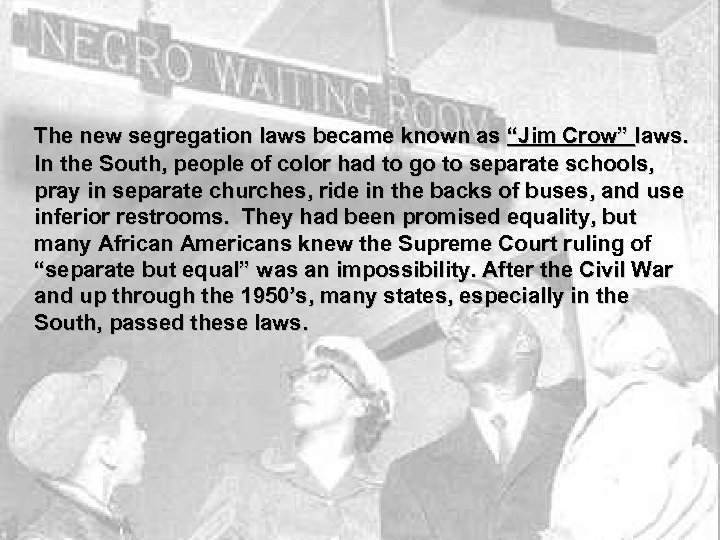 The new segregation laws became known as “Jim Crow” laws. In the South, people of color had to go to separate schools, pray in separate churches, ride in the backs of buses, and use inferior restrooms. They had been promised equality, but many African Americans knew the Supreme Court ruling of “separate but equal” was an impossibility. After the Civil War and up through the 1950’s, many states, especially in the South, passed these laws.
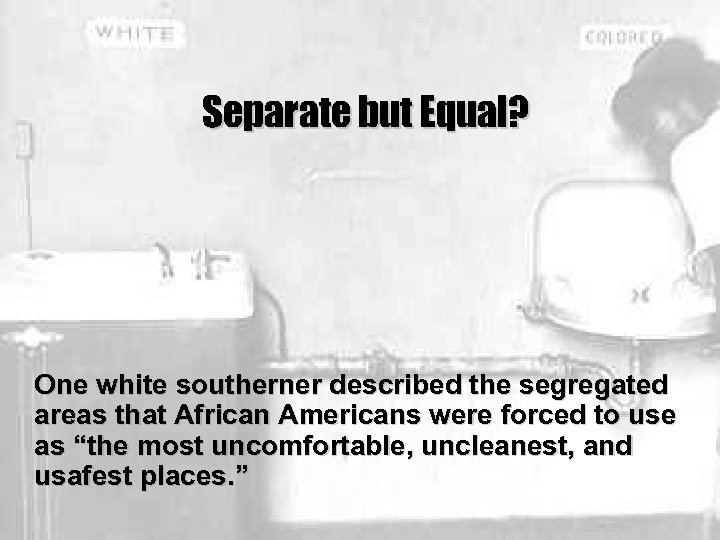 Separate but Equal? One white southerner described the segregated areas that African Americans were forced to use as “the most uncomfortable, uncleanest, and usafest places. ”