


 Скачать презентацию Disaster Management Flood Control An Initiative
a5a8abb9c1be00f55fa67396bf55c9fd.ppt
- Количество слайдов: 34
 Disaster Management & Flood Control – An Initiative by Pune Municipal Corporation A Presentation by Smt. Rajlakshmi Bhosale Mayor, Pune
 CONTENTS 1 INTRODUCTION 2 FLOOD SCENARIO IN PUNE 3 CAUSE AND EFFECT 4 CURRENT FLOOD PROTECTION MEASURES 5 FUTURE ACTION PLAN FOR FLOOD CONTROL & DISASTER MANAGEMENT
 Introduction “Punyanagari The City of Virtuous Deeds”


 River and the City
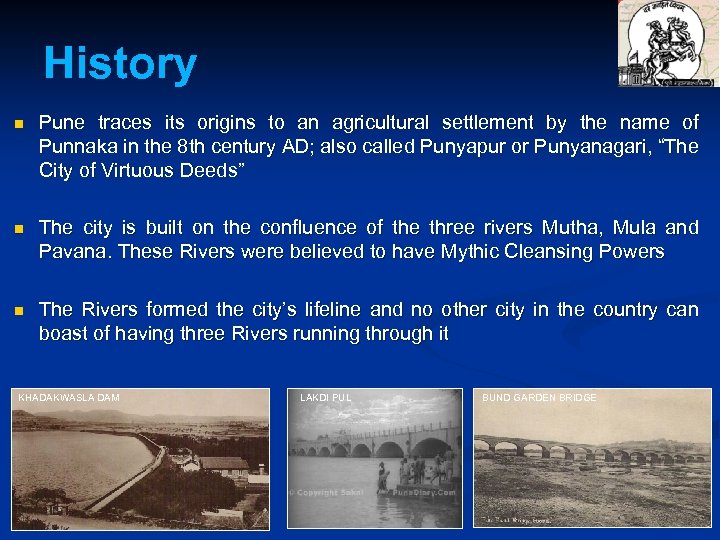 History n Pune traces its origins to an agricultural settlement by the name of Punnaka in the 8 th century AD; also called Punyapur or Punyanagari, “The City of Virtuous Deeds” n The city is built on the confluence of the three rivers Mutha, Mula and Pavana. These Rivers were believed to have Mythic Cleansing Powers n The Rivers formed the city’s lifeline and no other city in the country can boast of having three Rivers running through it KHADAKWASLA DAM LAKDI PUL BUND GARDEN BRIDGE
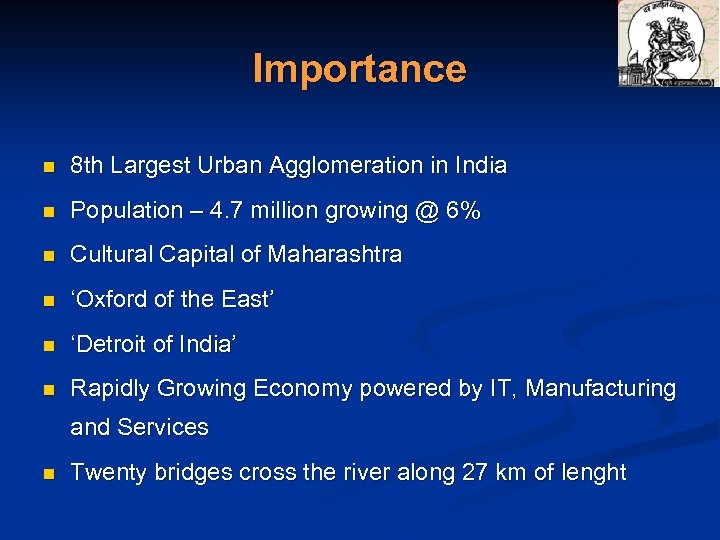 Importance n 8 th Largest Urban Agglomeration in India n Population – 4. 7 million growing @ 6% n Cultural Capital of Maharashtra n ‘Oxford of the East’ n ‘Detroit of India’ n Rapidly Growing Economy powered by IT, Manufacturing and Services n Twenty bridges cross the river along 27 km of lenght
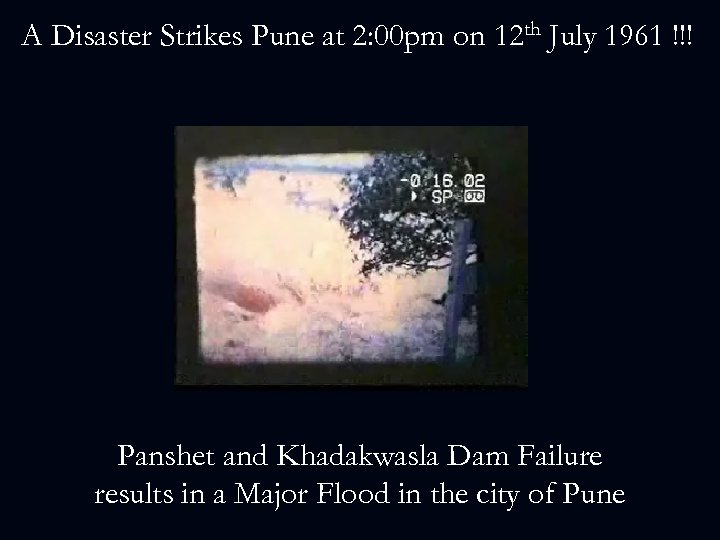 A Disaster Strikes Pune at 2: 00 pm on 12 th July 1961 !!! Panshet and Khadakwasla Dam Failure results in a Major Flood in the city of Pune
 FLOOD SCENARIO IN PUNE
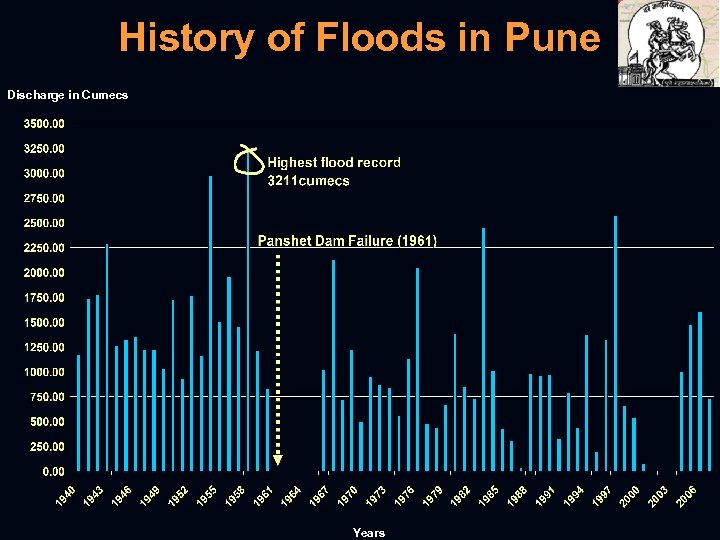 History of Floods in Pune Discharge in Cumecs Years
 Flood Frequency Analysis was conducted for 1940 to 2007 of the maximum discharge data from Khadakwasla The 1958 flood with a magnitude of 3211 cumecs is the highest flood recorded. The mean annual peak flood is about 1165 cumecs. Every decade had recorded one severe flood during the last six decades (1944, 1958, 1961, 1976, 1983, 1997 and 2005). The post 1961 period shows a significant decline in the peak flood magnitudes and increase in the flood variability. This could be attributed to the increased control of dams located on the river, such as Temghar and Varasgaon that were constructed during the post-1961 period.
 CAUSE AND EFFECT
 Causes n Reduction in Carrying Capacity of the river n n n Encroachment in river and tributaries (nullahs) draining into the rivers Disposal of Debris and solid wastes including plastics Lack of Remote Rain Gauging and Telemetric Early Warning System
 Effects I. Displacement of Families in the river banks II. Destruction of private property on the river banks III. Destruction of Biodiversity on the river banks IV. Disruption of Transport and communication systems V. Destruction of drainage and sewage system VI. Eroding of river banks VII. Adverse effect on Public Health
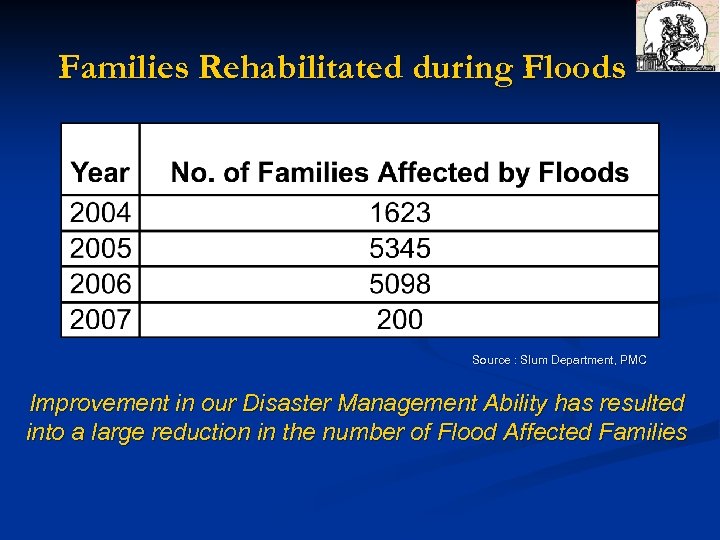 Families Rehabilitated during Floods Source : Slum Department, PMC Improvement in our Disaster Management Ability has resulted into a large reduction in the number of Flood Affected Families
 CURRENT FLOOD PROTECTION MEASURES
 Disaster Management Initiative by Pune Municipal Corporation (PMC) 2006 - 2007 PMC embarked upon preparation of a a comprehensive Disaster Management Plan Involving all agencies of the local self government law enforcing agencies, state govt and education institutes MAY 2007 DMP WAS PROMULGATED
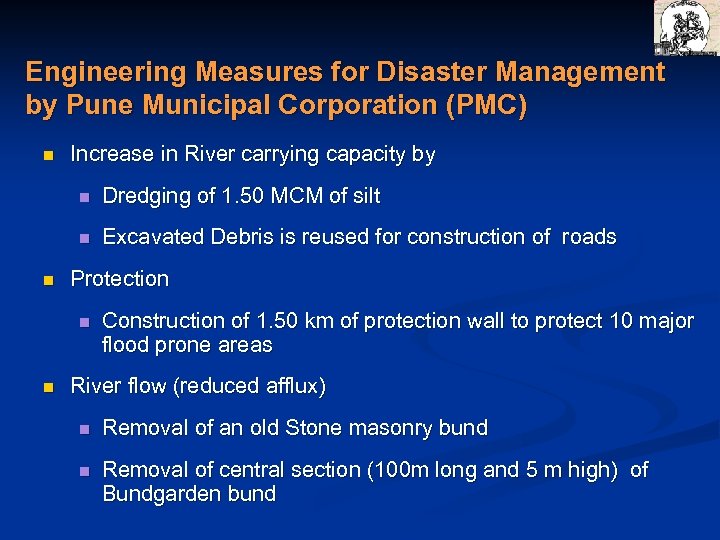 Engineering Measures for Disaster Management by Pune Municipal Corporation (PMC) n Increase in River carrying capacity by n n n Dredging of 1. 50 MCM of silt Excavated Debris is reused for construction of roads Protection n n Construction of 1. 50 km of protection wall to protect 10 major flood prone areas River flow (reduced afflux) n Removal of an old Stone masonry bund n Removal of central section (100 m long and 5 m high) of Bundgarden bund
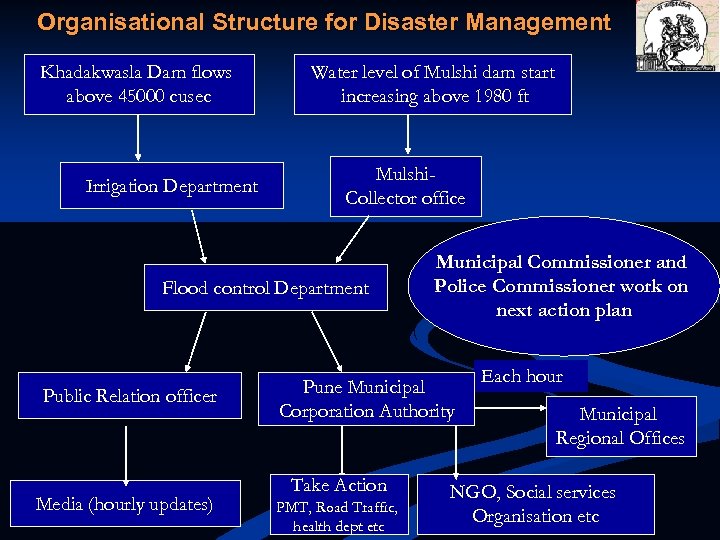 Organisational Structure for Disaster Management Khadakwasla Dam flows above 45000 cusec Irrigation Department Water level of Mulshi dam start increasing above 1980 ft Mulshi. Collector office Flood control Department Public Relation officer Media (hourly updates) Municipal Commissioner and Police Commissioner work on next action plan Pune Municipal Corporation Authority Take Action PMT, Road Traffic, health dept etc Each hour Municipal Regional Offices NGO, Social services Organisation etc
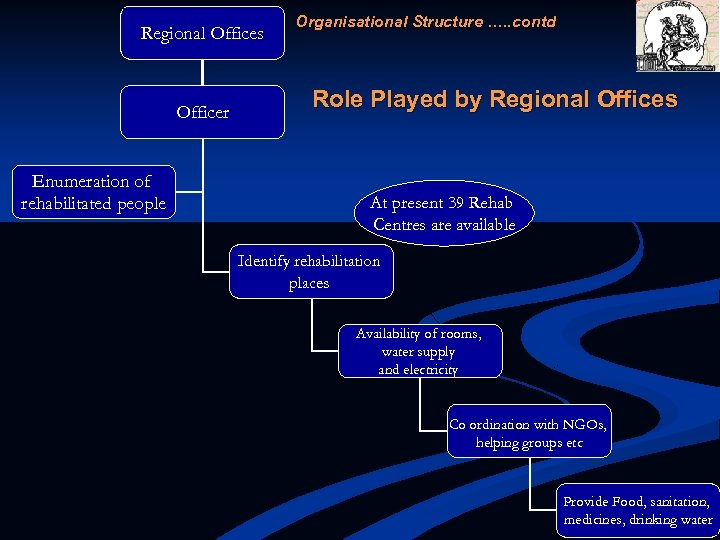 Regional Offices Officer Enumeration of rehabilitated people Organisational Structure …. . contd Role Played by Regional Offices At present 39 Rehab Centres are available Identify rehabilitation places Availability of rooms, water supply and electricity Co ordination with NGOs, helping groups etc Provide Food, sanitation, medicines, drinking water
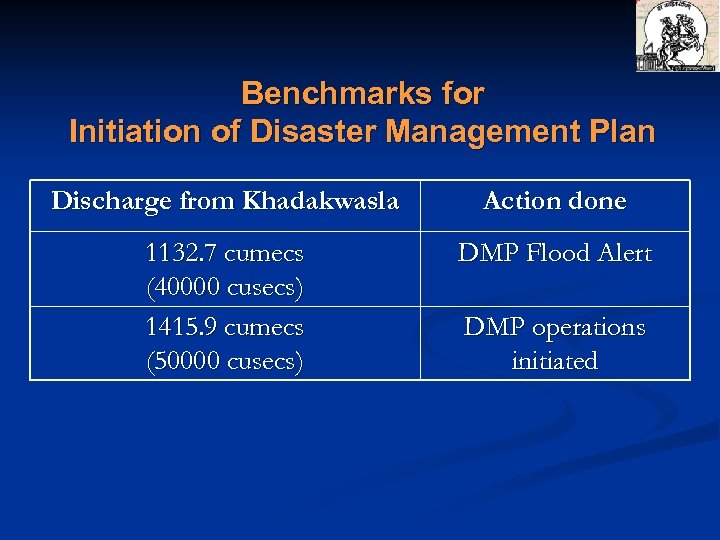 Benchmarks for Initiation of Disaster Management Plan Discharge from Khadakwasla Action done 1132. 7 cumecs (40000 cusecs) 1415. 9 cumecs (50000 cusecs) DMP Flood Alert DMP operations initiated
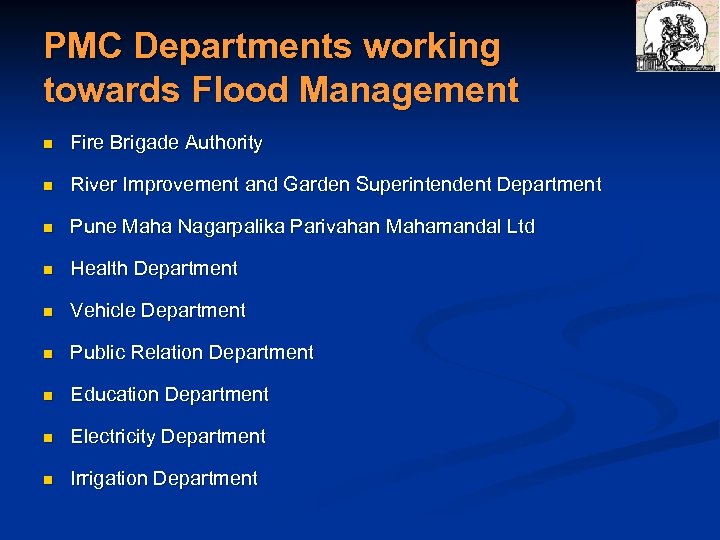 PMC Departments working towards Flood Management n Fire Brigade Authority n River Improvement and Garden Superintendent Department n Pune Maha Nagarpalika Parivahan Mahamandal Ltd n Health Department n Vehicle Department n Public Relation Department n Education Department n Electricity Department n Irrigation Department
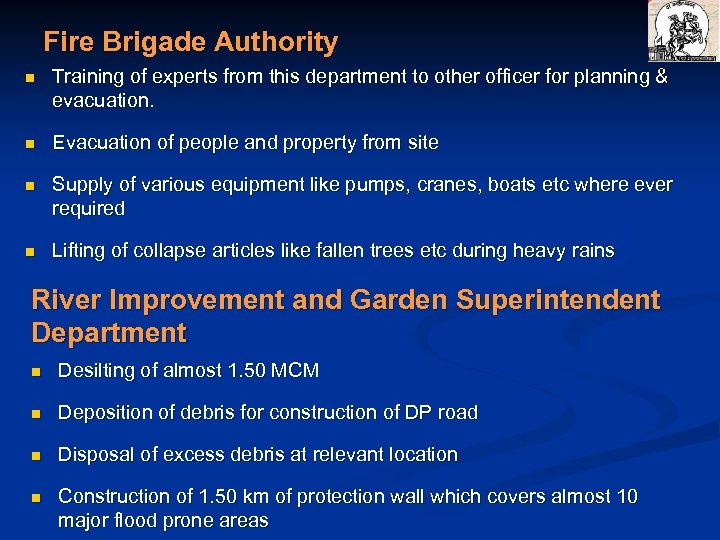 Fire Brigade Authority n Training of experts from this department to other officer for planning & evacuation. n Evacuation of people and property from site n Supply of various equipment like pumps, cranes, boats etc where ever required n Lifting of collapse articles like fallen trees etc during heavy rains River Improvement and Garden Superintendent Department n Desilting of almost 1. 50 MCM n Deposition of debris for construction of DP road n Disposal of excess debris at relevant location n Construction of 1. 50 km of protection wall which covers almost 10 major flood prone areas
 Pune Maha Nagarpalika Parivahan Mahamandal Ltd. n Release of public transport n Make vehicles available wherever required n Make drivers available n Get updates about traffic diversions and inform it to the drivers. n Keep stock of fuel and other material required Health Department n Make Doctors, Pharmacist, auxiliary nurse etc available. n Supply medicines n Ambulance
 Vehicle Department n Make wireless vehicles, truck and drivers available n Coordination with fire brigade authorities through these wireless vehicles Public Relation Department n At as a communication medium within the government and public n Public awareness n Information to media (press, channels etc) Education Department n Make school and college available during floods n Make infrastructure in school available n Teachers and other staff also provide help in this respect
 Electricity Department n As the electric supply is completely damage during floods provide generators to evacuation teams n Provide temporary electric wiring at rehabilitation centers n Provide emergency lamps Irrigation Department n Control discharge at each of the dams n Supply flood update to Flood control department of PMC
 FUTURE ACTION PLAN FOR FLOOD FORECASTING & DISASTER MANAGEMENT
 Salient Features 1. Installation of Remote Rain Gauging, level gauging and telemetry system for early warning to control peak discharge from Khadakwasla to within 50, 000 Cusecs during the rainy season 2. Prevent encroachment of the river and streams by declaration of Biodiversity Restoration Zones along the banks 3. Use of Gabions/Reno Mattresses on river banks for stabilisation and allow percolation of water
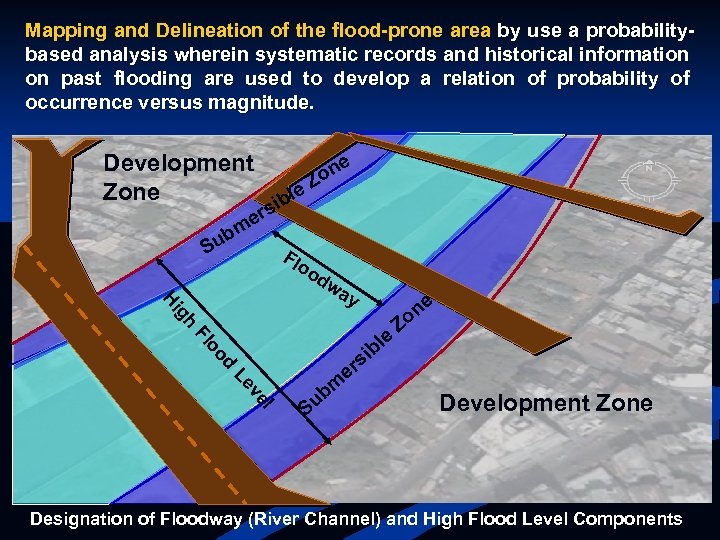 Mapping and Delineation of the flood-prone area by use a probabilitybased analysis wherein systematic records and historical information on past flooding are used to develop a relation of probability of occurrence versus magnitude. e Development on Z Zone le sib r Su me b Flo od wa gh Hi y d oo Fl le ib rs ne Zo e l ve Le bm u S Development Zone Designation of Floodway (River Channel) and High Flood Level Components
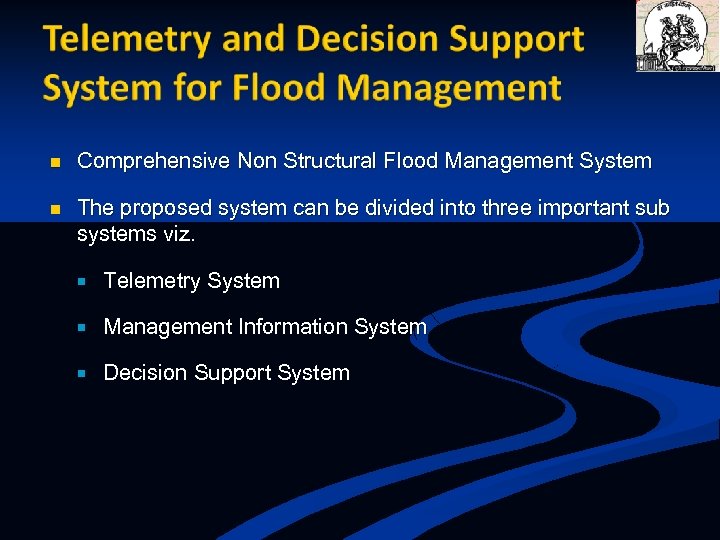 n Comprehensive Non Structural Flood Management System n The proposed system can be divided into three important sub systems viz. Telemetry System Management Information System Decision Support System
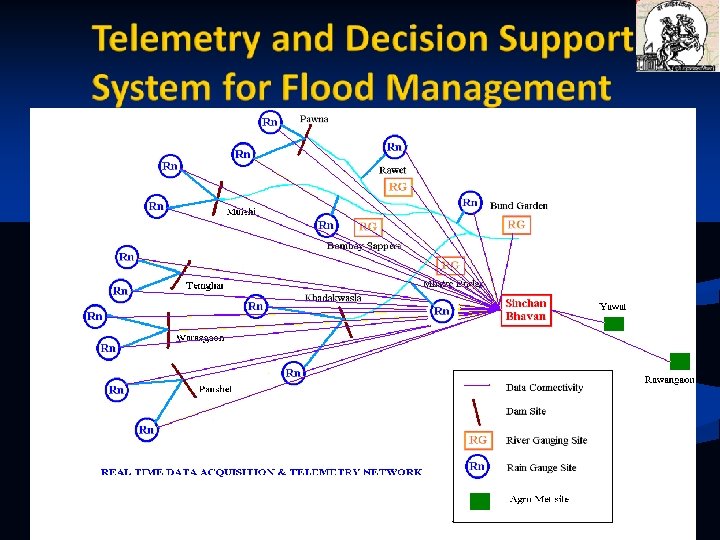
 n Telemetry System gathers hydrological and meteorological data such as Rain fall data from rain-gauge stations in the catchment Water level data from river gauge stations Reservoir level data from level sensors installed at the reservoirs Data is gathered without any human intervention n Collected data is then presented to the Management Information System and the Decision Support System n Based on the received data and the pre-fed conditions/parameters/rules the system computes information required for controlling discharge of water
 Conclusions Our experience of PMC has shown that initiative by the local self governing body can control & reduce the magnitude of disaster and effectively manage a disaster