


 Скачать презентацию Director Training Certification IFC GCGF Workshop 2 4
51bda06a7d5f4a518773cbb3837eac0a.ppt
- Количество слайдов: 21
 Director Training Certification IFC/GCGF Workshop 2 : 4 -5 May 2009 William Foster: Executive Director, Mudara Institute of Directors 1
 Agenda • • 2 The Regional Directorship Challenge Professional Associations are KEY Why Mudara IOD Director and Training Certification
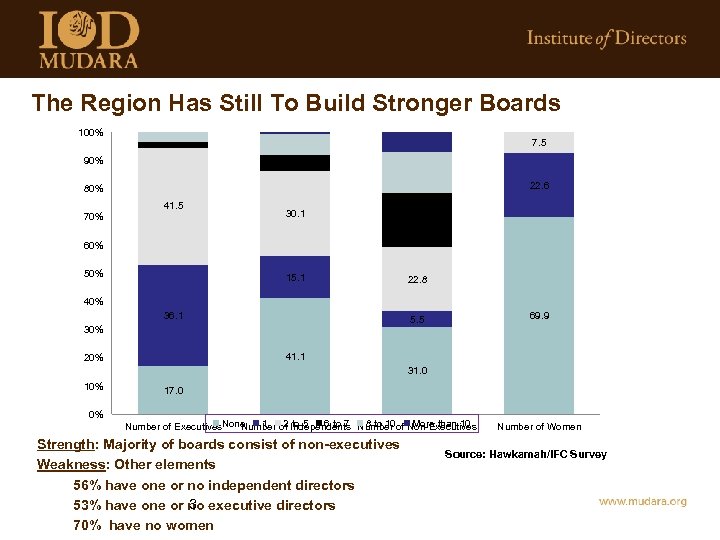 The Region Has Still To Build Stronger Boards 100% 7. 5 90% 22. 6 80% 70% 41. 5 30. 1 60% 50% 15. 1 22. 8 40% 36. 1 69. 9 5. 5 30% 41. 1 20% 31. 0 10% 0% 17. 0 1 2 to 5 6 to 7 8 to 10 More than 10 Number of Executives. None Number of Independents Number of Non-Executives Strength: Majority of boards consist of non-executives Weakness: Other elements 56% have one or no independent directors 3 53% have one or no executive directors 70% have no women Number of Women Source: Hawkamah/IFC Survey
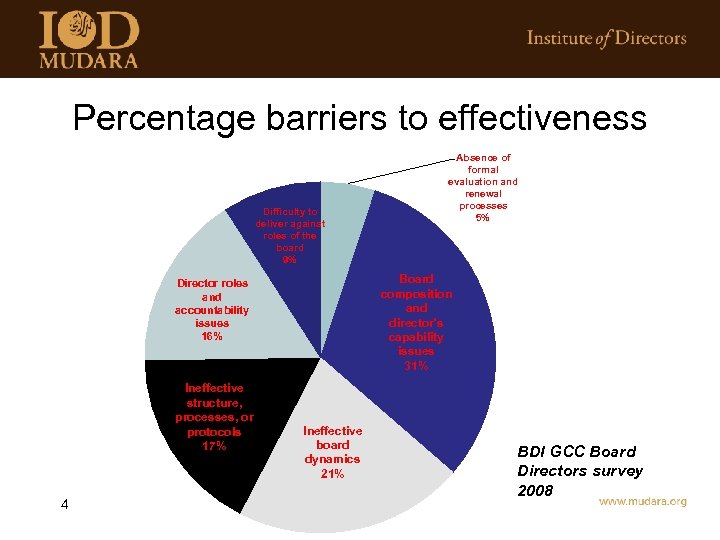 Percentage barriers to effectiveness Difficulty to deliver against roles of the board 9% Board composition and director's capability issues 31% Director roles and accountability issues 16% Ineffective structure, processes, or protocols 17% 4 Absence of formal evaluation and renewal processes 5% Ineffective board dynamics 21% BDI GCC Board Directors survey 2008
 Professional Associations are Key Institutions “Director’s behaviour is fundamentally driven by individual ethics and accountability, not by laws imposed from outside. Ivor Francis: Future Direction, The Power of the Competitive Board”: 1997 5
 MUDARA, the Institute of Directors ………. improving professional directorship to contribute to the well-being of the region. Vision: to be the region’s leading, international best practice, professional membership organisation representing the interest of directors. Mission: to build the Institute and benefit members by offering Learning, Networking, Communication and related ancillary Services to members, establishing a network of local branches, and partnerships with recognized affiliate organizations. What we do: • Assist members to achieve high standards of professionalism; • Provide continuing professional development and accreditation programmes; • Increase the recognition of the role of directors; • Provide a forum for members to network and contribute; • Provide services to members to add value and enhance their skills and contributions. Member Categories: Associate, Member, Graduate Member, Fellow, International, Honarary 6
 Why Mudara? Supporting high levels of national and regional growth requires: • Professional, qualified and independent directors. • Directors with international vision and capability. • Training and encouraging young nationals for governance roles. A Professional Directors Institute will: • Help promote networking across cultural, age and gender lines • Provide a forum foreign professionals to contribute • Complement the work of other groups such as Hawkamah, YAL, AIWF and EIOD • Provide high standards of professional development training for members and potential members. 7
 Why a regional IOD? • Demonstrates leadership for the region from within the region • DIFC provides the right legal and regulatory framework (e. g. Data protection) for a professional membership association • Provides a channel for, and coordinates, external support • Sets regional standards (qualifications, experience, conduct) • Offers credible regional benchmark for accreditation and certification • Strengthens international recognition • Provides “own” regional umbrella for local development • Assists initial “Branch” formation • Facilitates regional networking and cross border director appointments • Provides common services and training support for smaller IOD/CG groups • Provides a regional focus for awareness and research 8
 What is Certification? • Certification is the confirmation by an independent oversight body (usually professional) that a person, object or organisation, has certain characteristics. • Certification requires providing proof of passing standards or meeting predetermined requirements for Certification. This may include meeting continuous or regular review requirements. • Professional certification for individuals usually requires experience, and the passing of knowledge or competence tests and commitment to a Code of Conduct. • Certification of Institutions or Organisations usually requires meeting standards of quality and performance and processes which may include regular reviews. With assistance from Wikipedia • Certification is not licensing 9
 What is Accreditation? • Accreditation is a process of presenting credentials to, and their acceptance by, an independent accrediting body, which then attests that certain requirements have been met. • This is a more general concept and may cover accrediting certification programmes, or accrediting testing or certifying institutions. • It is used as a form of recognition of marks of standards or quality where there is a less common standard of certification. Different programmes or bodies with different standards may be accredited by, or to, an organisation as meeting some common minimum objectives or requirements. With assistance from Wikipedia 10
 Types of entities which might be Certified or Accredited • Directors may be Certified (by their IOD or other body) as having met some additional standards. In the UK the term is Chartered. (Directors are accredited to their professional Association (IOD) by virtue of membership). • Directors may also be accredited to a body or group within the Professional body, that meets higher standards. • Training Programmes may be Accredited or Certified • Training Service providers (Companies or individual trainers) may be Accredited or Certified 11
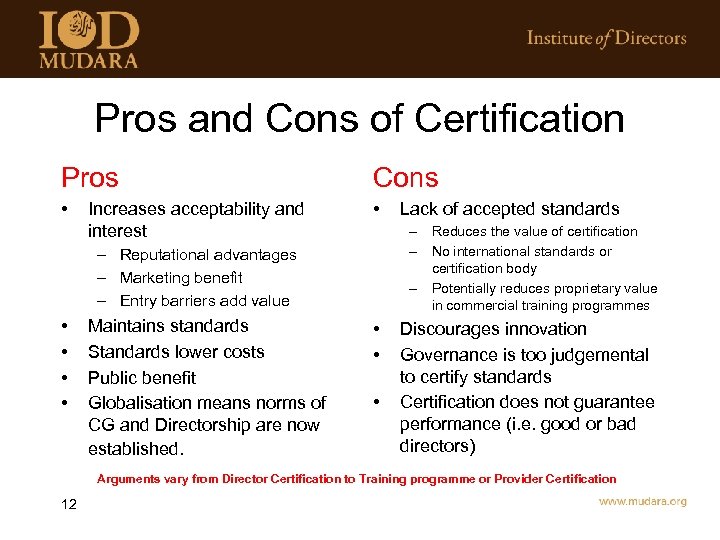 Pros and Cons of Certification Pros Cons • • Increases acceptability and interest – Reduces the value of certification – No international standards or certification body – Potentially reduces proprietary value in commercial training programmes – Reputational advantages – Marketing benefit – Entry barriers add value • • Maintains standards Standards lower costs Public benefit Globalisation means norms of CG and Directorship are now established. Lack of accepted standards • • • Discourages innovation Governance is too judgemental to certify standards Certification does not guarantee performance (i. e. good or bad directors) Arguments vary from Director Certification to Training programme or Provider Certification 12
 Certifying Directors The prerequisites are: • Experience • Recognised Qualification and Training (i. e a pass in a recognised professional training course) • Examination by Peers – This is judgemental and causes most argument about independence (a common professional association issue) • Currently only done by each IOD itself – no portability. • Certification is yet not a requirement anywhere. • Because of the lack of standards, the term Certified (or Chartered) Director has no international meaning. 13
 Testing Knowledge • There are no accepted standards for outcomes of Director Training Programmes (but should be). • Attendance at a prescribed course is a requirement, but some Institutes require tests, others do not. • In developing markets, outcome or knowledge testing, as well as attendance, should be the norm. • Mudar. IOD has developed an on-line testing programme for the GCGF Toolkit workshops to drive a regional standard for director knowledge. – We will make this available on-line to any individual having attended an accepted director training programme. 14
 Certifying Training Programmes • Not done yet by any credible body outside each IOD which provides their own training programme. • Accreditation is provided by Riskmetrics – On a programme by programme basis • EIOD (and Mudara IOD) accredited their IFC based DDP • Mudara IOD has accredited its new DDP programme with Riskmetrics based on the GCGF Board Leadership Toolkit, and has established a new on-line testing programme for knowledge from the DDP 15
 Certifying Trainers • Trainers can be certified as trained to provide accepted standards of Director Training programmes. • Training Organisations can be Accredited to provide standard programmes using certified trainers. • IFC/GCGF have adopted this approach with the new Board Leadership Toolkit and it will help ensure quality of training and standards of delivery. 16
 Cost and Time Implications • Developing testing and Certification processes is expensive (professionals are often required to give their time for free in NFP IODs), BUT • Standardisation reduces time and cost for both providers and users • Certification costs, and users have to pay for the benefit of being Certified. • Standardising Certification helps justify the expense 17
 Alternatives to formal Certification • The alternative to establishing standards and requirements (at least for professional independent directors) is voluntary professional improvement. • For emerging areas where little value is perceived in having governance skills, this will take a long time. • Regulators will not wait to improve governance, transparency and independence requirements and could set governance standards. • Training organisations can seek to promote and brand their own standards, but this will cause confusion and fragmentation. 18
 The Way Forward? • There is an opportunity now for training organisations (principally Director Membership Institutes) to establish International Standards for Governance Training; trainers; and for Directors and other trainees taking basic Directorship programmes. • With the support provided by the initiative of the GCGF to provide the Board Leadership toolkit, a group of individuals and organisations is seeking to create an IFGTO to provide the necessary Forum and vehicle for setting International standards to prevent dilution and fragmentation of training, loss of content IP, and to support the viability of developing IODs and other governance training organisations. 19
 International Federation of Governance Training Organisations OBJECTS: The objects of the IFGTO are: • To establish and advance international standards for the content, quality, delivery and outcomes of professional governance training activities for public benefit; • To share and exchange information amongst member organizations on governance and adult education trends, development and best practices; • To collect and provide international statistics related to governance training; • To promote the interests of member organizations and governance training; • To provide a focus for and support international agencies in their international capacity building roles. 20
 Thank You! 21