 Скачать презентацию Directions in Model Based Testing R M Hierons
268e0f9e1234febe86589a11b1f812b1.ppt
- Количество слайдов: 86



Directions in Model Based Testing R. M. Hierons Brunel University, UK rob. hierons@brunel. ac. uk http: //people. brunel. ac. uk/~csstrmh TTCN-3 User Conference
What is Model Based Testing? • At its simplest: – We build a model – We use this model to help in testing • A model represents what is to be tested. • It need not model the entire system and can leave out many details (abstraction). • Models are often much simpler than requirements. TTCN-3 User Conference
What sorts of languages? • Almost anything. Languages used include: – Diagrammatic notations (e. g. statecharts, SDL, sequence diagrams) – Formal specification languages (Z, B, CASL, LOTOS) – High level code (e. g. python) – Finite state machines TTCN-3 User Conference
Why bother? • Benefits include: – – Automating test generation Automating checking of results Validating requirements/design through building model Regression testing – change the model not the tests • But – There is an initial cost of building the model – Building a model requires particular skills/training – The model may be wrong TTCN-3 User Conference
Topics • I will say a little about: – Coverage and automated generation from state machines – Testability and transformations for state machines – Regression testing and ordering adaptive/TTCN -3 test cases • Context: black-box testing TTCN-3 User Conference
Coverage and Test automation TTCN-3 User Conference
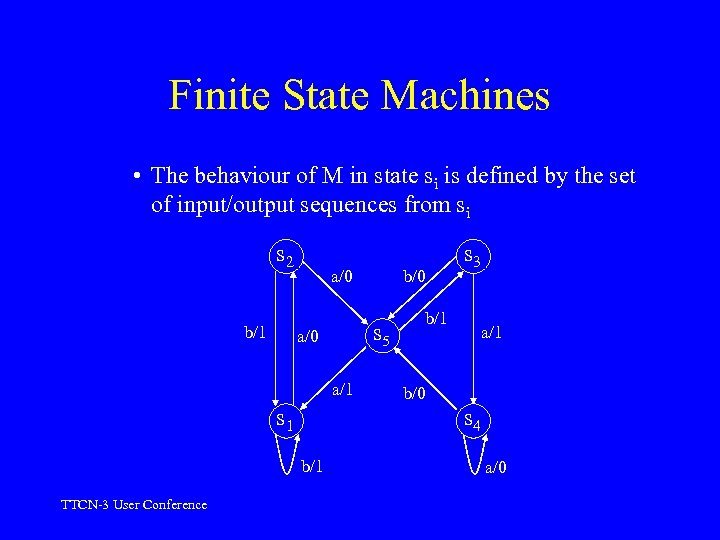
Finite State Machines • The behaviour of M in state si is defined by the set of input/output sequences from si s 2 b/1 a/0 s 5 a/0 a/1 s 1 b/1 a/1 b/0 s 4 b/1 TTCN-3 User Conference b/0 s 3 a/0
Test coverage • There are many popular notions of code coverage such as: Statement, Branch, MC/DC, LCSAJ, … • It is natural to define measures of model coverage. • For FSMs we have: – State coverage – Transition coverage TTCN-3 User Conference
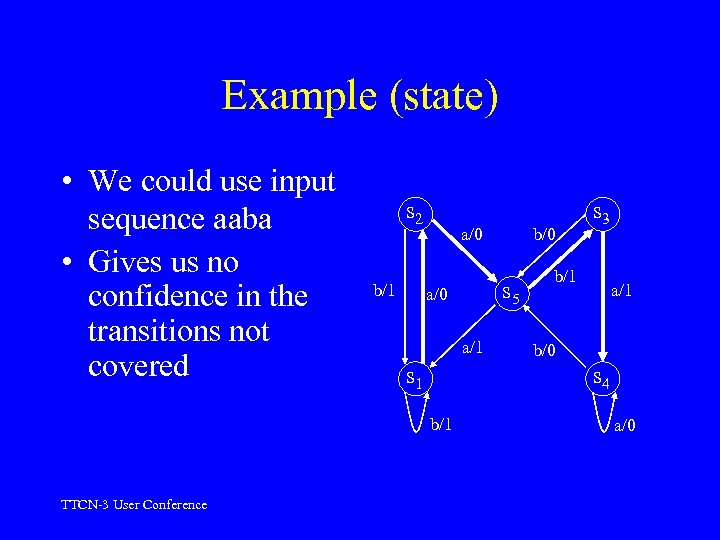
Example (state) • We could use input sequence aaba • Gives us no confidence in the transitions not covered s 2 b/1 a/0 a/1 b/1 a/1 b/0 s 4 b/1 TTCN-3 User Conference s 5 a/0 s 1 b/0 s 3 a/0
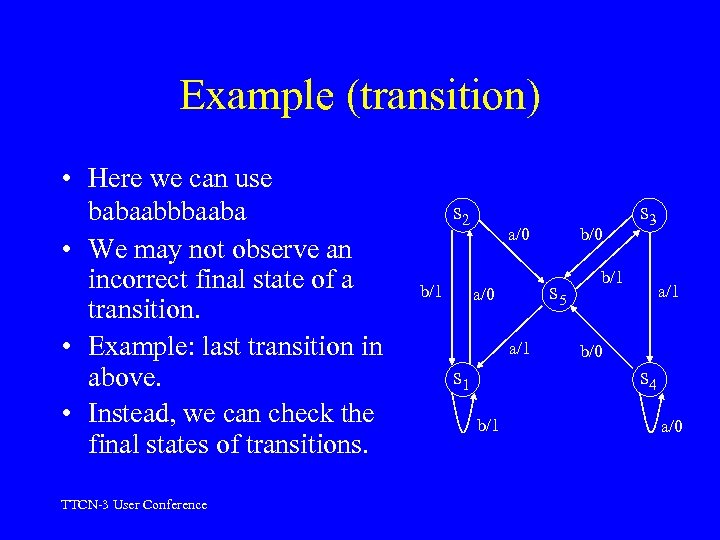
Example (transition) • Here we can use babaabbbaaba • We may not observe an incorrect final state of a transition. • Example: last transition in above. • Instead, we can check the final states of transitions. TTCN-3 User Conference s 2 b/1 a/0 s 5 a/0 a/1 s 1 b/0 s 3 b/1 a/1 b/0 s 4 b/1 a/0
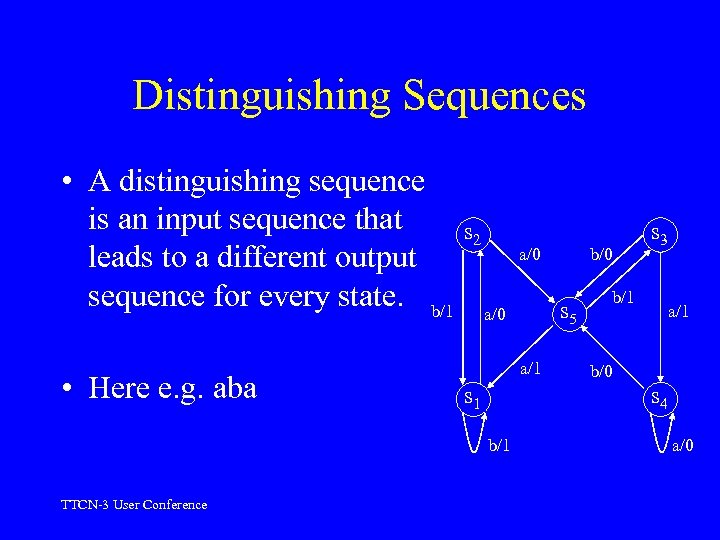
Distinguishing Sequences • A distinguishing sequence is an input sequence that s 2 leads to a different output sequence for every state. b/1 a/0 • Here e. g. aba s 1 b/0 s 5 a/1 b/1 a/1 b/0 s 4 b/1 TTCN-3 User Conference a/0 s 3 a/0
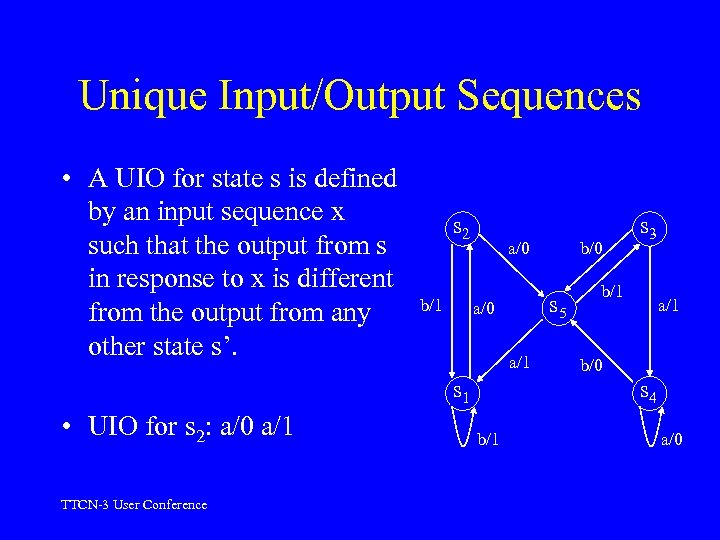
Unique Input/Output Sequences • A UIO for state s is defined by an input sequence x such that the output from s in response to x is different from the output from any other state s’. s 2 b/1 a/0 • UIO for s 2: a/0 a/1 TTCN-3 User Conference s 5 a/0 a/1 s 1 b/0 s 3 b/1 a/1 b/0 s 4 b/1 a/0
Characterizing sets • A set W of input sequences such that: – for every pair s, s’ of distinct states there is an input sequence in W that leads to different output sequences from s and s’. • Note: – we can easily extend this to non-deterministic models. TTCN-3 User Conference
Relative merits • If we have a distinguishing sequence then we can use this for every state • Every (minimal) FSM has a characterization set but we may need to run multiple tests to check a transition • Practitioners report that many real FSMs have (short) UIOs. TTCN-3 User Conference
Test generation based on coverage • In order to test a transition t it is sufficient to: – – Use a preamble to reach the start state of t Apply the input of t Check the final state of t (if required) Return to the initial state using a postamble/reset • We can do this for every transition and automate the process. TTCN-3 User Conference
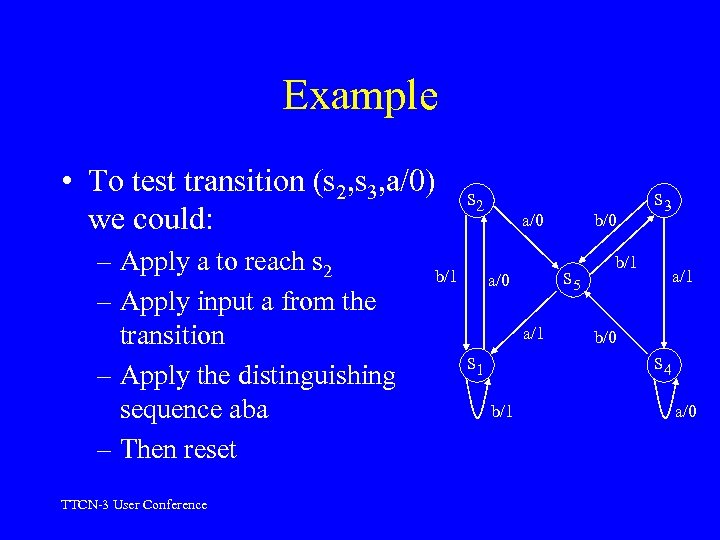
Example • To test transition (s 2, s 3, a/0) we could: – Apply a to reach s 2 – Apply input a from the transition – Apply the distinguishing sequence aba – Then reset TTCN-3 User Conference s 2 b/1 a/0 s 5 a/0 a/1 s 1 b/0 s 3 b/1 a/1 b/0 s 4 b/1 a/0
Efficient test generation • We could follow a transition test by another transition test. • We might produce one sequence to test all of the transitions, benefits including: – Fewer test inputs – Longer test sequence so more likely to find faults due to extra states. TTCN-3 User Conference
A simple approach • The following produces a single sequence: – Start with the preamble and test for a transition t 1. – Now choose another transition t 2 and move to its start state and then add a test for t 2. – Repeat until we have included tests for every transition. • How do we choose a best order in which to do this? TTCN-3 User Conference
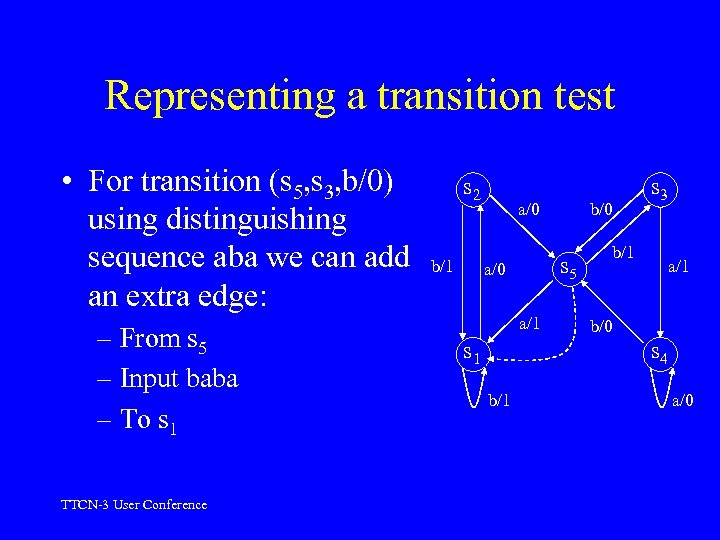
Representing a transition test • For transition (s 5, s 3, b/0) using distinguishing sequence aba we can add an extra edge: – From s 5 – Input baba – To s 1 TTCN-3 User Conference s 2 b/1 a/0 s 5 a/0 a/1 s 1 b/0 s 3 b/1 a/1 b/0 s 4 b/1 a/0
Solving the optimisation problem • Our problem can be seen as: – find a shortest sequence that contains every ‘extra’ edge. • This is an instance of the (NP-hard) Rural Postman Problem. • There is an algorithm that is optimal if: – There is a reset to be tested; or – Every state has a self-loop • This approach has been implemented in tools. TTCN-3 User Conference
Overlap • The Rural Postman approach produces separate tests for the transitions and connects these. • However, the transition tests might overlap. • There algorithms that utilize this. TTCN-3 User Conference
Resets • We may have to include resets in a test sequence. • It has been found that resets: – Can be difficult to implement, possibly requiring human involvement and reconfiguration of a system. – Can make it less likely that faults due to additional states will be found. • However, we can find a test sequence that has fewest resets – and can do so in polynomial time. TTCN-3 User Conference
A problem with coverage • No guarantees: – Even if we have checked the final state of every transition we may fail to detect faulty implementations. • This is because: – The methods to check states work in the model but might not work in the implementation. • The (limited) empirical evidence suggests that: – These approaches are more effective than transition coverage – They often do not provide full fault coverage even if there are no additional states. TTCN-3 User Conference
Fault Models • A fault model is a set F of models such that: – The tester believes that the implementation behaves like some (unknown) element of F. • Fault models allow us to reason about test effectiveness: – If the system under test passes a test suite T then it must be equivalent to one of the members of F that passes T. • Similar to Test Hypotheses and mutation testing. TTCN-3 User Conference
Test generation using fault models • The aim is: – Produce a test suite T such that no faulty member of F passes T. • If our assumption is correct then: – If the implementation passes T then it must be correct • So, testing can show the absence of bugs (relative to a fault model). TTCN-3 User Conference
Fault models for FSMs • The standard fault model is: – The set Fm of FSMs with the same input and output alphabets as the specification/model M and no more than m states, some predefined m. • A test suite is a checking experiment if it determines correctness relative to Fm. • A checking experiment is a checking sequence if it contains only one sequence. TTCN-3 User Conference
Generating a checking experiment • There algorithms for producing a checking experiment using a characterization set: – Given fault model Fm and FSM M with n states, these are exponential in n-m. • There are polynomial time algorithms for producing a checking sequence if: – our FSM M has a known distinguishing sequence and m=n. • However: – No known efficient algorithm for producing a shortest checking sequence – There is a polynomial algorithm for minimizing the number of resets. TTCN-3 User Conference
Papers • These include: • A. V. Aho, A. T. Dahbura, D. Lee, and M. U. Uyar, 1991, An Optimization Technique for Protocol Conformance Test Generation Based on UIO Sequences and Rural Chinese Postman Tours, IEEE Trans. on Communications, 39, 11, pp. 1604 -1615. • T. S. Chow, 1978, Testing Software Design Modeled by Finite-State Machines. IEEE Trans. Software Engm 4 3, pp. 178 -187. • R. M. Hierons and H. Ural, 2006, Optimizing the Length of Checking Sequences, IEEE Trans. on Computers, 55 5, pp. 618 -629. • R. M. Hierons, 2004, Using a minimal number of resets when testing from a finite state machine, Information Processing Letters, 90 6, pp. 287 -292. • M. Kapus-Kolar, 2007, Test as Collection of Evidence: An Integrated Approach to Test Generation for Finite State Machines, The Computer Journal, 50 3, pp. 315 -331. TTCN-3 User Conference
Future work • Many potential areas: – Domain specific fault models. – Verifying fault models. – Concurrent communicating FSMs. – Adding time, … TTCN-3 User Conference
Testability Transformations for Extended Finite State Machines TTCN-3 User Conference
Extended finite state machines • FSMs with: – Memory (variables) – Inputs with parameters – Outputs with parameters – Guards on transitions • Languages such as SDL and Statecharts have more features. TTCN-3 User Conference
Testing from EFSMs • One approach is: – Choose a test criterion – Find a set of paths through EFSM that satisfy the criterion – Generate an input sequence for each path. • Note: – FSM techniques produce sequences that test control structure, we can add sequences for dataflow. • There is a problem: we might choose infeasible paths. TTCN-3 User Conference
Testability transformations • We could rewrite the EFSM so that: – all paths are feasible; or – there is a known set of feasible sufficient paths. • Note: in general, this problem is uncomputable. TTCN-3 User Conference
Special case • The problem can be solved when: – All assignments and guards are linear • Approach has been applied to real protocols (Uyar and co-authors). TTCN-3 User Conference
General case • We can split states on the basis of: – Transition guards (preconditions) – Transition postconditions • However: – Analysis requires us to reason about predicates – May lead to exponential increase in number of states. • Framework has been described but little more. TTCN-3 User Conference
Estimating feasibility • A transition can make a sequence infeasible through its guard. • We might estimate how ‘difficult’ it is to satisfy a guard. • Use the score for each transition to estimate the ‘feasibility’ of a sequence. • This can direct us towards ‘better’ sequences. TTCN-3 User Conference
Initial results • Experiments with: – a simple function that estimates ‘feasibility’ – two EFSMs • we get: – a correlation between estimate of feasibility and actual feasibility. TTCN-3 User Conference
Papers • These include: – M. A. Fecko, M. U. Uyar, A. Y. Duale, P. D. Amer, 2003, A Technique to Generate Feasible Tests for Communications Systems with Multiple Timers, IEEE/ACM Trans. on Networking, 11 5, pp. 796 -809. – A. Y. Duale and M. U. Uyar, 2004, A Method Enabling Feasible Conformance Test Sequence Generation for EFSM Models. IEEE Trans. on Computers, 53 5, pp. 614 -627. – R. M. Hierons, T. -H. Kim, and H. Ural, 2004, On The Testability of SDL Specifications, Computer Networks, 44 5, pp. 681 -700. TTCN-3 User Conference
Future Work • Many problems to be solved: – Transformations for non-linear arithmetic – Domain specific transformations – Estimating feasibility using ‘more refined’ information – Larger case studies regarding estimating feasibility TTCN-3 User Conference
Ordering to reduce the cost of test application TTCN-3 User Conference
Motivation • There is a cost associated with running our tests. • This is a repeated cost due to regression testing. • If we can reduce this cost/time we can speed up development and the fix/retest cycle. TTCN-3 User Conference
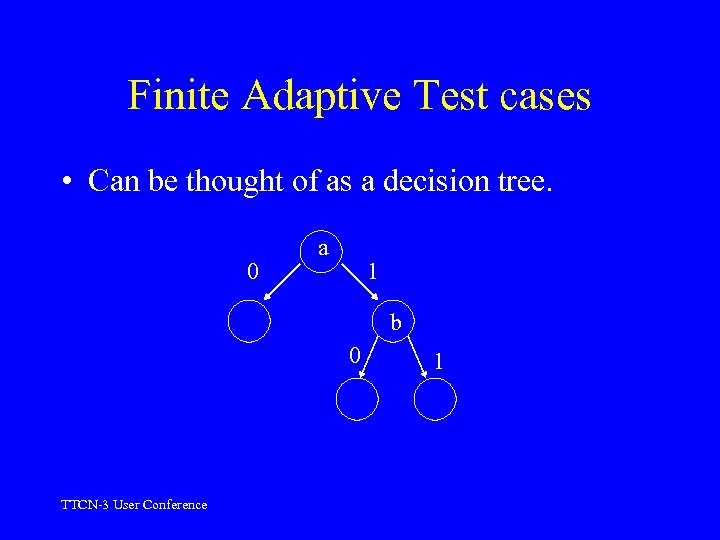
Finite Adaptive Test cases • Can be thought of as a decision tree. 0 a 1 b 0 TTCN-3 User Conference 1
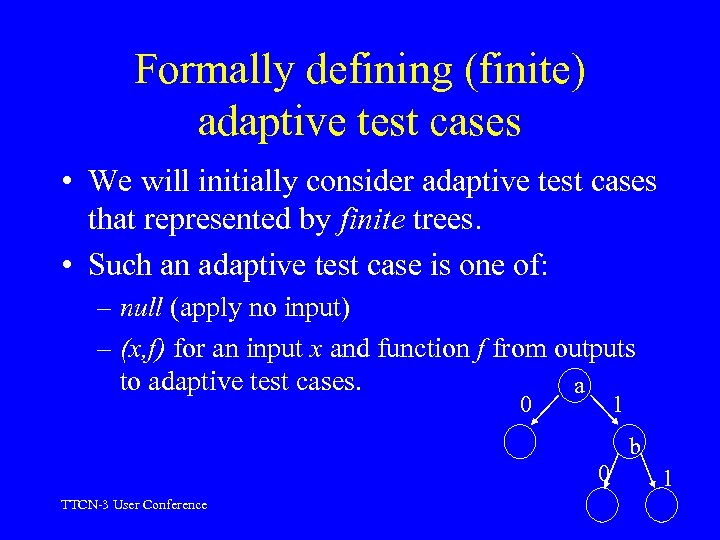
Formally defining (finite) adaptive test cases • We will initially consider adaptive test cases that represented by finite trees. • Such an adaptive test case is one of: – null (apply no input) – (x, f) for an input x and function f from outputs to adaptive test cases. a 0 1 b 0 TTCN-3 User Conference 1
Context • We will: – Assume that the adaptive test cases are already given – Assume that we reset between adaptive test cases – Focus on minimising the cost of executing our adaptive test cases • Note: sometimes this is important, but not always! • We wish to minimise the cost of testing without reducing its inherent effectiveness. TTCN-3 User Conference
Selective regression testing • There are methods that choose a subset of a regression test suite. • Most based on maintaining coverage. • Can lead to significant reduction in test suite size but … also a reduction in test suite effectiveness. TTCN-3 User Conference
Testing deterministic systems TTCN-3 User Conference
An initial observation • Suppose we apply adaptive test case , observe trace x/y, reset and apply again. • Since the system under test is deterministic we will again observe x/y. – There is no need to apply an adaptive test case more than once. – If we have already observed trace x/y then we do not have to apply . TTCN-3 User Conference
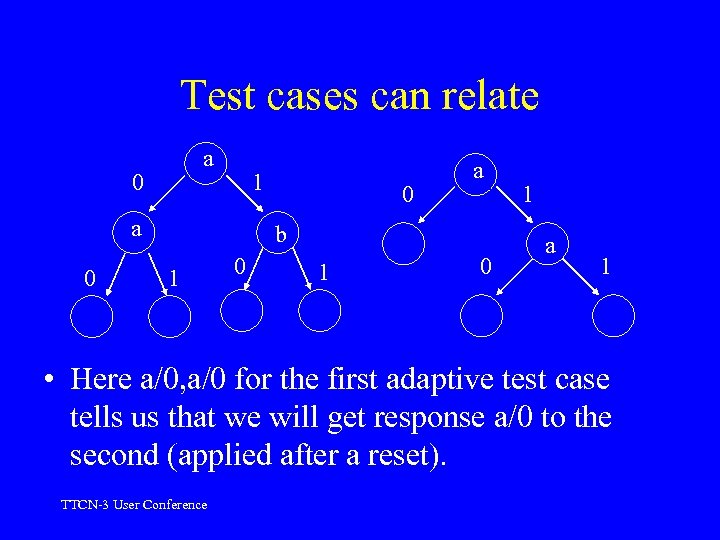
Test cases can relate a 0 1 a 0 0 a b 1 0 1 a 1 • Here a/0, a/0 for the first adaptive test case tells us that we will get response a/0 to the second (applied after a reset). TTCN-3 User Conference
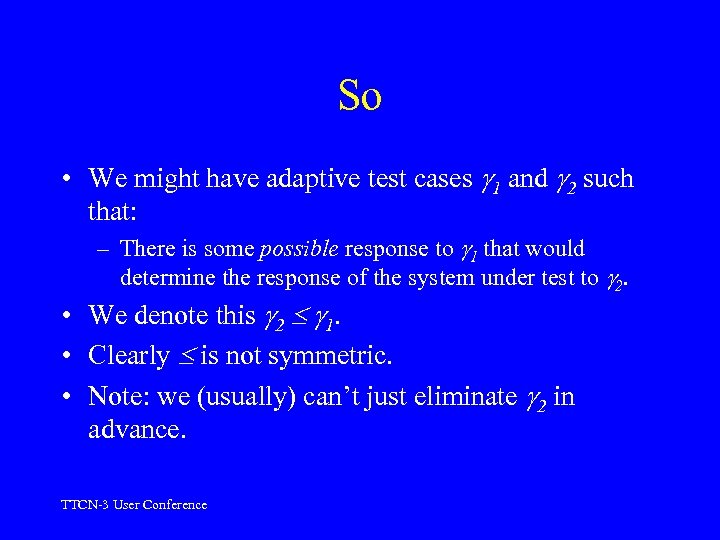
So • We might have adaptive test cases 1 and 2 such that: – There is some possible response to 1 that would determine the response of the system under test to 2. • We denote this 2 1. • Clearly is not symmetric. • Note: we (usually) can’t just eliminate 2 in advance. TTCN-3 User Conference
Consequence • The expected cost of testing depends upon the order in which the adaptive test cases are to be applied. • Question: how can we find an order that minimises the expected cost of testing? TTCN-3 User Conference
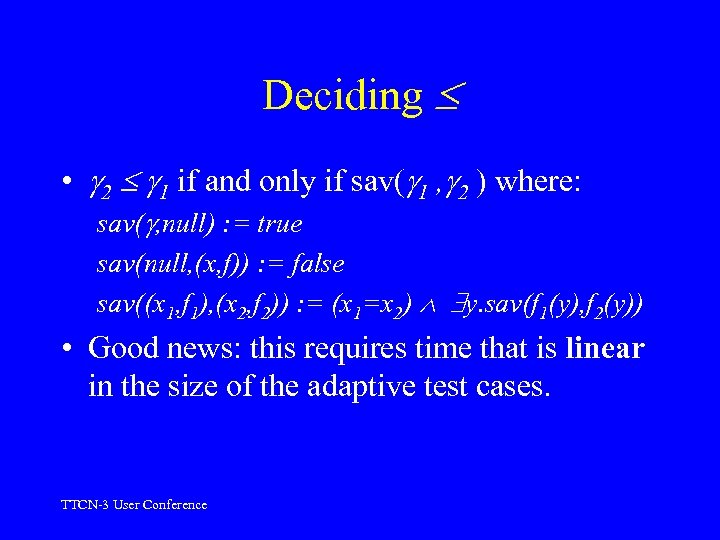
Deciding • 2 1 if and only if sav( 1 , 2 ) where: sav( , null) : = true sav(null, (x, f)) : = false sav((x 1, f 1), (x 2, f 2)) : = (x 1=x 2) y. sav(f 1(y), f 2(y)) • Good news: this requires time that is linear in the size of the adaptive test cases. TTCN-3 User Conference
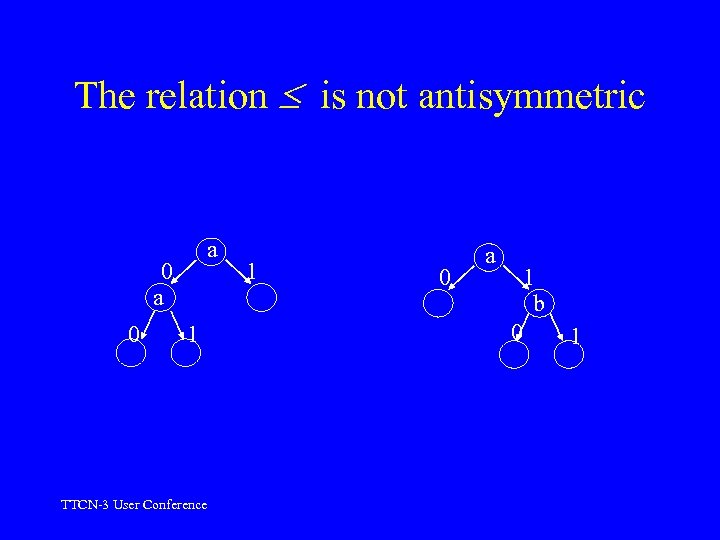
The relation is not antisymmetric a 0 1 TTCN-3 User Conference 1 0 a 1 b 0 1
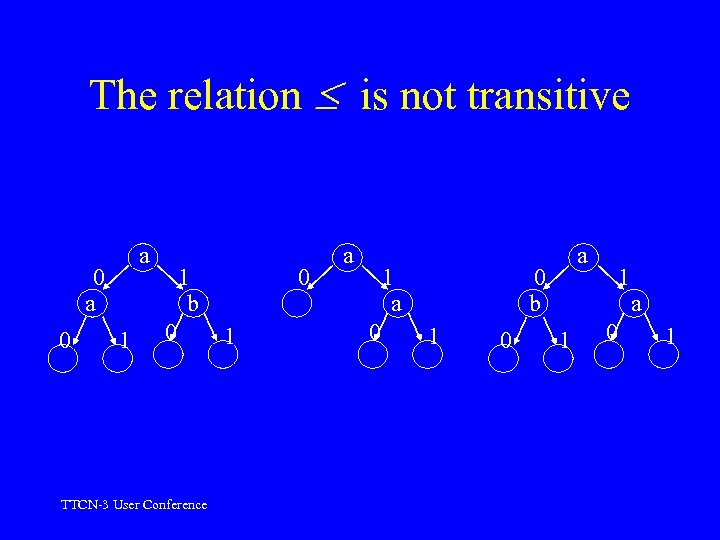
The relation is not transitive a 0 1 1 b 0 TTCN-3 User Conference 0 1 a 0 a 0 b 1 0 1 1 0 a 1
The optimisation problem • Given our set of adaptive test cases we want to: – Find an ordering that minimises the expected cost of testing. • We can rephrase this as: – Find an ordering that maximises the expected saving through not having to apply some of the adaptive test cases. TTCN-3 User Conference
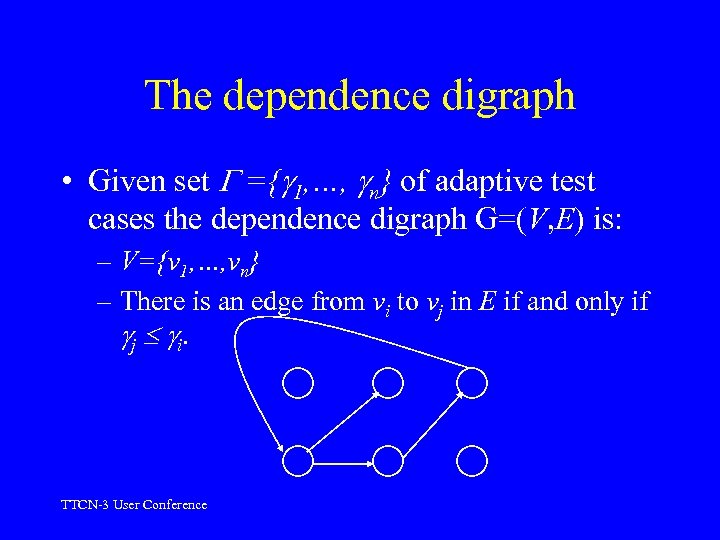
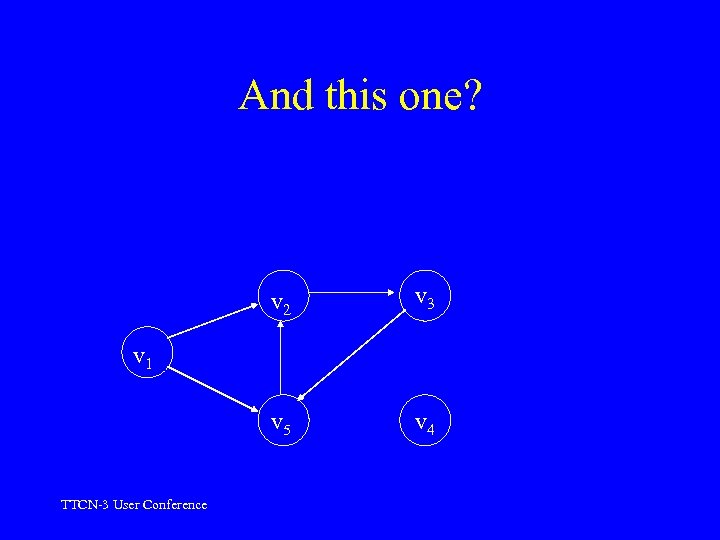
The dependence digraph • Given set ={ 1, …, n} of adaptive test cases the dependence digraph G=(V, E) is: – V={v 1, …, vn} – There is an edge from vi to vj in E if and only if j i. TTCN-3 User Conference
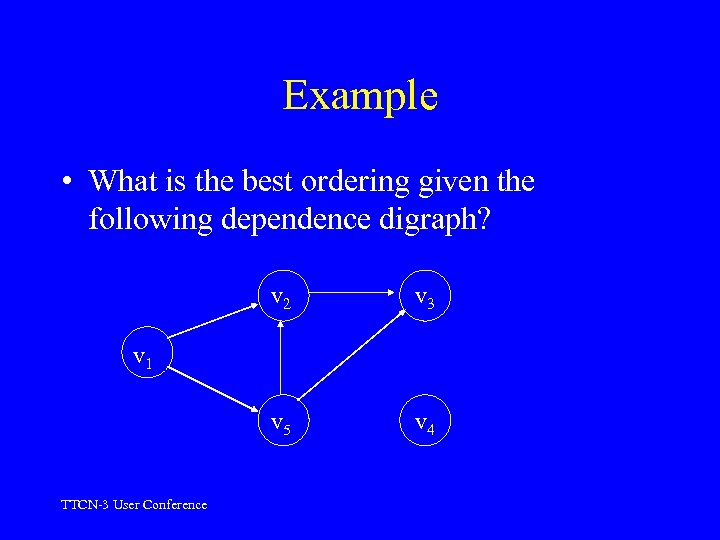
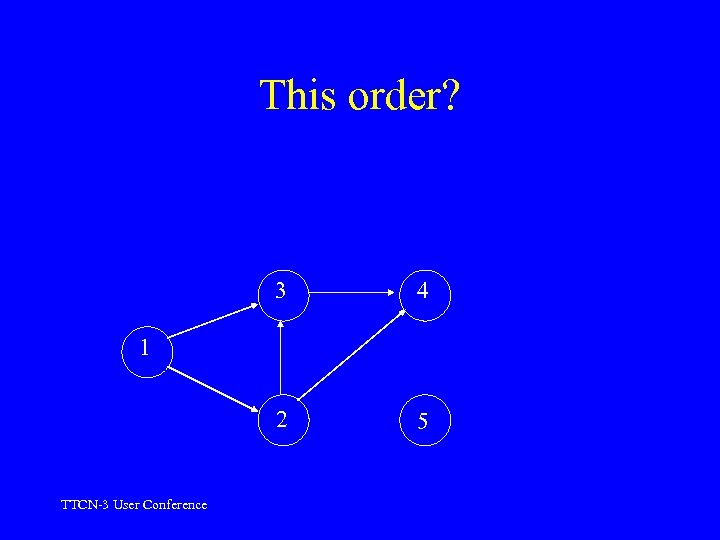
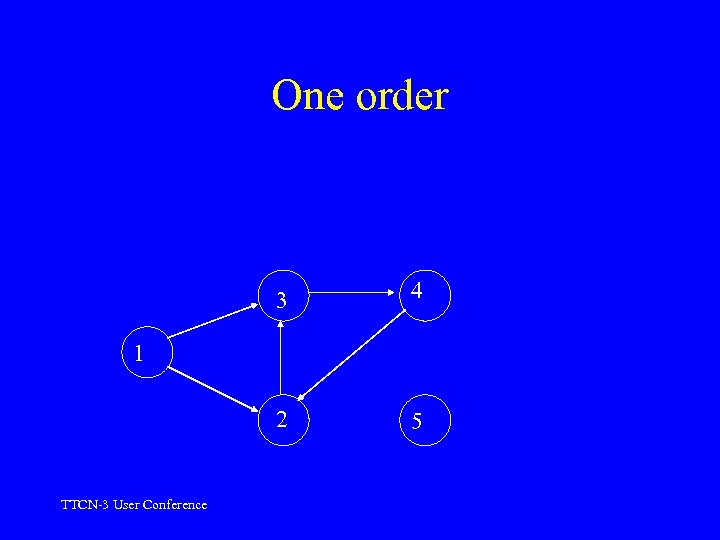
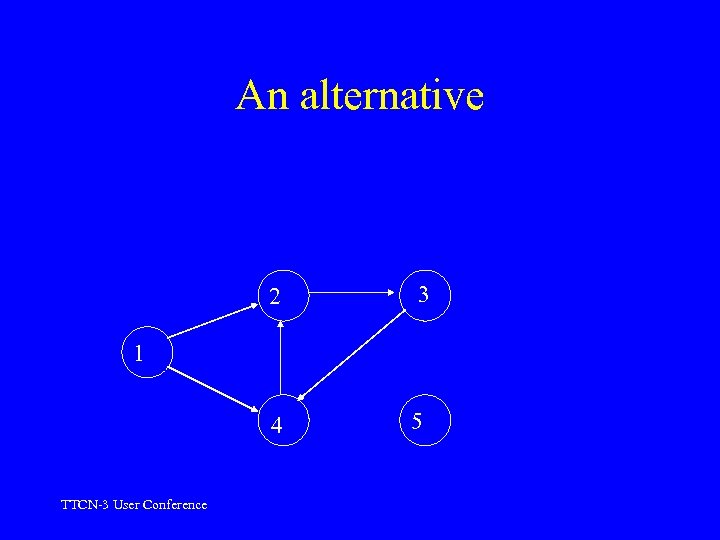
Example • What is the best ordering given the following dependence digraph? v 2 v 3 v 5 v 4 v 1 TTCN-3 User Conference
This order? 3 4 2 5 1 TTCN-3 User Conference
And this one? v 2 v 3 v 5 v 4 v 1 TTCN-3 User Conference
One order 3 4 2 5 1 TTCN-3 User Conference
An alternative 2 3 1 4 TTCN-3 User Conference 5
Solving in terms of the dependence digraph • If we consider only G then the optimal order is: – The order that minimises the number of edges that ‘point backwards’ • Finding this is an instance of the Feedback Arc Set (FAS) problem. • Our problem is NP-hard. TTCN-3 User Conference
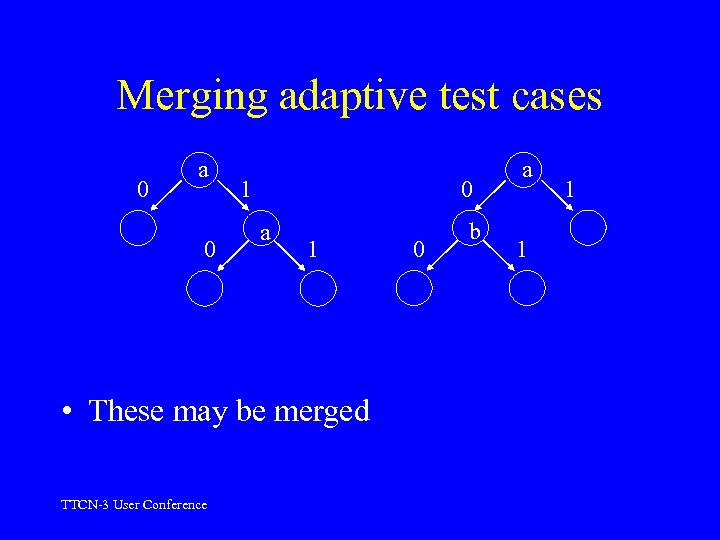
Merging adaptive test cases 0 a 0 1 0 a 1 • These may be merged TTCN-3 User Conference 0 b a 1 1
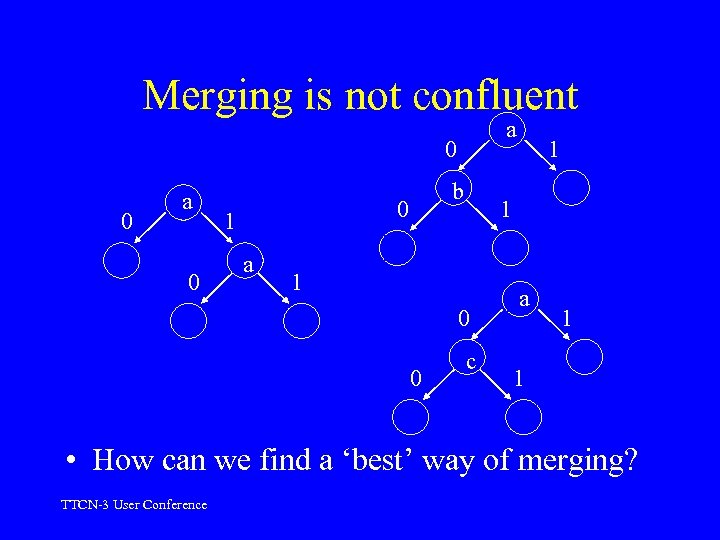
Merging is not confluent a 0 0 a 0 b 0 1 a 1 1 0 0 1 c a 1 1 • How can we find a ‘best’ way of merging? TTCN-3 User Conference
Reducing the size of the problem • We can: – Merge adaptive test cases – Separately consider classes of ‘independent’ adaptive test cases. • Result: – these two approaches do not ‘conflict’. TTCN-3 User Conference
A special case: acyclic dependence digraph • Here we simply repeat the following until all adaptive test cases have been chosen: – Choose a vertex vi of G with no edge entering it. – Add i to the end of the current order and delete vi and the corresponding edges from G. • We are finding an ordering based on a DAG. TTCN-3 User Conference
A simple algorithm • We can: – Solve the FAS problem to find some feedback arc set A. – Let G’=(V, EA) – Find an order based on G’ TTCN-3 User Conference
Another factor: expected saving • The potential saving varies. • So does the likelihood of saving: – If 2 1, how likely is it that we will have to use 2 if we first use 1? • We might estimate the expected saving from using 1 before 2? • A simple approach: give the dependence digraph weighted edges. TTCN-3 User Conference
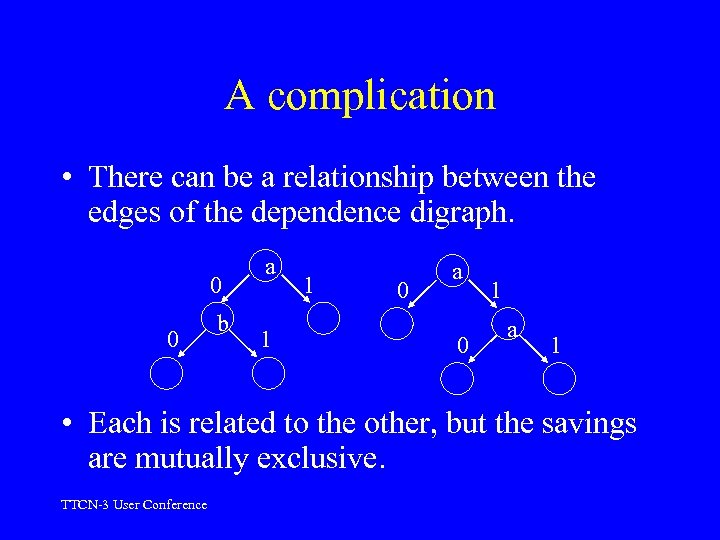
A complication • There can be a relationship between the edges of the dependence digraph. 0 0 b a 1 1 0 a 0 1 a 1 • Each is related to the other, but the savings are mutually exclusive. TTCN-3 User Conference
Infinite Adaptive Test Cases TTCN-3 User Conference
Adaptive test case need not be bounded • We have assumed that our adaptive test cases are given by finite trees. • This does not allow us to include tests such as: continue doing ‘x’ until ‘y’ happens and then … • In order to represent these as trees we need infinite trees. TTCN-3 User Conference
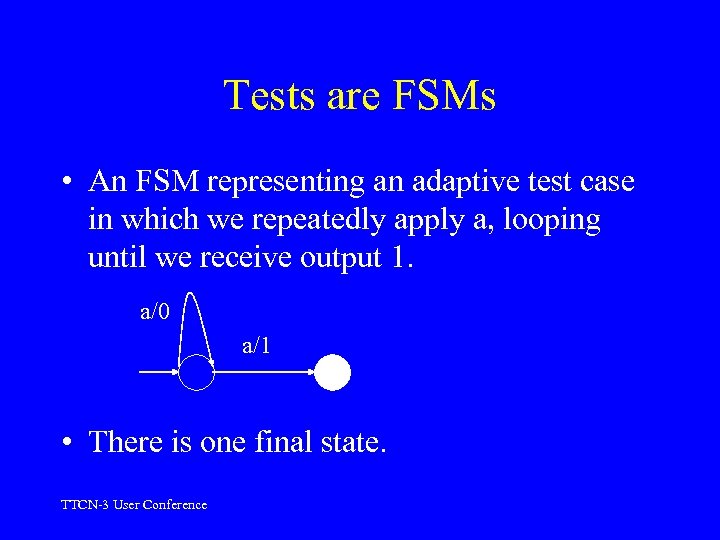
Tests are FSMs • An FSM representing an adaptive test case in which we repeatedly apply a, looping until we receive output 1. a/0 a/1 • There is one final state. TTCN-3 User Conference
Languages • Given an FSM M we let L(M) denote the corresponding regular language. • If we have FSMs M 1 and M 2 representing adaptive test cases 1 and 2 respectively then the response to 1 can predict the response to 2 if and only if: – There is a sequence in L(M 2) that is a prefix of a sequence in L(M 1). TTCN-3 User Conference
A decision procedure • Given adaptive test cases 1 and 2 it is sufficient to do the following: – Define FSMs M 1 and M 2 representing 1 and 2 respectively in which every state of M 1 is a final state. – The response to 1 can predict the response to 2 if and only if L(M 1) L(M 2) . • This is decidable in polynomial time. TTCN-3 User Conference
Nondeterministic Implementations TTCN-3 User Conference
The issue • We can no longer predict the behaviour of an adaptive test case based on a trace. • Even if we apply the same adaptive test case again, we can observe a different trace. TTCN-3 User Conference
Repeating tests • Suppose we apply an adaptive test case 10 times and observe only two traces. • Is this different from only seeing two traces having applied it 1000 times? TTCN-3 User Conference
Possible approaches • We can produce results by either: • Making a fairness assumption • Assuming that all possible observations have at least a given probability • Making no assumptions • The stronger the assumptions made: • the greater the potential for reducing the cost of testing • the greater the potential for reducing test effectiveness. TTCN-3 User Conference
Fairness Assumptions • We assume that for some predetermined k, if we apply an adaptive test case k times then we see all possible responses. • If in testing we apply each adaptive test case k times then we can apply analysis similar to that for deterministic implementations. • We get results similar to the deterministic case. TTCN-3 User Conference
Bounds on probabilities • We could assume that: – In every state s of the SUT and for input x, each possible response of the SUT to x when in s has probability at least p for some fixed/known p. • We can then use results from statistical sampling theory to provide a degree of confidence in having observed all possible traces in response to an adaptive test case. TTCN-3 User Conference
How it works • We apply each adaptive test case a sufficient number of times for us to have the required confidence that no other traces can result from its application. • We can then apply the function defined for the fairness assumption. TTCN-3 User Conference
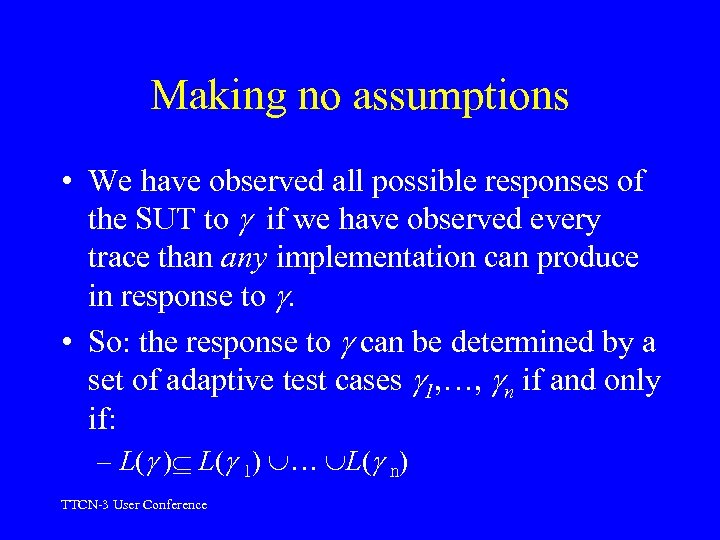
Making no assumptions • We have observed all possible responses of the SUT to if we have observed every trace than any implementation can produce in response to . • So: the response to can be determined by a set of adaptive test cases 1, …, n if and only if: – L( ) L( 1) … L( n) TTCN-3 User Conference
On-the-fly methods • There are on-the-fly methods for deterministic implementations • These will do no worse than the preset methods • However, they require a more sophisticated environment and additional processing during the application of a test case. TTCN-3 User Conference
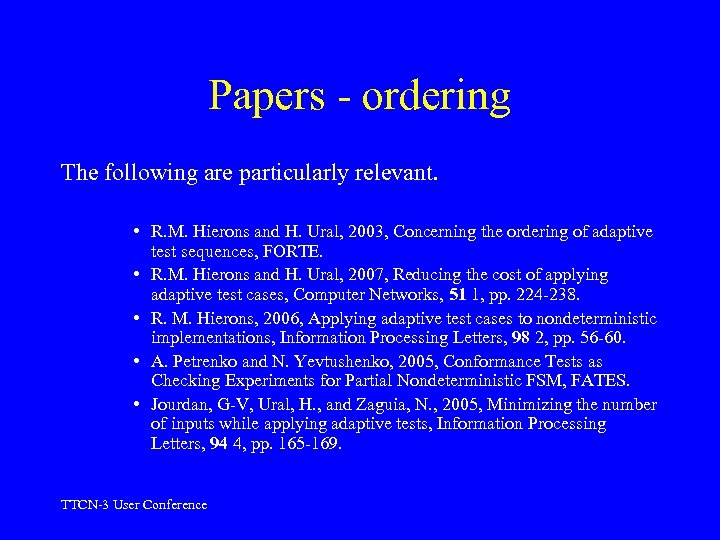
Papers - ordering The following are particularly relevant. • R. M. Hierons and H. Ural, 2003, Concerning the ordering of adaptive test sequences, FORTE. • R. M. Hierons and H. Ural, 2007, Reducing the cost of applying adaptive test cases, Computer Networks, 51 1, pp. 224 -238. • R. M. Hierons, 2006, Applying adaptive test cases to nondeterministic implementations, Information Processing Letters, 98 2, pp. 56 -60. • A. Petrenko and N. Yevtushenko, 2005, Conformance Tests as Checking Experiments for Partial Nondeterministic FSM, FATES. • Jourdan, G-V, Ural, H. , and Zaguia, N. , 2005, Minimizing the number of inputs while applying adaptive tests, Information Processing Letters, 94 4, pp. 165 -169. TTCN-3 User Conference
Future work • Could include: – Optimization using wider range of sources of information. – Test cases that are timed, distributed … – Empirical studies. – On-the-fly with non-deterministic implementations. – Combining with selective regression TTCN-3 User Conference
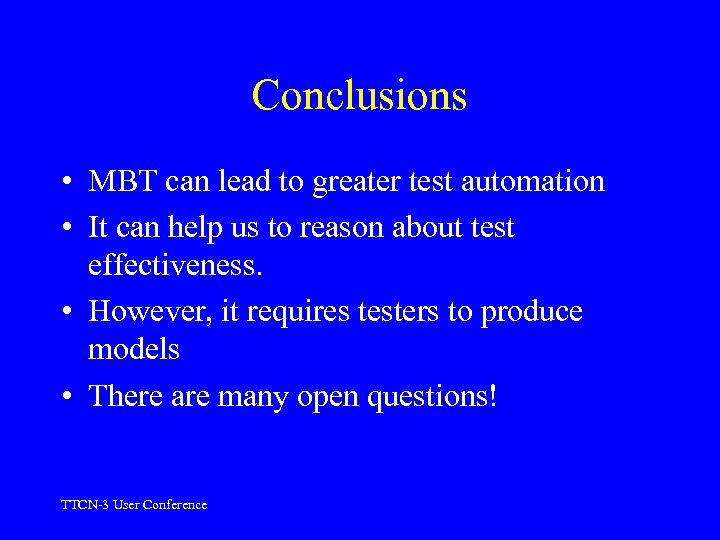
Conclusions • MBT can lead to greater test automation • It can help us to reason about test effectiveness. • However, it requires testers to produce models • There are many open questions! TTCN-3 User Conference
Questions? TTCN-3 User Conference
Скачать презентацию Directions in Model Based Testing R M Hierons
268e0f9e1234febe86589a11b1f812b1.ppt