


 Скачать презентацию Direction-sensitive monitoring of nuclear power plants R J
2c3f539288c782eb1e4ec4c0e50949b9.ppt
- Количество слайдов: 32
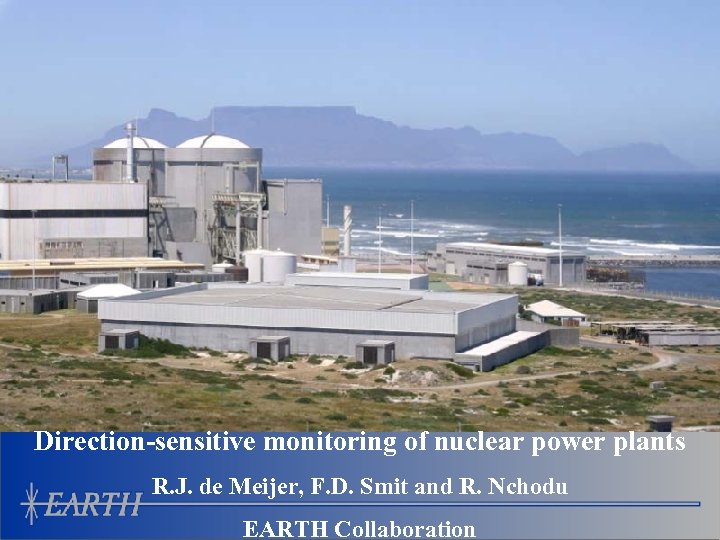 Direction-sensitive monitoring of nuclear power plants R. J. de Meijer, F. D. Smit and R. Nchodu EARTH Collaboration
 Antineutrinos • Postulated by Pauli to resolve the mystery of continuous β-spectra around 1930. • Realising the extreme small cross sections for interactions (10 -43) Pauli exclaimed: “I have done something terrible by postulating a particle that cannot be detected. • Experimentally detected by Reines and Cowan in the 1950’s.
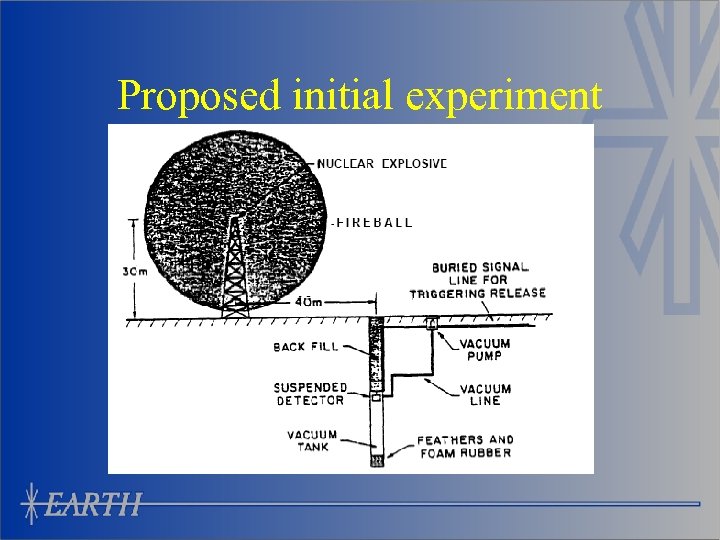 Proposed initial experiment
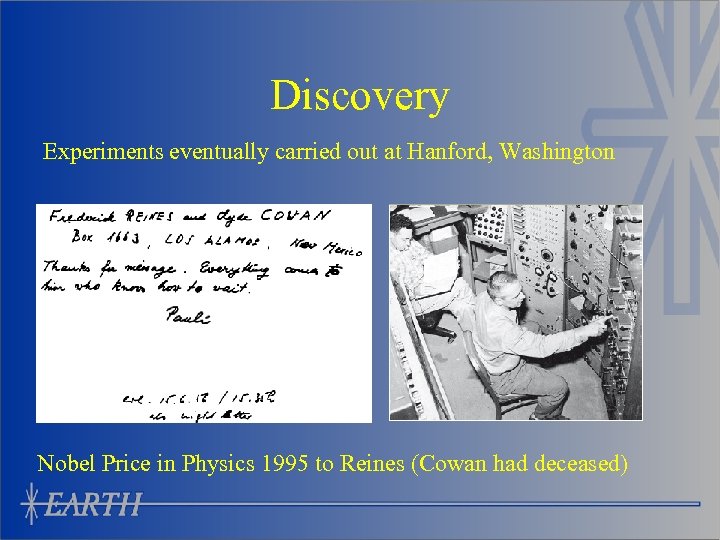 Discovery Experiments eventually carried out at Hanford, Washington Nobel Price in Physics 1995 to Reines (Cowan had deceased)
 IAEA-Oct 2008 Recommendations • Consider antineutrino detection and monitoring in the current IAEA programme; • Consider antineutrino monitoring in Safeguards by Design for power and fissile monitoring of new and next generation reactors; • IAEA work with experts to consider future reactor designs, using existing simulation codes for reactor evolution and detector response;
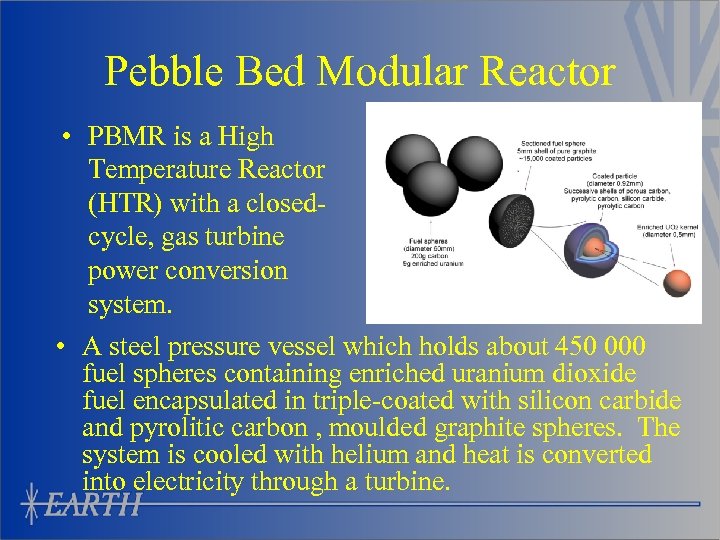 Pebble Bed Modular Reactor • PBMR is a High Temperature Reactor (HTR) with a closedcycle, gas turbine power conversion system. • A steel pressure vessel which holds about 450 000 fuel spheres containing enriched uranium dioxide fuel encapsulated in triple-coated with silicon carbide and pyrolitic carbon , moulded graphite spheres. The system is cooled with helium and heat is converted into electricity through a turbine.
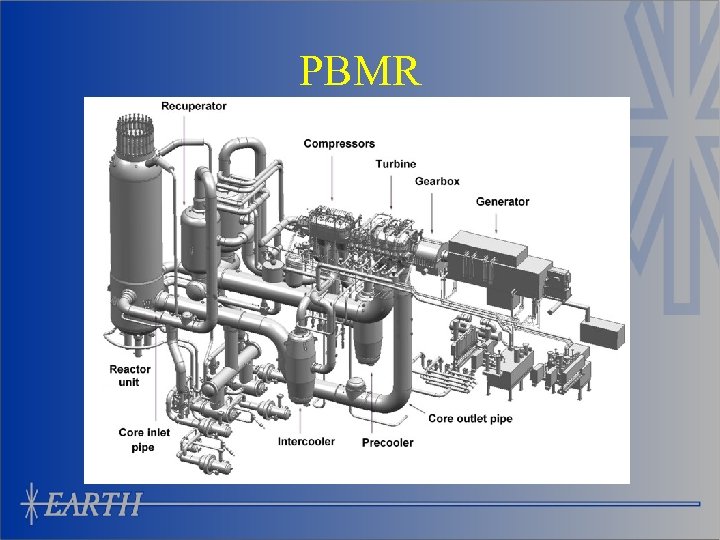 PBMR
PBMR
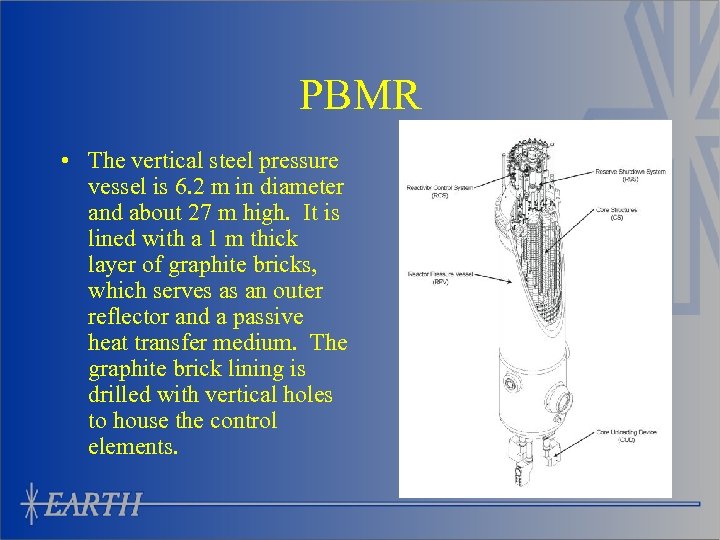 PBMR • The vertical steel pressure vessel is 6. 2 m in diameter and about 27 m high. It is lined with a 1 m thick layer of graphite bricks, which serves as an outer reflector and a passive heat transfer medium. The graphite brick lining is drilled with vertical holes to house the control elements.
 Application to PBMR • Antineutrino measurements provide information on elemental and isotopic composition of an entire fissioning reactor core, providing a type of bulk accountancy. • So antineutrino detection provides a unique alternative approach to maintaining continuity of knowledge and near real-time safeguards information about PBMRs.
 Limitations • Burn-up in the PBMR is not homogeneous. • One single detector therefore provides solidangle integrated information. • A modular set of detectors with a smaller footprint would be preferred. • Size reduction of antineutrino detectors based on γ-rays not feasible.
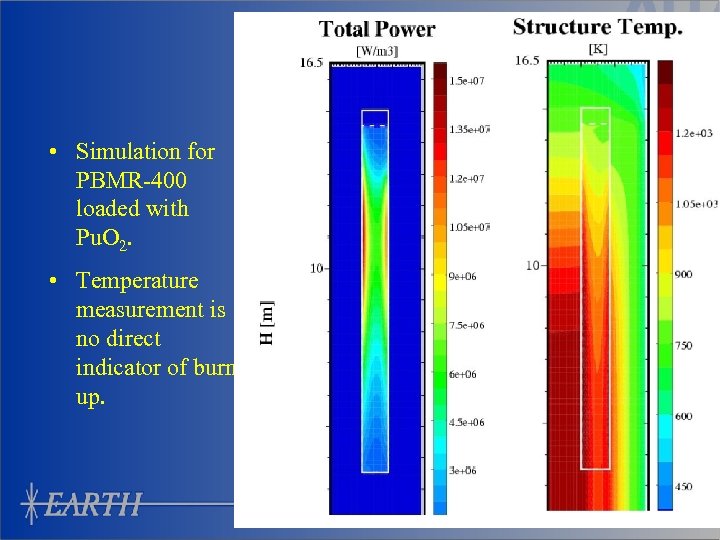 • Simulation for PBMR-400 loaded with Pu. O 2. • Temperature measurement is no direct indicator of burnup.
 EARTH Programme • Programme EARTH develops direction-sensitive antineutrino detectors, which eventually put together will form a network of about ten telescopes looking into the Earth and map the radiogenic heat sources. • Each telescope contains ~ 4000 ton detection material. • Starts from proven, state of the art technology and develops and incorporates new technologies.
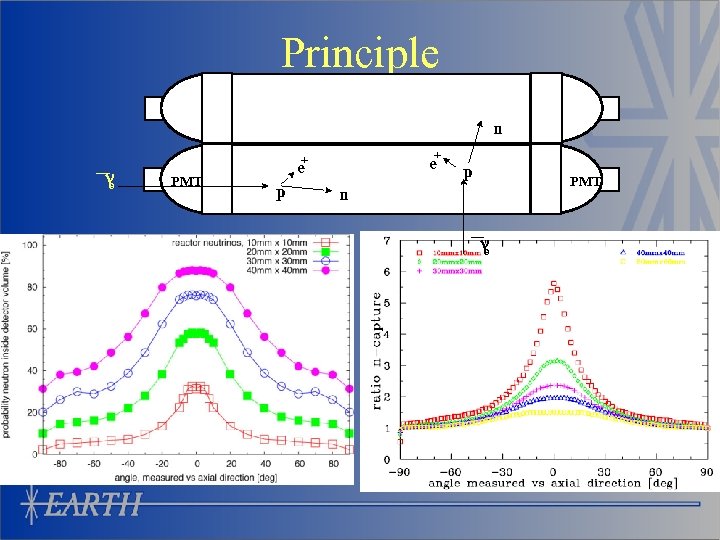
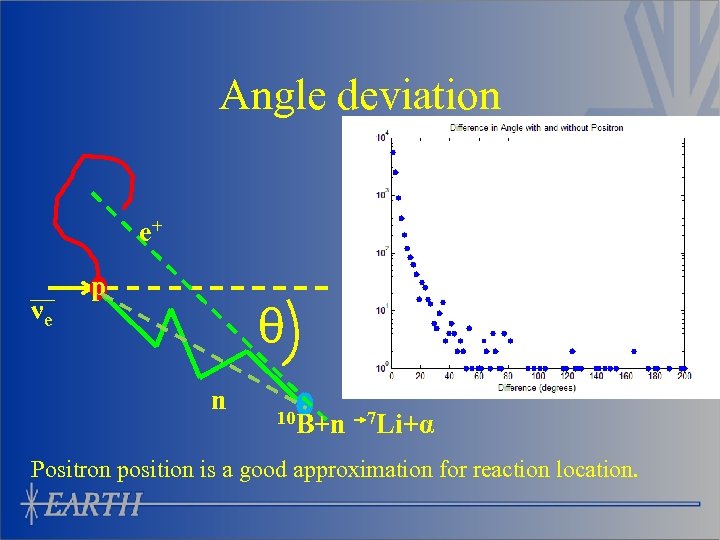 Angle deviation e+ νe p θ n 10 B+n 7 Li+α Positron position is a good approximation for reaction location.
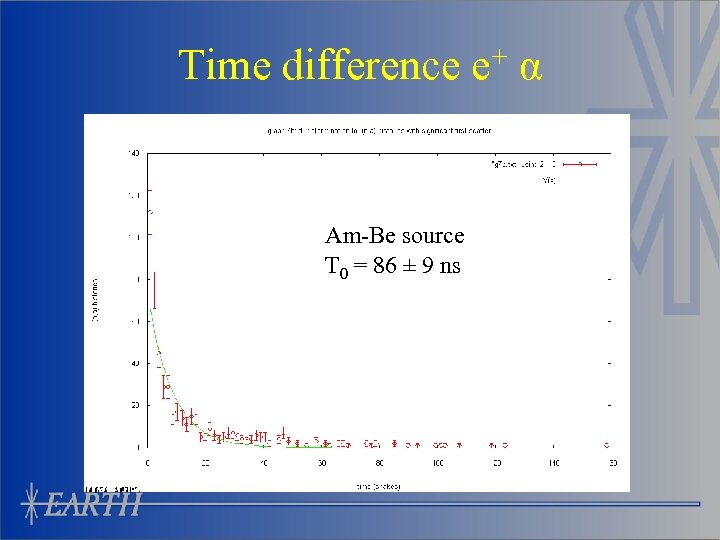 Time difference e+ α Am-Be source T 0 = 86 ± 9 ns
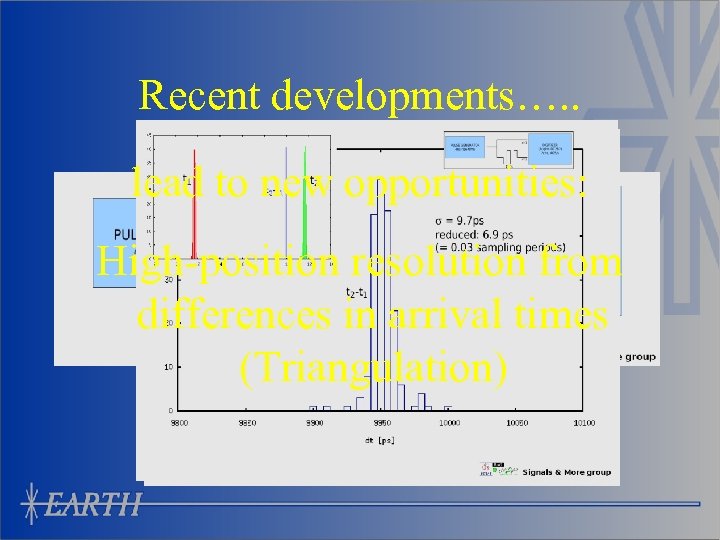 Recent developments…. . lead to new opportunities: High-position resolution from differences in arrival times (Triangulation)
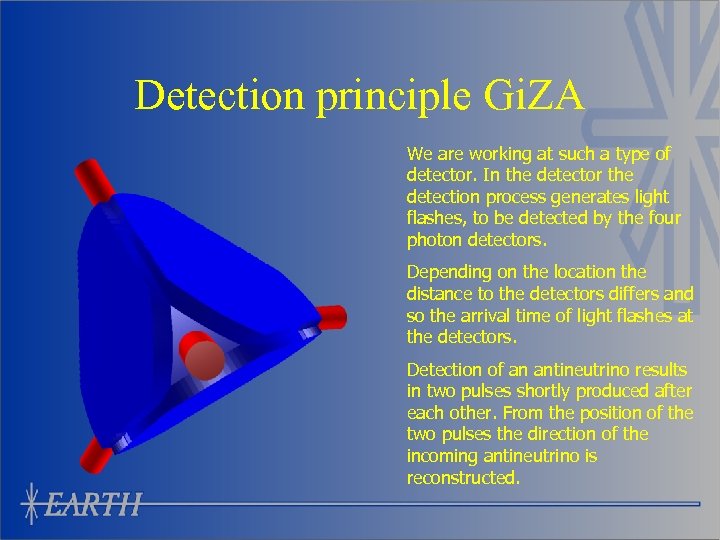 Detection principle Gi. ZA We are working at such a type of detector. In the detector the detection process generates light flashes, to be detected by the four photon detectors. Depending on the location the distance to the detectors differs and so the arrival time of light flashes at the detectors. Detection of an antineutrino results in two pulses shortly produced after each other. From the position of the two pulses the direction of the incoming antineutrino is reconstructed.
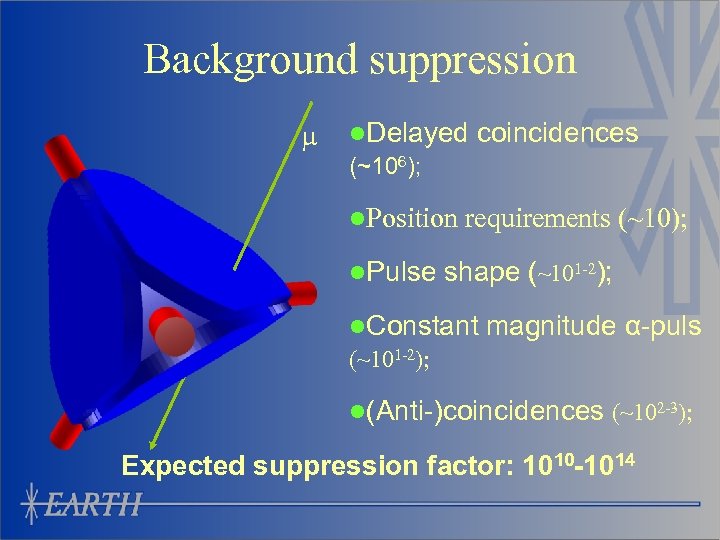 Background suppression l. Delayed (~106); coincidences l. Position requirements (~10); l. Pulse shape (~101 -2); l. Constant (~101 -2); magnitude α-puls l(Anti-)coincidences (~102 -3); Expected suppression factor: 1010 -1014
 Present development within Sensor Universe • Plausibility study liquid scintillation materials, including construction of test cells, construction design of Gi. ZA and test of cells in South Africa. • Feasibility study by Polyvation, Groningen, new detector materials based on light emitting polymers.
 Next steps within Sensor Universe • Construct Gi. ZA and test it at Koeberg nuclear power plant (SA) • “Copy” SONGS detector and demonstrate it at Koeberg as preparation for implementing it in Pebble Bed Modular Reactor (PBMR). • Collaboration with IAEA, NRG, LLNL (USA) and PBMR (? ).
 Direction sensitivity • Capture reaction of antineutrinos on a proton provides direction sensitivity in the emission of the neutron. • Direction sensitivity gets reduced by slow down of neutrons by scattering. • Early neutron capture by 10 B or 6 Li preserves direction information and reduces uncorrelated background.
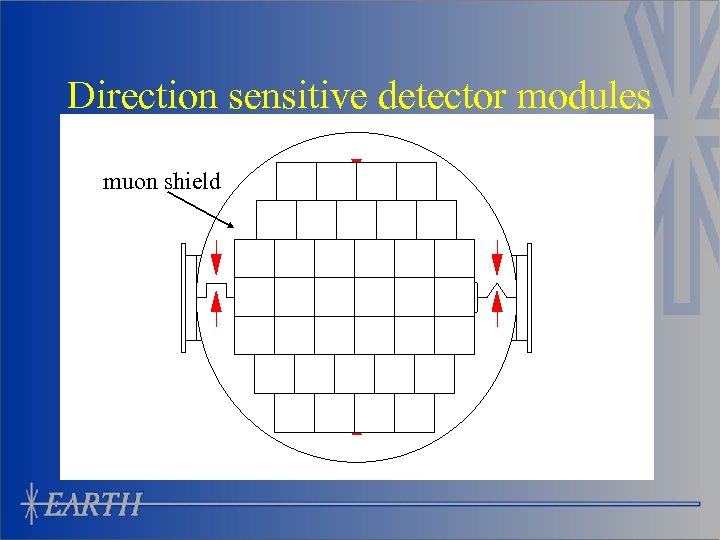
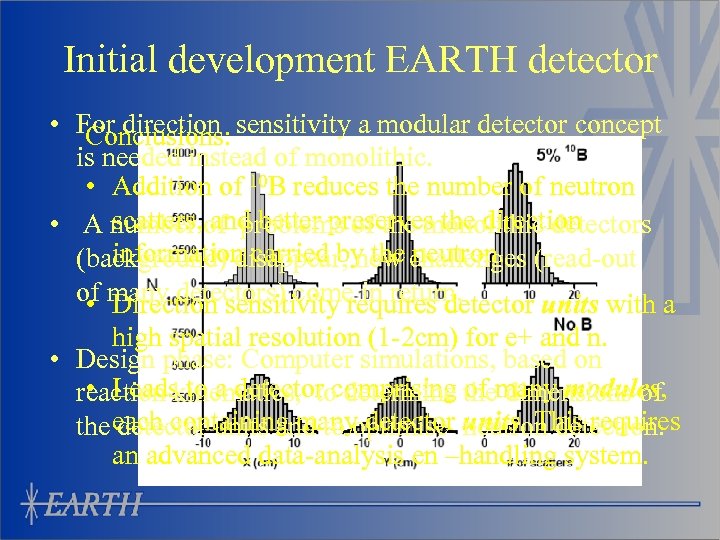 Initial development EARTH detector • For direction sensitivity a modular detector concept Conclusions: is needed instead of monolithic. • Addition of 10 B reduces the number of neutron scatters, and better preserves the direction • A number of problems of the monolithic detectors information carried by the neutron. (background) disappear, new challenges (read-out of many detectors) come in return. • Direction sensitivity requires detector units with a high spatial resolution (1 -2 cm) for e+ and n. • Design phase: Computer simulations, based on • Leads to a detector comprising of many modules, reaction kinematics, to determine the dimensions of each containing many detector units. This requires the detector units and to optimise neutron detection. an advanced data-analysis en –handling system.
 Principle n n e + PMT e p p PMT n n e
 Direction sensitive detector modules muon shield 11 10 9 19 1 5 6 7 18 13 4 3 2 8 12 17 14 15 16
 Development first phase POP (successfully concluded) • Use existing small (3. 8 cm diameter; 2. 5 cm long) detectors. • Simulate double-pulse events with n-source. • Determine time characteristics of coincidences and pulse shape.
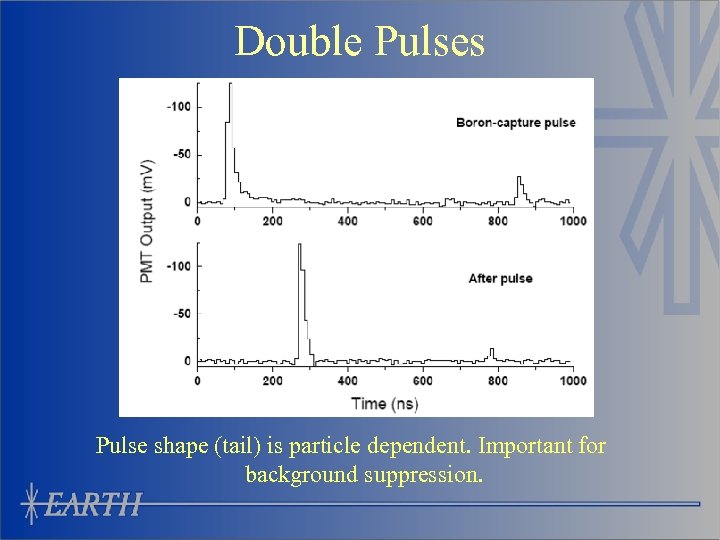 Double Pulses Pulse shape (tail) is particle dependent. Important for background suppression.
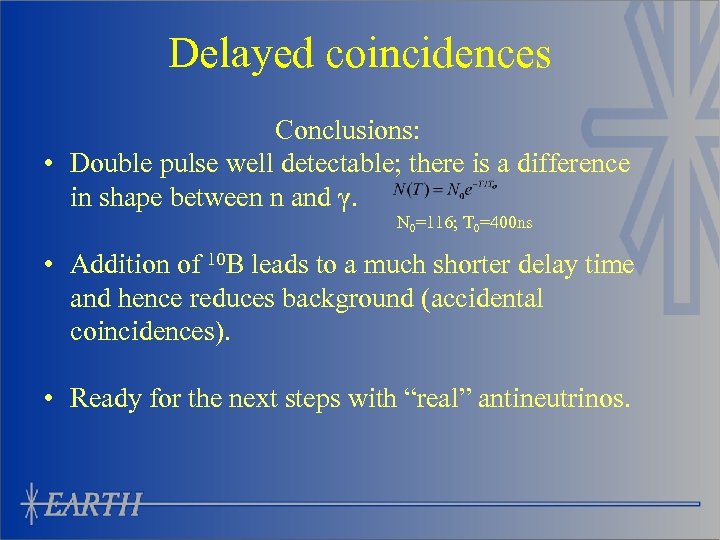 Delayed coincidences Conclusions: • Double pulse well detectable; there is a difference in shape between n and γ. N 0=116; T 0=400 ns • Addition of 10 B leads to a much shorter delay time and hence reduces background (accidental coincidences). • Ready for the next steps with “real” antineutrinos.
 Development strategy EARTH • Use existing, proven technologies and demonstrate the Proof Of Principle (POP) of direction sensitive antineutrino detection near a nuclear power plant (strong source of antineutrinos). • Develop in parallel new technologies for light detection, detection materials, signal analysis and processing, data storage. Only after sufficient testing incorporate them in the detector set ups.
 Development strategy EARTH • Scale-up detector dimensions step by step. (Started very small, next step is still small but afterwards we intend to reach our goal in one or two steps of development) • Apply new technologies if appropriate. • Look during development for applications (financing).
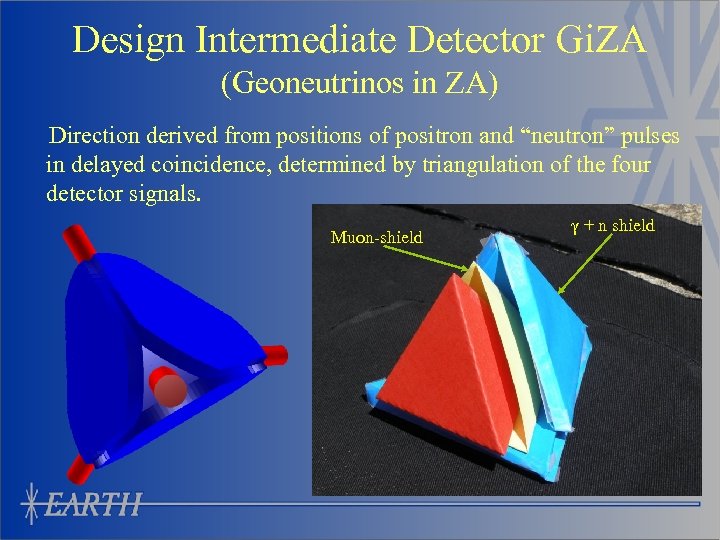 Design Intermediate Detector Gi. ZA (Geoneutrinos in ZA) Direction derived from positions of positron and “neutron” pulses in delayed coincidence, determined by triangulation of the four detector signals. Muon-shield γ + n shield
 Expected properties • Characterising antineutrinos with appropriate background reduction; • Position determination based on arrival-time differences; • Relatively easy to manoeuvre due to limited volume and weight ~40 l; • Sufficient count rate for testing properties.
 Optimisations • Physical properties liquid scintillators; • Designing and developing polymers with high light output for α-particles and good particle identification on pulse shape; • Replacing PMTs by other light converters not sensitive to magnetic disturbances. • …….
 Goals for the next phase • Measure real antineutrino signature with Giza and tubular detectors; • Check possibilities triangulation; • Investigate pulse characteristics and light attenuation of gelled and polymer detectors; • Investigate background reduction in the lab and in an underground laboratory (Pyhäsalmi Finland); • Design prototype detector for reactor monitoring.