


 Скачать презентацию Direction for Tier 3 R Yoshida Argonne National
72d661e1a9a8411b8a3a918cc8209b3d.ppt
- Количество слайдов: 8
 Direction for Tier 3 R. Yoshida Argonne National Laboratory T 2/T 3 Workshop, Chicago 20 Aug 2009 1
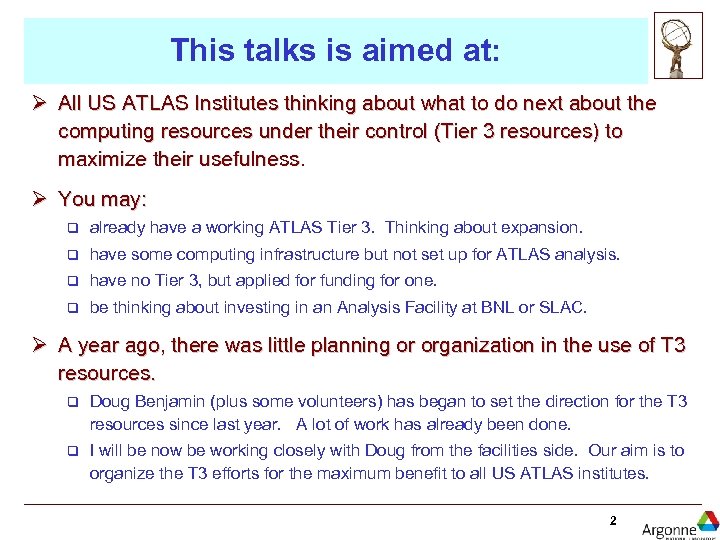 This talks is aimed at: Ø All US ATLAS Institutes thinking about what to do next about the computing resources under their control (Tier 3 resources) to maximize their usefulness. Ø You may: q already have a working ATLAS Tier 3. Thinking about expansion. q have some computing infrastructure but not set up for ATLAS analysis. q have no Tier 3, but applied for funding for one. q be thinking about investing in an Analysis Facility at BNL or SLAC. Ø A year ago, there was little planning or organization in the use of T 3 resources. q Doug Benjamin (plus some volunteers) has began to set the direction for the T 3 resources since last year. A lot of work has already been done. q I will be now be working closely with Doug from the facilities side. Our aim is to organize the T 3 efforts for the maximum benefit to all US ATLAS institutes. 2
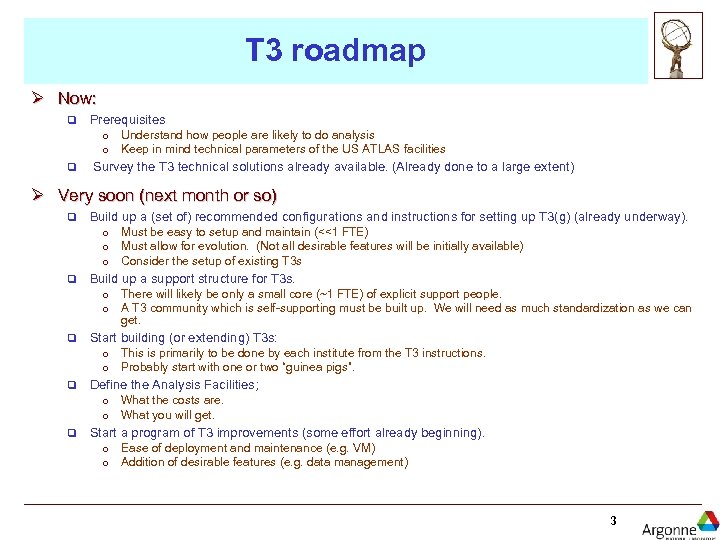 T 3 roadmap Ø Now: q Prerequisites o o q Understand how people are likely to do analysis Keep in mind technical parameters of the US ATLAS facilities Survey the T 3 technical solutions already available. (Already done to a large extent) Ø Very soon (next month or so) q Build up a (set of) recommended configurations and instructions for setting up T 3(g) (already underway). o o o q Build up a support structure for T 3 s. o o q o This is primarily to be done by each institute from the T 3 instructions. Probably start with one or two “guinea pigs”. Define the Analysis Facilities; o o q There will likely be only a small core (~1 FTE) of explicit support people. A T 3 community which is self-supporting must be built up. We will need as much standardization as we can get. Start building (or extending) T 3 s: o q Must be easy to setup and maintain (<<1 FTE) Must allow for evolution. (Not all desirable features will be initially available) Consider the setup of existing T 3 s What the costs are. What you will get. Start a program of T 3 improvements (some effort already beginning). o o Ease of deployment and maintenance (e. g. VM) Addition of desirable features (e. g. data management) 3
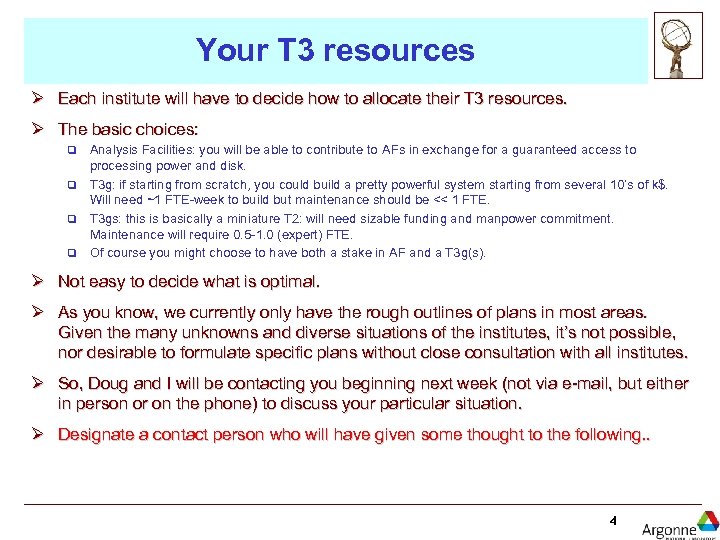 Your T 3 resources Ø Each institute will have to decide how to allocate their T 3 resources. Ø The basic choices: Analysis Facilities: you will be able to contribute to AFs in exchange for a guaranteed access to processing power and disk. q T 3 g: if starting from scratch, you could build a pretty powerful system starting from several 10’s of k$. Will need ~1 FTE-week to build but maintenance should be << 1 FTE. q T 3 gs: this is basically a miniature T 2: will need sizable funding and manpower commitment. Maintenance will require 0. 5 -1. 0 (expert) FTE. q Of course you might choose to have both a stake in AF and a T 3 g(s). q Ø Not easy to decide what is optimal. Ø As you know, we currently only have the rough outlines of plans in most areas. Given the many unknowns and diverse situations of the institutes, it’s not possible, nor desirable to formulate specific plans without close consultation with all institutes. Ø So, Doug and I will be contacting you beginning next week (not via e-mail, but either in person or on the phone) to discuss your particular situation. Ø Designate a contact person who will have given some thought to the following. . 4
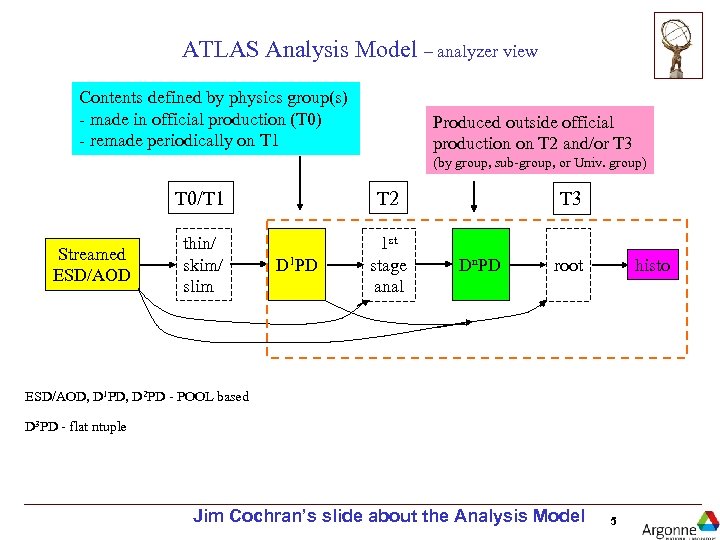 ATLAS Analysis Model – analyzer view Contents defined by physics group(s) - made in official production (T 0) - remade periodically on T 1 Produced outside official production on T 2 and/or T 3 (by group, sub-group, or Univ. group) T 0/T 1 Streamed ESD/AOD T 2 thin/ skim/ slim 1 st stage anal D 1 PD T 3 Dn. PD histo root ESD/AOD, D 1 PD, D 2 PD - POOL based D 3 PD - flat ntuple Jim Cochran’s slide about the Analysis Model 5
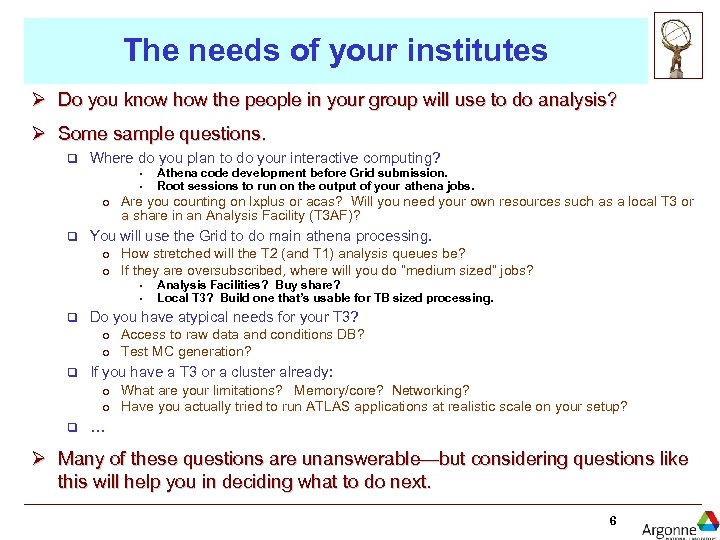 The needs of your institutes Ø Do you know how the people in your group will use to do analysis? Ø Some sample questions. q Where do you plan to do your interactive computing? § § o q Are you counting on lxplus or acas? Will you need your own resources such as a local T 3 or a share in an Analysis Facility (T 3 AF)? You will use the Grid to do main athena processing. o o How stretched will the T 2 (and T 1) analysis queues be? If they are oversubscribed, where will you do “medium sized” jobs? § § q o Access to raw data and conditions DB? Test MC generation? If you have a T 3 or a cluster already: o o q Analysis Facilities? Buy share? Local T 3? Build one that’s usable for TB sized processing. Do you have atypical needs for your T 3? o q Athena code development before Grid submission. Root sessions to run on the output of your athena jobs. What are your limitations? Memory/core? Networking? Have you actually tried to run ATLAS applications at realistic scale on your setup? … Ø Many of these questions are unanswerable—but considering questions like this will help you in deciding what to do next. 6
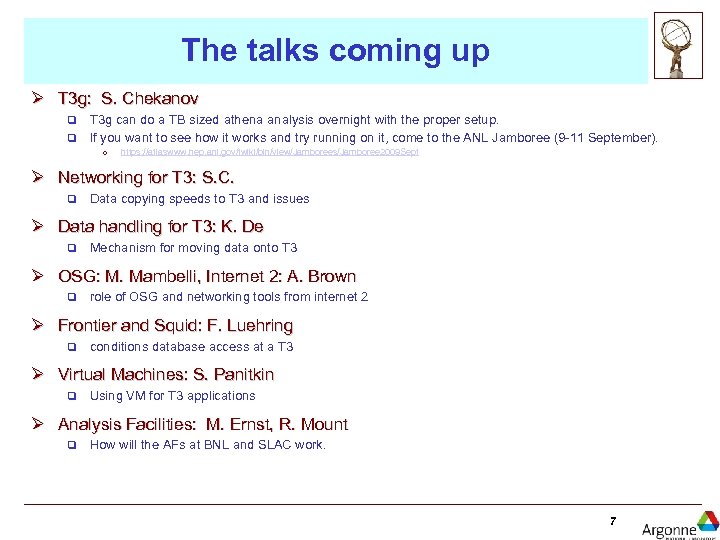 The talks coming up Ø T 3 g: S. Chekanov T 3 g can do a TB sized athena analysis overnight with the proper setup. q If you want to see how it works and try running on it, come to the ANL Jamboree (9 -11 September). q o https: //atlaswww. hep. anl. gov/twiki/bin/view/Jamborees/Jamboree 2009 Sept Ø Networking for T 3: S. C. q Data copying speeds to T 3 and issues Ø Data handling for T 3: K. De q Mechanism for moving data onto T 3 Ø OSG: M. Mambelli, Internet 2: A. Brown q role of OSG and networking tools from internet 2 Ø Frontier and Squid: F. Luehring q conditions database access at a T 3 Ø Virtual Machines: S. Panitkin q Using VM for T 3 applications Ø Analysis Facilities: M. Ernst, R. Mount q How will the AFs at BNL and SLAC work. 7
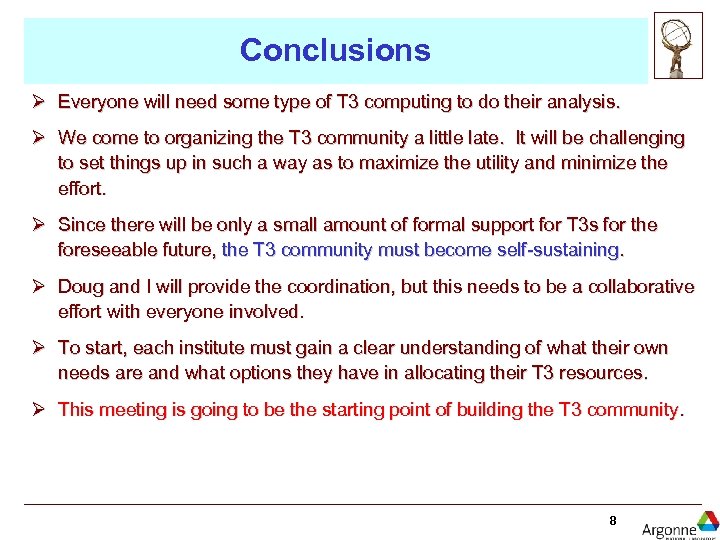 Conclusions Ø Everyone will need some type of T 3 computing to do their analysis. Ø We come to organizing the T 3 community a little late. It will be challenging to set things up in such a way as to maximize the utility and minimize the effort. Ø Since there will be only a small amount of formal support for T 3 s for the foreseeable future, the T 3 community must become self-sustaining. Ø Doug and I will provide the coordination, but this needs to be a collaborative effort with everyone involved. Ø To start, each institute must gain a clear understanding of what their own needs are and what options they have in allocating their T 3 resources. Ø This meeting is going to be the starting point of building the T 3 community. 8