


 Скачать презентацию Direct-to-Discovery D 2 D Claudia Huff F 3 GTRI
6846bb773935265c9a867d82b57a9b9c.ppt
- Количество слайдов: 23
 Direct-to-Discovery (D 2 D) Claudia Huff (F 3/GTRI), Ed Morrison (BCS) and Warren Matthews (Georgia Tech).
 Abstract • • • We present the direct-to-discovery project and the opportunities to augment classroom learning via interactive sessions with leading-edge researchers in Georgia and beyond. The project uses high-speed networking and HD video conferencing to bring children from all grade levels face-to-face with subjectmatter experts without the time and cost of field trips. For example, students have explored the clean room at Georgia Tech and examined nano-tubes under an electron microscope. Students have also talked to genome researchers at UGA, questioned engineers at NASA, and experienced music with the Philadelphia Orchestra. As the program grows, students will interact with divers at Gray's Reef National Marine Sanctuary and remotely access telescopes. Teachers are paired with researchers to develop lesson plans and address particular GPS. In most cases the teacher-researcher pairing is a long-term partnership providing students with additional opportunities to work on special projects with Ph. D students. The project began as a partnership between the Georgia Institute of Technology and Barrow County Schools. It is currently in a proven prototype stage and in the process of expanding beyond the pilot site. Special consideration is given to evaluation and is in the process of being formalized. 2
 Present a novel approach to using technology in the classroom that can enrich science instruction in a meaningful way Enumerate the essential components & provide examples Discuss possible applications for your classroom Objectives “We’re here to recruit you” as a D 2 D enthusiast!
 Multidisciplinary collaboration based at GT/GTRI with Barrow County as “learning laboratory” Partners include GSU, BOR, and school systems in De. Kalb, Hall, and Putnam counties Who and What is D 2 D? Major components include • connectivity • professional development and ongoing PLCs classroom
 Shortage of qualified science/math teachers Out-of-date textbooks in science No funding for field trips/out-of-classroom activities Issues Addressed by D 2 D Inadequate numbers in the science/math pipeline to meet the challenges of global competitiveness
 Explore applications using advanced research & education networks (non-commodity internet, Peach. Net in Georgia). Supplement & enrich classroom instruction via interaction with practicing scientists and engineers in emerging technical fields. Opportunities University and K-12 faculty collaboratively develop and deliver content tied to GPS and ultimately, conduct collaborative research projects. Access an array of scientific resources around the world that can help motivate and inspire future scientists.
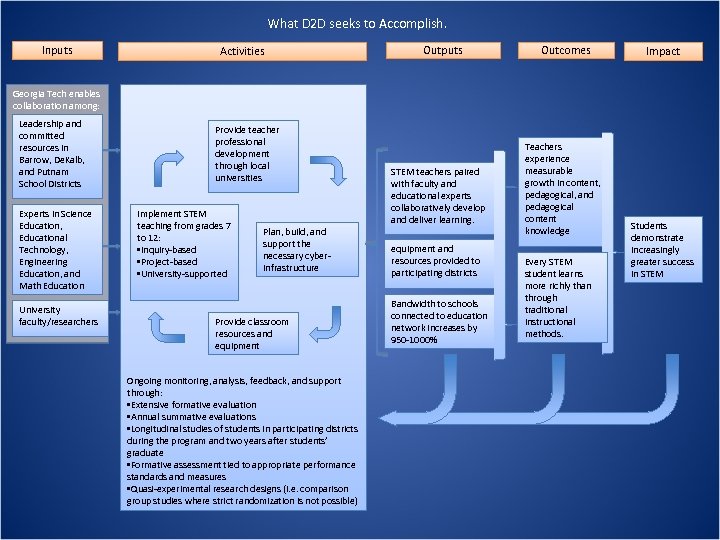 What D 2 D seeks to Accomplish. Inputs Activities Outputs Outcomes Impact Georgia Tech enables collaboration among: Leadership and committed resources in Barrow, De. Kalb, and Putnam School Districts Experts in Science Education, Educational Technology, Engineering Education, and Math Education University faculty/researchers Provide teacher professional development through local universities Implement STEM teaching from grades 7 to 12: • Inquiry-based • Project-based • University-supported Plan, build, and support the necessary cyberinfrastructure Provide classroom resources and equipment Ongoing monitoring, analysis, feedback, and support through: • Extensive formative evaluation • Annual summative evaluations • Longitudinal studies of students in participating districts during the program and two years after students’ graduate • Formative assessment tied to appropriate performance standards and measures • Quasi-experimental research designs (i. e. comparison group studies where strict randomization is not possible) STEM teachers paired with faculty and educational experts collaboratively develop and deliver learning. equipment and resources provided to participating districts Bandwidth to schools connected to education network increases by 950 -1000% Teachers experience measurable growth in content, pedagogical, and pedagogical content knowledge Every STEM student learns more richly than through traditional instructional methods. Students demonstrate increasingly greater success in STEM
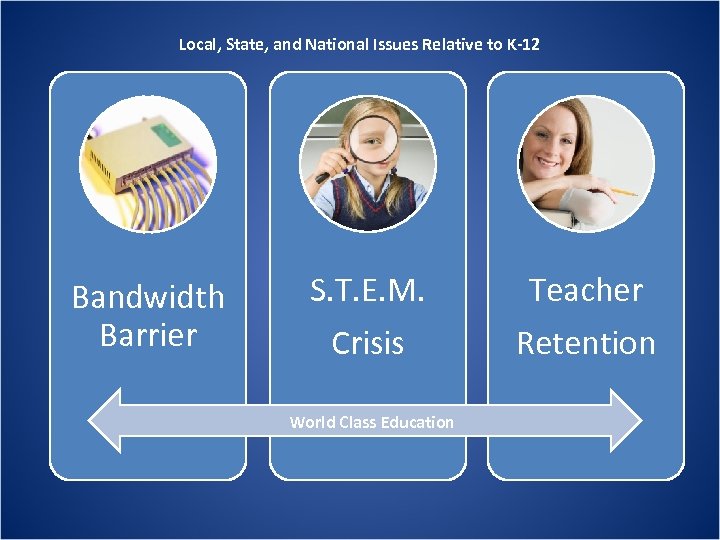 Local, State, and National Issues Relative to K-12 Bandwidth Barrier S. T. E. M. Crisis World Class Education Teacher Retention
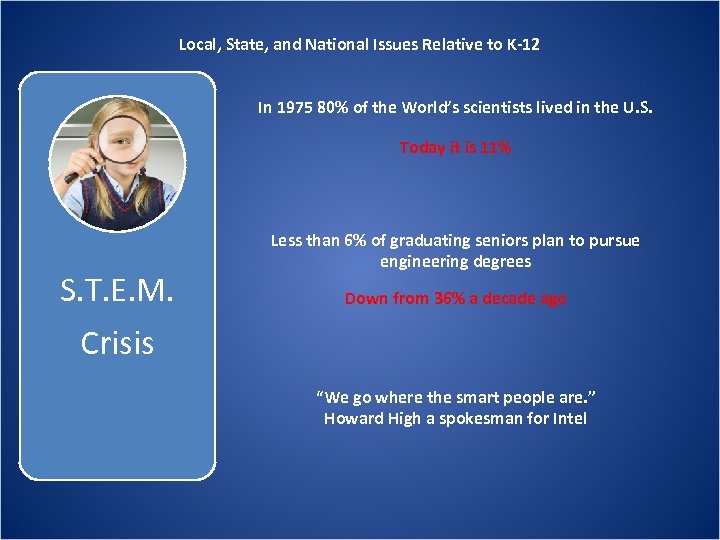 Local, State, and National Issues Relative to K-12 In 1975 80% of the World’s scientists lived in the U. S. Today it is 11% S. T. E. M. Crisis Less than 6% of graduating seniors plan to pursue engineering degrees Down from 36% a decade ago “We go where the smart people are. ” Howard High a spokesman for Intel
 Local, State, and National Issues Relative to K-12 Direct To Discovery Seeks to engage and motivate students in the excitement of science discovery Leverages high speed networks and advanced media technologies to create lab to classroom experiences S. T. E. M. Crisis Provides ageless curricula consistently in sync with advances and discoveries in science Establishes a process for collaboration on problems important to K-12 and post secondary institutions Potentially a strong component in the development of Georgia’s labor and talent pool The network also supports cultural events
 Think about what becomes possible when Bandwidth is not a limiting factor. Capabilities Beyond the Bandwidth Barrier. Videoconferencing Teleimmersion/telepresence Remote control of scientific instrumentation Sensors, simulations Haptics You can’t do anything without capacity. Capacity is required but not sufficient. Also latency, jitter and advanced services such as multicast.
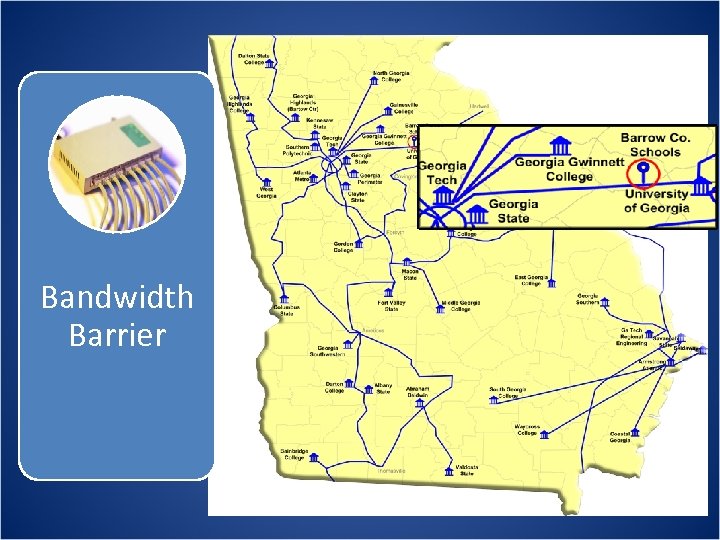 Bandwidth Barrier
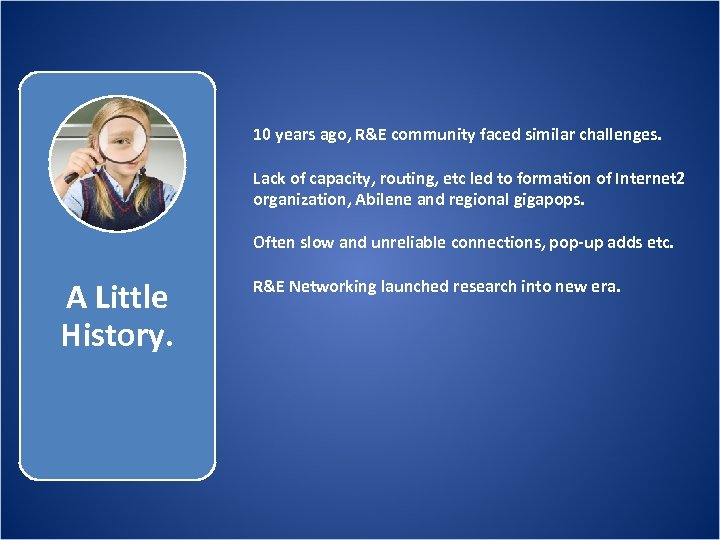 10 years ago, R&E community faced similar challenges. Lack of capacity, routing, etc led to formation of Internet 2 organization, Abilene and regional gigapops. Often slow and unreliable connections, pop-up adds etc. A Little History. R&E Networking launched research into new era.
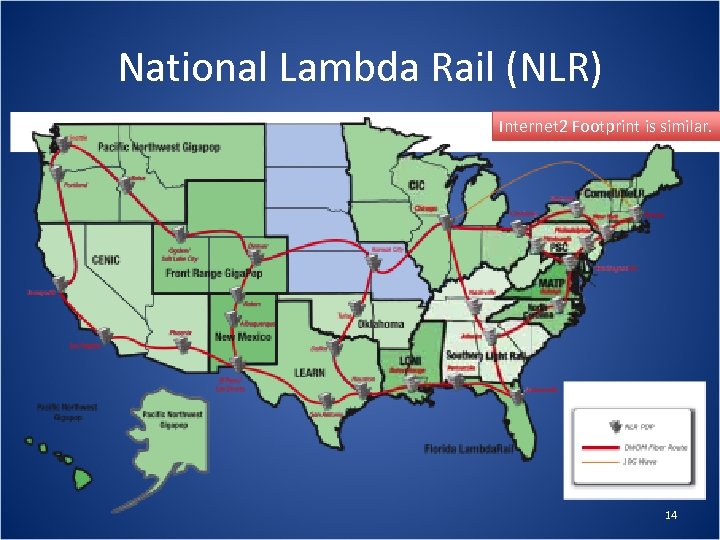 National Lambda Rail (NLR) Internet 2 Footprint is similar. 14
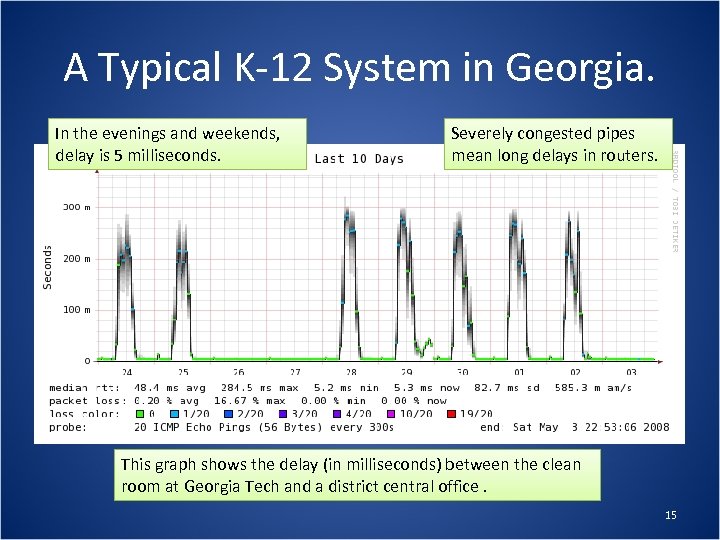 A Typical K-12 System in Georgia. In the evenings and weekends, delay is 5 milliseconds. Severely congested pipes mean long delays in routers. This graph shows the delay (in milliseconds) between the clean room at Georgia Tech and a district central office. 15
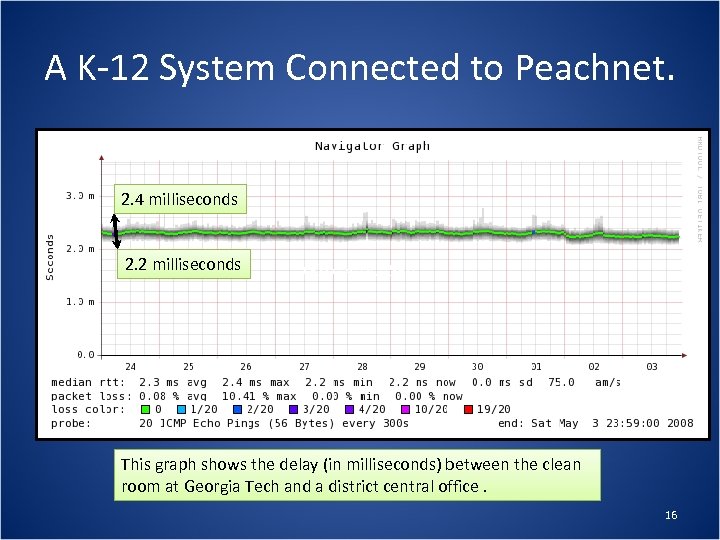 A K-12 System Connected to Peachnet. 2. 4 milliseconds 2. 2 milliseconds 001 e. 4 fbf. e 53 d This graph shows the delay (in milliseconds) between the clean room at Georgia Tech and a district central office. 16
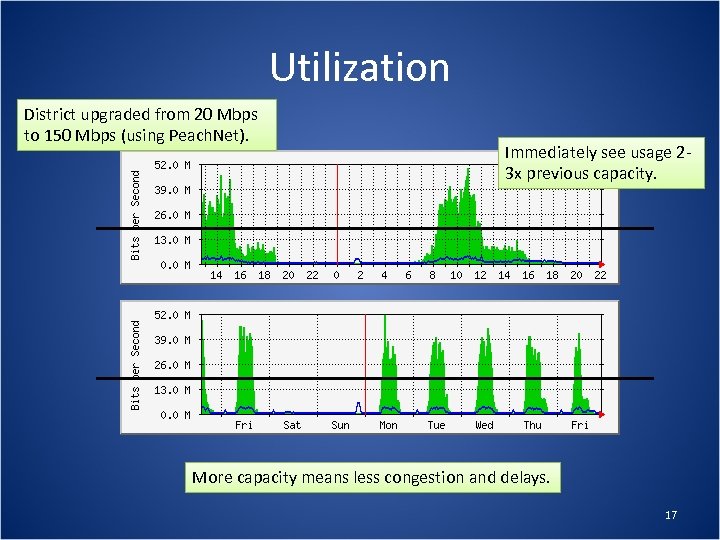 Utilization District upgraded from 20 Mbps to 150 Mbps (using Peach. Net). Immediately see usage 23 x previous capacity. More capacity means less congestion and delays. 17
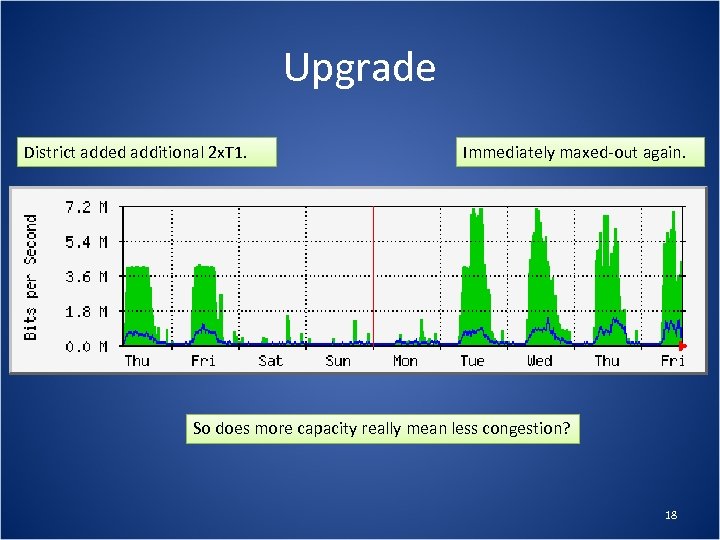 Upgrade District added additional 2 x. T 1. Immediately maxed-out again. So does more capacity really mean less congestion? 18
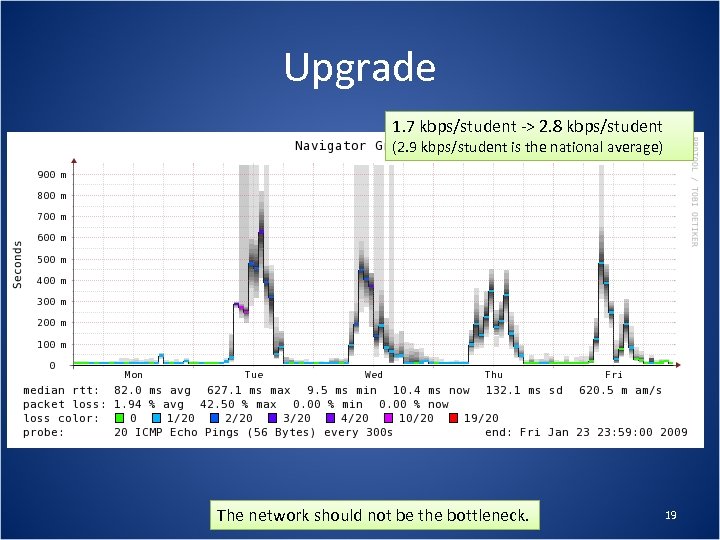 Upgrade 1. 7 kbps/student -> 2. 8 kbps/student (2. 9 kbps/student is the national average) The network should not be the bottleneck. 19
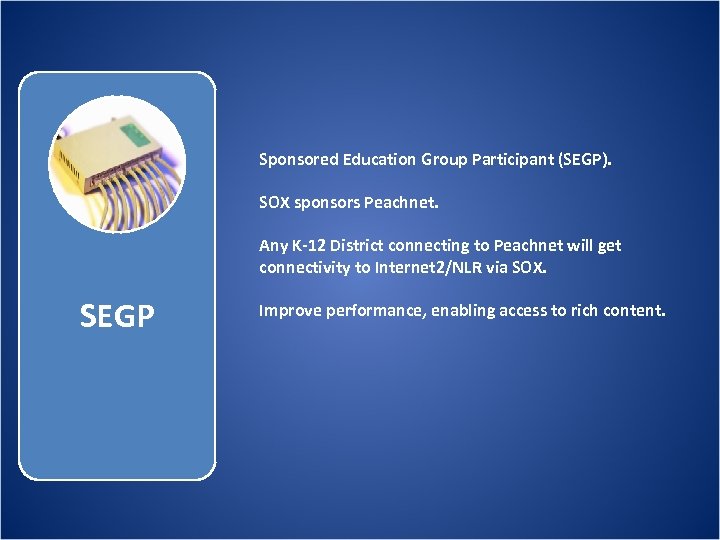 Sponsored Education Group Participant (SEGP). SOX sponsors Peachnet. Any K-12 District connecting to Peachnet will get connectivity to Internet 2/NLR via SOX. SEGP Improve performance, enabling access to rich content.
 Polycom Tandberg Life Size Equipment Promethean/Safari
 Equipment and Professional Development To make optimal use of R&E networking, you need to have the classroom-side equipment and professional development for teachers who need to know how to use it to further learning. Professional Development
 Other things to include. • Scheming – Ideas – feedback form – Lit review – GER paper • Sharing – 10 minutes • Sign up for Muse! – http: //k 20. internet 2. edu 23