 Скачать презентацию Direct speech indirect speech 直接引语和间接引语 引述别人的话语一般采用两种方式
0be886348e5d468ff8f347118da3d408.ppt
- Количество слайдов: 31




Direct speech & indirect speech 直接引语和间接引语
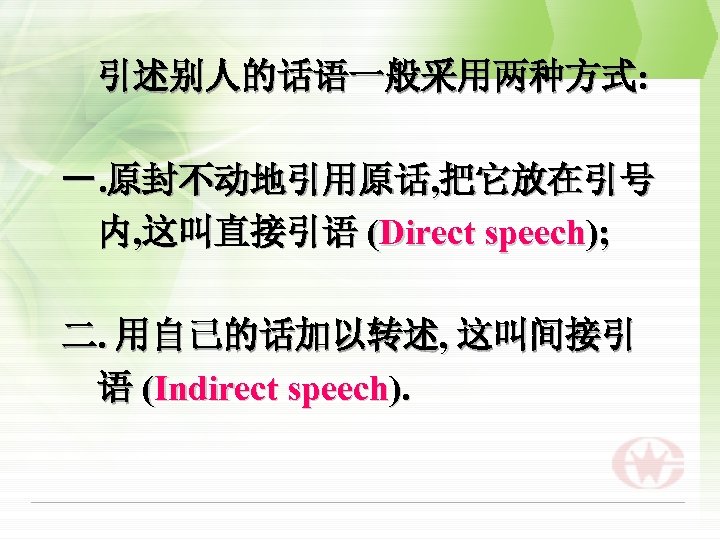
引述别人的话语一般采用两种方式: 一. 原封不动地引用原话, 把它放在引号 内, 这叫直接引语 (Direct speech); 二. 用自己的话加以转述, 这叫间接引 语 (Indirect speech).
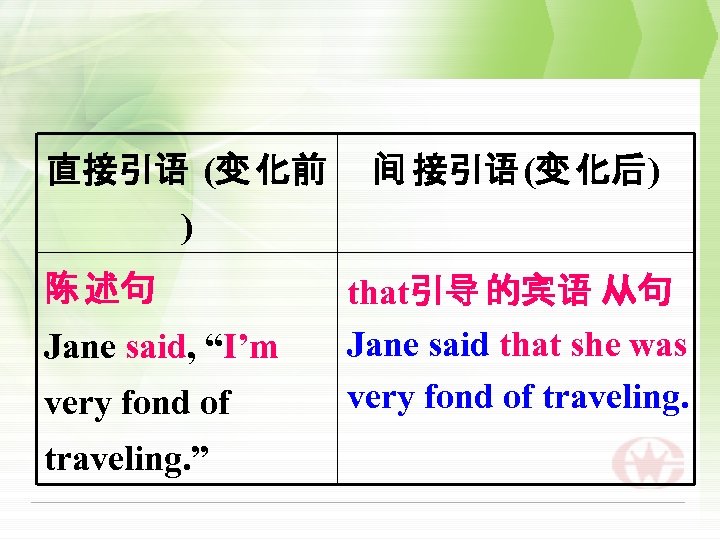
直接引语 (变 化前 间 接引语 (变 化后) ) 陈 述句 Jane said, “I’m very fond of traveling. ” that引导 的宾语 从句 Jane said that she was very fond of traveling.
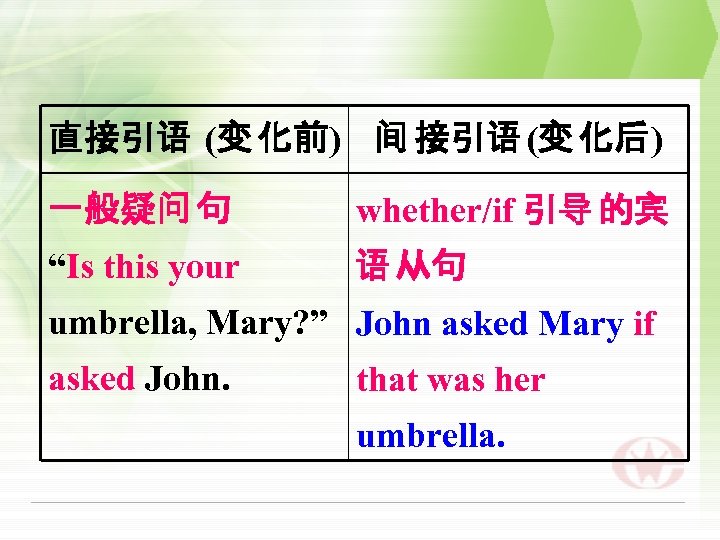
直接引语 (变 化前) 间 接引语 (变 化后) 一般疑问 句 whether/if 引导 的宾 “Is this your 语 从句 umbrella, Mary? ” John asked Mary if asked John. that was her umbrella.
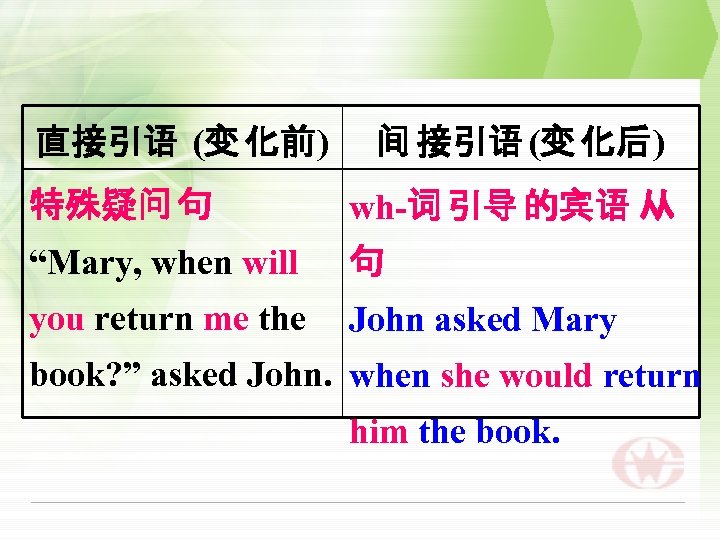
直接引语 (变 化前) 间 接引语 (变 化后) 特殊疑问 句 wh-词 引导 的宾语 从 “Mary, when will 句 you return me the John asked Mary book? ” asked John. when she would return him the book.
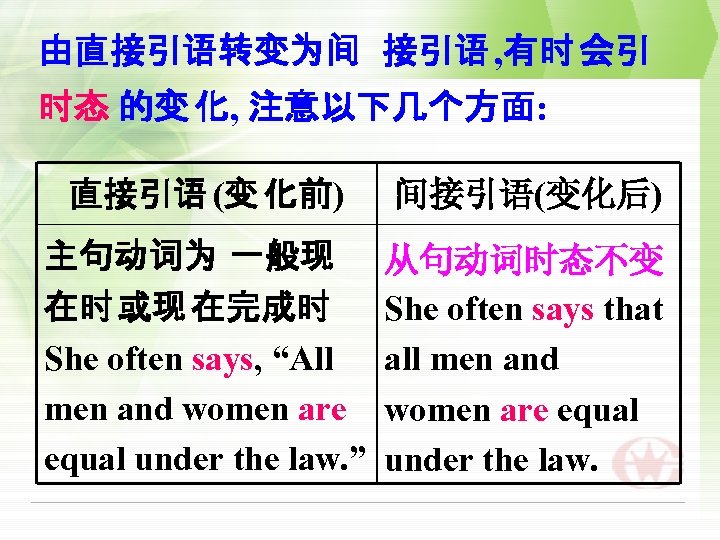
由直接引语转变为间 接引语 , 有时 会引 时态 的变 化, 注意以下几个方面: 直接引语 (变 化前) 间接引语(变化后) 主句动词为 一般现 在时 或现 在完成时 She often says, “All men and women are equal under the law. ” 从句动词时态不变 She often says that all men and women are equal under the law.
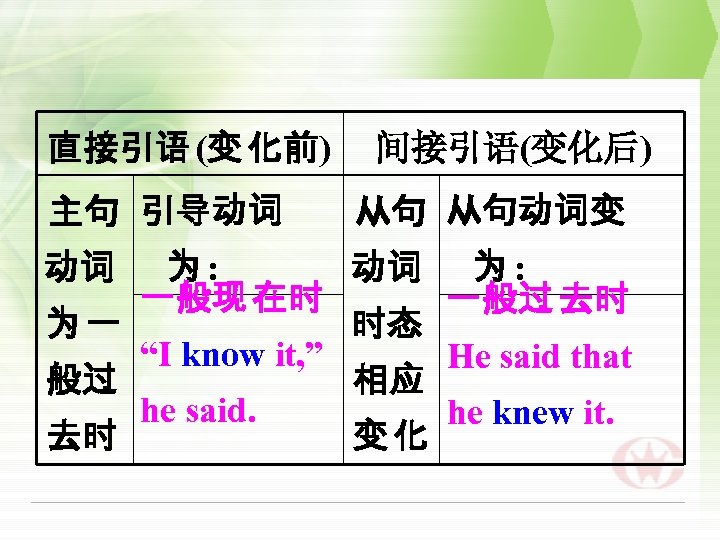
直接引语 (变 化前) 主句 引导动词 间接引语(变化后) 从句 从句动词变 为: 动词 为 : 一般现 在时 一般过 去时 为一 时态 “I know it, ” He said that 般过 相应 he said. he knew it. 去时 变化 动词
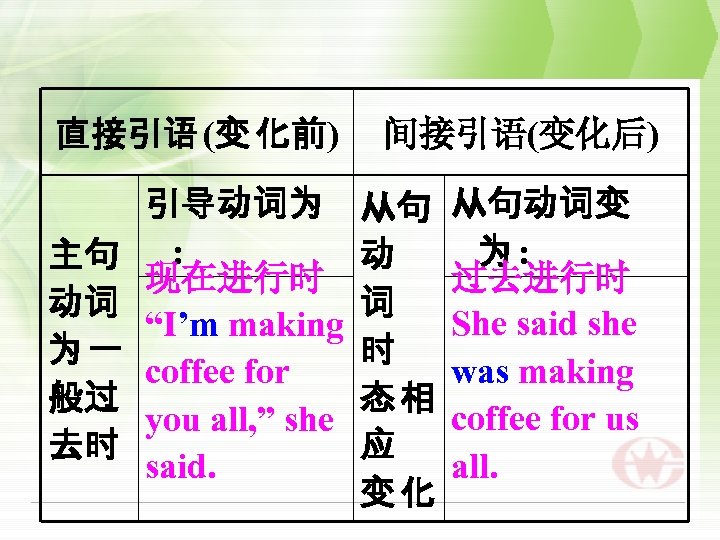
直接引语 (变 化前) 主句 动词 为一 般过 去时 引导动词为 : 现在进行时 “I’m making coffee for you all, ” she said. 间接引语(变化后) 从句 动 词 时 态相 应 变化 从句动词变 为: 过去进行时 She said she was making coffee for us all.
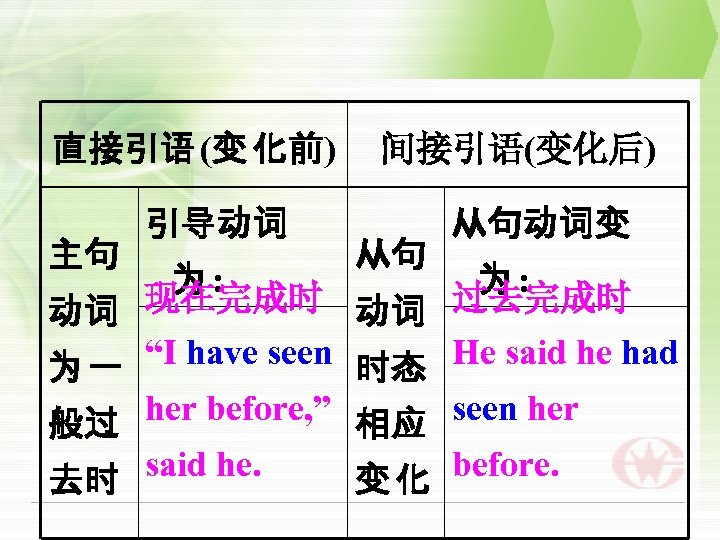
直接引语 (变 化前) 主句 引导动词 间接引语(变化后) 从句 从句动词变 为: 为: 现在完成时 动词 过去完成时 动词 “I have seen 时态 He said he had 为一 her before, ” 相应 seen her 般过 said he. 去时 before. 变化
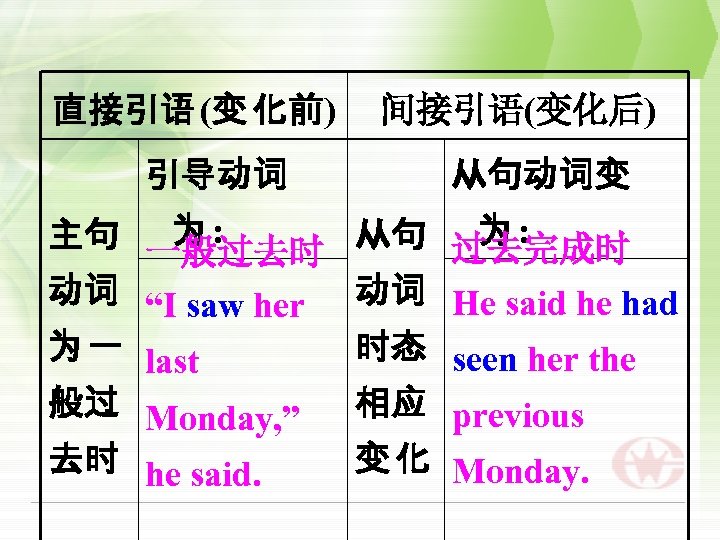
直接引语 (变 化前) 引导动词 间接引语(变化后) 从句动词变 为: 为: 主句 一般过去时 从句 过去完成时 动词 “I saw her 动词 He said he had 为 一 last 时态 seen her the 般过 Monday, ” 相应 previous 去时 he said. 变 化 Monday.
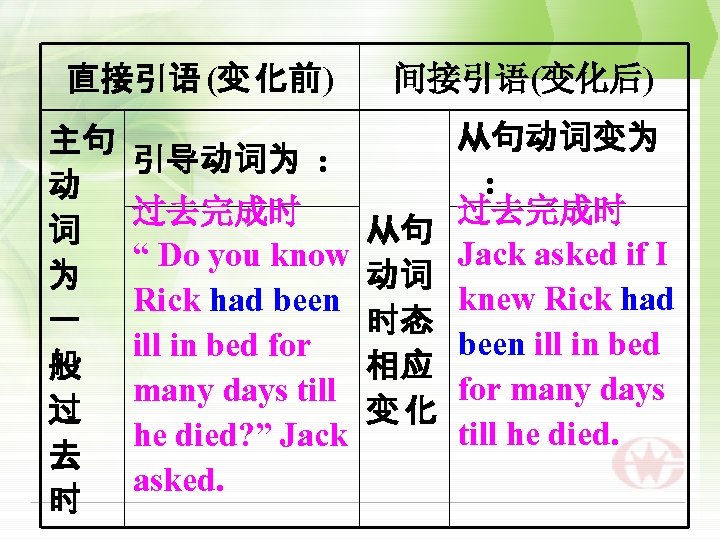
直接引语 (变 化前) 主句 动 词 为 一 般 过 去 时 间接引语(变化后) 引导动词为 : 过去完成时 “ Do you know Rick had been ill in bed for many days till he died? ” Jack asked. 从句 动词 时态 相应 变化 从句动词变为 : 过去完成时 Jack asked if I knew Rick had been ill in bed for many days till he died.
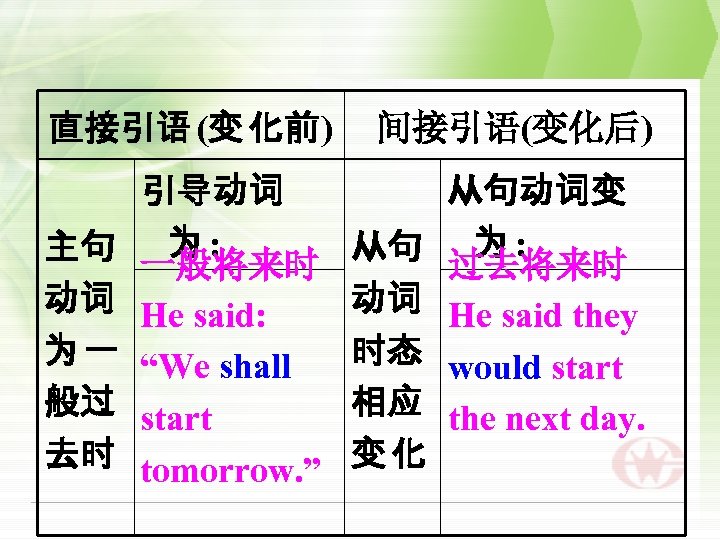
直接引语 (变 化前) 主句 动词 为一 般过 去时 引导动词 为: 一般将来时 He said: “We shall start tomorrow. ” 间接引语(变化后) 从句 动词 时态 相应 变化 从句动词变 为: 过去将来时 He said they would start the next day.
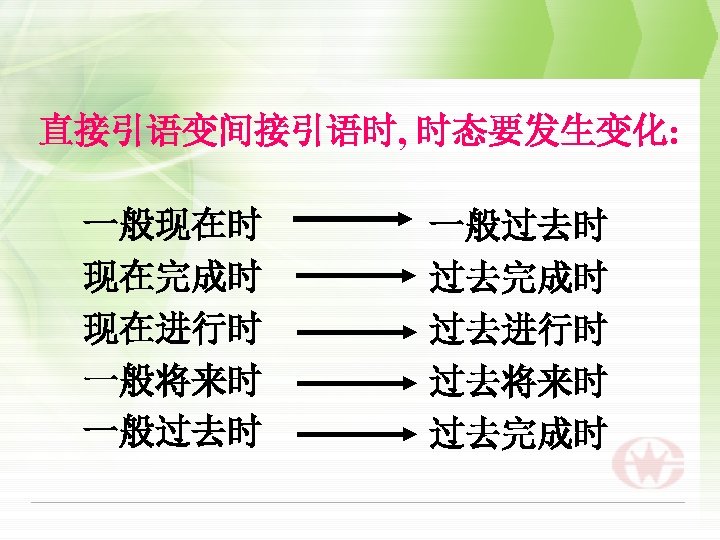
直接引语变间接引语时, 时态要发生变化: 一般现在时 现在完成时 现在进行时 一般将来时 一般过去时 过去完成时 过去进行时 过去将来时 过去完成时
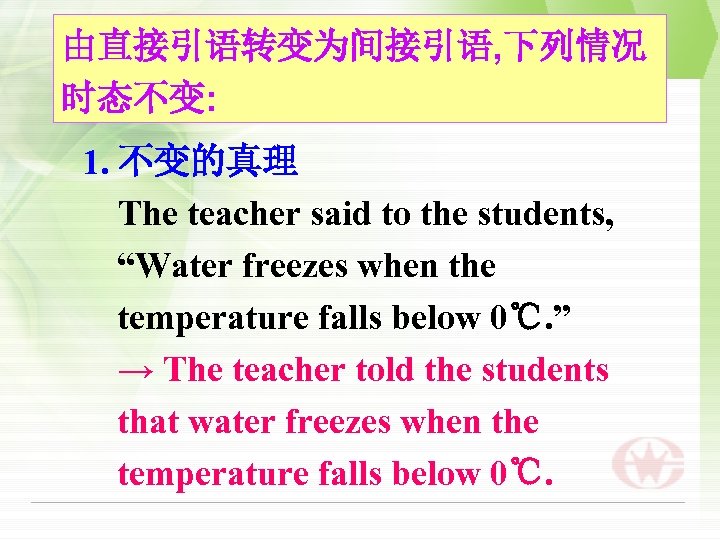
由直接引语转变为间接引语, 下列情况 时态不变: 1. 不变的真理 The teacher said to the students, “Water freezes when the temperature falls below 0℃. ” → The teacher told the students that water freezes when the temperature falls below 0℃.
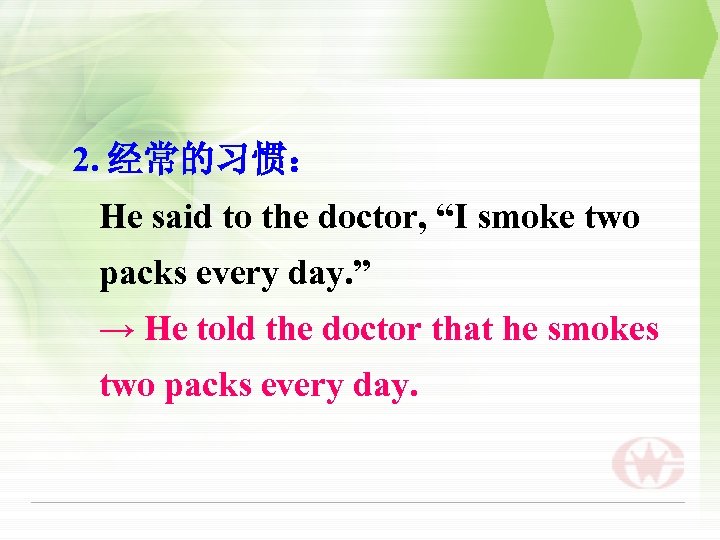
2. 经常的习惯: He said to the doctor, “I smoke two packs every day. ” → He told the doctor that he smokes two packs every day.
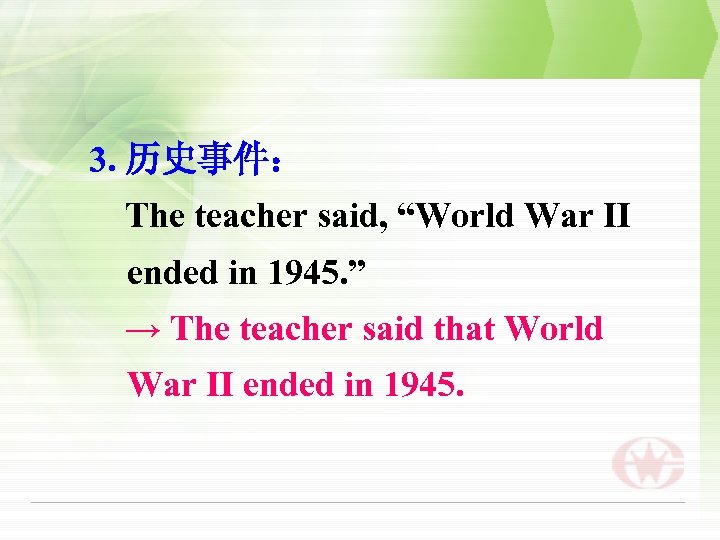
3. 历史事件: The teacher said, “World War Ⅱ ended in 1945. ” → The teacher said that World War Ⅱ ended in 1945.
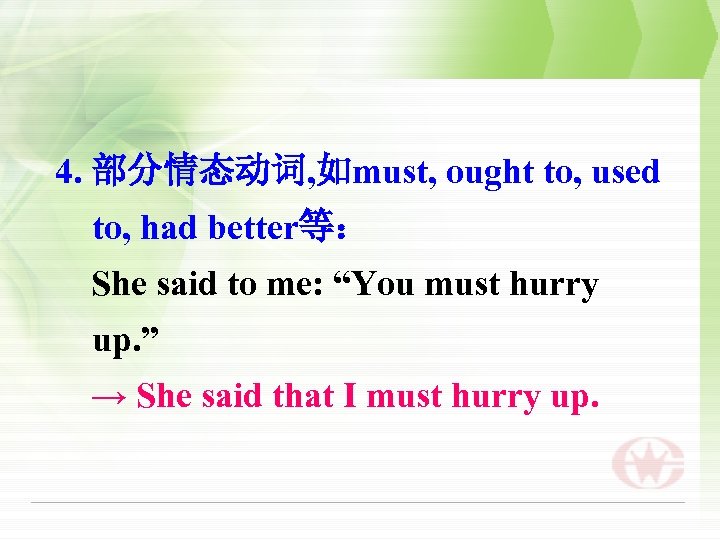
4. 部分情态动词, 如must, ought to, used to, had better等: She said to me: “You must hurry up. ” → She said that I must hurry up.
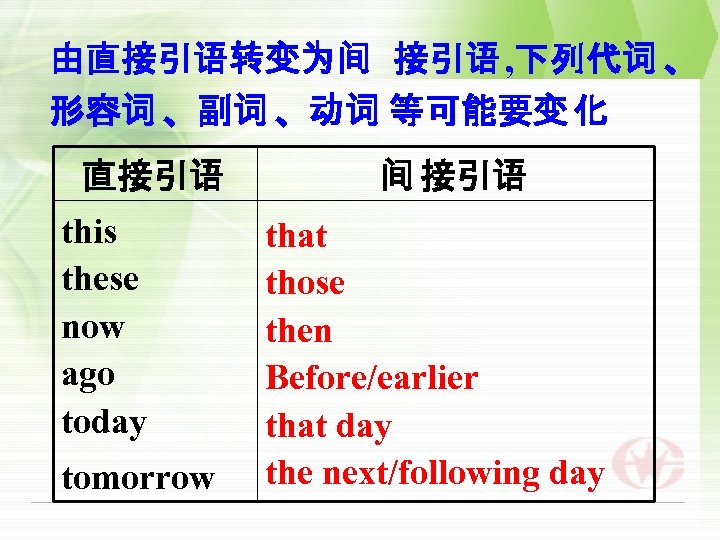
由直接引语转变为间 接引语 , 下列代词 、 形容词 、副词 、动词 等可能要变 化 直接引语 this these now ago today tomorrow 间 接引语 that those then Before/earlier that day the next/following day
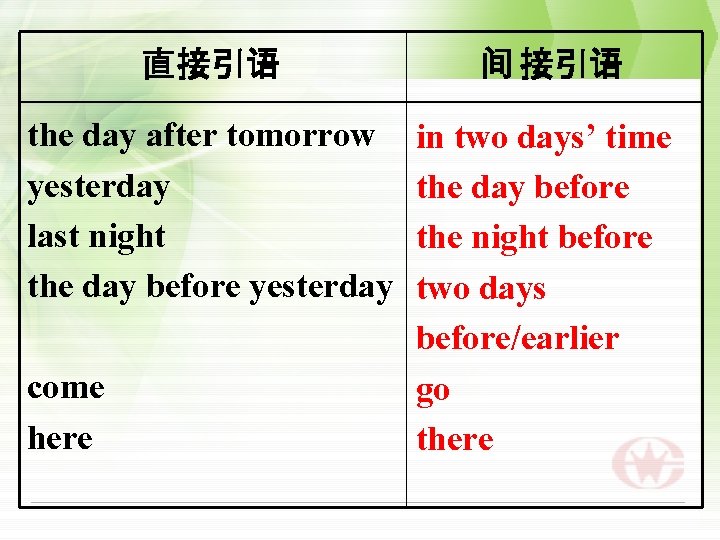
直接引语 间 接引语 the day after tomorrow yesterday last night the day before yesterday in two days’ time the day before the night before two days before/earlier go there come here
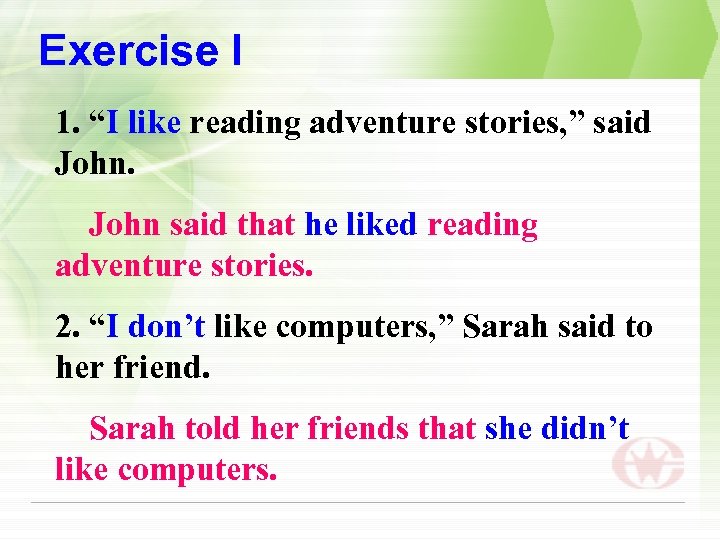
Exercise I 1. “I like reading adventure stories, ” said John said that he liked reading adventure stories. 2. “I don’t like computers, ” Sarah said to her friend. Sarah told her friends that she didn’t like computers.
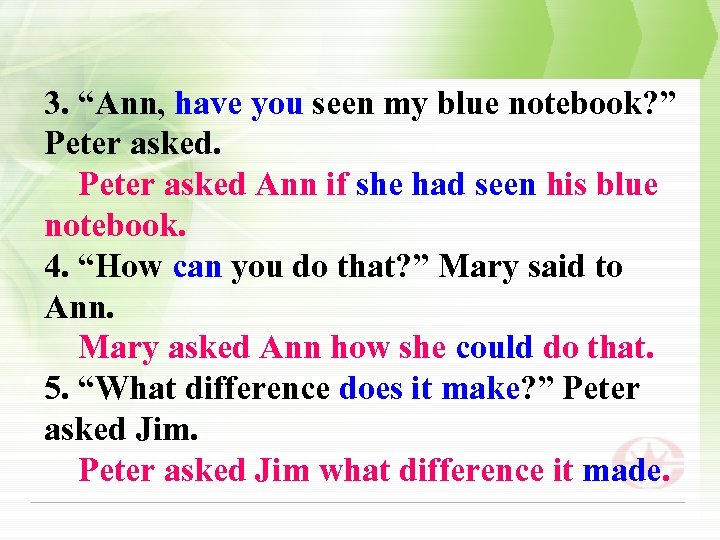
3. “Ann, have you seen my blue notebook? ” Peter asked Ann if she had seen his blue notebook. 4. “How can you do that? ” Mary said to Ann. Mary asked Ann how she could do that. 5. “What difference does it make? ” Peter asked Jim what difference it made.
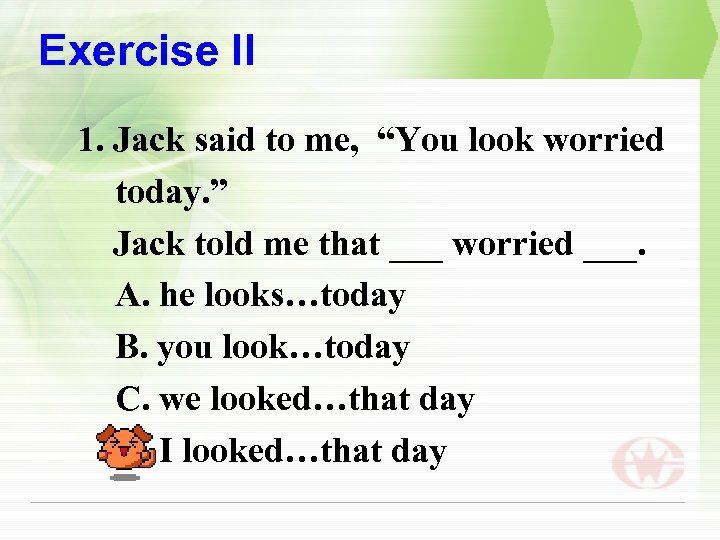
Exercise II 1. Jack said to me, “You look worried today. ” Jack told me that ___ worried ___. A. he looks…today B. you look…today C. we looked…that day D. I looked…that day
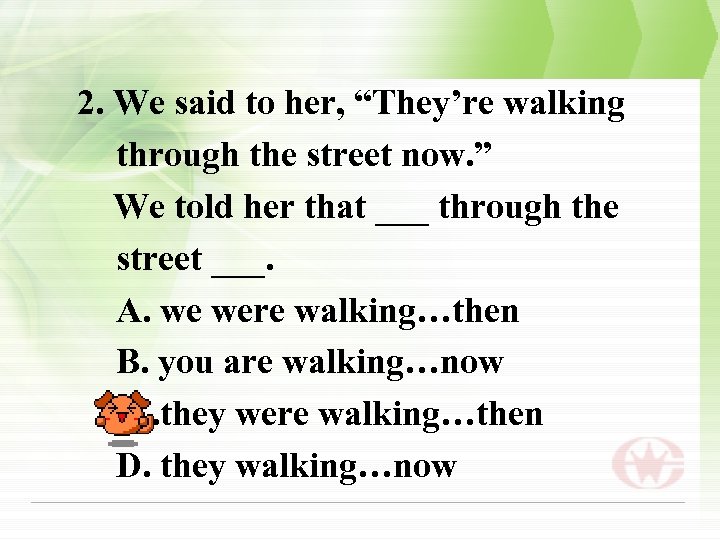
2. We said to her, “They’re walking through the street now. ” We told her that ___ through the street ___. A. we were walking…then B. you are walking…now C. they were walking…then D. they walking…now
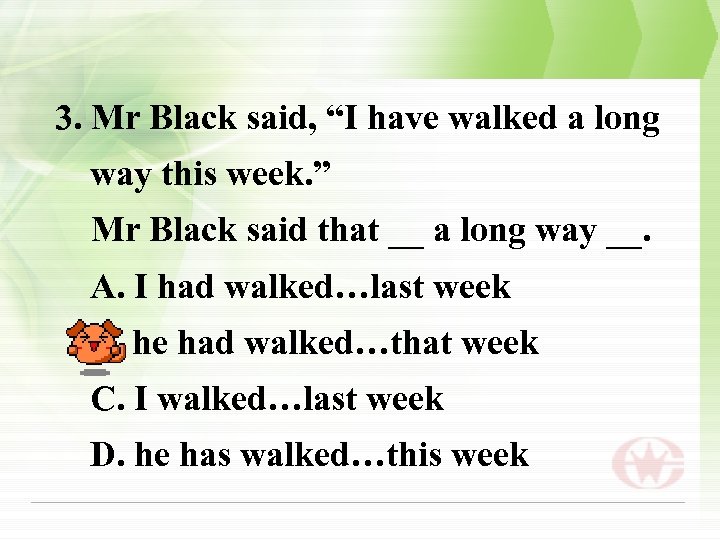
3. Mr Black said, “I have walked a long way this week. ” Mr Black said that __ a long way __. A. I had walked…last week B. he had walked…that week C. I walked…last week D. he has walked…this week
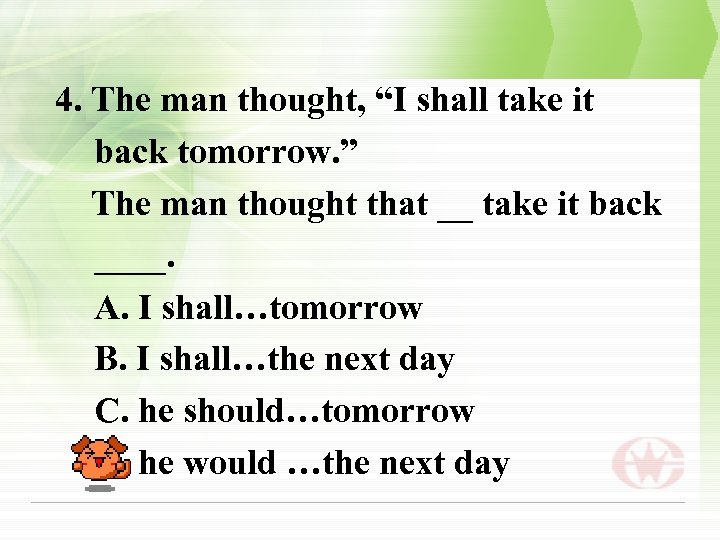
4. The man thought, “I shall take it back tomorrow. ” The man thought that __ take it back ____. A. I shall…tomorrow B. I shall…the next day C. he should…tomorrow D. he would …the next day
5. They said to us, “Are you afraid to leave this house ? ” They asked us ____ afraid to leave _____ house. A. that were we…this B. that we were…that C. if were we …this D. if we were…that
6. Jane said, “What did he hear about a week ago? ” Jane asked ____ about _____. A. that he heard…a week ago B. what he had heard…the week before C. what he had herd… a week ago D. if he heard…the week ago
7. She asked, “Whose house will he break into next time ? ” She asked whose house ____ break into _____. A. will he…next time B. would he…the next time C. he would…the next time D. he will…next time
8. Jack said to her, “Where do you spend your holidays? ” Jack asked her where ____ holidays. A. she spent her B. you spend your C. she spend her D. you spent your
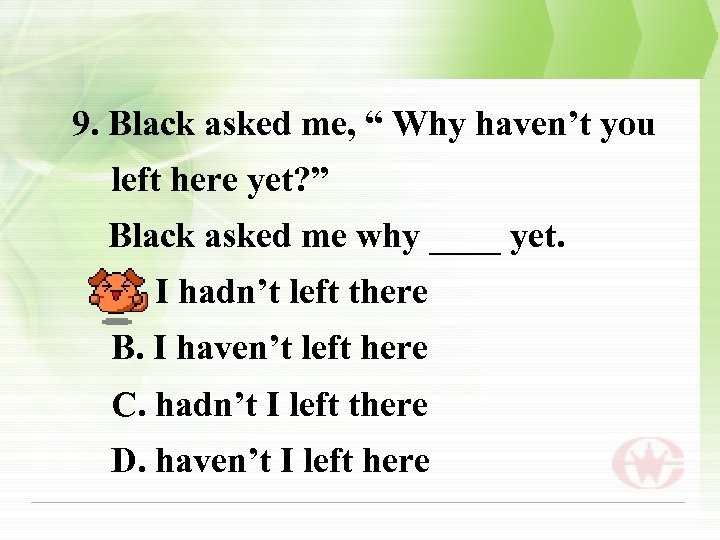
9. Black asked me, “ Why haven’t you left here yet? ” Black asked me why ____ yet. A. I hadn’t left there B. I haven’t left here C. hadn’t I left there D. haven’t I left here
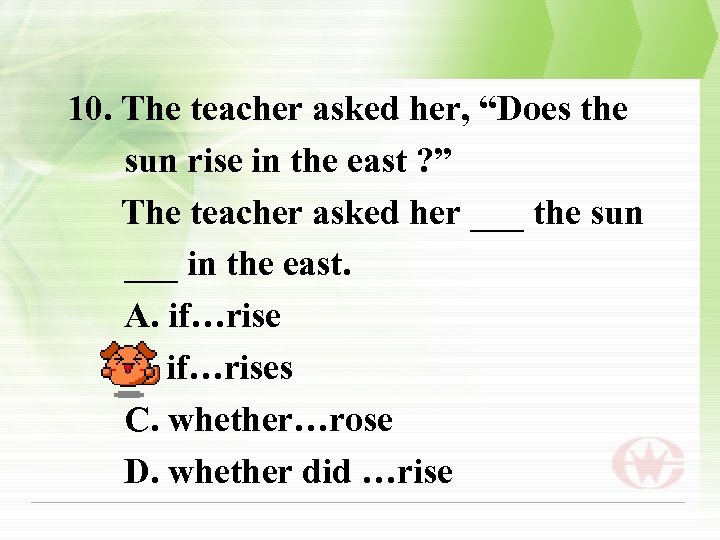
10. The teacher asked her, “Does the sun rise in the east ? ” The teacher asked her ___ the sun ___ in the east. A. if…rise B. if…rises C. whether…rose D. whether did …rise
Скачать презентацию Direct speech indirect speech 直接引语和间接引语 引述别人的话语一般采用两种方式
0be886348e5d468ff8f347118da3d408.ppt