


 Скачать презентацию Direct Sgr A Stellar-Mass Intermediate-Mass and Supermassive
fa71bac000d0a720e5cf53a1cc73e8fe.ppt
- Количество слайдов: 40
 Direct Sgr. A* "Stellar-Mass, Intermediate-Mass, and Supermassive Black Holes" Kyoto International Community House, Kyoto, Japan October 28 - 31, 2003 imaging of a super massive black hole, M. Miyoshi, Pepe Ishitsuka, S. Kameno (NAOJ), Z. Shen (Shanghai Astronomical Obs. ) & S. Horiuchi (SKA) Imaging the vicinity of black hole is one of the ultimate goals of VLBI astronomy. Sgr. A*, the closest super massive black hole, located at our Galactic center is the leading candidate for such observations. Because of the apparent Schwarzschild radius is estimated to be larger than 6 - micro arc seconds from the mass (2. 6 -3. 7*10^6 solar mass) and the distance (8 kpc), the corresponding shadow of black hole is 30 micro arc seconds in diameter and because mm and sub-mm VLBI will soon obtain the sufficient spatial resolutions for the imaging. Recent detections of the rapid flaring from a few hours to 30 min at mm-wave, infrared, and x-ray emissions mean that the structure of the black hole system of Sgr. A* will also change rapidly. One of VLBA observations at 43 GHz really shows such rapid changes of structure of Sgr. A* occur. We also show performance of a supposing but realistic ground-based mm and sub-mm VLBI array for imaging the Sgr. A* black hole system.
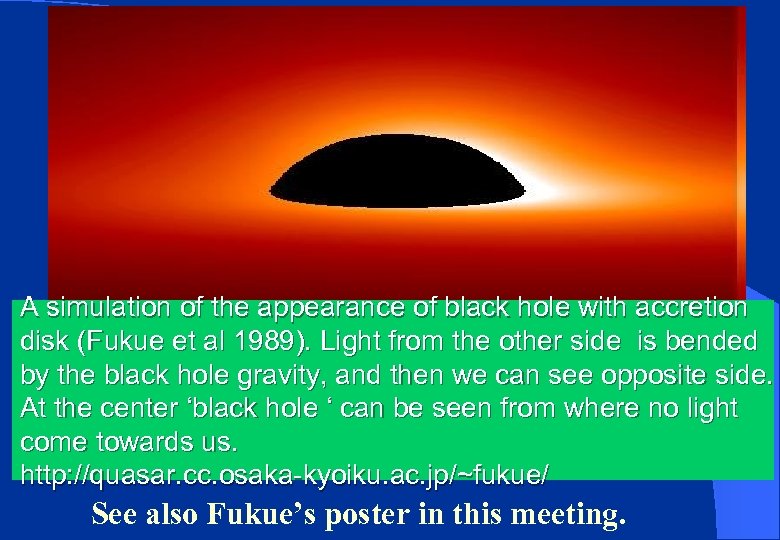 A simulation of the appearance of black hole with accretion disk (Fukue et al 1989). Light from the other side is bended by the black hole gravity, and then we can see opposite side. At the center ‘black hole ‘ can be seen from where no light come towards us. http: //quasar. cc. osaka-kyoiku. ac. jp/~fukue/ See also Fukue’s poster in this meeting.
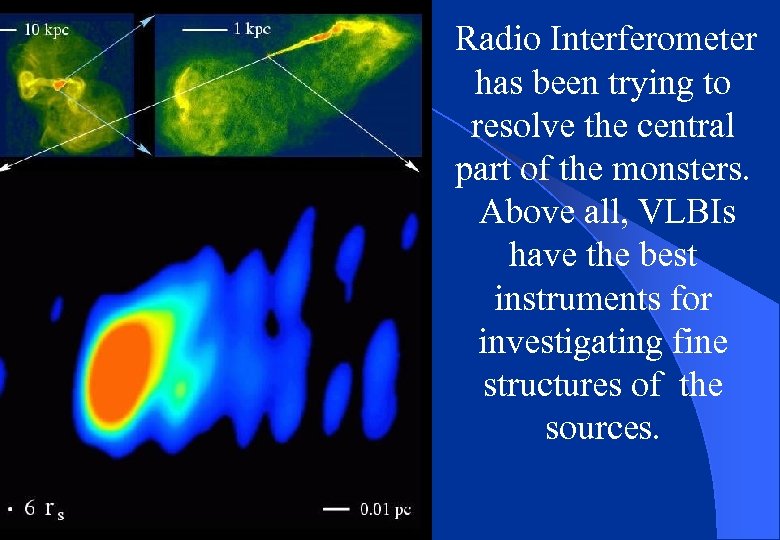 Radio Interferometer has been trying to resolve the central part of the monsters. Above all, VLBIs have the best instruments for investigating fine structures of the sources.
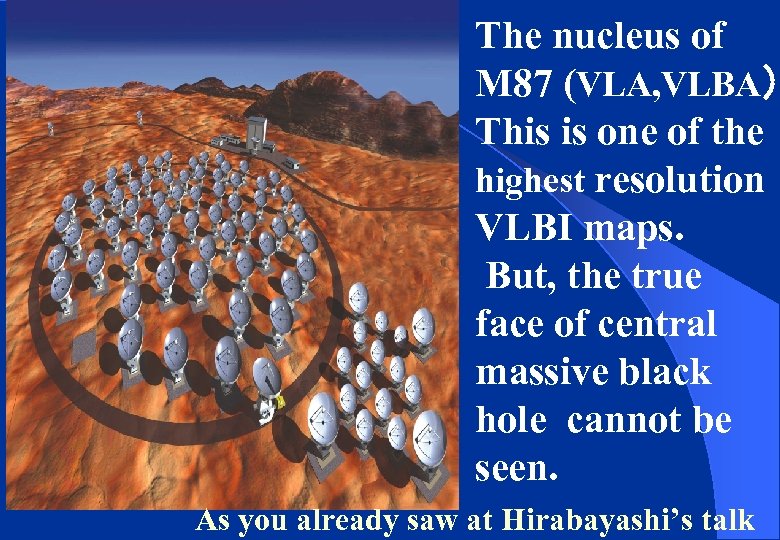 The nucleus of M 87 (VLA, VLBA) This is one of the highest resolution VLBI maps. But, the true face of central massive black hole cannot be seen. As you already saw at Hirabayashi’s talk
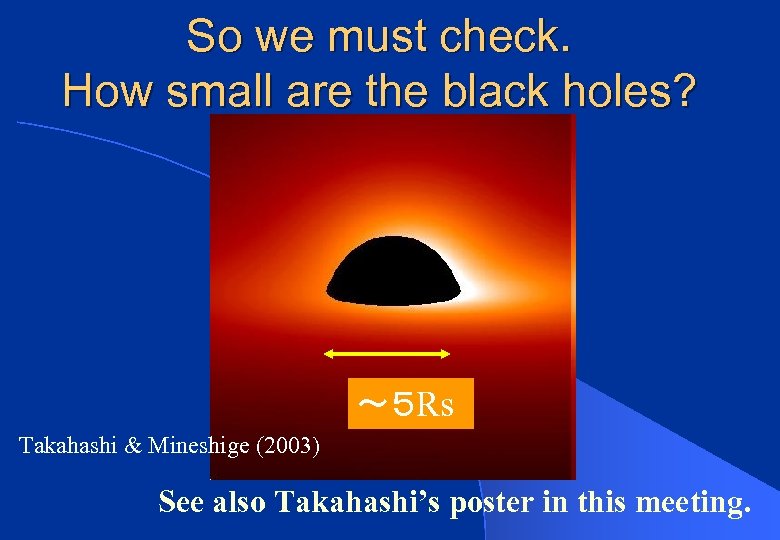 So we must check. How small are the black holes? ~5 Rs Takahashi & Mineshige (2003) See also Takahashi’s poster in this meeting.
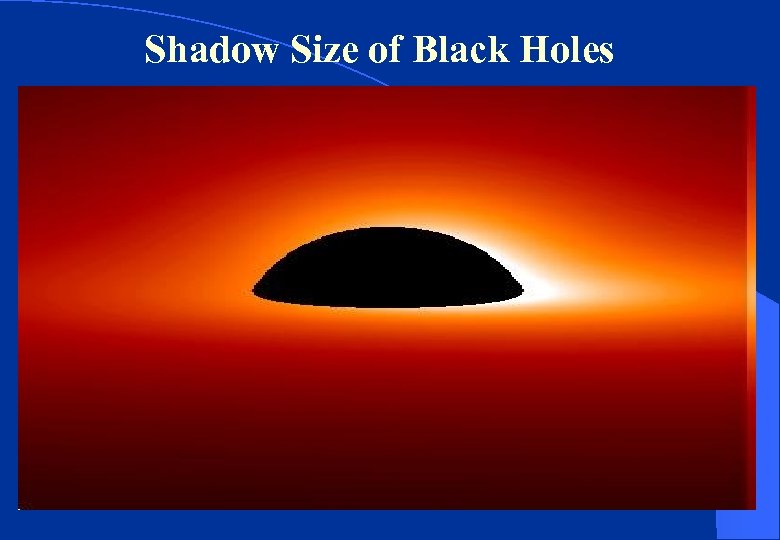 Shadow Size of Black Holes
 If you want to look a black hole (shadow), SgrA* should be observed because it is the biggest.
 Our galactic central black hole SgrA*is the most convincing black hole candidate.
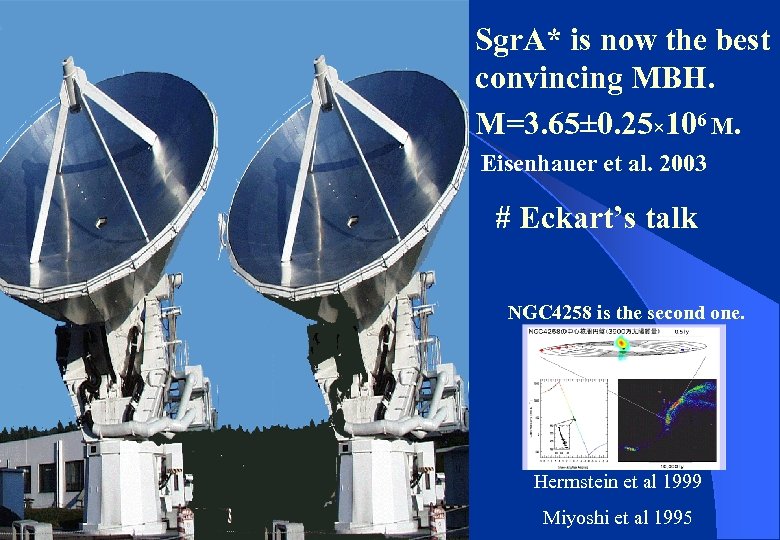 Sgr. A* is now the best convincing MBH. M=3. 65± 0. 25× 106 M. Eisenhauer et al. 2003 # Eckart’s talk NGC 4258 is the second one. Herrnstein et al 1999 Miyoshi et al 1995
 Our galactic central black hole SgrA*is not only the most convincing black hole candidate, but now also shows some activities though not so spectacular as its’ old days (# Koyama’s talk).
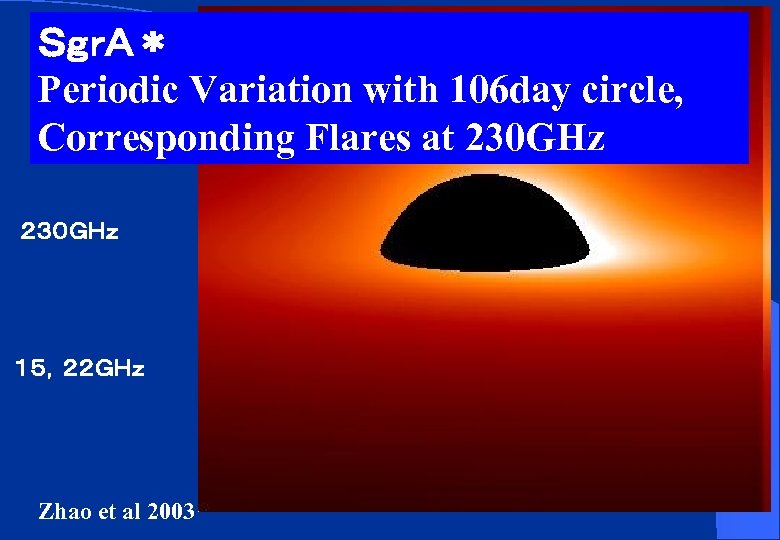 SgrA* Periodic Variation with 106 day circle, Corresponding Flares at 230 GHz 230GHz 15,22GHz Zhao et al 2003
 Our Galactic central BH,SgrA* Rapid changes of its intensity are revealed recently. l. X ray flare (Td=10^4 – 3× 10^3 sec) (Baganoff et al. 2001, Porquet et al. 2003) l. IR flare up for (Genzel et al. 2003) l. Radio about 30 min flare up at mm-wave length (Miyazaki, Tsutsumi & Tsuboi 準備中)
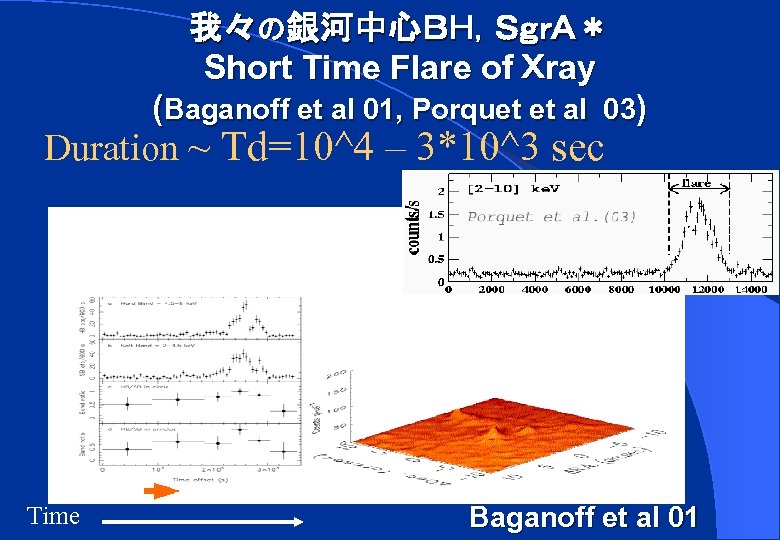 我々の銀河中心BH,SgrA* Short Time Flare of Xray (Baganoff et al 01, Porquet et al 03) Duration ~ Td=10^4 – 3*10^3 sec Time Baganoff et al 01
 Our Galactic central BH,SgrA* Rapid changes of its intensity are revealed recently. l. X ray flare (Td=10^4 – 3× 10^3 sec) (Baganoff et al. 2001, Porquet et al. 2003) l. IR flare up for (Genzel et al. 2003) l. Radio about 30 min flare up at mm-wave length (Miyazaki, Tsutsumi & Tsuboi 準備中)
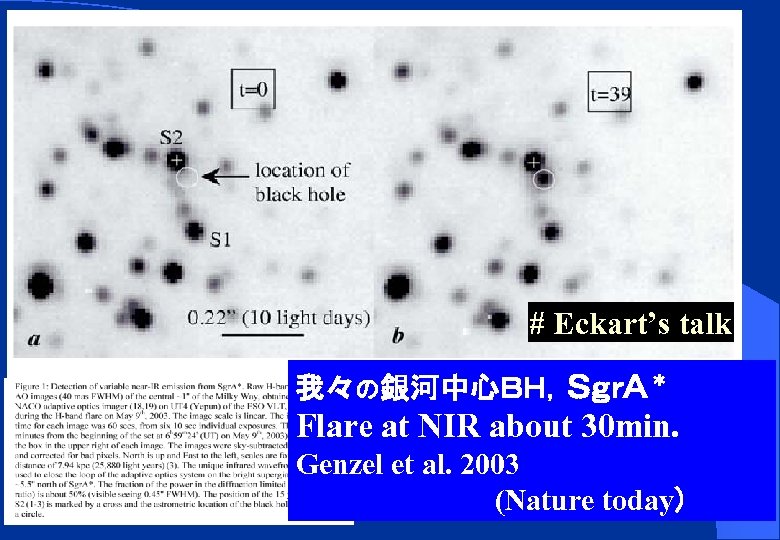 # Eckart’s talk 我々の銀河中心BH,SgrA* Flare at NIR about 30 min. Genzel et al. 2003 (Nature today)
 Our Galactic central BH,SgrA* Rapid changes of its intensity are revealed recently. l. X ray flare (Td=10^4 – 3× 10^3 sec) (Baganoff et al. 2001, Porquet et al. 2003) l. IR flare up for (Genzel et al. 2003) l. Radio about 30 min flare up at mm-wave length (Miyazaki, Tsutsumi & Tsuboi 準備中)
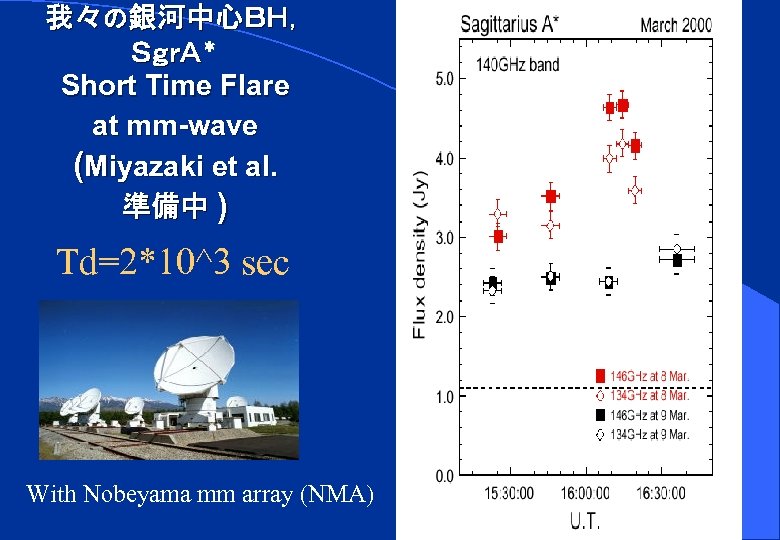 我々の銀河中心BH, SgrA* Short Time Flare at mm-wave (Miyazaki et al. 準備中 ) Td=2*10^3 sec Next day With Nobeyama mm array (NMA)
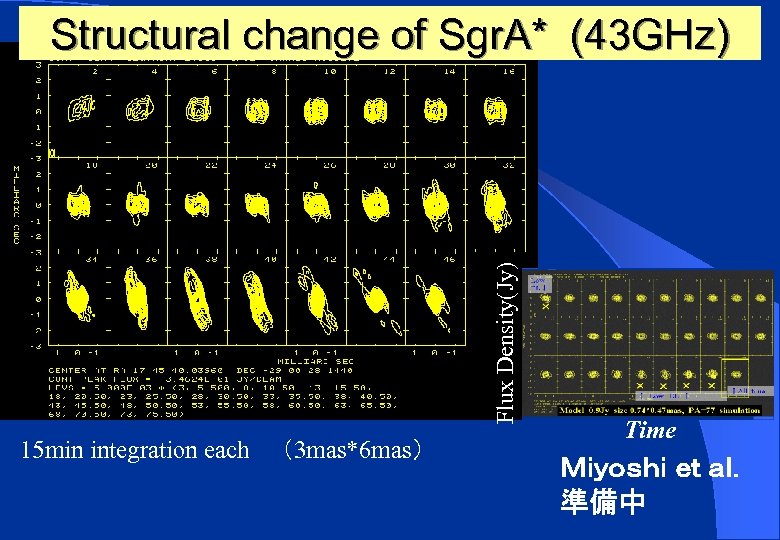 Flux Density(Jy) Structural change of Sgr. A* (43 GHz) 15 min integration each (3 mas*6 mas) Time Miyoshi et al. 準備中
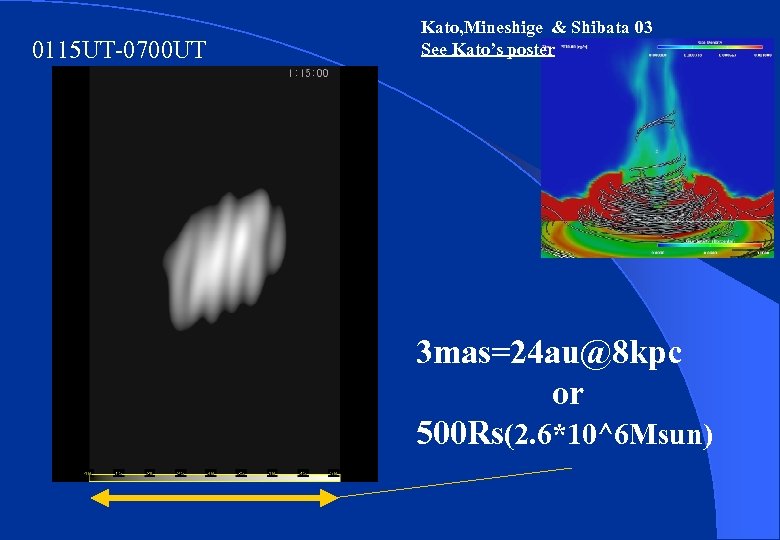 0115 UT-0700 UT Kato, Mineshige & Shibata 03 See Kato’s poster 3 mas=24 au@8 kpc or 500 Rs(2. 6*10^6 Msun)
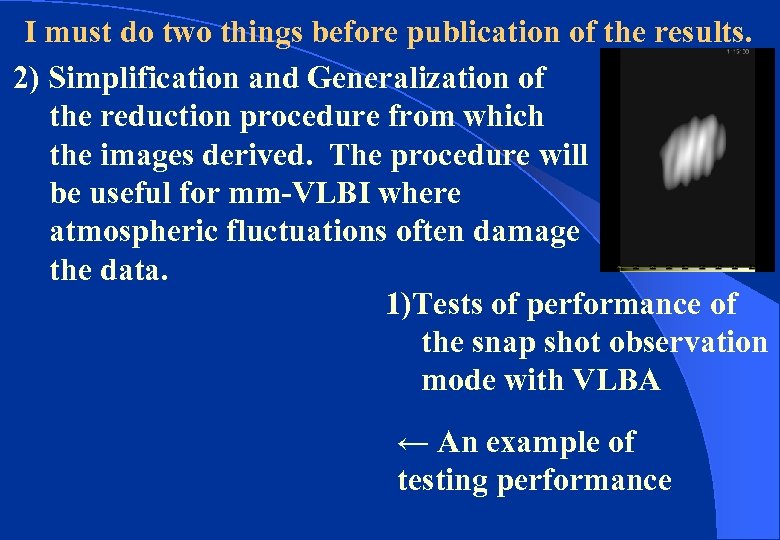 I must do two things before publication of the results. 2) Simplification and Generalization of the reduction procedure from which the images derived. The procedure will be useful for mm-VLBI where atmospheric fluctuations often damage the data. 1)Tests of performance of the snap shot observation mode with VLBA ← An example of testing performance
 SgrA*is not only the most convincing black hole candidate, but now also shows some activities, has become interesting However one nuisance remains. Scattering by surrounding plasma
 VLBI images of the Sgr. A* from 5 GHz to 43 GHz. from Lo et al (1999) The intrinsic image is blurred and broadened because of scattering effect.
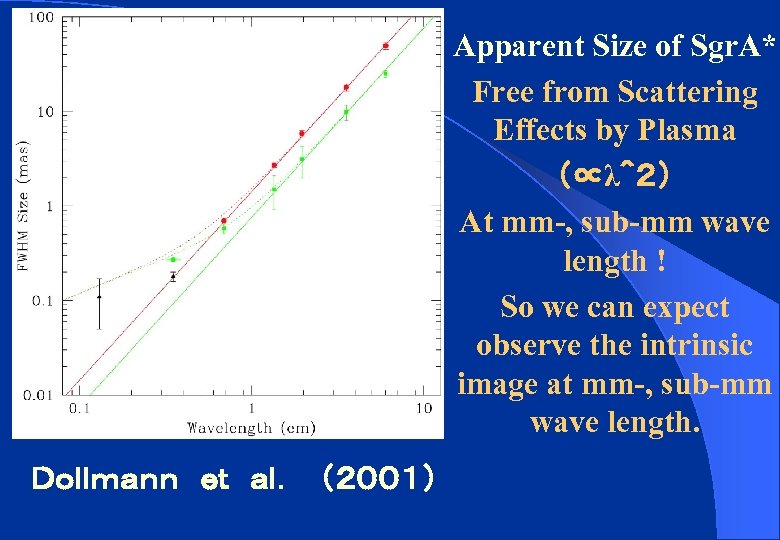 Apparent Size of Sgr. A* Free from Scattering Effects by Plasma (∝λ^2) At mm-, sub-mm wave length ! So we can expect observe the intrinsic image at mm-, sub-mm wave length. Dollmann et al. (2001)
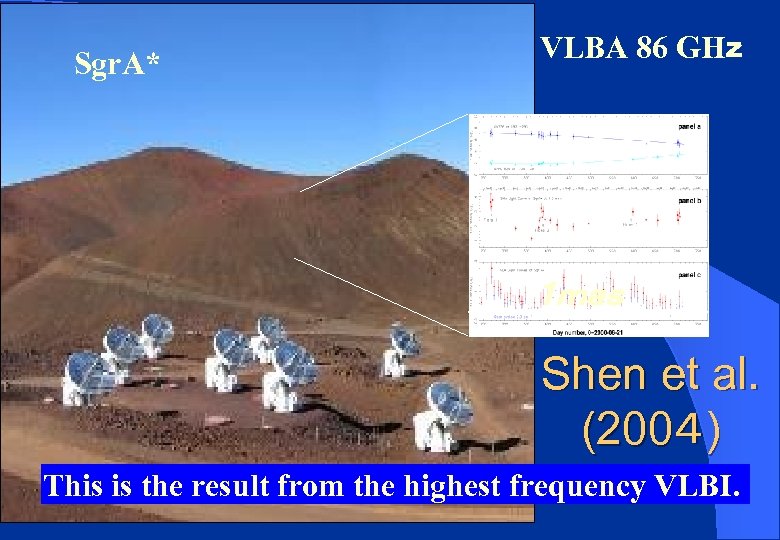 Sgr. A* VLBA 86 GHz 1mas Shen et al. (2004) This is the result from the highest frequency VLBI.
 Sgr. A* should be observed at mm to sub-mm VLBI if you want to look black hole.
 First, Can we get the image of the black hole shadow of Sgr. A* with 86 GHz VLBA? note. VLBA 86 GHz observations of Sgr. A* is really important to measure the intrinsic size. See deeply the Poster of Shen et al. at this meeting.
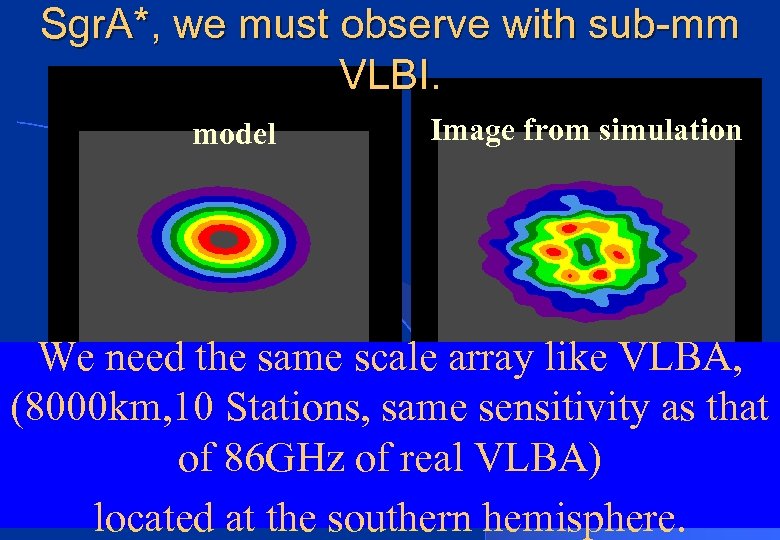
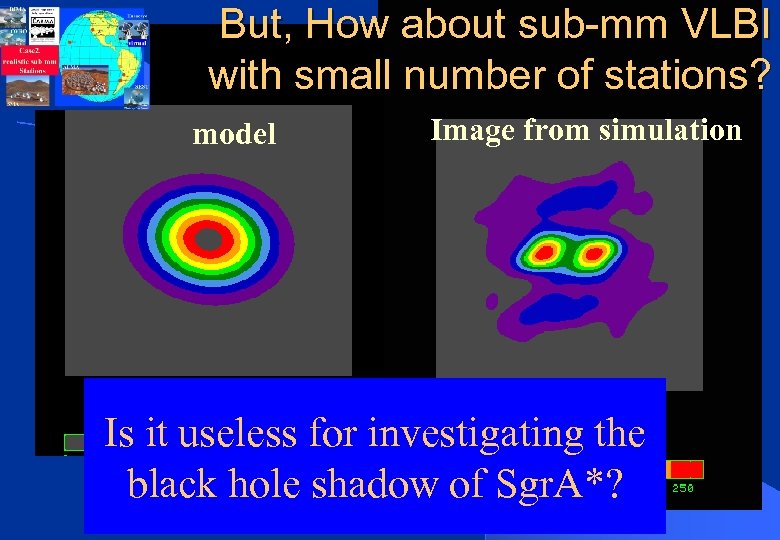
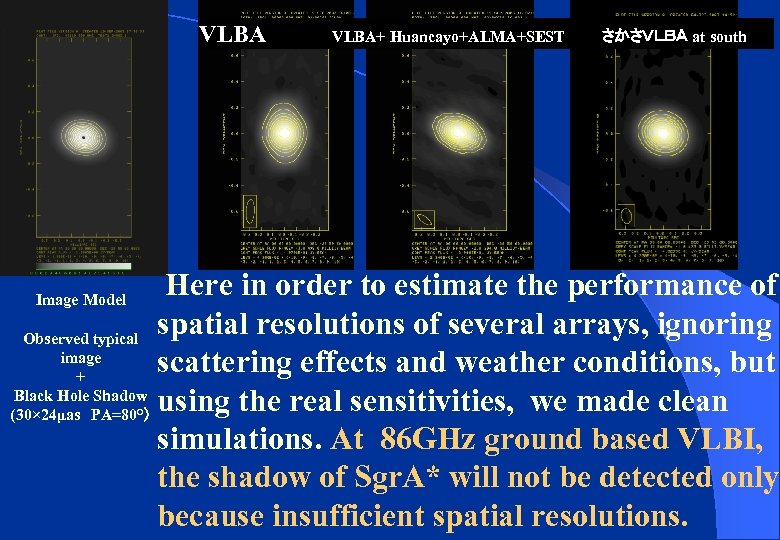 VLBA+ Huancayo+ALMA+SEST さかさVLBA at south Here in order to estimate the performance of spatial resolutions of several arrays, ignoring Observed typical image scattering effects and weather conditions, but + Black Hole Shadow using the real sensitivities, we made clean (30× 24μas PA=80°) simulations. At 86 GHz ground based VLBI, the shadow of Sgr. A* will not be detected only because insufficient spatial resolutions. Image Model
 Then, What kind of sub-mm VLBI array should we construct for imaging the black hole shadow of Sgr. A*? I made simulations with three types of arrays. SgrA* locates at δ=-30°, Observations from the southern hemisphere is preferable.
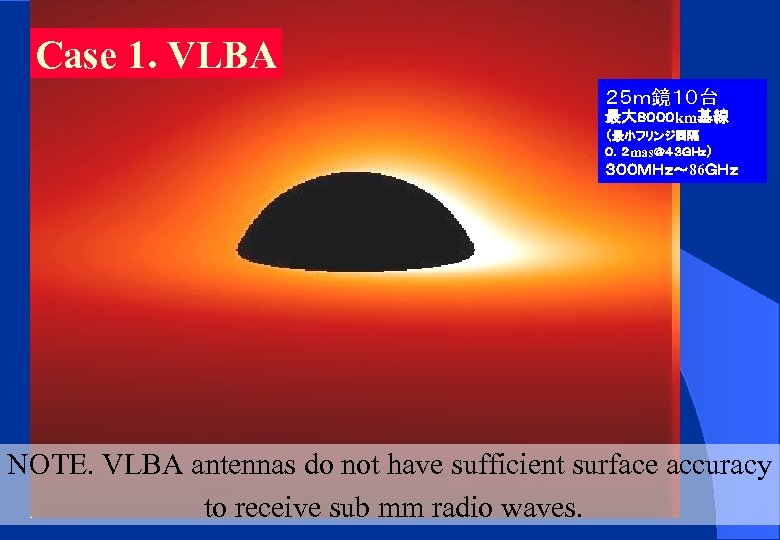 Case 1. VLBA 25m鏡10台 最大8000 km基線 (最小フリンジ間隔 0.2 mas@43GHz) 300MHz~ 86GHz NOTE. VLBA antennas do not have sufficient surface accuracy to receive sub mm radio waves.
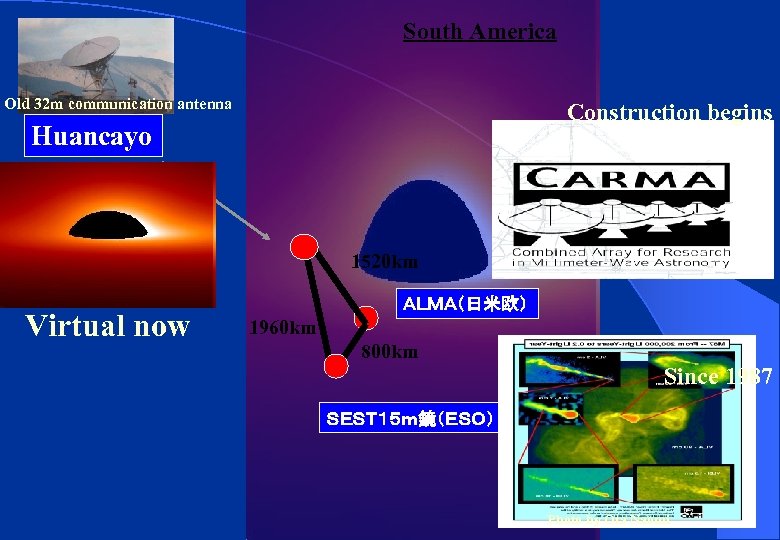
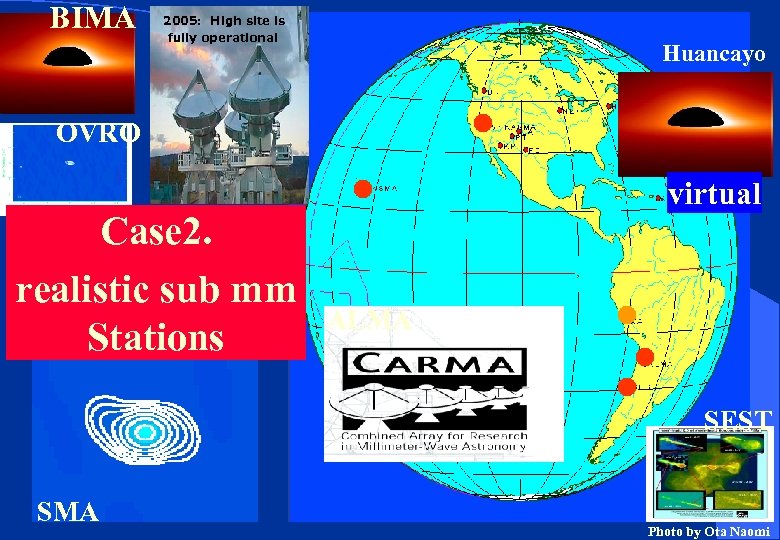 BIMA 2005: High site is fully operational Huancayo OVRO Case 2. realistic sub mm Stations virtual ALMA SEST SMA Photo by Ota Naomi
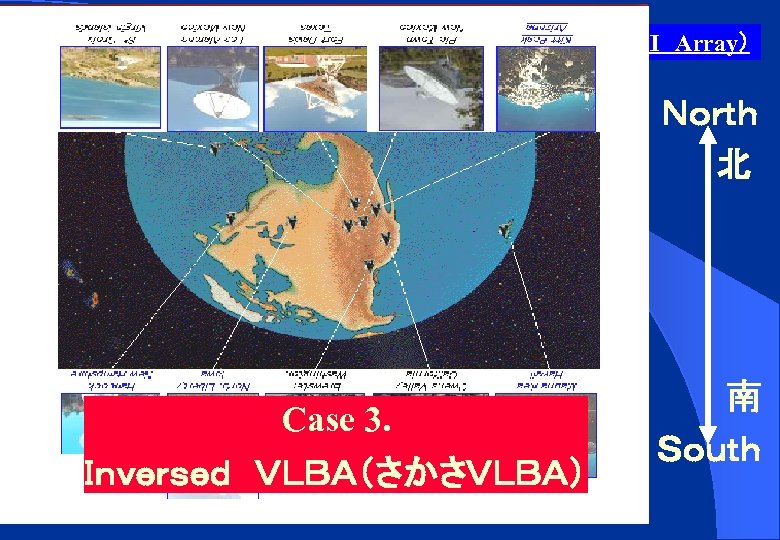 VLBA(VLBI Array) North 北 Case 3. Inversed VLBA(さかさVLBA) 南 South
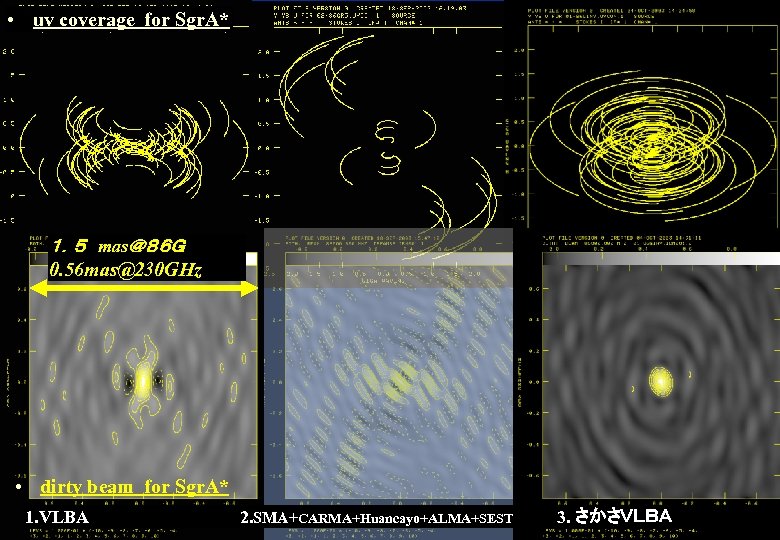 • uv coverage for Sgr. A* 1.5 mas@86G 0. 56 mas@230 GHz • dirty beam for Sgr. A* 1. VLBA 2. SMA+CARMA+Huancayo+ALMA+SEST 3. さかさVLBA
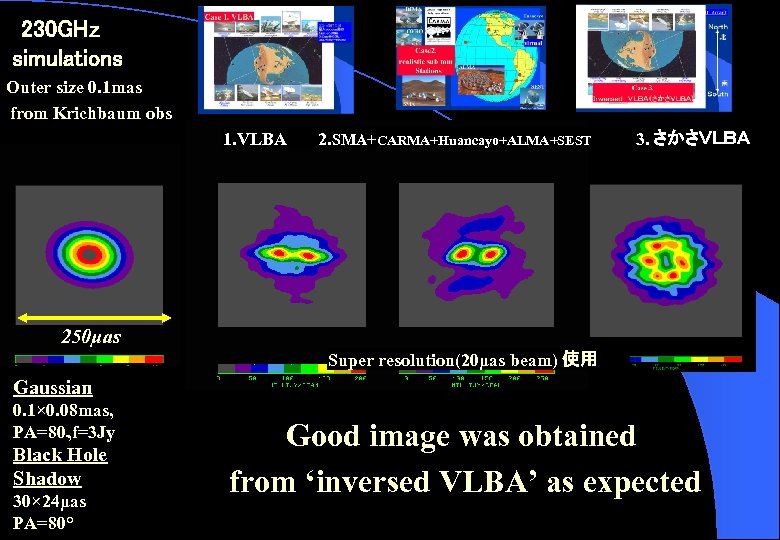 230 GHz simulations Outer size 0. 1 mas from Krichbaum obs 1. VLBA 2. SMA+CARMA+Huancayo+ALMA+SEST 3. さかさVLBA 250μas Super resolution(20μas beam) 使用 Gaussian 0. 1× 0. 08 mas, PA=80 , f=3 Jy ° Black Hole Shadow 30× 24μas PA=80° Good image was obtained from ‘inversed VLBA’ as expected
 Sgr. A*, we must observe with sub-mm VLBI. model Image from simulation We need the same scale array like VLBA, (8000 km, 10 Stations, same sensitivity as that of 86 GHz of real VLBA) located at the southern hemisphere.
 But, How about sub-mm VLBI with small number of stations? model Image from simulation Is it useless for investigating the black hole shadow of Sgr. A*?
 An Example of the relation of Visibility Amplitudes and Structure of SgrA* (230GHz) BH 3.7×10^6Ms Ds=44μas BH 2.6×10^6Ms Ds=30μas NO Black hole NO Shadow Null point shifts with the size of BH shadow, namely BH mass We can estimate the shadow size and then the BH mass with submm VLBI including only small number of stations. b
 South America Old 32 m communication antenna Construction begins Huancayo 1520 km Virtual now ALMA(日米欧) 1960 km 800 km Since 1987 SEST15m鏡(ESO) Photo by Ota Naomi
 In order to image Black Hole directly: 1)the first and best target should be Sgr. A* has the biggest apparent size of black hole shadow (D=30 -45 micro arc sec ) Sgr. A* shows short time flares, then we can expect to investigate the active phenomena occurring on accretion disk. 2) Sub mm VLBI (230 GHz or higher frequency) with like VLBA location (=10 stations & 8000 km ) in southern hemisphere is needed to image clearly.
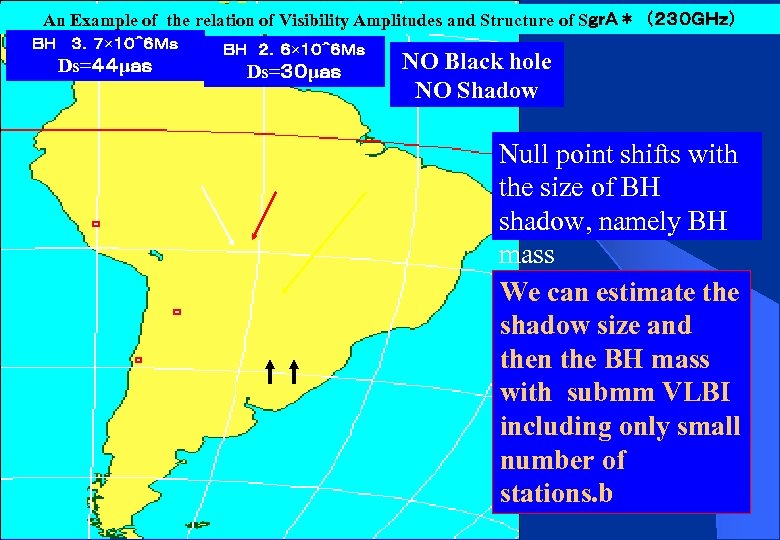
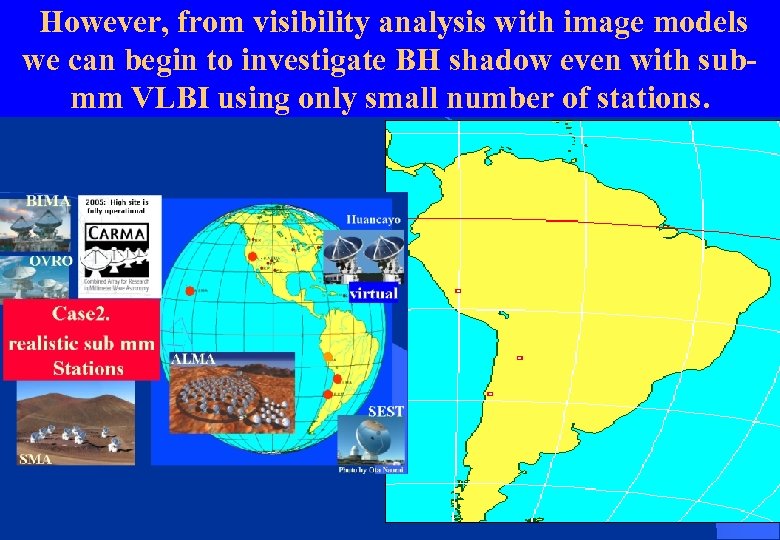 However, from visibility analysis with image models we can begin to investigate BH shadow even with submm VLBI using only small number of stations.
 Conclusions So We Should Start sub-mm VLBI at the Southern Hemisphere at once! Thanks ! Sgr. A* Black Hole Shadow (Falcke et al 00)