


 Скачать презентацию Direct Proportion Lesson Aims To understand what
30a8da3479df7e71b533a50b6eda446e.ppt
- Количество слайдов: 18
 Direct Proportion
 Lesson Aims To understand what is meant by direct proportion.
 Keywords Proportionality Direct proportion Constant of proportionality
 An Example of Direct Proportion If I were to go shopping in Poundland buy 5 items, the cost would be £ 5. How much would it cost for 10 items? £ 10 …. and so on
 So what can we say about the relationship between the price & number of items bought? The more items that are bought the more it costs. (No. of items bought = price paid). Therefore, the price and number of items are said to be directly proportional.
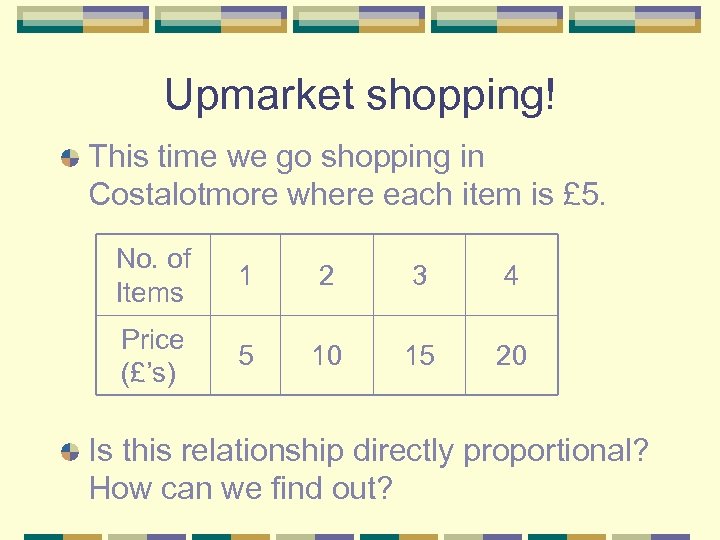 Upmarket shopping! This time we go shopping in Costalotmore where each item is £ 5. No. of Items 1 2 3 4 Price (£’s) 5 10 15 20 Is this relationship directly proportional? How can we find out?
 Look at Ratios We can look at the number of items and the cost of them in terms of their ratios. 1: 5, 2: 10, 3: 15 & 4: 20. What is the simplest form of each ratio? 1: 5 As the price increases at the same rate as the number of items, they are directly proportional.
 Look at a graph
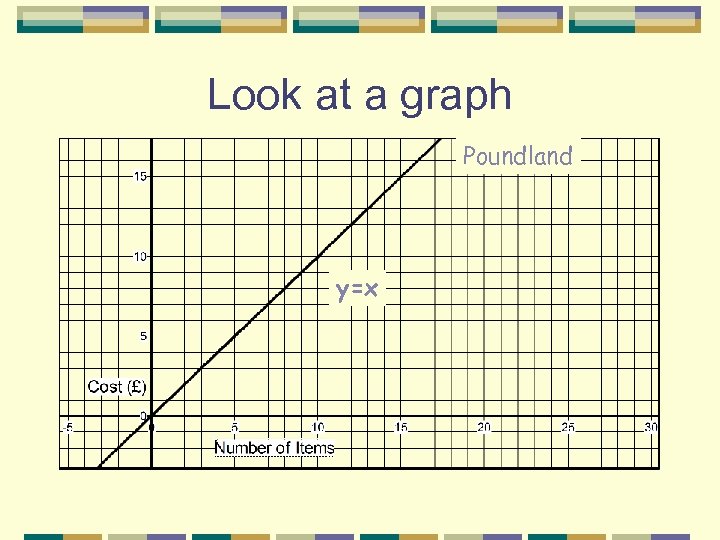 Look at a graph Poundland y=x
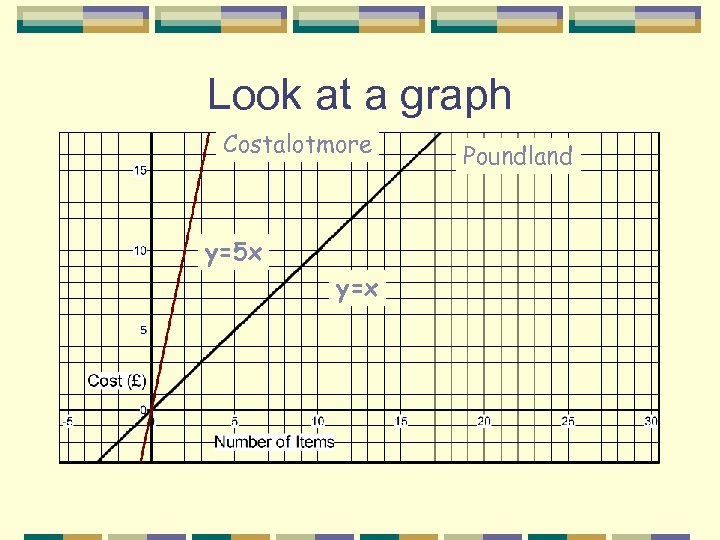 Look at a graph Costalotmore y=5 x y=x Poundland
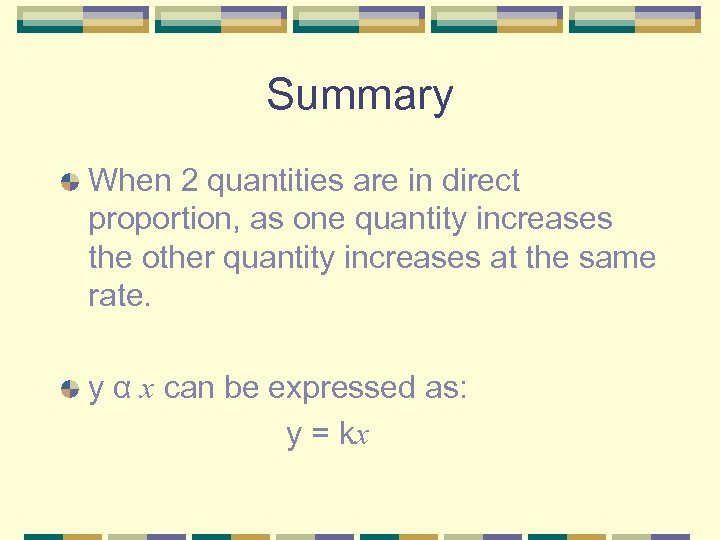
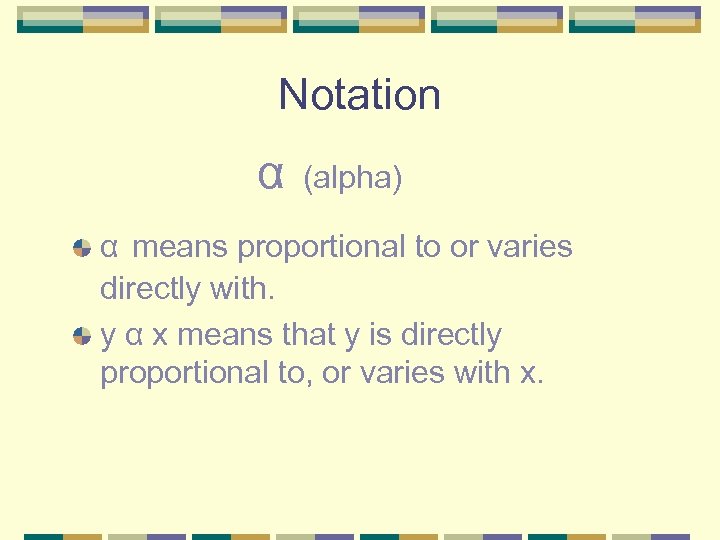 Notation α (alpha) α means proportional to or varies directly with. y α x means that y is directly proportional to, or varies with x.
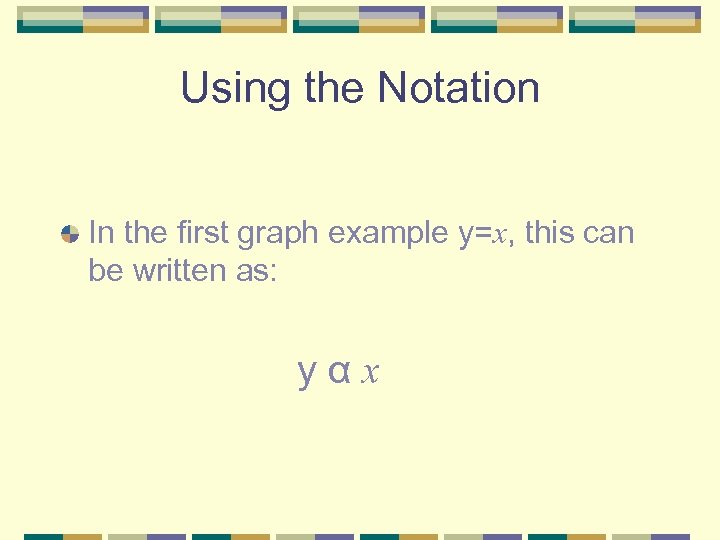 Using the Notation In the first graph example y=x, this can be written as: yαx
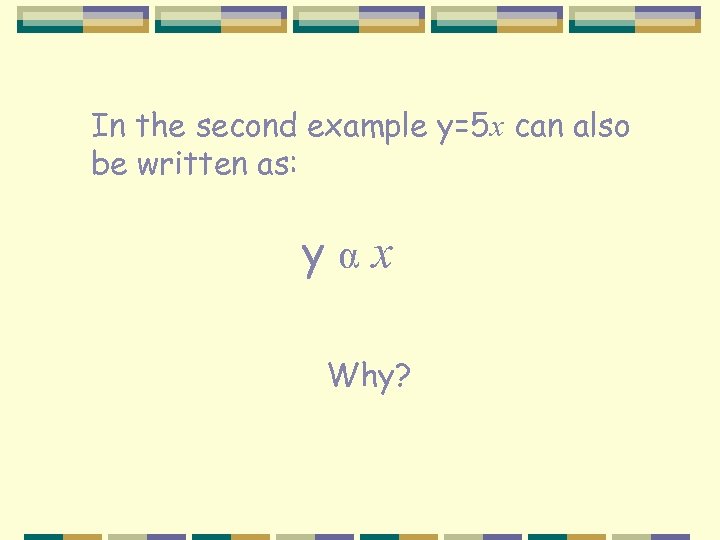 In the second example y=5 x can also be written as: yαx Why?
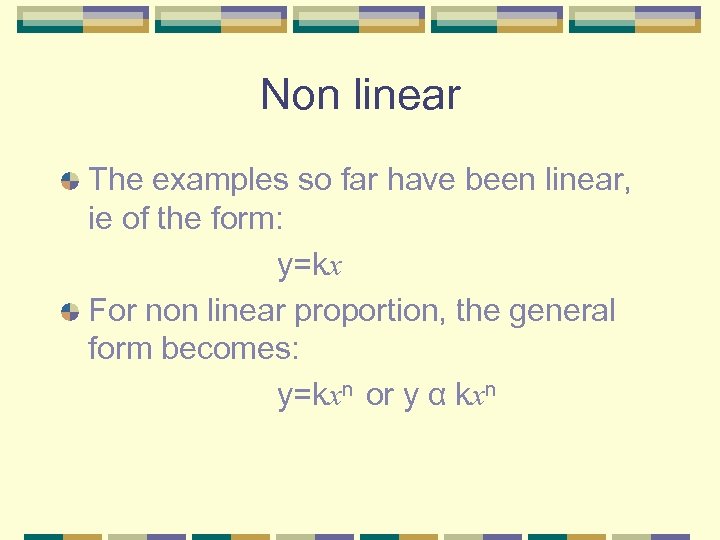
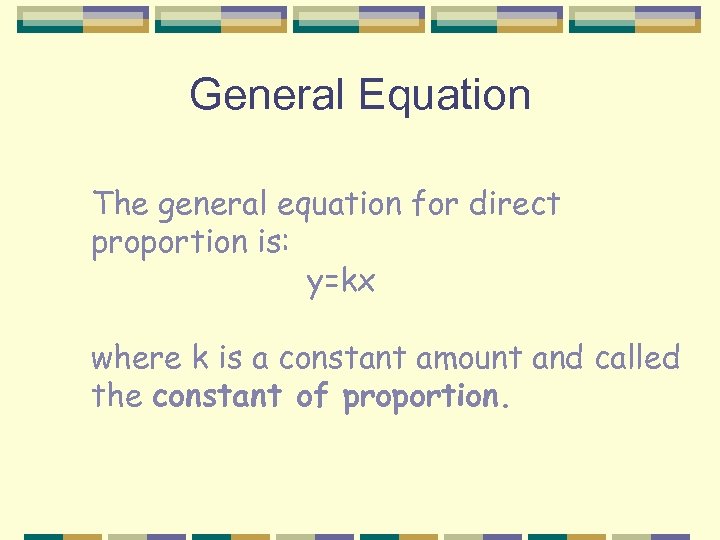 General Equation The general equation for direct proportion is: y=kx where k is a constant amount and called the constant of proportion.
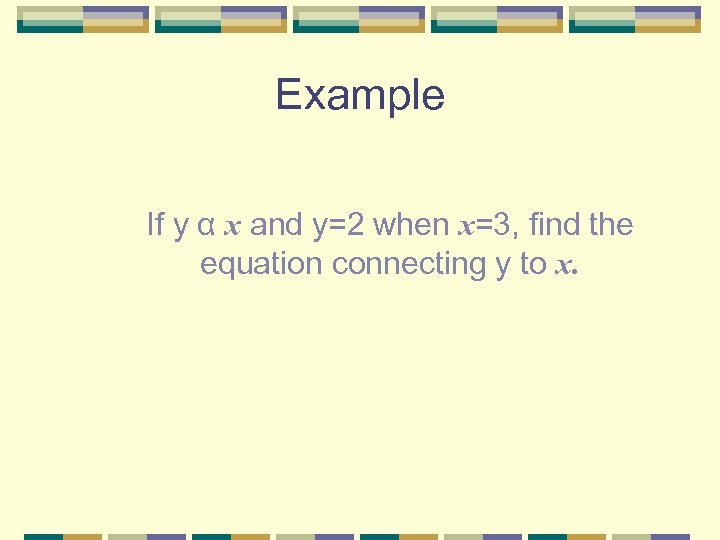 Example If y α x and y=2 when x=3, find the equation connecting y to x.
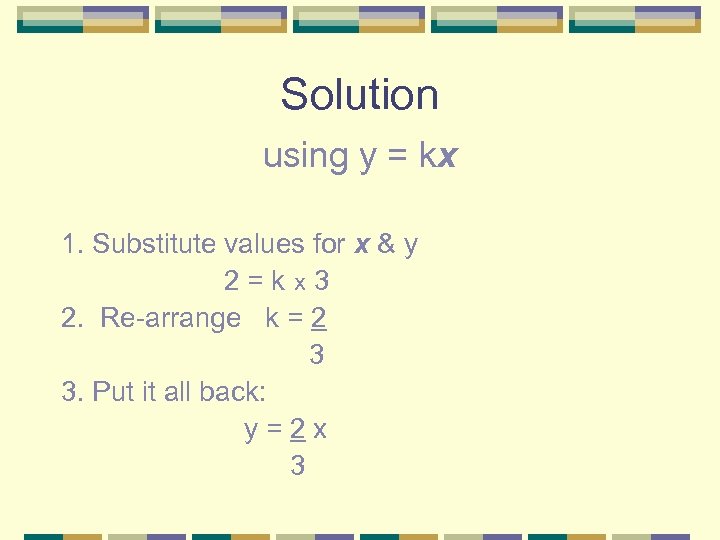 Solution using y = kx 1. Substitute values for x & y 2=kx 3 2. Re-arrange k = 2 3 3. Put it all back: y=2 x 3
 Summary When 2 quantities are in direct proportion, as one quantity increases the other quantity increases at the same rate. y α x can be expressed as: y = kx
 Non linear The examples so far have been linear, ie of the form: y=kx For non linear proportion, the general form becomes: y=kxn or y α kxn