 Скачать презентацию Direct Marketing When There Are Voluntary Buyers Presenter
037eb5f9c6b3a39efd434ce6cdad19a2.ppt
- Количество слайдов: 11



Direct Marketing When There Are Voluntary Buyers Presenter: _______ Yi-Ting Lai, Ke Wang Daymond Ling, Hua Shi, Jason Zhang Simon Fraser University {llai 2, wangk}@cs. sfu. ca Canadian Imperial Bank of Commerce {Daymond. Ling, Hua. Shi, Jason. Zhang}@cibc. com
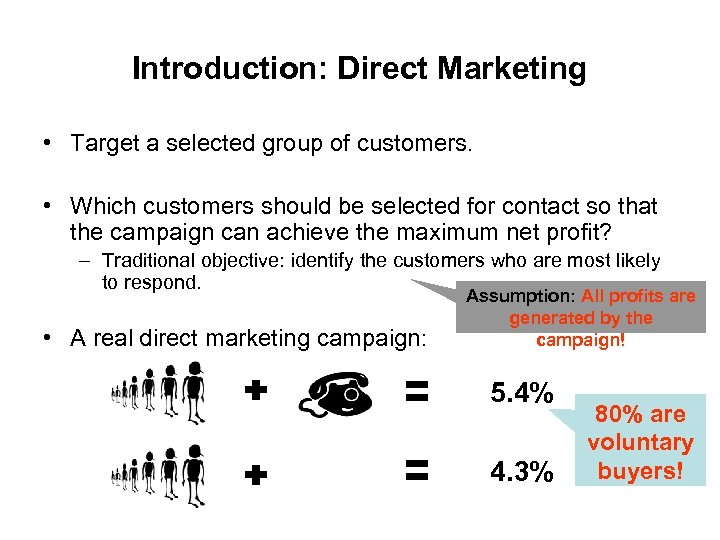
Introduction: Direct Marketing • Target a selected group of customers. • Which customers should be selected for contact so that the campaign can achieve the maximum net profit? – Traditional objective: identify the customers who are most likely to respond. • A real direct marketing campaign: Assumption: All profits are generated by the campaign! 5. 4% 4. 3% 80% are voluntary buyers!
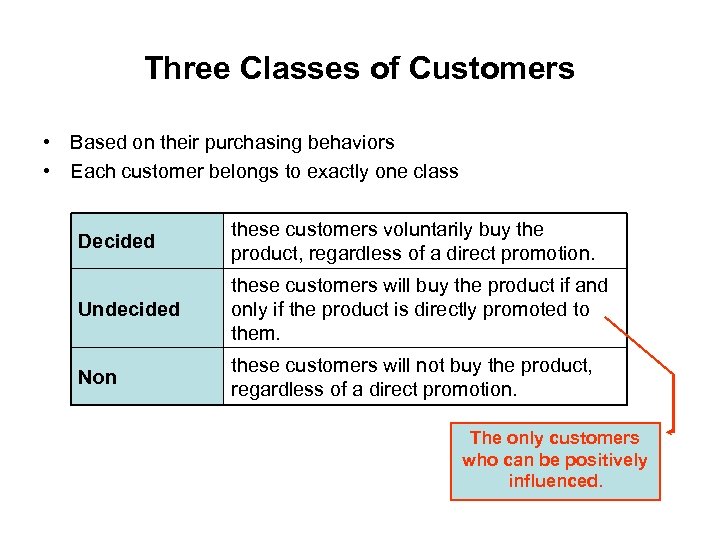
Three Classes of Customers • Based on their purchasing behaviors • Each customer belongs to exactly one class Decided these customers voluntarily buy the product, regardless of a direct promotion. Undecided these customers will buy the product if and only if the product is directly promoted to them. Non these customers will not buy the product, regardless of a direct promotion. The only customers who can be positively influenced.
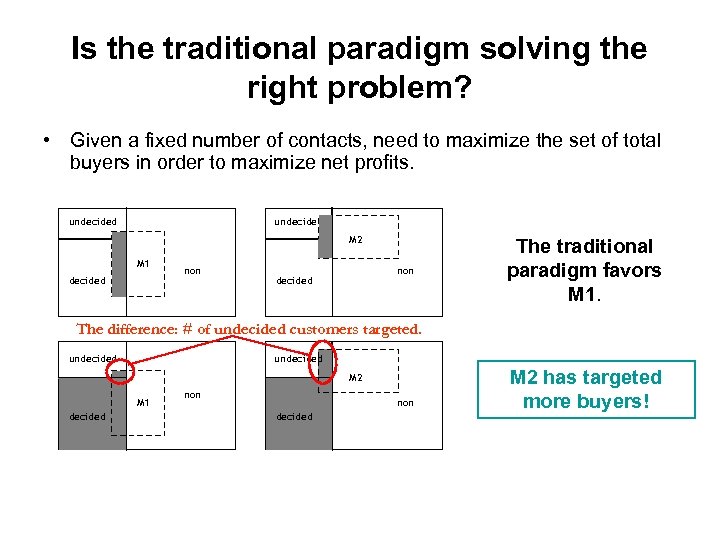
Is the traditional paradigm solving the right problem? • Given a fixed number of contacts, need to maximize the set of total buyers in order to maximize net profits. undecided M 2 M 1 decided non decided The traditional paradigm favors M 1. The difference: # of undecided customers targeted. undecided M 2 M 1 decided non decided M 2 has targeted more buyers!
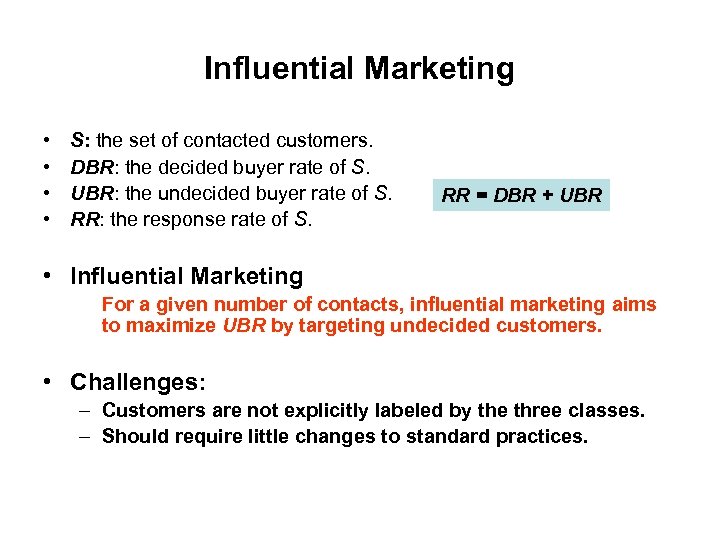
Influential Marketing • • S: the set of contacted customers. DBR: the decided buyer rate of S. UBR: the undecided buyer rate of S. RR: the response rate of S. RR = DBR + UBR • Influential Marketing For a given number of contacts, influential marketing aims to maximize UBR by targeting undecided customers. • Challenges: – Customers are not explicitly labeled by the three classes. – Should require little changes to standard practices.
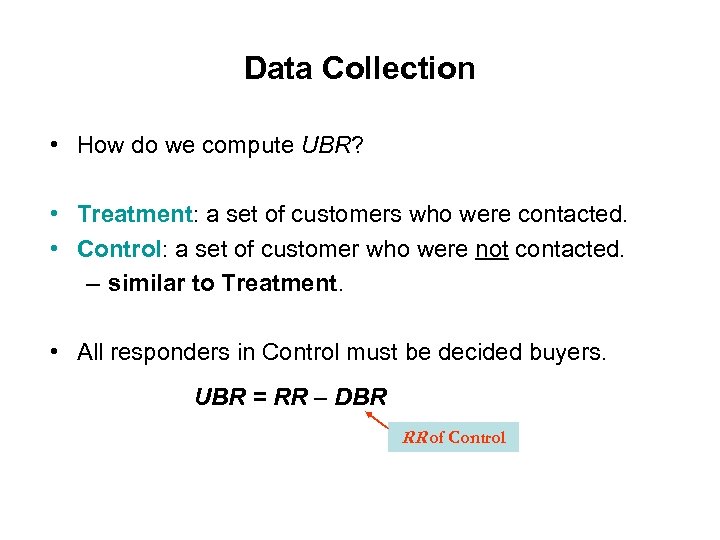
Data Collection • How do we compute UBR? • Treatment: a set of customers who were contacted. • Control: a set of customer who were not contacted. – similar to Treatment. • All responders in Control must be decided buyers. UBR = RR – DBR RR of Control
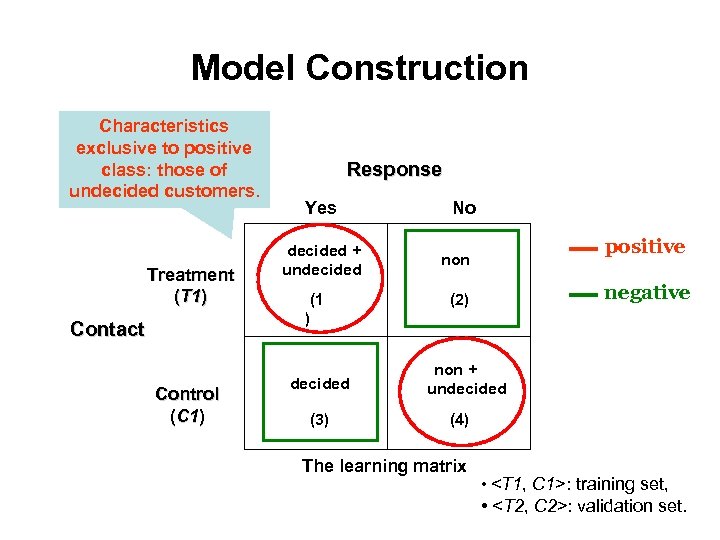
Model Construction Characteristics exclusive to positive class: those of undecided customers. Treatment (T 1) Contact Control (C 1) Response Yes decided + undecided (1 ) decided (3) No positive non negative (2) non + undecided (4) The learning matrix • <T 1, C 1>: training set, • <T 2, C 2>: validation set.
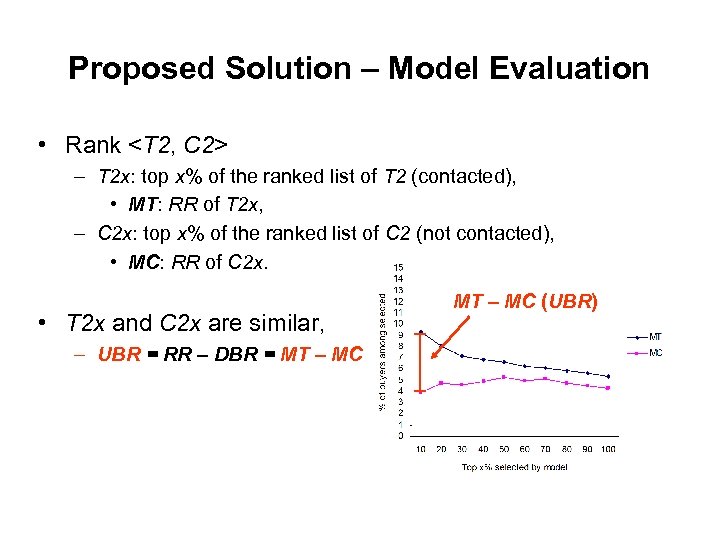
Proposed Solution – Model Evaluation • Rank <T 2, C 2> – T 2 x: top x% of the ranked list of T 2 (contacted), • MT: RR of T 2 x, – C 2 x: top x% of the ranked list of C 2 (not contacted), • MC: RR of C 2 x. • T 2 x and C 2 x are similar, – UBR = RR – DBR = MT – MC (UBR)
Related Work – Lo’s • Predict the amount of positive influence the contact has on each customer. • Positive class: responders, • Negative class: non-responders, similar to traditional paradigm • Use treatment variable T to describe if a customer has responded. However, – T = 1 needs to be more strongly associated with the positive class.
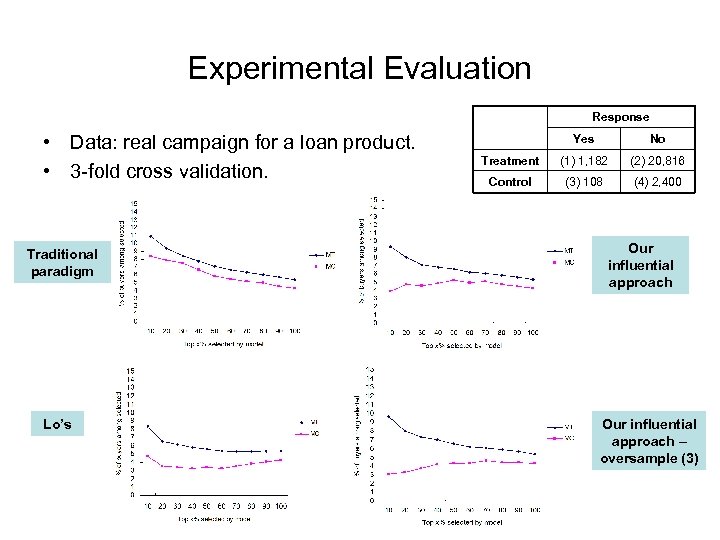
Experimental Evaluation Response • Data: real campaign for a loan product. • 3 -fold cross validation. Traditional paradigm Lo’s Yes No Treatment (1) 1, 182 (2) 20, 816 Control (3) 108 (4) 2, 400 Our influential approach – oversample (3)
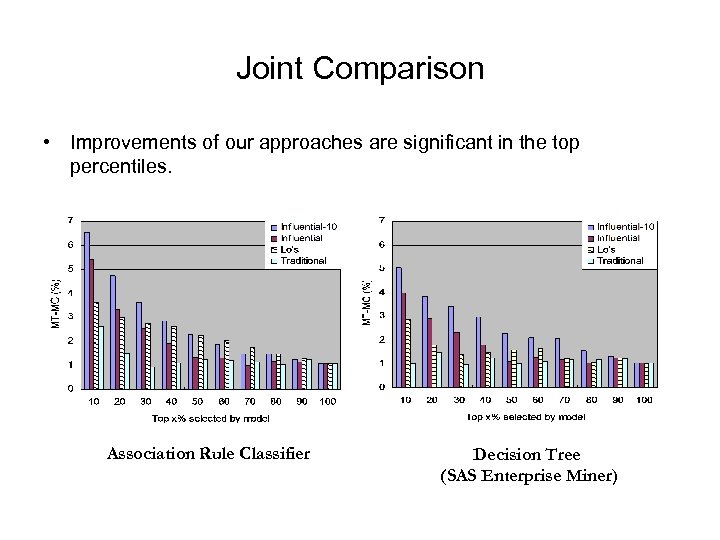
Joint Comparison • Improvements of our approaches are significant in the top percentiles. Association Rule Classifier Decision Tree (SAS Enterprise Miner)
Скачать презентацию Direct Marketing When There Are Voluntary Buyers Presenter
037eb5f9c6b3a39efd434ce6cdad19a2.ppt