 Скачать презентацию Diplomatic ranks Done by Zakir Umit the
Diplomatic_ranks__done_by_Zakir_U.pptx
- Количество слайдов: 7



Diplomatic ranks Done by Zakir Umit , the 2 nd year student of international relations department of Turan university
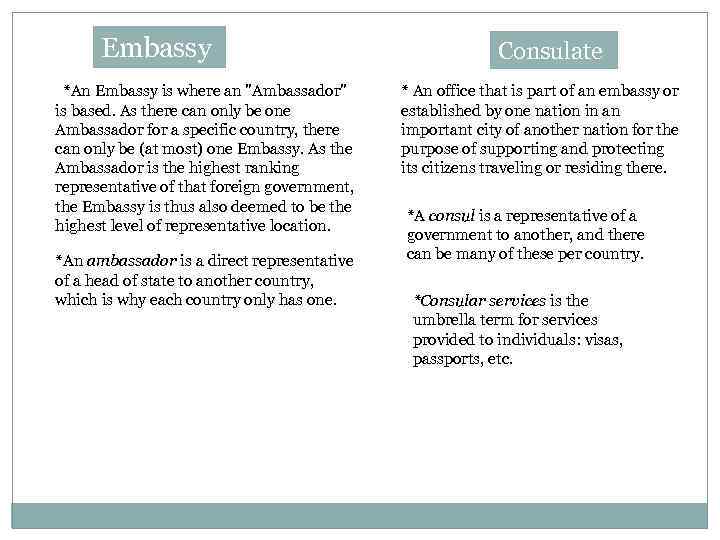
Embassy *An Embassy is where an "Ambassador" is based. As there can only be one Ambassador for a specific country, there can only be (at most) one Embassy. As the Ambassador is the highest ranking representative of that foreign government, the Embassy is thus also deemed to be the highest level of representative location. *An ambassador is a direct representative of a head of state to another country, which is why each country only has one. Consulate * An office that is part of an embassy or established by one nation in an important city of another nation for the purpose of supporting and protecting its citizens traveling or residing there. *A consul is a representative of a government to another, and there can be many of these per country. *Consular services is the umbrella term for services provided to individuals: visas, passports, etc.
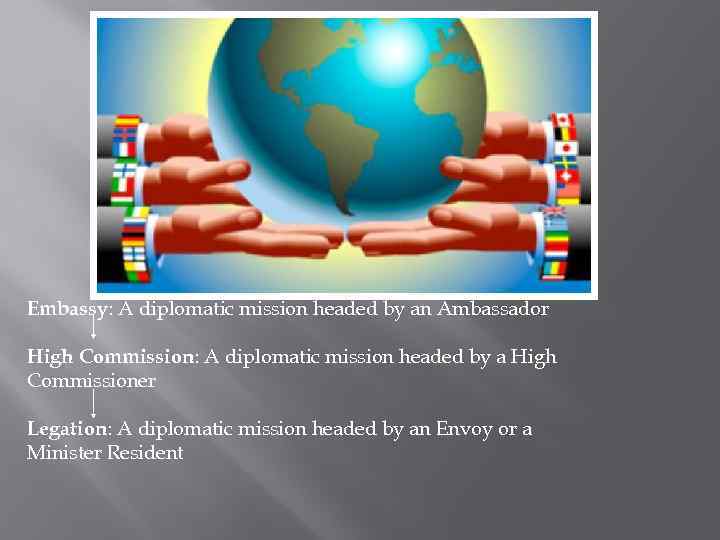
Embassy: A diplomatic mission headed by an Ambassador High Commission: A diplomatic mission headed by a High Commissioner Legation: A diplomatic mission headed by an Envoy or a Minister Resident
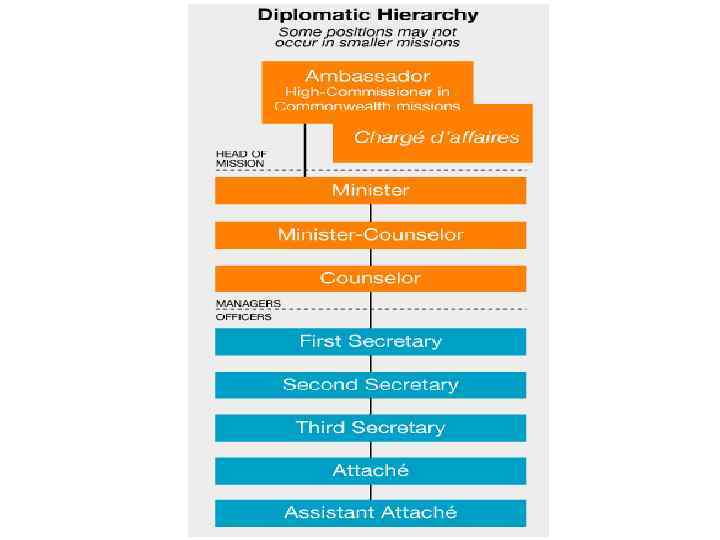
In an attempt to resolve the problem, the Congress of Vienna of 1815 formally established an international system of diplomatic ranks. The four ranks within the system are: Ambassador Extraordinary and Plenipotentiary. An Ambassador is a head of mission, formally representing the head of state, with plenipotentiary powers (i. e. , full authority to represent the government). High Commissioner, who represents the government rather than the head of state. Envoy Extraordinary and Minister Plenipotentiary. An Envoy is a head of mission, not considered a representative of the head of state, but nonetheless with plenipotentiary powers (i. e. , full authority to represent the government). Minister Resident or Resident Minister. Introduced by the Congress of Aix-la-Chapelle (1818), this is the lowest rank of full head of mission, above only chargé d'affaires (who are considered substitutes or acting chiefs of mission). Note that both the Envoy (Minister Plenipotentiary) and the Minister Resident are diplomatic ministers, which are not the same thing as government ministers or religious ministers.
Consular counterpart Consular officers, being nominally more distant from the politically sensitive aspects of diplomacy, can more easily render a wide range of services to private citizens, enterprises, et cetera. They may be more numerous since diplomatic missions are posted only in a nation's capital, while consular officials are stationed in various other cities as well. However, it is not uncommon for individuals to be transferred from one hierarchy to the other, and for consular officials to serve in a capital carrying out strictly consular duties within the "consular section" of a diplomatic post, e. g. , within an embassy. Some countries routinely provide their embassy officials with consular commissions, including those without formal consular responsibilities, since a consular commission allows the individual to legalize documents, sign certain documents, and undertake certain other necessary functions.
Formally the consular career (ranking in descending order: consul-general, consul, vice-consul, consular agent; equivalents with consular immunity limited to official acts only include honorary consul-general, honorary consul, and honorary vice-consul) forms a separate hierarchy. Many countries do not internally have a separate consular path or stream, and the meaning of "consular" responsibilities and functions will differ from country to country. Other titles, including "vice consul-general", have existed in the past. Consular titles may be used concurrently with diplomatic titles if the individual is assigned to an embassy. Diplomatic immunity is more limited for consular officials without other diplomatic accreditation, and broadly limited to immunity with respect to their official duties.
Скачать презентацию Diplomatic ranks Done by Zakir Umit the
Diplomatic_ranks__done_by_Zakir_U.pptx