


 Скачать презентацию Diplomacy Diplomacy is the art of conducting international
a96268b55d73666f42560495df521017.ppt
- Количество слайдов: 85
 Diplomacy? Diplomacy is the art of conducting international relations, The American Heritage Dictionary (Houghton Mifflin, 1997, The profession, activity, or skill of managing international relations The art of dealing with people in a sensitive and tactful way Diplomacy is the art of letting the other party have things your way The profession or skill of preserving or creating friendly relationship between countries The ability to deal with people in a sensitive way that does not upset or offend them
 Diplomacy origin late 18 th century: from French diplomatie, from diplomatique 'diplomatic'
 Diplomat? Early 19 th century: from French diplomate, backformation from diplomatique 'diplomatic', from Latin diploma
 Diplomat…. A person appointed by a national government to conduct official negotiations and maintain political, economic, and social relations with another country or countries A person who is tactful and skillful in managing delicate situations, handling people, etc An official representing a country abroad A person who can deal with others in a sensitive and tactful way A person who is skilled at dealing with difficult situations in a way which does not offend people
 Diplomacy The word is often used, incorrectly, as a synonym foreign policy. Whereas the latter can be described as the substance, aims and attitudes of a state's relations with others, diplomacy is one of the instruments employed to put these into effect.
 Diplomacy (Historical Background) Diplomacy is concerned with dialogue and negotiations and in this sense is not merely an instrument of state, it is also an institution of the state - system itself. The emissary, or ambassador, is one of the earliest political roles established in human society, but it was not until the fifteenth century in the Italian city-states that the concept of a permanent representative mission (or legation) was formalized. Since the emergence of the state - system in Europe in the fifteenth century an organized and fairly coherent system or permanent relations has developed among the actors and, even when these relations have been interrupted by armed conflict, diplomacy has still been the principal means of communication. Diplomacy as an instrument and as an institution is an essential part of the whole rationale of international relations, Evans, Graham; Newhman, Jeffrey - "The Penguin Dictionary of International Relations" (Penguin Group, 1998)
 Diplomacy (Historical background) The rules which established a common and coherent diplomatic system were developed in piecemeal fashion from the fifteenth to the twentieth centuries. In the twentieth century the Vienna conventions of 1961, 1963 and 1969 have codified international law relating to Diplomatic Relations, Consular Relations and the Law of Treaties, thus tightening up and giving new impetus to past and future practice. Diplomacy has moved from being dominated in the nineteenth and the first part of the twentieth century by the management of war and peace to include in the post-World War II period economic and trade policy issues as being of equal importance. Diplomacy has also already been significantly changed by an increase in the number of states, many of whom come to the table with different cultures.
 Main function of diplomacy The main function of diplomacy is negotiation - which broadly means discussions designed to identify common interests and areas of conflict between the parties. To establish the conditions under which negotiations can take place a number of other tasks are undertaken. The first is representation.
 Purpose and Function of Diplomacy During the Renaissance period, (1450 -1600) a systematic and largely professional diplomatic service was established with the purpose of obtaining information, interpreting policies and trends, safeguarding military and political interests and promoting commerce and trade links, Sinning, Vince - "Diplomacy In The 21 st Century. Another function of diplomacy is representation of a state's interests is to formulate and identify the goals and objectives, ( in the larger sense, is the overall management of orderly relations as well as being the means whereby change is effected). Finally, diplomacy is concerned with establishing and renewing the rules and procedures which regulate the international system. In this last sense, diplomacy is the enabling vehicle for the operation of international law and international organizations.
 Purpose…. . Mostly the following developments which occurred as a result of the increasing complexity of inter-state relations; the intrusion of ideological conflict and the opening up of diplomatic dialogue; the change of emphasis from bilateral to multilateral dealings; the increased use of experts and specialists; the increased number of treaties; the growth in importance of the media and the expansion of the international community and of non-state actors.
 Diplomatic Immunity (The Vienna Convention 1961) The premises of a diplomatic mission, the private residence of the diplomats permit and protect free communication between the diplomats of the mission and their home country, a diplomatic bag must never be opened even on suspicion of abuse, and diplomatic courier must never be arrested or detained. Article 29. Diplomats must not be liable to any form of arrest or detention. They are immune from civil or criminal prosecution, they are exempt from most taxes, and under Article 36 they are exempt from most customs duties. The family members of a diplomat that are living in the host country enjoy most of the same protections as the diplomats themselves. Article 9. The host nation may at any time and for any reason declare a particular member of the diplomatic staff to be PERSONA NON GRATA. The sending state must recall this person within a reasonable period of time, or otherwise this person may lose their diplomatic immunity.
 PURPOSE: International issues, the challenge and relationships of nations, states and welfare International Law International Court of justice United Nations
 Major focused issues of Area Environment/biodiversity Development/economy Social Security/Social Justice IT/communication/science and technology Natural resources/social and political issues Military power Humanitarian Intervention (Security Council) Terrorism
 Environment/biodiversity a) Global Warming: Carbon dioxide and other air pollution that is collecting in the atmosphere like a thickening blanket, trapping the sun's heat and causing the planet to warm up. b) Energy c) Air d) Oceans e) Wild lands f) Wildlife
 Development/economy Basic economic principles Essentials of international economics key economic forces and players in the international arena The inherent challenges of the global economy
 Social Security/Social Justice Children’s Rights Civil Liberties Disability Rights Indigenous Peoples Rights LGBT Rights (Lesbians, gays, bisexual and transgender people) Refugee Rights of Minorities Women’s Rights Note: Human well-being is a core challenge, for individuals, governments and international organizations
 IT/communication/science and technology Data Privacy Internet & E-commerce (positive and negative aspects) Technology Competition & Regulation
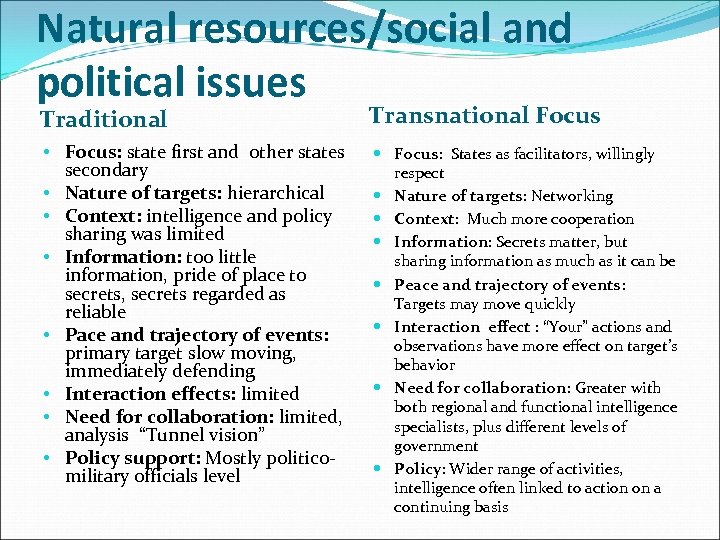 Natural resources/social and political issues Traditional Transnational Focus • Focus: state first and other states secondary • Nature of targets: hierarchical • Context: intelligence and policy sharing was limited • Information: too little information, pride of place to secrets, secrets regarded as reliable • Pace and trajectory of events: primary target slow moving, immediately defending • Interaction effects: limited • Need for collaboration: limited, analysis “Tunnel vision” • Policy support: Mostly politicomilitary officials level Focus: States as facilitators, willingly respect Nature of targets: Networking Context: Much more cooperation Information: Secrets matter, but sharing information as much as it can be Peace and trajectory of events: Targets may move quickly Interaction effect : “Your” actions and observations have more effect on target’s behavior Need for collaboration: Greater with both regional and functional intelligence specialists, plus different levels of government Policy: Wider range of activities, intelligence often linked to action on a continuing basis
 Military power Administration, Budget, Management and Reform Political and Security trans-national issue (Nuclear Weapons, Biological Weapons, (WMD, balloons etc) Note: political and security matters of many countries are under discussion at the United Nations.
 Diplomatic recognition ? Taiwan Palestinian Authority Abkhazia, (Dispute with Georgia but recognized by Russia) Transnistria, (Dispute with Moldovan government) Somaliland, (located in the Horn of Africa and dispute with Somalia) Nagorno Karabakh, (dispute the governments of Armenia and Azerbaijan) Turkish Cyprus
 New Information Technology and Diplomacy The advancement of technologies has dramatically changed the means by which states conduct diplomacy. Because of Rapid changes in information technology, diplomacy today refers not only to the advancement of national interests and the practice of persuasion but also to the management of global issues. The conduct of diplomacy is changing. Although the capacity of diplomats to adapt to the use of Internet Communications Technologies (ICTs) in the conduct of diplomacy plays a crucial role in their missions, the traditional way of "face to face" interaction is still considered important compared to "video conferencing" or "teleconferencing". Note: The use of ICTs in diplomatic negotiations does not work very well unless the parties know each other and the issues involved are minor.
 Diplomacy and Several Tracks Track I Diplomacy Track II Diplomacy Track One and Half Diplomacy Informal diplomacy Cultural diplomacy (involving new non governmental and non professional actors in the making of diplomacy)
 Track I Diplomacy Track-one diplomacy is conducted by official representatives of a state and known official governmental diplomacy. Track own diplomatic activities are informal consultations, good offices, special envoys, mediation, and negotiation, and fact-finding mission, diplomatic and economic sanction. Track one diplomats are committed to representing their state's interests, which may not always include a strong interest in quickly resolving a conflict. So track-one diplomacy is not always easily applied for successful conflict resolution. Track One Diplomacy is usually considered to be the primary peacemaking tool of a state’s foreign policy. It is carried out by diplomats, high-ranking government officials, and heads of states and is aimed at influencing the structures of political power. The Track One level includes actors such as the UN, regional organizations, heads of state, and government representatives. The major task of these actors is to facilitate negotiations at the top level leadership in order to influence change or the resolution of a conflict.
 Track II Diplomacy Track Two Diplomacy “unofficial, informal interaction between members of adversary groups or nations that aim to develop strategies, to influence public opinion, organize human and material resources in ways that might help resolve their conflict” Agha, H. , Feldman, S. , Khalidi, A. , & Schiff, Z. (2003). Track II Diplomacy: Lessons from the Middle East. Cambridge: Belfer Center for Science and International Affairs. Track Two Diplomacy is not a substitute for Track One Diplomacy, but compensates for the constraints imposed on leaders by their people’s psychological expectations. Most important, Track Two Diplomacy is intended to provide a bridge or complement official Track One negotiations. Examples of Track Two organizations are West African Network for Peace building (WANEP), European Centre for Conflict Prevention (ECCP). Note: Private and public organizations that deal with conflict resolution commonly operate at a Track Two level where they facilitate Top leadership Middle Leadership Grassroots.
 Track One and Half Diplomacy There is also called Track One and Half Diplomacy which the third party is not a representative of a political institution. Examples of institutions are such as ICG, Carter Center, and any non-government organization as well as third parties who practice this type of peacemaking, who are working for peace. Track One and a Half Diplomacy as a link between Track One and Track Two conflict resolution efforts. The main reason for introducing Track One and a Half Diplomacy is not just to enrich conflict resolution vocabulary, but to highlight its theoretical and practical utility in resolving interstate and ethno-political conflicts by bridging the gap between Track One and Track Two Diplomacy. Another very important characteristic of Track One and a Half diplomacy is that, third parties can be from national and international respect fields, former President Carter and Nelson Mandela as examples. These personalities can play important role around the world to resolve the conflict.
 Leadership Paradigm for diplomacy The four components of transformational leadership are charisma, inspiration, individual consideration, and intellectual stimulation. Some times people in conflict feel that they have lost control and Conflict Resolution bring solutions and order,
 Arbitration known as a form of binding dispute resolution, It is equivalent to litigation in the courts. Under English law, the first recorded judicial decision relating to arbitration was in England in 1610. During twentieth century many countries promoted the use of a arbitration. Also international arbitration as a means for resolving disputes under international commercial contracts. Today arbitration also more in use online as a Online Dispute Resolution (ODR)
 Arbitration This is an efficient way for to settle disputes that are not resolved during the routine timing. It gives parties another option in the dispute resolution process to help them resolve issues specific to their individual experience. Note: In contrast to mediation, a party cannot unilaterally withdraw from arbitration.
 Arbitration’s Principles Consensual The parties chose the arbitrator Arbitration is neutral Arbitration is a confidential procedure The decision of the arbitral tribunal is final and easy to enforce
 Arbitral tribunals are usually divided into two types (ad hoc arbitration tribunals, which appoints arbitrators approved by the parties or institutional arbitration tribunals, which are professional bodies providing arbitration services. Note: In some jurisdictions, the tribunal may have the same power as a court to such as order. In other jurisdiction it may not have the legal authority to order.
 Adjudication This is the legal process, which an arbiter or judge reviews evidence and argumentation (including legal reasoning) to come to a decision. Disputes are normally between private parties, private parties and public officials and disputes between public officials or public bodies. It is a fast-track process that aims to produce a binding, but not necessarily final, outcome to disputes on construction contracts.
 Adjudication It is intended to be quicker and more cost effective than litigation or arbitration. It is normally used to ensure payment (although most types of dispute can be adjudicated). The Adjudicator must generally decide the dispute in less than 42 days. The decision is binding and is usually upheld by the Courts.
 Humanitarian Intervention MAINTENANCE OF INTERNATIONAL PEACE AND SECURITY – THE UNITED NATIONS CHARTER CHAPTER VII - SECURITY COUNCIL RESOLUTIONS The Maintenance of International Peace and Security is the fundamental role of the United Nations as well as its primary purpose (art. 1. 1. of UN Charter). The Charter contains a whole system that aims at this object, which has been complete by the United Nations practice in this respect.
 Humanitarian…. THE PREAMBLE AND THE PRINCIPLES OF THE CHARTER OF UNITED NATIONS The preamble of the United Nations Charter states, among other things, that the armed force will not be used but when the common interest is at stake. That's to say, that the states will have to be tolerant, live together in peace and join their efforts to safeguard and maintain peace and Security, by accepting principles and by adopting methods to assure that the armed force will not be used unless the use of such force were necessary for the common interest.
 Humanitarian… Humanitarian intervention means to entry into a country of the armed forces of another country or international organization with the aim of protecting citizens from persecution or the violation of their human rights, (Somalia, Haiti, Liberia, Rwanda, Bosnia, and Sierra Leone and The North Atlantic Treaty Organization’s ‘humanitarian war’ in Kosovo in 1999).
 Humanitarian… “Humanitarian Intervention as the threat or use of force by a state, group of states, or international organization primarily for the purpose of protecting the nationals of the target state from widespread deprivations of internationally recognized human rights” Sean Murphy (1996). Humanitarian Intervention is to help people who victim by civil war, humanitarian crisis, or crimes including genocide, (collapse of state institutions and breakdown of law and order). When civilians become the main targets and combatants employ starvation, slaughter, and various civilian and military technologies to expel or kill civilians including demonstration- killings than humanitarian interventions is absolutely needed, (United Nations Secretary-General, Boutros Ghali).
 Humanitarian… Under Article 39 of the Charter to allow for Security Council-mandated military intervention to respond to grave humanitarian crises, even where such crises have been purely domestic in nature, “the Security Council has availed itself of a right of humanitarian intervention”. (By adopting a series of resolutions which have progressively expanded the definition of a "threat to international peace and security”).
 Cooperation of willing Human Cooperation/qualities of individuals Strong personal commitment to co-operation, connection, respect, honesty, peace, sharing, learning, growing, sustainability Commitment to contributing to a more sustainable, compassionate, respectful, healthy, just, equitable, & wonderful world for all Commitment to people care, earth care & sharing Grounded in belief & practice of non-violence Desire & willingness to contribute & be of service, open, passion, determination, courage of their convictions, aspiring, optimistic, positive resourceful, visionary/ has vision, inspirational clarity Desire to make a difference, desire to make a contribution, creative, self confidence, excellent listening ability & skills, knowledge & skills for working in groups, able to read track the energy of another person & of group, aware of one's energy & intention when something is going or has gone wrong.
 Cooperation of willing Cooperation: common effort, association of persons for common benefit. Note: Cooperation of the willing, form a local level, to a global scale, which creates an environment for People, and Nations, to work together for the Betterment of all Humanity. There is a possibility to create world peace with the tools, networking, cooperation, and willing. Also Cooperation depends on expectations aligned with power.
 Overview of the four-frame Model Structure Human Resources Political Symbolic
 Topics will focus Perception in leadership Leadership style and skills to conflict management Survey to determine our own cognitive strengths and vulnerabilities Putting it all together-effective leadership for conflict management for today
 Structural Central concept: Rules, roles, goals, policies, technology, environment, task, data, Rationality, procedure Image of leadership: Social architecture
 Human Resources Central concepts: Needs, skills, relationship Image of leadership: Empowerment
 Political Central concepts: Power, conflict, competition, organizational politics, network, bargaining, coalitions, alliances, negotiation Image of leadership: Advocacy
 Symbolic Centrals concepts: Culture, meaning, ritual ceremony, stories, heroes, faith, belief, Image of leadership: Inspiration
 Leadership qualities Charismatic leaders have outstanding traits and skills, they arise during times of conflict, they propose and support extreme solutions to conflict/crises, followers are attracted to charismatic leaders because of the inspiration they receive through their relationship with such leaders, and charismatic leaders' gifts are validated through successful experiences. Several personality characteristics are associated with charismatic leaders, including: Expressive verbally and physically, Exhibit self-confidence. Self-directed. Must have insight into the needs of their followers and have the ability to use these needs to persuade followers. Must be free of internal conflict and eloquent speakers, Sensitive, enlightened, and knowledgeable, generate pride in the organization. Demonstrate high levels of activity, self-confidence, and determination, have a sense of mission, Have expectations for high levels of performance.
 Indigenous and Traditional Mechanisms of Conflict Resolution in Nepal
 Mediation has a long and colorful history Islamic concept Hikmah. (Hikmah means wisdom and refers to the conflict intervention style of third party interveners), the qualified intervener, known as the Hakam, is trustworthy, impartial, and possesses a deep knowledge of conflict. In the Qur’an, it states, “if two parties of believers fall to fighting, then make peace between them. ”
 Mediation has a long and colorful history Buddhist Karuna: (compassion) thoughts and feelings. Empathetic listening” and “mindful speech” allow the mediator to hear the emotional needs behind the disputants’. Metta: known as loving kindness, metta involves cultivating goodwill toward others.
 Mediation in Christian Practice Forgiveness: “forgive and you shall be forgiven”. So, Christian tradition calls all people to peacefully walk together as brothers and sisters rather than separately. Peace between two parties is seen as benefiting the larger community. Shalom bids: (the Jewish peace). Shalom greets the other with hope that their relationship might be one of respect and integrity, peace and justice, wholeness and flourishing. The rodef shalom, “pursuer of peace. ”, elicits that person’s perspective on the conflict and listens to his/her pain The Greek word: “walk together again”. Note: Such understanding inspires the concept of mediation.
 Hindu practice Dharma (one’s worldly obligation, moral responsibility to perform correct and responsible actions that meet his/her duty and thereby maintain the stability of society) Ahimsa: (noninjury) model. Yajna: Means for the mediator to encourage the parties to realistically assess the options presented by their opponent, and to honestly assess the impact of their own settlement offers.
 Mediation in Sri Lanka has a strong tradition of consensus based dispute resolution. The practice of mediation in Sri Lanka dates back to the reign of the Ceylon kings, who ruled Sri Lanka prior to colonial settlement. In the former Kingdom of Ceylon the institution of Gamsabhawa (the village council) had the mandate to maintain peace and harmony at village level by facilitating the amicable settlement of disputes. Similarly, the village temple formed the traditional centre of social life and the Head Priest of the temple also took an active role in dispute resolution. 1958 reintroduce the concept of the ‘amicable settlement of disputes’ by introducing the Conciliation Boards Act 1958 Note: Eventually the adversarial legal system based on English common law became the dominant form of formal dispute resolution in Sri Lanka, suppressing traditional mediation processes.
 Mediation in Sri Lanka conti. . The 1983 riots (open the doors for the mediation) Mediation in Sri Lanka today is practiced extensively on a community level. Mediation Board Act 1988: all mediators under the Act are required to attend a training course conducted by the Ministry of Justice before they can be approved as mediators. A matter can come to mediation in one of four ways. Voluntary referral Mandatory referral: civil disputes relating to property, debt, damage or demand not exceeding 25, 000 rupees Mandatory referral (criminal matters): there is mandatory referral to mediation for criminal offences specifically set out in the Act. These include property offences, assault, trespass Court referral: Any court may refer a dispute to a mediation panel with the consent of the parties.
 India History The concept of mediation is ancient and deep rooted. The ancient courts called Kula, Sreni and Gana served as a platform for dispute resolution. Panchayat at the community level. Panches used to be called Panch Parmeshwar. 1966 the Supreme Court of India has started the process of reforms in the Indian Judicial System. These days the Supreme Court promote alternative methods of dispute resolution. Note: Some High Courts in India have already successfully taken the initiative to refer matters before them to mediation. The High Court of Madras has taken the initiative to open the Tamil Nadu Mediation and Conciliation Centre in April 2005, in Chennai. The aim of the centre is to settle matters referred to it within 60 days.
 Nepal Much of the history of the dispute resolution structure in Nepal is associated with customary practices and religious codes of conduct. Society developed an approach to settle disputes through ‘community involvement’ during Lichhhavi period (2 nd -12 th Century), Gosthi (currently known as guthi) was the lowest body of the society to ‘mediate disputes’. Panchyati’: Mediators involved in the dispute settlement process were called ‘bhaladmi’ ( bhala- gentle and admi-men). This practice continued for long time in the history, until Rana regime destroyed the ‘practice of community mediation for its deceptive move to ‘generate revenues out of court proceedings and penalties’ Rishikesh Shaha, 1992. Ancient and Medieval Nepal. A formal justice delivery system was established in Nepal as late as the 1950’s
 The Case of Nepal Violent conflict/people war?
 Nepal Characteristics Ø The size of Nepal is 147, 000 square kilometers. It is a landlocked country. Ø Over 25 million people live on this small piece of land. Ø Nepal is a least developing country and one of poorest in the world (per capita income is $300). It is dependent on foreign aid? Ø It has very few natural resources that can be developed. Ø Most of the population (over 80%) survive through agriculture. Ø There is almost no infrastructure for transportation and communication, and very limited infrastructure for basic services like health and education. Ø There is very low literacy rate 65%. Ø Nepal was closed to trade and interaction with the outside world until 1951. Ø There is no long-term history of a democratic culture where general citizens participate in decision-making and governance. .
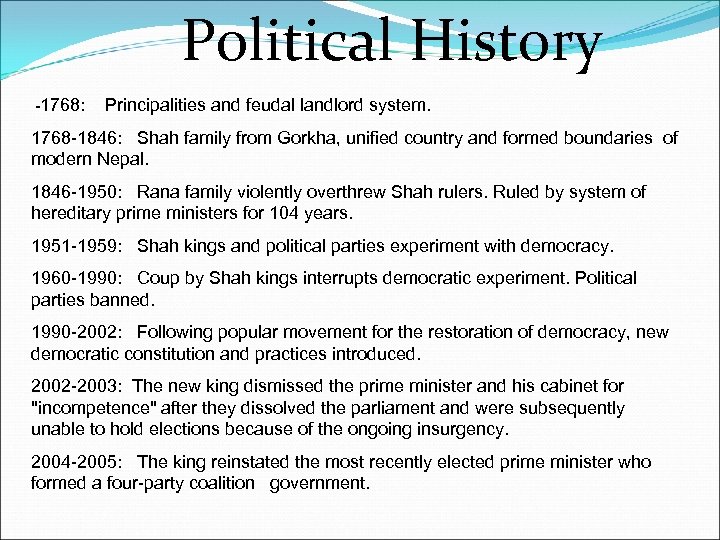 Political History -1768: Principalities and feudal landlord system. 1768 -1846: Shah family from Gorkha, unified country and formed boundaries of modern Nepal. 1846 -1950: Rana family violently overthrew Shah rulers. Ruled by system of hereditary prime ministers for 104 years. 1951 -1959: Shah kings and political parties experiment with democracy. 1960 -1990: Coup by Shah kings interrupts democratic experiment. Political parties banned. 1990 -2002: Following popular movement for the restoration of democracy, new democratic constitution and practices introduced. 2002 -2003: The new king dismissed the prime minister and his cabinet for "incompetence" after they dissolved the parliament and were subsequently unable to hold elections because of the ongoing insurgency. 2004 -2005: The king reinstated the most recently elected prime minister who formed a four-party coalition government.
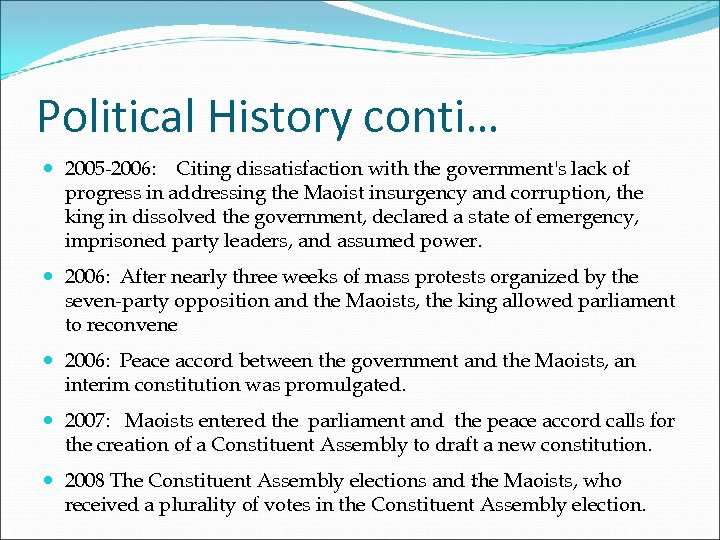 Political History conti… 2005 -2006: Citing dissatisfaction with the government's lack of progress in addressing the Maoist insurgency and corruption, the king in dissolved the government, declared a state of emergency, imprisoned party leaders, and assumed power. 2006: After nearly three weeks of mass protests organized by the seven-party opposition and the Maoists, the king allowed parliament to reconvene 2006: Peace accord between the government and the Maoists, an interim constitution was promulgated. 2007: Maoists entered the parliament and the peace accord calls for the creation of a Constituent Assembly to draft a new constitution. 2008 The Constituent Assembly elections and the Maoists, who received a plurality of votes in the Constituent Assembly election.
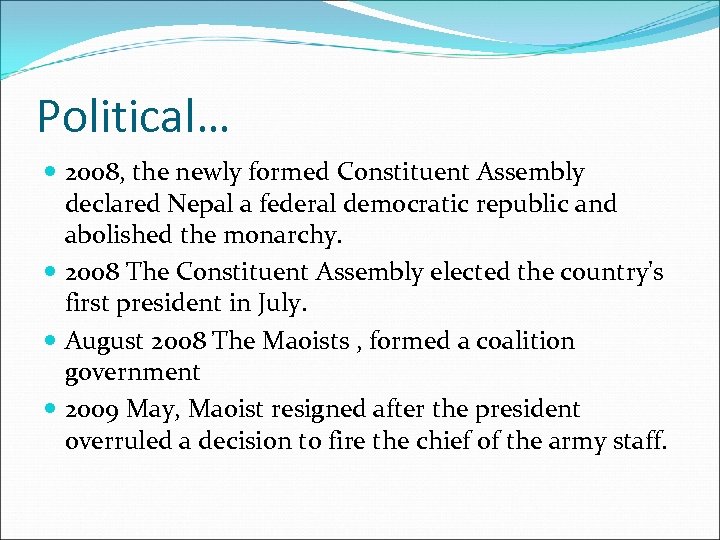 Political… 2008, the newly formed Constituent Assembly declared Nepal a federal democratic republic and abolished the monarchy. 2008 The Constituent Assembly elected the country's first president in July. August 2008 The Maoists , formed a coalition government 2009 May, Maoist resigned after the president overruled a decision to fire the chief of the army staff.
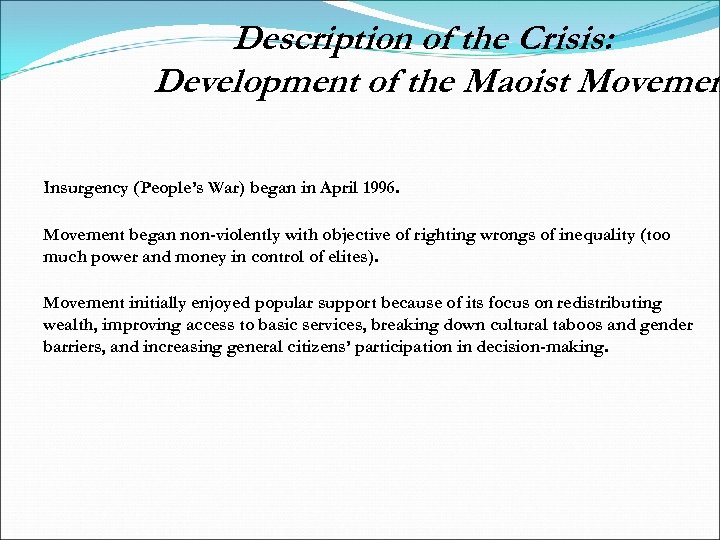 Description of the Crisis: Development of the Maoist Movemen Insurgency (People’s War) began in April 1996. Movement began non-violently with objective of righting wrongs of inequality (too much power and money in control of elites). Movement initially enjoyed popular support because of its focus on redistributing wealth, improving access to basic services, breaking down cultural taboos and gender barriers, and increasing general citizens’ participation in decision-making.
 Description of the Crisis: Evolution towards Violence As Maoists gained power, weapons and support from sympathetic groups outside Nepal, the movement became increasingly violent and used coercion to gain people’s support. With power came jealousy and fighting for power between Movement’s leaders. Factions began to steal for personal gain from the citizens they had promised to protect and whose interests they had promised to promote. Movement attacked and destroyed local governments, basic services, and development infrastructure.
 Description of the Crisis: No Solution other than Peace Police and military action was initiated to counter growing Maoist threat. Violence escalated. Efforts to stop violence resulted in ceasefire, but this was broken by Maoists after they rested and re-armed (criticized). Violence introduced in urban areas, and it interfered with development, investment, food supplies, basic services. After long time of political turmoil Peace accord between the government and the Maoists, an interim constitution was promulgated. Maoists entered the parliament and the peace accord calls for the creation of a Constituent Assembly to draft a new constitution.
 Solving the Crisis What is needed to solve the crisis? A negotiated constitution that is acceptable to all parties with power interests (Maoists, political parties), general citizens, and Nepal’s neighbors. Why is this needed? Without such a settlement, efforts to disarm, demobilize and reintegrate Maoists and other former combatants into the mainstream cannot take place. These efforts are needed for a return to economic development and stability.
 Solving the Crisis: Obstacles to Peace History of leadership that focuses on family and other personal connections as main important criteria for leadership. Leadership culture supported by nepotism and corruption, and that has limited re leadership qualities based on qualifications, experience, and achievement. Diverse ethnic, religious and language groups that have own ideas, needs and loyalties to own group. Difficult geographic situation that makes it difficult to develop one main national that keeps Nepal isolated. One of poorest and least developed countries in world that has limited resources and a history of dependency on foreign aid. History of limited foreign policy involvement mainly focused on maintaining Nep and authoritarian rule.
 Creating a Supportive Environment for Peace Respond rapidly and effectively to the humanitarian crises caused by the conflict Provide support for continued growth of an independent media Provide support for an independent judiciary Ensure donor and other foreign government oversight and involvement in the peace process to motivate the Government of Nepal Commit significant resources to immediate reconstruction and rehabilitation work encourages people to return to their villages and towns and take up normal life aga Create an environment favorable to domestic and international investment that helps create new employment opportunities Invite citizen participation and oversight in local governance as a means to engage decision-making that directly affects them
 Solving the Crisis: A Post Conflict Response Disarmament, Demobilization and Reintegration: Efforts to disarm and demobilize ex-combatants (or to encourage combatants to consider becoming ex-combatants) will need to consider providing the following: ØExpanding educational opportunities for young ex-combatants ØIncreasing employment opportunities that are more profitable and provide more benefits than war ØProviding social services to families of ex-combatants ØSupporting social, economic and political reforms that encourage ex-combatants to accept normalization as the most sensible option ØProviding ex-combatants and their communities with opportunities and resources to identify and agree upon their priorities and to decide on ways to address their common priorities
 Solving the Crisis: A Post Conflict Response Conclusions for Achieving Peace If peace is going to be lasting and acceptable, then ex-combatants need to be reintegrated into the society they helped to disrupt. They often become combatants in the first place because they have been the most disadvantaged in society. They need to be a part of peace negotiations and they need to contribute as civilians to rebuilding the communities they helped to disrupt and destroy. Civilian peace-keeping operations are likely to be most successful when they involve both the ex-combatants and the victims of conflict in problem identification and problem solving. This can empower them to become positively productive in the future.
 POST-CONFLICT ISSUES Introduction This presentation presents the range of tasks often encountered when rebuilding a country in the wake of violent conflict. This will help to national and international practitioners for conceptualize, organize, and prioritize policy responses.
 Three Different Phases for Normalization Initial response Transformation Sustainability Note: Reconstruction often takes place at various times during and after conflict, between the violent conflict and the return to normalization situation
 Initial response is often characterized by military intervention for basic security, stability, and emergency services
 Transformation Focuses on developing legitimate and sustainable indigenous capacity Special attention to restarting the economy Establishing mechanisms for governance and participation Securing a foundation of justice and reconciliation
 Sustainability Consolidates long-term recovery efforts Withdrawal of all or most of the international military involvement. Lays the foundation for the prevention of conflict and the reemergence of violence
 Normalization situation Extraordinary outside intervention is no longer needed The processes of governance and economic activity largely function on a selfdetermined and self-sustaining basis Internal and external relations are conducted according to generally accepted norms of behavior
 FOUR FOUNDATION OF POST CONFLICT ISSUES Security Justice and reconciliation Social/economic and development growth Good governing
 Security Protection of People Protection of Key Individuals, Infrastructure, and Institutions Territorial Security Reform of Local Security Institutions Regional Security
 Justice and reconciliation Transitional Justice Law Enforcement Judicial System Laws and Human Rights Corrections International Courts and Tribunals Truth Commissions Community Rebuilding Individual Healing and Empowerment
 Social/economic and development growth Refugees and Internally Displaced Persons Food Security and Public Health Shelter Educational System, Social Safety Net Economic Strategy and Assistance, Employment Generation Physical Infrastructure, Markets Legal and Regulatory Reform, International Trade Investment, Banking and Finance
 Good governance National Constituting Processes Transitional Governance Executive Authority Legislative Strengthening Local Governance Transparency and Anti-Corruption Elections and Political Parties Civil Society and Media
 Discussion Question. Why is ADR not so successful? When is ADR not suitable or appropriate? How likely is it this situation can be resolved through mediation & facilitation? And what types of situation are appropriate for facilitation? What are the range of dispute resolution methods available for this conflict?
 Personal Conflict Impact essay Produce a two-pages essay in which you discuss the role of conflict and conflict resolution in your personal life experience. Some question you might respond to are:
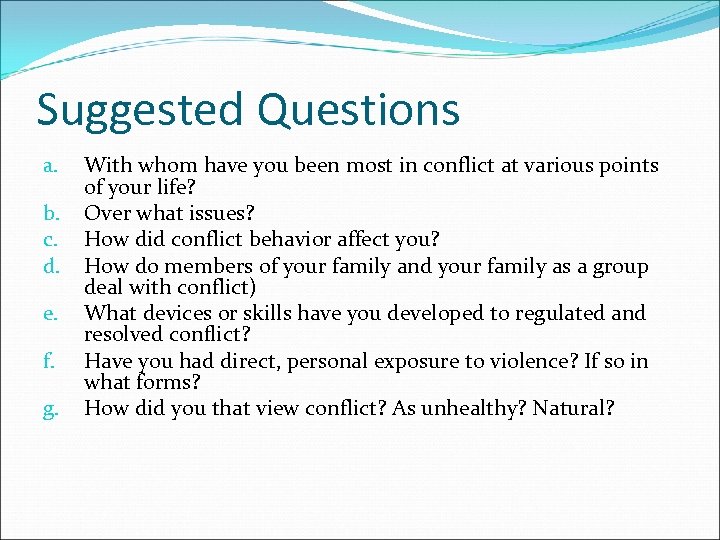 Suggested Questions a. b. c. d. e. f. g. With whom have you been most in conflict at various points of your life? Over what issues? How did conflict behavior affect you? How do members of your family and your family as a group deal with conflict) What devices or skills have you developed to regulated and resolved conflict? Have you had direct, personal exposure to violence? If so in what forms? How did you that view conflict? As unhealthy? Natural?
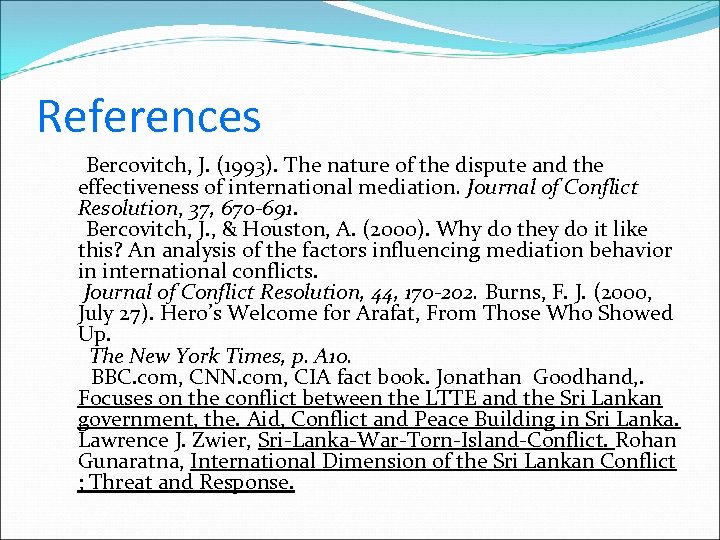 References Bercovitch, J. (1993). The nature of the dispute and the effectiveness of international mediation. Journal of Conflict Resolution, 37, 670 -691. Bercovitch, J. , & Houston, A. (2000). Why do they do it like this? An analysis of the factors influencing mediation behavior in international conflicts. Journal of Conflict Resolution, 44, 170 -202. Burns, F. J. (2000, July 27). Hero’s Welcome for Arafat, From Those Who Showed Up. The New York Times, p. A 10. BBC. com, CNN. com, CIA fact book. Jonathan Goodhand, . Focuses on the conflict between the LTTE and the Sri Lankan government, the. Aid, Conflict and Peace Building in Sri Lanka. Lawrence J. Zwier, Sri-Lanka-War-Torn-Island-Conflict. Rohan Gunaratna, International Dimension of the Sri Lankan Conflict ; Threat and Response.
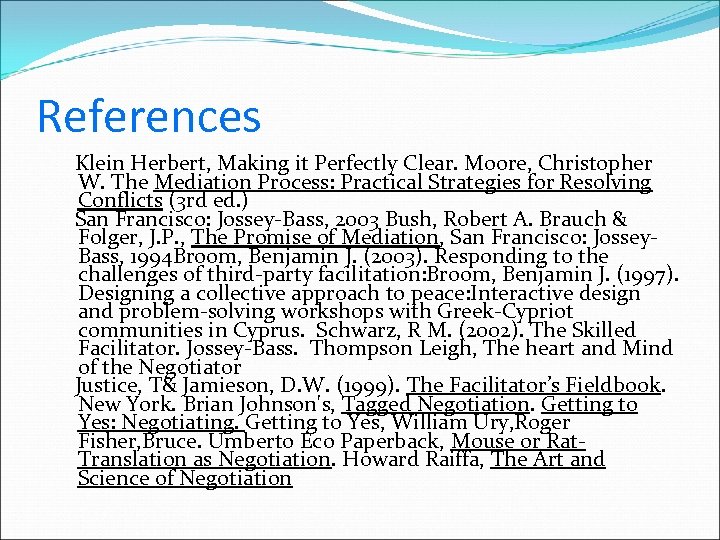 References Klein Herbert, Making it Perfectly Clear. Moore, Christopher W. The Mediation Process: Practical Strategies for Resolving Conflicts (3 rd ed. ) San Francisco: Jossey-Bass, 2003 Bush, Robert A. Brauch & Folger, J. P. , The Promise of Mediation, San Francisco: Jossey. Bass, 1994 Broom, Benjamin J. (2003). Responding to the challenges of third-party facilitation: Broom, Benjamin J. (1997). Designing a collective approach to peace: Interactive design and problem-solving workshops with Greek-Cypriot communities in Cyprus. Schwarz, R M. (2002). The Skilled Facilitator. Jossey-Bass. Thompson Leigh, The heart and Mind of the Negotiator Justice, T& Jamieson, D. W. (1999). The Facilitator’s Fieldbook. New York. Brian Johnson's, Tagged Negotiation. Getting to Yes: Negotiating. Getting to Yes, William Ury, Roger Fisher, Bruce. Umberto Eco Paperback, Mouse or Rat. Translation as Negotiation. Howard Raiffa, The Art and Science of Negotiation
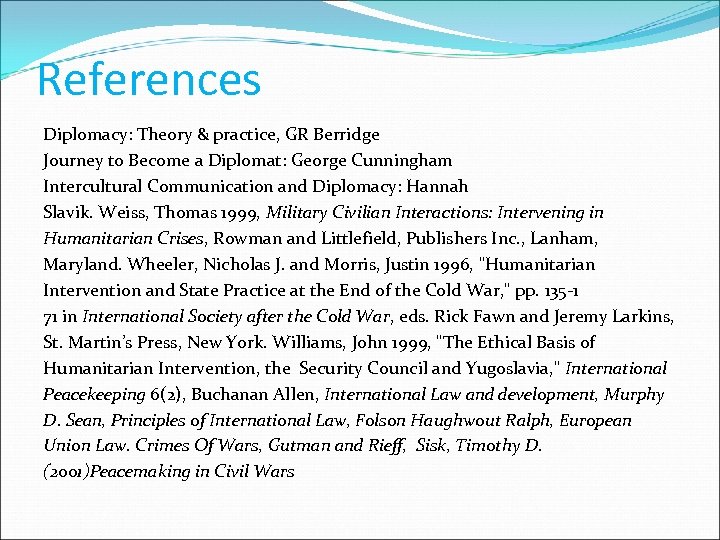 References Diplomacy: Theory & practice, GR Berridge Journey to Become a Diplomat: George Cunningham Intercultural Communication and Diplomacy: Hannah Slavik. Weiss, Thomas 1999, Military Civilian Interactions: Intervening in Humanitarian Crises, Rowman and Littlefield, Publishers Inc. , Lanham, Maryland. Wheeler, Nicholas J. and Morris, Justin 1996, "Humanitarian Intervention and State Practice at the End of the Cold War, " pp. 135 -1 71 in International Society after the Cold War, eds. Rick Fawn and Jeremy Larkins, St. Martin’s Press, New York. Williams, John 1999, "The Ethical Basis of Humanitarian Intervention, the Security Council and Yugoslavia, " International Peacekeeping 6(2), Buchanan Allen, International Law and development, Murphy D. Sean, Principles of International Law, Folson Haughwout Ralph, European Union Law. Crimes Of Wars, Gutman and Rieff, Sisk, Timothy D. (2001)Peacemaking in Civil Wars