 Скачать презентацию Diploma of Government Enterprise Architecture Block 02 Making
9fd3c82e2c31713e662629c1e1f0520f.ppt
- Количество слайдов: 33



Diploma of Government (Enterprise Architecture) Block 02 Making the Case for EA
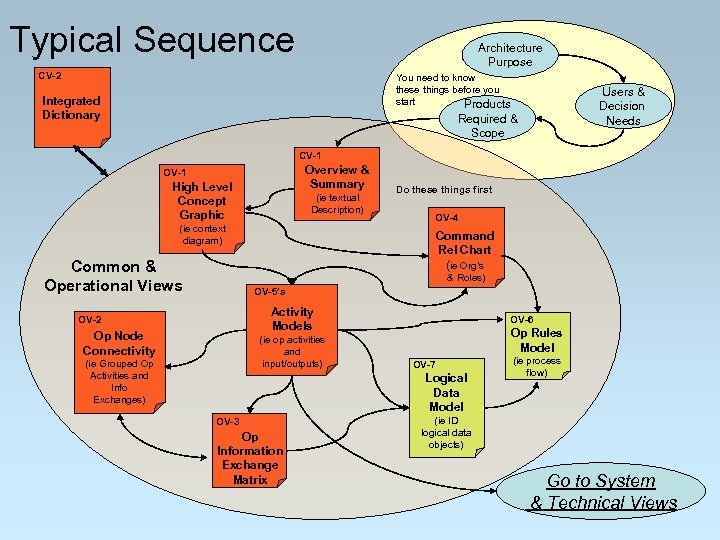
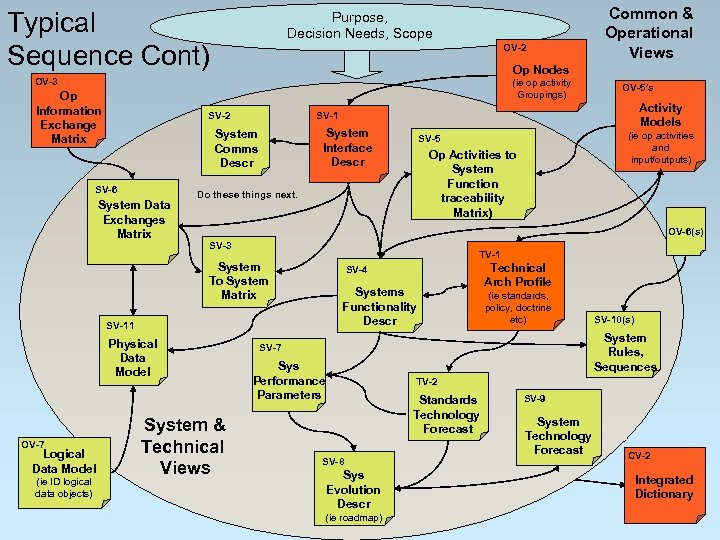
Overview • History of EA in the US • History of EA in Australia • The shape and scope of the challenges ahead • Expected benefits • How the Case Study fits in • Review of the product build sequence and product relationships • An Introduction to the Data Views
EA in the US • • • (Do. DAF_v 1_Volume_1. pdf, pp. 1 -5, 1 -6) “In the mid 1990 s with the increasing focus on joint and multinational operations, Do. D realized the need for a common approach for describing architectures. ” “In October 1995, the Deputy Secretary of Defense directed that a Do. D-wide effort be undertaken to define and develop better means and processes for ensuring that Command, Control, Communications, Computers, and Intelligence capabilities meet the needs of warfighters. In response to that direction, a C 4 ISR Integration Task Force (ITF) was established… under the direction of the Assistant Secretary of Defense for Command, Control, 1 -6 Communications, and Intelligence (ASD[C 3 I]). ” “The C 4 ISR Architecture Framework, Version 1. 0, dated 7 June 1996, was developed as a product of the Integrated Architectures Panel (IAP), one of several panels established by the ITF. ” “In October 1996, the ASD(C 3 I) and Joint Staff/J 6 established the C 4 ISR Architecture Working Group to continue the effort begun by the IAP. ” “The effort resulted in the publication of the C 4 ISR Architecture Framework, Version 2. 0, dated 18 December 1997. ” “The utility of the C 4 ISR Architecture Framework, combined with both Federal and Do. D policy encouraging the use of architectures, led Do. D to evolve the document into the Do. DAF in 2003. The Do. D Chief Information Officer (CIO) established the Architecture Framework Working Group (AFWG) to accomplish this evolution…” document published February 2004.
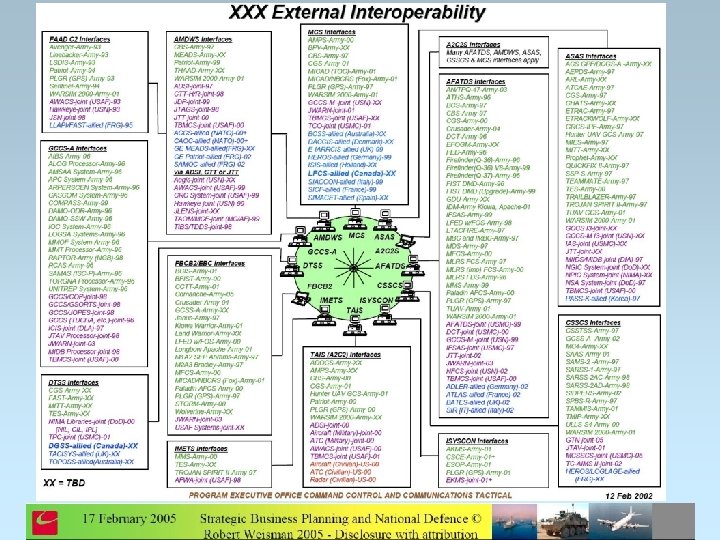
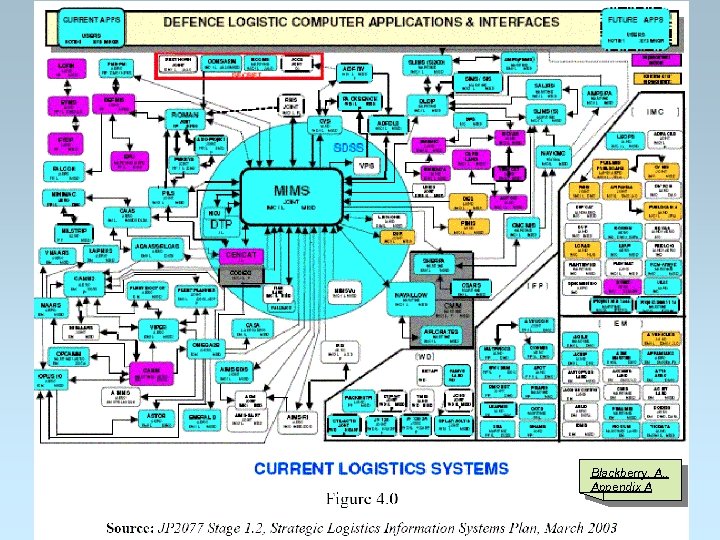
EA in Australia • • • The Defence White Paper (2000) noted that the effective use of information is at the heart of Australia's Defence Capability The poor state of the information systems supporting the DMO was identified as a significant risk at the organisation's inception in mid-2000… An Architecture and Strategic Plan for Materiel Information Management, Report of the DMO Business Information Systems Team, 30 Sep 2002 EA can be viewed as a master plan, integrating aspects of business planning including the goals, vision, strategies and governance of the organization… Corporate Governance of the Defence Information Environment (DIE), Portfolio Evaluation Report, Department of Defence, June 2004 The Defence Architecture Framework (DAF) is the overarching conceptual framework developed by the OCIO that describes the components of the enterprise and the interrelationships. Notwithstanding the introduction of the DAF, many projects within Defence are still, to a large extent, technology driven. The business need is often secondary to the selection of the product. As a result there are numerous software tools and solutions that have been procured by Defence to support the Materiel Environment, often overlapping in functionality. An example of the products supporting the Materiel Domain can be found at Appendix A 6. In the functional area of Inventory Management alone, there are over 20 systems! A similar pattern emerges for Engineering and Maintenance Support. Figure 4. 0 in Chapter 1 graphically illustrates this. Source: JP 2077 Phase 2 A Materiel Logistics Application Inventory, V 1. 1, dated 31 May 05
Blackberry, A. , Appendix A
Facing a new reality • In the new era of competition, opportunities and threats abound. • The merging of computing, telecommunications, publishing, and entertainment industries, as well as the pervasiveness of the Internet and other vehicles for electronic commerce, present strategic opportunities and threats for every firm. (p. 5) Weill, P. & Broadbent, M. , (1998), Leveraging the New Infrastructure: How Market Leaders Capitalize on Information Technology, Harvard Business School Press.
Chief of the Defence Force • “We are living in very uncertain times. Our Defence Organization, and the Defence Force in particular, must be agile enough to adjust to the ever-increasing and diverse demands of the future. ” (page iii) P. J. Cosgrove AC, MC, (2004), Enabling Future Warfighting: Network Centric Warfare Concept, ADDP-D. 3. 1
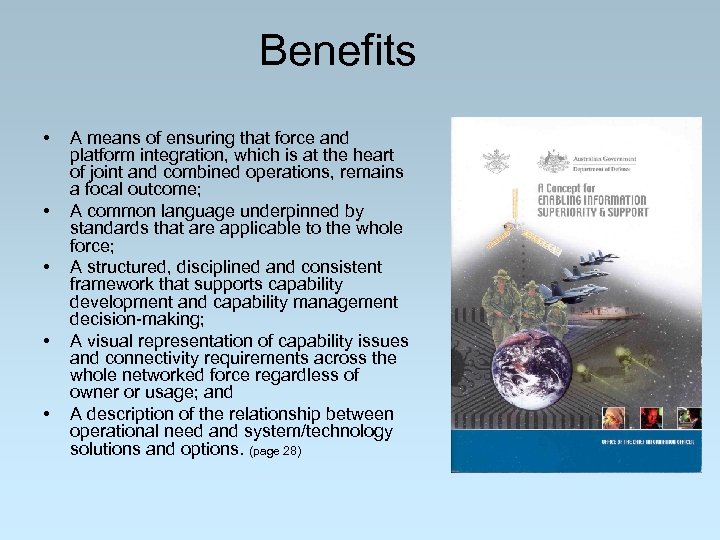
Benefits • • • A means of ensuring that force and platform integration, which is at the heart of joint and combined operations, remains a focal outcome; A common language underpinned by standards that are applicable to the whole force; A structured, disciplined and consistent framework that supports capability development and capability management decision-making; A visual representation of capability issues and connectivity requirements across the whole networked force regardless of owner or usage; and A description of the relationship between operational need and system/technology solutions and options. (page 28)
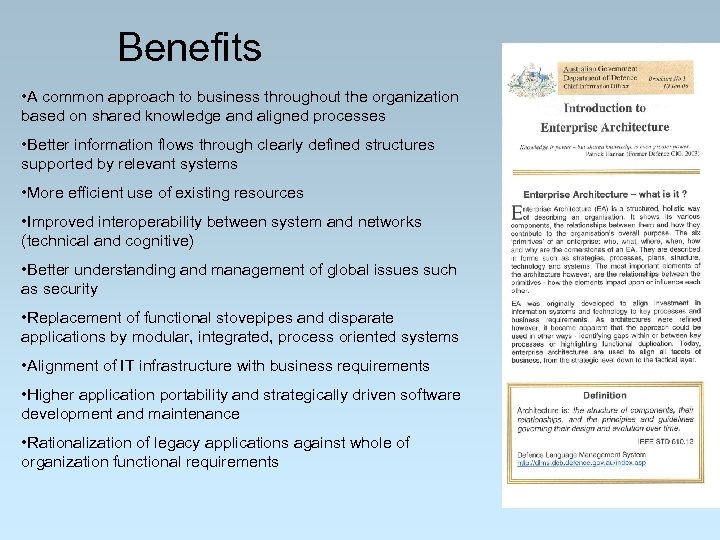
Benefits • A common approach to business throughout the organization based on shared knowledge and aligned processes • Better information flows through clearly defined structures supported by relevant systems • More efficient use of existing resources • Improved interoperability between system and networks (technical and cognitive) • Better understanding and management of global issues such as security • Replacement of functional stovepipes and disparate applications by modular, integrated, process oriented systems • Alignment of IT infrastructure with business requirements • Higher application portability and strategically driven software development and maintenance • Rationalization of legacy applications against whole of organization functional requirements
Justification for the Case Study • Improving logistics systems should not only increase combat power in the field but also save money. The Defence logistics system is one of Australia's largest and most complex. The cost to Defence of supporting this logistic supply chain is about $2. 5 b each year (Price Waterhouse Coopers, Department of Defence Support Command Australia Supply Chain Management Project Incorporating Scoping of Upgrade of SDSS, Appendix F-3, 08/06/2000), which is some 10% of Defence's budget. • Improved information will ensure that the cost of the logistic system is minimised by allowing Defence managers to review optimal inventory holdings and automate some reporting and management processes. • Defence has investments in assets of approximately $48 b. In comparison, asset rich companies such as Rio Tinto have some $38 b in assets with BHP Billiton having approximately $53 b (A Study of Defence Enterprise Architecture, By Allan Blackberry, B. Management, Grad Dip App. Fin (SIA), ASIA)
NCW Roadmap – 2005, (page 8) Force Generation and Sustainment in 2020 Key logistic function networks within the National Support Area (NSA) are linked with those in theatre, and provide connectivity and a collaborative ability with industry and coalition partners. • Commanders have an end-to-end visibility of the logistic system providing the ability to rapidly and effectively prioritise scarce resources required to generate and sustain deployed force elements. • Automated ordering and replenishment takes place as supplies and ordnance are consumed by platforms and field units. • The deployed force has minimised its vulnerabilities and greatly enhanced its mobility through more effective reach back, optimum force presence and the precision sustainment for the majority of logistic requirements. The target states outlined are necessarily broad in nature. While they outline the ADF’s desired NCW end state, they do not dictate how this will be achieved. D. HURLEY, AO, DSC, Lieutenant General, Chief Capability Development Group
Typical Sequence Architecture Purpose CV-2 You need to know these things before you start Products Integrated Dictionary Users & Decision Needs Required & Scope CV-1 Overview & Summary OV-1 High Level Concept Graphic (ie textual Description) (ie context diagram) Common & Operational Views Do these things first OV-4 Command Rel Chart (ie Org’s & Roles) OV-5’s Activity Models OV-2 Op Node Connectivity (ie op activities and input/outputs) (ie Grouped Op Activities and Info Exchanges) OV-6 Op Rules Model OV-7 Logical Data Model OV-3 Op Information Exchange Matrix (ie process flow) (ie ID logical data objects) Go to System & Technical Views
Typical Sequence Cont) Purpose, Decision Needs, Scope OV-2 Op Nodes OV-3 (ie op activity Groupings) Op Information Exchange Matrix SV-2 System Data Exchanges Matrix Op Activities to System Function traceability Matrix) OV-6(s) SV-3 Physical Data Model (ie ID logical data objects) (ie op activities and input/outputs) SV-5 Do these things next. TV-1 SV-4 Systems Functionality Descr SV-11 Logical Data Model Activity Models System Interface Descr System To System Matrix OV-7 OV-5’s SV-1 System Comms Descr SV-6 Common & Operational Views System & Technical Views Technical Arch Profile (ie standards, policy, doctrine etc) SV-10(s) System Rules, Sequences SV-7 Sys Performance Parameters TV-2 Standards Technology Forecast SV-8 Sys Evolution Descr (ie roadmap) SV-9 System Technology Forecast CV-2 Integrated Dictionary
Discussion Point • Challenges in using EA in Defence
The Data View Overview • The Data view compared with the process view • Transition from lists, data dictionaries and glossaries to Entity Relationship (ER) diagrams (ERD) • Why use databases?
Modelling Activities records the Processes and the Data used • Processes and Activities can change quite frequently, but the data they use changes less often • OV-5 diagrams – Record Processes which act upon or transform data – Record the data required for, and produced by, each process • OV-2 and OV-3 Identify major Data Stores, Repositories and Flows • Together they model the work flow of the organisation • What they do not show, is the relationships within the data shown on the OV-7 and SV-11
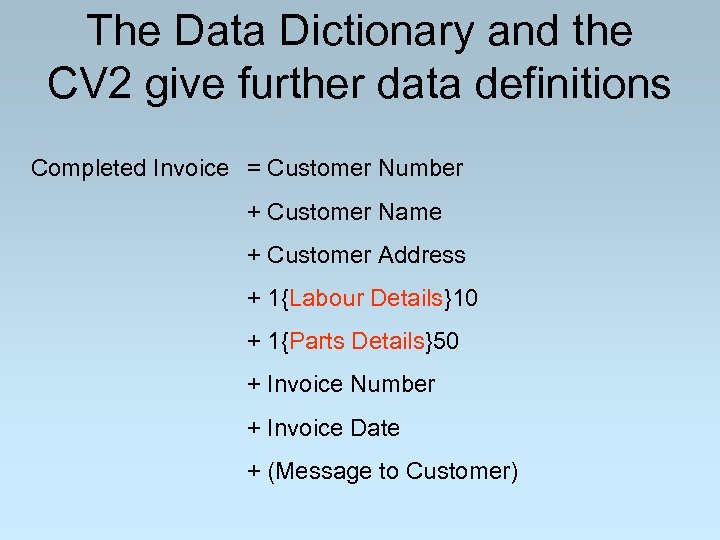
The Data Dictionary and the CV 2 give further data definitions Completed Invoice = Customer Number + Customer Name + Customer Address + 1{Labour Details}10 + 1{Parts Details}50 + Invoice Number + Invoice Date + (Message to Customer)
Entity Relationship Modelling • The E-R model is a Conceptual Model with a high degree of abstraction. • It models the Data in a system, and the Relationships that exist between the data. • Systems Architect will convert E-R models to OV 7 Logical Data Model and SV 11 Physical Data Model • It is essential to Database Design, because it yields the Conceptual Schema which is the database blueprint. • Systems Architect will also generate the Schema (SQL) for a number of prominent suppliers of Database software
So why use Databases? • Historically, Data often existed in independent files • Programs accessed data files directly leading to program/data dependence • Data often duplicated across many different files leading to inconsistency, confusion and difficulties of integration
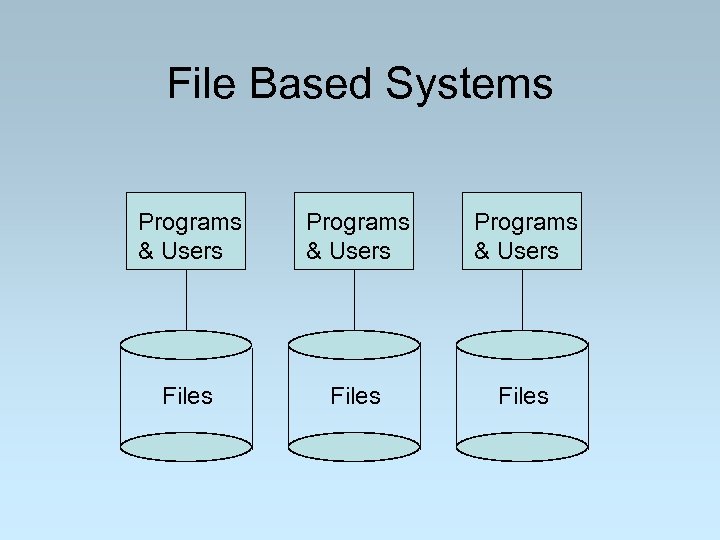
File Based Systems Programs & Users Files
Database Systems A database is, simplistically, a collection of files that contain related data l These related files are managed by a specialized piece of software known as a database management system (DBMS) l Users or application programs request the DBMS to retrieve/change/insert/delete it for them l
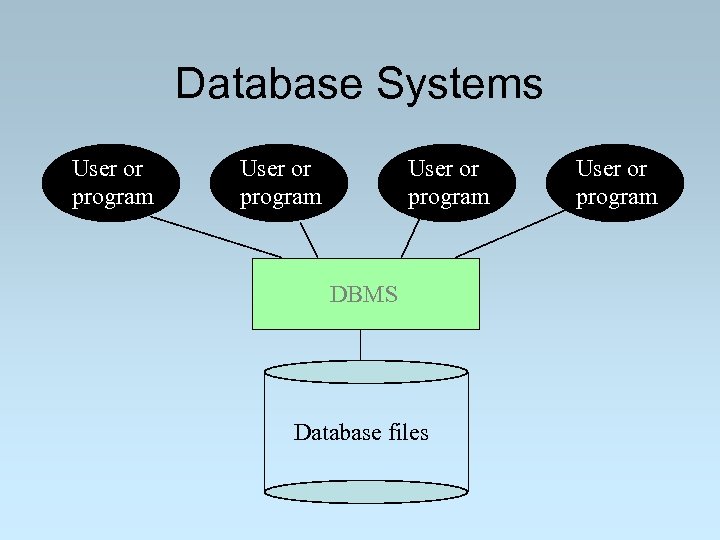
Database Systems User or program DBMS Database files User or program
Advantages of Database Systems • Users and application programs need not know exactly where or how the data is stored in order to access it - program/data independence • Proper database design can reduce or eliminate data redundancy and confusion • Better security facilities are generally offered
Advantages of Database Systems • Support for unforeseen (ad hoc) information requests are better supported better flexibility • Data can be more effectively shared between users and/or application programs • Data can be stored for long term analysis (data warehousing, data mining)
Database Technologies • There are four major database technologies or “models” – Hierarchical – Network – Relational – Object-oriented • Of these, hierarchical is mostly out-dated and network technologies are yet to deliver their promised flexibility
The Relational Model • Doesn’t have hidden pointers to connect entities - just uses data • Any entity can be connected to any other entity by using data • Is therefore VERY flexible • Data is organised into Tables, which can be accessed in any sorted order • ER diagrams can be “easily” converted into the relational model (in fact Systems Architect will convert them to OV-7 and SV-11 at the click of a button!)
Database Design • To reap the potential benefits offered by database technology, databases must be properly designed • Effort spent in design is always rewarded in data quality • There are different (though complementary) approaches to achieving a good design
Approaches to Database Design • Entity-Relationship (ER) data modelling – A graphical technique for understanding and organizing the data independently of the eventual database implementation • Normalization – An algorithmic process for evaluating the quality of a database design - most applicable to relational database designs
Entity-Relationship Models • Entity-Relationship models are conceptual models • That is, they are hardware & DBMS independent • They represent the semantics (i. e. meaning) of the data to be stored in the database • There are different notations; we will look at two
Entity-Relationship Basics: • The concepts upon which ER models are built are: – Entities (or, more correctly, entity sets) – Relationships (between entities) – Attributes (of entities and relationships)
Скачать презентацию Diploma of Government Enterprise Architecture Block 02 Making
9fd3c82e2c31713e662629c1e1f0520f.ppt