 Скачать презентацию diode bridge Electronics Overview Basic Circuits Power Supplies
accd79762ac4c5d77539e1abeb5cfb64.ppt
- Количество слайдов: 36



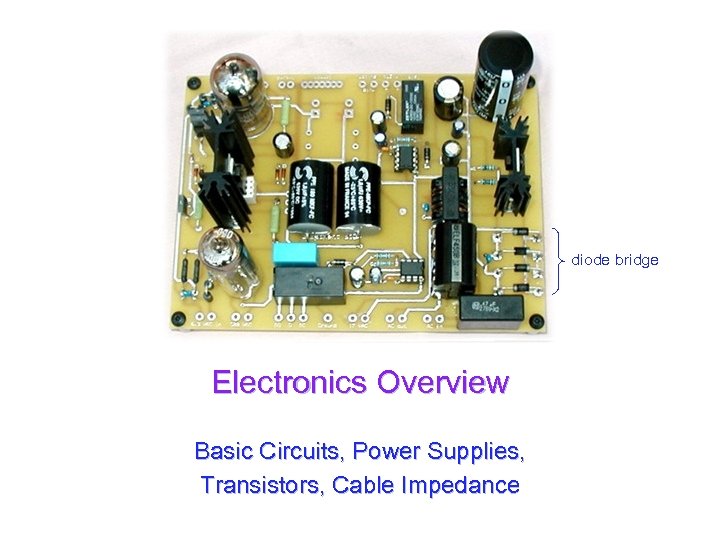
diode bridge Electronics Overview Basic Circuits, Power Supplies, Transistors, Cable Impedance
UCSD: Physics 121; 2012 Basic Circuit Analysis • What we won’t do: – common electronics-class things: RLC, filters, detailed analysis • What we will do: – set out basic relations – look at a few examples of fundamental importance (mostly resistive circuits) – look at diodes, voltage regulation, transistors – discuss impedances (cable, output, etc. ) Winter 2012 2
UCSD: Physics 121; 2012 The Basic Relations • V is voltage (volts: V); I is current (amps: A); R is resistance (ohms: ); C is capacitance (farads: F); L is inductance (henrys: H) • Ohm’s Law: V = IR; V = L(d. I/dt) • Power: P = IV = V 2/R = I 2 R • Resistors and inductors in series add • Capacitors in parallel add • Resistors and inductors in parallel, and capacitors in series add according to: Winter 2012 3
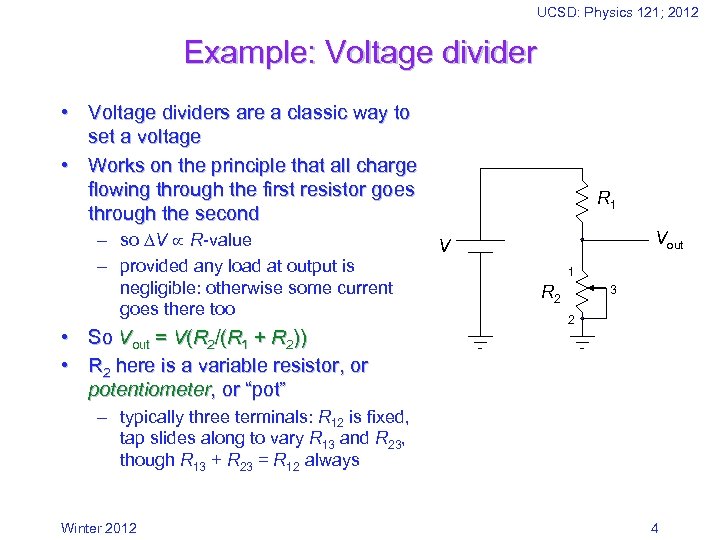
UCSD: Physics 121; 2012 Example: Voltage divider • Voltage dividers are a classic way to set a voltage • Works on the principle that all charge flowing through the first resistor goes through the second – so V R-value – provided any load at output is negligible: otherwise some current goes there too • So Vout = V(R 2/(R 1 + R 2)) • R 2 here is a variable resistor, or potentiometer, or “pot” R 1 Vout V 1 R 2 3 2 – typically three terminals: R 12 is fixed, tap slides along to vary R 13 and R 23, though R 13 + R 23 = R 12 always Winter 2012 4
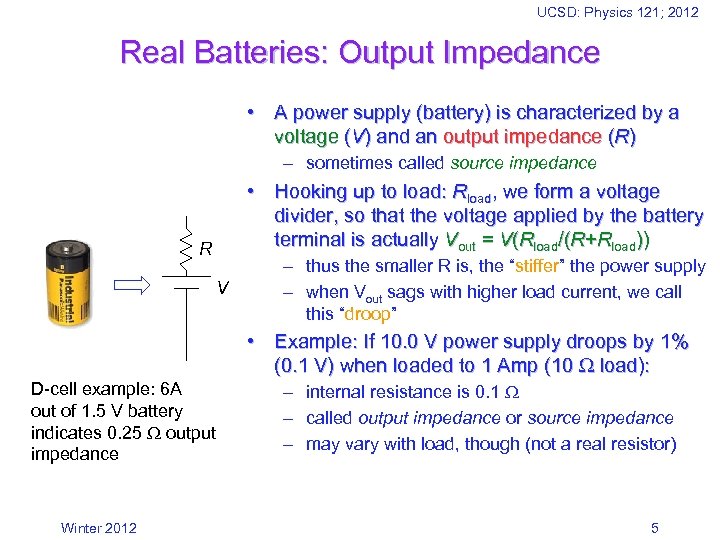
UCSD: Physics 121; 2012 Real Batteries: Output Impedance • A power supply (battery) is characterized by a voltage (V) and an output impedance (R) – sometimes called source impedance • Hooking up to load: Rload, we form a voltage divider, so that the voltage applied by the battery terminal is actually Vout = V(Rload/(R+Rload)) R V – thus the smaller R is, the “stiffer” the power supply – when Vout sags with higher load current, we call this “droop” • Example: If 10. 0 V power supply droops by 1% (0. 1 V) when loaded to 1 Amp (10 load): D-cell example: 6 A out of 1. 5 V battery indicates 0. 25 output impedance Winter 2012 – internal resistance is 0. 1 – called output impedance or source impedance – may vary with load, though (not a real resistor) 5
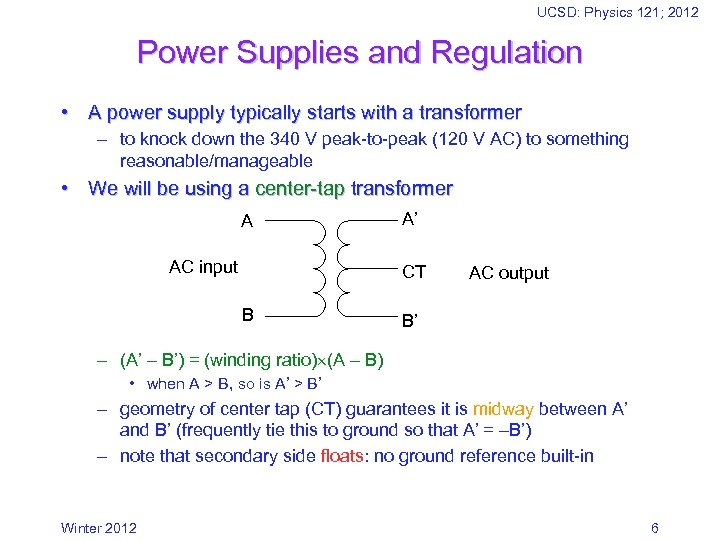
UCSD: Physics 121; 2012 Power Supplies and Regulation • A power supply typically starts with a transformer – to knock down the 340 V peak-to-peak (120 V AC) to something reasonable/manageable • We will be using a center-tap transformer A AC input A’ CT B AC output B’ – (A’ B’) = (winding ratio) (A B) • when A > B, so is A’ > B’ – geometry of center tap (CT) guarantees it is midway between A’ and B’ (frequently tie this to ground so that A’ = B’) – note that secondary side floats: no ground reference built-in Winter 2012 6
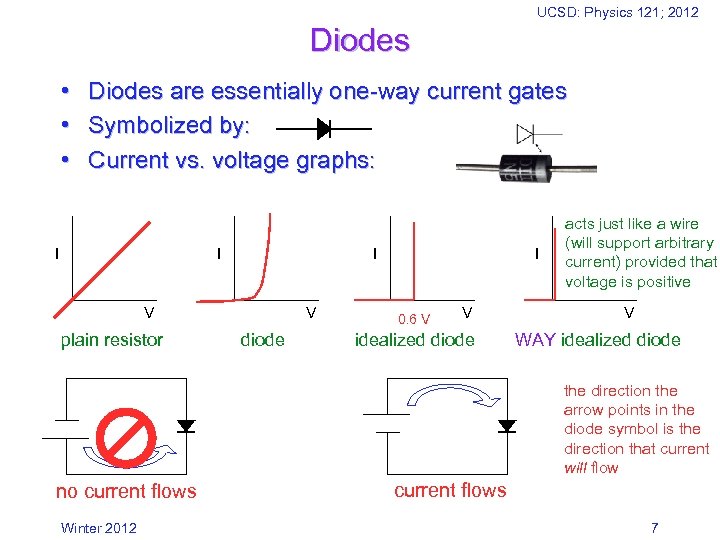
UCSD: Physics 121; 2012 Diodes • Diodes are essentially one-way current gates • Symbolized by: • Current vs. voltage graphs: I I I V plain resistor V diode I 0. 6 V V idealized diode acts just like a wire (will support arbitrary current) provided that voltage is positive V WAY idealized diode the direction the arrow points in the diode symbol is the direction that current will flow no current flows Winter 2012 current flows 7
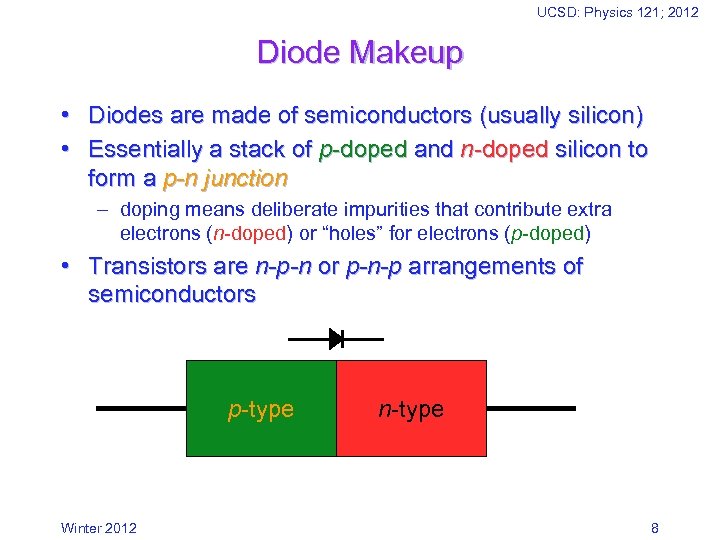
UCSD: Physics 121; 2012 Diode Makeup • Diodes are made of semiconductors (usually silicon) • Essentially a stack of p-doped and n-doped silicon to form a p-n junction – doping means deliberate impurities that contribute extra electrons (n-doped) or “holes” for electrons (p-doped) • Transistors are n-p-n or p-n-p arrangements of semiconductors p-type Winter 2012 n-type 8
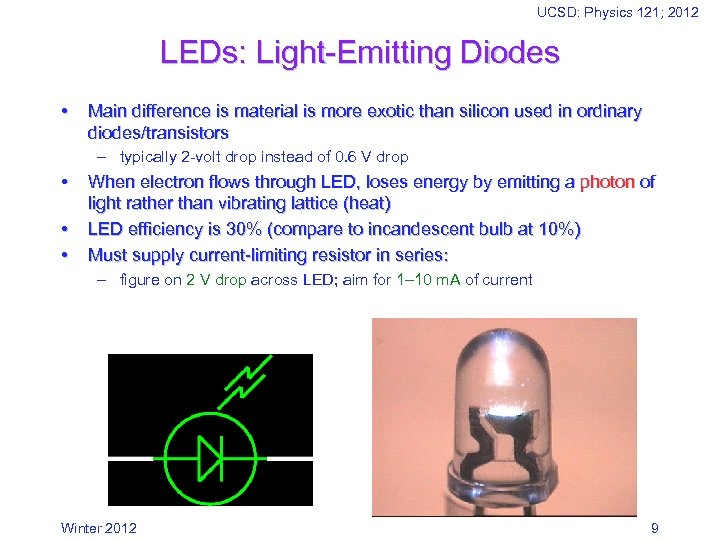
UCSD: Physics 121; 2012 LEDs: Light-Emitting Diodes • Main difference is material is more exotic than silicon used in ordinary diodes/transistors – typically 2 -volt drop instead of 0. 6 V drop • • • When electron flows through LED, loses energy by emitting a photon of light rather than vibrating lattice (heat) LED efficiency is 30% (compare to incandescent bulb at 10%) Must supply current-limiting resistor in series: – figure on 2 V drop across LED; aim for 1– 10 m. A of current Winter 2012 9
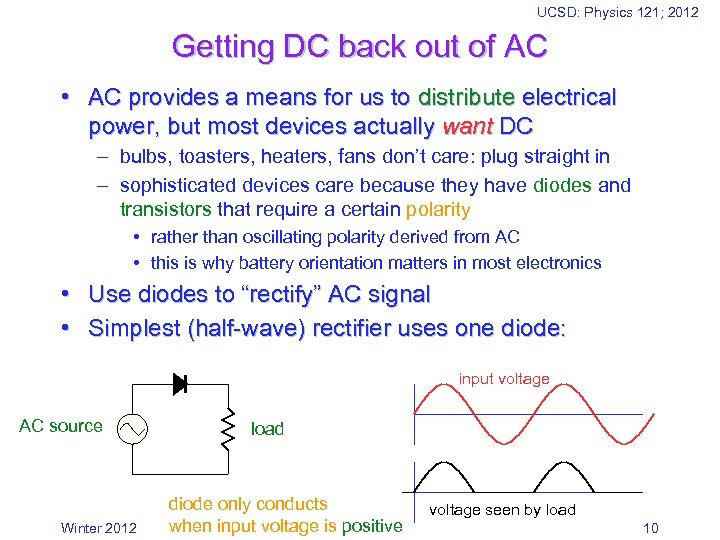
UCSD: Physics 121; 2012 Getting DC back out of AC • AC provides a means for us to distribute electrical power, but most devices actually want DC – bulbs, toasters, heaters, fans don’t care: plug straight in – sophisticated devices care because they have diodes and transistors that require a certain polarity • rather than oscillating polarity derived from AC • this is why battery orientation matters in most electronics • Use diodes to “rectify” AC signal • Simplest (half-wave) rectifier uses one diode: input voltage AC source Winter 2012 load diode only conducts when input voltage is positive voltage seen by load 10
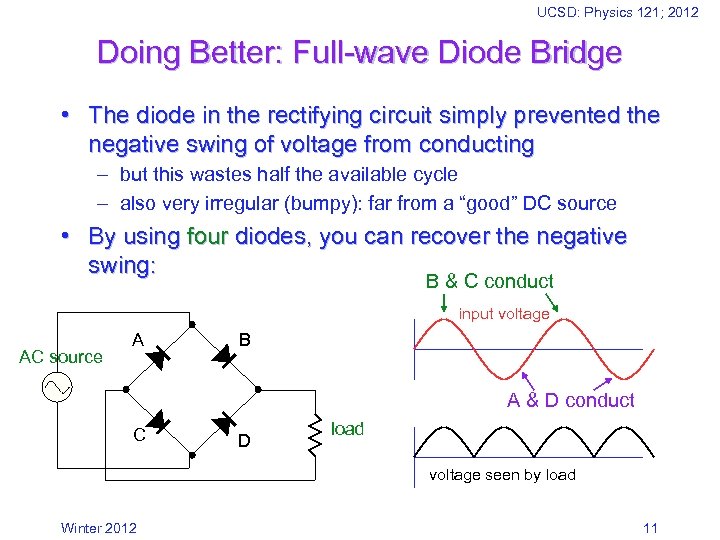
UCSD: Physics 121; 2012 Doing Better: Full-wave Diode Bridge • The diode in the rectifying circuit simply prevented the negative swing of voltage from conducting – but this wastes half the available cycle – also very irregular (bumpy): far from a “good” DC source • By using four diodes, you can recover the negative swing: B & C conduct input voltage AC source A B A & D conduct C D load voltage seen by load Winter 2012 11
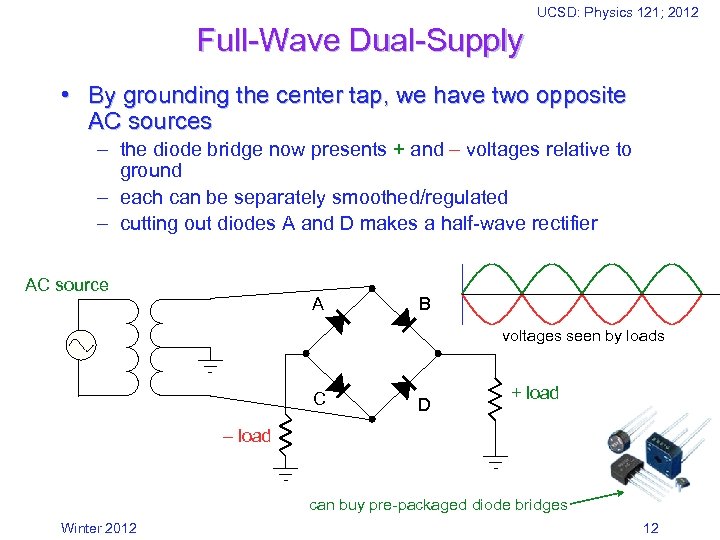
UCSD: Physics 121; 2012 Full-Wave Dual-Supply • By grounding the center tap, we have two opposite AC sources – the diode bridge now presents + and voltages relative to ground – each can be separately smoothed/regulated – cutting out diodes A and D makes a half-wave rectifier AC source A B voltages seen by loads C D + load can buy pre-packaged diode bridges Winter 2012 12
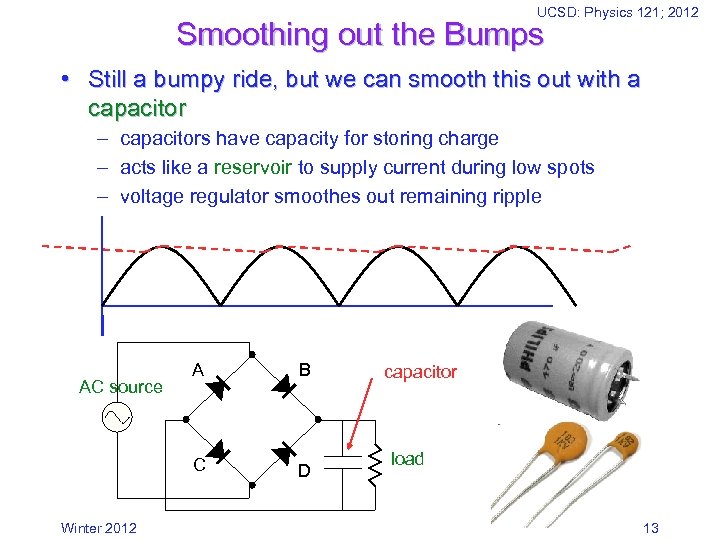
UCSD: Physics 121; 2012 Smoothing out the Bumps • Still a bumpy ride, but we can smooth this out with a capacitor – capacitors have capacity for storing charge – acts like a reservoir to supply current during low spots – voltage regulator smoothes out remaining ripple Winter 2012 B C AC source A D capacitor load 13
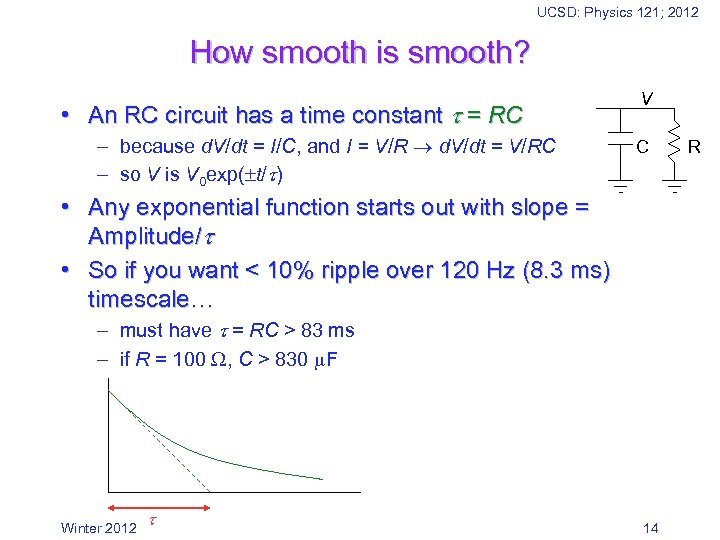
UCSD: Physics 121; 2012 How smooth is smooth? • An RC circuit has a time constant = RC – because d. V/dt = I/C, and I = V/R d. V/dt = V/RC – so V is V 0 exp( t/ ) V C • Any exponential function starts out with slope = Amplitude/ • So if you want < 10% ripple over 120 Hz (8. 3 ms) timescale… – must have = RC > 83 ms – if R = 100 , C > 830 F Winter 2012 14 R
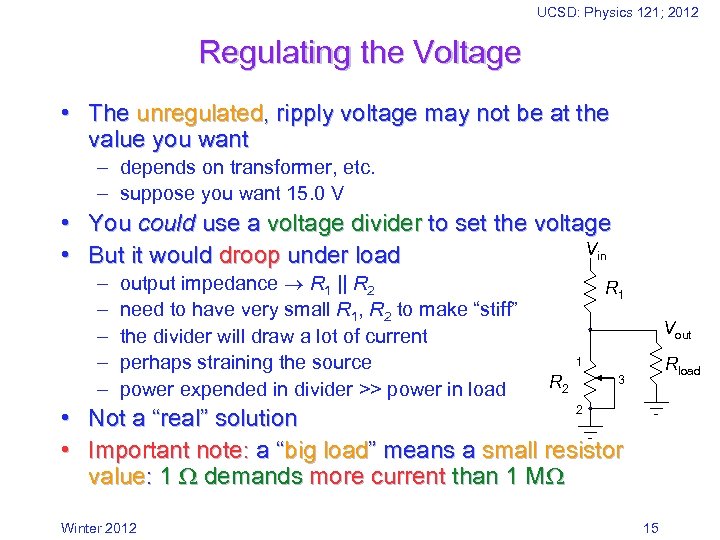
UCSD: Physics 121; 2012 Regulating the Voltage • The unregulated, ripply voltage may not be at the value you want – depends on transformer, etc. – suppose you want 15. 0 V • You could use a voltage divider to set the voltage Vin • But it would droop under load – – – output impedance R 1 || R 2 need to have very small R 1, R 2 to make “stiff” the divider will draw a lot of current perhaps straining the source power expended in divider >> power in load R 1 Vout Rload 1 R 2 3 2 • Not a “real” solution • Important note: a “big load” means a small resistor value: 1 demands more current than 1 M Winter 2012 15
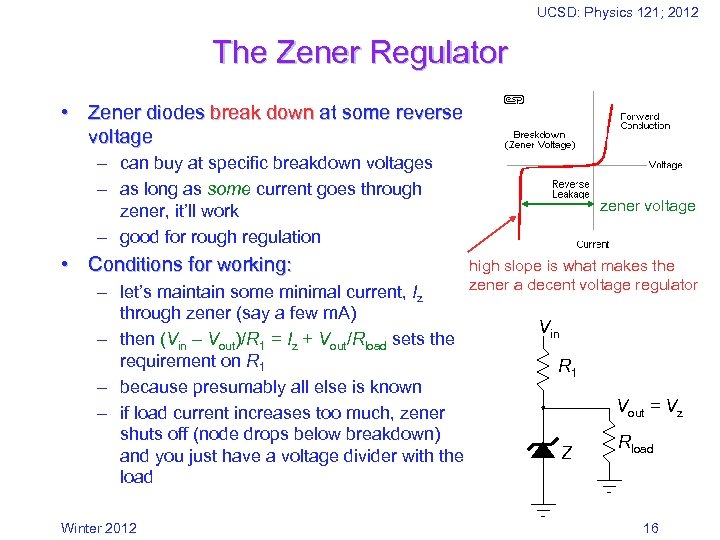
UCSD: Physics 121; 2012 The Zener Regulator • Zener diodes break down at some reverse voltage – can buy at specific breakdown voltages – as long as some current goes through zener, it’ll work – good for rough regulation • Conditions for working: – let’s maintain some minimal current, Iz through zener (say a few m. A) – then (Vin Vout)/R 1 = Iz + Vout/Rload sets the requirement on R 1 – because presumably all else is known – if load current increases too much, zener shuts off (node drops below breakdown) and you just have a voltage divider with the load Winter 2012 zener voltage high slope is what makes the zener a decent voltage regulator Vin R 1 Vout = Vz Z Rload 16
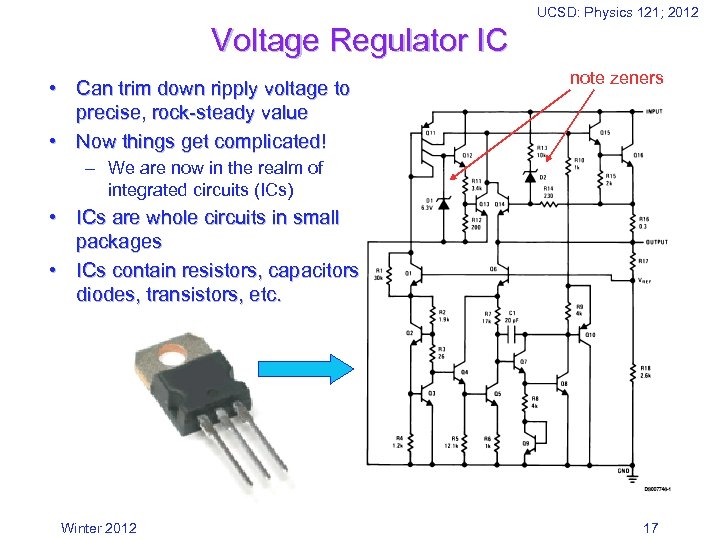
UCSD: Physics 121; 2012 Voltage Regulator IC • Can trim down ripply voltage to precise, rock-steady value • Now things get complicated! note zeners – We are now in the realm of integrated circuits (ICs) • ICs are whole circuits in small packages • ICs contain resistors, capacitors, diodes, transistors, etc. Winter 2012 17
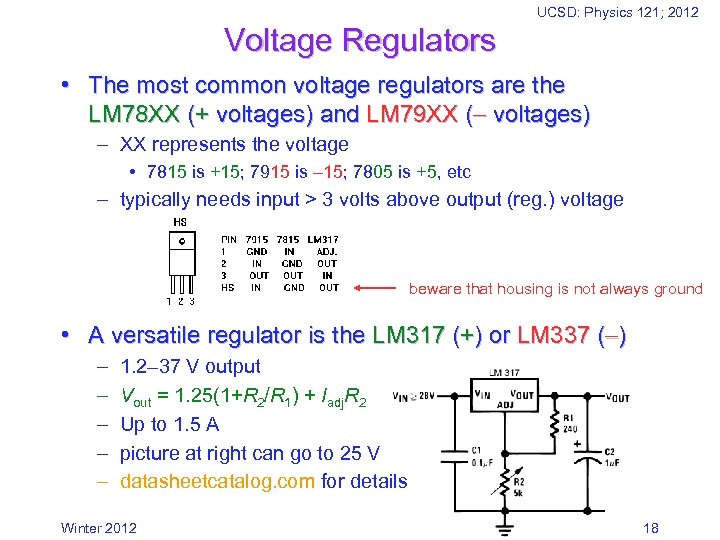
UCSD: Physics 121; 2012 Voltage Regulators • The most common voltage regulators are the LM 78 XX (+ voltages) and LM 79 XX ( voltages) – XX represents the voltage • 7815 is +15; 7915 is 15; 7805 is +5, etc – typically needs input > 3 volts above output (reg. ) voltage beware that housing is not always ground • A versatile regulator is the LM 317 (+) or LM 337 ( ) – – – 1. 2– 37 V output Vout = 1. 25(1+R 2/R 1) + Iadj. R 2 Up to 1. 5 A picture at right can go to 25 V datasheetcatalog. com for details Winter 2012 18
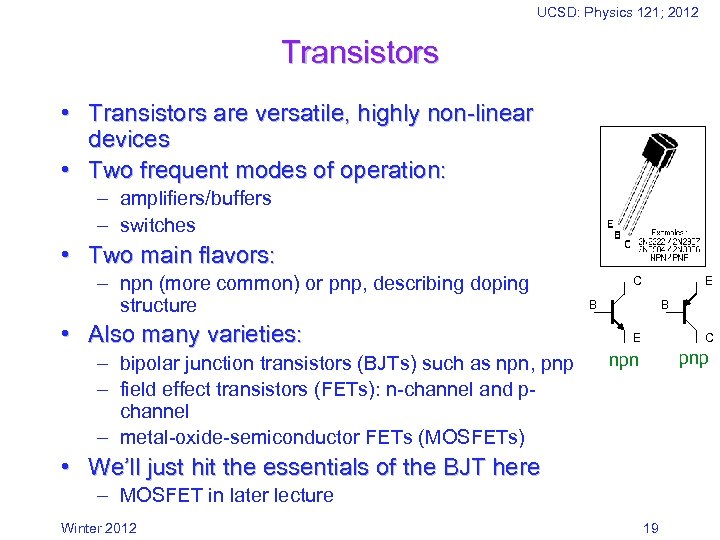
UCSD: Physics 121; 2012 Transistors • Transistors are versatile, highly non-linear devices • Two frequent modes of operation: – amplifiers/buffers – switches • Two main flavors: – npn (more common) or pnp, describing doping structure • Also many varieties: – bipolar junction transistors (BJTs) such as npn, pnp – field effect transistors (FETs): n-channel and pchannel – metal-oxide-semiconductor FETs (MOSFETs) C E B B E C pnp npn • We’ll just hit the essentials of the BJT here – MOSFET in later lecture Winter 2012 19
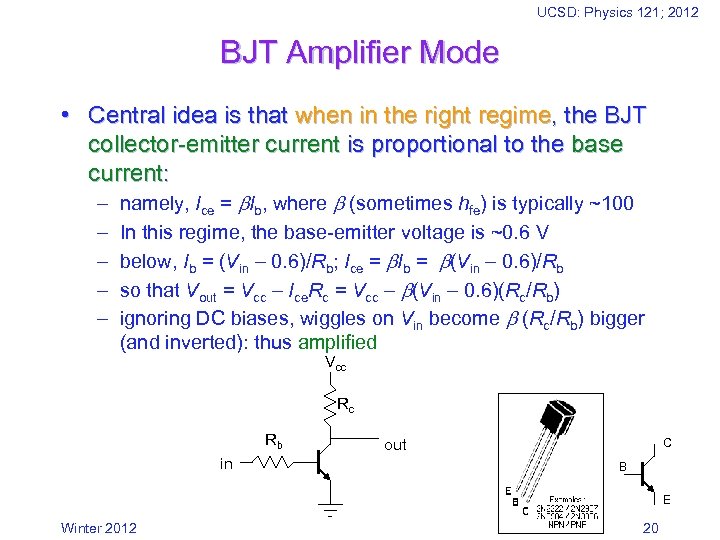
UCSD: Physics 121; 2012 BJT Amplifier Mode • Central idea is that when in the right regime, the BJT collector-emitter current is proportional to the base current: – – – namely, Ice = Ib, where (sometimes hfe) is typically ~100 In this regime, the base-emitter voltage is ~0. 6 V below, Ib = (Vin 0. 6)/Rb; Ice = Ib = (Vin 0. 6)/Rb so that Vout = Vcc Ice. Rc = Vcc (Vin 0. 6)(Rc/Rb) ignoring DC biases, wiggles on Vin become (Rc/Rb) bigger (and inverted): thus amplified Vcc Rc Rb in out C B E Winter 2012 20
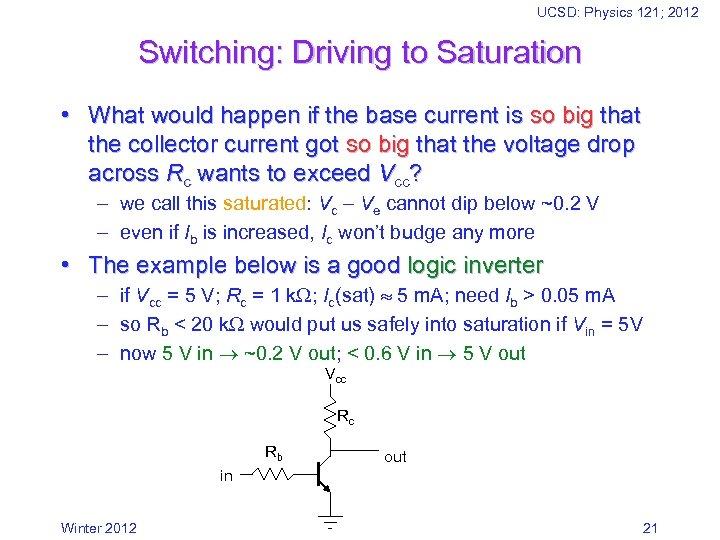
UCSD: Physics 121; 2012 Switching: Driving to Saturation • What would happen if the base current is so big that the collector current got so big that the voltage drop across Rc wants to exceed Vcc? – we call this saturated: Vc Ve cannot dip below ~0. 2 V – even if Ib is increased, Ic won’t budge any more • The example below is a good logic inverter – if Vcc = 5 V; Rc = 1 k ; Ic(sat) 5 m. A; need Ib > 0. 05 m. A – so Rb < 20 k would put us safely into saturation if Vin = 5 V – now 5 V in ~0. 2 V out; < 0. 6 V in 5 V out Vcc Rc Rb out in Winter 2012 21
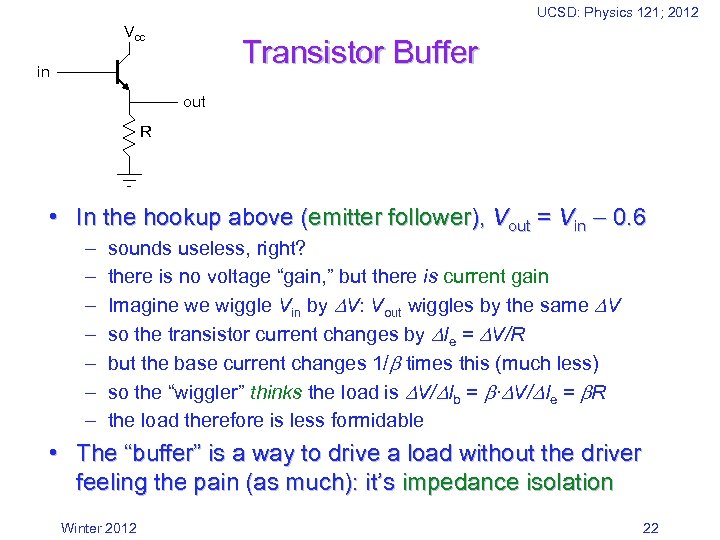
UCSD: Physics 121; 2012 Vcc Transistor Buffer in out R • In the hookup above (emitter follower), Vout = Vin 0. 6 – – – – sounds useless, right? there is no voltage “gain, ” but there is current gain Imagine we wiggle Vin by V: Vout wiggles by the same V so the transistor current changes by Ie = V/R but the base current changes 1/ times this (much less) so the “wiggler” thinks the load is V/ Ib = · V/ Ie = R the load therefore is less formidable • The “buffer” is a way to drive a load without the driver feeling the pain (as much): it’s impedance isolation Winter 2012 22
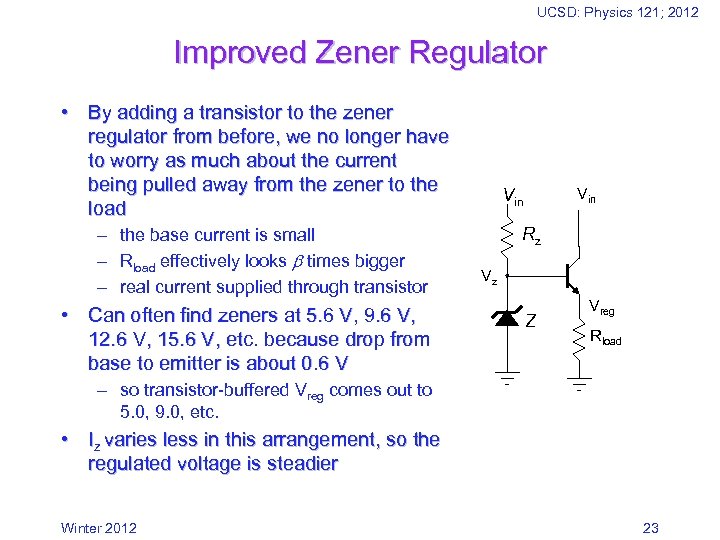
UCSD: Physics 121; 2012 Improved Zener Regulator • By adding a transistor to the zener regulator from before, we no longer have to worry as much about the current being pulled away from the zener to the load – the base current is small – Rload effectively looks times bigger – real current supplied through transistor • Can often find zeners at 5. 6 V, 9. 6 V, 12. 6 V, 15. 6 V, etc. because drop from base to emitter is about 0. 6 V Vin Rz Vz Z Vreg Rload – so transistor-buffered Vreg comes out to 5. 0, 9. 0, etc. • Iz varies less in this arrangement, so the regulated voltage is steadier Winter 2012 23
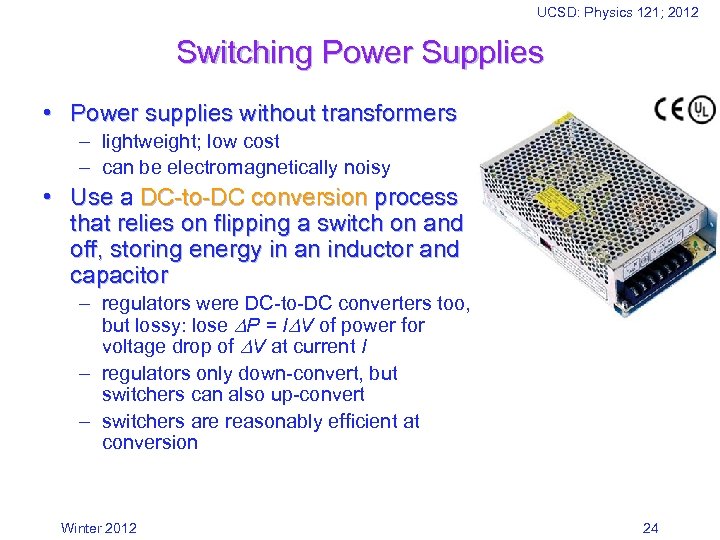
UCSD: Physics 121; 2012 Switching Power Supplies • Power supplies without transformers – lightweight; low cost – can be electromagnetically noisy • Use a DC-to-DC conversion process that relies on flipping a switch on and off, storing energy in an inductor and capacitor – regulators were DC-to-DC converters too, but lossy: lose P = I V of power for voltage drop of V at current I – regulators only down-convert, but switchers can also up-convert – switchers are reasonably efficient at conversion Winter 2012 24
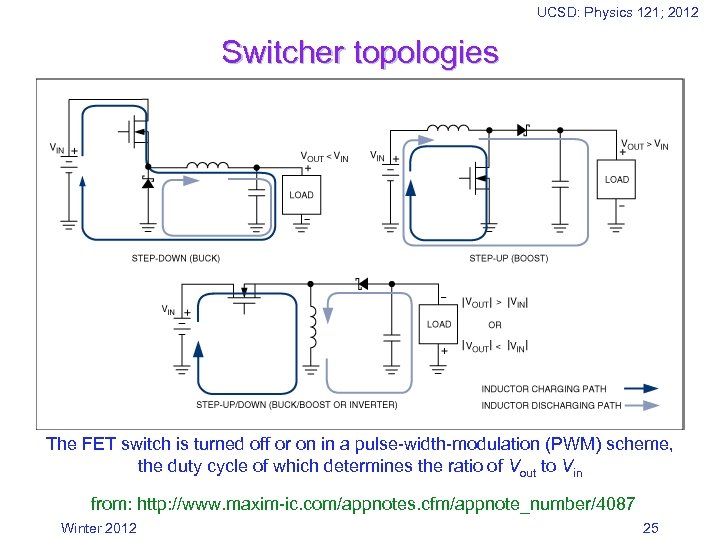
UCSD: Physics 121; 2012 Switcher topologies The FET switch is turned off or on in a pulse-width-modulation (PWM) scheme, the duty cycle of which determines the ratio of Vout to Vin from: http: //www. maxim-ic. com/appnotes. cfm/appnote_number/4087 Winter 2012 25
UCSD: Physics 121; 2012 Step-Down Calculations • If the FET is on for duty cycle, D (fraction of time on), and the period is T: – the average output voltage is Vout = DVin – the average current through the capacitor is zero, the average current through the load (and inductor) is 1/D times the input current – under these idealizations, power in = power out Winter 2012 26
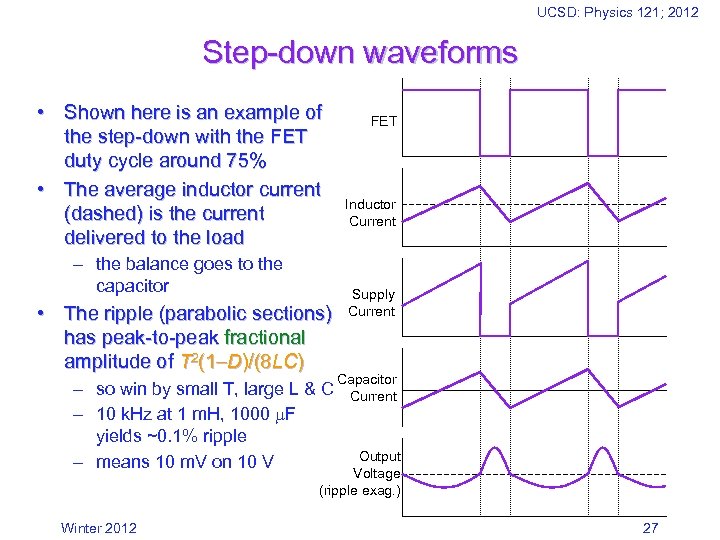
UCSD: Physics 121; 2012 Step-down waveforms • Shown here is an example of the step-down with the FET duty cycle around 75% • The average inductor current (dashed) is the current delivered to the load – the balance goes to the capacitor • The ripple (parabolic sections) has peak-to-peak fractional amplitude of T 2(1 D)/(8 LC) – so win by small T, large L & C – 10 k. Hz at 1 m. H, 1000 F yields ~0. 1% ripple – means 10 m. V on 10 V FET Inductor Current Supply Current Capacitor Current Output Voltage (ripple exag. ) Winter 2012 27
UCSD: Physics 121; 2012 Cable Impedances • RG 58 cable is characterized as 50 cable – RG 59 is 75 – some antenna cable is 300 • Isn’t the cable nearly zero resistance? And shouldn’t the length come into play, somehow? • There is a distinction between resistance and impedance – though same units • Impedances can be real, imaginary, or complex – resistors are real: Z = R – capacitors and inductors are imaginary: Z = i/ C; Z = i L – mixtures are complex: Z = R i/ C + i L Winter 2012 28
UCSD: Physics 121; 2012 Impedances, cont. • Note that: – – – capacitors become less “resistive” at high frequency inductors become more “resistive” at high frequency bigger capacitors are more transparent bigger inductors are less transparent i (√ 1) indicates 90 phase shift between voltage and current • after all, V = IZ, so Z = V/I • thus if V is sine wave, I is cosine for inductor/capacitor • and given that one is derivative, one is integral, this makes sense (slide # 3) – adding impedances automatically takes care of summation rules: add Z in series • capacitance adds as inverse, resistors, inductors straight-up Winter 2012 29
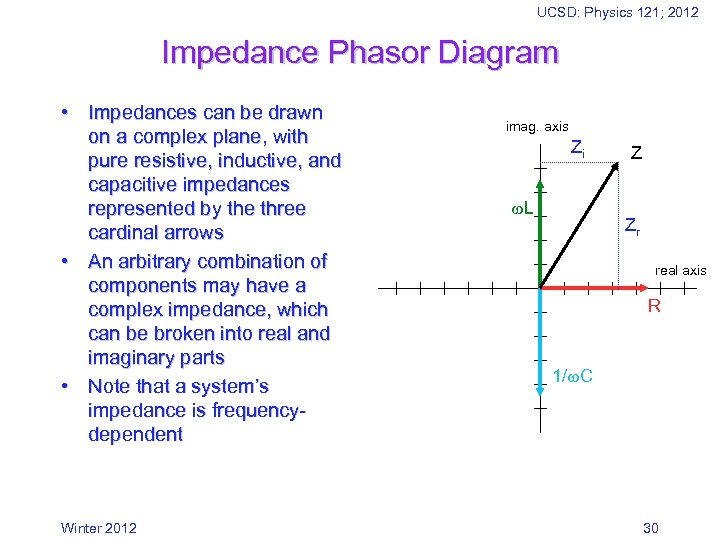
UCSD: Physics 121; 2012 Impedance Phasor Diagram • Impedances can be drawn on a complex plane, with pure resistive, inductive, and capacitive impedances represented by the three cardinal arrows • An arbitrary combination of components may have a complex impedance, which can be broken into real and imaginary parts • Note that a system’s impedance is frequencydependent Winter 2012 imag. axis Zi L Z Zr real axis R 1/ C 30
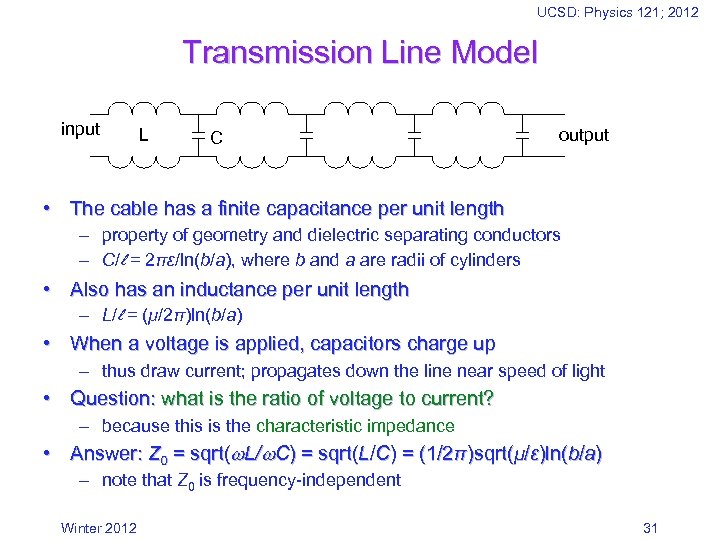
UCSD: Physics 121; 2012 Transmission Line Model input L C output • The cable has a finite capacitance per unit length – property of geometry and dielectric separating conductors – C/l = 2πε/ln(b/a), where b and a are radii of cylinders • Also has an inductance per unit length – L/l = (μ/2π)ln(b/a) • When a voltage is applied, capacitors charge up – thus draw current; propagates down the line near speed of light • Question: what is the ratio of voltage to current? – because this is the characteristic impedance • Answer: Z 0 = sqrt( L/ C) = sqrt(L/C) = (1/2π)sqrt(μ/ε)ln(b/a) – note that Z 0 is frequency-independent Winter 2012 31
UCSD: Physics 121; 2012 Typical Transmission Lines • RG 58 coax is abundant – 30 p. F per foot; 75 n. H per foot; 50 ; v = 0. 695 c; ~5 ns/m • RG 174 is the thin version – same parameters as above, but scaled-down geometry • RG 59 – used for video, cable TV – 21 p. F/ft; 118 n. H per foot; 75 ; v = 0. 695 c; ~5 ns/m • twisted pair – 110 at 30 turns/ft, AWG 24– 28 • PCB (PC-board) trace – get 50 if the trace width is 1. 84 times the separation from the ground plane (assuming fiberglass PCB with = 4. 5) Winter 2012 32
UCSD: Physics 121; 2012 Why impedance matters • For fast signals, get bounces (reflections) at every impedance mismatch – reflection amplitude is (Zt Zs)/(Zt + Zs) • s and t subscripts represent source and termination impedances • sources intending to drive a Z 0 cable have Zs = Z 0 • Consider a long cable shorted at end: insert pulse – driving electronics can’t know about the termination immediately: must charge up cable as the pulse propagates forward, looking like Z 0 of the cable at first – surprise at far end: it’s a short! retreat! – in effect, negative pulse propagates back, nulling out capacitors (reflection is 1) – one round-trip later (10 ns per meter, typically), the driving electronics feels the pain of the short Winter 2012 33
UCSD: Physics 121; 2012 Impedance matters, continued • Now other extreme: cable un-terminated: open – pulse travels merrily along at first, the driving electronics seeing a Z 0 cable load – at the end, the current has nowhere to go, but driver can’t know this yet, so keeps loading cable as if it’s still Z 0 – effectively, a positive pulse reflects back, double-charging capacitors (reflection is +1) – driver gets word of this one round-trip later (10 ns/m, typically), then must cease to deliver current (cable fully charged) • The goldilocks case (reflection = 0) – if the end of the cable is terminated with resistor with R = Z 0, then current is slurped up perfectly with no reflections – the driver is not being lied to, and hears no complaints Winter 2012 34
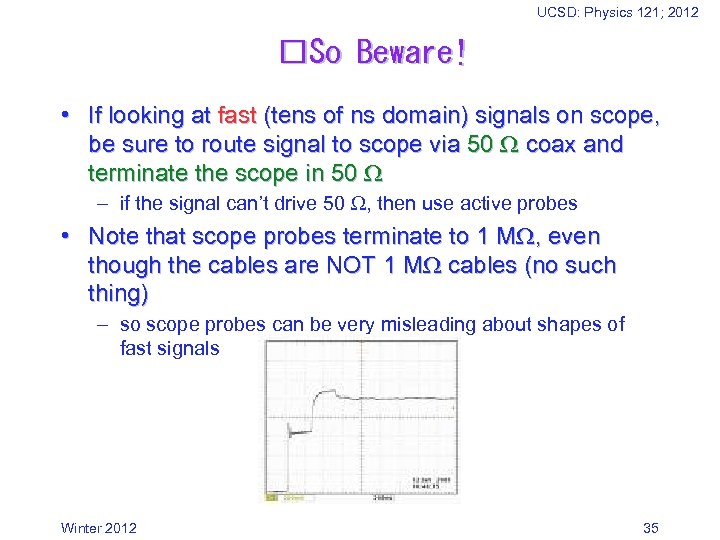
UCSD: Physics 121; 2012 So Beware! • If looking at fast (tens of ns domain) signals on scope, be sure to route signal to scope via 50 coax and terminate the scope in 50 – if the signal can’t drive 50 , then use active probes • Note that scope probes terminate to 1 M , even though the cables are NOT 1 M cables (no such thing) – so scope probes can be very misleading about shapes of fast signals Winter 2012 35
UCSD: Physics 121; 2012 References and Assignment • References: – The canonical electronics reference is Horowitz and Hill: The Art of Electronics – Also the accompanying lab manual by Hayes and Horowitz is highly valuable (far more practically-oriented) – And of course: Electronics for Dogs (just ask Gromit) • Reading – – Sections 6. 1. 1, 6. 1. 2 Skim 6. 2. 2, 6. 2. 3, 6. 2. 4 Sections 6. 3. 1, 6. 5. 2 Skim 6. 3. 2 Winter 2012 36
Скачать презентацию diode bridge Electronics Overview Basic Circuits Power Supplies
accd79762ac4c5d77539e1abeb5cfb64.ppt