


 Скачать презентацию Digital thermographic imaging a novel monitoring approach
e54ea23c7487df6ef3a51696558afe1f.ppt
- Количество слайдов: 1
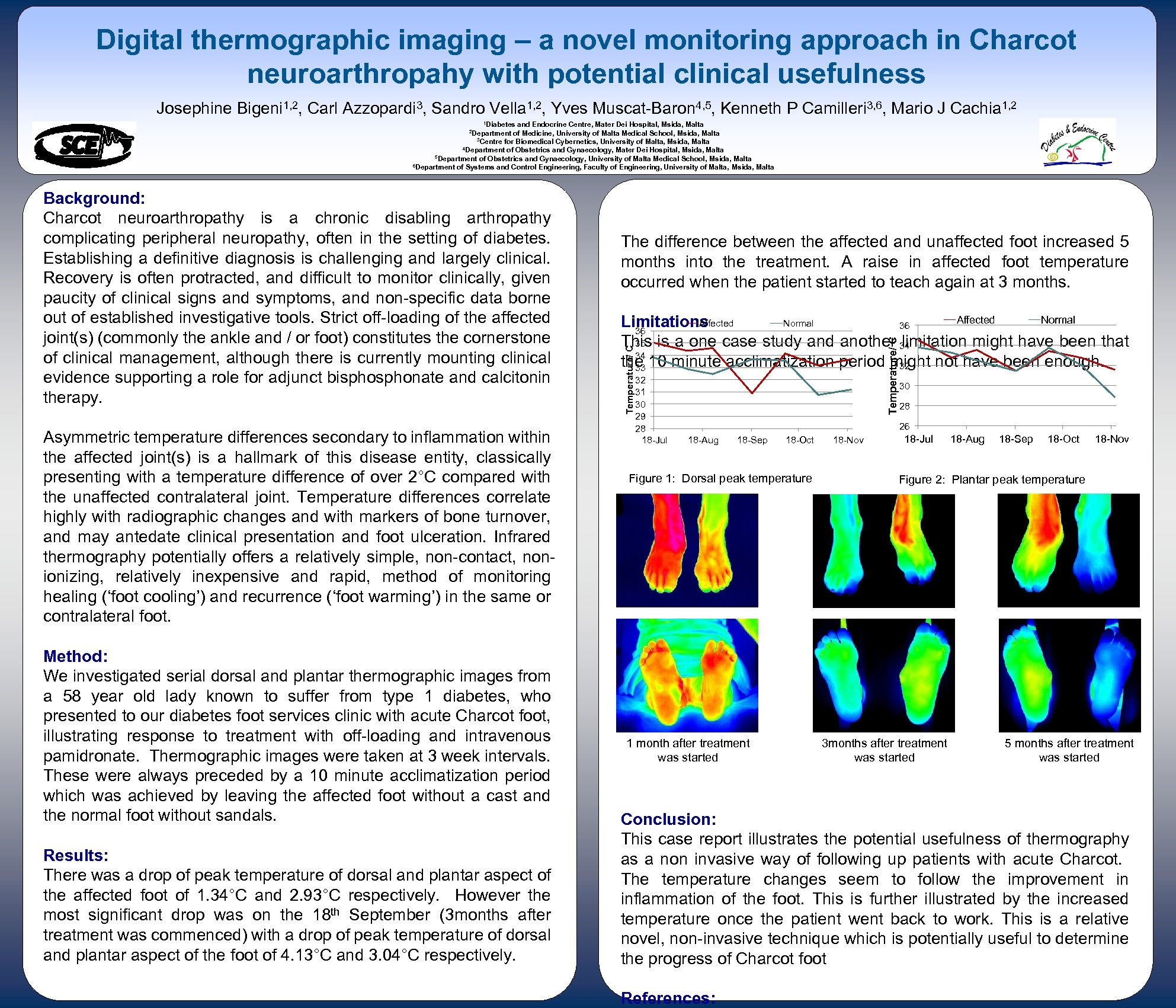 Digital thermographic imaging – a novel monitoring approach in Charcot neuroarthropahy with potential clinical usefulness Josephine Bigeni 1, 2, Carl Azzopardi 3, Sandro Vella 1, 2, Yves Muscat-Baron 4, 5, Kenneth P Camilleri 3, 6, Mario J Cachia 1, 2 1 Diabetes and Endocrine Centre, Mater Dei Hospital, Msida, Malta Asymmetric temperature differences secondary to inflammation within the affected joint(s) is a hallmark of this disease entity, classically presenting with a temperature difference of over 2°C compared with the unaffected contralateral joint. Temperature differences correlate highly with radiographic changes and with markers of bone turnover, and may antedate clinical presentation and foot ulceration. Infrared thermography potentially offers a relatively simple, non-contact, nonionizing, relatively inexpensive and rapid, method of monitoring healing (‘foot cooling’) and recurrence (‘foot warming’) in the same or contralateral foot. Method: We investigated serial dorsal and plantar thermographic images from a 58 year old lady known to suffer from type 1 diabetes, who presented to our diabetes foot services clinic with acute Charcot foot, illustrating response to treatment with off-loading and intravenous pamidronate. Thermographic images were taken at 3 week intervals. These were always preceded by a 10 minute acclimatization period which was achieved by leaving the affected foot without a cast and the normal foot without sandals. Results: There was a drop of peak temperature of dorsal and plantar aspect of the affected foot of 1. 34°C and 2. 93°C respectively. However the most significant drop was on the 18 th September (3 months after treatment was commenced) with a drop of peak temperature of dorsal and plantar aspect of the foot of 4. 13°C and 3. 04°C respectively. The difference between the affected and unaffected foot increased 5 months into the treatment. A raise in affected foot temperature occurred when the patient started to teach again at 3 months. Affected Normal Limitations 36 36 35 This is a one case study and another 34 limitation might have been that 34 the 10 minute acclimatization period might not have been enough. 32 33 32 31 30 29 28 18 -Jul Temperature/ C Background: Charcot neuroarthropathy is a chronic disabling arthropathy complicating peripheral neuropathy, often in the setting of diabetes. Establishing a definitive diagnosis is challenging and largely clinical. Recovery is often protracted, and difficult to monitor clinically, given paucity of clinical signs and symptoms, and non-specific data borne out of established investigative tools. Strict off-loading of the affected joint(s) (commonly the ankle and / or foot) constitutes the cornerstone of clinical management, although there is currently mounting clinical evidence supporting a role for adjunct bisphonate and calcitonin therapy. Temperature/ C • 2 Department of Medicine, University of Malta Medical School, Msida, Malta 3 Centre for Biomedical Cybernetics, University of Malta, Msida, Malta 4 Department of Obstetrics and Gynaecology, Mater Dei Hospital, Msida, Malta 5 Department of Obstetrics and Gynaecology, University of Malta Medical School, Msida, Malta 6 Department of Systems and Control Engineering, Faculty of Engineering, University of Malta, Msida, Malta 30 28 26 18 -Aug 18 -Sep 18 -Oct Figure 1: Dorsal peak temperature 1 month after treatment was started 18 -Nov 18 -Jul 18 -Aug 18 -Sep 18 -Oct 18 -Nov Figure 2: Plantar peak temperature 3 months after treatment was started 5 months after treatment was started Conclusion: This case report illustrates the potential usefulness of thermography as a non invasive way of following up patients with acute Charcot. The temperature changes seem to follow the improvement in inflammation of the foot. This is further illustrated by the increased temperature once the patient went back to work. This is a relative novel, non-invasive technique which is potentially useful to determine the progress of Charcot foot References: