


 Скачать презентацию Digital Sherpa Custom Grid Applications on the Tera
b056cb1d5fb6b1bb009ae9986d26ffb6.ppt
- Количество слайдов: 40
 Digital Sherpa: Custom Grid Applications on the Tera. Grid and Beyond GGF 18 / Grid. World 2006 Ronald C. Price, Victor E. Bazterra, Wayne Bradford, Julio C. Facelli Center for High Performance Computing at the University of Utah Partially funded by NSF ITR award #0326027
 First Things First HAPPY BIRTHDAY GLOBUS!!!
 Roles & Acknowledgments Ron: Grid Architect and Software Engineer Victor: Research Scientist & Grid Researcher, user of many HPC Resources Wayne: Grid Sys Admin Julio: Director Globus Mailing list and especially the Globus Alliance Entire Center for High Performance Computing University of Utah Staff
 Overview Problem & Solution – general problem – Solution – traditional approaches Past – sys admin caveats (briefly) – concepts and implementation Present – examples – applications Future – – applications features
 General Problem & Solution General Problem: – Many High Performance Computing (HPC) scientific projects require large number of loosely coupled executions in numerous HPC resources which can not be managed manually. Solution (Digital Sherpa): – Distribute the jobs of HPC scientific applications across a grid allowing access to more resources with automatic staging, jobs submission, monitoring, fault recovery and efficiency improvement.
 Traditional Approach: “babysitter” scripts are common but in general they have some problems: – not scalable (written to work with a specific scheduler) – Hard to maintain (typically a hack) – not portable (system specific)
 Digital Sherpa & Perspective A different perspective: – Schedulers: System Oriented Perspective Many jobs on one HPC resource, user doesn’t have control – Sherpa: User Oriented perspective Many jobs on many resource, user has control
 Digital Sherpa In General Digital Sherpa is a grid application for executing HPC applications across many grid enabled HPC resources. It automates non-scalable tasks such as staging, job submission and monitoring, including recovery features such as resubmission of failed jobs. The goal is to allow any HPC application to easily interoperate with Digital Sherpa to become a custom grid application. Distributing the jobs across HPC resources increases the amount of computer resources that can be accessed at a given time. Success using Digital Sherpa has been found on the Tera. Grid and there are many more applications of Digital Sherpa in progress.
 So, what is Digital Sherpa? Naming Convention for rest of Slides: Digital Sherpa = Sherpa is a multi threaded custom extension of the GT 4 WS-GRAM client. Sherpa has been designed and planned to be scalable, maintainable and used directly by people or other applications. It is based on Web Services Resource Framework (WSRF) and it is implemented in Java 1. 5 using the Globus Toolkit 4. 0 (GT 4). Sherpa has the ability to do a complete HPC submission (stage data in, run/monitor PBS job, stage data out and auto restart of failed jobs, improve efficiency)
 Why the name Sherpa? Digital Sherpa takes its name from “sherpa” who are known for their great mountaineering skills in the Himalayas, expert route finders and porters. – find the route for you (find an HPC resource for your needs, future feature ) – carry gear in for you (stage data in) – climb to the top (execute job and restart job if necessary) – and carry gear out for you (stage data out).
 Benefits and Significance Benefits: – Automation of login, data stage in and stage out, job submission, monitoring, and auto restart if the job fails, efficiency improvement – Distribute your jobs across various HPC resources to increase the amount of resources that can be used at a time. – Reduction of queue wait time by submitting jobs to several queues resulting in an increase of efficiency – Load balancing from increased granularity – Can be called from a separate application Significance: – Automates the flow of large number of jobs within grid environments – Increases throughput of HPC Scientific Applications
 Globus Toolkit 4 The Globus Toolkit is an open source software toolkit used for building Grid systems and applications Globus Toolkit 4. 0. x (GT 4) is the most recent release GT 4 is best thought of as a Grid Development Kit (GDK) GT 4 has four main components: – – Grid Security Infrastructure (GSI) Reliable File Transfer (RFT) Web Services - Monitoring and Discovery Service (WS-MDS) Web Services – Grid Resource Allocation Management (WSGRAM)
 Sherpa Requirements Globus Tookit 4: – Dependent GT 4 Components: – WS-GRAM (Execution Management) – RFT (Data Management) Java 1. 5
 Past: Sys Admin Caveats Did a lot of initial testing and configuration Build notes: – http: //wiki. chpc. utah. edu/index. php/System_A dministration_and_GT 4: _An_Addendum_to_t he_Globus_Alliance_Quick_Start_Guide – GT 4. 0. 2 doesn’t require postgres config
 Motivations for Creating Sherpa Reasons for Creating Digital Sherpa, Motivations: – Allow scientists to be scientists in their own fields, don’t force them to become computer scientists – Eliminate error prone time consuming non-scalable tasks of: job submission, monitoring, data staging – Allow easy access to more resources – Reduce total queue time – Increase efficiency
 Before Sherpa: Baby. Sitter – before GT 4 Conceptual details of Baby. Sitter – Resource manager and handler – Proprietary states similar to the external states of the managed job services in WS-GRAM – Not a general solution, scheduler specific Took GT 4 into the lab as it became available
 Sherpa Conceptually Past and Present: States Past: – Null, idle, running, done Realized Globus Alliance had already defined the states as GT 4 was finalized Present: external states of the managed job services in WS-GRAM – Unsubmitted, Stage. In, Pending, Active, Suspended, Stage. Out, Clean. Up, Done, Failed
 Digital Sherpa Implementation: Choice of API, Past and Present Past: babysitter – Java app using J 2 SSH to login to HPC resource and then query the output from the scheduler Present: GT 4 GDK – WS-GRAM API – when I wrote the Sherpa code Java. COG and GAT did not work with GT 4 and I needed GT 4 WS-GRAM hides scheduler specific complexities
 The “BLAH” Example: Test Jobs A test case for Sherpa: ***_blah. xml corresponds to ***_blah. out and ***_blah. xml corresponds to blah. out … Stage In: – Local blahsrc. txt -> remote RFT server blah. txt Run: – /bin/more blah. txt (std out to: blahtemp. out) Stage Out: – Remote RFT serverblahtemp. out -> local blah. out Clean Up: – deletes blahtemp. out at remote HPC resource
 Sherpa Input File Made use of the WS-GRAM XML Schema Example: argonne_blah. xml – File walk through
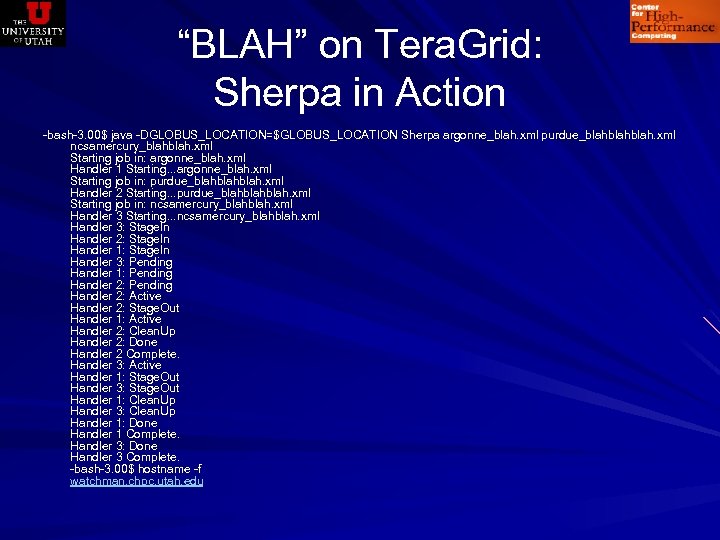 “BLAH” on Tera. Grid: Sherpa in Action -bash-3. 00$ java -DGLOBUS_LOCATION=$GLOBUS_LOCATION Sherpa argonne_blah. xml purdue_blahblahblah. xml ncsamercury_blah. xml Starting job in: argonne_blah. xml Handler 1 Starting. . . argonne_blah. xml Starting job in: purdue_blahblahblah. xml Handler 2 Starting. . . purdue_blahblahblah. xml Starting job in: ncsamercury_blahblah. xml Handler 3 Starting. . . ncsamercury_blahblah. xml Handler 3: Stage. In Handler 2: Stage. In Handler 1: Stage. In Handler 3: Pending Handler 1: Pending Handler 2: Active Handler 2: Stage. Out Handler 1: Active Handler 2: Clean. Up Handler 2: Done Handler 2 Complete. Handler 3: Active Handler 1: Stage. Out Handler 3: Stage. Out Handler 1: Clean. Up Handler 3: Clean. Up Handler 1: Done Handler 1 Complete. Handler 3: Done Handler 3 Complete. -bash-3. 00$ hostname -f watchman. chpc. utah. edu
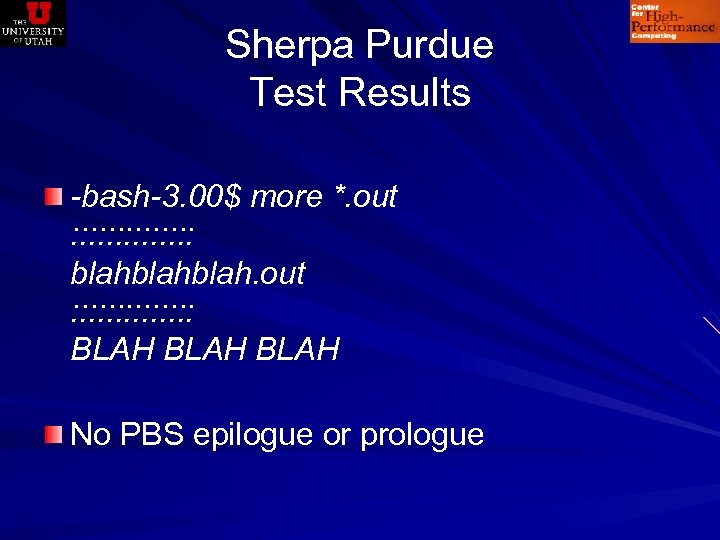 Sherpa Purdue Test Results -bash-3. 00$ more *. out : : : : blahblah. out : : : : BLAH No PBS epilogue or prologue
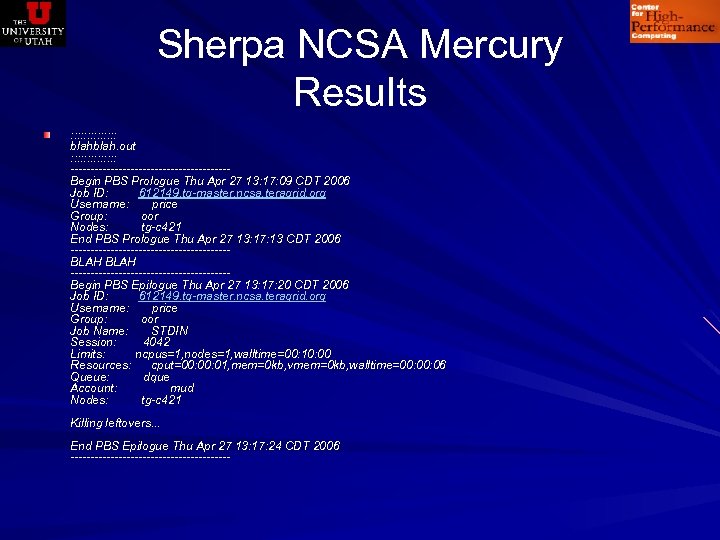 Sherpa NCSA Mercury Results : : : : blah. out : : : : --------------------Begin PBS Prologue Thu Apr 27 13: 17: 09 CDT 2006 Job ID: 612149. tg-master. ncsa. teragrid. org Username: price Group: oor Nodes: tg-c 421 End PBS Prologue Thu Apr 27 13: 17: 13 CDT 2006 --------------------BLAH --------------------Begin PBS Epilogue Thu Apr 27 13: 17: 20 CDT 2006 Job ID: 612149. tg-master. ncsa. teragrid. org Username: price Group: oor Job Name: STDIN Session: 4042 Limits: ncpus=1, nodes=1, walltime=00: 10: 00 Resources: cput=00: 00: 01, mem=0 kb, vmem=0 kb, walltime=00: 00: 06 Queue: dque Account: mud Nodes: tg-c 421 Killing leftovers. . . End PBS Epilogue Thu Apr 27 13: 17: 24 CDT 2006 --------------------
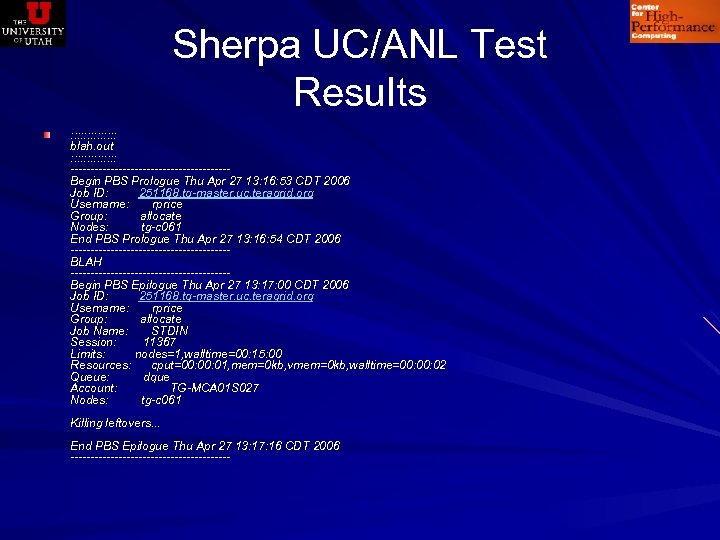 Sherpa UC/ANL Test Results : : : : blah. out : : : : --------------------Begin PBS Prologue Thu Apr 27 13: 16: 53 CDT 2006 Job ID: 251168. tg-master. uc. teragrid. org Username: rprice Group: allocate Nodes: tg-c 061 End PBS Prologue Thu Apr 27 13: 16: 54 CDT 2006 --------------------BLAH --------------------Begin PBS Epilogue Thu Apr 27 13: 17: 00 CDT 2006 Job ID: 251168. tg-master. uc. teragrid. org Username: rprice Group: allocate Job Name: STDIN Session: 11367 Limits: nodes=1, walltime=00: 15: 00 Resources: cput=00: 00: 01, mem=0 kb, vmem=0 kb, walltime=00: 00: 02 Queue: dque Account: TG-MCA 01 S 027 Nodes: tg-c 061 Killing leftovers. . . End PBS Epilogue Thu Apr 27 13: 17: 16 CDT 2006 --------------------
 MGAC Background Modified Genetic Algorithms for Crystals and Atomic Clusters (MGAC), an HPC chemistry application written in C++ In short based off of an energy criteria MGAC tries to predict the chemical structure Computing Needs: local serial computations and distributed parallel computations
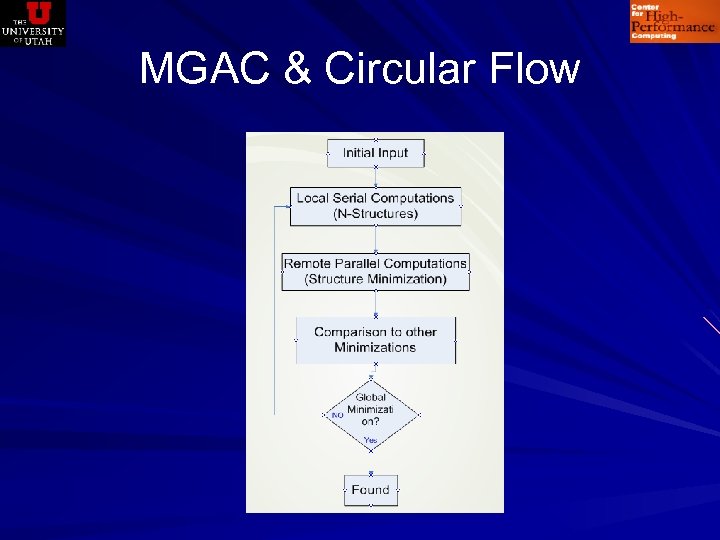 MGAC & Circular Flow
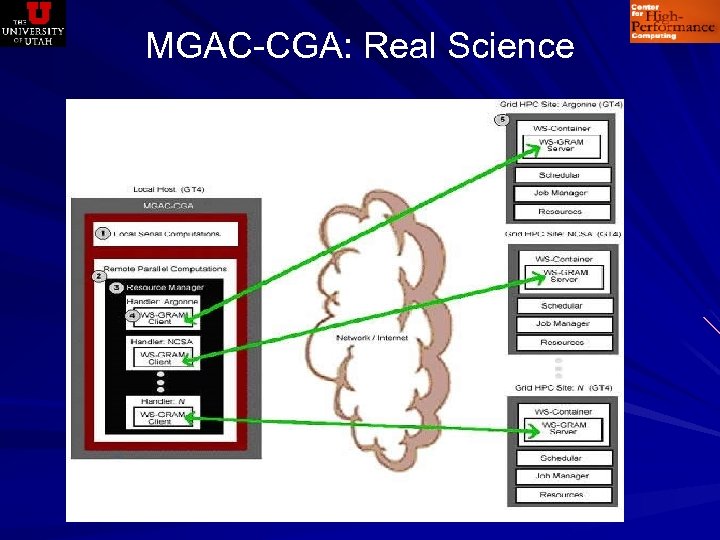 MGAC-CGA: Real Science
 Efficiency and HPC Resources Scheduler Side Effect: – 1 job submitted requiring 5 calculations 4 calculatons require 1 hour of compute time each 1 calculation requires 10 hours of compute time The other 4 nodes are still reserved although not being used and they can’t be used by anyone else until the 10 hr job has finished; 4*9 = 36 hrs of wasted compute time
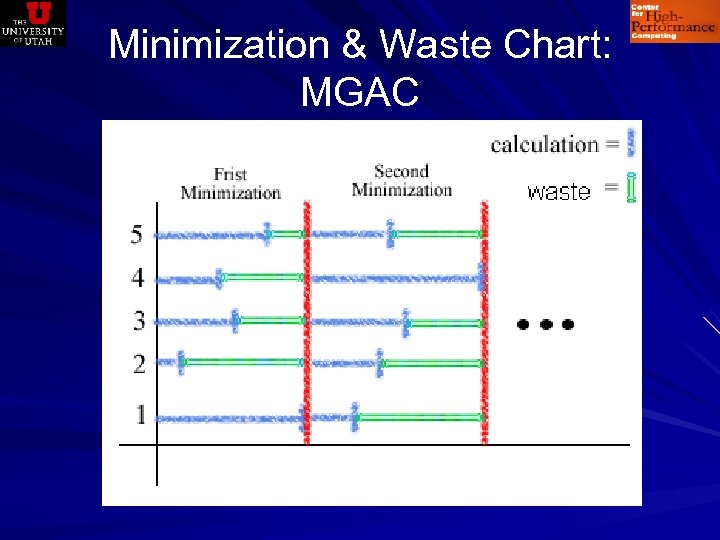 Minimization & Waste Chart: MGAC
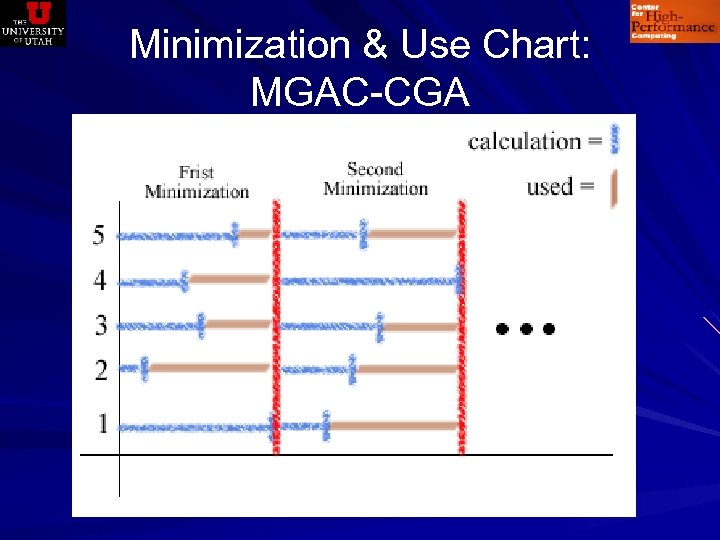 Minimization & Use Chart: MGAC-CGA
 Efficiency and HPC Resources Guesstimate: in one common MGAC run our average efficiency due to scheduler side effect is: 46%, – 54% or resources are wasted Sherpa continuously submits one job at a time which reduces the scheduler side effect because multiple schedulers are involved and jobs are submitted in a more granular fashion – Improved Efficiency #1: increased granularity Necessary sharing policies prohibit large number of jobs from being submitted all at one HPC resource, queue times become to long – Improved Efficiency #2: access to more resources Guesstimate: total computational time (including queue time) reduced by 89%-60% in our initial testing.
 Sherpa Performance & Load Capability Performance: – Sherpa is light weight, computationally intensive operations are done at HPC resource – Memory intensive Load Capability: – Hard to create a huge test case, need unique file names – Ran out of file handles around 100, 000 jobs without any HPC submission ( turned out system image software was misconfigured ) – Successfully initiated 500 jobs Emphasis on initiated, 500 jobs appeared in the test queue and although many ran to completion we did not have time to let them all run to completion
 Host Cert and Sherpa Globus GSI: – Uses PKI to verify that users and hosts are who they claim to be, creates trust – User certs and host certs are different and they provide different functionality Sherpa Requires a Globus host certificate ORNL granted us one Policy changed: got CRLd Confusion: Either WS-GRAM or RFT was requiring a valid host cert – Had to know if there was a way around the situation – Did some testing to investigate and trouble shoot
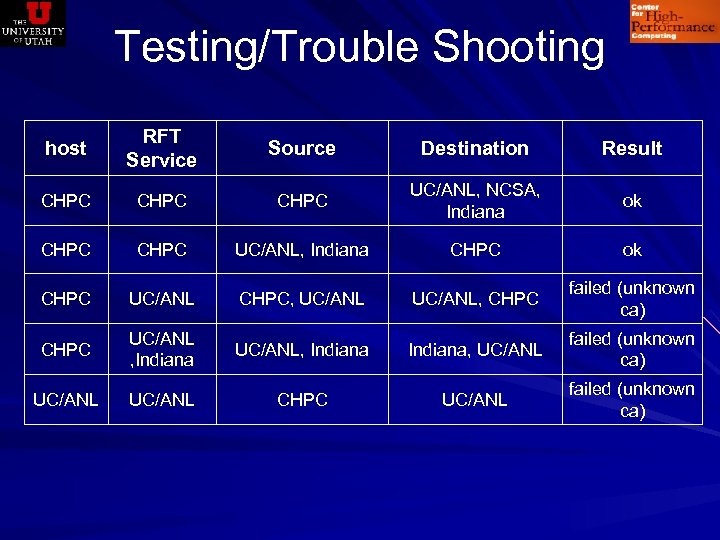 Testing/Trouble Shooting host RFT Service Source Destination Result CHPC UC/ANL, NCSA, Indiana ok CHPC UC/ANL, Indiana CHPC ok CHPC UC/ANL CHPC, UC/ANL, CHPC failed (unknown ca) CHPC UC/ANL , Indiana UC/ANL, Indiana, UC/ANL failed (unknown ca) UC/ANL CHPC UC/ANL failed (unknown ca)
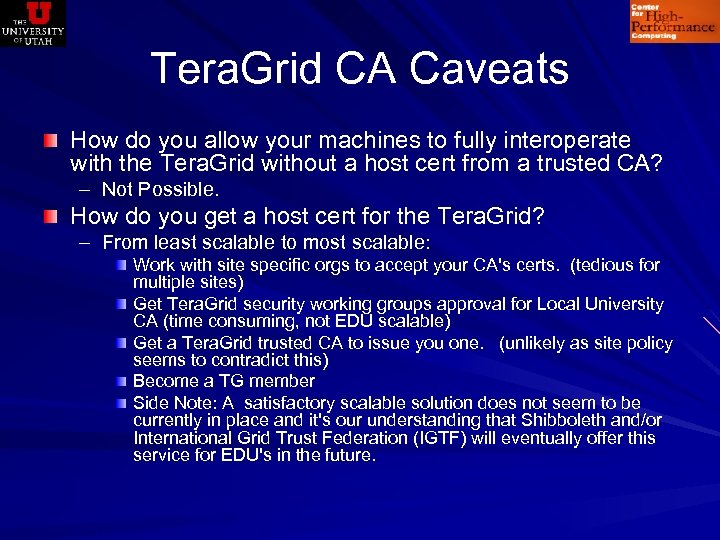 Tera. Grid CA Caveats How do you allow your machines to fully interoperate with the Tera. Grid without a host cert from a trusted CA? – Not Possible. How do you get a host cert for the Tera. Grid? – From least scalable to most scalable: Work with site specific orgs to accept your CA's certs. (tedious for multiple sites) Get Tera. Grid security working groups approval for Local University CA (time consuming, not EDU scalable) Get a Tera. Grid trusted CA to issue you one. (unlikely as site policy seems to contradict this) Become a TG member Side Note: A satisfactory scalable solution does not seem to be currently in place and it's our understanding that Shibboleth and/or International Grid Trust Federation (IGTF) will eventually offer this service for EDU's in the future.
 Not the End: Sherpa is Flexible Sherpa can work between any two machines that have GT 4 installed and configured: Flexible Can work in many locations Implicitly follows open standards
 Future Projects MGAC-CGA is the first example, we have other projects with Sherpa: – Nanotechnology simulation (web application) – Biomolecular docking (circular flow) AKA: protein docking, drug discovery – Combustion simulation (web application)
 Future Features and Implementation Future efforts will be directed towards: – implementing monitoring and discovery client logic – polling feature that will help identify when system related issues have occurred (i. e. network down, scheduler unavailable) – Grid Proxy Auto Renewal. Implementation (move to a more general API) – Simple API for Grid Apps – Research Group (SAGARG) – Grid Application Toolkit (GAT) – Java. COG
 How do I get a Hold of Sherpa? We are interested in collaborative efforts. Sorry, can’t download Sherpa because we don’t have the man power for support right now.
 Q&A With Audience Mail Questions to: ronald. charles. price@gmail. com Slides Availble at: http: //www. chpc. utah. edu/~rprice/grid_worl d_2006/ron_price_grid_world_presentatio n. ppt