 Скачать презентацию Digital Preservation of Electronic Publications The Mellon Electronic
634ea337a445099e20d49d650b5e847b.ppt
- Количество слайдов: 15



Digital Preservation of Electronic Publications: The Mellon Electronic Journal Archiving Program Donald Waters The Andrew W. Mellon Foundation November 29, 2001
Long -term maintenance of digital information l l This remains a vexing, but critical and high priority problem for those responsible for generating and maintaining the scholarly record There is a great deal of experimentation, definition of requirements and development: LC, Internet Archive, National Archives, emulation, RLG/OCLC, PADI, NEDLIB, UK, etc. 2
The need for journal archiving l l l Scholars demand the multiple advantages of e-journals (reference linking, search capabilities, inclusion of datasets, simulation, interactivity, multimedia) Despite demonstrated flexibility and functionality, the promise of lower costs for e-journals remains elusive: l Major journals are rarely published only in e-format l The costs of archiving are unknown Without trusted electronic archives, it is unlikely that ejournals can substitute for print and serve as the copy of record 3
Mellon Electronic Journal Archiving Program l l l Foundation staff consulted with librarians, publishers, and scholars about how best to stimulate investments in the archiving of electronic journals Seven proposals were selected and funded in December 2000 for one-year planning projects Depending on the results of the planning effort, the Foundation is prepared to fund up to 4 implementation projects beginning in 2002 (June) 4
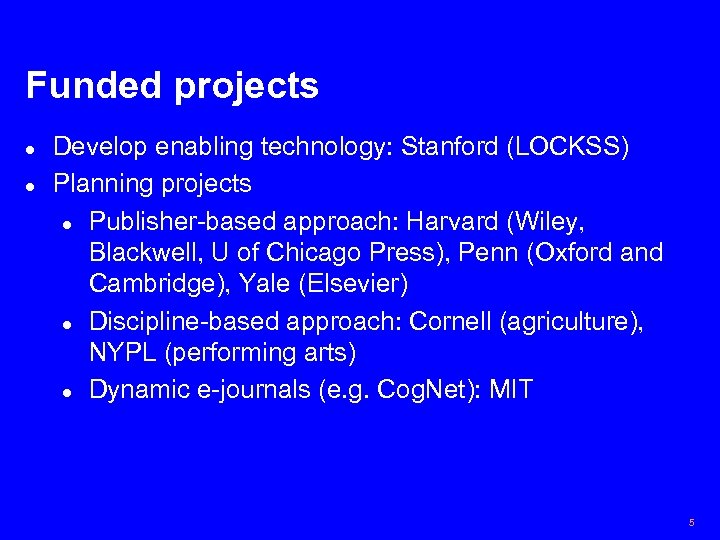
Funded projects l l Develop enabling technology: Stanford (LOCKSS) Planning projects l Publisher-based approach: Harvard (Wiley, Blackwell, U of Chicago Press), Penn (Oxford and Cambridge), Yale (Elsevier) l Discipline-based approach: Cornell (agriculture), NYPL (performing arts) l Dynamic e-journals (e. g. Cog. Net): MIT 5
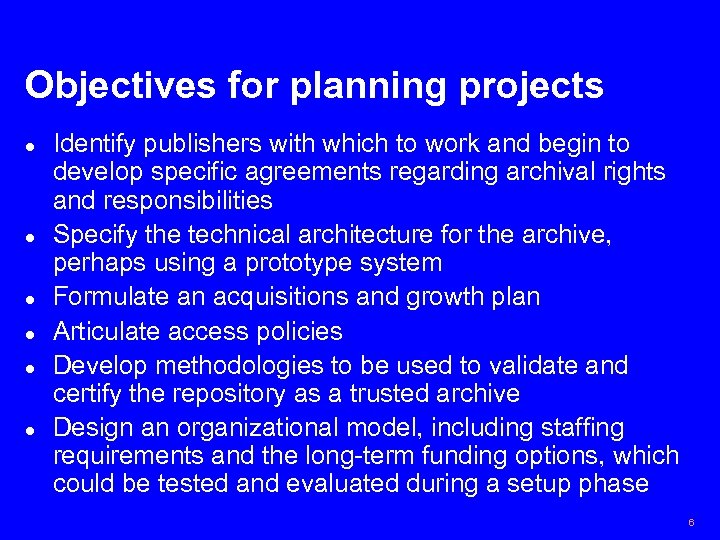
Objectives for planning projects l l l Identify publishers with which to work and begin to develop specific agreements regarding archival rights and responsibilities Specify the technical architecture for the archive, perhaps using a prototype system Formulate an acquisitions and growth plan Articulate access policies Develop methodologies to be used to validate and certify the repository as a trusted archive Design an organizational model, including staffing requirements and the long-term funding options, which could be tested and evaluated during a setup phase 6
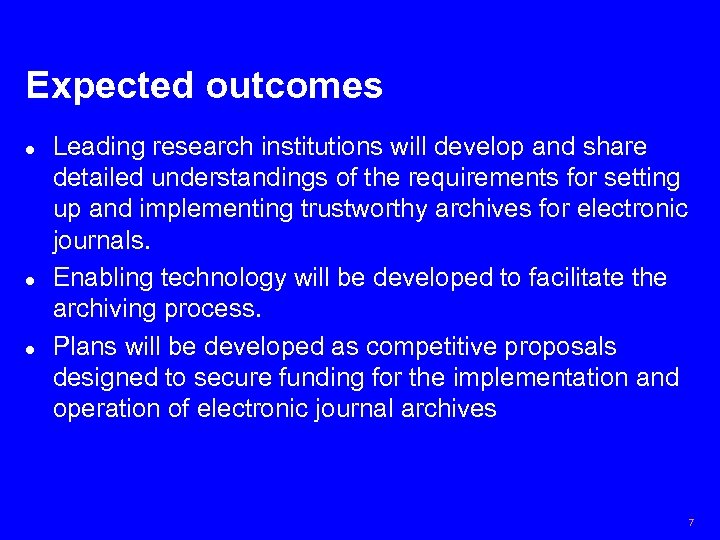
Expected outcomes l l l Leading research institutions will develop and share detailed understandings of the requirements for setting up and implementing trustworthy archives for electronic journals. Enabling technology will be developed to facilitate the archiving process. Plans will be developed as competitive proposals designed to secure funding for the implementation and operation of electronic journal archives 7
Progress? l l l Agreements Transfer to the archives Quality control and auditing Access Economic models Architecture 8
Agreements l l Differences in size and sophistication of publishers l Major publishers: concerned about competition, but able to consider normalizing formats l Smaller publishers: more eager to participate, but higher variability in formats Customized versus generic agreements 9
Transfer to the archives l l The ability of a publisher to transfer data to an archive is a proof of archivability Need to define the “manifest” for the transfer: what are the contents of an e-journal issue? Harvest (or “pull”) models depend on highly normalized formats: LOCKSS saves browser display formats Push methods from the publisher generally seek richer formats, but require deeper investment in normalizing methods 10
Quality control and auditing l l l Trust depends on the ability to verify independently that the archive is “good” l Does the material in the archive match (at some defined level) what was submitted? l Can material be found and “read? ” Frequent use may be the best test of integrity, but can automated methods be developed to “canonicalize” objects and test their integrity? A certified auditing mechanism could be a basis for building a cooperating network of archives 11
Access l l What types of access might be permitted? l Restricted to the site l Restricted to subscribers l Moving wall What events would give an archive the ability to broaden access at its discretion? l Journal is “out of print” l Publisher is out of business l Work is out of copyright 12
Economic models l l How to inject the costs of and responsibility for longterm maintenance into the system of electronic publishing l Publisher contributions l University, library, and archives contributions If libraries and archives bear the costs, what rights and privileges do they get? Given economies of scale how are costs shared to avoid “free-loading”? Are there non-competing uses that might generate an income stream: aggregation for data-mining? 13
Architecture l l l Need for common tools for normalization and auditing These needs suggest a natural layering of functions and interfaces for interoperability Given such points of interaction, specialization and division of labor become possible that could result in real economies 14
There is hope! l l The participants in these planning projects have framed the archiving problem very concretely as a problem of technical, organizational, and economic development Framed in this way, it seems solvable and increasingly less a source of free-floating anxiety 15
Скачать презентацию Digital Preservation of Electronic Publications The Mellon Electronic
634ea337a445099e20d49d650b5e847b.ppt