


 Скачать презентацию Digital Preservation and Deep Infrastructure Discussion of
9afc07dd92b55c1bed7c244fb0d31b8d.ppt
- Количество слайдов: 17
 Digital Preservation and Deep Infrastructure • Discussion of the article by Stewart Granger, University of Leeds • Published in D-Lib Magazine, 2002 • Review of a Report by the Task Force on ‘Archiving of Digital Information’ • Elaborates on his ‘big picture’ of the meaning of ‘deep infrastructure’ Feb 5, 2004/Dan Swaney
 What is Deep Infrastructure? • A structure for supporting “a digital system of digital archives”. – As cited in ‘Attributes of a Trusted Digital Repository: Meeting the Needs of Research Resources – An RLG-OCLC Report. ” August 2001. • Why is it needed? – – Focuses on Managing the Risks to Digital Preservation by providing an Agenda An Agenda, in this case, is a List of the Identified Requirements needed to satisfy Digital Archiving – – ‘Deep’ implies something ‘fuzzy’ or ‘unknown’ that required more work to ‘drill down deeper’ to the details. There’s no complete solution, but hopefully the Agenda will influence follow-on collaboration (through strength in numbers) – To help raise awareness of what is missing from existing digital repositories today. – • • Influence other groups and individuals to collaborative help to implement/define them. Gives legislators something to consider before rushing laws that need to be well thought out before they prevent digital preservation. To help guide/facilitate decision making though collaboration. Responsibilities that are too much for one alone, can be distributed through collaboration. • Influences national and international sharing • Difficulties? - Hard to define all of what ‘deep infrastructure’ is. Need to take a step back to identify the ‘big picture’ first showing the main aspects. Feb 5, 2004/Dan Swaney
 What is Deep Infrastructure? • The Task Force identified two main apsects: #1: A Need for Certified Archives (Granger Agrees With) • Certification helps to ensure that digital information is being properly kept and maintained. • Covered in the RLG/OCLC Report (March 2000) – Defines a framework for developing a certification – Not complete -- Recommends “organizations and individuals” develop standard criteria and methods to certify repositories of digital information as archives”. • The process of certification includes 4 types: – Individuals – personnel/professional certification or accreditation (No certification exists for electronic archiving or digital repository management. ) – Programs – applies to institutions or organizations – Processes – methods/procedures following a set of guidelines – Data – persistence/reliability over time and security Feb 5, 2004/Dan Swaney
 What is Deep Infrastructure? The Task Force identified a second aspect: #2: A ‘Fail Safe’ mechanism • Granger wasn’t happy with results on this area. • Maintain “a ‘technology watch’ to manage the risk as technology evolves to provide [‘on-the-fly’] access” through Migration. • According to Granger, Migration is not the only viable digital preservation strategy! • What do we do in the meantime when there isn’t a way to migrate? • Who pays for it? Should we share costs? • How can businesses be influenced to pro-actively support digital preservation? • Granger: Save what we can now…even if the methods might be outdated tomorrow. Simultaneously work on building the culture. Feb 5, 2004/Dan Swaney
![Granger’s View of Deep Infrastructure “Identify Requirements [of users] and build the system to](https://present5.com/presentation/9afc07dd92b55c1bed7c244fb0d31b8d/image-5.jpg "Granger’s View of Deep Infrastructure “Identify Requirements [of users] and build the system to") Granger’s View of Deep Infrastructure “Identify Requirements [of users] and build the system to meet those requirements”. – Although Basic in Rules of Building Software, this is not always followed. – Do this independent of economics, resources available, costs. First focus on who the users are and what they want or need. – Technical Solutions should meet the needs of varying users with varying interests, needs, requirements, and culture/ways of use. – Are formats built with Customer Validation in mind? • Most commercial businesses support what is cost effective to make a profit. • If I use PDF who’s to say that is the proper way to archive? – – Are PDAs here to stay? Or just a fad that is ‘gone’ tomorrow? How do I know that digital archive is archiving correctly? What is the risk to loss between one digital archive and another? Feb 5, 2004/Dan Swaney
Granger’s View of Deep Infrastructure “Identify Requirements [of users] and build the system to meet those requirements”. – Although Basic in Rules of Building Software, this is not always followed. – Do this independent of economics, resources available, costs. First focus on who the users are and what they want or need. – Technical Solutions should meet the needs of varying users with varying interests, needs, requirements, and culture/ways of use. – Are formats built with Customer Validation in mind? • Most commercial businesses support what is cost effective to make a profit. • If I use PDF who’s to say that is the proper way to archive? – – Are PDAs here to stay? Or just a fad that is ‘gone’ tomorrow? How do I know that digital archive is archiving correctly? What is the risk to loss between one digital archive and another? Feb 5, 2004/Dan Swaney
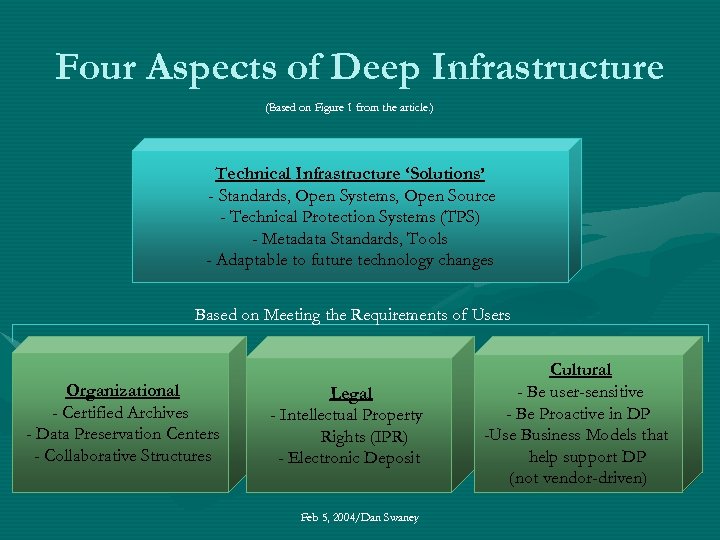 Four Aspects of Deep Infrastructure (Based on Figure 1 from the article. ) Technical Infrastructure ‘Solutions’ - Standards, Open Systems, Open Source - Technical Protection Systems (TPS) - Metadata Standards, Tools - Adaptable to future technology changes Based on Meeting the Requirements of Users Organizational - Certified Archives - Data Preservation Centers - Collaborative Structures Legal - Intellectual Property Rights (IPR) - Electronic Deposit Feb 5, 2004/Dan Swaney Cultural - Be user-sensitive - Be Proactive in DP -Use Business Models that help support DP (not vendor-driven)
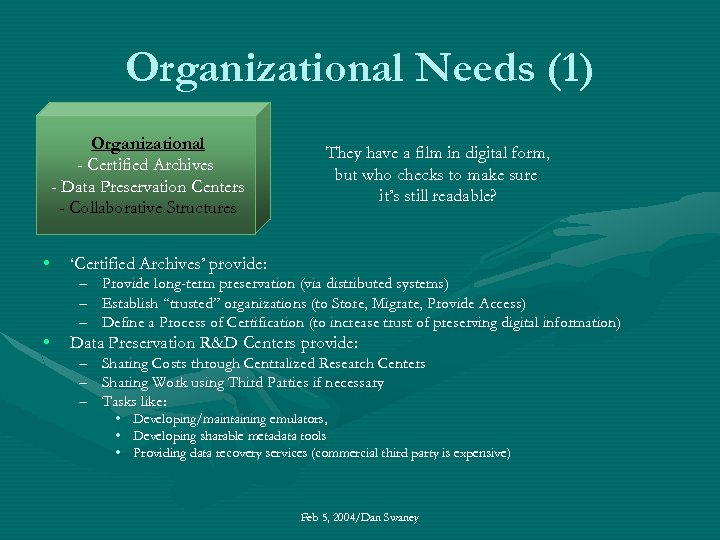 Organizational Needs (1) Organizational - Certified Archives - Data Preservation Centers - Collaborative Structures • • They have a film in digital form, but who checks to make sure it’s still readable? ‘Certified Archives’ provide: – – – Provide long-term preservation (via distributed systems) Establish “trusted” organizations (to Store, Migrate, Provide Access) Define a Process of Certification (to increase trust of preserving digital information) Data Preservation R&D Centers provide: – – – Sharing Costs through Centralized Research Centers Sharing Work using Third Parties if necessary Tasks like: • Developing/maintaining emulators, • Developing sharable metadata tools • Providing data recovery services (commercial third party is expensive) Feb 5, 2004/Dan Swaney
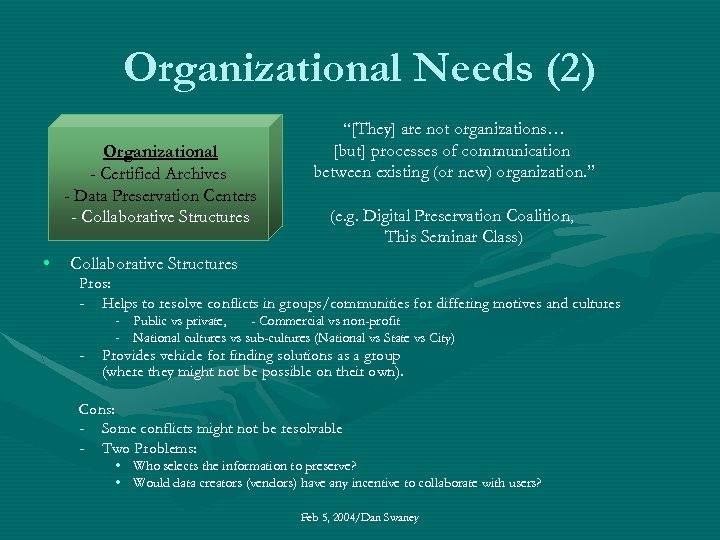 Organizational Needs (2) Organizational - Certified Archives - Data Preservation Centers - Collaborative Structures • “[They] are not organizations… [but] processes of communication between existing (or new) organization. ” (e. g. Digital Preservation Coalition, This Seminar Class) Collaborative Structures Pros: - Helps to resolve conflicts in groups/communities for differing motives and cultures - Public vs private, - Commercial vs non-profit - National cultures vs sub-cultures (National vs State vs City) - Provides vehicle for finding solutions as a group (where they might not be possible on their own). Cons: - Some conflicts might not be resolvable - Two Problems: • Who selects the information to preserve? • Would data creators (vendors) have any incentive to collaborate with users? Feb 5, 2004/Dan Swaney
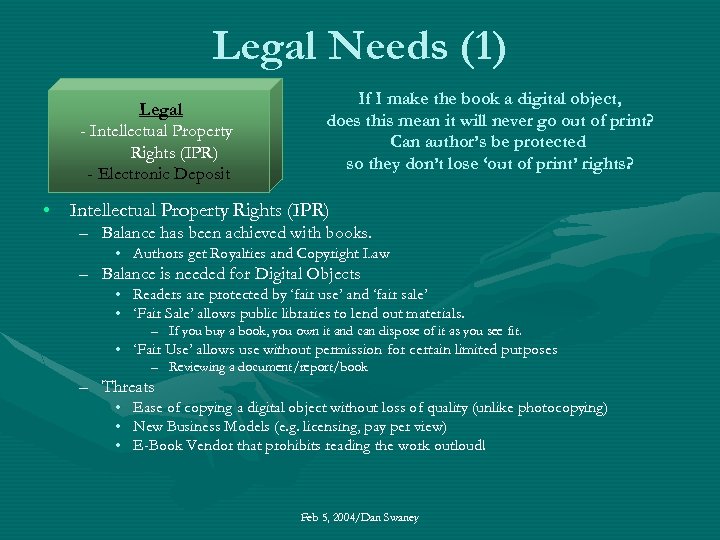 Legal Needs (1) Legal - Intellectual Property Rights (IPR) - Electronic Deposit If I make the book a digital object, does this mean it will never go out of print? Can author’s be protected so they don’t lose ‘out of print’ rights? • Intellectual Property Rights (IPR) – Balance has been achieved with books. • Authors get Royalties and Copyright Law – Balance is needed for Digital Objects • Readers are protected by ‘fair use’ and ‘fair sale’ • ‘Fair Sale’ allows public libraries to lend out materials. – If you buy a book, you own it and can dispose of it as you see fit. • ‘Fair Use’ allows use without permission for certain limited purposes – Reviewing a document/report/book – Threats • • • Ease of copying a digital object without loss of quality (unlike photocopying) New Business Models (e. g. licensing, pay per view) E-Book Vendor that prohibits reading the work outloud! Feb 5, 2004/Dan Swaney
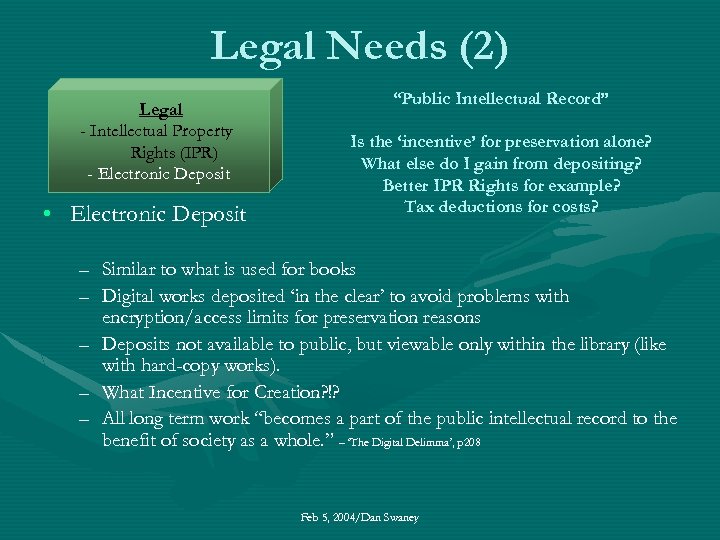 Legal Needs (2) Legal - Intellectual Property Rights (IPR) - Electronic Deposit • Electronic Deposit “Public Intellectual Record” Is the ‘incentive’ for preservation alone? What else do I gain from depositing? Better IPR Rights for example? Tax deductions for costs? – Similar to what is used for books – Digital works deposited ‘in the clear’ to avoid problems with encryption/access limits for preservation reasons – Deposits not available to public, but viewable only within the library (like with hard-copy works). – What Incentive for Creation? !? – All long term work “becomes a part of the public intellectual record to the benefit of society as a whole. ” – ‘The Digital Delimma’, p 208 Delimma’, Feb 5, 2004/Dan Swaney
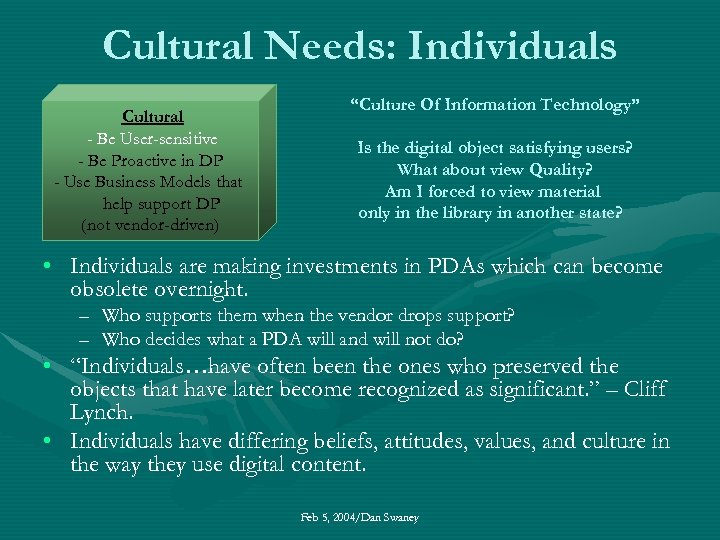 Cultural Needs: Individuals Cultural - Be User-sensitive - Be Proactive in DP - Use Business Models that help support DP (not vendor-driven) “Culture Of Information Technology” Is the digital object satisfying users? What about view Quality? Am I forced to view material only in the library in another state? • Individuals are making investments in PDAs which can become obsolete overnight. – Who supports them when the vendor drops support? – Who decides what a PDA will and will not do? • “Individuals…have often been the ones who preserved the objects that have later become recognized as significant. ” – Cliff Lynch. • Individuals have differing beliefs, attitudes, values, and culture in the way they use digital content. Feb 5, 2004/Dan Swaney
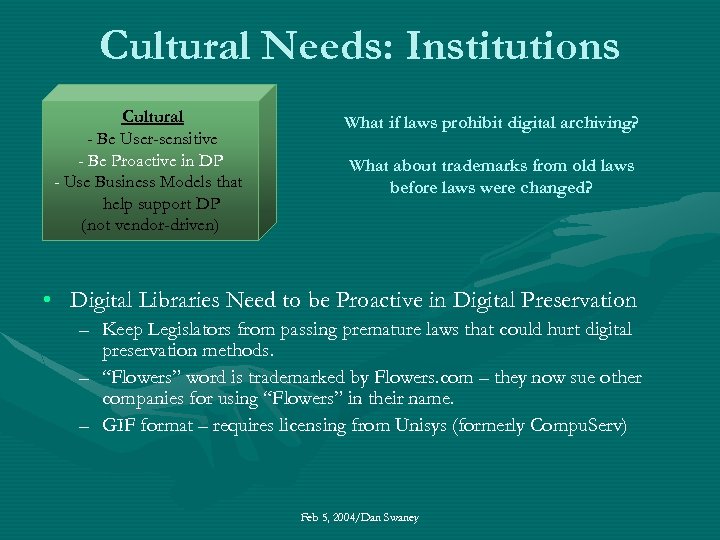 Cultural Needs: Institutions Cultural - Be User-sensitive - Be Proactive in DP - Use Business Models that help support DP (not vendor-driven) What if laws prohibit digital archiving? What about trademarks from old laws before laws were changed? • Digital Libraries Need to be Proactive in Digital Preservation – Keep Legislators from passing premature laws that could hurt digital preservation methods. – “Flowers” word is trademarked by Flowers. com – they now sue other companies for using “Flowers” in their name. – GIF format – requires licensing from Unisys (formerly Compu. Serv) Feb 5, 2004/Dan Swaney
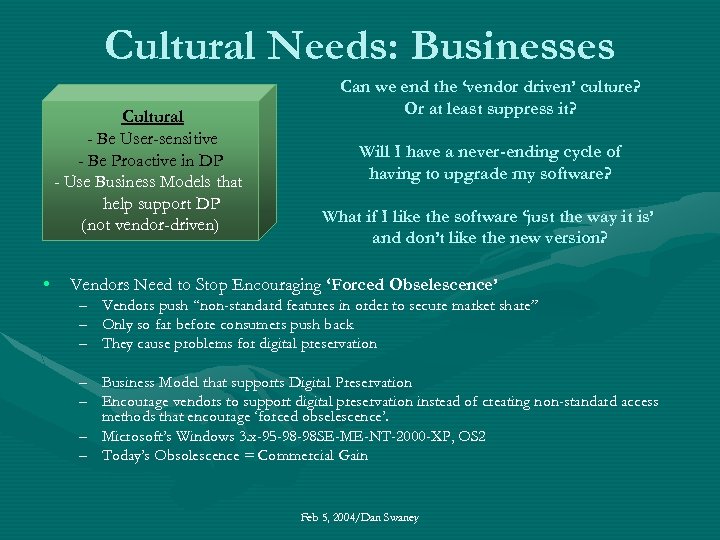 Cultural Needs: Businesses Cultural - Be User-sensitive - Be Proactive in DP - Use Business Models that help support DP (not vendor-driven) • Can we end the ‘vendor driven’ culture? Or at least suppress it? Will I have a never-ending cycle of having to upgrade my software? What if I like the software ‘just the way it is’ and don’t like the new version? Vendors Need to Stop Encouraging ‘Forced Obselescence’ – Vendors push “non-standard features in order to secure market share” – Only so far before consumers push back – They cause problems for digital preservation – Business Model that supports Digital Preservation – Encourage vendors to support digital preservation instead of creating non-standard access methods that encourage ‘forced obselescence’. – Microsoft’s Windows 3. x-95 -98 -98 SE-ME-NT-2000 -XP, OS 2 – Today’s Obsolescence = Commercial Gain Feb 5, 2004/Dan Swaney
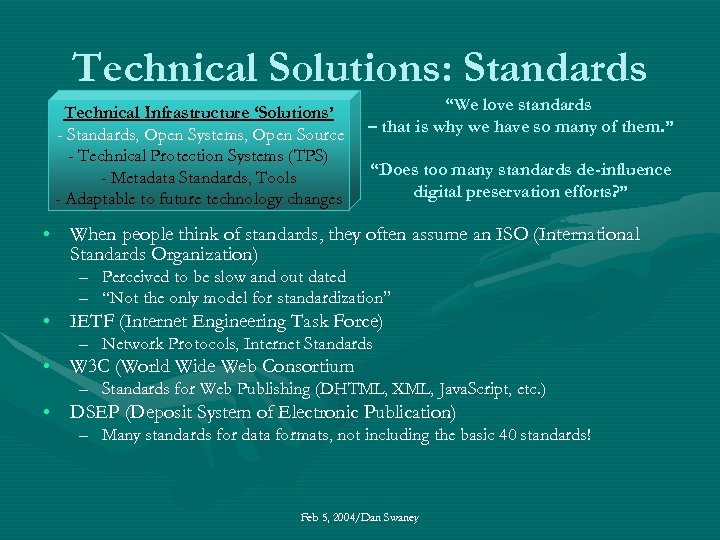 Technical Solutions: Standards Technical Infrastructure ‘Solutions’ - Standards, Open Systems, Open Source - Technical Protection Systems (TPS) - Metadata Standards, Tools - Adaptable to future technology changes “We love standards – that is why we have so many of them. ” “Does too many standards de-influence digital preservation efforts? ” • When people think of standards, they often assume an ISO (International Standards Organization) – Perceived to be slow and out dated – “Not the only model for standardization” • IETF (Internet Engineering Task Force) – Network Protocols, Internet Standards • W 3 C (World Wide Web Consortium – Standards for Web Publishing (DHTML, XML, Java. Script, etc. ) • DSEP (Deposit System of Electronic Publication) – Many standards for data formats, not including the basic 40 standards! Feb 5, 2004/Dan Swaney
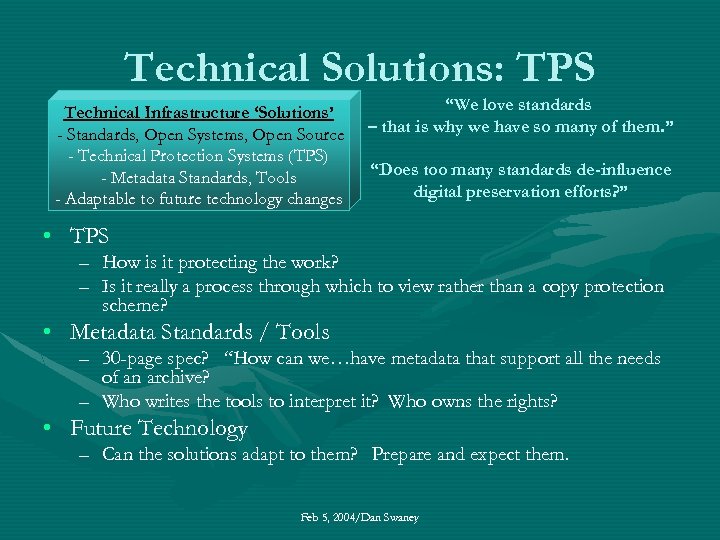 Technical Solutions: TPS Technical Infrastructure ‘Solutions’ - Standards, Open Systems, Open Source - Technical Protection Systems (TPS) - Metadata Standards, Tools - Adaptable to future technology changes “We love standards – that is why we have so many of them. ” “Does too many standards de-influence digital preservation efforts? ” • TPS – How is it protecting the work? – Is it really a process through which to view rather than a copy protection scheme? • Metadata Standards / Tools – 30 -page spec? “How can we…have metadata that support all the needs of an archive? – Who writes the tools to interpret it? Who owns the rights? • Future Technology – Can the solutions adapt to them? Prepare and expect them. Feb 5, 2004/Dan Swaney
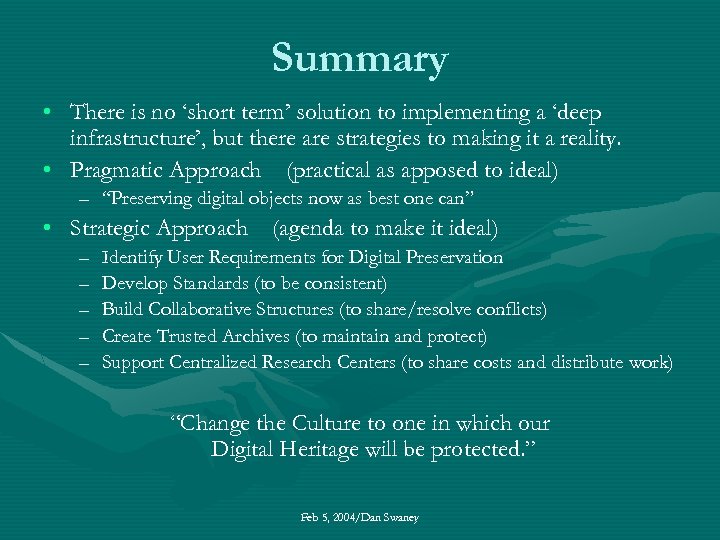 Summary • There is no ‘short term’ solution to implementing a ‘deep infrastructure’, but there are strategies to making it a reality. • Pragmatic Approach (practical as apposed to ideal) – “Preserving digital objects now as best one can” • Strategic Approach (agenda to make it ideal) – – – Identify User Requirements for Digital Preservation Develop Standards (to be consistent) Build Collaborative Structures (to share/resolve conflicts) Create Trusted Archives (to maintain and protect) Support Centralized Research Centers (to share costs and distribute work) “Change the Culture to one in which our Digital Heritage will be protected. ” Feb 5, 2004/Dan Swaney
 References • • “Digital Preservation and Deep Infrastructure, ” Stewart Granger, D-Lib Magazine, Feb. 2002. “Attributes of a Trusted Digital Repository” available at: – • • http: //www. rlg/org/longterm/attributes 01. pdf “The Digital Delimma, ” Computer Science and Telecommunications Board, National Research Council, National Academy Press, 2002, ISBN: 0 -309 -06499 -6 Clifford Lynch, 2001, “The Battle to Define the Future of the Bool in the Digital World, ” First Monday at: http: //firstmonday. org/issues 6_6/lynch/index. html Feb 5, 2004/Dan Swaney