


 Скачать презентацию Digital Payments Jim Woodworth Head of Marketing ACI
09768580ea863cb4b8988224d283c62c.ppt
- Количество слайдов: 45
 Digital Payments Jim Woodworth Head of Marketing, ACI Worldwide
 Firstly, who are ACI ? ACI software process 300 billion digital payments per year www. aciworldwide. com
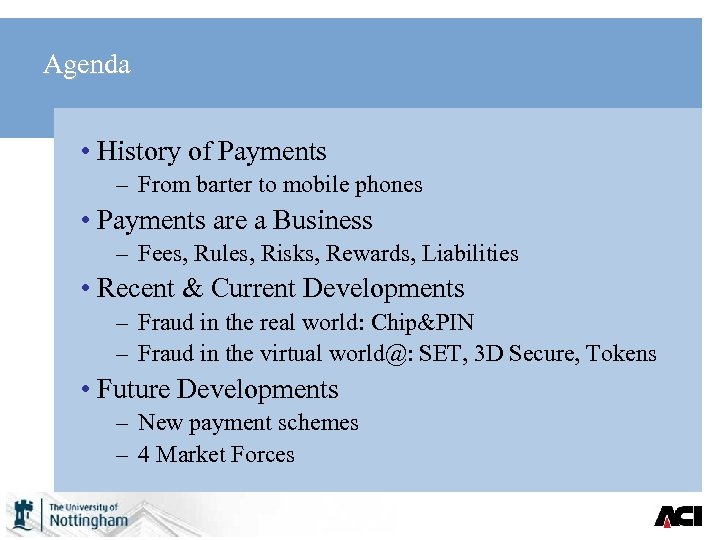 Agenda • History of Payments – From barter to mobile phones • Payments are a Business – Fees, Rules, Risks, Rewards, Liabilities • Recent & Current Developments – Fraud in the real world: Chip&PIN – Fraud in the virtual world@: SET, 3 D Secure, Tokens • Future Developments – New payment schemes – 4 Market Forces
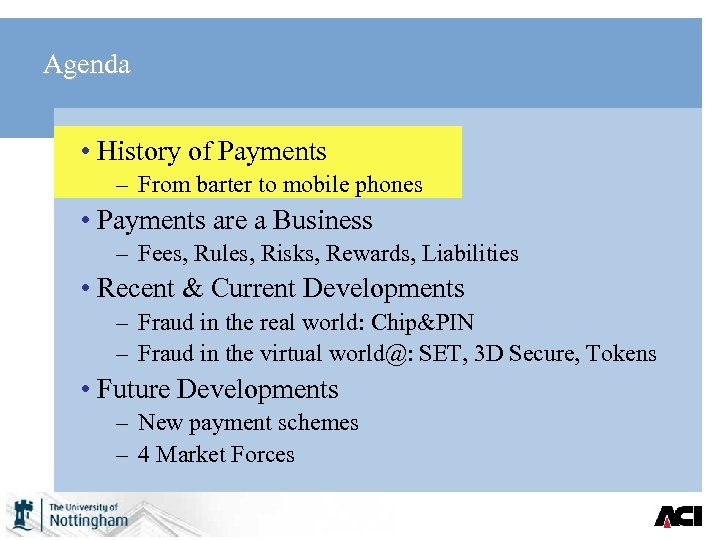 Agenda • History of Payments – From barter to mobile phones • Payments are a Business – Fees, Rules, Risks, Rewards, Liabilities • Recent & Current Developments – Fraud in the real world: Chip&PIN – Fraud in the virtual world@: SET, 3 D Secure, Tokens • Future Developments – New payment schemes – 4 Market Forces
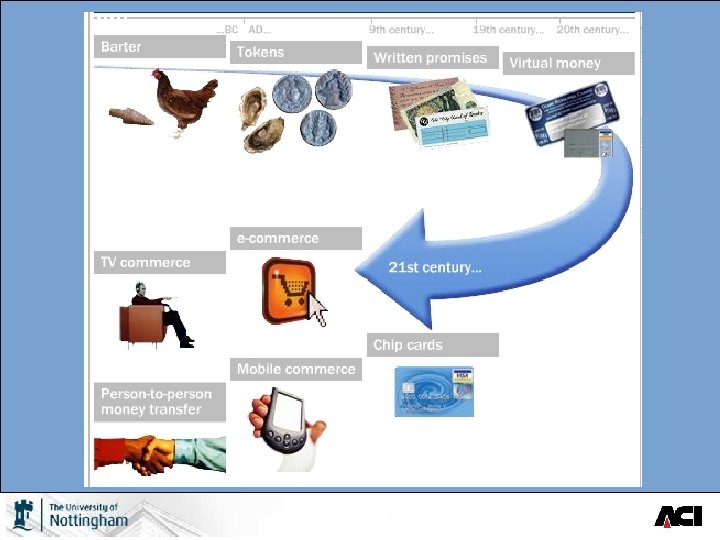
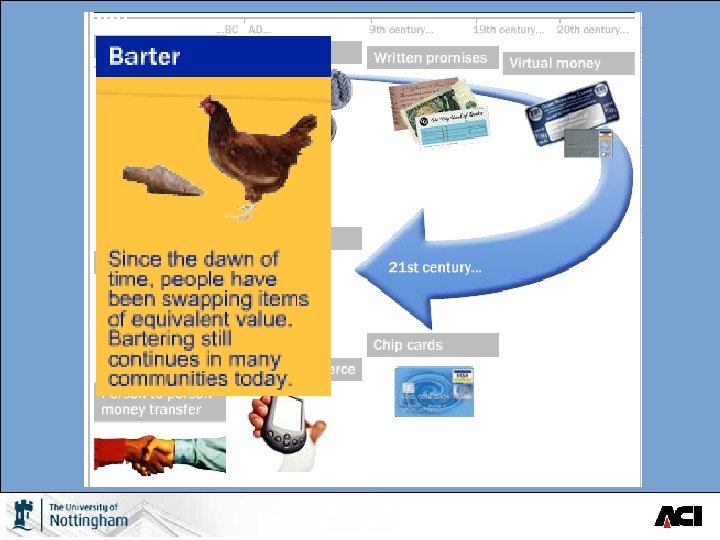
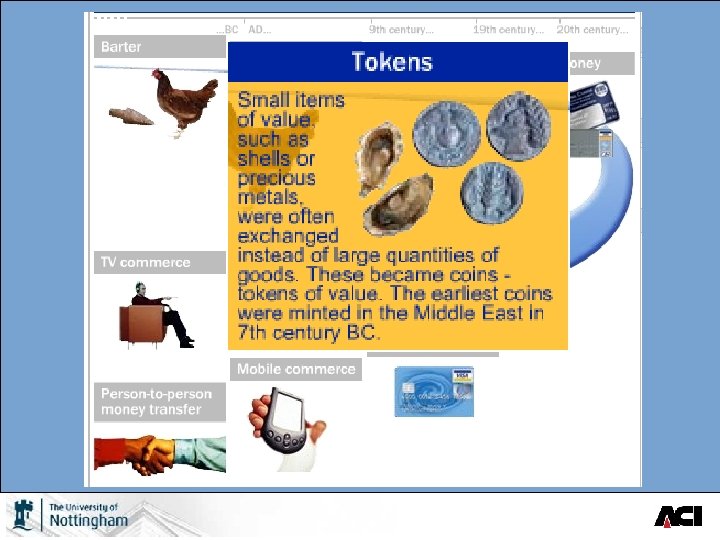
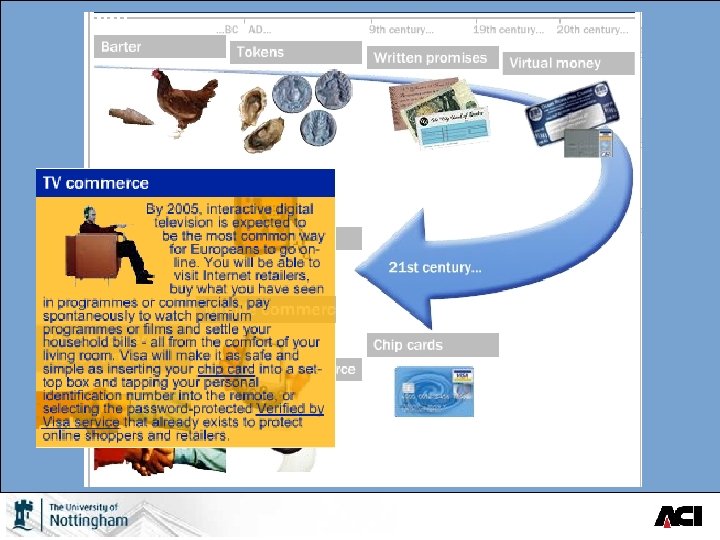
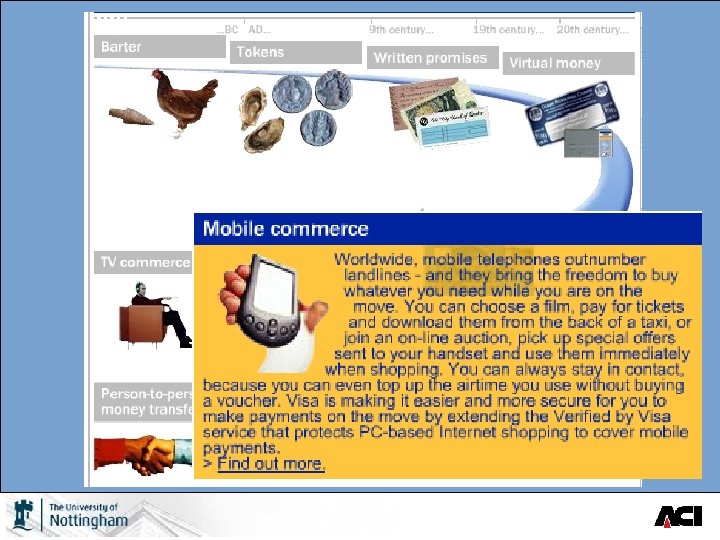
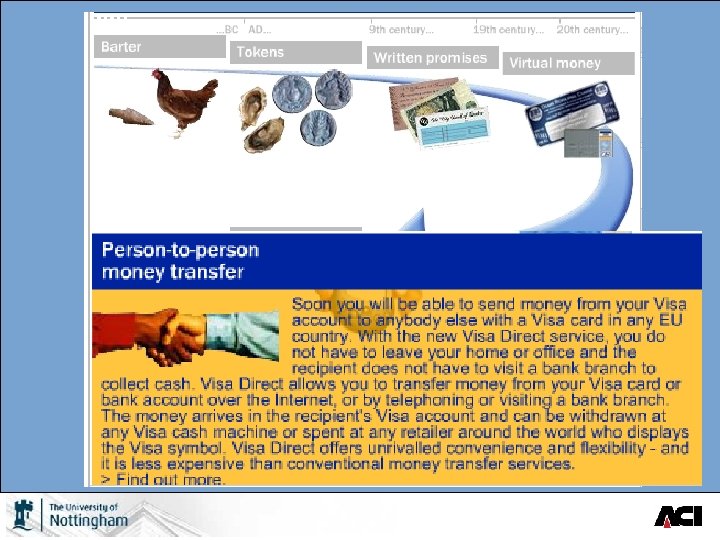
 A brief history of payments Courtesy of www. visa. com
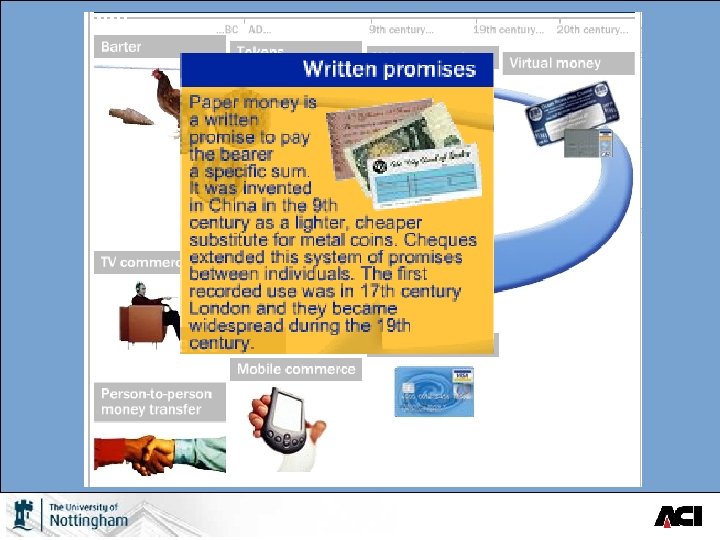
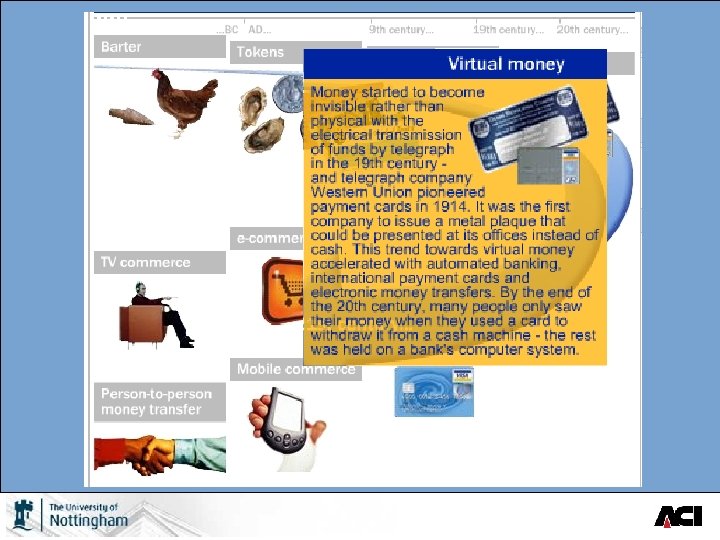
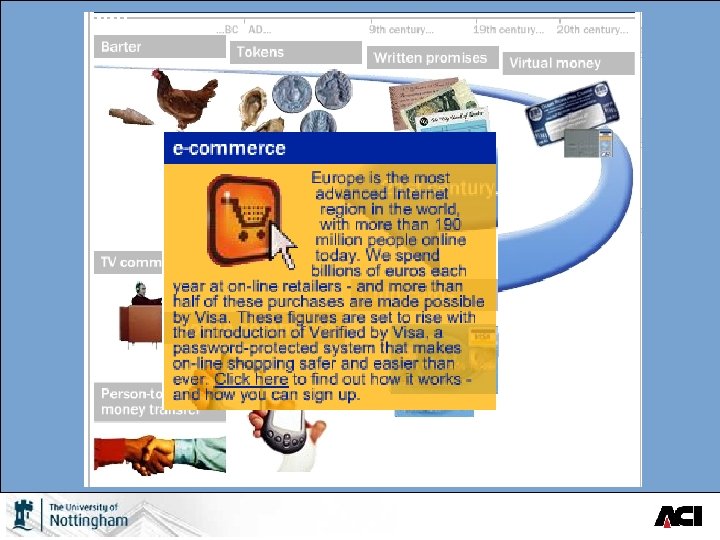
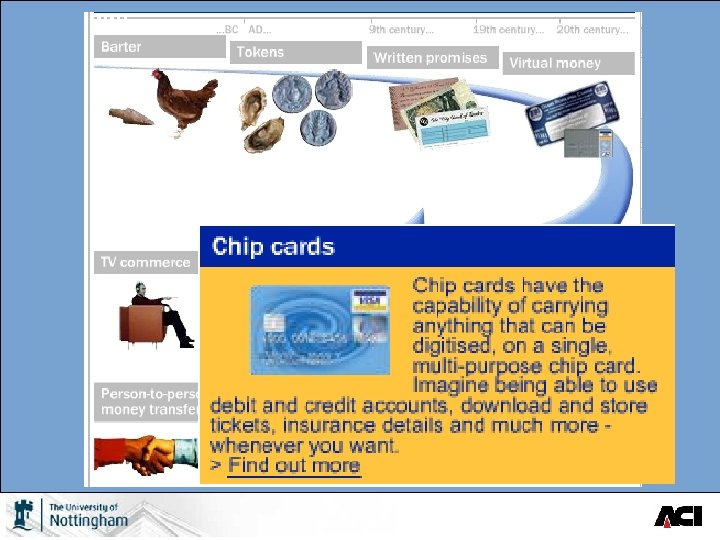
 Two New Payment Types that VISA don’t mention • Paypal • Google Express “furthermore, the Google service is set to undercut fees charged to merchants by Pay. Pal. Google will charge merchants 20 cents and two per cent of a total transaction cost to use the service, which is considerably lower than the 30 cents and 2. 9% fees levied by Pay. Pal. Google also plans to discount fees based on how much merchants spend on its advertising packages”
 Agenda • History of Payments – From barter to mobile phones • Payments are a Business – Fees, Rules, Risks, Rewards, Liabilities • Recent & Current Developments – Fraud in the real world: Chip&PIN – Fraud in the virtual world@: SET, 3 D Secure, Tokens • Future Developments – New payment schemes – 4 Market Forces
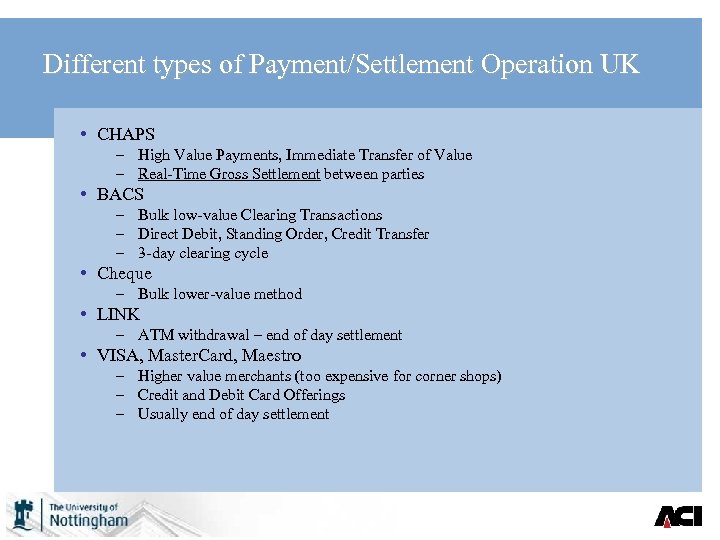 Different types of Payment/Settlement Operation UK • CHAPS – High Value Payments, Immediate Transfer of Value – Real-Time Gross Settlement between parties • BACS – Bulk low-value Clearing Transactions – Direct Debit, Standing Order, Credit Transfer – 3 -day clearing cycle • Cheque – Bulk lower-value method • LINK – ATM withdrawal – end of day settlement • VISA, Master. Card, Maestro – Higher value merchants (too expensive for corner shops) – Credit and Debit Card Offerings – Usually end of day settlement
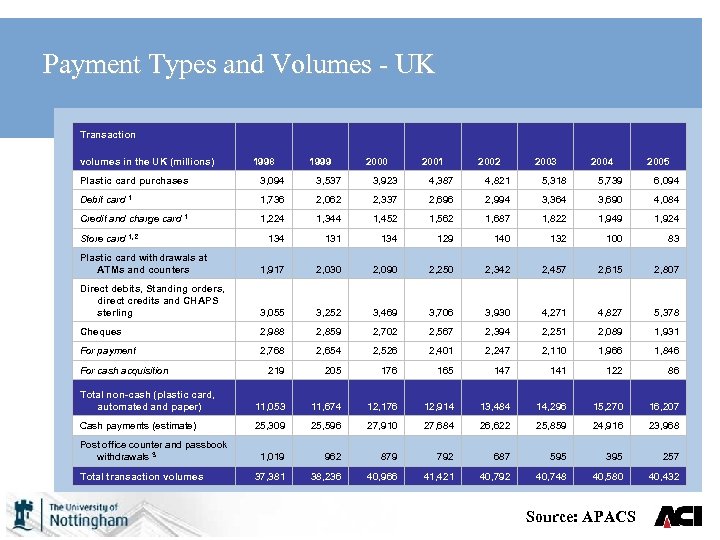 Payment Types and Volumes - UK Transaction volumes in the UK (millions) 1998 1999 2000 2001 2002 2003 2004 2005 Plastic card purchases 3, 094 3, 537 3, 923 4, 387 4, 821 5, 318 5, 739 6, 094 Debit card 1 1, 736 2, 062 2, 337 2, 696 2, 994 3, 364 3, 690 4, 084 Credit and charge card 1 1, 224 1, 344 1, 452 1, 562 1, 687 1, 822 1, 949 1, 924 131 134 129 140 132 100 83 Plastic card withdrawals at ATMs and counters 1, 917 2, 030 2, 090 2, 250 2, 342 2, 457 2, 615 2, 807 Direct debits, Standing orders, direct credits and CHAPS sterling 3, 055 3, 252 3, 469 3, 706 3, 930 4, 271 4, 827 5, 378 Cheques 2, 988 2, 859 2, 702 2, 567 2, 394 2, 251 2, 089 1, 931 For payment 2, 768 2, 654 2, 526 2, 401 2, 247 2, 110 1, 966 1, 846 219 205 176 165 147 141 122 86 Total non-cash (plastic card, automated and paper) 11, 053 11, 674 12, 176 12, 914 13, 484 14, 296 15, 270 16, 207 Cash payments (estimate) 25, 309 25, 596 27, 910 27, 684 26, 622 25, 859 24, 916 23, 968 1, 019 962 879 792 687 595 395 257 37, 381 38, 236 40, 966 41, 421 40, 792 40, 748 40, 580 40, 432 Store card 1, 2 For cash acquisition Post office counter and passbook withdrawals 3 Total transaction volumes Source: APACS
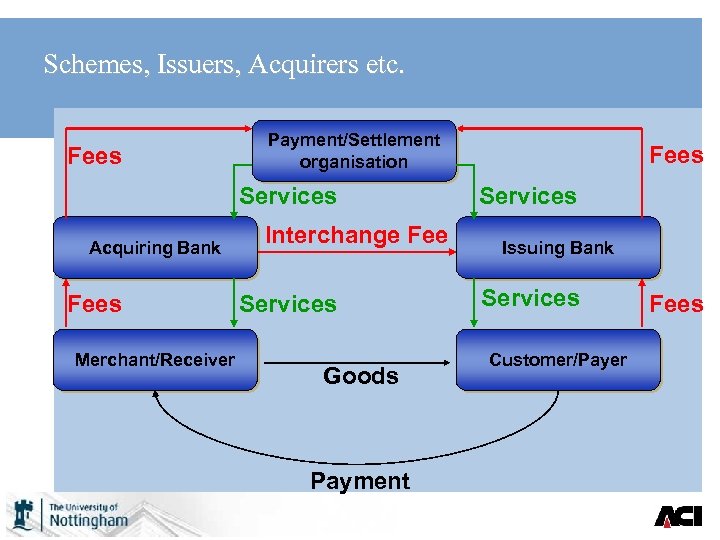 Schemes, Issuers, Acquirers etc. Fees Payment/Settlement organisation Services Acquiring Bank Fees Merchant/Receiver Interchange Fee Services Goods Payment Fees Services Issuing Bank Services Customer/Payer Fees
 Fees enable all parties to make a profit • Banks pay fess to the scheme (Link, VISA etc) – Monthly fees and per-transaction fees • Merchant pays fees to their acquiring bank – Monthly fees – Per-transaction fees • Customer pays fees to their issuing bank – Monthly fees etc. (it’s often hidden !!) • Interchange Fee (between banks) is a very contentious issue for Merchants – Wal. Mart won $1 bn in damages in 2003 from VISA and Master. Card because it’s anti-competitive
 Merchants must follow the rules to get payment • Merchant is guaranteed payment if: – Card Reader can read chip cards – Card was present at time of purchase – Card is valid – Card has no chip and signature checked • On. Line Merchant not guaranteed payment – Unless using ‘secure method’
 On-line merchants take big risks • Merchant accepts risk in all Internet transactions • Sometimes the acquiring bank will accept some losses to keep the relationship sweet • But the bank will charge big fees to the merchant for the increased risks • 50% of all disputed transactions are generated by Internet transactions
 Agenda • History of Payments – From barter to mobile phones • Payments are a Business – Fees, Rules, Risks, Rewards, Liabilities • Recent & Current Developments – Fraud in the real world: Chip&PIN – Fraud in the virtual world@: SET, 3 D Secure, Tokens • Future Developments – New payment schemes – 4 Market Forces
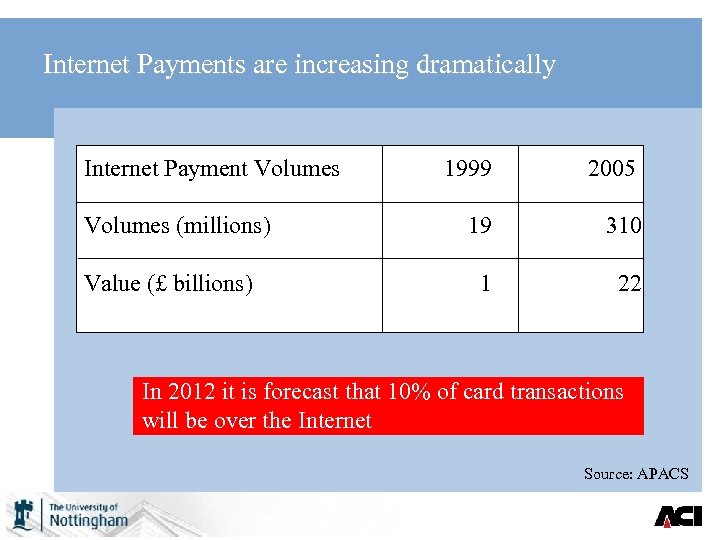 Internet Payments are increasing dramatically Internet Payment Volumes (millions) Value (£ billions) 1999 2005 19 310 1 22 In 2012 it is forecast that 10% of card transactions will be over the Internet Source: APACS
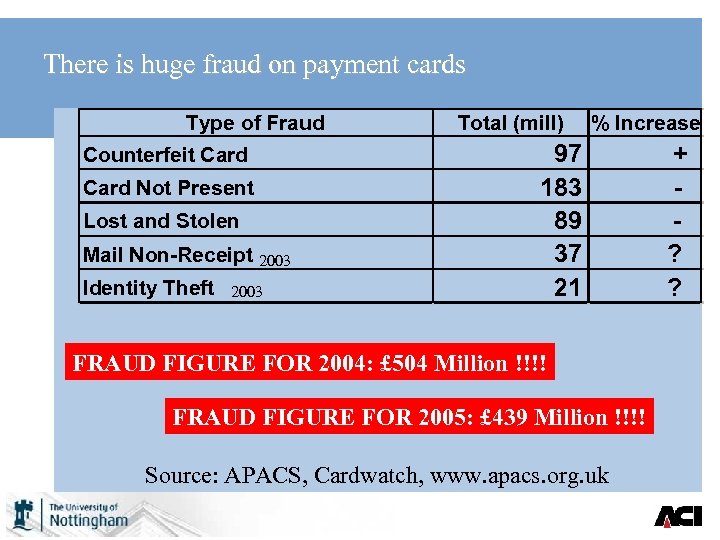 There is huge fraud on payment cards Type of Fraud Counterfeit Card Not Present Lost and Stolen Mail Non-Receipt Identity Theft 2003 Total (mill) % Increase 97 183 89 37 21 FRAUD FIGURE FOR 2004: £ 504 Million !!!! FRAUD FIGURE FOR 2005: £ 439 Million !!!! Source: APACS, Cardwatch, www. apacs. org. uk + ? ?
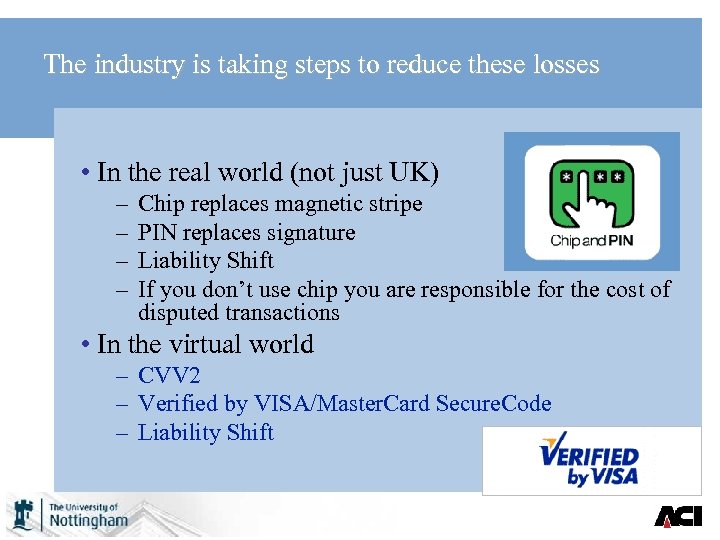 The industry is taking steps to reduce these losses • In the real world (not just UK) – – Chip replaces magnetic stripe PIN replaces signature Liability Shift If you don’t use chip you are responsible for the cost of disputed transactions • In the virtual world – CVV 2 – Verified by VISA/Master. Card Secure. Code – Liability Shift
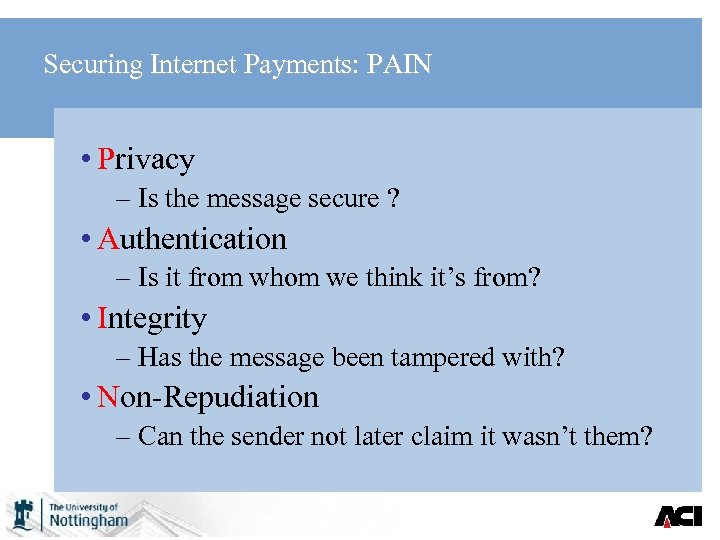 Securing Internet Payments: PAIN • Privacy – Is the message secure ? • Authentication – Is it from whom we think it’s from? • Integrity – Has the message been tampered with? • Non-Repudiation – Can the sender not later claim it wasn’t them?
 Why did SET fail ? • Secure Electronic Transaction (SET) was a standard designed to provide Internet payment security • SET was designed by technologists – Very secure, very sophisticated … – … and very hard to use !! • No thought given to implementation – Merchants don’t want it until customers have it – Customers don’t see a need if merchants don’t use it • An expensive lesson: Security and useability are a trade-off
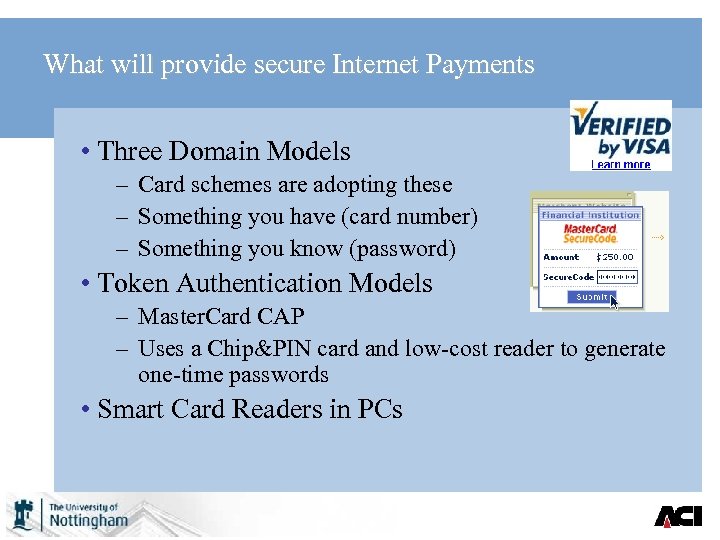 What will provide secure Internet Payments • Three Domain Models – Card schemes are adopting these – Something you have (card number) – Something you know (password) • Token Authentication Models – Master. Card CAP – Uses a Chip&PIN card and low-cost reader to generate one-time passwords • Smart Card Readers in PCs
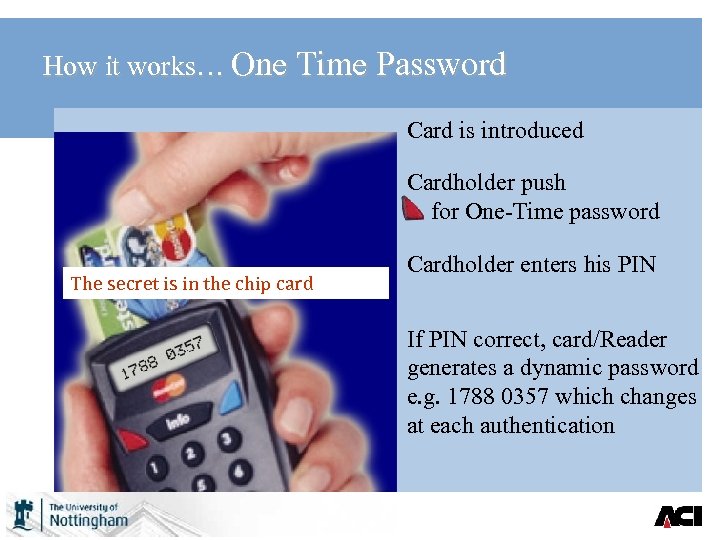 How it works… One Time Password Card is introduced Cardholder push for One-Time password The secret is in the chip card Cardholder enters his PIN If PIN correct, card/Reader generates a dynamic password e. g. 1788 0357 which changes at each authentication
 Agenda • History of Payments – From barter to mobile phones • Payments are a Business – Fees, Rules, Risks, Rewards, Liabilities • Recent & Current Developments – Fraud in the real world: Chip&PIN – Fraud in the virtual world@: SET, 3 D Secure, Tokens • Future Developments – New payment schemes – 4 Market Forces
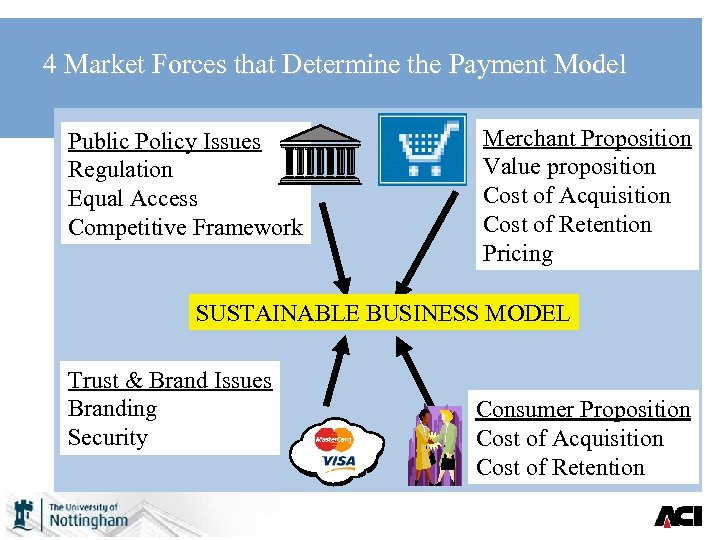 4 Market Forces that Determine the Payment Model Public Policy Issues Regulation Equal Access Competitive Framework Merchant Proposition Value proposition Cost of Acquisition Cost of Retention Pricing SUSTAINABLE BUSINESS MODEL Trust & Brand Issues Branding Security Consumer Proposition Cost of Acquisition Cost of Retention
 Public Policy Issues determine the shape of a payment system • Banking Regulation – UK and European Regulation, especially SEPA – Banking and Electronic Money Licences • Pricing Transparency – Competitive Framework Required • Anti-Monopolistic Behaviour – Must not exclude potential entrants – Banks DO operates as a cartel • Security and Fraud Issues – Money Laundering, criminal funding REGULATION IS THE BIGGEST DRIVER FOR CHANGE
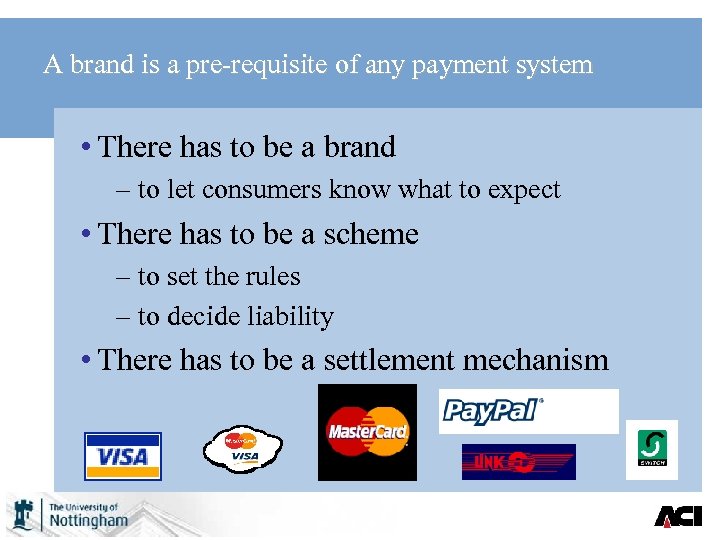 A brand is a pre-requisite of any payment system • There has to be a brand – to let consumers know what to expect • There has to be a scheme – to set the rules – to decide liability • There has to be a settlement mechanism
 Merchants are crucial to a payment system • Banks have a comprehensive Merchant Account base • Relationship is much more than payments • Enrolment, retention, training, support • Banks often make more money from merchant relationships than consumers • There is huge tension between banks and merchants
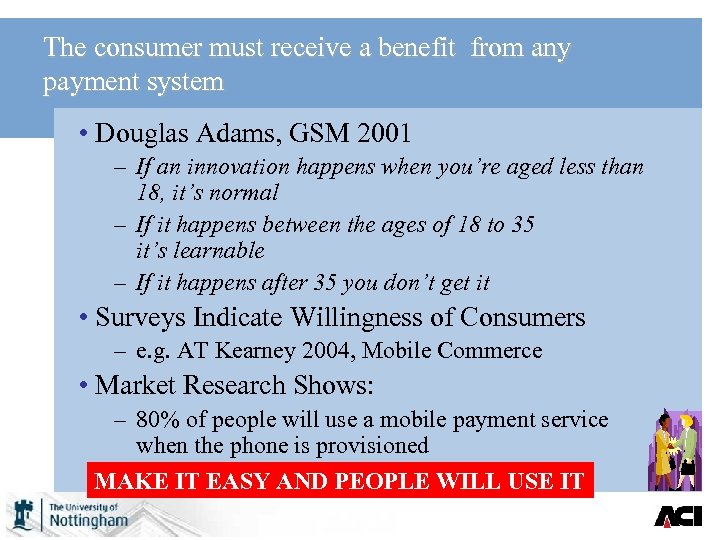 The consumer must receive a benefit from any payment system • Douglas Adams, GSM 2001 – If an innovation happens when you’re aged less than 18, it’s normal – If it happens between the ages of 18 to 35 it’s learnable – If it happens after 35 you don’t get it • Surveys Indicate Willingness of Consumers – e. g. AT Kearney 2004, Mobile Commerce • Market Research Shows: – 80% of people will use a mobile payment service when the phone is provisioned MAKE IT EASY AND PEOPLE WILL USE IT
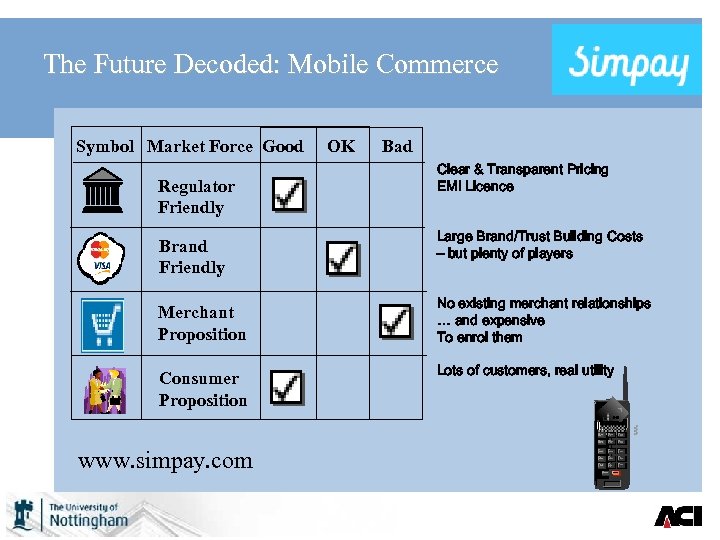 The Future Decoded: Mobile Commerce Symbol Market Force Good Regulator Friendly Brand Friendly Merchant Proposition Consumer Proposition www. simpay. com OK Bad Clear & Transparent Pricing EMI Licence Large Brand/Trust Building Costs – but plenty of players No existing merchant relationships … and expensive To enrol them Lots of customers, real utility
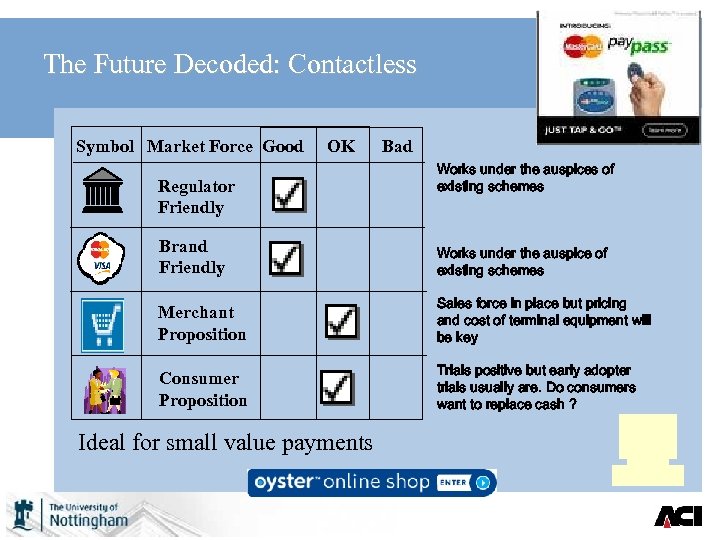 The Future Decoded: Contactless Symbol Market Force Good OK Regulator Friendly Bad Works under the auspices of existing schemes Brand Friendly Works under the auspice of existing schemes Merchant Proposition Sales force in place but pricing and cost of terminal equipment will be key Consumer Proposition Trials positive but early adopter trials usually are. Do consumers want to replace cash ? Ideal for small value payments
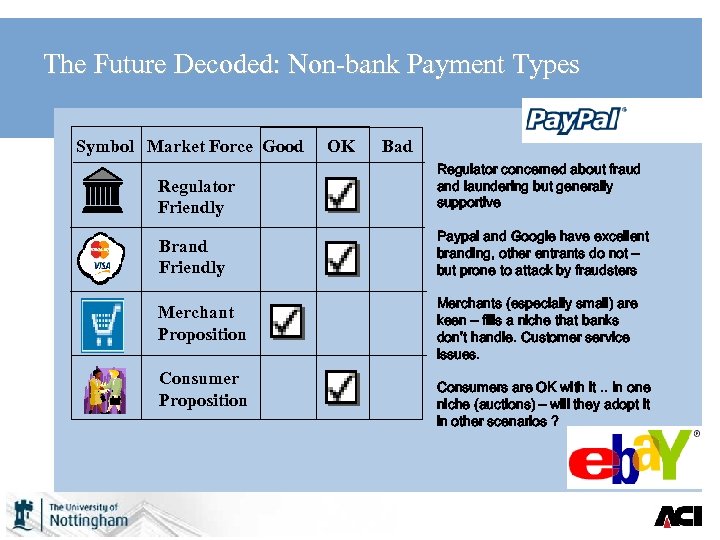 The Future Decoded: Non-bank Payment Types Symbol Market Force Good OK Bad Regulator Friendly Regulator concerned about fraud and laundering but generally supportive Brand Friendly Paypal and Google have excellent branding, other entrants do not – but prone to attack by fraudsters Merchant Proposition Merchants (especially small) are keen – fills a niche that banks don’t handle. Customer service issues. Consumer Proposition Consumers are OK with it. . In one niche (auctions) – will they adopt it in other scenarios ?
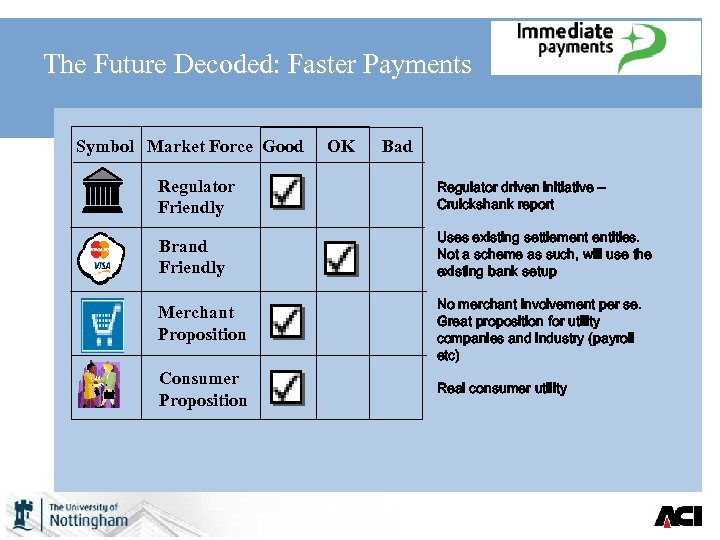 The Future Decoded: Faster Payments Symbol Market Force Good OK Bad Regulator Friendly Regulator driven initiative – Cruickshank report Brand Friendly Uses existing settlement entities. Not a scheme as such, will use the existing bank setup Merchant Proposition No merchant involvement per se. Great proposition for utility companies and industry (payroll etc) Consumer Proposition Real consumer utility
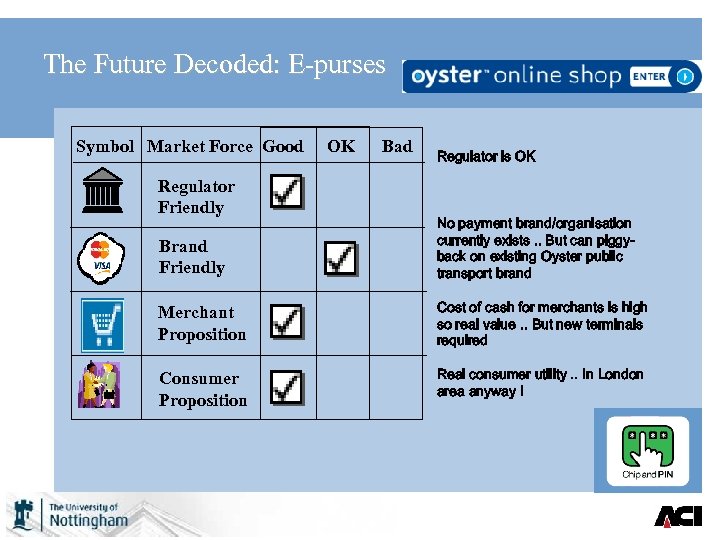 The Future Decoded: E-purses Symbol Market Force Good Regulator Friendly OK Bad Regulator is OK Brand Friendly No payment brand/organisation currently exists. . But can piggyback on existing Oyster public transport brand Merchant Proposition Cost of cash for merchants is high so real value. . But new terminals required Consumer Proposition Real consumer utility. . In London area anyway !
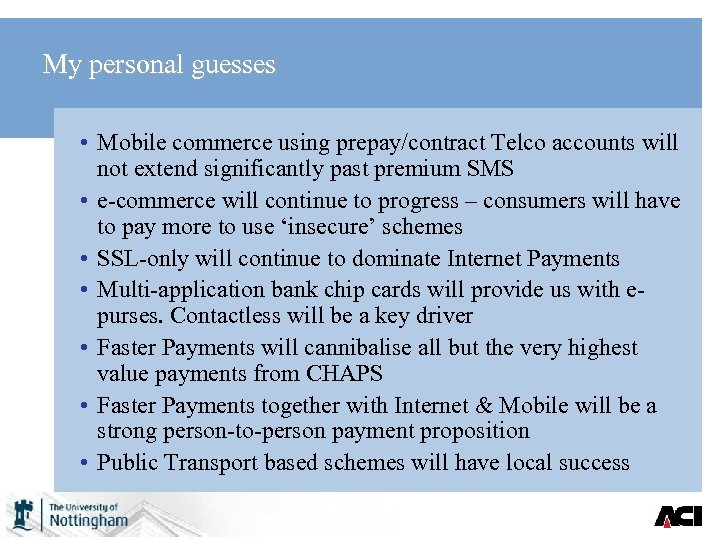 My personal guesses • Mobile commerce using prepay/contract Telco accounts will not extend significantly past premium SMS • e-commerce will continue to progress – consumers will have to pay more to use ‘insecure’ schemes • SSL-only will continue to dominate Internet Payments • Multi-application bank chip cards will provide us with epurses. Contactless will be a key driver • Faster Payments will cannibalise all but the very highest value payments from CHAPS • Faster Payments together with Internet & Mobile will be a strong person-to-person payment proposition • Public Transport based schemes will have local success
 Finally But …Cash will always be king especially, if you owe me money
 www. aciworldwide. com