 Скачать презентацию Digital Libraries Variety of perspectives and models Tefko
63370c8c8663936d35d50bbe70f923e8.ppt
- Количество слайдов: 29



Digital Libraries: Variety of perspectives and models Tefko Saracevic, Ph. D. School of Communication, Information and Library Studies Rutgers University New Brunswick, New Jersey, U. S. A. tefko@scils. rutgers. edu http: //www. scils. rutgers. edu/people/ faculty/tefko. html Tefko Saracevic, Rutgers University
On the scene F Several different communities involved in digital libraries, each with quite different èperspectives, concepts, meanings in dealing èconcentration, emphasis, approach F Many disciplines, institutions involved F National & global interest F Large research and developmental projects F Large operational projects F Large commercial undertakings Tefko Saracevic, Rutgers University 2
Why? F Evolution of information society èrole of knowledge & knowledge records èimportance to records in digital forms F Strategic place of information èto society, economy, future èstrategic policies for support in many countries èdigital libraries part of that strategy F Technological èjust imperative the right time for application to DL Tefko Saracevic, Rutgers University 3
Basic problems addressed F Creating means & ways for dealing with & using human knowledge records in the new digitalized and networked world F What to do with the electronic “book”, journals, publications, images, sounds, assembly of data? F Problems are technical, organizational, managerial, social, legal, economic, cultural … F Digital revolution may be as far reaching as that created by Gutenberg & the printed book Tefko Saracevic, Rutgers University 4
What is a DIGITAL LIBRARY? F No single, all-encompassing answer F Several perspectives è from different communities - different agendas F Little communication among them F Coherent, integrating concept, approach not yet emerged - but do we need? F Complex problems in any approach èMany F Highly experiments; many experts & “experts” exciting & volatile area; big $$$$$ Tefko Saracevic, Rutgers University 5
Criteria 1. User community 2. Digital collection 3. Organization - physical, intellectual 4. Interface - access, physical, intellectual 5. Delivery 6. Persistence Tefko Saracevic, Rutgers University 6
Research support: two models 1. Digital Libraries Initiatives approach: èseek & fund research topics, mostly in technological areas èExamples: u DLI 1 & 2 in the US u ERCIM DLI: DELOS working group 2. Collaboration seeking approach èinvolving different communities: libraries, publishers, institutions, users … èGermany: Global Info; UK: electronic libraries Tefko Saracevic, Rutgers University 7
Computer science, engineering F Concentrating on R&D F Technology centered èdistributed & organized knowledge resources in electronic, digital formats u diverse types of information – texts, images, sounds, multimedia ènew kind of distributed database services to manage unstructured multimedia resources F Important for infrastructure Tefko Saracevic, Rutgers University 8
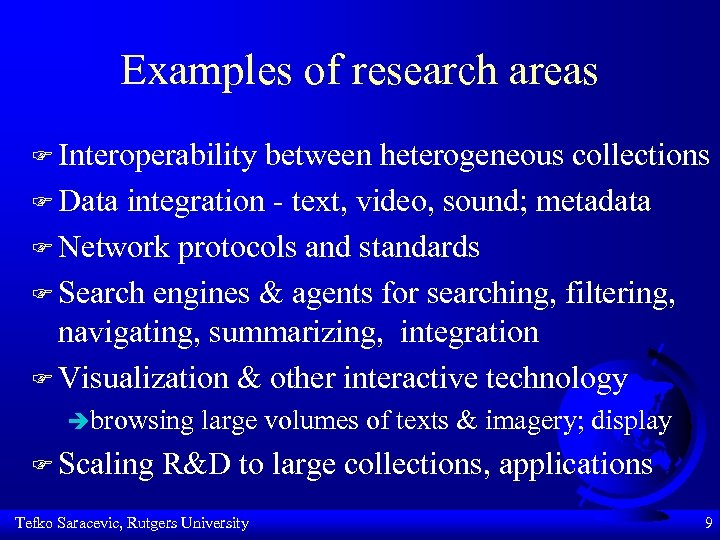
Examples of research areas F Interoperability between heterogeneous collections F Data integration - text, video, sound; metadata F Network protocols and standards F Search engines & agents for searching, filtering, navigating, summarizing, integration F Visualization & other interactive technology èbrowsing F Scaling large volumes of texts & imagery; display R&D to large collections, applications Tefko Saracevic, Rutgers University 9
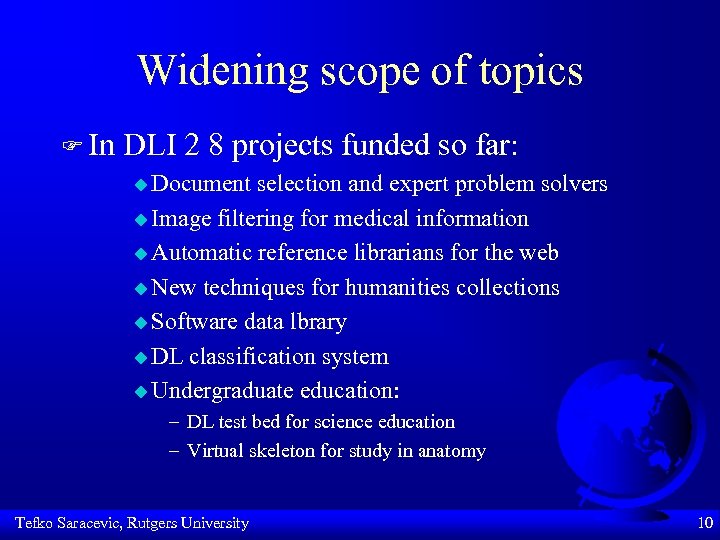
Widening scope of topics F In DLI 2 8 projects funded so far: u Document selection and expert problem solvers u Image filtering for medical information u Automatic reference librarians for the web u New techniques for humanities collections u Software data lbrary u DL classification system u Undergraduate education: – DL test bed for science education – Virtual skeleton for study in anatomy Tefko Saracevic, Rutgers University 10
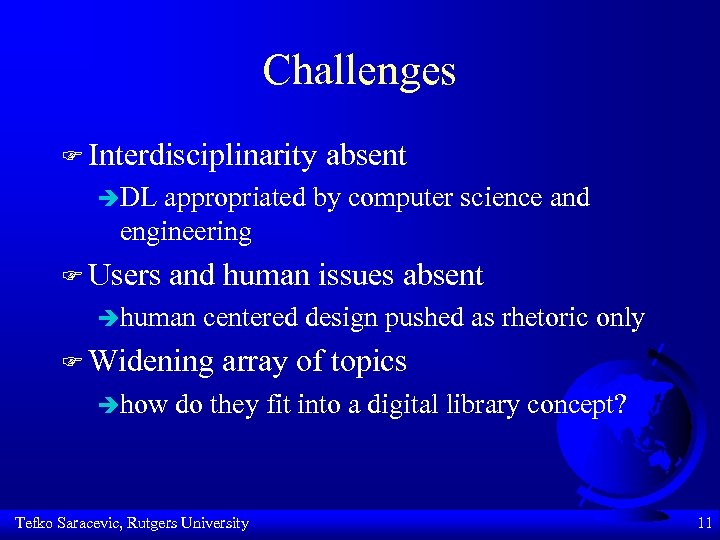
Challenges F Interdisciplinarity absent èDL appropriated by computer science and engineering F Users and human issues absent èhuman centered design pushed as rhetoric only F Widening èhow array of topics do they fit into a digital library concept? Tefko Saracevic, Rutgers University 11
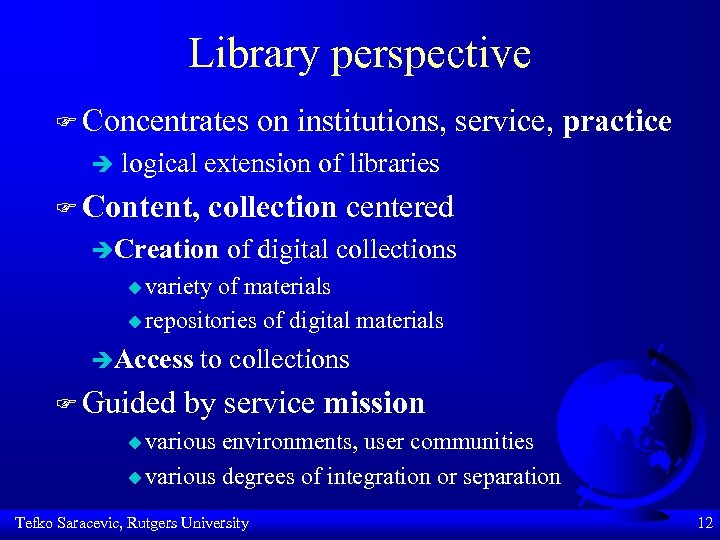
Library perspective F Concentrates è on institutions, service, practice logical extension of libraries F Content, collection centered èCreation of digital collections u variety of materials u repositories of digital materials èAccess to collections F Guided by service mission u various environments, user communities u various degrees of integration or separation Tefko Saracevic, Rutgers University 12
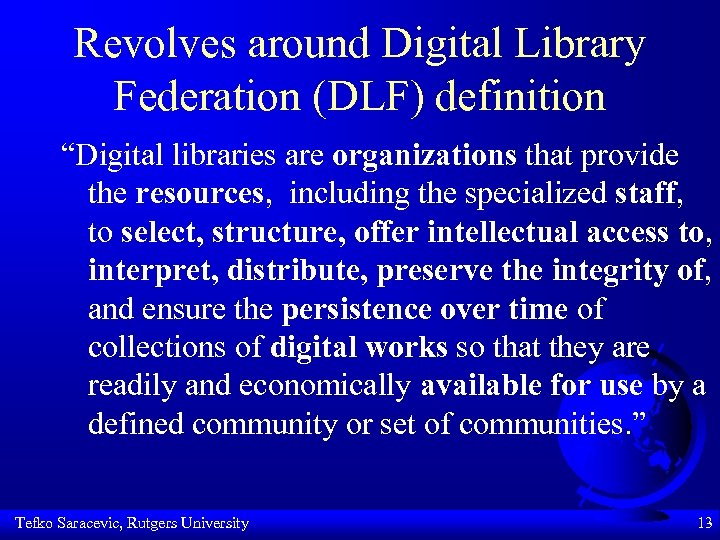
Revolves around Digital Library Federation (DLF) definition “Digital libraries are organizations that provide the resources, including the specialized staff, to select, structure, offer intellectual access to, interpret, distribute, preserve the integrity of, and ensure the persistence over time of collections of digital works so that they are readily and economically available for use by a defined community or set of communities. ” Tefko Saracevic, Rutgers University 13
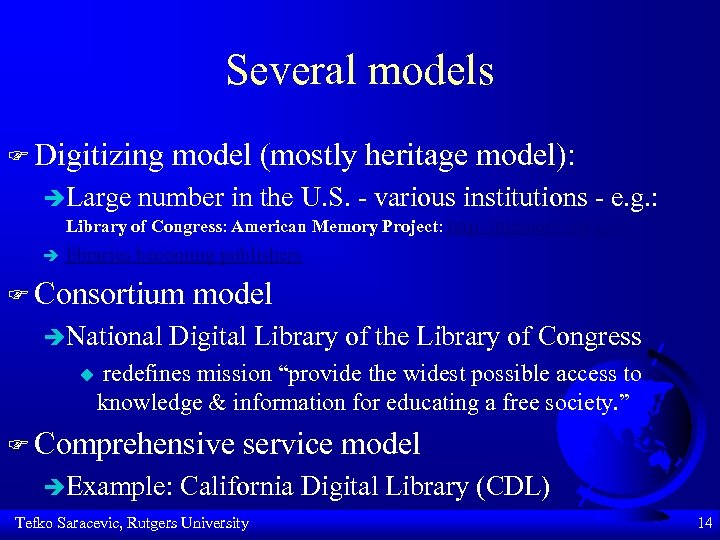
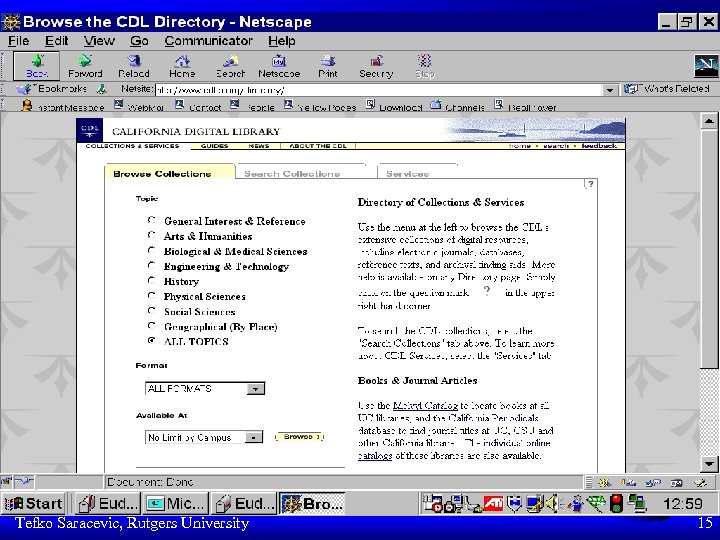
Several models F Digitizing èLarge model (mostly heritage model): number in the U. S. - various institutions - e. g. : Library of Congress: American Memory Project: http: //memory. loc. gov è libraries becoming publishers F Consortium èNational u model Digital Library of the Library of Congress redefines mission “provide the widest possible access to knowledge & information for educating a free society. ” F Comprehensive èExample: service model California Digital Library (CDL) Tefko Saracevic, Rutgers University 14
Tefko Saracevic, Rutgers University 15
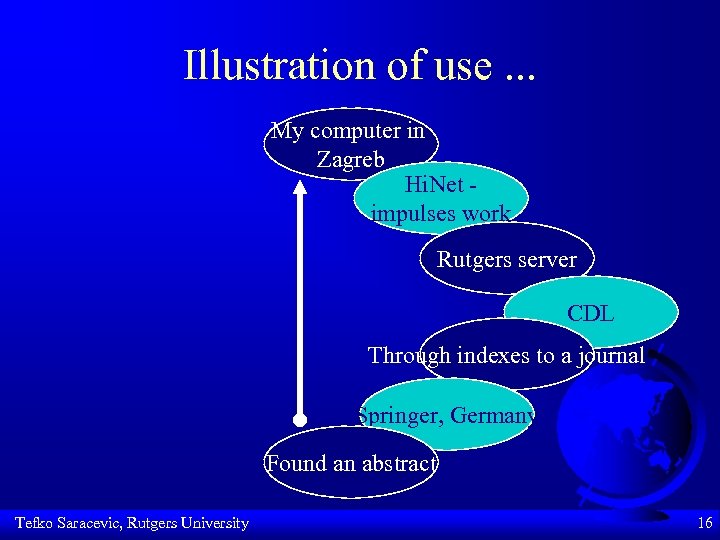
Illustration of use. . . My computer in Zagreb Hi. Net impulses work Rutgers server CDL Through indexes to a journal Springer, Germany Found an abstract Tefko Saracevic, Rutgers University 16
Challenges F Integration between print and digital èmixing new digital technology with print, local with global; managing diverse resources - all difficult F Competition for scarce resources sharpening F Institutional & social adjustments not easy F Resistance, threats: èguerilla warfare within and nuclear annihilation without Tefko Saracevic, Rutgers University 17
Disciplinary perspective F Concentrates on collections & new forms of publishing in their area - discipline centered F Association model: u scientific & technical societies provide DL in their area u Example: ACM Digital Library u Public access to a certain parts u Subscription for full text - subscription library model F Disciplinary èproviding u Brown èthese units model: collection of information in their field e. g. University Physics Internet Resources are more link than DL - handbook model Tefko Saracevic, Rutgers University 18
Publishing perspective F Commercial digital publishing u Example: Elsevier Science Direct & library model – own & other journals, mostly digitized print journals – indexes, abstracts, online services – various subscription, access & delivery modes F Replacement of scholarly u Example: e-Print archive journal model – submission of reports, archiving, searching & free access to full text in various science fields; issue of peer review not resolved F Newspaper model: u Example Wall Street Journal Online – coupling with newspaper morgue & many other resources Tefko Saracevic, Rutgers University 19
Exchange of roles F Libraries and publishers had a well defined relation - now it is blurring èpublishers have libraries èlibraries started publishing èpublishers provide server (“shelf”) space èlicensing rather than ownership becomes predominant transaction mode F Newspapers èbased discovered a new model on their strength of editorial processes Tefko Saracevic, Rutgers University 20
Policy perspective F Legal issues u copyright protection u database security u intellectual freedom u equity F Technical issues u standards u scaling u equity implementation F Above & beyond DL, but DL bring out Tefko Saracevic, Rutgers University 21
Futurists’ perspective F Concentrate on social future F Third wave centered èManifestation of the World Brain F Universal access to organized world’s knowledge F Prophesies: Disappearance of libraries, books, librarians F Utopian to a large degree Tefko Saracevic, Rutgers University 22
Economic issues F Costs not insignificant - WHO PAYS? èPresently F Dilemma R&D support from agencies - but after? in library budgets èlicensing of digital publications vs. subscriptions F Publishers’ economics for digital publications èapproaches vary, not settled, even scared èeven: who is a publisher? - lines blurring F Economics èroom of digital libraries still up in the air for research & experimentation Tefko Saracevic, Rutgers University 23
Social issues F Individual: èrole privacy protection; rights; obligations in information exchanges, work, needs; life. . . F Organizations: integration; changing structure F Traditional libraries: disappearing? changing? F Impact: on research, business, education? F Education: professional, continuing, general F Computing & society: growing disparity between information rich & poor Tefko Saracevic, Rutgers University 24
General opportunities F Building digital collections of national importance from existing texts, documents, images èhistorical, educational, strategic, legislative … F Creating new digital documents & linking them F Cataloging Internet resources in own domain F Selecting digital resources from wherever & creating & maintaining linkages F Developing/adapting search engines & other management tools for digital collections Tefko Saracevic, Rutgers University 25
General opportunities … continued F Providing access to digital collections F Integrating digital & other library collections èincl. integration of OPACs & library management tools F Establishing services for digital libraries èonline access & offline support èeducation & training of users, and librarians F Addressing social, legal, policy issues F Cooperative national & international ventures F Outsourcing services; going into business of DL Tefko Saracevic, Rutgers University 26
Conclusions “War is too important a matter to be left to the generals. ” Georges Clemenceau F Digital libraries are too important to be left to any one discipline, any one agency F Why? Work on digital libraries is defining the future of handling of human knowledge records F Caught a lot of interest globally & politically F They are also redefining the role of libraries in society & the role of librarians & inf. specialists Tefko Saracevic, Rutgers University 27
Conclusions … continued F Digital libraries provide challenge & opportunity for cooperative, interdisciplinary ventures F Provide a GREAT opportunity for many institutions to participate in many ways èHave room for smaller institutions & projects F Digital libraries will not replace libraries F But no matter what: libraries and information agencies cannot escape digital libraries, must change èso might as well actively join the movement Tefko Saracevic, Rutgers University 28
Tefko Saracevic, Rutgers University 29
Скачать презентацию Digital Libraries Variety of perspectives and models Tefko
63370c8c8663936d35d50bbe70f923e8.ppt