


 Скачать презентацию Digital Imaging CHAPTERS 1 4 -7 CARTER
532e9f0038ed20727c2f7b66ff30ab21.ppt
- Количество слайдов: 33
 Digital Imaging CHAPTERS 1, 4 -7 CARTER
 CHAPTER 1 • • • Conventional radiography Film/screen system Light exposes film Film processed with chemicals Film taken to radiologist for interpretation
 Let’s compare rooms for • Conventional (Film) • CR • DR
 Let’s compare image formation/acquisition • Film • CR • DR
 Let’s compare image processing • Film • CR • DR
 CR- Chapter 4 • • IP layers Protective Phosphor/active Reflective Conductive Color Support Backing barcode • Protects phosphor • • • PSP-barium fluorohalide Sends light forward when released in the reader Absorbs/reduces static electricity Absorb stimulating light (laser)/reflects emitted light Protects the back of cassette Match image with patient
 Reading the IP • Red laser light scans in a raster pattern at 2 e. V • Laser scans multiple times as IP moves through reader =translation • Light produced –detected by photomultiplier
 DIGITIZING • PHOSPHOR STORAGE CENTER IS SCANNED • RELEASED ELECTRON ENTER DIGITIZER DIVIDES THE ANALOG SIGNAL INTO SQUARES (MATRIX). • EACH SQUARE IS ASSIGNED A NUMBER BASED ON THE BRIGHTNESS OF THE SQUARE • SQUARE IS CALLED A PIXEL
 SPATIAL RESOLUTION • Film screen = 10 line pairs per mm • CR =2. 55 to 5 line pairs per mm (lp/mm) • Less detail in CR but more tissue densities seen given the appearance of better detail • Wider dynamic recording range
 speed • Film – determined by size and layers of crystals and phosphors • CR – amount of photostimulable luminescence given off = 100 film speed screen (approx)
 EXPOSURE –CASSETTE BASED-chapter 5 • What is the relationship between selecting the correct body part and computer interpretation of the image? • Too much k. Vp (above 120) and too little (below 45) can over excite or produce too little excitation of the phosphors • Does the pixel size of a 2000 x 2000 matrix change when using an 8 X 10 vs a 14 x 17 CRcassette? • How does the change in pixel size impact resolution?
 MOIRE PATTERN • Grid lines from a stationary grid can cause a wavy artifact known as a moire pattern. The grid lines and the scanning laser run parallel
 Exposure Indicators • Exposure indicator number • Fuji, Philips, Konica – S numberindirect relationship • Kodak –Exposure index (EI)-direct relationship • Page 88 tables 5 -1 and 5 -2
 HISTOGRAM • Graphic representation of the numerical tone (grays/blacks/whites) of an x-ray exposure • More when we move on to Chapter 7
 OTHER ARTIFACTS • Plate artifacts – Adhesive tape residue – cracks • Plate reader artifacts – Line patterns – Plate reader loads multiple IP in one cassette • Image processing artifacts – Incorrect erasure (ghosting) – moire • Printer artifacts – White lines
 CASSETTELESS Chapter 6 • Direct and indirect • DR plate (amorphous selenium) or(a. Se)-converts radiation into an electrical signal –CCD or silicon detectors • Signal stored in a Thin film transmitter (TFT)
 INDIRECT • Two step process • X-rays convert to light • Light converted to electrical signal • Sent to TFT DIRECT • X-rays converted directly to an electrical signal • Sent to TFT
 DQE • Detective Quantum Efficiency • Ability to convert an x-ray signal into a useful image • Of the following-which do you think has the most efficient DQE? • Film or CR or indirect capture DR or direct capture DR?
 Digital Radiographic Image Processing and Manipulation Chapter 7
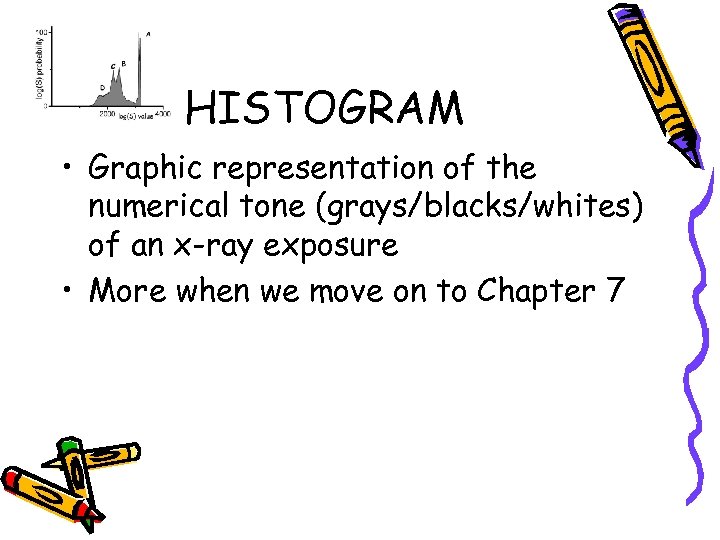
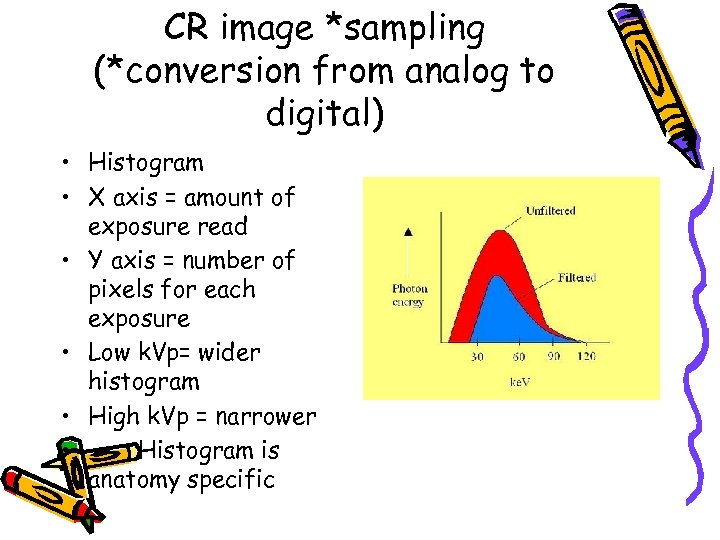 CR image *sampling (*conversion from analog to digital) • Histogram • X axis = amount of exposure read • Y axis = number of pixels for each exposure • Low k. Vp= wider histogram • High k. Vp = narrower • Histogram is anatomy specific
 histogram http: //bloggingradiography. blogspo t. com/2007/08/anatomy-ofhistogram. html
 NYQUIST THEOREM • When sampling(converting from analog to digital) a signal, the sampling frequency must be greater than the bandwidth of the input signal • http: //images. google. com/imgres? imgurl=h ttp: //www. cs. cf. ac. uk/Dave/Multimedia/ny quist. gif&imgrefurl=http: //www. cs. cf. ac. uk /Dave/Multimedia/node 149. html&h=420&w =529&sz=6&hl=en&start=10&um=1&tbnid=z y. DOLJNUH 6 m. M 8 M: &tbnh=105&tbnw=132 &prev=/images%3 Fq%3 Dnyquist%
 Sample? Try this at home • http: //www. pcguide. com/art/sound. Sa mple. Rate-c. html
 ALIASING • When the spatial frequency is greater than the Nyquist frequency and the sampling occurs less than twice per cycle, information is lost causing a moire effect.
 Automatic Rescaling • Fixing the image • Why is this dangerous?
 LUT and Windowing • Automatic rescaling to achieve appropriate contrast on an image • http: //www. sprawls. org/resources/D IGPROCESS/module. htm#13
 LATITUDE • Find the percentage the exposure can be greater or less than before it impacts the image in CR
 IMAGE MANIPULATION cont. • Window- how light or dark an image should be • Level-contrast • Background removal or shuttering – Removing the unexposed borders or to blacken the white borders
 MTF • Modular Transfer function • Reproducing the spatial resolution of an object as a diagnostic image • 100% of the spatial resolution of the object can never be perfectly reproduced – even with DR and CR – why? -See Bushong – pgs 451 -454
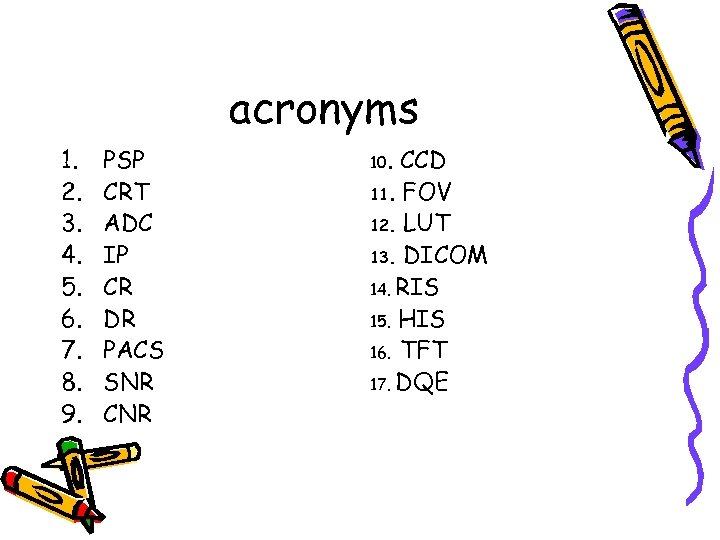 acronyms 1. 2. 3. 4. 5. 6. 7. 8. 9. PSP CRT ADC IP CR DR PACS SNR CNR 10. CCD 11. FOV 12. LUT 13. DICOM 14. RIS 15. HIS 16. TFT 17. DQE
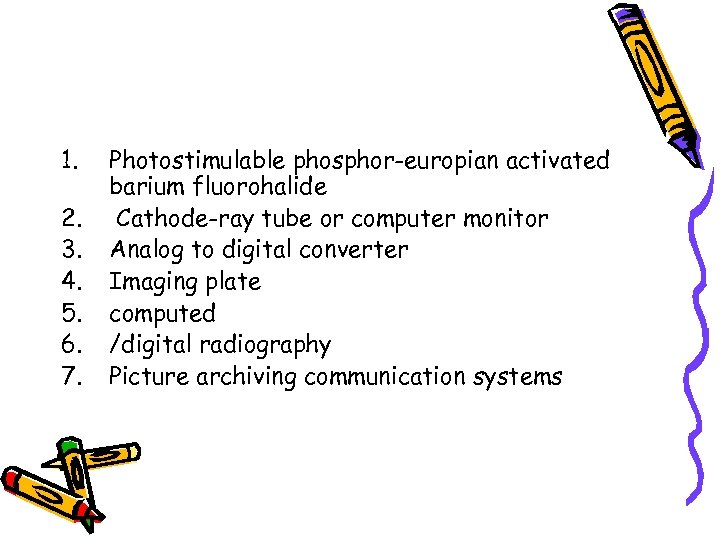 1. 2. 3. 4. 5. 6. 7. Photostimulable phosphor-europian activated barium fluorohalide Cathode-ray tube or computer monitor Analog to digital converter Imaging plate computed /digital radiography Picture archiving communication systems
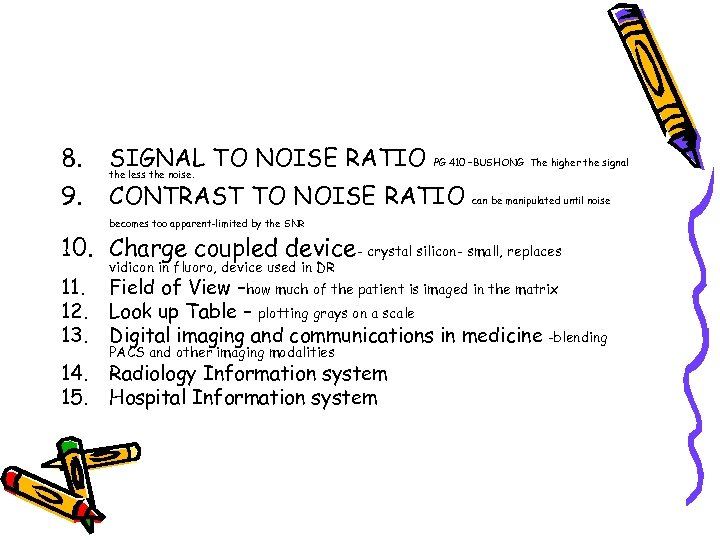 8. SIGNAL TO NOISE RATIO 9. CONTRAST TO NOISE RATIO the less the noise. PG 410 –BUSHONG The higher the signal can be manipulated until noise becomes too apparent-limited by the SNR 10. Charge coupled device- crystal silicon- small, replaces 11. 12. 13. 14. 15. vidicon in fluoro, device used in DR Field of View –how much of the patient is imaged in the matrix Look up Table – plotting grays on a scale Digital imaging and communications in medicine -blending PACS and other imaging modalities Radiology Information system Hospital Information system
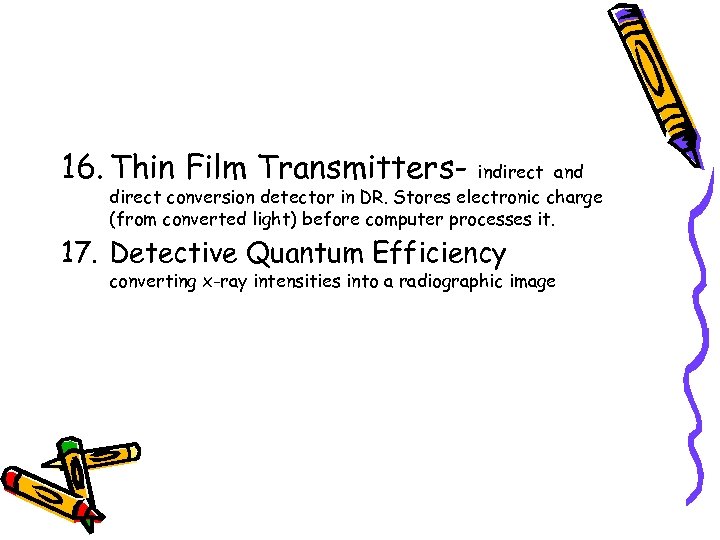 16. Thin Film Transmitters- indirect and direct conversion detector in DR. Stores electronic charge (from converted light) before computer processes it. 17. Detective Quantum Efficiency converting x-ray intensities into a radiographic image