 Скачать презентацию Digital Environment and IPRs Invited Talk by Dr
ed247ab55f3c2dcbd5526101bb34bf8a.ppt
- Количество слайдов: 36



Digital Environment and IPRs Invited Talk by Dr AL Moorthy Director, DESIDOC NACLIN-2009 24 September 2009 Punjab University, Chandigarh
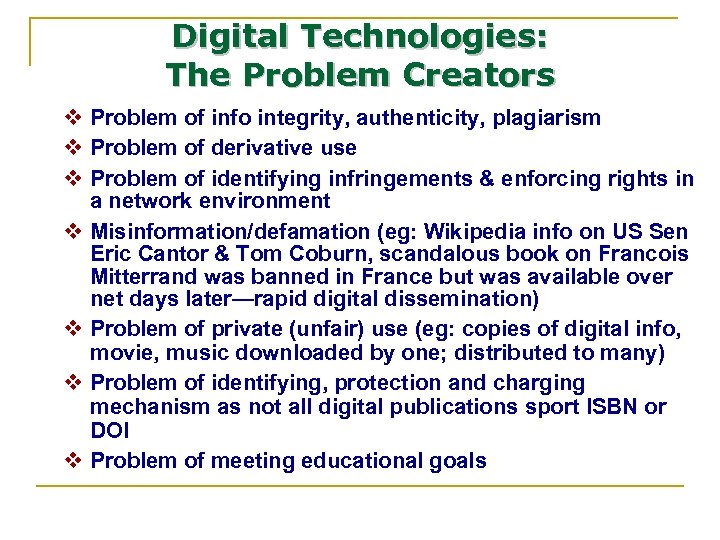
Digital Technologies: The Problem Creators v Problem of info integrity, authenticity, plagiarism v Problem of derivative use v Problem of identifying infringements & enforcing rights in a network environment v Misinformation/defamation (eg: Wikipedia info on US Sen Eric Cantor & Tom Coburn, scandalous book on Francois Mitterrand was banned in France but was available over net days later—rapid digital dissemination) v Problem of private (unfair) use (eg: copies of digital info, movie, music downloaded by one; distributed to many) v Problem of identifying, protection and charging mechanism as not all digital publications sport ISBN or DOI v Problem of meeting educational goals
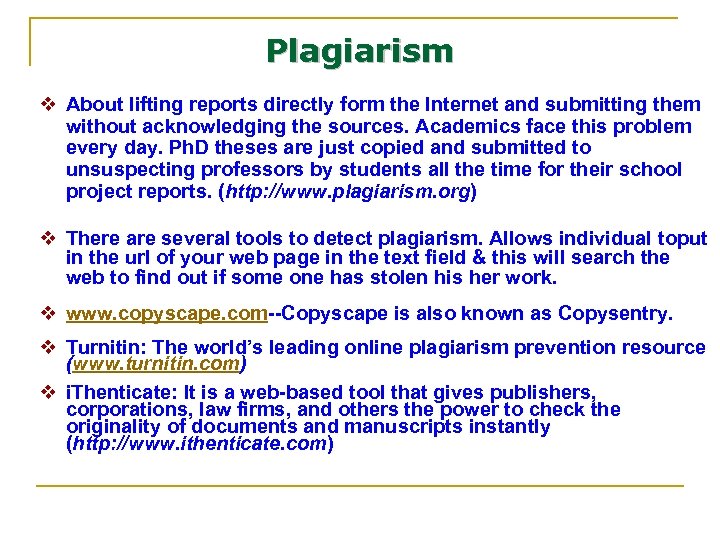
Plagiarism v About lifting reports directly form the Internet and submitting them without acknowledging the sources. Academics face this problem every day. Ph. D theses are just copied and submitted to unsuspecting professors by students all the time for their school project reports. (http: //www. plagiarism. org) v There are several tools to detect plagiarism. Allows individual toput in the url of your web page in the text field & this will search the web to find out if some one has stolen his her work. v www. copyscape. com--Copyscape is also known as Copysentry. v Turnitin: The world’s leading online plagiarism prevention resource (www. turnitin. com) v i. Thenticate: It is a web-based tool that gives publishers, corporations, law firms, and others the power to check the originality of documents and manuscripts instantly (http: //www. ithenticate. com)
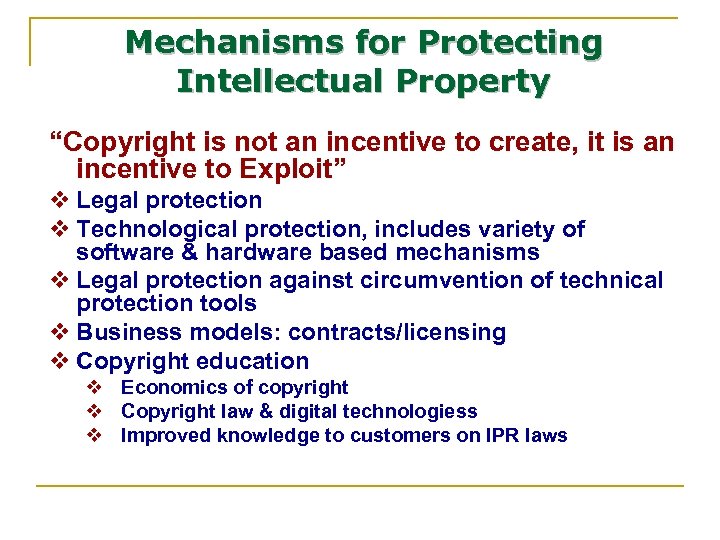
Mechanisms for Protecting Intellectual Property “Copyright is not an incentive to create, it is an incentive to Exploit” v Legal protection v Technological protection, includes variety of software & hardware based mechanisms v Legal protection against circumvention of technical protection tools v Business models: contracts/licensing v Copyright education v Economics of copyright v Copyright law & digital technologiess v Improved knowledge to customers on IPR laws
Digital Rights Management v Digital rights management (DRM) is a systematic approach to copyright protection for digital media. v. The purpose of DRMs is to prevent illegal distribution of paid content over the Internet. v. DRM products were developed in response to the rapid increase in online piracy of commercially marketed material, which proliferated through the widespread use of Napster and other peer-topeer file exchange programs.
Intellectual Property Rights v Allow exploitation of inventions and innovations v Protect from infringement of rights and exploitation by persons other than rights holders v Provide inspiration to creators of works to further create/ innovate v The International Intellectual Property Alliance (IIPA) is the watchdog monitoring international piracy v The gap between advanced and developing or underdeveloped economies is largely due to the level of penetration/percolation of the importance of IPRs in their societies. v Technology haves exploit technology have nots
Intellectual Property Rights v An intellectually rich country is characterized by strict IP laws, large number of patents filed, robust publishing industry, and of course, increased number of litigations v An important factor for economic growth of nations v Copyright-related industry—known as cultural or creative industry—contributes 3 to 6. 5 % to the GNP of countries (11. 12% for USA in 2005) v IPR-based Technologies led to decrease in the time for national income to double v “While it took 50 years for the United States to double its output in the mid-19 th century, and 60 years for Britain in the late-18 th century, a number of countries today are doubling output every 10 years —Marber (Knowledge Economist) Knowledge economy of UK was > 23 bn (US$ 45 bn) in 2005
IPR & Publications v Five countries, namely, USA, UK, Germany, France and Spain—account for nearly 60% of book exports v Book piracy ranges between 20 -30% in developed countries; around 60% in some forward looking countries with good copyright protection laws v In a few countries it is as much as 90% v Despite high level publicity, pre-publication booking of millions of copies, works of JK Rowling, Tolkien etc were pirated and sold
IPR & Films, Music, etc v Films are produced with high investments; any films are released on Internet before or just after the release of the film v Lending of imported DVDs from a country for home viewing in another country when the film is not released in that country v To determine piracy, rights owners employ private firms or send phony files, chaffs, decoys, etc to frustrate illegal users. Firms like Over Peer Inc (New York, USA) blocks over 200 million piracies per month. v RIAA maintains a list of songs the rights of which are held by its member institutions.
IPR & Films, Music, etc v Media Sentry, engaged by RIAA, is tasked to search for online pirates; the firm searches the titles of songs on Lime. Wire network if anyone is offering one of them on Internet. If any infringer is found, take down notices under the digital Millennium Copyright Act are sent. v Rights holders also exploit some times; Hari Puttar vs Harry Potter, Ghajini, Magadheera, Sholay vs RGV’s Aag, and so on. On many instances Courts were approached at the eleventh hour for stay and the “infringers” paid huge sums of money. v Courts have rightly rejected such last minutes litigations but awarded damages for the infringement when the original rights holder approached them in time.
Cyber Warfare v Information warfare vs Cyber warfare: Use of Malware to damage networks, sending data thru Botnet structures, Distributed Denial of Service, etc. v Use of metadata analyzers or data fusion techniques to decide illegal copies. v Research is going on for linking databases together and matching records of same characteristics to find out cyber frauds and cyber crimes v Cyber offences like theft of passwords are covered in a limited way under Sec 66 (computer hacking) of the IT Act necessitating simultaneous application of cheating or other provisions under IPC. Since India has emerged as an important destination for BPO & racing towards KPO, strong cyber-laws are needed.
IPR & Digital Environment v Digital Data is 281 billion gigabyte (or 281 EBs) in 2007 which is 10% larger than estimated. v With a CAGR of almost 60%, the digital universe is growing faster and is projected to be nearly 1. 8 ZBs (1, 800 EBs) in 2011, a 10 -fold increase during 20062011. That is, by 2011, the digital universe will be 10 times the size it was in 2006 v Digital environment makes copyright protection a difficult task v Unlike printed publications, close monitoring and restriction of usage of digital works is difficult v Due to the digital divide, there exists a gap in the intellectual capital possessed by technologically developed and not so developed nations.
Rights Protection in Digital Environment v WWW has become the primary publishing medium v Copyright laws apply to Internet and the Web v Various information resources on the web are © protected so long as they fulfill the originality criterion v Electronic transmission of copyrighted material by anyone other than the rights owner is infringement v The copyright laws hold the Internet Service Providers responsible for the infringements by their users, unless they prove that they are complying with security measures to protect rights
Rights Protection in Digital Environment v Internet is creating new and newer avenues for rights and consumer privacy violations v Most of the copying over Internet does not qualify under exceptions of fair dealing/fair use v Copyright laws do not clearly distinguish electronic information from print media thus making it difficult to apply fair dealing laws to the digital environment v Advances in technology have produced radical shifts in the ability to reproduce, distribute, control, and publish information v With its commercialization and integration into everyday life, the information infrastructure has run headlong into intellectual property law.
Web Publishing Web is providing a dynamic and challenging environment for authors. It provides authors a medium to publish, thereby retaining rights of their works (conventional publisher control copyright). www. Lulu. com: Web’s premier independent publishing market place for digital do-it-yourselfers. One can publish, sell or buy anything: digital books, films, music, comics, photos. It provides a mechanism to publish and tools to control the content.
Issues and Concerns Accessing Digital Information v Stakeholders are many and varied v Public expects that digital information should be quickly, cheaply and freely available. v Content creators have different agendas handle IP according to varying strategies, and look for different kinds of returns on their investment (Eg: Traditional vs Web publishing) v Fundamental legal concepts can be interpreted differently (eg: Fair Use, paracopyright) v Laws and practices vary worldwide, yet networks have global reach (IP owners, servers, users in different countries—whose laws will apply? ) v The economics of information products and IP can be subtle (eg: contribution of IP to country’s economy).
Issues and Concerns Accessing Digital Information v Public Access Copying and access Print vs dig info: Affects authors and pubs who wish to distribute dig pubs; web allows access, yet to protect IP Archiving and preservation Licensee cannot archive, perpetual access; digital publication depositaries (vs print) Access to Government Information v Individual Access Private use and diminishing scope of Fair use Dig Techs provide opportunities and challenges for Authors and Publishers v OA is not Free—somebody has to pay for its creation, aggregation, hosting and dissemination of the digital material. Someone has to own and control it.
Concerns of Digital Info v Cite. Seer, a popular online DL, automatically indexes digital documents v DLs cannot distinguish copyright material from author posted material. Can DLs allow printing papers whenever needed or only once copy allowed? Online DLs are likely to violate one or more copyright regulations. v Few Libraries have trained staff to examine each digital document, find rights owners, seek permission to download or add to an online collection. v One way is authors making explicit what is permitted on Internet. Alternatives are using GPL of FSF or GNU Free Document License or CC license that gets some or all of author’s rights to public. Yahoo and Google allow users to search only CC licensed documents (<1% of total documents available in these systems).
Licensing v License is a legal method of voluntary transfer of ownership of an intellectual property over a definite period. v In simple words this is the permission by the owner of an IP to another persons or legal entity to perform or enjoy the exclusive rights of the owner as per the mutually agreed terms and conditions during a mutually agreed period of time. v Licensor licenses the licensee: Publishers are licensors of other people’s IP; But they license the licensor institutions and makes them licensees
Licensing Digital Content v Licensed content comes with a set of terms and conditions, or clauses, that govern the permitted use of that content. v No two licensees are identical v License should clearly define the content. It should have content name, licensor’s complete details, rights, terms and condition, perpetual license, mode of payment (annual/ renewal) etc. v Standard clauses like warranties, indemnity & liability limitation, governing laws and amendments, dispute resolution/arbitration, jurisdiction should also be ensured.
Licensing Digital Content v Two types of rights are granted through license v Exclusive: Owner may only grant the content to one enterprise at any given time. v Non-exclusive: Owner may grant another enterprise the right to use the same content at the same time. v Most licenses for databases, online journals, images and photographs are non-exclusive v Why should creators of copyright works in future would create material for which no control or no income is guaranteed?
Concerns of E-books v Book publishing is in transition to E-books (aka Music 10 years ago). Amazon sells e-books at flat rate of US$ 9. 99 and Amazon Kindle is easier for eyes to read v Whispernet delivers newspapers through mobile nets. v These books use proprietary format ØLimitation of transfer to other media or lend them to friends v Fictionwire. com sells e-books of multiple formats, but a majority are encrypted. v Pdf form e-books can be transmitted but are prone to piracy. v Once Google Digital Library is operational, millions of books will be available—many out of print and orphan works.
Issues in E-access v E-Books Onetime Payment vs Renewals Annual Licensing Back-up Copy Perpetual Access Bundling/Minimum No. of Titles v E-Standards Annual Licensing & Perpetual Dependence Revised Standards vs All Standards Time Lock/Software Lock Perpetual Access Exorbitant Pricing
Issues in E-access v E-Journals/Online Journals Pricing for print, print+online Back-up copy Content fee Cross-sharing fee Additional charges Bundling of journals Multiplication by No. of labs Abnormal pricing Differential pricing for different organizations Professional societies vs commercial publishers Perpetual access Problems when subscriptions are discontinued
Issues in E-preservation v Formats & standards v Open access/open archives v Institutional archiving/repositories v Self archiving v Proving which e-version is the correct scholarly work when it is not clear which version is the authentic or correct one v Obsolescence of technology for preservation
Unfair Practices by Content Owners v Intellectual capital is transferred to publishers v Publishers do not spend anything to the R&D carried out by the author nor do spend towards pre-publication process expenditure of US$ 500 to 1000 per paper approx is borne by the academic community voluntarily. v The institutions are transferring rights freely only to buy back its intellectual/knowledge capital after publication in a journal. v Some publishers do not provide perpetual access to the content subscribed by institutions; current year and two or three year’s back files only accessible as publisher’s policy AND charge huge amount for back files. v A weekly journal charges more than 11 times of print value for online access (Rs 4. 73 vs 53. 97 lakhs for 29 sites) v For the same number of sites and journals one publisher charges different amounts from two different organizations v No standard pricing model for digital objects.
Unfair Practices by Content Owners v IPRs designed to Encourage Creativity and Enhance Learning. But on the Web © is used to silence; Companies are exploiting legal loopholes to censor websites without going to Courts (Eg: ISPs/Web hosts like Google receive “takedown notices”). v World is moving towards open access (OA) and self archiving (SA) as they enhances the visibility of authors’ knowledge capital, R&D, citability. But not all publishers accept/allow OA or SA. v Springer’s Open Choice allows authors retain copyright for a basic fee v Taylor & Francis’ Open Access makes an author’s research output freely available for one time fee of US$3100. v Campaigns by JISC in UK and SURF in the Netherlands persuade authors to retain copyright of their scholarly work.
What is Needed? v Federation/association of Indian consortia v Single agency (Government) to negotiate with publishers and decide the subscription charges for various educational and R&D institutions v Strong cyber laws v Failure to ensure reasonable pricing and terms for licensing encourages promotes piracy (eg: Napster, Olga) v i. Tunes started providing DRM free music and now is the largest seller of music in the world.
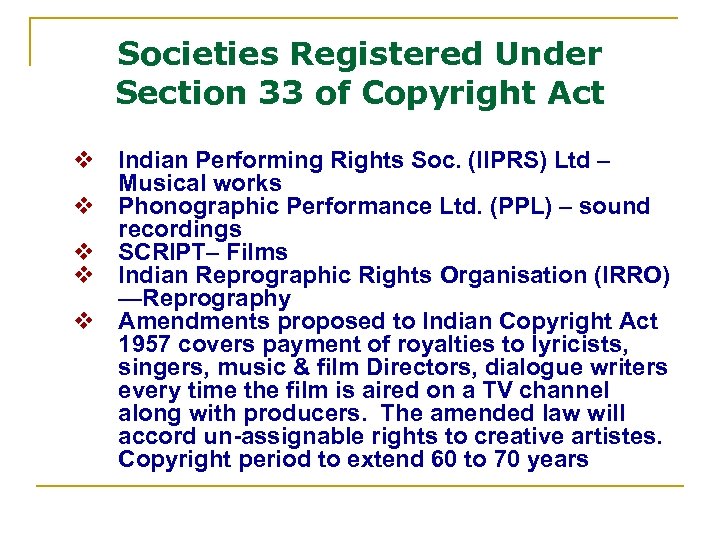
Societies Registered Under Section 33 of Copyright Act v Indian Performing Rights Soc. (IIPRS) Ltd – Musical works v Phonographic Performance Ltd. (PPL) – sound recordings v SCRIPT– Films v Indian Reprographic Rights Organisation (IRRO) —Reprography v Amendments proposed to Indian Copyright Act 1957 covers payment of royalties to lyricists, singers, music & film Directors, dialogue writers every time the film is aired on a TV channel along with producers. The amended law will accord un-assignable rights to creative artistes. Copyright period to extend 60 to 70 years
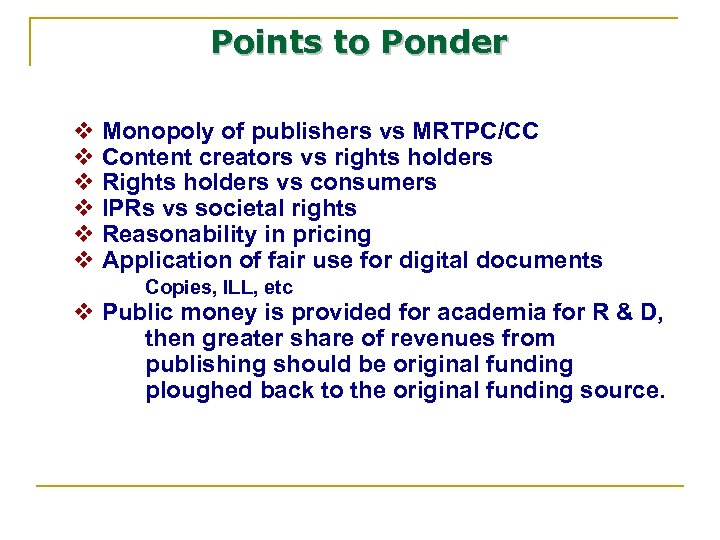
Points to Ponder v Monopoly of publishers vs MRTPC/CC v Content creators vs rights holders v Rights holders vs consumers v IPRs vs societal rights v Reasonability in pricing v Application of fair use for digital documents Copies, ILL, etc v Public money is provided for academia for R & D, then greater share of revenues from publishing should be original funding ploughed back to the original funding source.
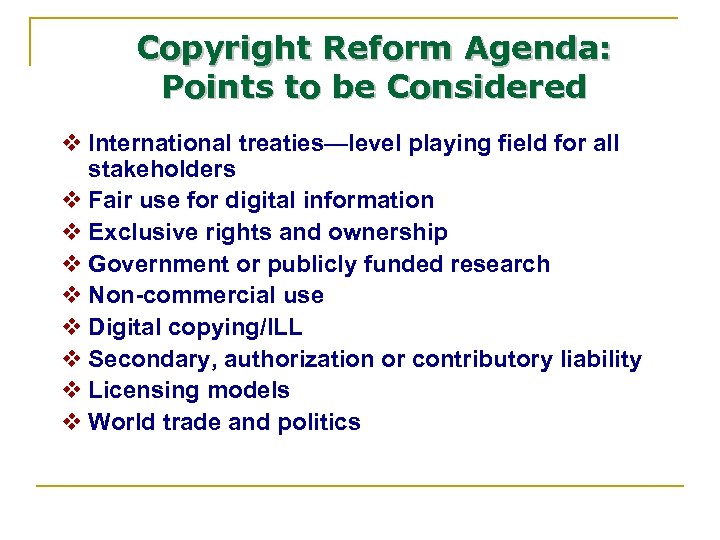
Copyright Reform Agenda: Points to be Considered v International treaties—level playing field for all stakeholders v Fair use for digital information v Exclusive rights and ownership v Government or publicly funded research v Non-commercial use v Digital copying/ILL v Secondary, authorization or contributory liability v Licensing models v World trade and politics
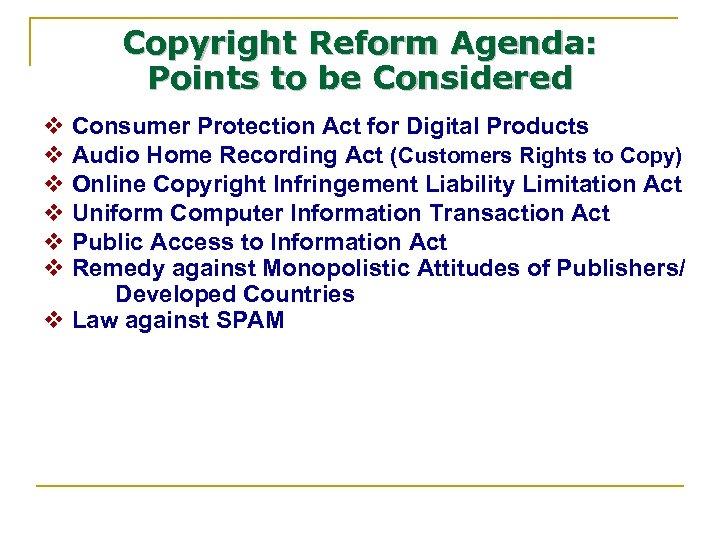
Copyright Reform Agenda: Points to be Considered v Consumer Protection Act for Digital Products v Audio Home Recording Act (Customers Rights to Copy) v Online Copyright Infringement Liability Limitation Act v Uniform Computer Information Transaction Act v Public Access to Information Act v Remedy against Monopolistic Attitudes of Publishers/ Developed Countries v Law against SPAM
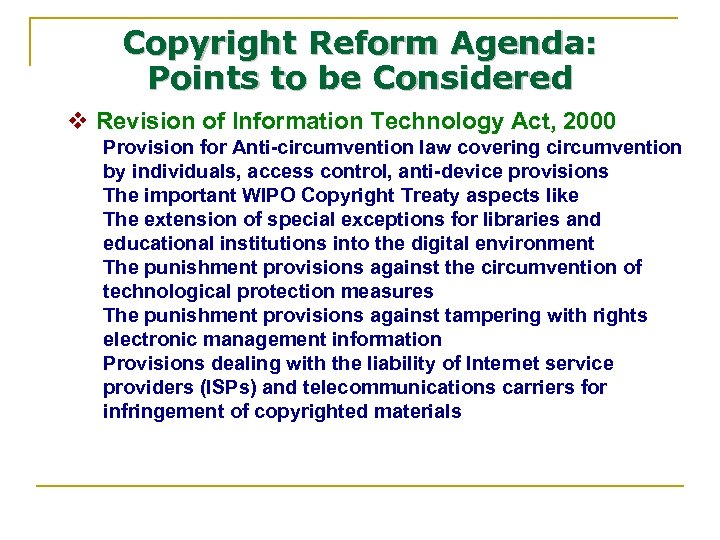
Copyright Reform Agenda: Points to be Considered v Revision of Information Technology Act, 2000 Provision for Anti-circumvention law covering circumvention by individuals, access control, anti-device provisions The important WIPO Copyright Treaty aspects like The extension of special exceptions for libraries and educational institutions into the digital environment The punishment provisions against the circumvention of technological protection measures The punishment provisions against tampering with rights electronic management information Provisions dealing with the liability of Internet service providers (ISPs) and telecommunications carriers for infringement of copyrighted materials
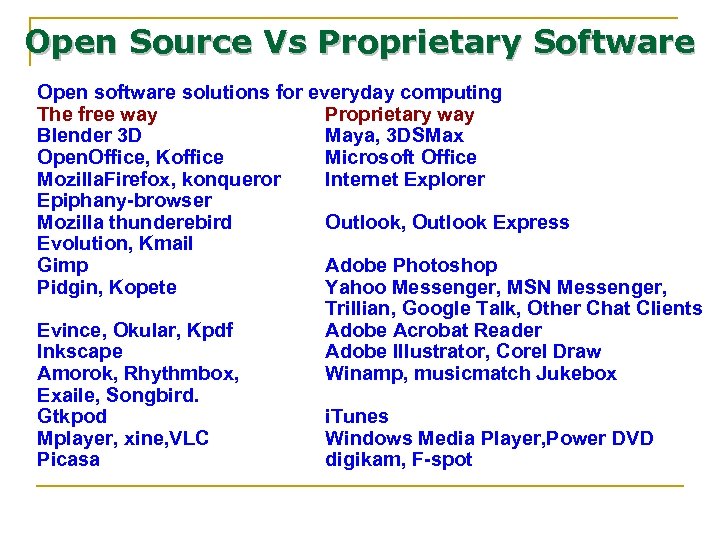
Open Source Vs Proprietary Software Open software solutions for everyday computing The free way Proprietary way Blender 3 D Maya, 3 DSMax Open. Office, Koffice Microsoft Office Mozilla. Firefox, konqueror Internet Explorer Epiphany-browser Mozilla thunderebird Outlook, Outlook Express Evolution, Kmail Gimp Adobe Photoshop Pidgin, Kopete Yahoo Messenger, MSN Messenger, Trillian, Google Talk, Other Chat Clients Evince, Okular, Kpdf Adobe Acrobat Reader Inkscape Adobe Illustrator, Corel Draw Amorok, Rhythmbox, Winamp, musicmatch Jukebox Exaile, Songbird. Gtkpod i. Tunes Mplayer, xine, VLC Windows Media Player, Power DVD Picasa digikam, F-spot
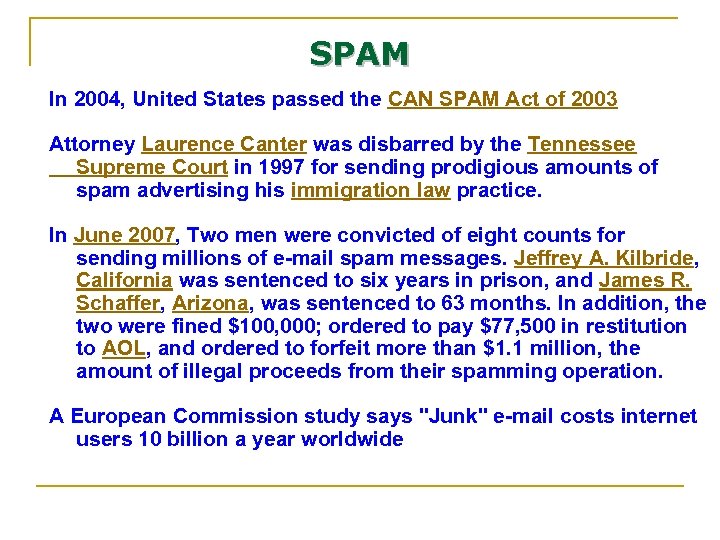
SPAM In 2004, United States passed the CAN SPAM Act of 2003 Attorney Laurence Canter was disbarred by the Tennessee Supreme Court in 1997 for sending prodigious amounts of spam advertising his immigration law practice. In June 2007, Two men were convicted of eight counts for sending millions of e-mail spam messages. Jeffrey A. Kilbride, California was sentenced to six years in prison, and James R. Schaffer, Arizona, was sentenced to 63 months. In addition, the two were fined $100, 000; ordered to pay $77, 500 in restitution to AOL, and ordered to forfeit more than $1. 1 million, the amount of illegal proceeds from their spamming operation. A European Commission study says "Junk" e-mail costs internet users 10 billion a year worldwide
Thank You Any Questions Please?
Скачать презентацию Digital Environment and IPRs Invited Talk by Dr
ed247ab55f3c2dcbd5526101bb34bf8a.ppt