


 Скачать презентацию Digital Cinema in Japan HPA Tech Retreat 2005
648bc460b155080343c46c33d2053643.ppt
- Количество слайдов: 21
 Digital Cinema in Japan HPA Tech Retreat 2005 Laurin Herr President Pacific Interface, Inc.
 Digital Cinema in Japan • • • Self-introduction Japanese cinema industry, market & trends Japanese digital cinema organizations Japanese digital cinema technology Japanese 4 K digital cinema activities
 Self Introduction of Laurin Herr • • • 1980 - present; founder and President, Pacific Interface Inc. , an international consulting company based in Oakland, California that coordinates research and business between people in Japan, America and Europe, primarily in the fields of high technology and media. 1982 - 92: ACM SIGGRAPH representative to Japan. Organized seminal computer graphics conferences in Japan. Produced two public exhibitions in Japan of the SIGGRAPH Computer Art Show. Conducted various market research projects for Japanese, American and European clients. Produced television programs in America for TV Asahi, NHK and TBS. Produced five Special Issues of the SIGGRAPH Video Review. 1995 - present: consultant to NTT Labs for Super High Definition (SHD) and Photonic Networking Applications 2000 - present: Advisory Member of the Digital Cinema Consortium of Japan In parallel, 1992 - 2004: senior executive at Super. Mac, Radius, Truevision, and Pinnacle Systems
 Japanese Cinema A Few Over-Simplistic Generalizations • While the Hollywood movie production business is often played as a highrisk, high-return, global “big hits” business, in Japan production is often approached more as a low-risk, low-return domestic “don’t fail” business. • Production budgets for Japanese feature films typically average less than $5 M with investment “consortium” formed by the Japanese studios from broadcasters, book publishers, and ad agencies that have distribution/marketing channels of their own. The members of the consortium gain seats on the “production committee” which jointly holds the copyright. Actual production is then entrusted to a producer/director who is in the relatively weak position of making a movie as a subcontractor to a committee. • Japanese cinema distribution and exhibition are less independent of each other than in USA, making the biggest domestic players quite dominant and offering less variety and choice for cinema audiences in Japan than in USA.
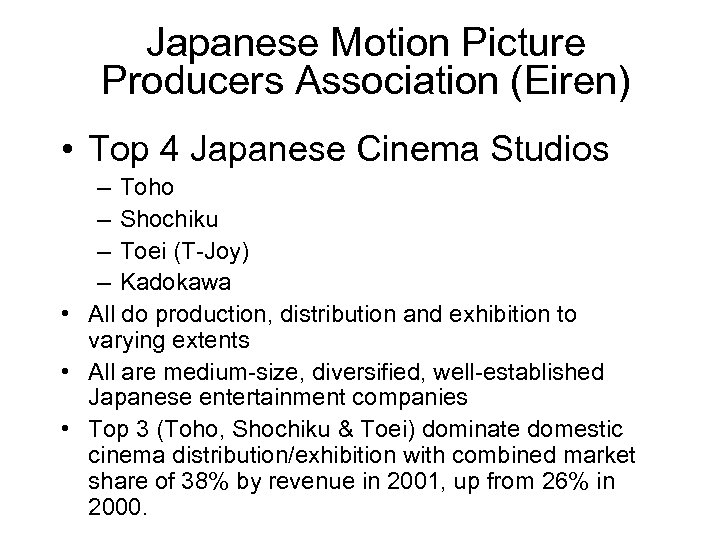 Japanese Motion Picture Producers Association (Eiren) • Top 4 Japanese Cinema Studios – Toho – Shochiku – Toei (T-Joy) – Kadokawa • All do production, distribution and exhibition to varying extents • All are medium-size, diversified, well-established Japanese entertainment companies • Top 3 (Toho, Shochiku & Toei) dominate domestic cinema distribution/exhibition with combined market share of 38% by revenue in 2001, up from 26% in 2000.
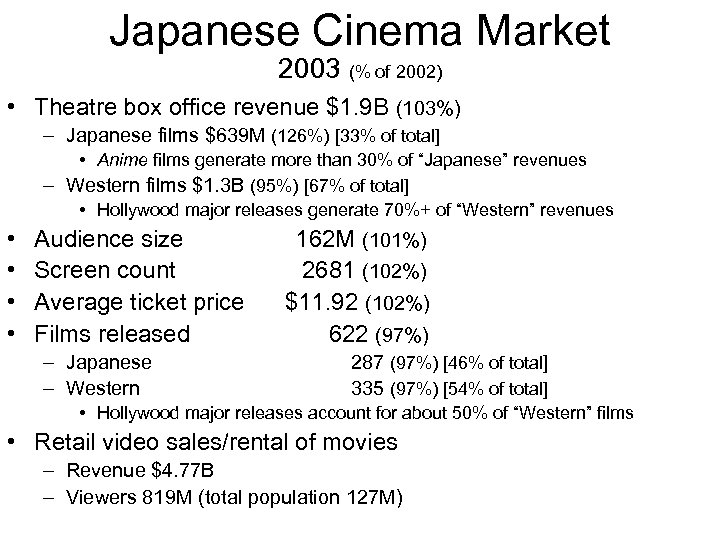 Japanese Cinema Market 2003 (% of 2002) • Theatre box office revenue $1. 9 B (103%) – Japanese films $639 M (126%) [33% of total] • Anime films generate more than 30% of “Japanese” revenues – Western films $1. 3 B (95%) [67% of total] • Hollywood major releases generate 70%+ of “Western” revenues • • Audience size Screen count Average ticket price Films released – Japanese – Western 162 M (101%) 2681 (102%) $11. 92 (102%) 622 (97%) 287 (97%) [46% of total] 335 (97%) [54% of total] • Hollywood major releases account for about 50% of “Western” films • Retail video sales/rental of movies – Revenue $4. 77 B – Viewers 819 M (total population 127 M)
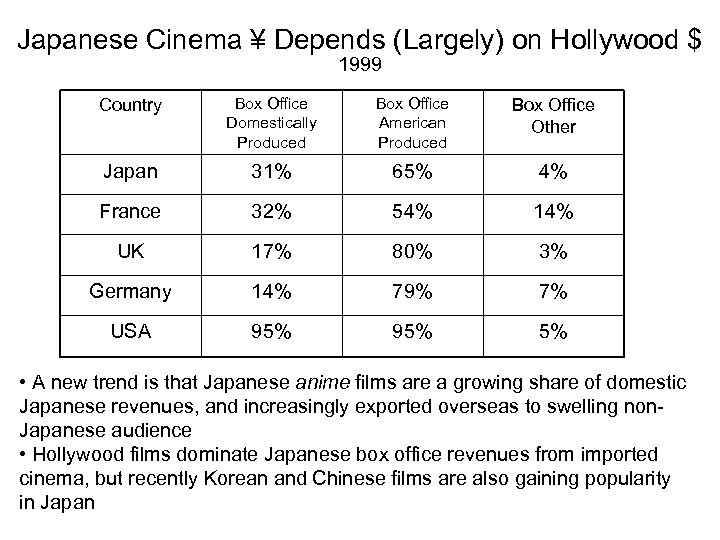 Japanese Cinema ¥ Depends (Largely) on Hollywood $ 1999 Country Box Office Domestically Produced Box Office American Produced Box Office Other Japan 31% 65% 4% France 32% 54% 14% UK 17% 80% 3% Germany 14% 79% 7% USA 95% 5% • A new trend is that Japanese anime films are a growing share of domestic Japanese revenues, and increasingly exported overseas to swelling non. Japanese audience • Hollywood films dominate Japanese box office revenues from imported cinema, but recently Korean and Chinese films are also gaining popularity in Japan
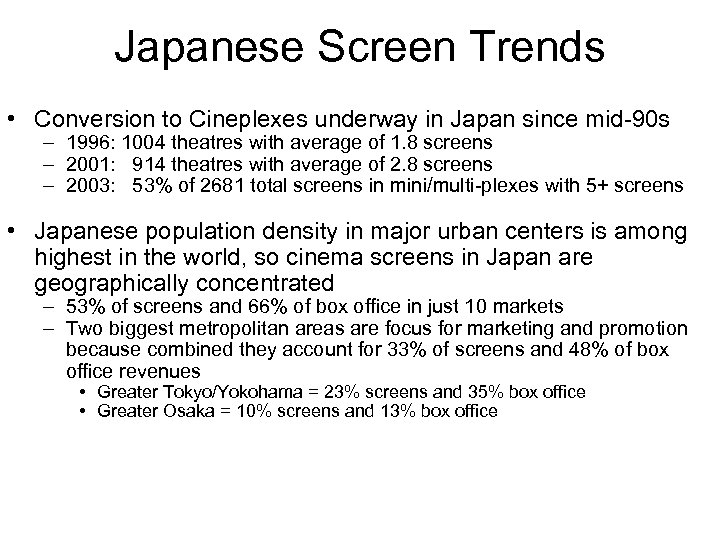 Japanese Screen Trends • Conversion to Cineplexes underway in Japan since mid-90 s – 1996: 1004 theatres with average of 1. 8 screens – 2001: 914 theatres with average of 2. 8 screens – 2003: 53% of 2681 total screens in mini/multi-plexes with 5+ screens • Japanese population density in major urban centers is among highest in the world, so cinema screens in Japan are geographically concentrated – 53% of screens and 66% of box office in just 10 markets – Two biggest metropolitan areas are focus for marketing and promotion because combined they account for 33% of screens and 48% of box office revenues • Greater Tokyo/Yokohama = 23% screens and 35% box office • Greater Osaka = 10% screens and 13% box office
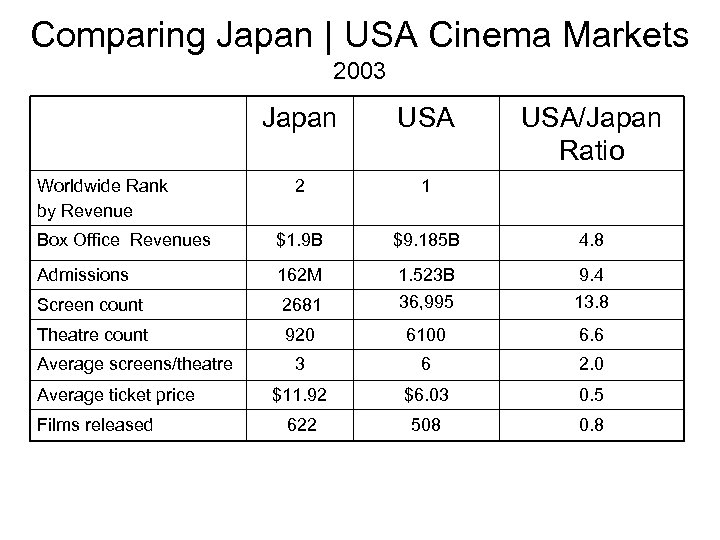 Comparing Japan | USA Cinema Markets 2003 Japan USA 2 1 Box Office Revenues $1. 9 B $9. 185 B 4. 8 Admissions 162 M Screen count 2681 1. 523 B 36, 995 9. 4 13. 8 Theatre count 920 6100 6. 6 3 6 2. 0 $11. 92 $6. 03 0. 5 622 508 0. 8 Worldwide Rank by Revenue Average screens/theatre Average ticket price Films released USA/Japan Ratio
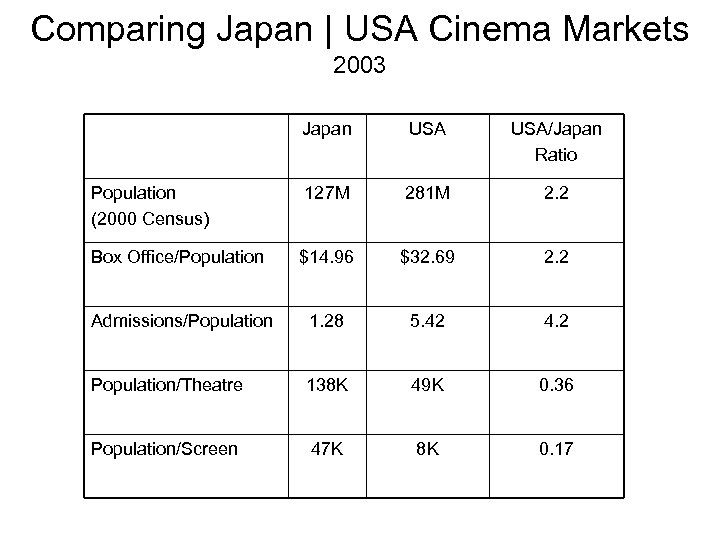 Comparing Japan | USA Cinema Markets 2003 Japan USA/Japan Ratio Population (2000 Census) 127 M 281 M 2. 2 Box Office/Population $14. 96 $32. 69 2. 2 Admissions/Population 1. 28 5. 42 4. 2 Population/Theatre 138 K 49 K 0. 36 Population/Screen 47 K 8 K 0. 17
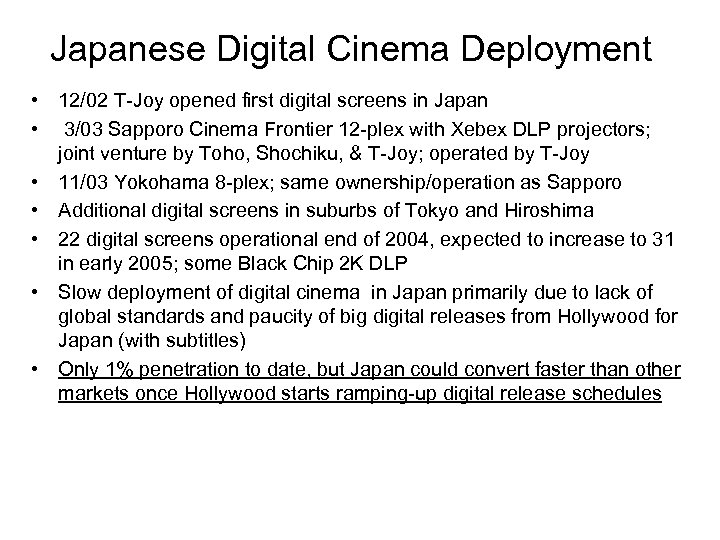 Japanese Digital Cinema Deployment • 12/02 T-Joy opened first digital screens in Japan • 3/03 Sapporo Cinema Frontier 12 -plex with Xebex DLP projectors; joint venture by Toho, Shochiku, & T-Joy; operated by T-Joy • 11/03 Yokohama 8 -plex; same ownership/operation as Sapporo • Additional digital screens in suburbs of Tokyo and Hiroshima • 22 digital screens operational end of 2004, expected to increase to 31 in early 2005; some Black Chip 2 K DLP • Slow deployment of digital cinema in Japan primarily due to lack of global standards and paucity of big digital releases from Hollywood for Japan (with subtitles) • Only 1% penetration to date, but Japan could convert faster than other markets once Hollywood starts ramping-up digital release schedules
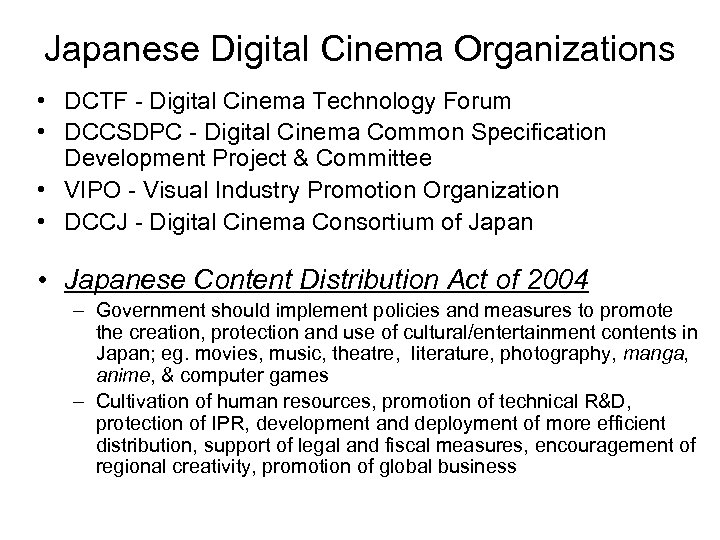 Japanese Digital Cinema Organizations • DCTF - Digital Cinema Technology Forum • DCCSDPC - Digital Cinema Common Specification Development Project & Committee • VIPO - Visual Industry Promotion Organization • DCCJ - Digital Cinema Consortium of Japan • Japanese Content Distribution Act of 2004 – Government should implement policies and measures to promote the creation, protection and use of cultural/entertainment contents in Japan; eg. movies, music, theatre, literature, photography, manga, anime, & computer games – Cultivation of human resources, promotion of technical R&D, protection of IPR, development and deployment of more efficient distribution, support of legal and fiscal measures, encouragement of regional creativity, promotion of global business
 DCTF • • Established May 31, 2004 with the cooperation of the Ministry of Internal Affairs and Communication (MIC) Objectives: – Support development of fundamental technologies for networked distribution of digital cinema – Support experiments and tests to advance understanding of the techniques for distribution, image quality evaluation and security of digital cinema based on the so-called “ 4 K” format with the support of all Japanese stake-holders from production to distribution to exhibition – Cultivate relations with similar organizations in America, Europe and Asia to promote the development of digital cinema and global standardization – Conduct surveys to understand requirements for early deployment – Sponsor events, demonstrations and symposia related to the technology and usage of digital cinema • Corporate and institutional members – DCCJ, National Institute for Information and Communication Technology (Ni. CT), Japan Society of Cinematographers, Kadokawa Pictures, NAMCO/Nikkatsu, Sony, Ikegami, Olympus, JVC, NEC, Mitsubishi Electric, Keisoku Gikken, IMAGICA, Nac, NTT , KDDI Labs, NHK, TV Asahi, TV Tokyo, Fuji TV, Tokyo Broadcast System (TBS), many Universities, others • Chairman: Tomonori Aoyama, Professor of the University of Tokyo
 DCCSDP & DCCSDC • The Digital Cinema Common Specification Development Project (DCCSDP) led by the Digital Cinema Common Specification Development Committee (DCCSDC) was established on July 1, 2004. • Purpose of the DCCSDP is to study the basic technology components necessary for a total digital cinema system and to make a Digital Cinema Common Specification which can be widely adopted for digital cinema environments above HD levels. • Since its inception, the Working Groups (WG) of the DCCSDP have made efforts to develop common specifications in an HD level digital cinema environment. The first important achievement is the construction of a “High Quality Theatre” for evaluation of color reproduction, scheduled to open in Spring 2005. Color space conversion methods, metadata sets, scalable image coding schemes, semi-automated CG movie creation methods and a DRM system with new watermarking schemes to be developed. • 5 Working Groups – – – WG 1: Common specification for video image processing and color management technology dev. WG 2: Common intelligent creation and management system development for total production process WG 3: Technology development for content transfer and storage WG 4: DRM and DRE (Digital Rights Expression) technology development for digital cinema WG 5: Digital Cinema archive technologies • Chairman: Hiroshi Yasuda, Professor of the University of Tokyo
 VIPO • • • Established December 6, 2004 in order to strengthen the international competitiveness of Japanese visual content industries such as cinema, television, animation and video games. In process to be registered as Non-Profit Organization (NPO) and start operations April 2005. VIPO modeled on the AFI, UK Film Council, National Film Board of Canada, French CNC, German FFA, and Korean KOFIC VIPO structured to benefit from the support and cooperation of the Keidanren (Japan Federation of Economic Organizations) and solicit additional support from various government ministries and regional/municipal agencies to achieve its goals • Support the cultivation of human resources for visual-content businesses through education and professional re-training programs in university and graduate level institutions • Support production of content “works” by enabling reduced cost access to studios and production equipment through such means as encouraging low-interest loans and various forms of subsidies from public and private financial institutions • Support business operations by making available low-cost office space and equipment through various forms of public assistance • Support the development of visual-content related “markets” such as film festivals, animation fairs, and gaming shows domestically and internationally, as well as promoting communication amongst related Japanese organizations • • VIPO will have 35 directors drawn from the senior executives of Japan’s major studios, broadcast networks and hardware companies, leaders from the animation, video gaming and music industry, prominent academics, and others Chairman: Junichi Sakomoto, President of Shochiku
 DCCJ • Established in 2000 as voluntary association of dues-paying individuals; formally incorporated as a Non-Profit Organization (NPO) in May 2002 • Created to promote advancement in culture and art through the development, test, evaluation and standardization of very high quality digital cinema formats and related infrastructure – Gather and disseminate info on development of D-Cinema to encourage its use – Liaison with organizations inside and outside of Japan to assist the establishment of global standards for digital cinema. – Support the making, distribution and presentation of digital cinema to promote better understanding of the technology and creative capabilities • Corporate and Individual Members – Sony, JVC, NTT, Olympus, NEC, Mitsubishi Electric, IMAGICA, Ikegami, NAC, Skip City, Keisoku Giken, DNP, Nippon Cine. Arts, Astro. Design, others – Advisory members from Matsushita, KDDI, NAMCO/Nikkatsu, Japan Society of Cinematographers, University of Tokyo, Keio University, Kyoto University, Tokyo University of Technology, Tama Art College, Pacific Interface, others • Chairman: Tomonori Aoyama, Professor of the University of Tokyo
 Japanese Digital Cinema Technology • Japanese technology, and the interaction between Japan and Hollywood, has been central to the evolution of digital cinema for nearly 25 years. • Regardless of which “flavor” of digital cinema you favor, Japanese technology companies are among the leading suppliers of critical components for commercial implementation
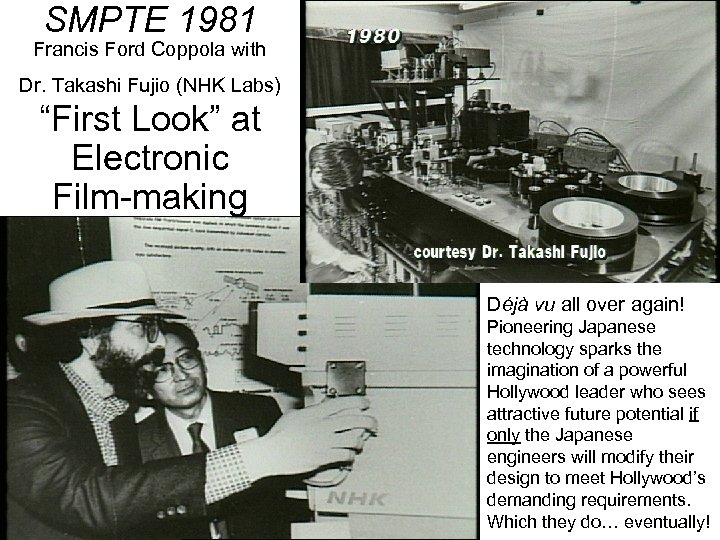 SMPTE 1981 Francis Ford Coppola with Dr. Takashi Fujio (NHK Labs) “First Look” at Electronic Film-making Déjà vu all over again! Pioneering Japanese technology sparks the imagination of a powerful Hollywood leader who sees attractive future potential if only the Japanese engineers will modify their design to meet Hollywood’s demanding requirements. Which they do… eventually!
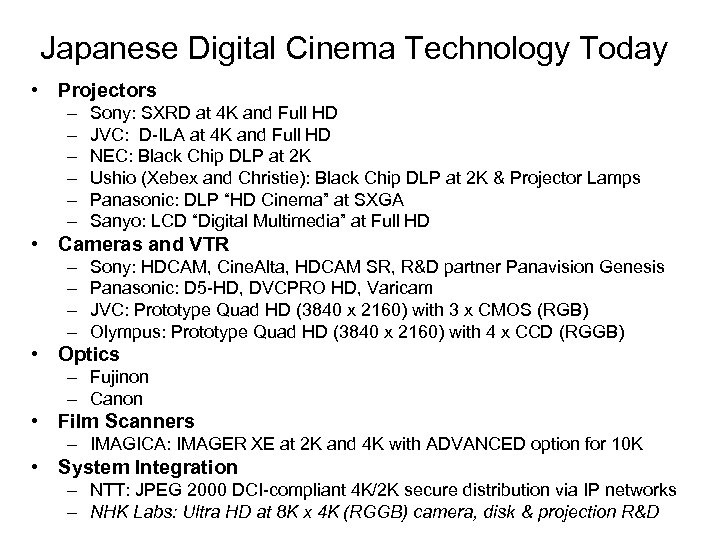 Japanese Digital Cinema Technology Today • Projectors – – – Sony: SXRD at 4 K and Full HD JVC: D-ILA at 4 K and Full HD NEC: Black Chip DLP at 2 K Ushio (Xebex and Christie): Black Chip DLP at 2 K & Projector Lamps Panasonic: DLP “HD Cinema” at SXGA Sanyo: LCD “Digital Multimedia” at Full HD • Cameras and VTR – – Sony: HDCAM, Cine. Alta, HDCAM SR, R&D partner Panavision Genesis Panasonic: D 5 -HD, DVCPRO HD, Varicam JVC: Prototype Quad HD (3840 x 2160) with 3 x CMOS (RGB) Olympus: Prototype Quad HD (3840 x 2160) with 4 x CCD (RGGB) • Optics – Fujinon – Canon • Film Scanners – IMAGICA: IMAGER XE at 2 K and 4 K with ADVANCED option for 10 K • System Integration – NTT: JPEG 2000 DCI-compliant 4 K/2 K secure distribution via IP networks – NHK Labs: Ultra HD at 8 K x 4 K (RGGB) camera, disk & projection R&D
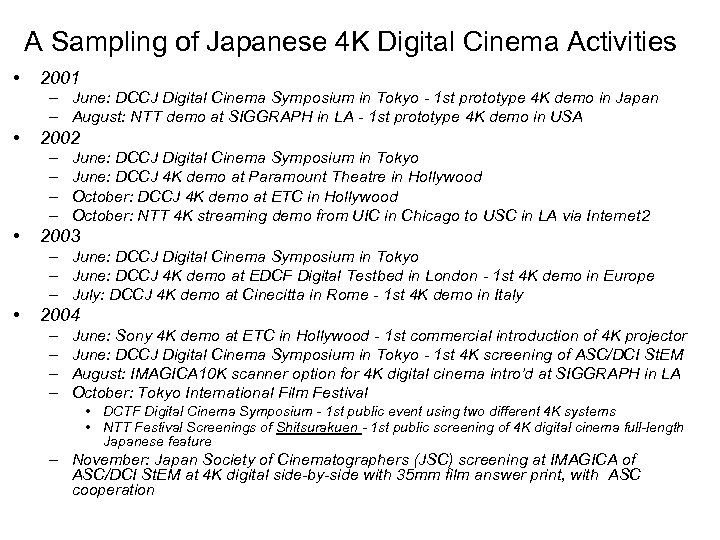 A Sampling of Japanese 4 K Digital Cinema Activities • 2001 – June: DCCJ Digital Cinema Symposium in Tokyo - 1 st prototype 4 K demo in Japan – August: NTT demo at SIGGRAPH in LA - 1 st prototype 4 K demo in USA • 2002 – – • June: DCCJ Digital Cinema Symposium in Tokyo June: DCCJ 4 K demo at Paramount Theatre in Hollywood October: DCCJ 4 K demo at ETC in Hollywood October: NTT 4 K streaming demo from UIC in Chicago to USC in LA via Internet 2 2003 – June: DCCJ Digital Cinema Symposium in Tokyo – June: DCCJ 4 K demo at EDCF Digital Testbed in London - 1 st 4 K demo in Europe – July: DCCJ 4 K demo at Cinecitta in Rome - 1 st 4 K demo in Italy • 2004 – – June: Sony 4 K demo at ETC in Hollywood - 1 st commercial introduction of 4 K projector June: DCCJ Digital Cinema Symposium in Tokyo - 1 st 4 K screening of ASC/DCI St. EM August: IMAGICA 10 K scanner option for 4 K digital cinema intro’d at SIGGRAPH in LA October: Tokyo International Film Festival • DCTF Digital Cinema Symposium - 1 st public event using two different 4 K systems • NTT Festival Screenings of Shitsurakuen - 1 st public screening of 4 K digital cinema full-length Japanese feature – November: Japan Society of Cinematographers (JSC) screening at IMAGICA of ASC/DCI St. EM at 4 K digital side-by-side with 35 mm film answer print, with ASC cooperation
 Thank You Laurin@pacific-interface. com 510 -547 -2758