Скачать презентацию Diffuse Optical Methods A lesser-known technology for monitoring
NIRS.ppt
- Количество слайдов: 17
 Diffuse Optical Methods A lesser-known technology for monitoring brain function capitalizes on the absorption and scattering properties of near-infrared light to provide information about brain activity. In 1977 (Jobsis) it was discovered that useful information could be obtained from thick tissue samples, including brain monitoring using light applied to and detected from the scalp. The technique goes variously by the names of 1) near-infrared spectroscopy (NIRS), 2) diffuse optical tomography (or topography; DOT) 3) and/or near-infrared imaging (NIRI). All of the techniques are based on essentially the same concept — shine light onto the scalp, detect it as it exits the head, and use the absorption spectra of the light absorbing molecules (chromophores) present in tissue to interpret the detected light levels as changes in chromophore concentrations.
 The “Optical Window” Diffuse optical recordings depend on two critical characteristics of the electromagnetic spectrum as it interacts with biological tissue. First, while biological tissue is relatively opaque to visible light, it is not totally opaque, as may be demonstrated by simple experiments. Near-infrared (NIR) light—from approximately 650 – 950 nm—is even more weakly absorbed by tissue than the red wavelengths. As a result, this range of wavelengths is often called an “optical window” into biological tissue. This property allows light of these wavelengths to penetrate several centimeters through tissue and still be detected. The second critical characteristic of NIR light as it interacts with biological tissue is presence of two dominant chromophores. Two dominant chromophores for the NIR wavelength range just happen to be two biologically relevant markers for brain activity: oxyhemoglobin (Hb. O 2) and deoxyhemoglobin (Hb. R).
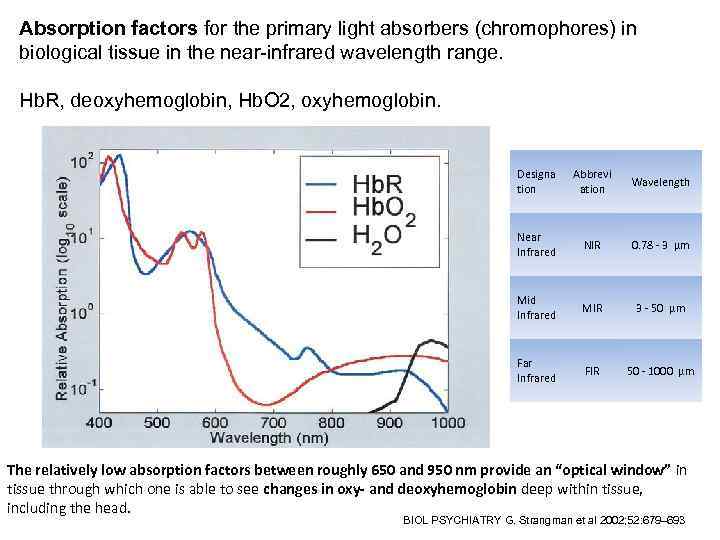 Absorption factors for the primary light absorbers (chromophores) in biological tissue in the near-infrared wavelength range. Hb. R, deoxyhemoglobin, Hb. O 2, oxyhemoglobin. Designa tion Abbrevi ation Wavelength Near Infrared NIR 0. 78 - 3 µm Mid Infrared MIR 3 - 50 µm Far Infrared FIR 50 - 1000 µm The relatively low absorption factors between roughly 650 and 950 nm provide an “optical window” in tissue through which one is able to see changes in oxy- and deoxyhemoglobin deep within tissue, including the head. BIOL PSYCHIATRY G. Strangman et al 2002; 52: 679– 693
 Types of Diffuse Optical Measurements The amplitude of the recorded signal in a diffuse optical measurement is determined by two factors: (i) absorption of light by the tissue, and (ii) light scattering within the tissue. An increase in either factor results in a decrease in detected light levels, and a corresponding decrease in signal. The goal of diffuse optical measurements is to detect such changes. Absorption changes are predominantly driven by changes in hemoglobin concentrations. When a diffuse optical probe is placed on the head, the observed hemoglobin changes reflect underlying brain activity. Scattering changes, in contrast, are less clear.
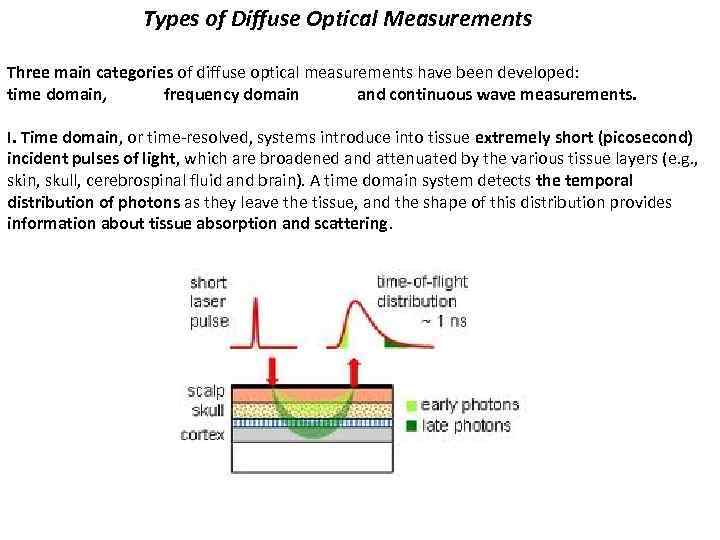 Types of Diffuse Optical Measurements Three main categories of diffuse optical measurements have been developed: time domain, frequency domain and continuous wave measurements. I. Time domain, or time-resolved, systems introduce into tissue extremely short (picosecond) incident pulses of light, which are broadened and attenuated by the various tissue layers (e. g. , skin, skull, cerebrospinal fluid and brain). A time domain system detects the temporal distribution of photons as they leave the tissue, and the shape of this distribution provides information about tissue absorption and scattering.
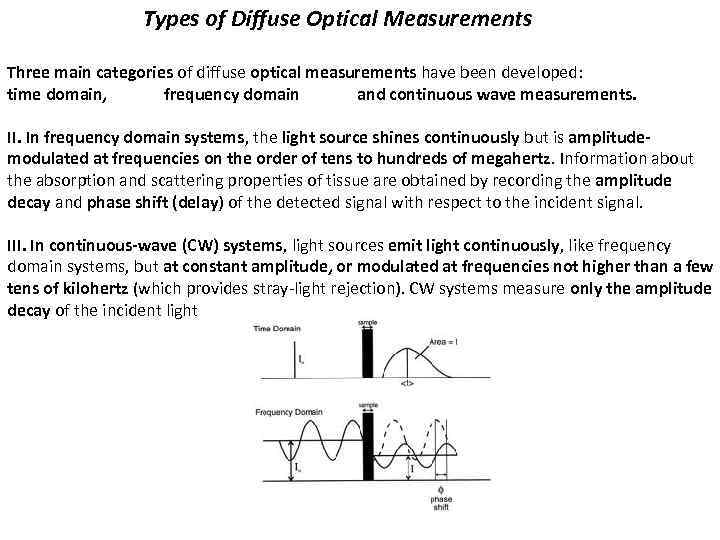 Types of Diffuse Optical Measurements Three main categories of diffuse optical measurements have been developed: time domain, frequency domain and continuous wave measurements. II. In frequency domain systems, the light source shines continuously but is amplitudemodulated at frequencies on the order of tens to hundreds of megahertz. Information about the absorption and scattering properties of tissue are obtained by recording the amplitude decay and phase shift (delay) of the detected signal with respect to the incident signal. III. In continuous-wave (CW) systems, light sources emit light continuously, like frequency domain systems, but at constant amplitude, or modulated at frequencies not higher than a few tens of kilohertz (which provides stray-light rejection). CW systems measure only the amplitude decay of the incident light
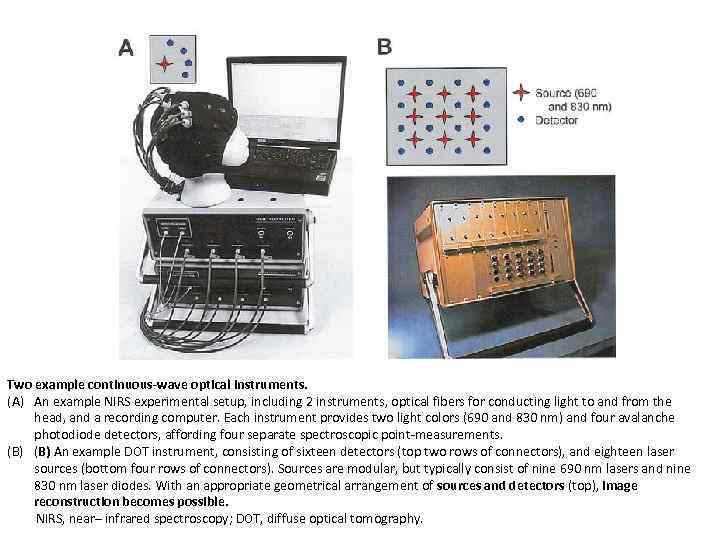 Two example continuous-wave optical instruments. (A) An example NIRS experimental setup, including 2 instruments, optical fibers for conducting light to and from the head, and a recording computer. Each instrument provides two light colors (690 and 830 nm) and four avalanche photodiode detectors, affording four separate spectroscopic point-measurements. (B) An example DOT instrument, consisting of sixteen detectors (top two rows of connectors), and eighteen laser sources (bottom four rows of connectors). Sources are modular, but typically consist of nine 690 nm lasers and nine 830 nm laser diodes. With an appropriate geometrical arrangement of sources and detectors (top), image reconstruction becomes possible. NIRS, near– infrared spectroscopy; DOT, diffuse optical tomography.
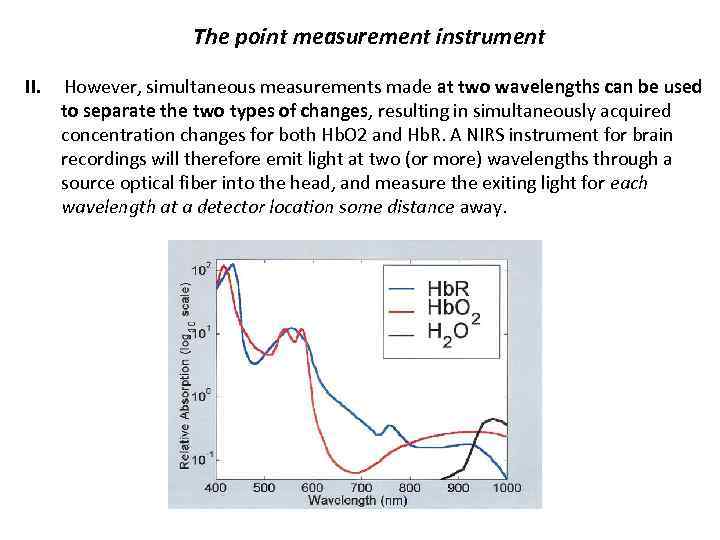 The point measurement instrument II. However, simultaneous measurements made at two wavelengths can be used to separate the two types of changes, resulting in simultaneously acquired concentration changes for both Hb. O 2 and Hb. R. A NIRS instrument for brain recordings will therefore emit light at two (or more) wavelengths through a source optical fiber into the head, and measure the exiting light for each wavelength at a detector location some distance away.
 The point measurement instrument III. Three or more wavelengths can be used either to (i) improve the measures of Hb. O 2 and Hb. R, or (ii) extract changes in other, less-absorbing species such as water, and/or cytochrome oxidase. All of this can be accomplished with just one (multi-color) source location and one detector location.
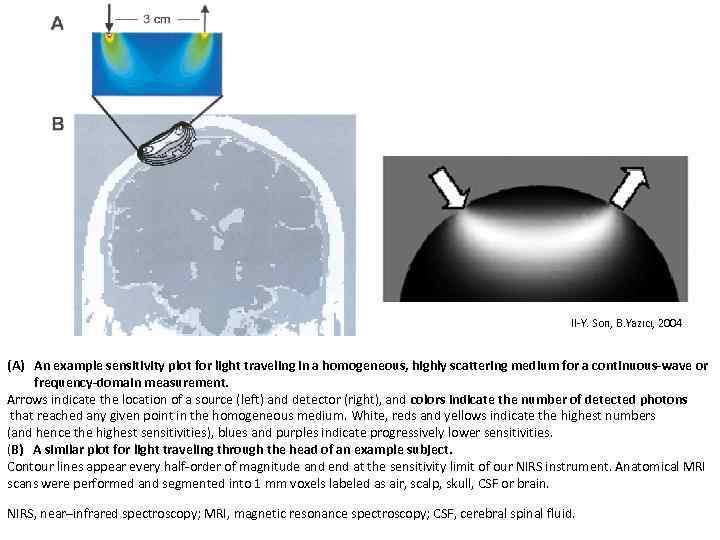 Il-Y. Son, B. Yazıcı, 2004 (A) An example sensitivity plot for light traveling in a homogeneous, highly scattering medium for a continuous-wave or frequency-domain measurement. Arrows indicate the location of a source (left) and detector (right), and colors indicate the number of detected photons that reached any given point in the homogeneous medium. White, reds and yellows indicate the highest numbers (and hence the highest sensitivities), blues and purples indicate progressively lower sensitivities. (B) A similar plot for light traveling through the head of an example subject. Contour lines appear every half-order of magnitude and end at the sensitivity limit of our NIRS instrument. Anatomical MRI scans were performed and segmented into 1 mm voxels labeled as air, scalp, skull, CSF or brain. NIRS, near–infrared spectroscopy; MRI, magnetic resonance spectroscopy; CSF, cerebral spinal fluid.
 Non-invasive Spatial Localization q The sensitivity to changes in brain tissue will be maximal below and between the source and detector. As an approximate rule of thumb—for frequency domain and continuous wave measurements—the depth of maximum brain sensitivity is approximately half the source-detector separation distance. q The sensitivity pattern for time domain measurements, on the other hand, is variable, affording deeper sensitivities by selectively rejecting light that travels exclusively through these superficial tissue layers. q Regardless of the measurement type, however, the fact that tissue strongly scatters light means spatial resolution decreases with depth. o Localizing activation to the amygdala, for example, is not feasible, and cingulate cortex would be difficult. o Superficial cortex, including (but not limited to) dorsolateral prefrontal cortex, superior parietal cortex, and language and primary sensorimotor areas, on the other hand, are all within detectable limits of the current diffuse optical tools.
 Coupling, Light Levels, and Penetration Depth Several issues affect coupling: q hair (absorption and instability), hair follicles (follicles strongly absorb near infrared wavelengths), skin color or variations (darker skin regions are typically more absorbing of NIR wavelengths), q and general fiber stability against the head (a function of rigidity, strain relief, torque and subject comfort). q While penetration depth increases with source-detector separation, current diffuse optical instruments can only detect light with maximum source-detector separations of up to 5 or 6 cm on an adult head. q This contrasts with an infant head, where light may well be detectable when transmitted straight through from one side of the head to the other, due to a thinner skull, smaller head, less hair and smaller follicles.
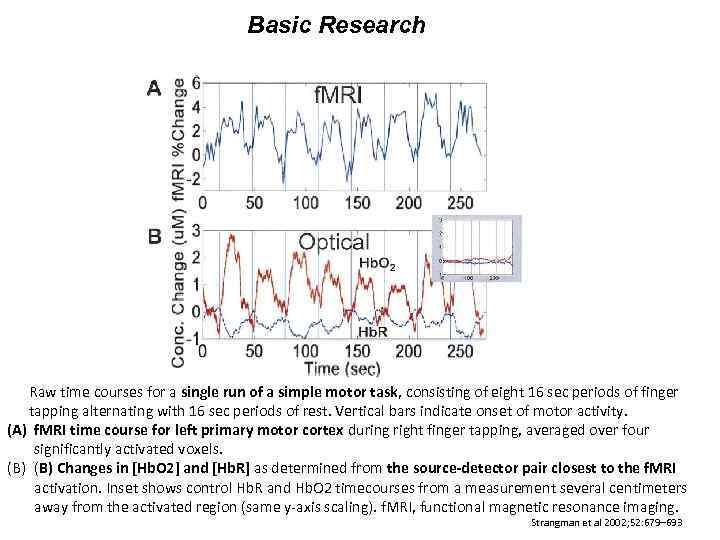 Basic Research Raw time courses for a single run of a simple motor task, consisting of eight 16 sec periods of finger tapping alternating with 16 sec periods of rest. Vertical bars indicate onset of motor activity. (A) f. MRI time course for left primary motor cortex during right finger tapping, averaged over four significantly activated voxels. (B) Changes in [Hb. O 2] and [Hb. R] as determined from the source-detector pair closest to the f. MRI activation. Inset shows control Hb. R and Hb. O 2 timecourses from a measurement several centimeters away from the activated region (same y-axis scaling). f. MRI, functional magnetic resonance imaging. Strangman et al 2002; 52: 679– 693
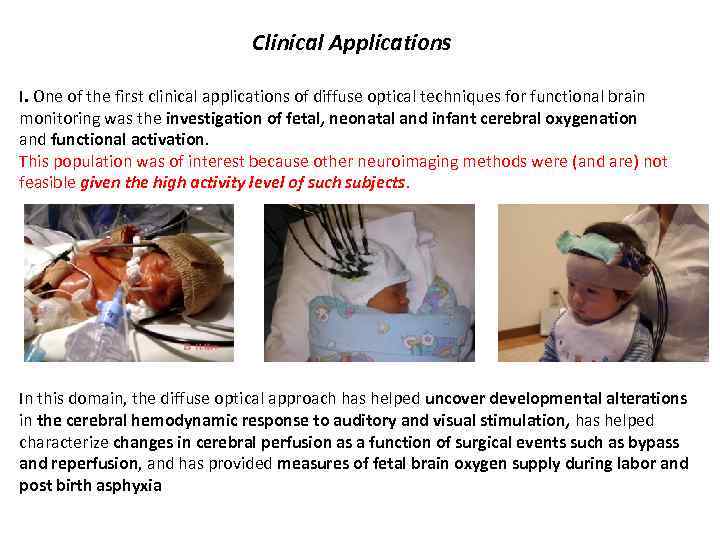 Clinical Applications I. One of the first clinical applications of diffuse optical techniques for functional brain monitoring was the investigation of fetal, neonatal and infant cerebral oxygenation and functional activation. This population was of interest because other neuroimaging methods were (and are) not feasible given the high activity level of such subjects. In this domain, the diffuse optical approach has helped uncover developmental alterations in the cerebral hemodynamic response to auditory and visual stimulation, has helped characterize changes in cerebral perfusion as a function of surgical events such as bypass and reperfusion, and has provided measures of fetal brain oxygen supply during labor and post birth asphyxia
 More direct methods of neuronal activity monitoring. q Diffuse optical techniques also make non-hemoglobin-based measures feasible. For example, by recording data from several wavelengths simultaneously, one can measure other tissue chromophores, including cytochrome oxidase. As a marker of metabolic demands, cytochrome oxidase measurements can provide more direct information about neuronal activity than hemoglobin changes. q There is also evidence to suggest that diffuse optical methods can detect cell swelling that occurs in the 50– 200 milliseconds following neuronal firing, which would be an even more direct measure of neuronal activity than the hemodynamic or metabolic markers. This type of “fast”signal appears to be significantly smaller than the hemodynamic signals (on the order of a 0. 01% signal change). Current research suggests that the biological basis of the phenomenon is swelling (in the case of depolarization) or shrinking (in the case of hyperpolarization ) of neurites (mostly dendrites) due to movement of water across the membrane associated with ion transport. -----------------------q Thus, diffuse optical techniques may be simultaneously capable of providing both indirect and more direct methods of neuronal activity monitoring complementary sources of information about brain function.
 Advantages q The instrumentation — which is completely noninvasive — can be made portable, unobtrusive, low-cost, low-power, and can even be made robust to motion artifacts. q Could be useful for monitoring the effects of slowly acting drugs, or slowly evolving pathologies. And, the fact that near infrared light is nonionizing means that there is no limit to the number of scans one can undergo.