


 Скачать презентацию Different Types of Annuities P Antolín OECD Private
86d8c5f4e40ce12e1b092012a5837527.ppt
- Количество слайдов: 22
 Different Types of Annuities P. Antolín OECD, Private Pension Unit at DAF/FIN 1
 Structure of the talk • What do we mean by annuities? • Distinguishing between annuity payments and annuity products. • The type of annuity products. • How annuity products can help bridge the transition from accumulation to payout phase. • The risks involved (e. g. longevity risk). 2
 What is an annuity? • An annuity is an amount of money paid to someone at some regular interval. • Most people think in terms of annuity products: an agreement or contract for one person or organisation to pay another (the annuitant) a stream or series of payments (annuity payments). 3
 Annuity payments and products • A public pension is a stream of income paid at regular intervals. • The pension benefits paid by a definedbenefit pension plan is a stream of income paid at regular intervals. • An annuity product is a contract, different from an annuity payment. 4
 Annuitization • Financial economics: people better off if a large share of their retirement income is annuitized (protect against longevity risk) • Until recently people where heavily annuitized through public pensions and DB pension plans. • They both provide a constant stream of income at retirement or annuity payment. 5
 Relevance of annuity products • Recent changes in public pensions: lower RR. • Shift from DB to DC funded pension plans • Need to buy annuity products to protect against risks, especially longevity risk (the likelihood of outliving one’s resources). 6
 Relevance of annuity products • Some countries in LA and CEE have introduced DC personal plans as main source of retirement income. • At retirement, pension wealth is the form of a lump-sum. Retirement income is not annuitized. • Annuity products could help in bridging the accumulation and the pay-out phase. 7
 Type of annuity products • There are several dimensions to classified annuity products. • According to the type of guarantees they provide. 8
 According to how they financed • Single premium • Flexible premium (e. g. contributions) – Fixed – Variable 9
 According to primary purpose • Immediate pay-out • Deferred (accumulation) 10
 According to the underlying investment • According how annuity products create future value • Fixed: guarantee a return and a specific payout at retirement. • Variable: returns and payment depend on how your portfolio performs • Equity-index 11
 According to the nature of the payout commitment • The duration of the payout • Life: payout last for the life time of the annuitant • Fixed-tem or certain: e. g. 10 years • Temporary: payout last for the earlier of the two • Guarantee: payout last for the later of the two 12
 According to the providers • Qualified annuities: the provider during both the accumulation and the pay-out phases is the same (annuities as vehicles attached to certain retirement plans, 401(k)s, IRAs) • Non-qualified: providers are separate entities 13
 According to … • People covered – Single – Joint-survivor • Way annuity is purchased – Individual – Group • Other feature – Enhanced or impaired – Inflation indexed – Tax advantages 14
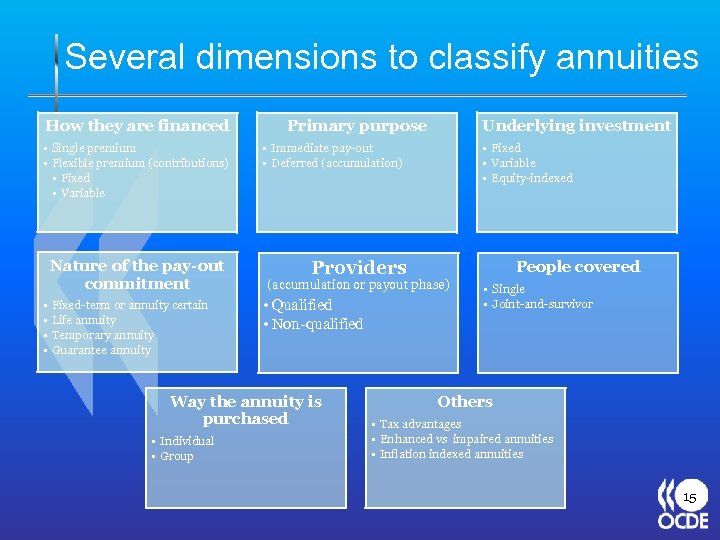 Several dimensions to classify annuities How they are financed • Single premium • Flexible premium (contributions) • Fixed • Variable Nature of the pay-out commitment • • Fixed-term or annuity certain Life annuity Temporary annuity Guarantee annuity Primary purpose • Immediate pay-out • Deferred (accumulation) • Fixed • Variable • Equity-indexed Providers People covered (accumulation or payout phase) • Qualified • Non-qualified Way the annuity is purchased • Individual • Group Underlying investment • Single • Joint-and-survivor Others • Tax advantages • Enhanced vs impaired annuities • Inflation indexed annuities 15
 Annuity products and guarantees • What distinguishes the different type of annuity products is the type of guarantees they provide • These guarantees determine the size of the risks involved in annuities: – Longevity risk. – Investment risk. – Interest rate risk. – Inflation risk. 16
 Annuity products and risks • Life, deferred and fixed annuity. This is the annuity product that replicates a DB plan 1. Impact of LR on the total amount of annuity payments (liabilities) (LR: uncertainty regarding future mortality and life expectancy outcomes) 2. The interaction btw the risks involved (interest rate and LR): super-additivity. 17
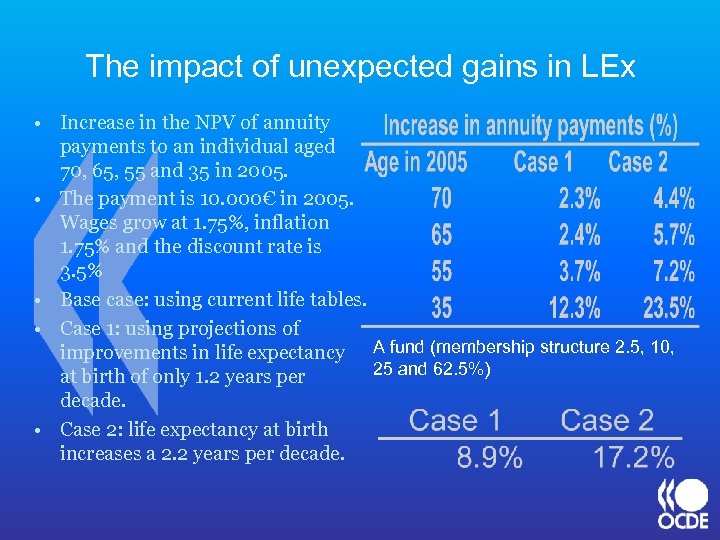 The impact of unexpected gains in LEx • Increase in the NPV of annuity payments to an individual aged 70, 65, 55 and 35 in 2005. • The payment is 10. 000€ in 2005. Wages grow at 1. 75%, inflation 1. 75% and the discount rate is 3. 5% • Base case: using current life tables. • Case 1: using projections of improvements in life expectancy A fund (membership structure 2. 5, 10, 25 and 62. 5%) at birth of only 1. 2 years per decade. • Case 2: life expectancy at birth increases a 2. 2 years per decade.
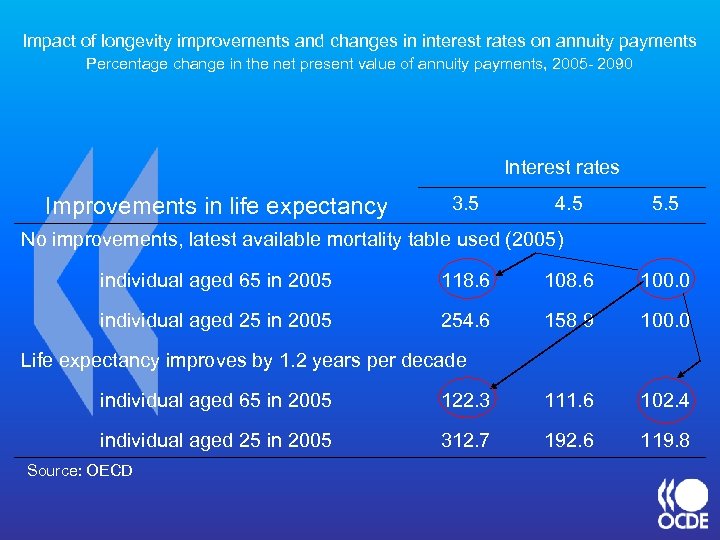 Impact of longevity improvements and changes in interest rates on annuity payments Percentage change in the net present value of annuity payments, 2005 - 2090 Interest rates Improvements in life expectancy 3. 5 4. 5 5. 5 No improvements, latest available mortality table used (2005) individual aged 65 in 2005 118. 6 100. 0 individual aged 25 in 2005 254. 6 158. 9 100. 0 Life expectancy improves by 1. 2 years per decade individual aged 65 in 2005 122. 3 111. 6 102. 4 individual aged 25 in 2005 312. 7 192. 6 119. 8 Source: OECD

 Conclusions • Annuity products could help bridge the transition from the accumulation to the payout phase. • Several types of annuity products depending on the type of guarantees provided. • Depending on those guarantees different impact of risks. • LR non-negligible. Super-additivity effect. 21
 THANK YOU! pablo. antolin@oecd. org http: //www. oecd. org/daf/pensions