 Скачать презентацию Different Bikes for Different Needs By Mr Seth
f2c99ba3206f8eec6842ced956a489d7.ppt
- Количество слайдов: 32



Different Bikes for Different Needs By Mr. Seth Welton Technology Exploration 8
Scenario Bicycles provide an environmentally friendly means for commuting to work, school, or other activities. They can also provide for our exercise and recreation needs. The broad range of bicycle designs reflects the many different uses of bicycles. However, there are three primary types of bicycle designs: the road bicycle, built for racing and distance riding; the mountain bicycle, built for off-road and recreational riding; and the utility (hybrid) bicycle, built for multiple surfaces and getting around town. Your challenge is to design a bike for one of the three Jensen’s. Mark Jensen commutes 4 ½ miles to work. Mark wants a practical bike so that he can get some exercise by riding to work. Mark also needs to save money to put Cindy, his daughter, through college. Cindy wants a bike for getting around campus as well as for exploring the state park in the nearby mountains. Cindy’s brother, Ted Jensen, is an athlete who wants a bike for riding in competitive events. These events typically occur on well paved roadways and run from 50 to 100 miles. You must also account for height and weight of the rider and any additional accessories that may be needed by each rider. Upon completion of your design, you will write an essay and prepare and perform a 5 - to 7 -minute sales pitch to convince us how your design will meet the needs of the Jensen family member you selected. The presentation should include sketches and specific information about drive systems, tires, seats, handle bars, frames, and accessories.
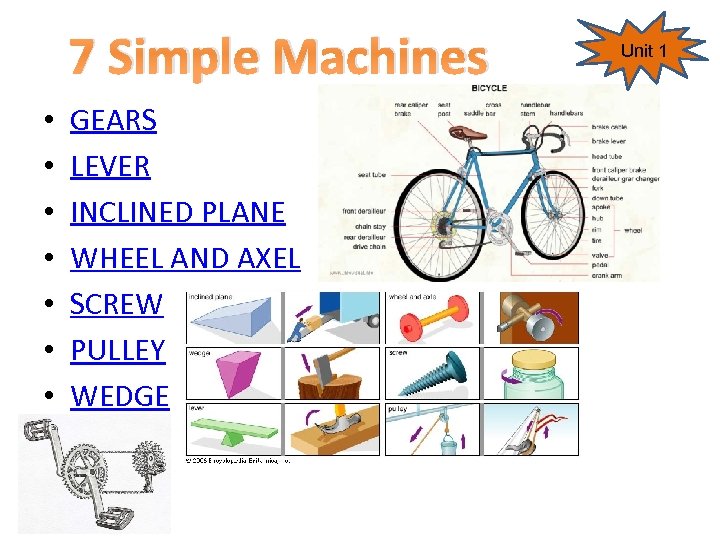
7 Simple Machines • • GEARS LEVER INCLINED PLANE WHEEL AND AXEL SCREW PULLEY WEDGE Unit 1
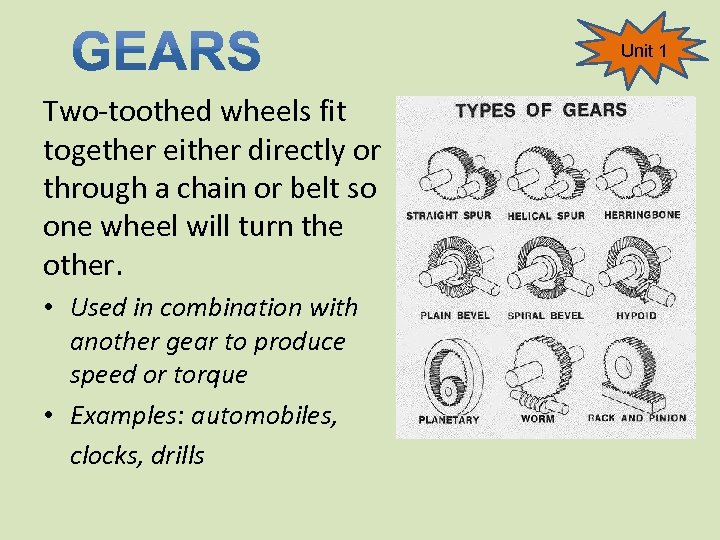
Unit 1 Two-toothed wheels fit together either directly or through a chain or belt so one wheel will turn the other. • Used in combination with another gear to produce speed or torque • Examples: automobiles, clocks, drills
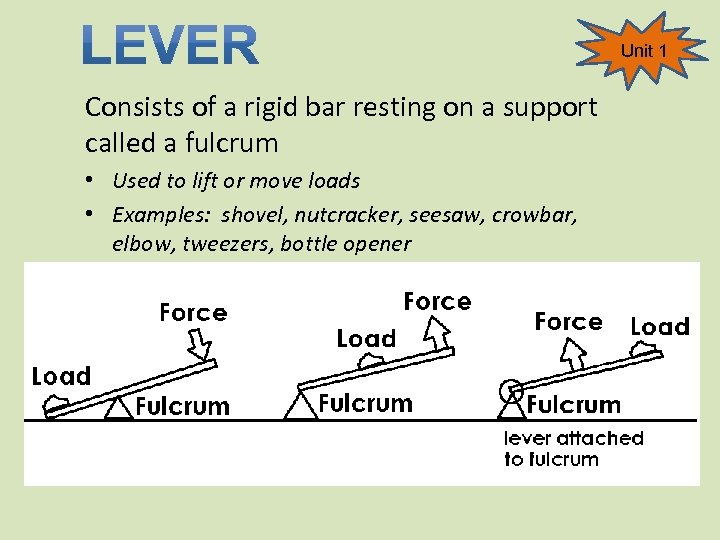
Unit 1 Consists of a rigid bar resting on a support called a fulcrum • Used to lift or move loads • Examples: shovel, nutcracker, seesaw, crowbar, elbow, tweezers, bottle opener
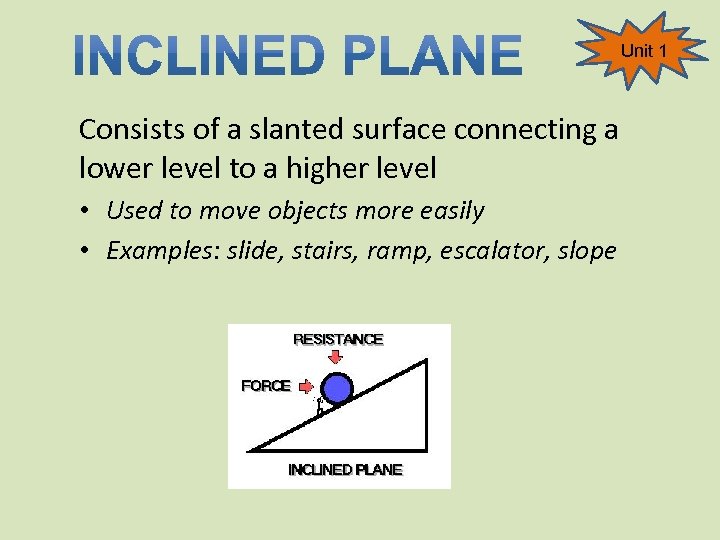
Unit 1 Consists of a slanted surface connecting a lower level to a higher level • Used to move objects more easily • Examples: slide, stairs, ramp, escalator, slope
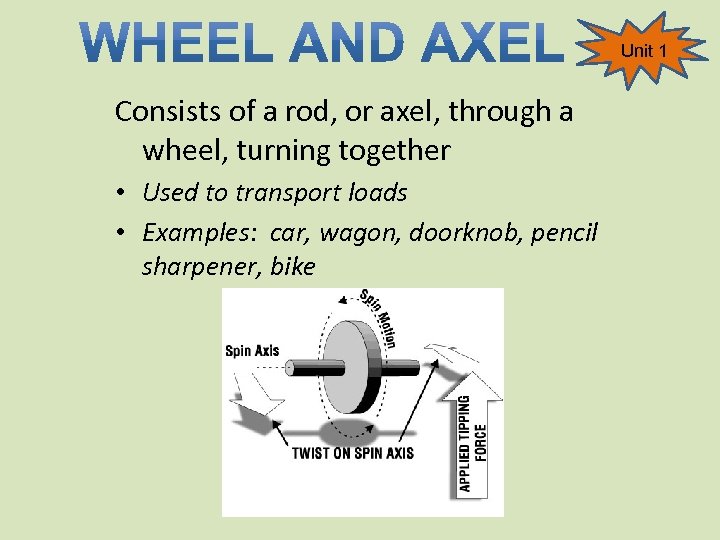
Unit 1 Consists of a rod, or axel, through a wheel, turning together • Used to transport loads • Examples: car, wagon, doorknob, pencil sharpener, bike

Unit 1 Consists of an inclined plane wrapped around a pole • Used to hold things together or lift • Examples: screw, jar lid, vise, bolt, drill, corkscrew
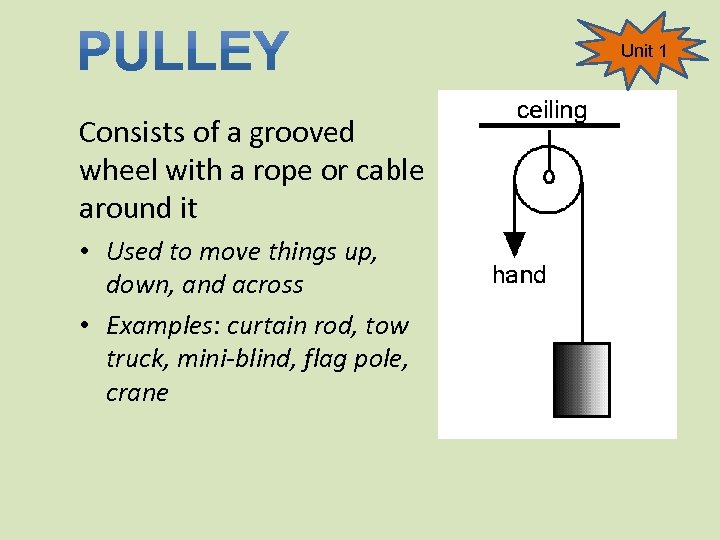
Unit 1 Consists of a grooved wheel with a rope or cable around it • Used to move things up, down, and across • Examples: curtain rod, tow truck, mini-blind, flag pole, crane
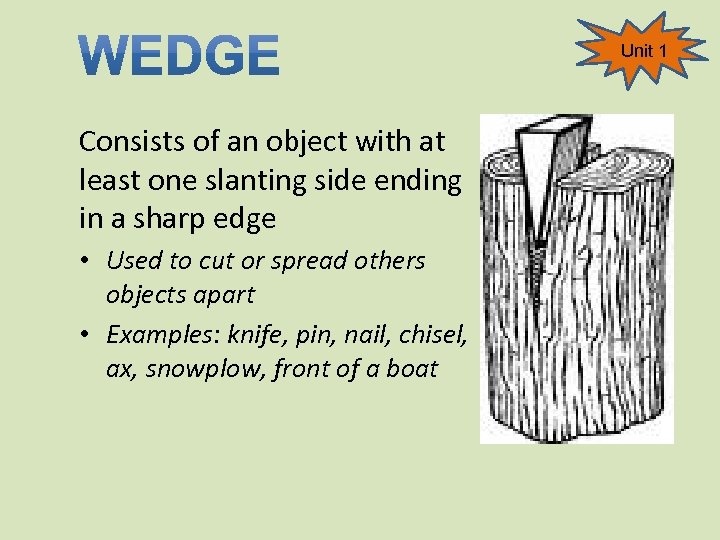
Unit 1 Consists of an object with at least one slanting side ending in a sharp edge • Used to cut or spread others objects apart • Examples: knife, pin, nail, chisel, ax, snowplow, front of a boat
Activity Unit 1 Click on the “Click Here to START” button below to visit the “Edheads” Web site <http: //www. edheads. org/activities/simple-machines/frame_loader. htm>. Select an icon from the house and play the game. To return to the assignment after visiting each part of the house and answering all of the questions, close the window.
Learning Gears Unit 1 • Click on the picture of the gear to go to the “Science of Cycling” Web site <http: //www. exploratorium. edu/cycling/gears 1. html>. • Read the following articles and answer the questions on the next slide: – Drives and gears – Early drives – Benefits of gears – Paul de Vivie alias “Velocio” – Count your teeth. • Watch the video clip with Paul Poherty. • Close the window to return to this screen.
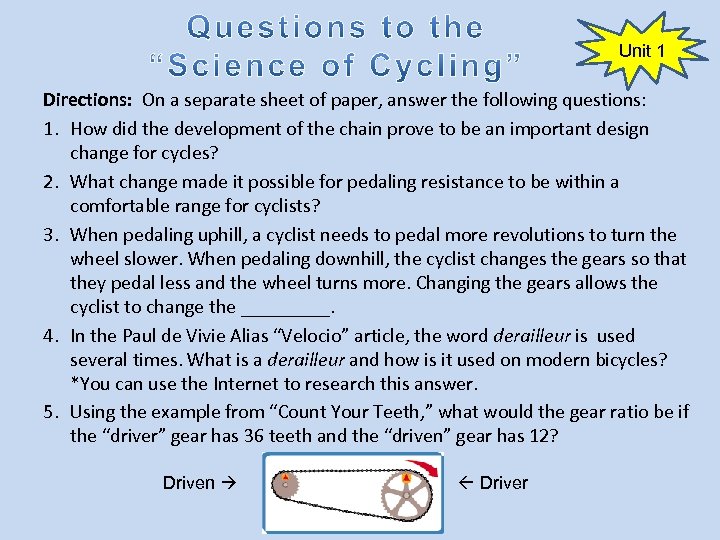
Unit 1 Directions: On a separate sheet of paper, answer the following questions: 1. How did the development of the chain prove to be an important design change for cycles? 2. What change made it possible for pedaling resistance to be within a comfortable range for cyclists? 3. When pedaling uphill, a cyclist needs to pedal more revolutions to turn the wheel slower. When pedaling downhill, the cyclist changes the gears so that they pedal less and the wheel turns more. Changing the gears allows the cyclist to change the _____. 4. In the Paul de Vivie Alias “Velocio” article, the word derailleur is used several times. What is a derailleur and how is it used on modern bicycles? *You can use the Internet to research this answer. 5. Using the example from “Count Your Teeth, ” what would the gear ratio be if the “driver” gear has 36 teeth and the “driven” gear has 12? Driven Driver
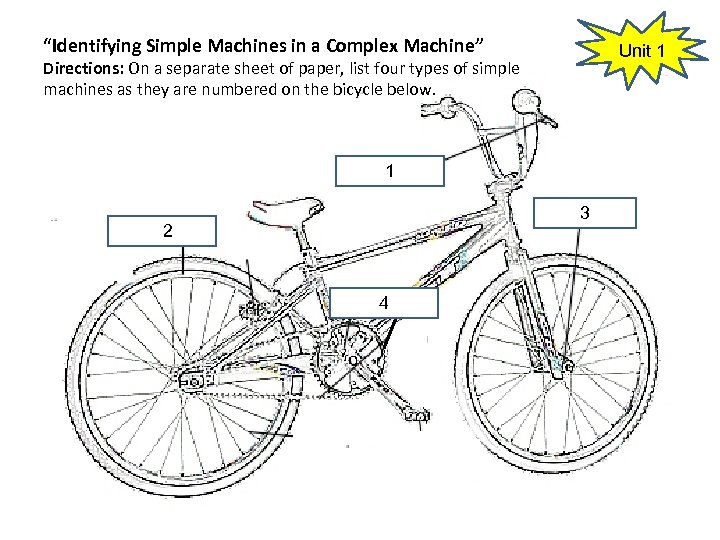
“Identifying Simple Machines in a Complex Machine” Unit 1 Directions: On a separate sheet of paper, list four types of simple machines as they are numbered on the bicycle below. 1 3 2 4
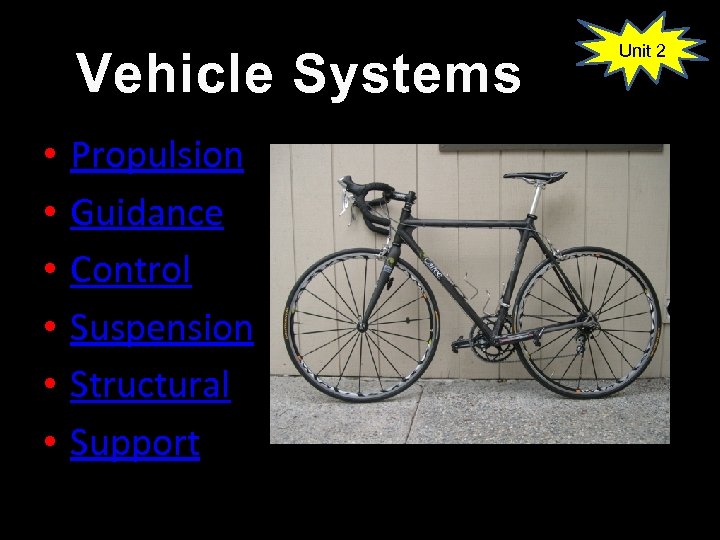
Vehicle Systems • • • Propulsion Guidance Control Suspension Structural Support Unit 2
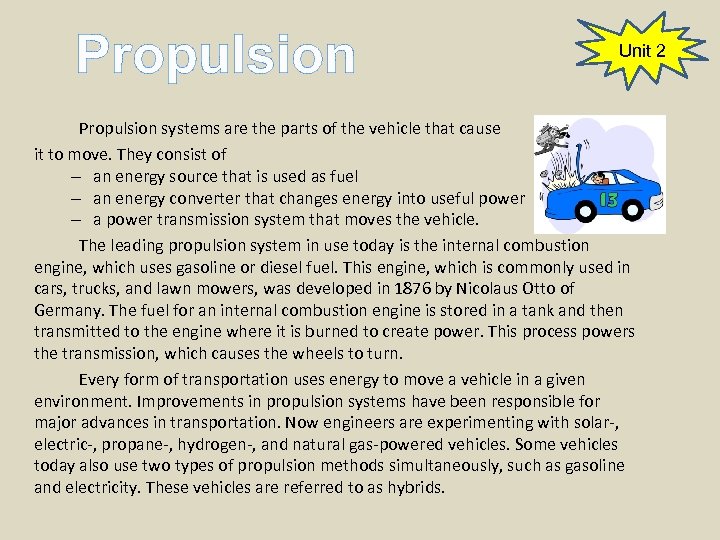
Propulsion Unit 2 Propulsion systems are the parts of the vehicle that cause it to move. They consist of – an energy source that is used as fuel – an energy converter that changes energy into useful power – a power transmission system that moves the vehicle. The leading propulsion system in use today is the internal combustion engine, which uses gasoline or diesel fuel. This engine, which is commonly used in cars, trucks, and lawn mowers, was developed in 1876 by Nicolaus Otto of Germany. The fuel for an internal combustion engine is stored in a tank and then transmitted to the engine where it is burned to create power. This process powers the transmission, which causes the wheels to turn. Every form of transportation uses energy to move a vehicle in a given environment. Improvements in propulsion systems have been responsible for major advances in transportation. Now engineers are experimenting with solar-, electric-, propane-, hydrogen-, and natural gas-powered vehicles. Some vehicles today also use two types of propulsion methods simultaneously, such as gasoline and electricity. These vehicles are referred to as hybrids.
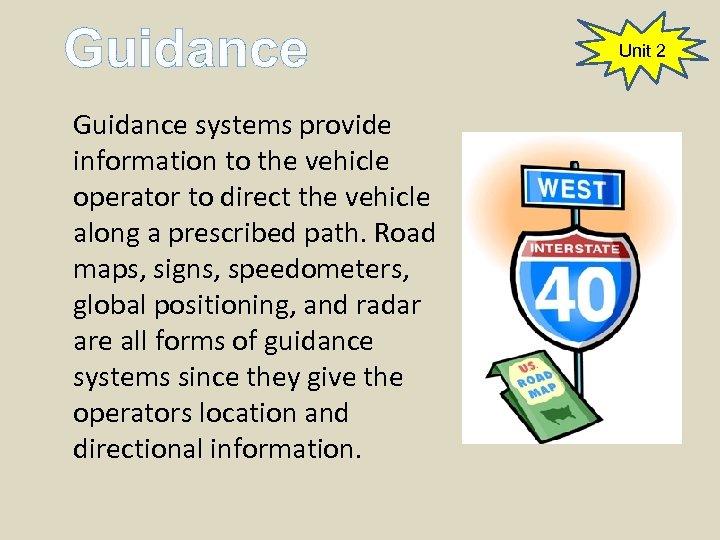
Guidance systems provide information to the vehicle operator to direct the vehicle along a prescribed path. Road maps, signs, speedometers, global positioning, and radar are all forms of guidance systems since they give the operators location and directional information. Unit 2
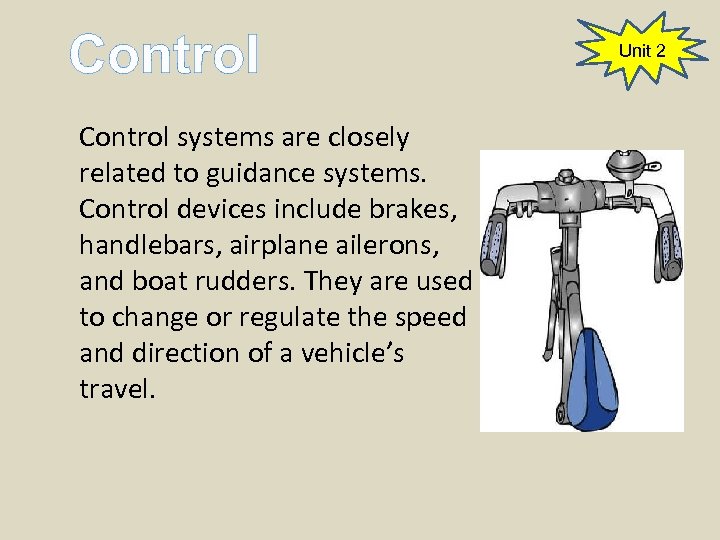
Control systems are closely related to guidance systems. Control devices include brakes, handlebars, airplane ailerons, and boat rudders. They are used to change or regulate the speed and direction of a vehicle’s travel. Unit 2
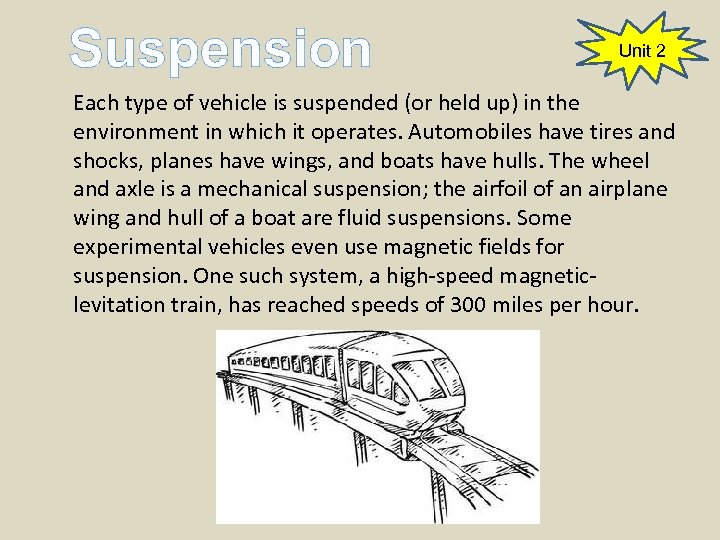
Suspension Unit 2 Each type of vehicle is suspended (or held up) in the environment in which it operates. Automobiles have tires and shocks, planes have wings, and boats have hulls. The wheel and axle is a mechanical suspension; the airfoil of an airplane wing and hull of a boat are fluid suspensions. Some experimental vehicles even use magnetic fields for suspension. One such system, a high-speed magneticlevitation train, has reached speeds of 300 miles per hour.
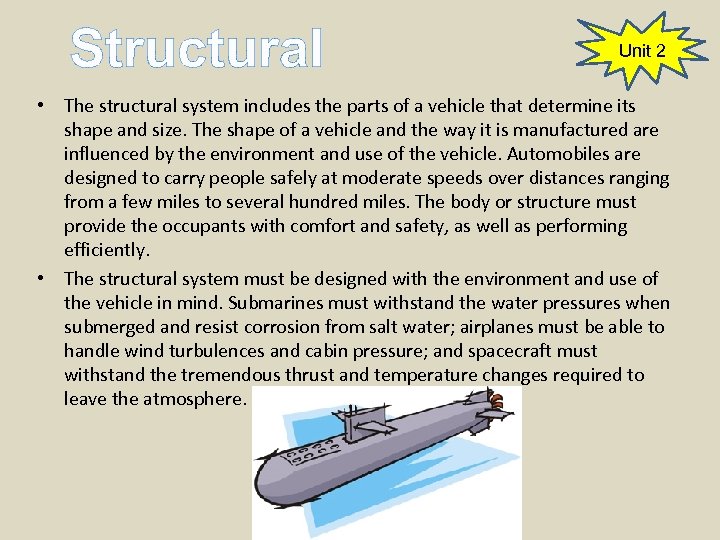
Structural Unit 2 • The structural system includes the parts of a vehicle that determine its shape and size. The shape of a vehicle and the way it is manufactured are influenced by the environment and use of the vehicle. Automobiles are designed to carry people safely at moderate speeds over distances ranging from a few miles to several hundred miles. The body or structure must provide the occupants with comfort and safety, as well as performing efficiently. • The structural system must be designed with the environment and use of the vehicle in mind. Submarines must withstand the water pressures when submerged and resist corrosion from salt water; airplanes must be able to handle wind turbulences and cabin pressure; and spacecraft must withstand the tremendous thrust and temperature changes required to leave the atmosphere.
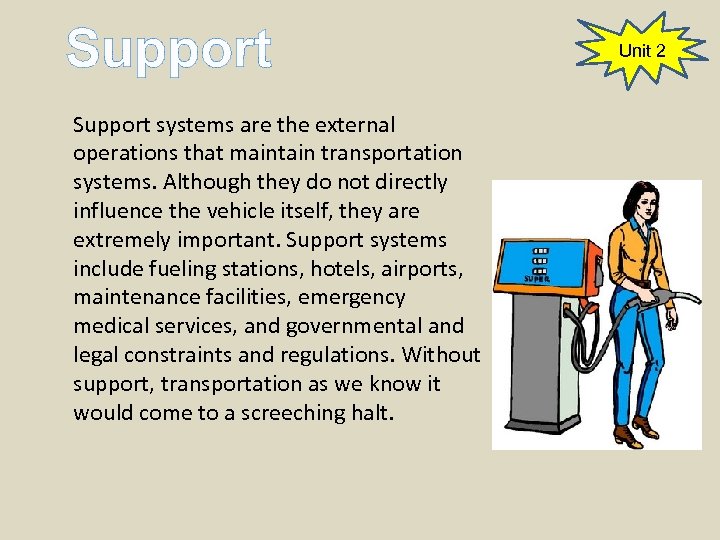
Support systems are the external operations that maintain transportation systems. Although they do not directly influence the vehicle itself, they are extremely important. Support systems include fueling stations, hotels, airports, maintenance facilities, emergency medical services, and governmental and legal constraints and regulations. Without support, transportation as we know it would come to a screeching halt. Unit 2
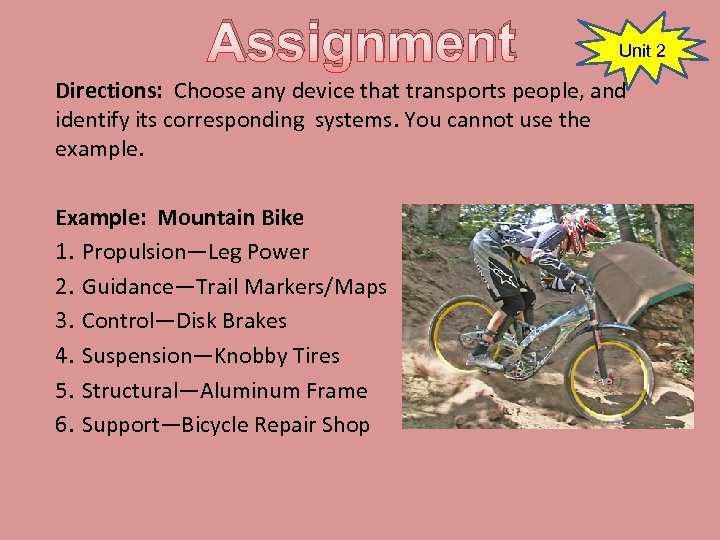
Assignment Unit 2 Directions: Choose any device that transports people, and identify its corresponding systems. You cannot use the example. Example: Mountain Bike 1. Propulsion—Leg Power 2. Guidance—Trail Markers/Maps 3. Control—Disk Brakes 4. Suspension—Knobby Tires 5. Structural—Aluminum Frame 6. Support—Bicycle Repair Shop
Unit 2 The environment in which the tire is to be used determines tread pattern. Whether your cycling takes you down a nice smooth road, through dusty desert trails, or bombing down a muddy, root-infested downhill course, the tread pattern is the key ingredient in how your bike handles.
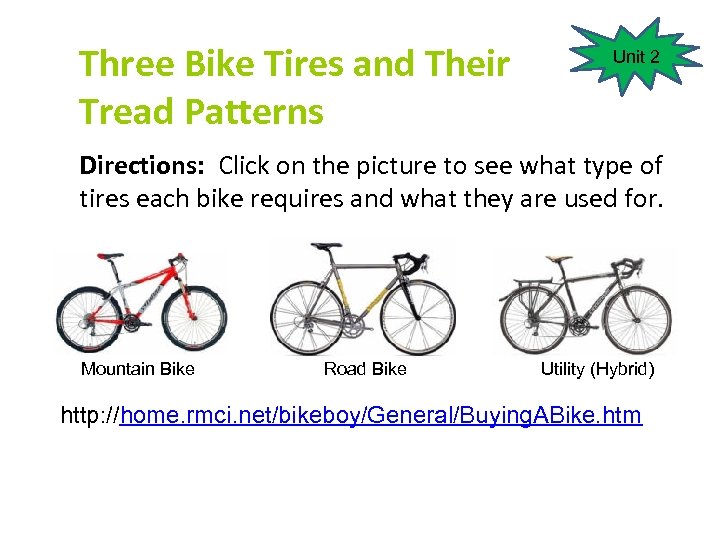
Three Bike Tires and Their Tread Patterns Unit 2 Directions: Click on the picture to see what type of tires each bike requires and what they are used for. Mountain Bike Road Bike Utility (Hybrid) http: //home. rmci. net/bikeboy/General/Buying. ABike. htm
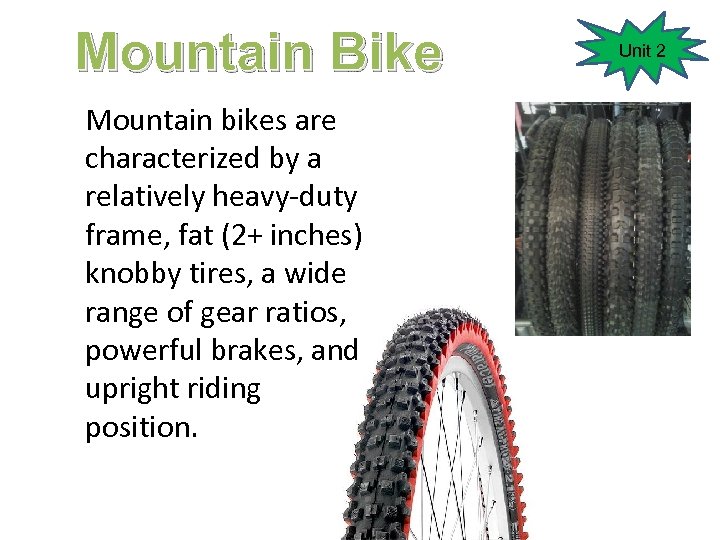
Mountain Bike Mountain bikes are characterized by a relatively heavy-duty frame, fat (2+ inches) knobby tires, a wide range of gear ratios, powerful brakes, and upright riding position. Unit 2
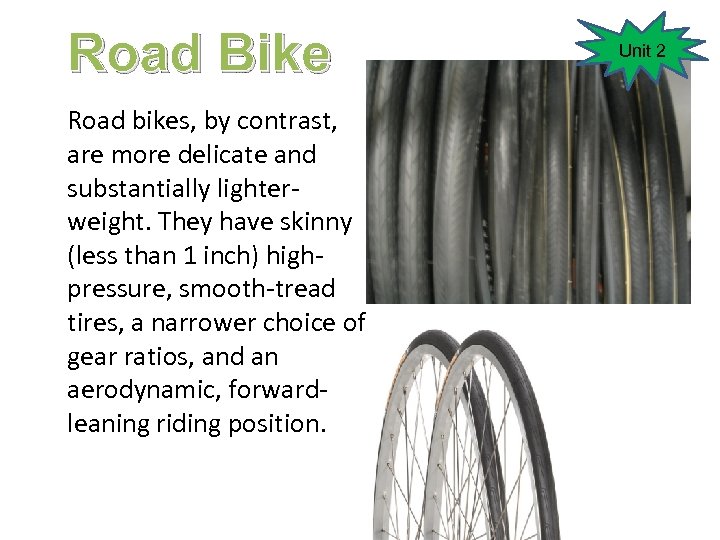
Road Bike Road bikes, by contrast, are more delicate and substantially lighterweight. They have skinny (less than 1 inch) highpressure, smooth-tread tires, a narrower choice of gear ratios, and an aerodynamic, forwardleaning riding position. Unit 2
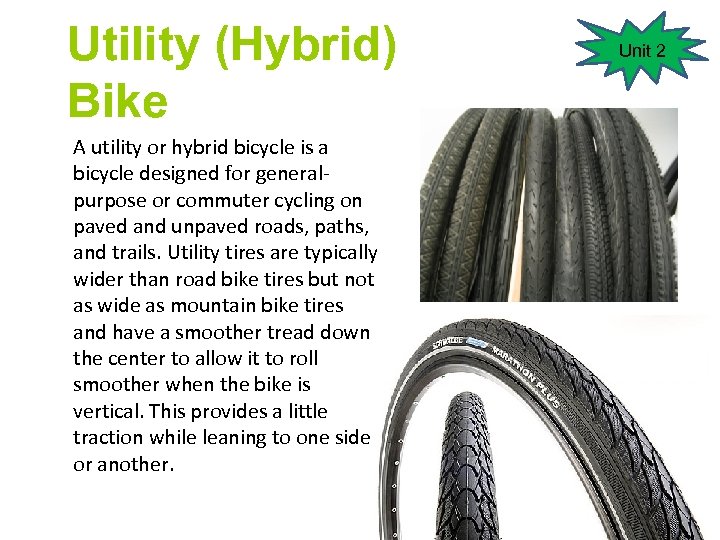
Utility (Hybrid) Bike A utility or hybrid bicycle is a bicycle designed for generalpurpose or commuter cycling on paved and unpaved roads, paths, and trails. Utility tires are typically wider than road bike tires but not as wide as mountain bike tires and have a smoother tread down the center to allow it to roll smoother when the bike is vertical. This provides a little traction while leaning to one side or another. Unit 2
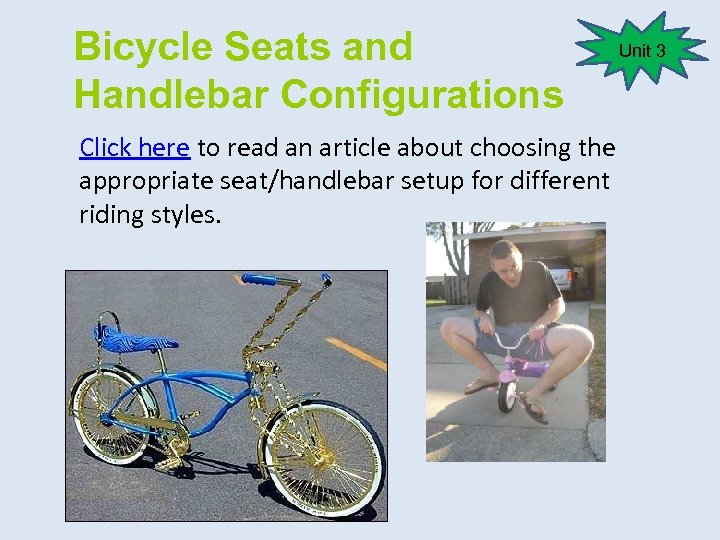
Bicycle Seats and Handlebar Configurations Unit 3 Click here to read an article about choosing the appropriate seat/handlebar setup for different riding styles.
Unit 3 Refer to “Fitting the Bicycle” <http: //www. bikemanual. com/brands/trek/om/hybrid/fitting. htm> to answer each question. 1. How should you be aerodynamically positioned on the bicycle when you are trying to increase speed? 2. How might you be positioned when you are making a long commute and are trying to achieve comfort? 3. What two bike parts work together to balance the rider on the bicycle? 4. Should the handlebars be lower or higher than the seat on a road bike? Why?
Unit 3 5. Should the handlebars be higher or lower on a utility/hybrid bicycle? Why? 6. According to what you’ve read, how do the handlebars fit under the control category? 7. Using the correct gearing is crucial to the amount of power generated while pedaling. Why is the seat height crucial to the amount of power generated? 8. What does changing the fore-aft and weight distribution of the seat have to do with control?
Design Challenge Unit 4 Culminating Activity Directions: Using all of the concepts that you’ve learned in this project, select one of the three members of the Jensen family who you met in the introductory scenario. Design a bike that fits the needs of the Jensen family member that you’ve selected. Write a 500 -word essay, providing specific information about vehicle systems, tires, seats, handle bars, frames, and accessories. You may also include any information about simple machines that you think is relevant. Next, to the best of your artistic ability, sketch the bicycle that you chose (or use design software). Note on your sketch the featured components that will likely sell this bike to the intended customer. Upon completion of your design, prepare a 5 - to 7 -minute presentation explaining how your design will meet the wants and needs of the consumer.
Additional Design Issues Unit 4 Remember to design a bicycle that will accommodate the size and needs of its intended rider. 1. Mark Jensen commutes 4½ miles to work. He is 6'2" and weighs 230 pounds. 2. Cindy wants a bike for getting around campus and for exploring the state park in the nearby mountains. She is 5'4" and weighs 115 pounds. 3. Cindy’s brother, Ted, is an athlete who wants a bike for riding in competitive events. These events typically occur on well-paved roadways and run from 50 to 100 miles. Ted is 5'10" and weighs 170 pounds.
Скачать презентацию Different Bikes for Different Needs By Mr Seth
f2c99ba3206f8eec6842ced956a489d7.ppt