


 Скачать презентацию Die demographische Situation in Europa Ein Ländervergleich
14f6372b67ff433e9ae01a0d9e868507.ppt
- Количество слайдов: 27
 Die demographische Situation in Europa – Ein Ländervergleich HS: Datenanalyse Prof. M. Häder Referentin: Bianka Gäbler 15. 11. 06
 Wiederholung: Was ist eine Datenanalyse? Phasen der Datenauswertung: 1. Kodierung und Datenübertragung 2. Fehlerkontrolle und –bereinigung; Ausschluss von „missing values“ 3. Rekodierung und Variablentransformation 4. Statistische Analyse von Verteilungen und Zusammenhängen
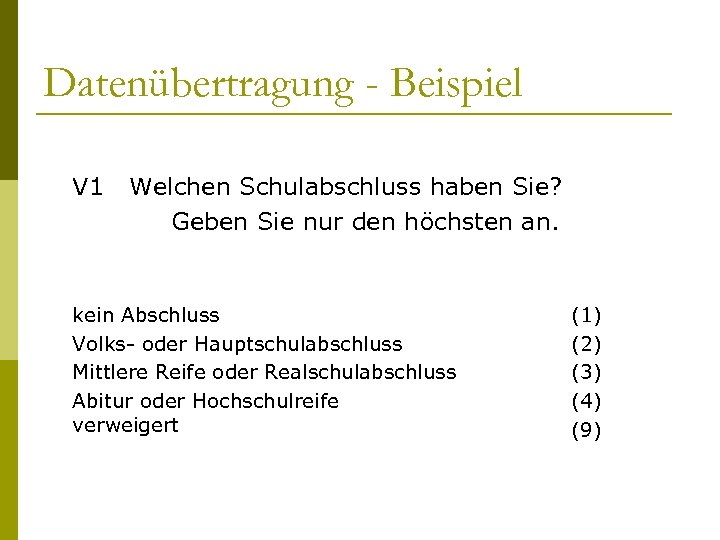 Datenübertragung - Beispiel V 1 Welchen Schulabschluss haben Sie? Geben Sie nur den höchsten an. kein Abschluss Volks- oder Hauptschulabschluss Mittlere Reife oder Realschulabschluss Abitur oder Hochschulreife verweigert (1) (2) (3) (4) (9)
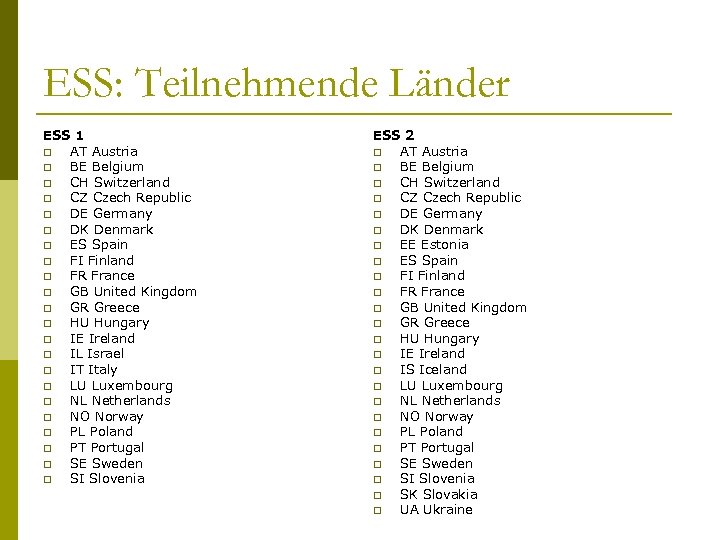 ESS: Teilnehmende Länder ESS 1 p AT Austria p BE Belgium p CH Switzerland p CZ Czech Republic p DE Germany p DK Denmark p ES Spain p FI Finland p FR France p GB United Kingdom p GR Greece p HU Hungary p IE Ireland p IL Israel p IT Italy p LU Luxembourg p NL Netherlands p NO Norway p PL Poland p PT Portugal p SE Sweden p SI Slovenia ESS 2 p AT Austria p BE Belgium p CH Switzerland p CZ Czech Republic p DE Germany p DK Denmark p EE Estonia p ES Spain p FI Finland p FR France p GB United Kingdom p GR Greece p HU Hungary p IE Ireland p IS Iceland p LU Luxembourg p NL Netherlands p NO Norway p PL Poland p PT Portugal p SE Sweden p SI Slovenia p SK Slovakia p UA Ukraine
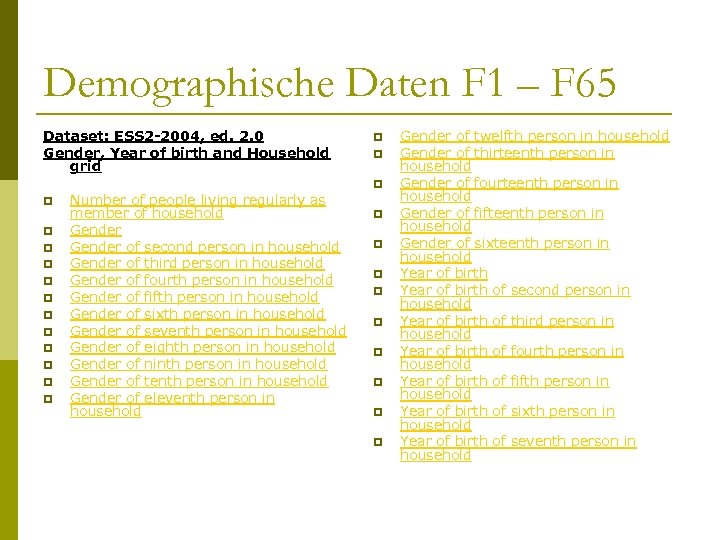 Demographische Daten F 1 – F 65 Dataset: ESS 2 -2004, ed. 2. 0 Gender, Year of birth and Household grid p p p p Number of people living regularly as member of household Gender of second person in household Gender of third person in household Gender of fourth person in household Gender of fifth person in household Gender of sixth person in household Gender of seventh person in household Gender of eighth person in household Gender of ninth person in household Gender of tenth person in household Gender of eleventh person in household p p p p p Gender of twelfth person in household Gender of thirteenth person in household Gender of fourteenth person in household Gender of fifteenth person in household Gender of sixteenth person in household Year of birth of second person in household Year of birth of third person in household Year of birth of fourth person in household Year of birth of fifth person in household Year of birth of sixth person in household Year of birth of seventh person in household
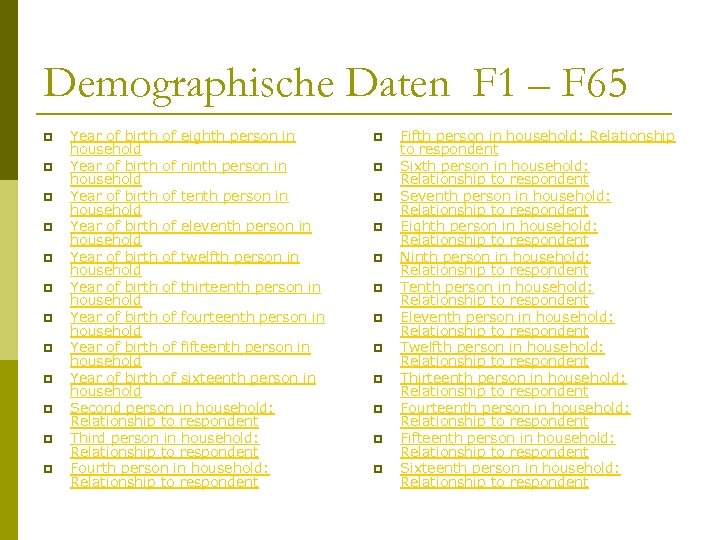 Demographische Daten F 1 – F 65 p p p Year of birth of eighth person in household Year of birth of ninth person in household Year of birth of tenth person in household Year of birth of eleventh person in household Year of birth of twelfth person in household Year of birth of thirteenth person in household Year of birth of fourteenth person in household Year of birth of fifteenth person in household Year of birth of sixteenth person in household Second person in household: Relationship to respondent Third person in household: Relationship to respondent Fourth person in household: Relationship to respondent p p p Fifth person in household: Relationship to respondent Sixth person in household: Relationship to respondent Seventh person in household: Relationship to respondent Eighth person in household: Relationship to respondent Ninth person in household: Relationship to respondent Tenth person in household: Relationship to respondent Eleventh person in household: Relationship to respondent Twelfth person in household: Relationship to respondent Thirteenth person in household: Relationship to respondent Fourteenth person in household: Relationship to respondent Fifteenth person in household: Relationship to respondent Sixteenth person in household: Relationship to respondent
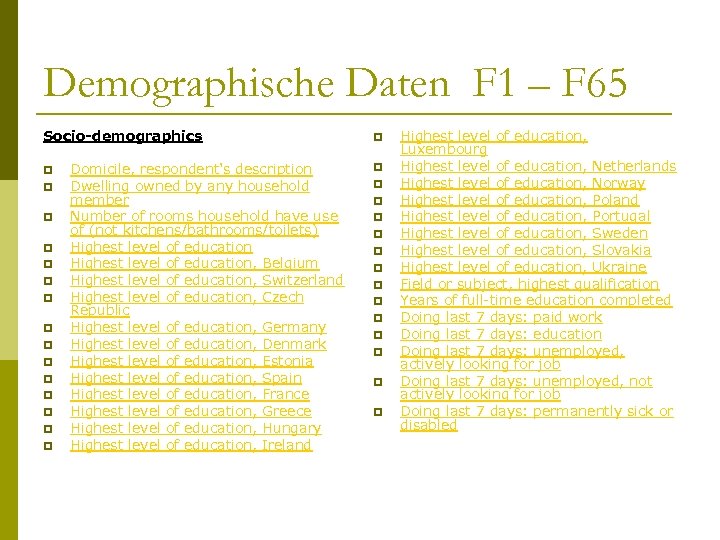 Demographische Daten F 1 – F 65 Socio-demographics p p p p Domicile, respondent's description Dwelling owned by any household member Number of rooms household have use of (not kitchens/bathrooms/toilets) Highest level of education, Belgium Highest level of education, Switzerland Highest level of education, Czech Republic Highest level of education, Germany Highest level of education, Denmark Highest level of education, Estonia Highest level of education, Spain Highest level of education, France Highest level of education, Greece Highest level of education, Hungary Highest level of education, Ireland p p p p Highest level of education, Luxembourg Highest level of education, Netherlands Highest level of education, Norway Highest level of education, Poland Highest level of education, Portugal Highest level of education, Sweden Highest level of education, Slovakia Highest level of education, Ukraine Field or subject, highest qualification Years of full-time education completed Doing last 7 days: paid work Doing last 7 days: education Doing last 7 days: unemployed, actively looking for job Doing last 7 days: unemployed, not actively looking for job Doing last 7 days: permanently sick or disabled
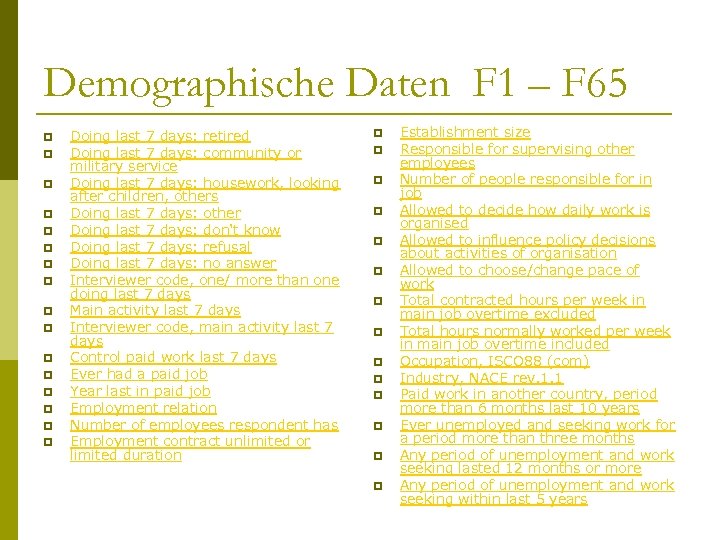 Demographische Daten F 1 – F 65 p p p p Doing last 7 days: retired Doing last 7 days: community or military service Doing last 7 days: housework, looking after children, others Doing last 7 days: other Doing last 7 days: don't know Doing last 7 days: refusal Doing last 7 days: no answer Interviewer code, one/ more than one doing last 7 days Main activity last 7 days Interviewer code, main activity last 7 days Control paid work last 7 days Ever had a paid job Year last in paid job Employment relation Number of employees respondent has Employment contract unlimited or limited duration p p p p Establishment size Responsible for supervising other employees Number of people responsible for in job Allowed to decide how daily work is organised Allowed to influence policy decisions about activities of organisation Allowed to choose/change pace of work Total contracted hours per week in main job overtime excluded Total hours normally worked per week in main job overtime included Occupation, ISCO 88 (com) Industry, NACE rev. 1. 1 Paid work in another country, period more than 6 months last 10 years Ever unemployed and seeking work for a period more than three months Any period of unemployment and work seeking lasted 12 months or more Any period of unemployment and work seeking within last 5 years
 Demographische Daten F 1 – F 65 p p p p Member of trade union or similar organisation Main source of household income Household's total net income, all sources Porportion of household income respondent provides Feeling about household's income nowadays Borrow money to make ends meet, difficult or easy Lives with husband/wife/partner at F 4 Partner's highest level of education Partner doing last 7 days: paid work Partner doing last 7 days: education Partner doing last 7 days: unemployed, actively looking for job Partner doing last 7 days: unemployed, not actively looking for job Partner doing last 7 days: permanently sick or disabled Partner doing last 7 days: retired Partner doing last 7 days: community or military service p p p p Partner doing last 7 days: housework, looking after children, others Partner doing last 7 days: other Partner doing last 7 days: don't know Partner doing last 7 days: not applicable Partner doing last 7 days: refusal Partner doing last 7 days: no answer Interviewer code, one/ more than one doing partner last 7 days Partner's main activity last 7 days Partner, control paid work last 7 days Occupation partner, ISCO 88 (com) Partner's employment relation Number of employees partner has Partner responsible for supervising other employees Number of people partner responsible for in job Partner allowed to decide how daily work is organised
 Demographische Daten F 1 - F 65 p p p p p Partner is allowed to influence policy decisions about activities of organisation Hours normally worked a week in main job overtime included, partner Father's highest level of education Father's employment status when respondent 14 Number of employees father had Father responsible for supervising other employees Father's occupation when respondent 14 Mother's highest level of education Mother's employment status when respondent 14 Number of employees mother had p p p p Mother responsible for supervising other employees Mother's occupation when respondent 14 Improve knowledge/skills: course/lecture/conference, last 12 months Legal marital status (France) Currently living with husband/wife Currently living with another partner than husband/wife Currently living with partner
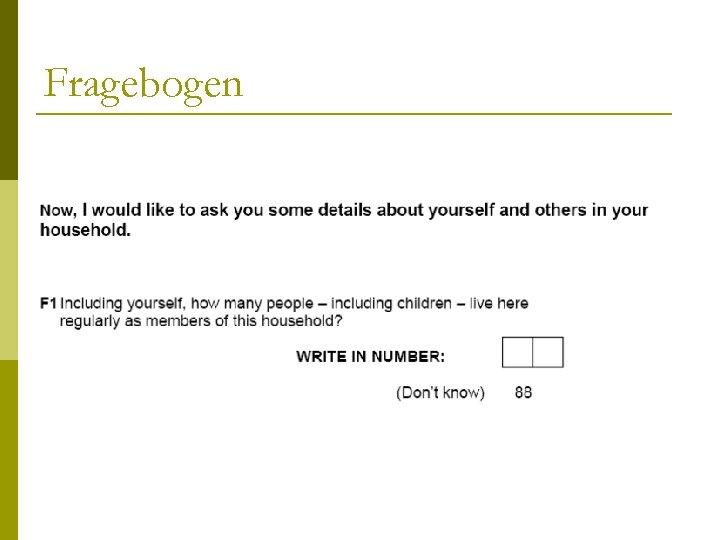 Fragebogen
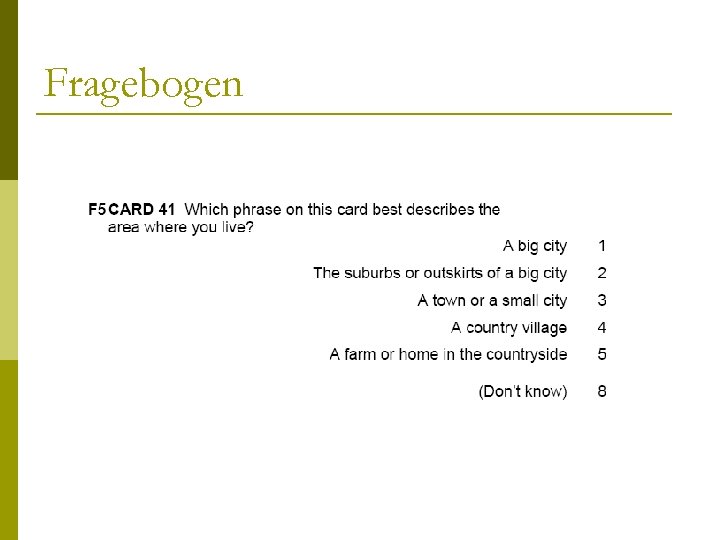 Fragebogen
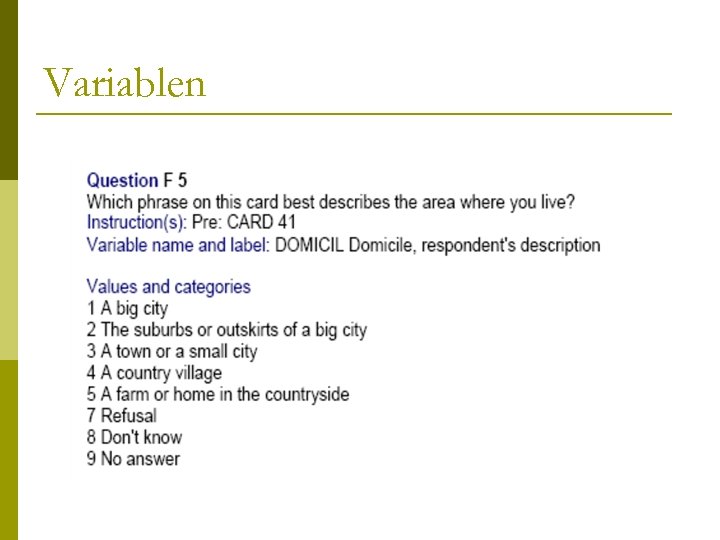 Variablen
 Datenanalyse mit F 1 – F 65
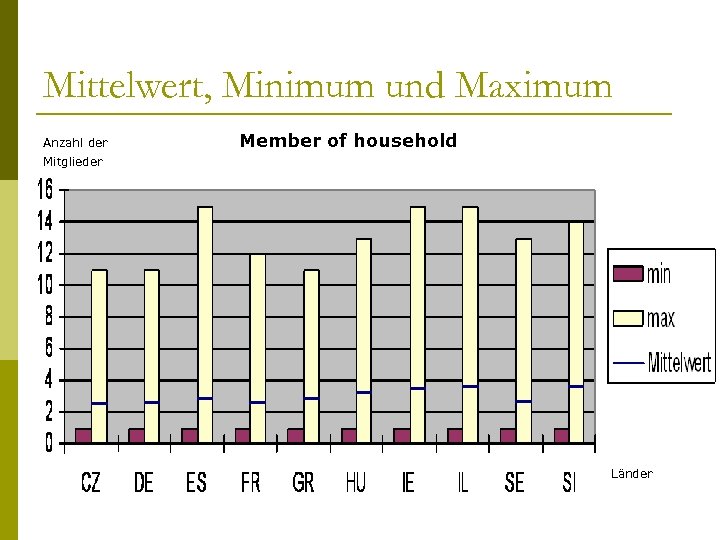 Mittelwert, Minimum und Maximum Anzahl der Member of household Mitglieder Länder
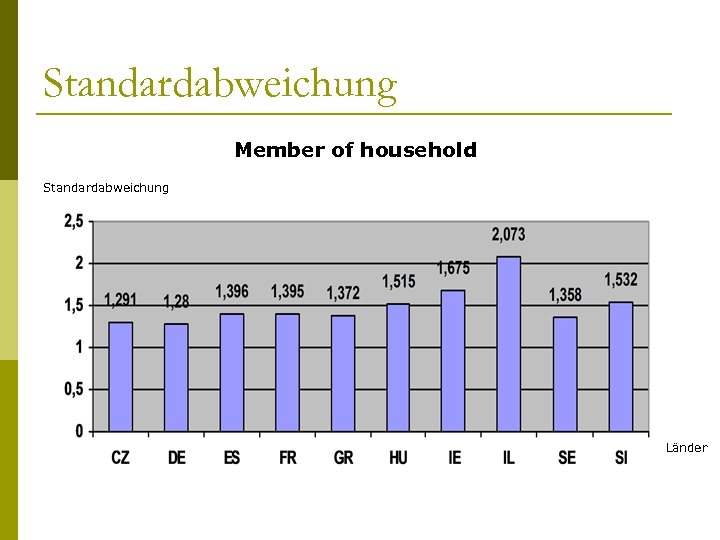 Standardabweichung Member of household Standardabweichung Länder
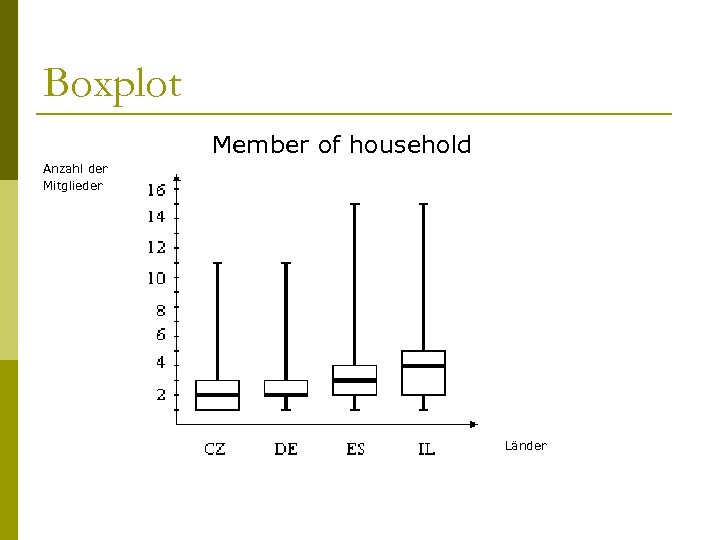 Boxplot Member of household Anzahl der Mitglieder Länder
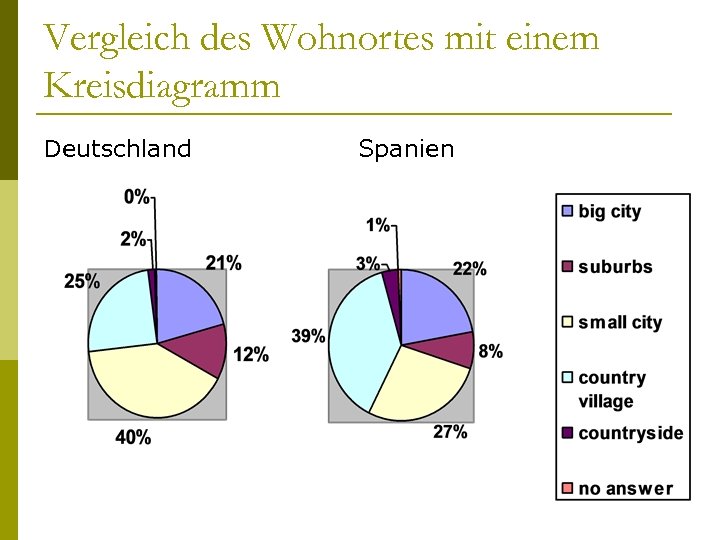 Vergleich des Wohnortes mit einem Kreisdiagramm Deutschland Spanien
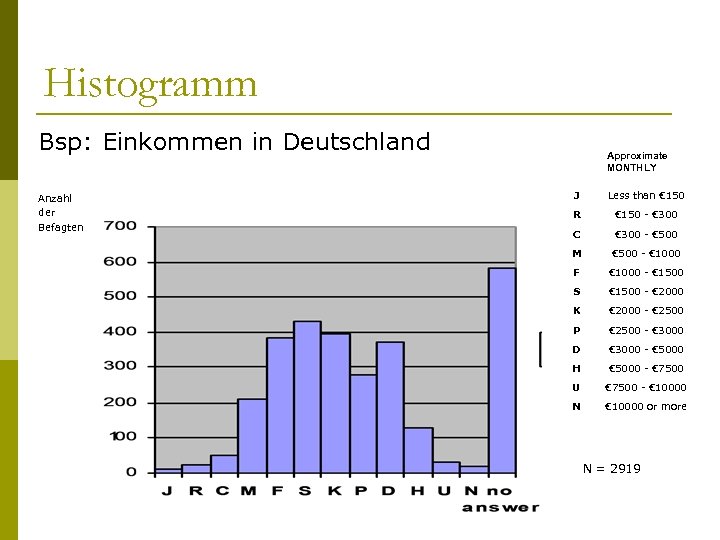 Histogramm Bsp: Einkommen in Deutschland Anzahl der Befagten Approximate MONTHLY J Less than € 150 R € 150 - € 300 C € 300 - € 500 M € 500 - € 1000 F € 1000 - € 1500 S € 1500 - € 2000 K € 2000 - € 2500 P € 2500 - € 3000 D € 3000 - € 5000 H € 5000 - € 7500 U € 7500 - € 10000 N € 10000 or more N = 2919
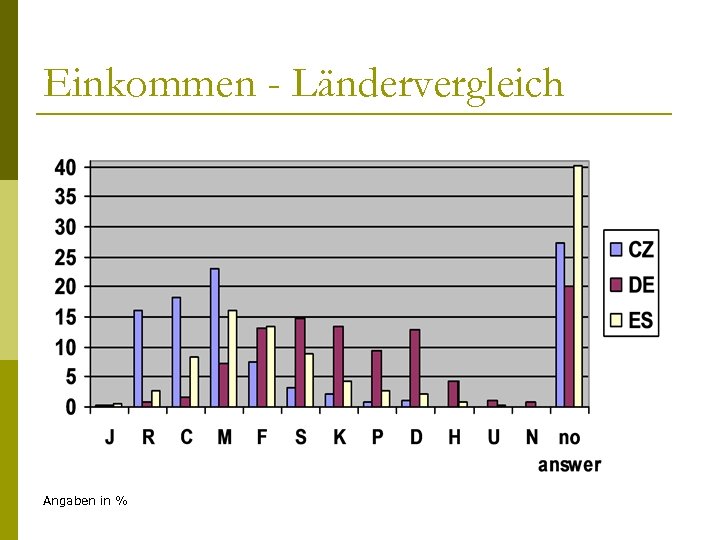 Einkommen - Ländervergleich Angaben in %
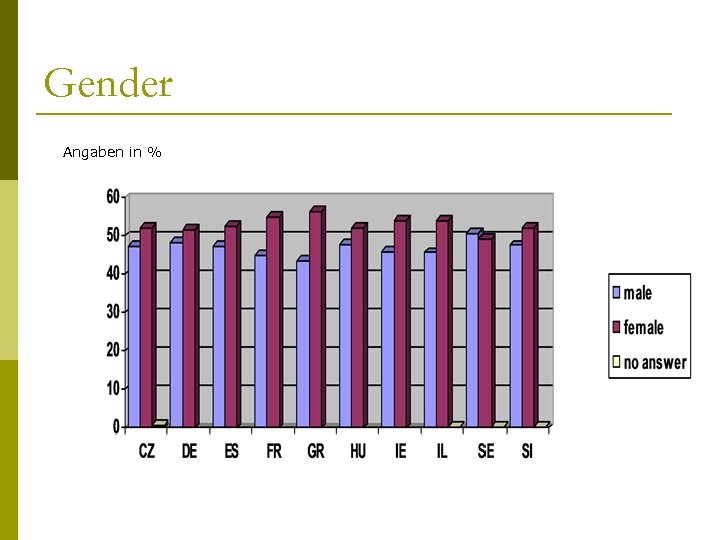 Gender Angaben in %
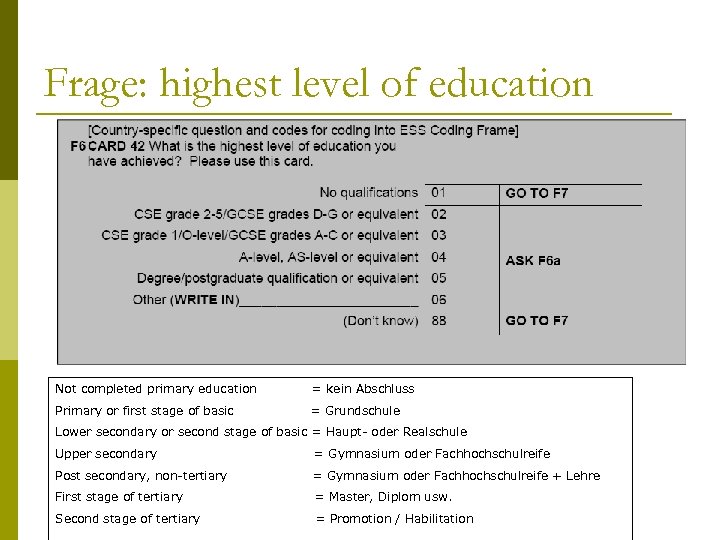 Frage: highest level of education Not completed primary education = kein Abschluss Primary or first stage of basic = Grundschule Lower secondary or second stage of basic = Haupt- oder Realschule Upper secondary = Gymnasium oder Fachhochschulreife Post secondary, non-tertiary = Gymnasium oder Fachhochschulreife + Lehre First stage of tertiary = Master, Diplom usw. Second stage of tertiary = Promotion / Habilitation
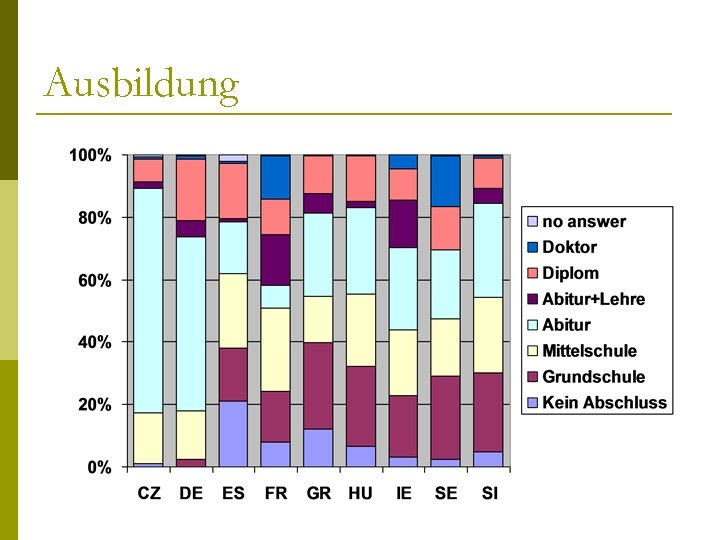 Ausbildung
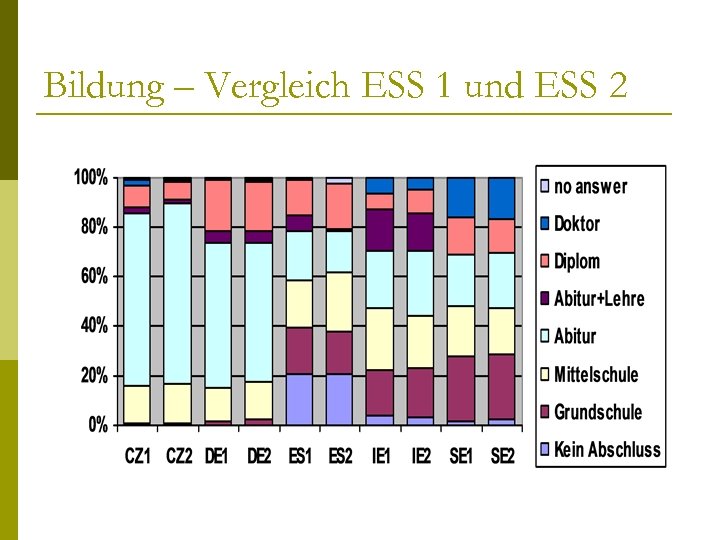 Bildung – Vergleich ESS 1 und ESS 2
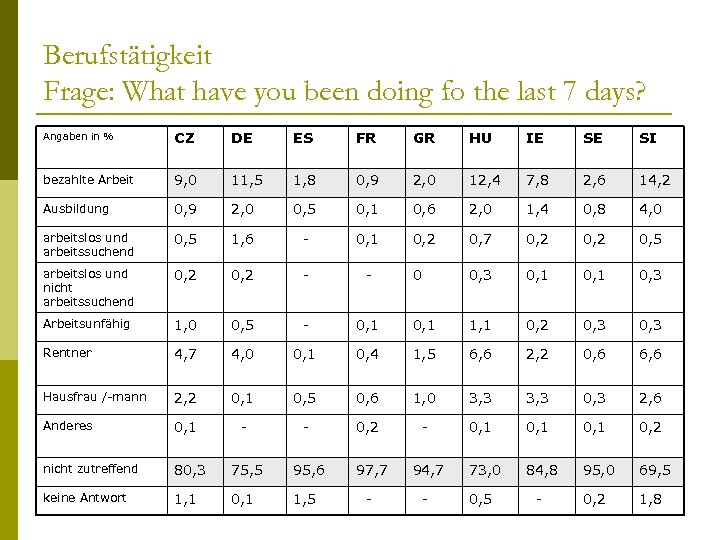 Berufstätigkeit Frage: What have you been doing fo the last 7 days? Angaben in % CZ DE ES FR GR HU IE SE SI bezahlte Arbeit 9, 0 11, 5 1, 8 0, 9 2, 0 12, 4 7, 8 2, 6 14, 2 Ausbildung 0, 9 2, 0 0, 5 0, 1 0, 6 2, 0 1, 4 0, 8 4, 0 arbeitslos und arbeitssuchend 0, 5 1, 6 - 0, 1 0, 2 0, 7 0, 2 0, 5 arbeitslos und nicht arbeitssuchend 0, 2 - - 0 0, 3 0, 1 0, 3 Arbeitsunfähig 1, 0 0, 5 - 0, 1 1, 1 0, 2 0, 3 Rentner 4, 7 4, 0 0, 1 0, 4 1, 5 6, 6 2, 2 0, 6 6, 6 Hausfrau /-mann 2, 2 0, 1 0, 5 0, 6 1, 0 3, 3 0, 3 2, 6 Anderes 0, 1 - - 0, 2 - 0, 1 0, 2 nicht zutreffend 80, 3 75, 5 95, 6 73, 0 84, 8 95, 0 69, 5 keine Antwort 1, 1 0, 1 1, 5 0, 2 1, 8 97, 7 94, 7 - - 0, 5 -
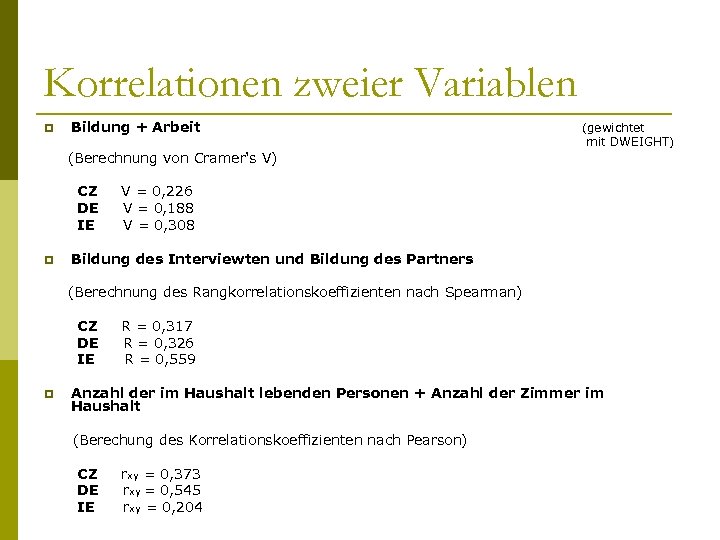 Korrelationen zweier Variablen p Bildung + Arbeit (Berechnung von Cramer‘s V) CZ DE IE p (gewichtet mit DWEIGHT) V = 0, 226 V = 0, 188 V = 0, 308 Bildung des Interviewten und Bildung des Partners (Berechnung des Rangkorrelationskoeffizienten nach Spearman) CZ DE IE p R = 0, 317 R = 0, 326 R = 0, 559 Anzahl der im Haushalt lebenden Personen + Anzahl der Zimmer im Haushalt (Berechung des Korrelationskoeffizienten nach Pearson) CZ DE IE rxy = 0, 373 rxy = 0, 545 rxy = 0, 204
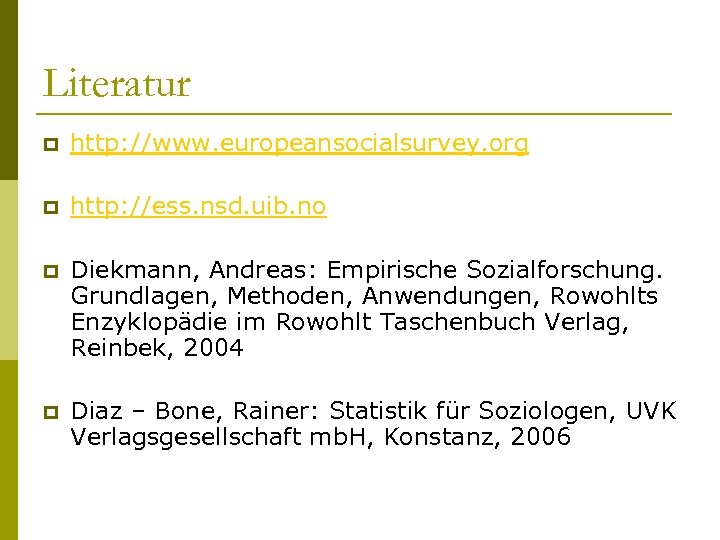 Literatur p http: //www. europeansocialsurvey. org p http: //ess. nsd. uib. no p Diekmann, Andreas: Empirische Sozialforschung. Grundlagen, Methoden, Anwendungen, Rowohlts Enzyklopädie im Rowohlt Taschenbuch Verlag, Reinbek, 2004 p Diaz – Bone, Rainer: Statistik für Soziologen, UVK Verlagsgesellschaft mb. H, Konstanz, 2006