 Скачать презентацию Diaspora Bonds Track Record and Potential Suhas Ketkar
03191c077093bf5ffae6b88c02d2b9c6.ppt
- Количество слайдов: 22



Diaspora Bonds Track Record and Potential Suhas Ketkar Vanderbilt University & Dilip Ratha The World Bank Migration and Development Conference World Bank, Washington DC May 23, 2007
Main messages Ø Israel and India have raised $35 -40 billion financing Ø. . . Often in times of crisis Ø. . . Often at a discount Ø There is scope for other countries with large diaspora abroad to issue diaspora bonds for financing development
Diaspora Bonds: Introduction Ø Definition: Bonds issued by a country to its own Diaspora to tap into their assets in the adopted developed countries Ø Examples: State of Israel bonds, RIBs and IMDs from India, also bonds issued by Lebanon and Sri Lanka Ø Distinct from FCDs but similar to Islamic bonds placed in int’l capital markets
Diaspora Bonds: Agenda Ø Rationale: why would countries issue and investors buy Diaspora bonds? Ø Israeli and Indian track-record: significant differences and regulatory issues Ø Minimum conditions for the issuance of Diaspora bonds and potential issuers
Attraction for issuing countries Ø Patriotic discount: why not seek charity? Ø Stable source of finance, esp. in bad times Ø Support to sovereign credit rating Israel: S&P believes such support to be important but not decisive. Moody’s believes that it is more relevant now that the economic house has been put in order India: Did not prevent downgrading in 1998

Attraction for investors Ø Patriotism Ø Risk management – Diaspora investors are likely to view the risk of receiving debt service in local currency with much less trepidation Ø Desire to do “good” in the country of origin
Diaspora Bonds: Israeli experience DCI established in 1951 to raise funds from Jewish Diaspora Ø Since then, Israel has raised over $25 bn via this stable source of finance Ø. . receiving significant patriotic discount – 4% coupon until 1990 regardless of US interest rates Ø Patriotic discount has declined of late as Jewish Diaspora with less direct links to the Holocaust is making investment decisions based on total returns Ø
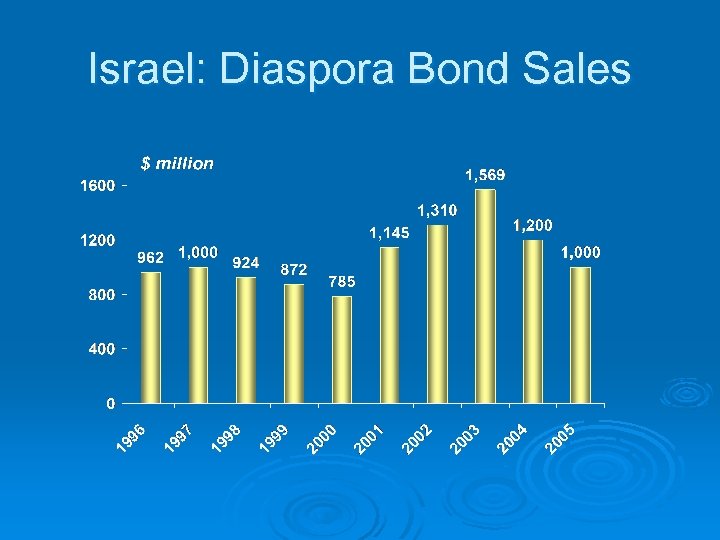
Israel: Diaspora Bond Sales
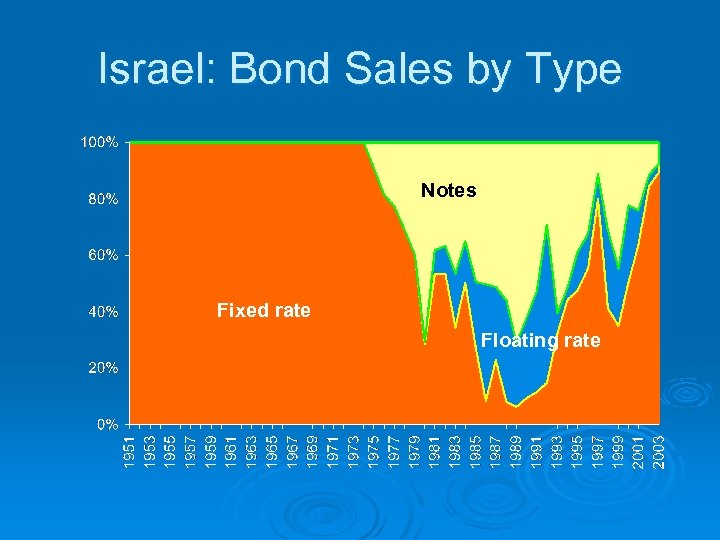
Israel: Bond Sales by Type Notes Fixed rate Floating rate
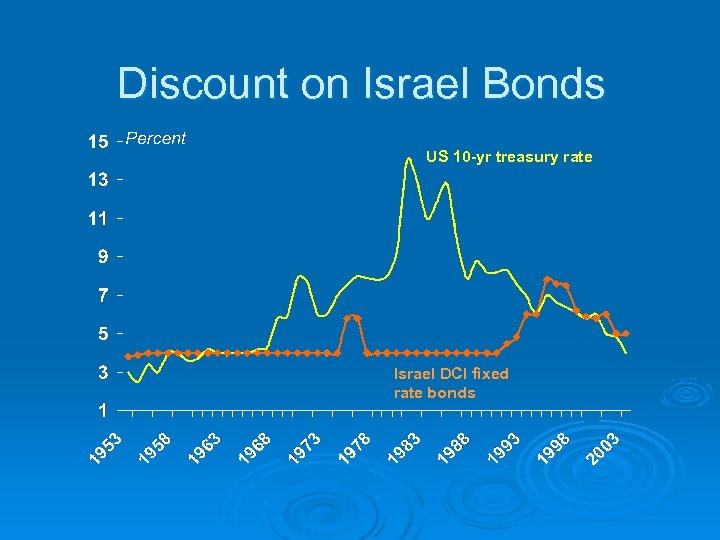
Discount on Israel Bonds US 10 -yr treasury rate Israel DCI fixed rate bonds
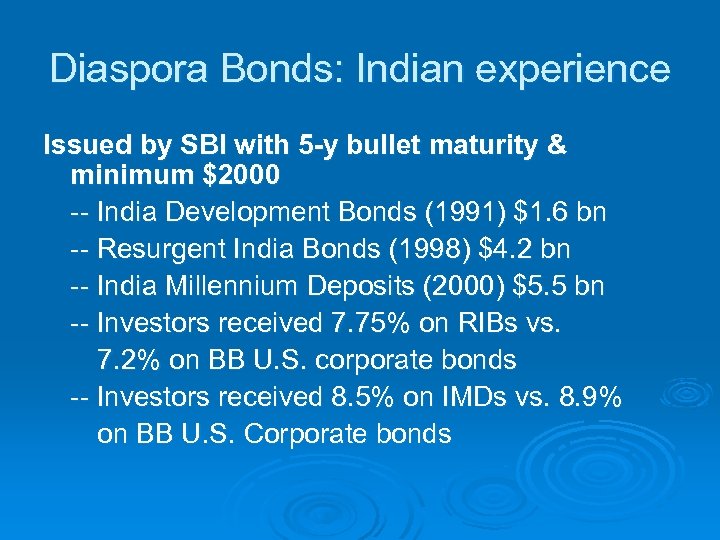
Diaspora Bonds: Indian experience Issued by SBI with 5 -y bullet maturity & minimum $2000 -- India Development Bonds (1991) $1. 6 bn -- Resurgent India Bonds (1998) $4. 2 bn -- India Millennium Deposits (2000) $5. 5 bn -- Investors received 7. 75% on RIBs vs. 7. 2% on BB U. S. corporate bonds -- Investors received 8. 5% on IMDs vs. 8. 9% on BB U. S. Corporate bonds
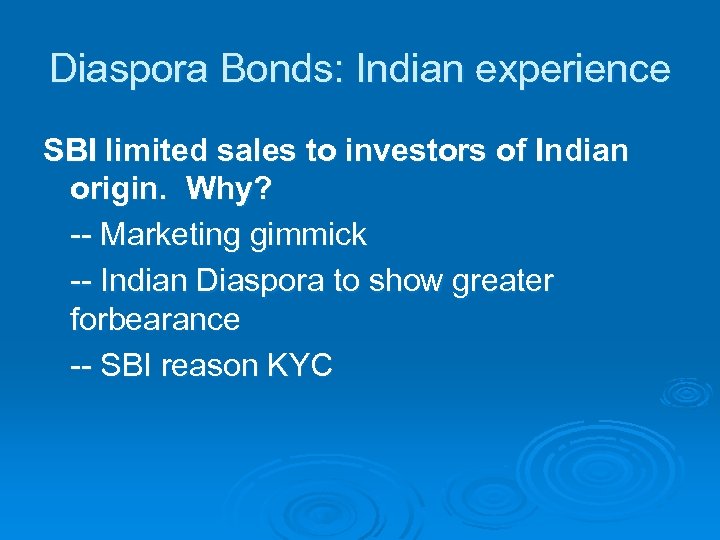
Diaspora Bonds: Indian experience SBI limited sales to investors of Indian origin. Why? -- Marketing gimmick -- Indian Diaspora to show greater forbearance -- SBI reason KYC
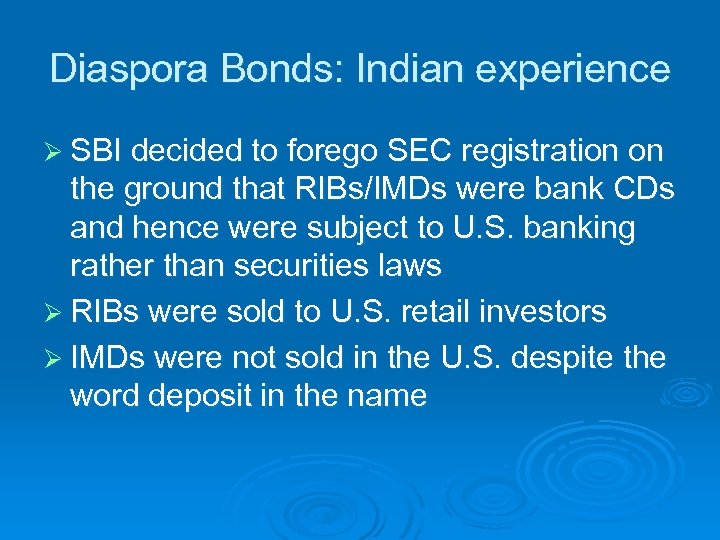
Diaspora Bonds: Indian experience Ø SBI decided to forego SEC registration on the ground that RIBs/IMDs were bank CDs and hence were subject to U. S. banking rather than securities laws Ø RIBs were sold to U. S. retail investors Ø IMDs were not sold in the U. S. despite the word deposit in the name
Diaspora Bonds: Indian experience Deterrents to SEC registration include: -- High costs (but $500 K not material) -- Stringent disclosure requirements (but no problem for SBI) -- Long lead time of up to 3 months -- Plaintiff-friendly U. S. court system -- India rejected U. S. courts as well as U. S. laws
Diaspora Bonds: Indian experience Ø “In addition to class action mechanisms to aggregate individual claims not prevalent in other countries, U. S. procedures – including rules of discovery, pleading requirements, contingent fees, and the absence of ‘loser pays’ cost rule – are far more favorable to plaintiffs than those of foreign courts. ” Roberta Romano (1998)
Diaspora Bonds: Indian experience Ø While SEC registration is not optional, the Indian case raises an interesting issue of giving investors the choice of law and forum Ø Make such choice another attribute of the security to be priced in the market Ø Can be supported on efficiency grounds Ø Unlikely in short run given Enron, MCI etc. Ø But market pressure will come into play
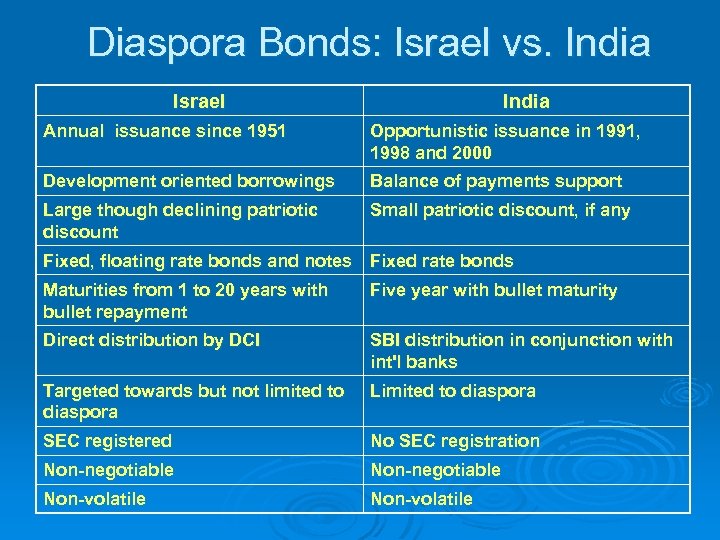
Diaspora Bonds: Israel vs. India Israel India Annual issuance since 1951 Opportunistic issuance in 1991, 1998 and 2000 Development oriented borrowings Balance of payments support Large though declining patriotic discount Small patriotic discount, if any Fixed, floating rate bonds and notes Fixed rate bonds Maturities from 1 to 20 years with bullet repayment Five year with bullet maturity Direct distribution by DCI SBI distribution in conjunction with int'l banks Targeted towards but not limited to diaspora Limited to diaspora SEC registered No SEC registration Non-negotiable Non-volatile
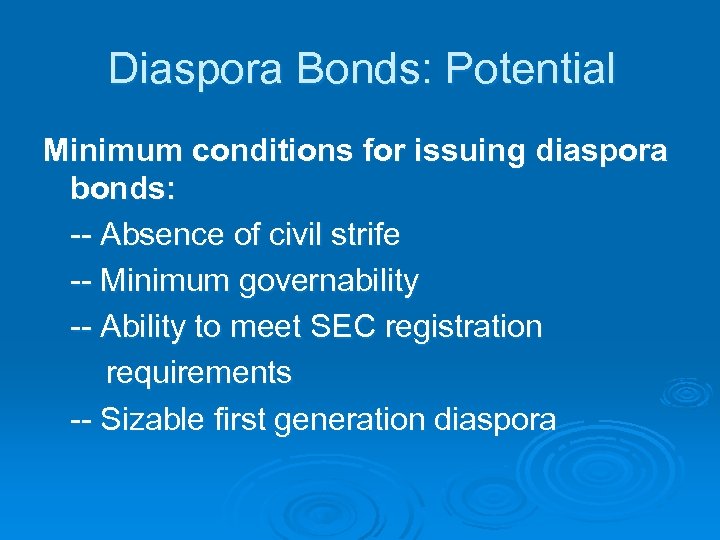
Diaspora Bonds: Potential Minimum conditions for issuing diaspora bonds: -- Absence of civil strife -- Minimum governability -- Ability to meet SEC registration requirements -- Sizable first generation diaspora
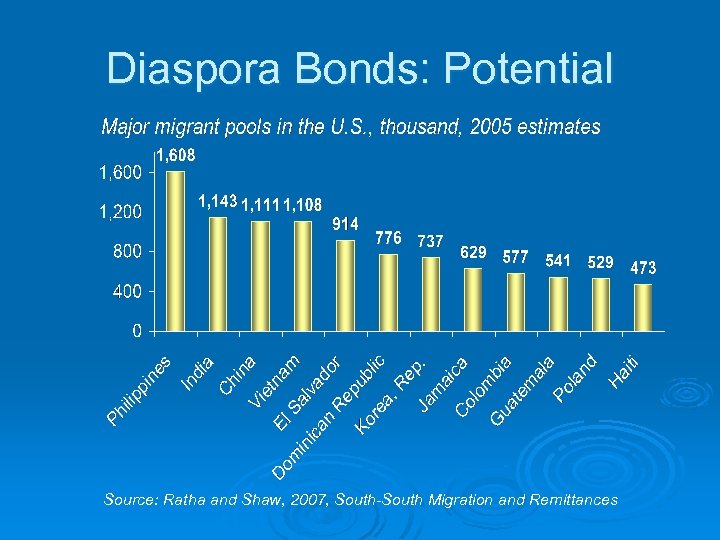
Diaspora Bonds: Potential Source: Ratha and Shaw, 2007, South-South Migration and Remittances
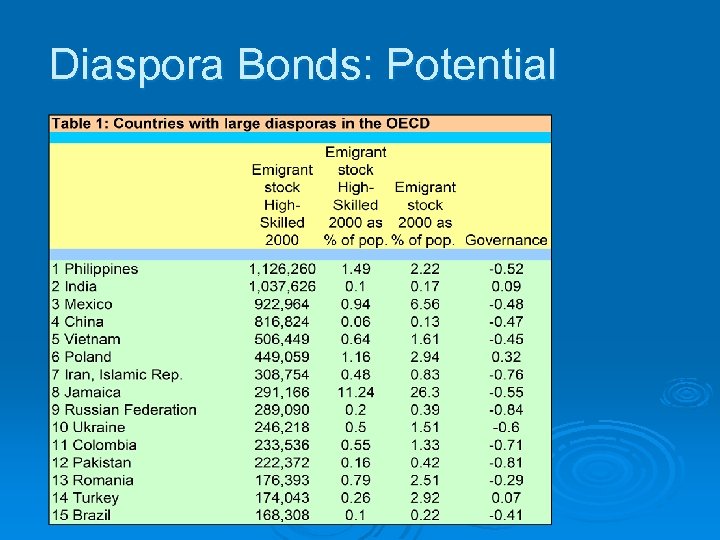
Diaspora Bonds: Potential
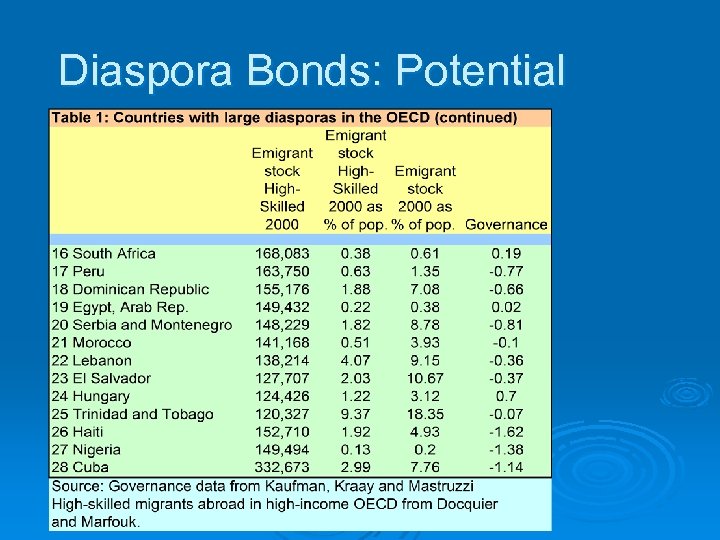
Diaspora Bonds: Potential
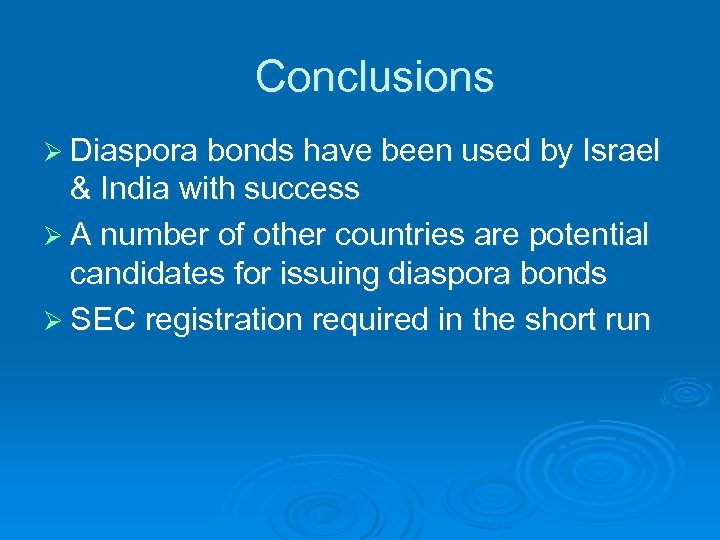
Conclusions Ø Diaspora bonds have been used by Israel & India with success Ø A number of other countries are potential candidates for issuing diaspora bonds Ø SEC registration required in the short run
Скачать презентацию Diaspora Bonds Track Record and Potential Suhas Ketkar
03191c077093bf5ffae6b88c02d2b9c6.ppt