


 Скачать презентацию Diamond Detector Prototyping Anna Micherdzinska Outline Recipe how
3722b9e702689e73a1e48822c721e7c4.ppt
- Количество слайдов: 12
 Diamond Detector Prototyping Anna Micherdzinska Outline: Recipe “how to make a diamond detector” 1. Buy 2. Clean with various acids/bases 3. Metallize 4. Mount in a nice package and wirebond 5. Tests – checks to see if you did a good job 6. Summary
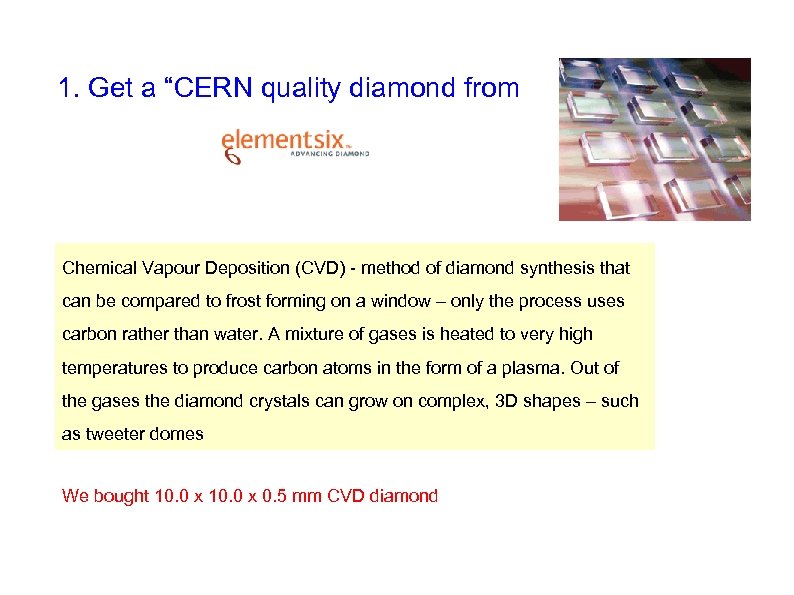 1. Get a “CERN quality diamond from Chemical Vapour Deposition (CVD) - method of diamond synthesis that can be compared to frost forming on a window – only the process uses carbon rather than water. A mixture of gases is heated to very high temperatures to produce carbon atoms in the form of a plasma. Out of the gases the diamond crystals can grow on complex, 3 D shapes – such as tweeter domes We bought 10. 0 x 0. 5 mm CVD diamond
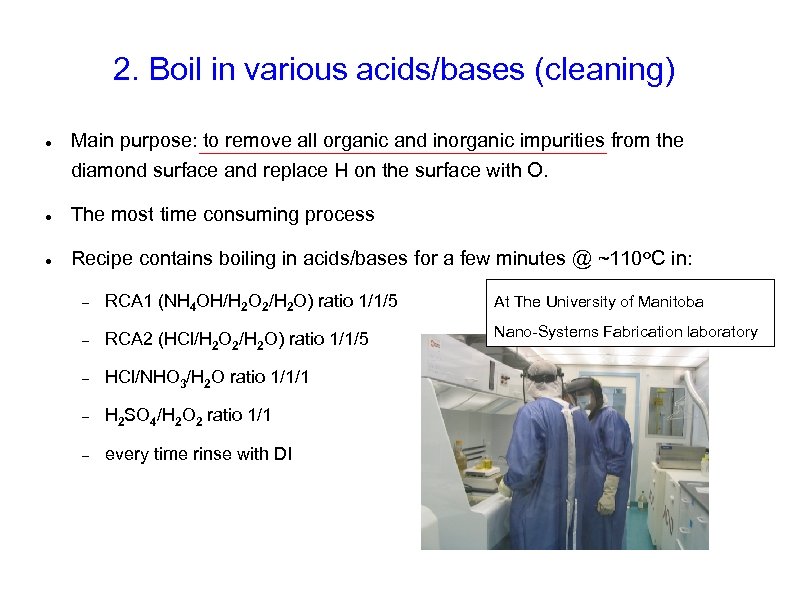 2. Boil in various acids/bases (cleaning) Main purpose: to remove all organic and inorganic impurities from the diamond surface and replace H on the surface with O. The most time consuming process Recipe contains boiling in acids/bases for a few minutes @ ~110 o. C in: RCA 1 (NH 4 OH/H 2 O 2/H 2 O) ratio 1/1/5 At The University of Manitoba RCA 2 (HCl/H 2 O 2/H 2 O) ratio 1/1/5 Nano-Systems Fabrication laboratory HCl/NHO 3/H 2 O ratio 1/1/1 H 2 SO 4/H 2 O 2 ratio 1/1 every time rinse with DI
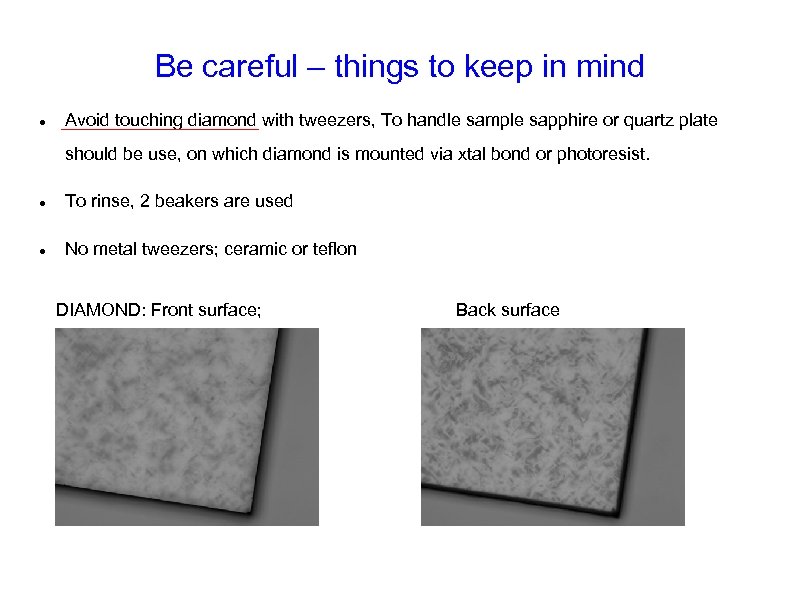 Be careful – things to keep in mind Avoid touching diamond with tweezers, To handle sample sapphire or quartz plate should be use, on which diamond is mounted via xtal bond or photoresist. To rinse, 2 beakers are used No metal tweezers; ceramic or teflon DIAMOND: Front surface; Back surface
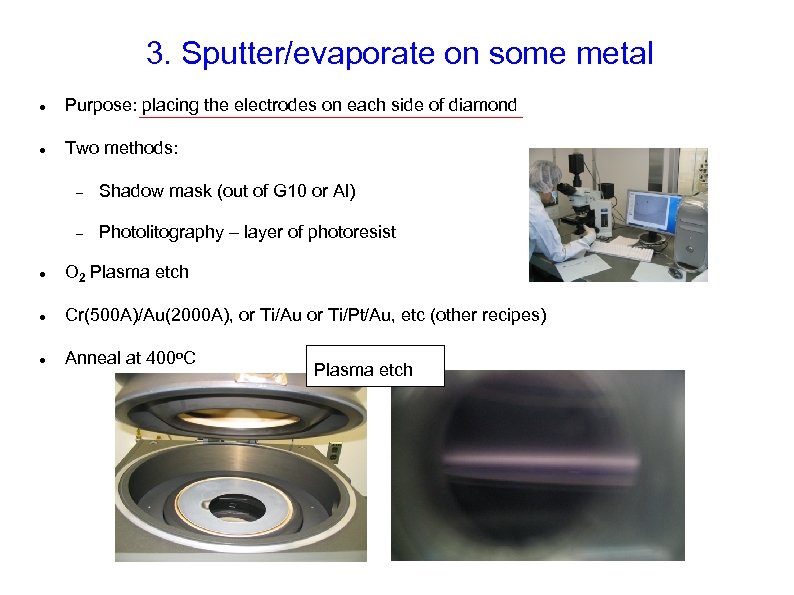 3. Sputter/evaporate on some metal Purpose: placing the electrodes on each side of diamond Two methods: Shadow mask (out of G 10 or Al) Photolitography – layer of photoresist O 2 Plasma etch Cr(500 A)/Au(2000 A), or Ti/Au or Ti/Pt/Au, etc (other recipes) Anneal at 400 o. C Plasma etch
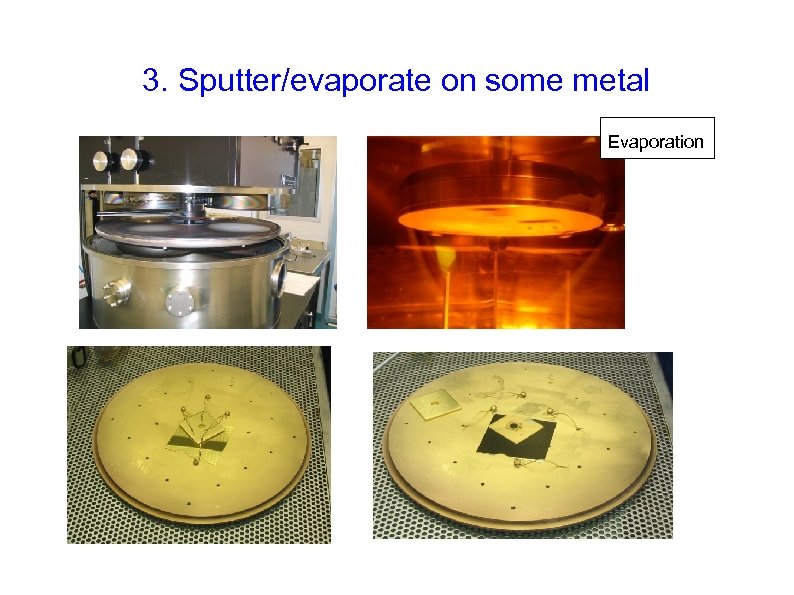 3. Sputter/evaporate on some metal Evaporation
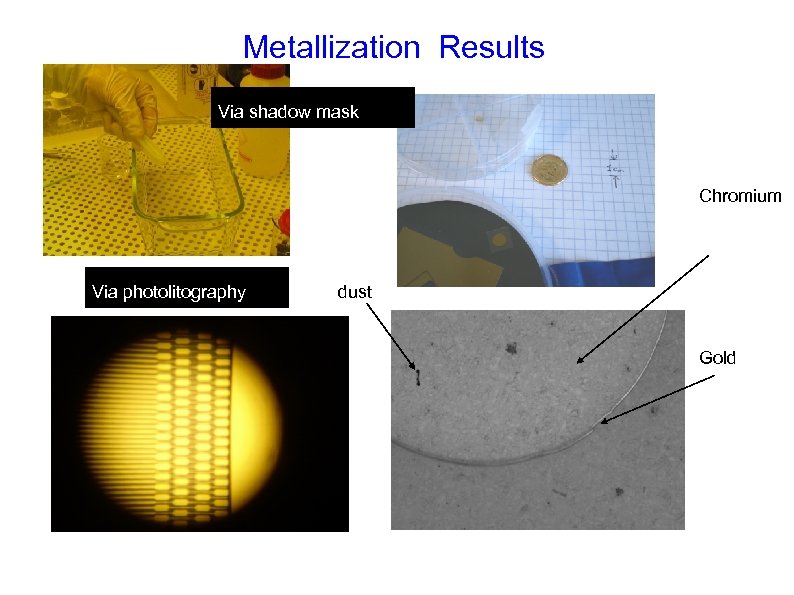 Metallization Results Via shadow mask Chromium Via photolitography dust Gold
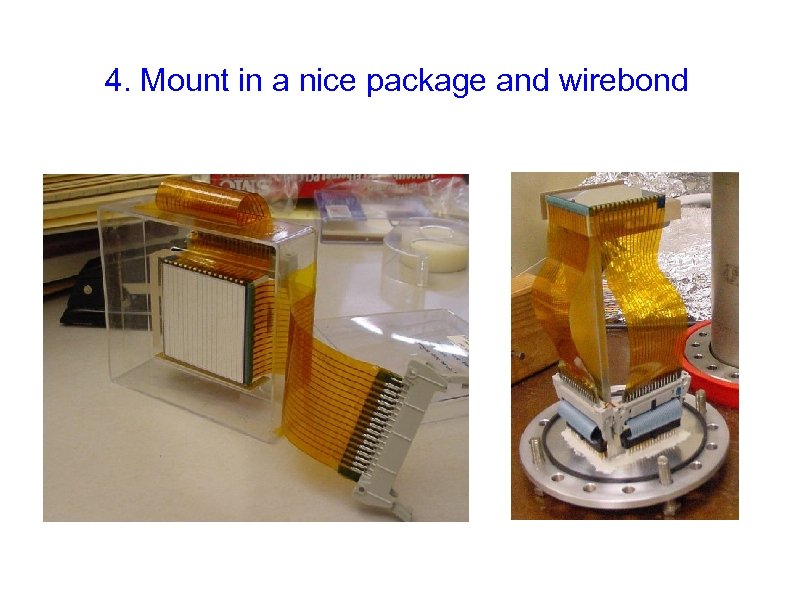 4. Mount in a nice package and wirebond
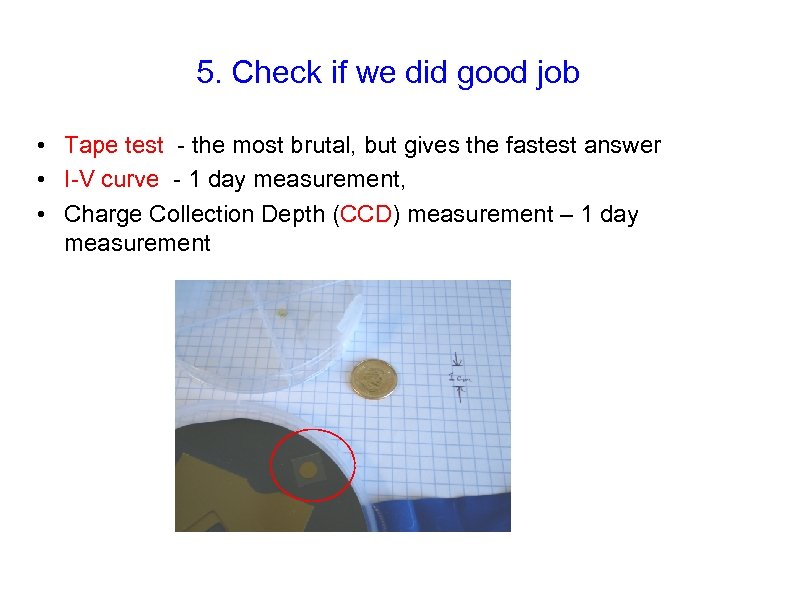 5. Check if we did good job • Tape test - the most brutal, but gives the fastest answer • I-V curve - 1 day measurement, • Charge Collection Depth (CCD) measurement – 1 day measurement
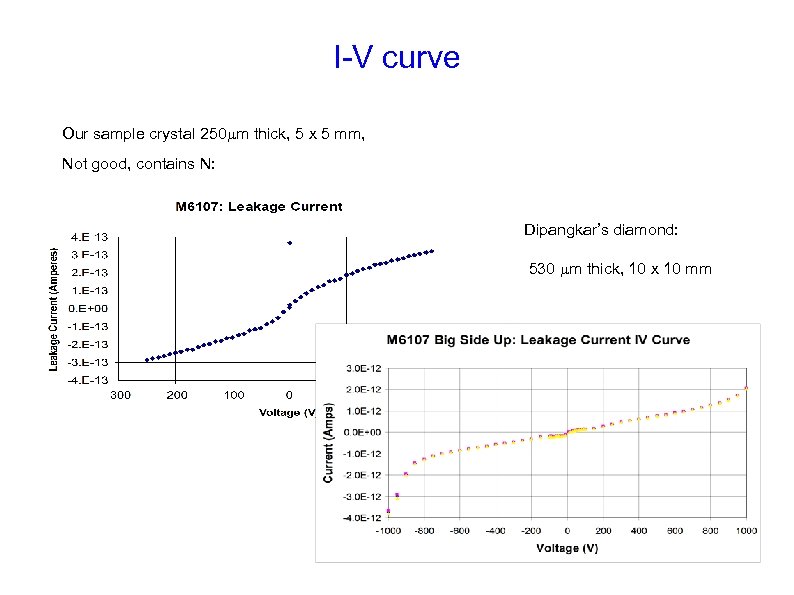 I-V curve Our sample crystal 250 mm thick, 5 x 5 mm, Not good, contains N: Dipangkar’s diamond: 530 mm thick, 10 x 10 mm
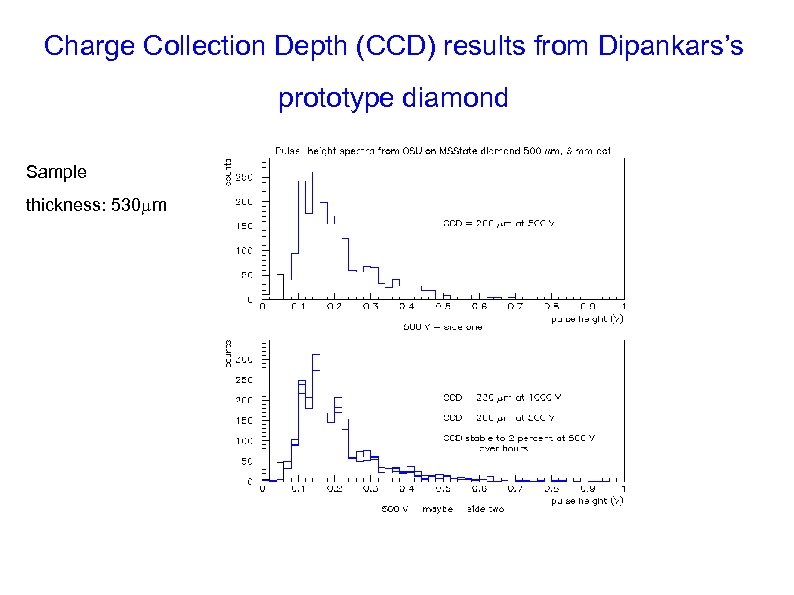 Charge Collection Depth (CCD) results from Dipankars’s prototype diamond Sample thickness: 530 mm
 Summary Coated first test diamond at NSFL (University of Manitoba EE) Visited Ohio State University (Harris Kagan group) learned diamond preparation/metallization in context of a second diamond (D. Dutta's) learned multi-strip detector fabrication learned test procedures CCD measurement I-V curve Coated third diamond (hopefully did it right) at NSFL