

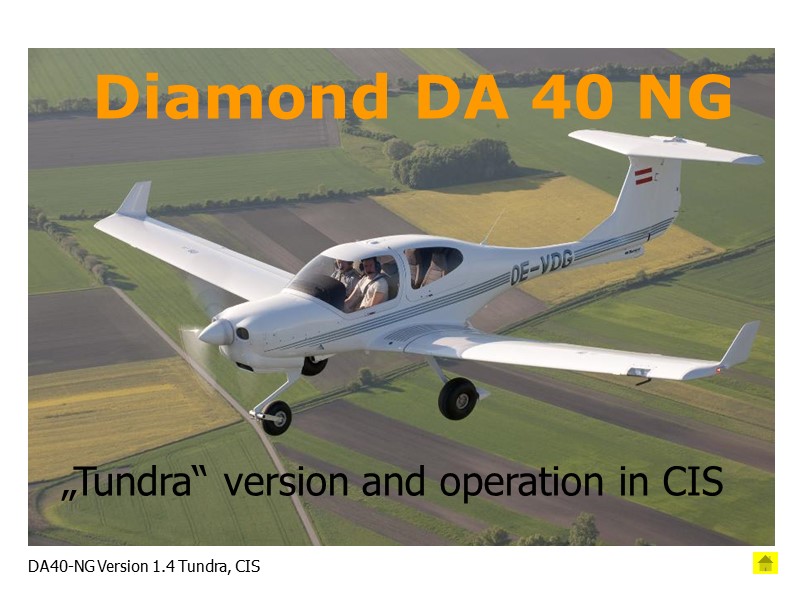
Diamond DA 40 NG DA40-NG Version 1.4 Tundra,



 Скачать презентацию Diamond DA 40 NG DA40-NG Version 1.4 Tundra,
33080-diamond_da40-ng__v1_4_tundra_cis.ppt
- Количество слайдов: 269
Diamond DA 40 NG DA40-NG Version 1.4 Tundra, CIS „Tundra“ version and operation in CIS
© Peter Schmidleitner Diamond DA40 NG Dimensions + Exterior Operating Limitations Mass Speeds Flight controls Instrument panel G1000 Quickie + EIS Hydraulics Power Plant Cooling Turbocharger Fuel System Electrical System Autopilot Performance Mass and Balance Emergency Equipment KOEL Servicing Flight Procedures
Dimensions
© Peter Schmidleitner Dimensions Tundra
© Peter Schmidleitner Dimensions Tundra
© Peter Schmidleitner Dimensions Tundra
Exterior
© Peter Schmidleitner ELT and VHF COM 1 Antenna
© Peter Schmidleitner VHF COM 2 antenna
© Peter Schmidleitner VHF NAV + GP Antennas in the horizontal stabilizer
© Peter Schmidleitner Marker Antenna Fuselage belly
© Peter Schmidleitner GPS Antennas Cabin roof
© Peter Schmidleitner DME, TXPDR Antenna Fuselage belly
© Peter Schmidleitner ADF antenna
© Peter Schmidleitner Pitot Probe Left wing
© Peter Schmidleitner Static Ports Both sides of fuselage
© Peter Schmidleitner Lift Detector (Stall Warning) Left wing
© Peter Schmidleitner Landing/Taxi Light Left wing
© Peter Schmidleitner Engine Oil and Gear Oil
© Peter Schmidleitner Engine Oil
© Peter Schmidleitner Gear Oil
© Peter Schmidleitner Air Inlets Intercooler Coolant heat exchanger Cabin air heater and Reduction Gear cooling
© Peter Schmidleitner Air Inlets Cabin air heater and Reduction Gear cooling
© Peter Schmidleitner RH frontVentilation Engine air intake Air Inlets
© Peter Schmidleitner LH front Ventilation Air Inlets
© Peter Schmidleitner Air Inlets Rear Ventilation
Operating Limitations
© Peter Schmidleitner Temperature Limitation The airplane may only be operated when its temperature prior to operation is not less than -20°C. With the airplane cold soaked and its temperature below -20°C the use of an external pre-heater for the engine and pilot compartment prior to operation is mandatory. With ventilation inlet baffle installed: max OAT for Take-off: 15°C
© Peter Schmidleitner Altitude Limitation Maximum operating altitude: 16.400 ft (5.000 m) Pressure Altitude
© Peter Schmidleitner Other Limitations Aerobatics, spinning, more than 60° bank are prohibited Canopy and passenger door must be unlocked during operation Max. demonstrated crosswind: 25 kts
© Peter Schmidleitner Other Limitations No Take-off for Night-VFR or IFR with an empty main batttery No engine start with external power because of an empty main battery if IFR or Night-VFR flight is planned. Battery must be charged first. No IFR flight if seal on the Emergency Switch is broken
© Peter Schmidleitner Operating Limitations CIS Operating Altitude Above 3600m (11811ft) crew must use oxygen Between 3000m(9842ft) and 3600m (11811ft) maximum time 30 minutes for crew without oxygen Max FL under IFR: 4200m (13779ft) Max airfield ELEV: 3049m (999ft) Pressure Altitude Flight Crew: Piloting only from the left hand front seat Right seat not a crew member: remove stick CIS
© Peter Schmidleitner Operating Limitations CIS Airspace Only along routes with continuous ATC monitoring and VHF coverage Outside Ground Air Temperature Between -35° C and +45° C and airplane was not stored at a temperature below 20° C for more than 5 hours CIS
© Peter Schmidleitner Operating Limitations CIS Runway Only paved RWY, dry or wet „Tundra“ Version: also dry or wet unpaved surfaces with minimum soil strength of 6kg/cm2 Flights over water Permitted within limitations of operational regulations CIS
Mass
© Peter Schmidleitner Mass Tundra
© Peter Schmidleitner Max. Baggage Load
© Peter Schmidleitner Mass Option „Baggage Tray + Extended Compartment“
© Peter Schmidleitner „Short“ Baggage Extension
© Peter Schmidleitner Mass (Weight) Attention! JET fuel is heavier than AVGAS! Typical fuel weight: JET A1: 0,8 kg/ltr 3,03 kg/USG
Speeds
© Peter Schmidleitner Characteristic Speeds
© Peter Schmidleitner Characteristic Speeds
© Peter Schmidleitner Characteristic Speeds
© Peter Schmidleitner Characteristic Speeds
© Peter Schmidleitner Stalling Speeds 1080 kg 1280 kg VS1 VSO 57 60 60 66
© Peter Schmidleitner Stalling Speeds VS1 VSO 59 63 63 68 1080 kg 1280 kg
© Peter Schmidleitner Stalling Speeds VS1 VSO 64 69 69 74 1080 kg 1280 kg
© Peter Schmidleitner Stalling Speeds VS1 VSO 76 82 82 88 1080 kg 1280 kg
Flight Controls
© Peter Schmidleitner Flight Control Operation
© Peter Schmidleitner Flight Control Operation
Instrument Panel
© Peter Schmidleitner Instrument Panel
© Peter Schmidleitner Instrument Panel
© Peter Schmidleitner Instrument Panel IFR flights are not permitted when the seal on the emergency switch is broken.
© Peter Schmidleitner Instrument Panel
© Peter Schmidleitner Instrument Panel
© Peter Schmidleitner Instrument Panel
© Peter Schmidleitner Instrument Panel
© Peter Schmidleitner Instrument Panel
© Peter Schmidleitner Instrument Panel
© Peter Schmidleitner Alternate Static Valve
© Peter Schmidleitner Alternate Static Valve
Garmin 1000 Quick overview
© Peter Schmidleitner Garmin 1000 For a detailed description of the G1000 integrated instrument system consult the instruction modules „DA42 G1000, parts 1 to 3“
© Peter Schmidleitner Garmin 1000 Primary Flight Display Multi Function Display
© Peter Schmidleitner PFD Turn and bank Indicator?
© Peter Schmidleitner MFD
© Peter Schmidleitner Engine Indication System
© Peter Schmidleitner Default page Display when pushing the SYSTEM button Display when pushing the FUEL button Engine Indication System Upper part always the same LOAD is not measured, but calculated from common rail fuel pressure, ECU commanded injection time, manifold pressure and Prop RPM
© Peter Schmidleitner Engine Indication System Fuel Flow is not measured, but calculated from fuel pressure and ECU commanded injection time
© Peter Schmidleitner NAV and COM Tuning LH identical RH
© Peter Schmidleitner NAV COM NAV and COM Tuning
© Peter Schmidleitner Active: inside Standby: outside COM COM Tuning
© Peter Schmidleitner NAV Active: inside Standby: outside NAV Tuning
© Peter Schmidleitner Audio panel GMA 1347
© Peter Schmidleitner Audio panel
© Peter Schmidleitner Audio panel Last 2,5 minutes of communication
Hydraulic System
© Peter Schmidleitner Hydraulic brakes
© Peter Schmidleitner Hydraulic brakes
© Peter Schmidleitner Hydraulic brakes Parking brake „Pumping“ Pressure builds up
© Peter Schmidleitner Parking brake
Power Plant
© Peter Schmidleitner Power plant 1 Austro Engine E4-A Four cylinders, liquid-cooled 1991 ccm Common-rail direct injection Reduction gear 1:1,69 Dual digital engine control Turbocharger Torsion vibration damper isolates engine from propeller Max. power: 100% (5 minutes time limit) 123,5 kW (165,6 DIN-HP) at 2300 RPM Max cont. power: 92% 113,6 kW (152,3 DIN-HP) at 2100 RPM
© Peter Schmidleitner Austro Engine E4-A
© Peter Schmidleitner Austro Engine E4-A Fuel High Pressure Pump Turbo Charger Oil Sump Alternator Gearbox Propeller Shaft Front View
© Peter Schmidleitner Austro Engine E4-A Gearbox Glow Plug Control Unit Turbo Charger Fuel High Pressure Pump Water Pump Rip Belt Engine Oil Filter Housing Alternator Starter Oil Filler Cap Heat Exchanger Top View Propeller Shaft
© Peter Schmidleitner Austro Engine E4-A High Pressure Pump Starter Side glass of Gearbox Oil Level Alternator Water Pump Heat Exchanger Rip Belt Turbo Charger Engine Oil Level and Refill Cap Left Hand View Engine Oil Filter Housing Propeller Shaft
© Peter Schmidleitner Austro Engine E4-A
© Peter Schmidleitner Austro Engine E4-A Cabin heat exchanger Turbocharger Engine air filter and alternate air valve
© Peter Schmidleitner Alternate air lever Alternate air valve Alternate air
© Peter Schmidleitner Alternate air Alternate air lever pulled Alternate air valve open
© Peter Schmidleitner Use of Alternate Air
© Peter Schmidleitner Austro Engine E4-A Prop governor
© Peter Schmidleitner ECU – Engine Control Unit
© Peter Schmidleitner
© Peter Schmidleitner Engine Control Unit ECU „VOTER switch“ Normally in AUTO position Working ECU is automatically selected according operating hours or in case of malfunction
© Peter Schmidleitner ECU test button Test on ground (PWR lever idle)
© Peter Schmidleitner ECU test
© Peter Schmidleitner ECU Abnormal checklist
© Peter Schmidleitner Engine troubleshooting
© Peter Schmidleitner Power lever selects „LOAD“ in % RPM automatically determined by selected power Power plant Recommended Cruise Power Setting: 75%
© Peter Schmidleitner Propeller 3-blade wooden propeller Constant speed Prop pitch set by ECU via an electro-mechanical actuator on the governor Governor operated by gearbox oil Oil pressure up = pitch up = RPM down Oil pressure down = pitch down = RPM up
© Peter Schmidleitner RPM malfunctions
© Peter Schmidleitner RPM malfunctions
© Peter Schmidleitner Fuel pumps 1 engine driven pump this high pressure pump feeds the common rail (additional electrical fuel pumps are part of the fuel system)
© Peter Schmidleitner Power plant limitations Max overspeed: 2500 RPM, max 20 sec. Oil pressure: < 1500 RPM: min 1,5 bar >= 1500 RPM: min 2,5 bar Max: 6,5 bar Normal: 2,5 – 6 bar Oil quantity (per engine): 5.0 – 7.0 liters Max. oil consumption: 0.1 liters/hr Oil temperature: -30°C – 140 °C Normal: 50°C – 125°C
© Peter Schmidleitner Power plant limitations Gearbox temperature: Min: -30°C Min at full load: 35°C Max: 120 °C The yellow cautionary range is for information only. There is no time limit associated with the cautionary temperature range.
© Peter Schmidleitner Power plant limitations Coolant temperature: min -30°C for start up min 60°C full load max 105 °C Fuel temperature: min -25°C, max 60°C Fuel pressure: min 4 bar, max 7 bar no indication on G1000, but warning if below limit
© Peter Schmidleitner Power plant limitations Max. restart altitude: 16.400ft PA for immediate restart 10.000ft PA for restart within 2 minutes After more than 2 minutes cooldown a succesful restart may not be possible! Restart airspeed: The propeller will be windmilling Airspeed: 88 KIAS If propeller has stopped: mechanical engine defect. Do not consider a starter assisted restart!
© Peter Schmidleitner Power plant limitations Intentional negative-g manoeuvers are not permitted
© Peter Schmidleitner Starter limitations Operation: max 10 seconds 60 seconds cool down time
© Peter Schmidleitner Fuel: JET A or JET A-1 (ASTM 1655) TS-1 (GOST 10227-86) and blends thereof Minimum cetane number of 37 (EN ISA 5165/ASTM D613) recommended Oil: SHELL Helix Ultra 5W30 SHELL Helix Ultra 5W40 Gearbox oil: Shell Spirax GSX 75W-80 Shell Spirax S6 GXME 75W-80 Coolant: Destilled water + cooler protection 1:1 (BASF Glysantin Alu Protect Plus/G48) (freezing point –38 °C) Power plant fluid specifications
© Peter Schmidleitner Engine operation after line-up
© Peter Schmidleitner Engine operation
© Peter Schmidleitner Power plant warnings
© Peter Schmidleitner Power plant abnormals
Cooling System
© Peter Schmidleitner Cooling system
© Peter Schmidleitner Cooling system Coolant Temp. < ~80°C
© Peter Schmidleitner Cooling system Coolant Temp. > ~80°C
© Peter Schmidleitner Cooling system
© Peter Schmidleitner Cooling system
© Peter Schmidleitner Cabin heat
© Peter Schmidleitner Cabin heat Cabin Heat
© Peter Schmidleitner Ventilation Front ventilation
© Peter Schmidleitner Ventilation Cabin Rear ventilation
Turbocharger System
© Peter Schmidleitner Turbo Charger Exhaust gas drives turbine
© Peter Schmidleitner Turbo Charger Turbine drives compressor Compressor compresses intake air
Fuel System
© Peter Schmidleitner Standard Tanks Capacity: 2 x 15 USG 2 x 14 USG usable = 28 USG usable = 85 kg At 75% power: ~ 6,5 USG/hr Fuel System
© Peter Schmidleitner Long Range Tanks: Capacity: 2 x 20,5 USG 2 x 19,5 USG usable = 39 USG = 120 kg Max indicated fuel per tank: 14 USG Max. unbalance: 9 USG Fuel System
© Peter Schmidleitner Fuel System Fuel valve
© Peter Schmidleitner Fuel System
© Peter Schmidleitner Fuel System Up to 71 USG/hr Average 45 USG/hr ~60 USG/hr
© Peter Schmidleitner Fuel cooler Right wing Air inlet Air outlet
© Peter Schmidleitner Fuel System ~45 USG/hr Fuel cooler U/S
© Peter Schmidleitner Fuel system „Alternate means for fuel quantity indication“ Position: at the bore in the stall strip
© Peter Schmidleitner Fuel vents
© Peter Schmidleitner Fuel tank drain
© Peter Schmidleitner Fuel gascolator drain
© Peter Schmidleitner Fuel gascolator drain
© Peter Schmidleitner Fuel pumps 2 parallel electrical low pressure fuel pumps Normal Ops: only one pump working When pump fails (low fuel pressure): automatic switch over to other pump When ECU switches over: fuel pumps switch over as well For TKOF, LDG and with fuel press failure: both pumps switched on manually with FUEL PUMP switch
© Peter Schmidleitner Fuel pumps
© Peter Schmidleitner Fuel pumps
© Peter Schmidleitner Fuel pressure warning Warning annunciation: FUEL PRESS
© Peter Schmidleitner Fuel pressure warning
Electrical System
© Peter Schmidleitner Electrical system
© Peter Schmidleitner Power sources Electrical system
© Peter Schmidleitner Power distribution Electrical system
© Peter Schmidleitner Main Battery 24V 13,6Ah Alternator ECU backup battery 24V 7,2 Ah Battery power supply Electrical system
© Peter Schmidleitner Main Battery 24V 13,6Ah Alternator ECU backup battery 24V 7,2 Ah External power supply EPU Electrical system
© Peter Schmidleitner Main Battery 24V 13,6Ah Alternator ECU backup battery 24V 7,2 Ah Normal power supply Electrical system
© Peter Schmidleitner Main Battery 24V 13,6Ah Alternator ECU backup battery 24V 7,2 Ah Essential power supply Electrical system
© Peter Schmidleitner Main Battery 24V 13,6Ah Alternator ECU backup battery 24V 7,2 Ah Total electric fail Electrical system
© Peter Schmidleitner Hot battery bus Accessory power plug ELT
© Peter Schmidleitner Battery bus 1 and 2 Battery Bus 1 starter heavy duty power Battery Bus 2 ECU BUS Main Bus (Electric Master ON, ESS BUS OFF) Essential Bus (Electric Master ON, ESS BUS ON)
© Peter Schmidleitner Main bus Essential Bus (ESS BUS OFF) Avionic Bus Starter control MFD Fuel x-fer pump Avionic-, CDU-cooling fans Instrument lights Taxi + map lights Position lights Strobe lights
© Peter Schmidleitner Essential bus PFD Horizon Air Data Computer AHRS COM 1 GPS/NAV 1 Flood light Landing light Transponder Pitot heat Flap system Engine instruments
© Peter Schmidleitner Avionic bus COM 2 GPS/NAV 2 Audio panel Autopilot DME ADF WX 500 TAS
© Peter Schmidleitner Essential Bus, Avionic Master Electric Master
© Peter Schmidleitner Engine Master
© Peter Schmidleitner External Power Receptable Where is the external power receptable? It’s on the fuselage belly behind the left wing!
© Peter Schmidleitner External Power Receptable
© Peter Schmidleitner External Power Receptable Thank you, I have it!
© Peter Schmidleitner External Power Receptable
© Peter Schmidleitner External Power Receptable 28 V !
© Peter Schmidleitner Emergency Switch
© Peter Schmidleitner The mysterious Essential Bus Switch Essential bus switch
© Peter Schmidleitner Switch location
© Peter Schmidleitner When is it used ? When the alternator fails to disconnect unnecessary electrical consumers to supply battery power to essential electrical consumers
© Peter Schmidleitner Main unserviceable systems Starter control MFD Fuel x-fer pump Avionic-, CDU-cooling fans Instrument lights Taxi + map lights Position lights Strobe lights Avionics Bus COM2, NAV/GPS2, Audio, Autopilot, DME, ADF, WX500, TAS Essential Electrial Power
Autopilot GFC700
© Peter Schmidleitner GFC 700 AFCS „AFCS“: Automatic Flight Control System Flight Director Autopilot
© Peter Schmidleitner GFC 700 AFCS
© Peter Schmidleitner GFC 700 AFCS
© Peter Schmidleitner GFC 700 AFCS GFC 700 functions: Flight Director (FD) AUTO Pilot (AP) Manual Electric Trim (MET)
© Peter Schmidleitner Autopilot
© Peter Schmidleitner Autopilot GA button
© Peter Schmidleitner GFC 700 AFCS Flight Director Command Bars Image reproduced with the permission of Garmin. © Copyright 2006 Garmin Ltd. or its subsidiaries. All Rights Reserved.
© Peter Schmidleitner GFC 700 AFCS Aircraft Attitude Symbol Flight Director Command Bars Image reproduced with the permission of Garmin. © Copyright 2006 Garmin Ltd. or its subsidiaries. All Rights Reserved.
© Peter Schmidleitner Image reproduced with the permission of Garmin. © Copyright 2006 Garmin Ltd. or its subsidiaries. All Rights Reserved. Second push deactivates the mode GFC 700 AFCS
© Peter Schmidleitner GFC 700 AFCS System Status Annunciation Image reproduced with the permission of Garmin. © Copyright 2006 Garmin Ltd. or its subsidiaries. All Rights Reserved.
© Peter Schmidleitner GFC 700 AFCS Image reproduced with the permission of Garmin. © Copyright 2006 Garmin Ltd. or its subsidiaries. All Rights Reserved.
© Peter Schmidleitner GFC 700 AFCS Image reproduced with the permission of Garmin. © Copyright 2006 Garmin Ltd. or its subsidiaries. All Rights Reserved. When FD or AP is engaged:
© Peter Schmidleitner GFC 700 AFCS Flight Mode Annunciators „AFCS Status Box“ Image reproduced with the permission of Garmin. © Copyright 2006 Garmin Ltd. or its subsidiaries. All Rights Reserved.
© Peter Schmidleitner GFC 700 AFCS Flight Mode Annunciators „AFCS Status Box“ Image reproduced with the permission of Garmin. © Copyright 2006 Garmin Ltd. or its subsidiaries. All Rights Reserved.
© Peter Schmidleitner GFC 700 AFCS Flight Mode Annunciators „AFCS Status Box“ Image reproduced with the permission of Garmin. © Copyright 2006 Garmin Ltd. or its subsidiaries. All Rights Reserved.
© Peter Schmidleitner GFC 700 AFCS Flight Mode Annunciators „AFCS Status Box“ Image reproduced with the permission of Garmin. © Copyright 2006 Garmin Ltd. or its subsidiaries. All Rights Reserved.
© Peter Schmidleitner GFC 700 AFCS Flight Mode Annunciators „AFCS Status Box“ Image reproduced with the permission of Garmin. © Copyright 2006 Garmin Ltd. or its subsidiaries. All Rights Reserved.
© Peter Schmidleitner GFC 700 AFCS Vertical modes
© Peter Schmidleitner GFC 700 AFCS Image reproduced with the permission of Garmin. © Copyright 2006 Garmin Ltd. or its subsidiaries. All Rights Reserved. Vertical mode range and change increments
© Peter Schmidleitner GFC 700 AFCS Flight Mode Annunciators „AFCS Status Box“ Image reproduced with the permission of Garmin. © Copyright 2006 Garmin Ltd. or its subsidiaries. All Rights Reserved.
© Peter Schmidleitner GFC 700 AFCS Image reproduced with the permission of Garmin. © Copyright 2006 Garmin Ltd. or its subsidiaries. All Rights Reserved.
© Peter Schmidleitner GFC 700 AFCS GA mode active Wings level 7° pitch up
© Peter Schmidleitner GFC 700 AFCS Image reproduced with the permission of Garmin. © Copyright 2006 Garmin Ltd. or its subsidiaries. All Rights Reserved. What the FD/AP flies What the pilot wants
© Peter Schmidleitner GFC 700 AFCS Vertical Speed Mode Selected Vertical Speed Vertical Speed Bug Image reproduced with the permission of Garmin. © Copyright 2006 Garmin Ltd. or its subsidiaries. All Rights Reserved.
© Peter Schmidleitner GFC 700 AFCS IAS Hold Mode („Flight Level Change“) Selected Airspeed Airspeed Reference Bug Image reproduced with the permission of Garmin. © Copyright 2006 Garmin Ltd. or its subsidiaries. All Rights Reserved.
© Peter Schmidleitner GFC 700 AFCS flashing Overspeed Protection Image reproduced with the permission of Garmin. © Copyright 2006 Garmin Ltd. or its subsidiaries. All Rights Reserved.
© Peter Schmidleitner G 1000 System Loss Effect upon Autopilot Operation
© Peter Schmidleitner AP FD MET G 1000 System Loss Effect upon Autopilot Operation
© Peter Schmidleitner G 1000 System Loss Effect upon Autopilot Operation AP FD MET
© Peter Schmidleitner G 1000 System Loss Effect upon Autopilot Operation AP FD MET
© Peter Schmidleitner G 1000 System Loss Effect upon Autopilot Operation AP FD MET HDG function
© Peter Schmidleitner G 1000 System Loss Effect upon Autopilot Operation AP FD MET ALT VS FLC
© Peter Schmidleitner G 1000 System Loss Effect upon Autopilot Operation AP FD MET
© Peter Schmidleitner G 1000 System Loss Effect upon Autopilot Operation AP FD MET
© Peter Schmidleitner G 1000 System Loss Effect upon Autopilot Operation AP FD MET GPS 1 GPS 2 VHF NAV only, reduced accuracy
Performance
© Peter Schmidleitner The „DA 40 NG“ and „Density Altitude“ Attention! Performance data which are engine-power dependant cannot be determined by just using „Density Altitude“! Reason: the engine power output does not correspond to density altitude but pressure and temperature have their own, independent influence This is a feature of the ECU controlled, turbocharged Diesel-engine
© Peter Schmidleitner Fuel Flow 75%
© Peter Schmidleitner Cruising speed e.g. 6000 ft, ISA, 75 % 126 kts Tundra: Reduce by 9 % 115 kts Tundra
© Peter Schmidleitner TKOF distance Vrotate Vy up to 50ft Climb rate: 677 ft/min PWR MAX Flaps T/O Tundra
© Peter Schmidleitner TKOF distance Uphill slope 2% : + ~17% Tundra Tundra: Add 75m to the TKOF roll Add 90m to the TKOF distance TKOF roll TKOF dist
© Peter Schmidleitner Unpaved runway CIS Tundra
© Peter Schmidleitner Take off climb 72 KIAS 92% Flaps T/O Attention! Increasing downward Tundra: Reduce by 35 ft/min (0,36 m/s) Tundra
© Peter Schmidleitner Cruise climb 88 KIAS 92% Flaps UP Tundra: Reduce by 70 ft/min (0,18 m/s) Tundra
© Peter Schmidleitner ROC to gradient conversion
© Peter Schmidleitner Landing distance VREF
© Peter Schmidleitner Landing distance Downhill slope 2% : + ~10%
© Peter Schmidleitner Grass runway
© Peter Schmidleitner LDG Dist., abnormal flaps VREF
© Peter Schmidleitner LDG Dist., abnormal flaps Downhill slope 2% : + ~10%
© Peter Schmidleitner Grass RWY, abnormal flaps
© Peter Schmidleitner Go around PWR MAX Flaps LDG VGA 77 KIAS Tundra
© Peter Schmidleitner Glide Flaps UP 88 KIAS Tundra
© Peter Schmidleitner Obstacles ? „d“= (RWL + Obst.Dist.) - TOD Gradient = („h“ / „d“) * 100
© Peter Schmidleitner Vöslau RWY 31 „d“= (950 + 830) – 600 = 1180 Gradient = (30 / 1180) * 100 = 2,54 % Acc. Performance Graph: ~ 8 %
Mass and Balance
© Peter Schmidleitner Empty Mass Empty Mass includes: Equipment as per Equipment Inventory Brake fluid Coolant fluid Gear oil Engine oil Unusable fuel (2 x 1,0 USG)
© Peter Schmidleitner Center of Gravity Envelope 2.46 2.53
© Peter Schmidleitner Moment Arms
© Peter Schmidleitner M&B Calculation 80 170 10 1160 60 1220 391.0 260.0 38.9 2870.7 157.8 3028.5 170 x 2.30 = 391.0 80 x 3.25 = 260.0 ~20 USG
© Peter Schmidleitner M&B Calculation 2.47 2.48 80 170 10 1160 60 1220 391.0 260.0 38.9 2870.7 157.8 3028.5 2870.7 : 1160 = 2.47 3028.5 : 1220 = 2.48
© Peter Schmidleitner Center of Gravity Envelope
Emergency Equipment
© Peter Schmidleitner Emergency equipment
© Peter Schmidleitner Emergency Exit
© Peter Schmidleitner Emergency Exit
Kinds of Operation Equipment List (KOEL)
© Peter Schmidleitner Kinds of Operation Equipment List KOEL
© Peter Schmidleitner Kinds of Operation Equipment List KOEL
© Peter Schmidleitner Kinds of Operation Equipment List KOEL
© Peter Schmidleitner Kinds of Operation Equipment List KOEL
© Peter Schmidleitner Additional minimum equipment for the intended operation may be required by national operating rules and also depends on the route to be flown. Kinds of Operation Equipment List KOEL
Servicing
© Peter Schmidleitner Scheduled maintenance Every 100 hours 200 hours 1000 hours Annually
© Peter Schmidleitner Unscheduled maintenance Hard landings Propeller strike Engine fire Lightning strike Occurence of other malfunctions and damage
© Peter Schmidleitner Refuelling
© Peter Schmidleitner De-icing Approved de-icing fluids: Kilfrost TKS 80 Aeroshell Compound 07 Any AL-5 (DTD 406B) Procedure: Remove snow with brush Spray de-icing fluid Wipe dry
© Peter Schmidleitner Control surfaces gust lock
© Peter Schmidleitner Mooring
© Peter Schmidleitner Mooring
© Peter Schmidleitner Tow bar
© Peter Schmidleitner Tire pressure 1,2 bar Tundra
Flight Procedures
© Peter Schmidleitner TKOF Profile Safe altitude Circuit altitude Climb to cruise altitude Vy 72 KIAS 88 KIAS ~ 110 KIAS 88 KIAS Flaps UP Fuel pumps OFF Climb Power LDG Light OFF 60 % Rotate: 58-67 KIAS Vy up to 50 ft 65-72 KIAS 50 ft
© Peter Schmidleitner LDG Profile Circuit altitude 80 KIAS 70-78 KIAS < 110 KIAS Flaps T/O LDG Light ON Fuel pumps ON Downwind, latest Base leg Flaps LDG 72 KIAS GO AROUND Power MAX Flaps T/O 69-77 KIAS Continue with TKOF profile
© Peter Schmidleitner Checklists The checklists are not part of the AFM, and they are not „officially Diamond-endorsed“. They are a recommendation for „Operator Checklists“ published by „Diamond Aircraft Flight Training Division“.
© Peter Schmidleitner Emergency Procedures CIS
© Peter Schmidleitner Emergency procedures If possible switch on landing lights during emergency landing After emergency landing remove VHF radio from back of pilots seat and operate according enclosed instruction CIS
© Peter Schmidleitner Emergency procedures Disconnected or Jammed Rudder Use ailerons for directional control Use shallow glide path and extended pattern Avoid bank >20° in the pattern and >10° on final Power changes may lead to yaw movement (increase: left turn, decrease: right turn) CIS
© Peter Schmidleitner Emergency procedures Disconnected or Jammed Aileron Use rudder for lateral control Use shallow glide path and extended pattern Avoid bank >20° in the pattern and >10° on final During landing: Directional control with rudder CIS
© Peter Schmidleitner Emergency procedures Disconnected Elevator Pitch control with elevator trim and engine power Set flaps in very beginning of final approach Avoid aggressive power changes during approach Expect pitch down when reducing power Jammed Elevator Pitch control mainly with engine power and also with elevator trim in opposite sense Landing with flaps UP only Avoid aggressive power changes during approach Expect pitch down when reducing power CIS
© Peter Schmidleitner Thank you for your attention!