 Скачать презентацию Diamond amplifiers for photocathodes Ilan Ben-Zvi Collider-Accelerator Department
9f295f8423e91004ae28fa288b90d2d2.ppt
- Количество слайдов: 25



Diamond amplifiers for photocathodes Ilan Ben-Zvi Collider-Accelerator Department Brookhaven National Laboratory I. Ben-Zvi, ANL, February 2006
The motivation • Photocathodes allow emission of high charge in a short time, controlled by a laser. – Good match for RF guns – Large bunch charge (e. g. AWA) – Allow control of 3 -D electron bunch shape • Found just about anywhere • Problem: Trade-off between robustness and quantum efficiency. Gave lasers a bad name… I. Ben-Zvi, ANL, February 2006
New solution: • Use secondary emission to “amplify” the charge emitted by the photocathode. • Layout: Place a diamond thin film (~30 m) between photocathode and acceleration space. • The multiplication depends on the energy of the “primary” electrons: ~13 e. V/e-h pair. I. Ben-Zvi, ANL, February 2006
The diamond amplified photocathode • Photocathode produces primary electrons, amplification in diamond by secondary emission. • The diamond window may hold an atmosphere to provide simple transport of the capsule. • The diamond window will protect the niobium (or any other gun metal) from the cathode material • The diamond will protect the cathode (long life) • The secondary emission coefficient is very high • The emittance and temporal spread are very low • High current & low laser power due to amplification I. Ben-Zvi, ANL, February 2006
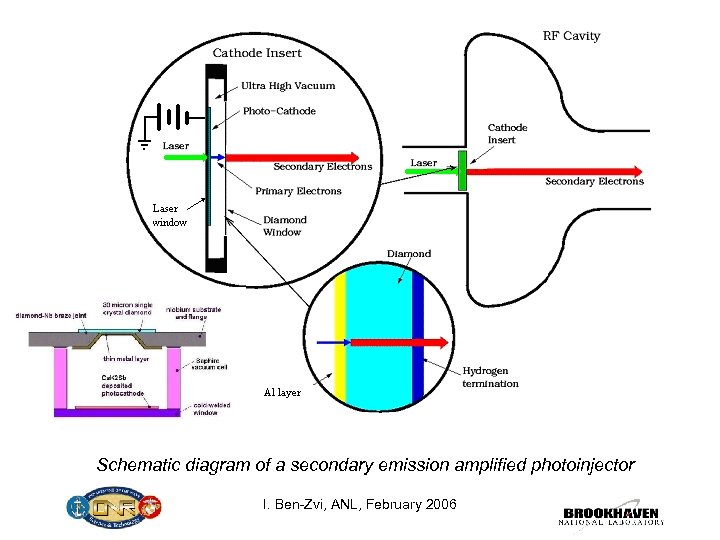
Schematic diagram of a secondary emission amplified photoinjector I. Ben-Zvi, ANL, February 2006
Many possible applications • High average current electron guns – RF guns, both SRF and NC – DC guns • Lasertrons • Imaging • For use in high-power FELs, two-beam accelerators, terahertz radiation, etc. I. Ben-Zvi, ANL, February 2006
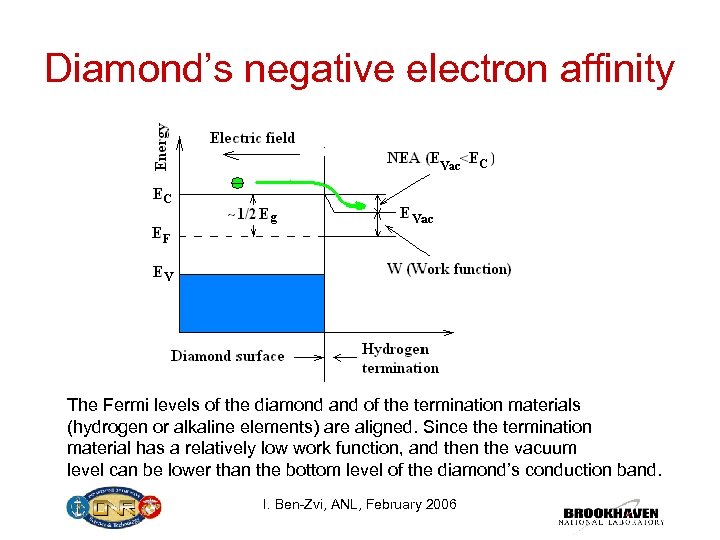
Diamond’s negative electron affinity The Fermi levels of the diamond and of the termination materials (hydrogen or alkaline elements) are aligned. Since the termination material has a relatively low work function, and then the vacuum level can be lower than the bottom level of the diamond’s conduction band. I. Ben-Zvi, ANL, February 2006
The current replenishment layer • Need good electrical conductivity for return current (holes and RF shielding) • Need low stopping power to transmit most of the energy of the primaries • Need good ohmic and thermal contact to the diamond • Aluminum is a good choice for the bulk, with titanium / platinum ohmic contact I. Ben-Zvi, ANL, February 2006
• The impurity problem – Impurities: Boron (p-type), Nitrogen (n-type), Hydrogen (ntype), Phosphorus (n-type), Lithium (n-type) and Sodium (ntype). – Heating and background current: • Electrons in the diamond’s conduction band (n-type) behave like secondary electrons. Thus they generate extra heat and a background current. • Holes on the valence band (P type) only generate the extra heat. – Charge carrier trapping and field shielding problem: • Impurities and grain boundaries can trap charge carriers therefore attenuate the RF field inside diamond and finally affects the conduction of the secondary electrons. I. Ben-Zvi, ANL, February 2006
The thickness of the diamond • In principle, a thick diamond is desired for various reasons: strength, thermal conductivity… • The optimized bunch launch phase < 35°. • Initial phase of secondary electrons > 5°. • That results a drift time ~30°, or ~120 ps. • The saturated electron drift velocity at a field > 2 MV/m is 2. 7 x 10⁵ m/s (independent of temperature). • This leads to a diamond thickness ~30 m. I. Ben-Zvi, ANL, February 2006
Sources of heat • Source in the diamond layer: – Stopping the primary electrons. – Transport of the secondary electrons through the diamond under the RF field. – Motion of the impurity induced free electrons in the diamond conduction band (Nitrogen doping) and holes in the valence band (Boron doping) driven by the RF field. • Sources in the metal layer: – Resistive heating by the replenishment current. – RF shielding currents. I. Ben-Zvi, ANL, February 2006
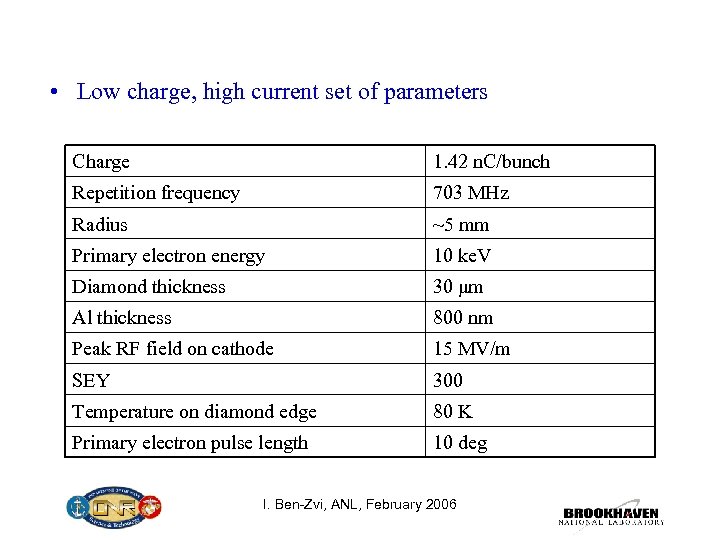
• Low charge, high current set of parameters Charge 1. 42 n. C/bunch Repetition frequency 703 MHz Radius ~5 mm Primary electron energy 10 ke. V Diamond thickness 30 μm Al thickness 800 nm Peak RF field on cathode 15 MV/m SEY 300 Temperature on diamond edge 80 K Primary electron pulse length 10 deg I. Ben-Zvi, ANL, February 2006
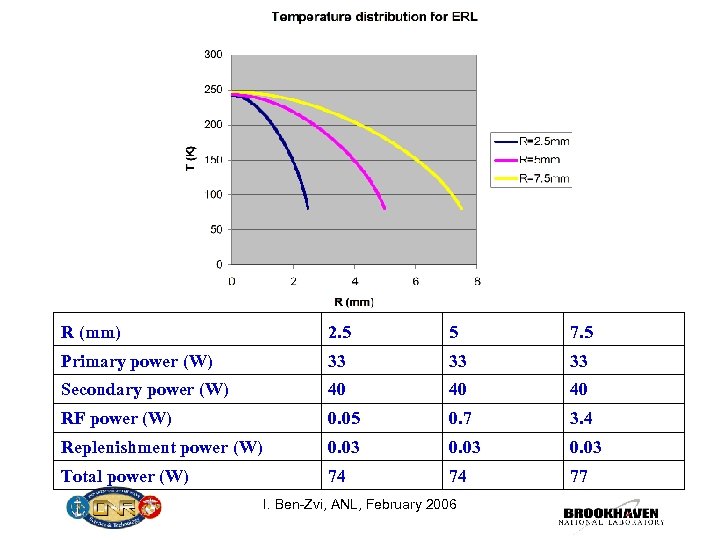
R (mm) 2. 5 5 7. 5 Primary power (W) 33 33 33 Secondary power (W) 40 40 40 RF power (W) 0. 05 0. 7 3. 4 Replenishment power (W) 0. 03 Total power (W) 74 74 77 I. Ben-Zvi, ANL, February 2006
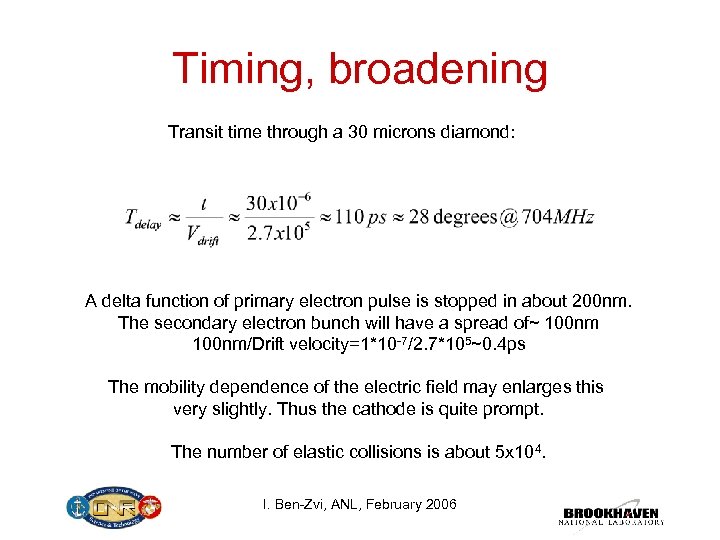
Timing, broadening Transit time through a 30 microns diamond: A delta function of primary electron pulse is stopped in about 200 nm. The secondary electron bunch will have a spread of~ 100 nm/Drift velocity=1*10 -7/2. 7*105~0. 4 ps The mobility dependence of the electric field may enlarges this very slightly. Thus the cathode is quite prompt. The number of elastic collisions is about 5 x 10⁴. I. Ben-Zvi, ANL, February 2006
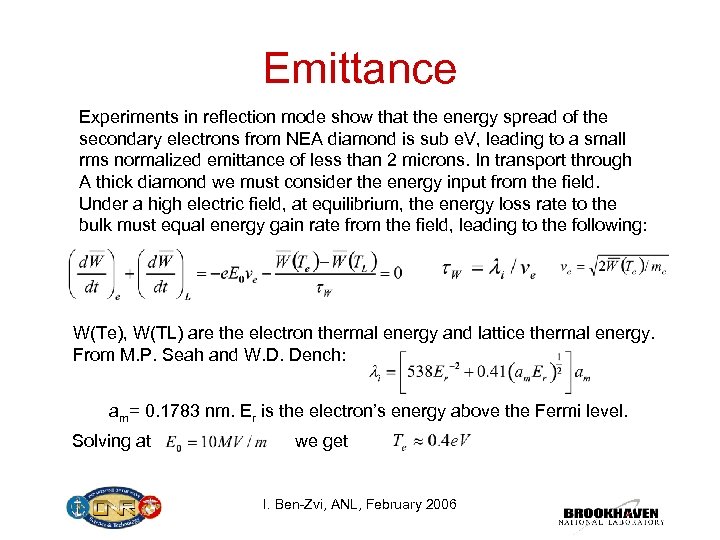
Emittance Experiments in reflection mode show that the energy spread of the secondary electrons from NEA diamond is sub e. V, leading to a small rms normalized emittance of less than 2 microns. In transport through A thick diamond we must consider the energy input from the field. Under a high electric field, at equilibrium, the energy loss rate to the bulk must equal energy gain rate from the field, leading to the following: W(Te), W(TL) are the electron thermal energy and lattice thermal energy. From M. P. Seah and W. D. Dench: am= 0. 1783 nm. Er is the electron’s energy above the Fermi level. Solving at we get I. Ben-Zvi, ANL, February 2006
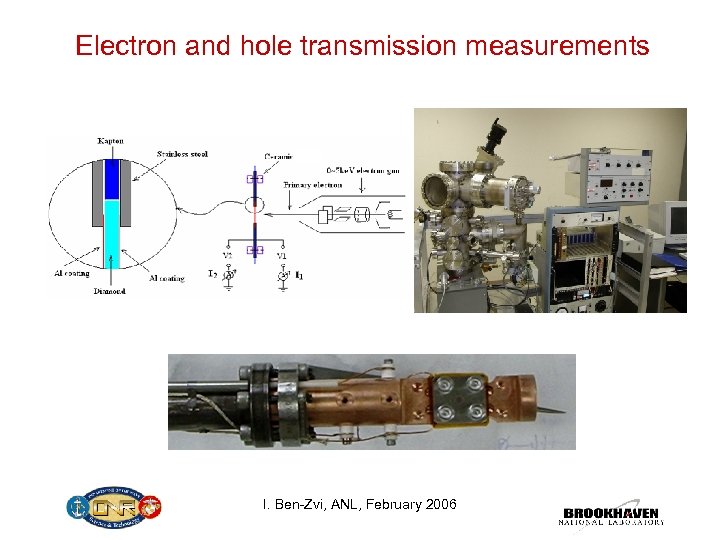
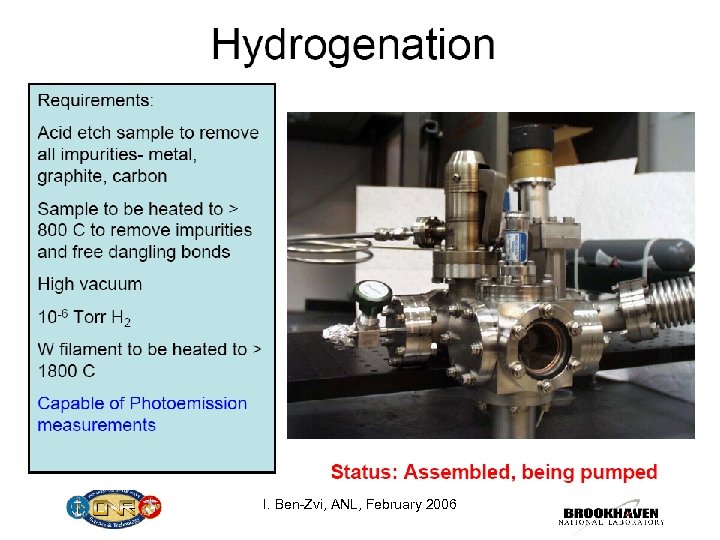
Electron and hole transmission measurements I. Ben-Zvi, ANL, February 2006
I. Ben-Zvi, ANL, February 2006
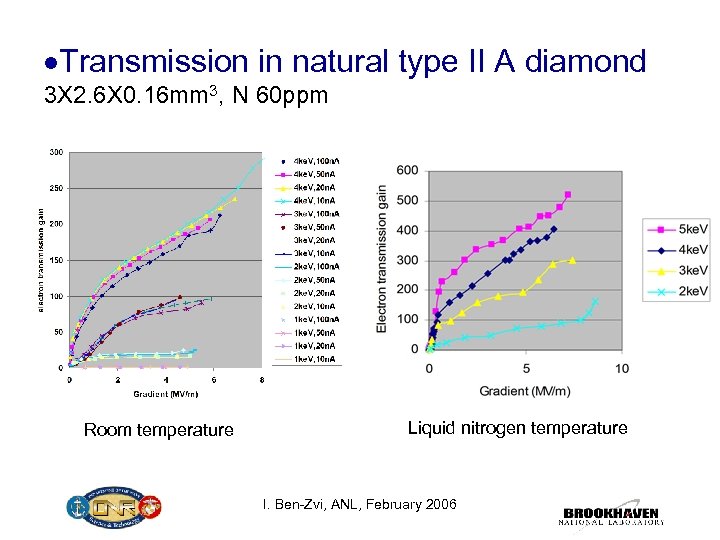
Transmission in natural type II A diamond 3 X 2. 6 X 0. 16 mm 3, N 60 ppm Room temperature Liquid nitrogen temperature I. Ben-Zvi, ANL, February 2006
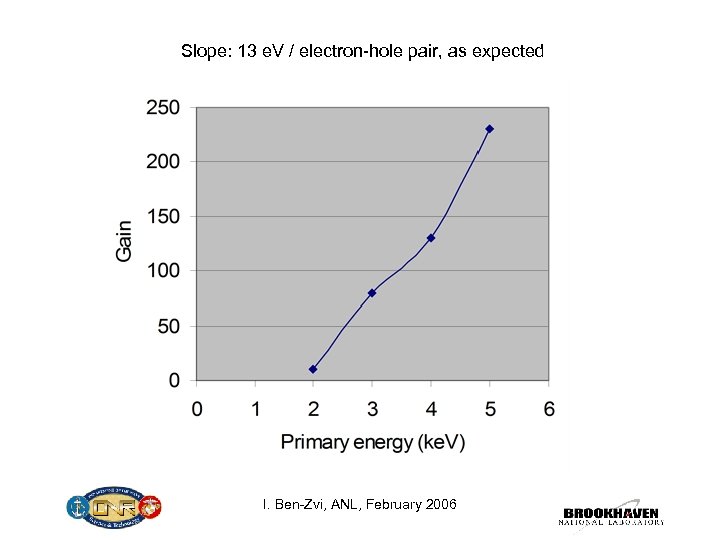
Slope: 13 e. V / electron-hole pair, as expected I. Ben-Zvi, ANL, February 2006
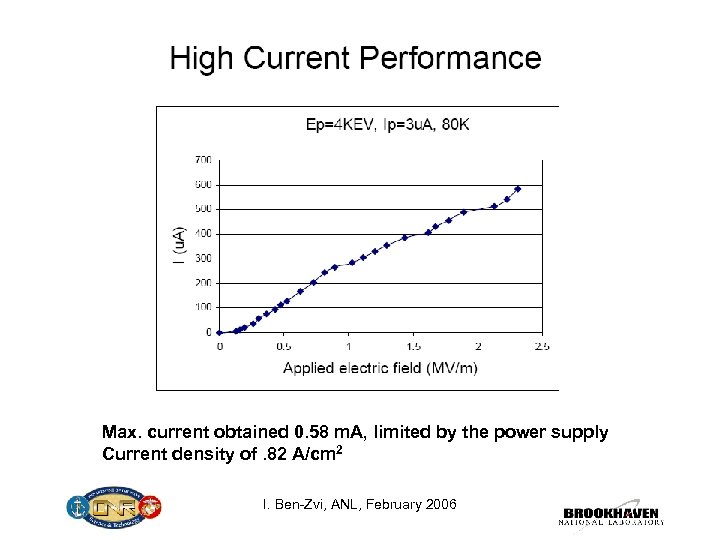
Max. current obtained 0. 58 m. A, limited by the power supply Current density of. 82 A/cm 2 I. Ben-Zvi, ANL, February 2006
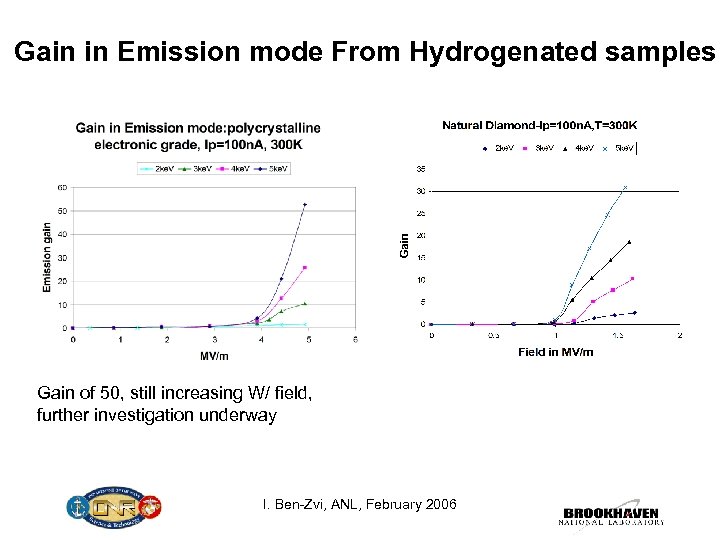
Gain in Emission mode From Hydrogenated samples Gain of 50, still increasing W/ field, further investigation underway I. Ben-Zvi, ANL, February 2006
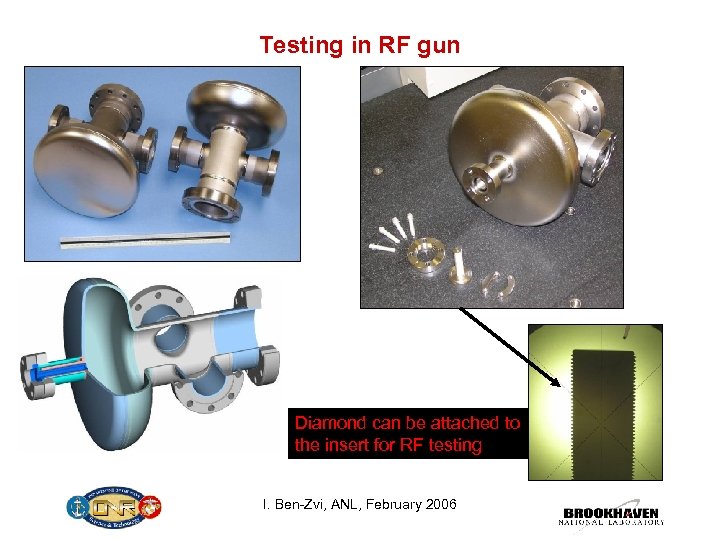
Testing in RF gun Diamond can be attached to the insert for RF testing I. Ben-Zvi, ANL, February 2006
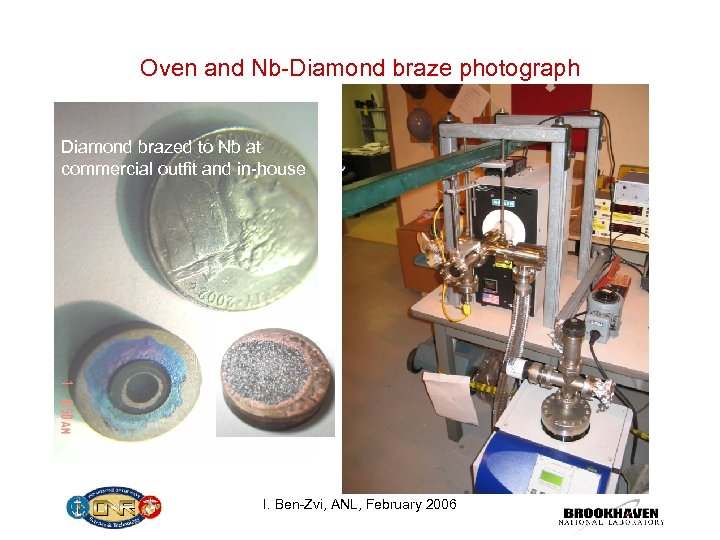
Oven and Nb-Diamond braze photograph Diamond brazed to Nb at commercial outfit and in-house I. Ben-Zvi, ANL, February 2006
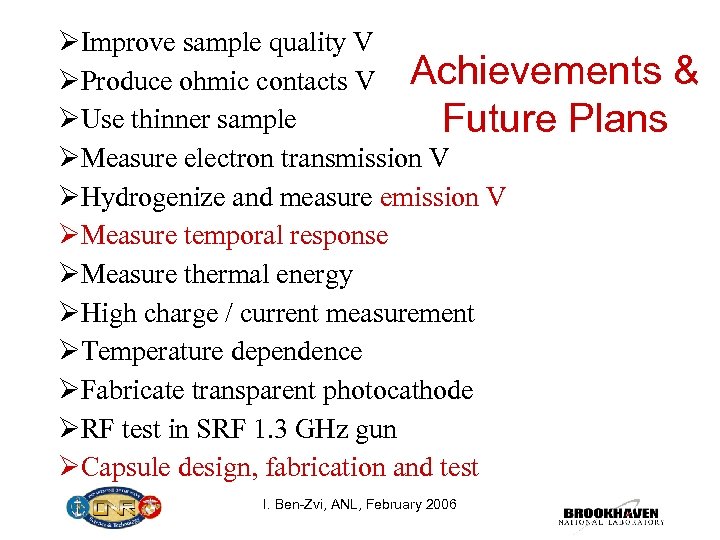
ØImprove sample quality V ØProduce ohmic contacts V Achievements & ØUse thinner sample Future Plans ØMeasure electron transmission V ØHydrogenize and measure emission V ØMeasure temporal response ØMeasure thermal energy ØHigh charge / current measurement ØTemperature dependence ØFabricate transparent photocathode ØRF test in SRF 1. 3 GHz gun ØCapsule design, fabrication and test I. Ben-Zvi, ANL, February 2006
Thanks and acknowledgements Thanks for people associated with the BNL project: • Andrew Burrill , Xiangyun Chang, Jacob Grimes, Peter Johnson, Jörg Kewisch, David Pate, James Rank, Triveni Rao, Zvi Segalov, John Smedley, Yong. Xiang Zhao • Support by DOE / NP, BNL / director’s Office and DOD / ONR I. Ben-Zvi, ANL, February 2006
Скачать презентацию Diamond amplifiers for photocathodes Ilan Ben-Zvi Collider-Accelerator Department
9f295f8423e91004ae28fa288b90d2d2.ppt