 Скачать презентацию Dialysis Chapter 47 Copyright 2014 by Mosby
f4c9100d819cdc78aaf94f554751be3b.ppt
- Количество слайдов: 57



Dialysis Chapter 47 Copyright © 2014 by Mosby, an imprint of Elsevier Inc.
Dialysis § Movement of fluid/molecules across a semipermeable membrane from one compartment to another § Used to correct fluid/electrolyte imbalances and to remove waste products in renal failure § Treat drug overdoses Copyright © 2014 by Mosby, an imprint of Elsevier Inc.
Dialysis § Two methods of dialysis available § Peritoneal dialysis (PD) § Hemodialysis (HD) Copyright © 2014 by Mosby, an imprint of Elsevier Inc.
Dialysis § Begun when patient’s uremia can no longer be adequately managed conservatively § Initiated when GFR (or creatinine clearance) is less than 15 m. L/min Copyright © 2014 by Mosby, an imprint of Elsevier Inc.
Dialysis § ESKD treated with dialysis because § There is a lack of donated organs § Some patients are physically or mentally unsuitable for transplantation § Some patients do not want transplants Copyright © 2014 by Mosby, an imprint of Elsevier Inc.
General Principles of Dialysis § Diffusion § Movement of solutes from an area of greater concentration to an area of lesser concentration Copyright © 2014 by Mosby, an imprint of Elsevier Inc.
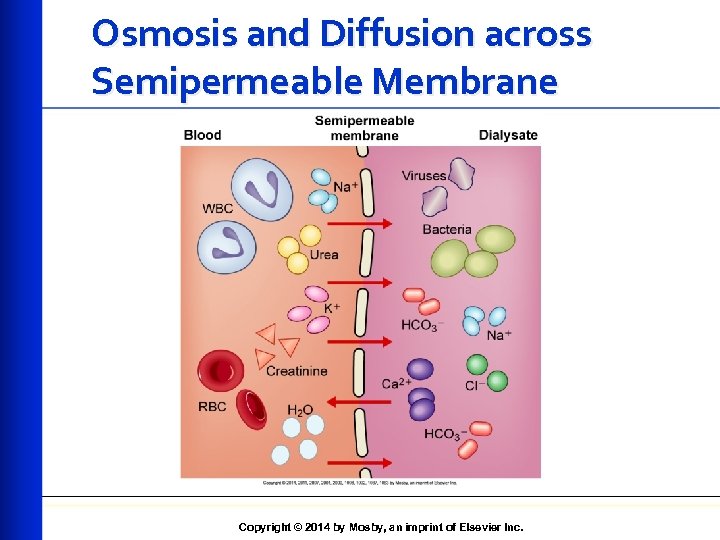
Osmosis and Diffusion across Semipermeable Membrane Copyright © 2014 by Mosby, an imprint of Elsevier Inc.
General Principles of Dialysis § Osmosis § Movement of fluid from an area of lesser concentration of solutes to area of greater concentration Copyright © 2014 by Mosby, an imprint of Elsevier Inc.
General Principles of Dialysis § Ultrafiltration § Water and fluid removal § Results when there is an osmotic gradient across the membrane Copyright © 2014 by Mosby, an imprint of Elsevier Inc.
Case Study Purestock/Thinkstock § K. W. , a 35 -year-old man, received a diagnosis of chronic glomerulonephritis (see case study in Power. Point presentation on chronic kidney disease). § He has now reached stage 5 chronic kidney disease. Copyright © 2014 by Mosby, an imprint of Elsevier Inc.
Case Study § K. W. ’s laboratory values: § BUN 72 mg/d. L § Serum creatinine 6. 5 mg/d. L § GFR 12 m. L/min Purestock/Thinkstock § What are his treatment options at this time? Copyright © 2014 by Mosby, an imprint of Elsevier Inc.
Peritoneal Dialysis § Peritoneal access is obtained by inserting a catheter through the anterior abdominal wall § Technique for catheter placement varies § Usually done via surgery Copyright © 2014 by Mosby, an imprint of Elsevier Inc.
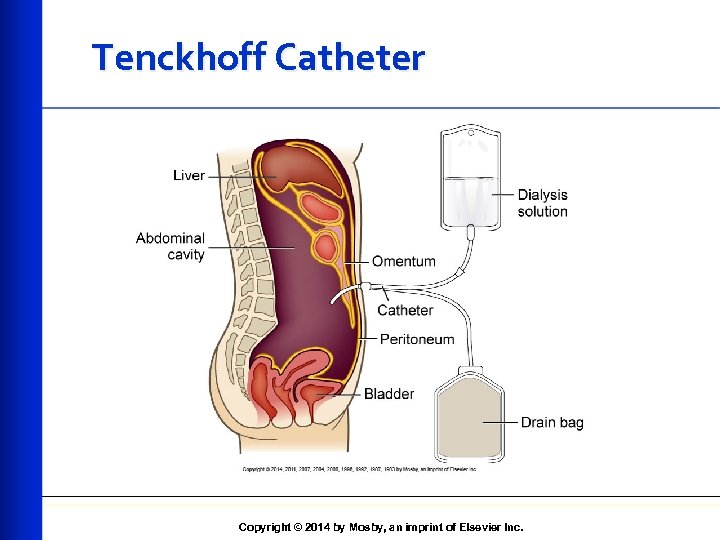
Tenckhoff Catheter Copyright © 2014 by Mosby, an imprint of Elsevier Inc.
Case Study Purestock/Thinkstock § K. W. decides to use peritoneal dialysis (PD) as his treatment. § He has a Tenckhoff catheter placed for PD. § He asks many questions about when he can begin using the catheter, as well as how he will manage his dialysis schedule. Copyright © 2014 by Mosby, an imprint of Elsevier Inc.
Peritoneal Dialysis § After catheter inserted, skin is cleaned with antiseptic solution and sterile dressing applied § Connected to sterile tubing system § Secured to abdomen with tape § Catheter irrigated immediately Copyright © 2014 by Mosby, an imprint of Elsevier Inc.
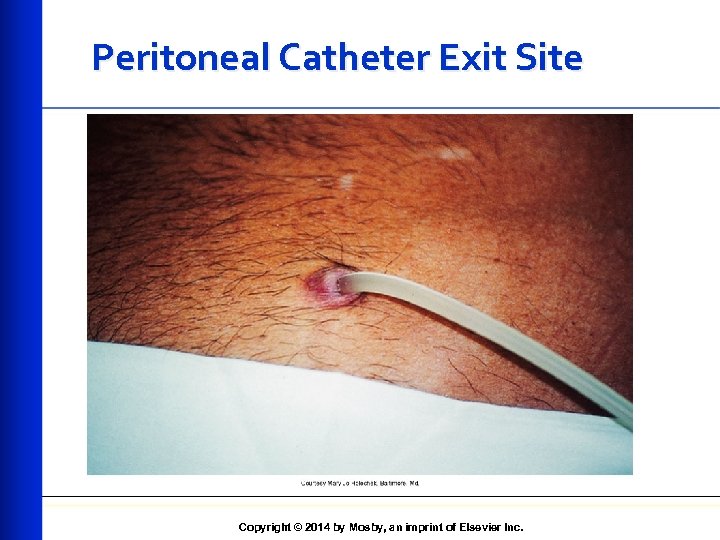
Peritoneal Catheter Exit Site Copyright © 2014 by Mosby, an imprint of Elsevier Inc.
Peritoneal Dialysis § Waiting period of 7 to 14 days preferable § Two to 4 weeks after implantation, exit site should be clean, dry, and free of redness/tenderness § Once site healed, patient may shower and pat dry Copyright © 2014 by Mosby, an imprint of Elsevier Inc.
Peritoneal Dialysis Solutions and Cycles § Available in 1 - or 2 -L plastic bags with glucose concentrations of 1. 5%, 2. 5%, and 4. 25% § Electrolyte composition similar to that of plasma § Solution warmed to body temperature Copyright © 2014 by Mosby, an imprint of Elsevier Inc.
Peritoneal Dialysis Solutions and Cycles § Three phases of PD cycle § Inflow (fill) § Dwell (equilibration) § Drain § Called an exchange Copyright © 2014 by Mosby, an imprint of Elsevier Inc.
Peritoneal Dialysis Solutions and Cycles § Inflow § Prescribed amount of solution infused through established catheter over about 10 minutes § After solution infused, inflow clamp closed to prevent air from entering tubing Copyright © 2014 by Mosby, an imprint of Elsevier Inc.
Peritoneal Dialysis Solutions and Cycles § Dwell § Also known as equilibration § Diffusion and osmosis occur between patient’s blood and peritoneal cavity § Duration of time varies, depending on method Copyright © 2014 by Mosby, an imprint of Elsevier Inc.
Peritoneal Dialysis Solutions and Cycles § Drain § Lasts 15 to 30 minutes § May be facilitated by gently massaging abdomen or changing position Copyright © 2014 by Mosby, an imprint of Elsevier Inc.
Peritoneal Dialysis Systems § Automated peritoneal dialysis (APD) § Cycler delivers the dialysate § Times and controls fill, dwell, and drain § Continuous ambulatory peritoneal dialysis (CAPD) § Manual exchange Copyright © 2014 by Mosby, an imprint of Elsevier Inc.
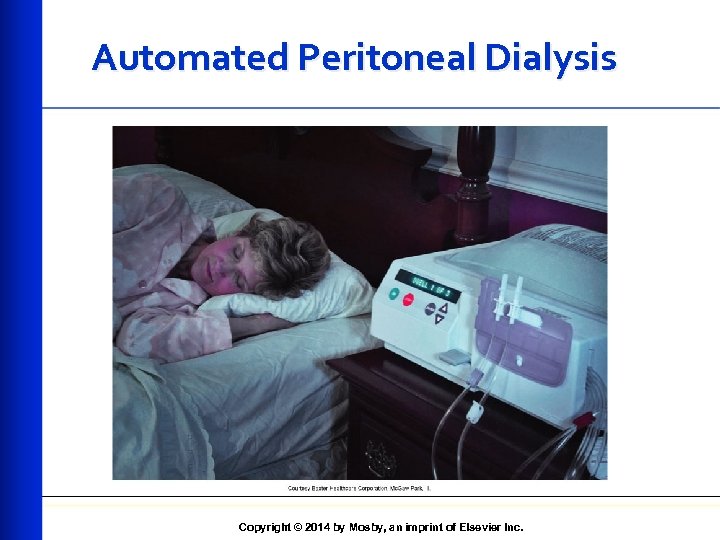
Automated Peritoneal Dialysis Copyright © 2014 by Mosby, an imprint of Elsevier Inc.
Peritoneal Dialysis Complications § Exit site infection § Peritonitis § Hernias Copyright © 2014 by Mosby, an imprint of Elsevier Inc.
Peritoneal Dialysis Complications § Lower back problems § Bleeding § Pulmonary complications § Protein loss Copyright © 2014 by Mosby, an imprint of Elsevier Inc.
Peritoneal Dialysis Effectiveness and Adaptation § Short training program § Independence § Ease of traveling § Fewer dietary restrictions § Greater mobility than with HD Copyright © 2014 by Mosby, an imprint of Elsevier Inc.
Case Study Purestock/Thinkstock § K. W. has difficulty managing his P. D. because of progressive visual limitations. § He develops a catheter infection, and it is determined that he should be switched to hemodialysis (HD). Copyright © 2014 by Mosby, an imprint of Elsevier Inc.
Hemodialysis Vascular Access Sites § Obtaining vascular access is one of most difficult problems § Types of access § Arteriovenous fistulas and grafts § Temporary vascular access Copyright © 2014 by Mosby, an imprint of Elsevier Inc.
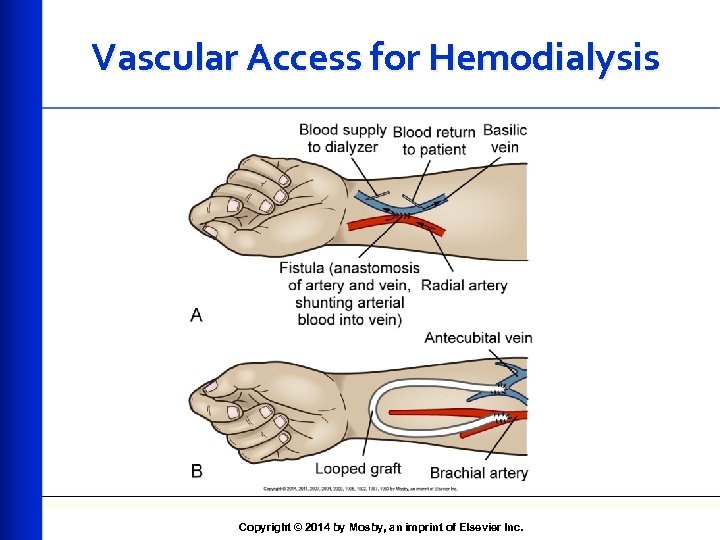
Vascular Access for Hemodialysis Copyright © 2014 by Mosby, an imprint of Elsevier Inc.
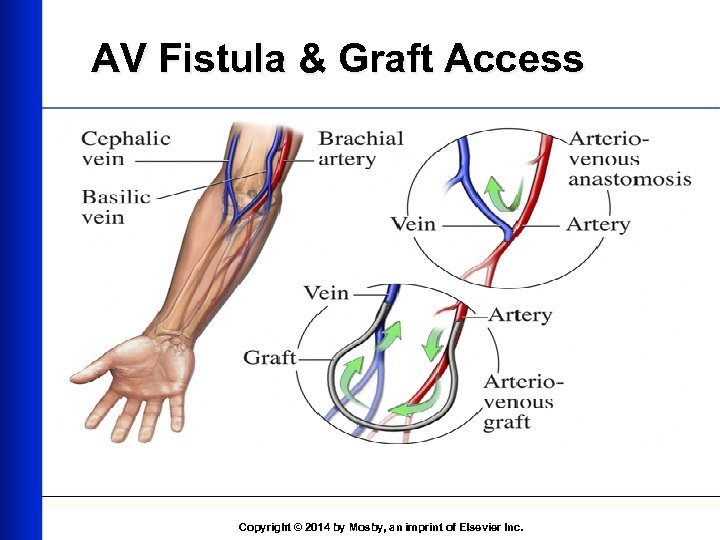
AV Fistula & Graft Access Copyright © 2014 by Mosby, an imprint of Elsevier Inc.
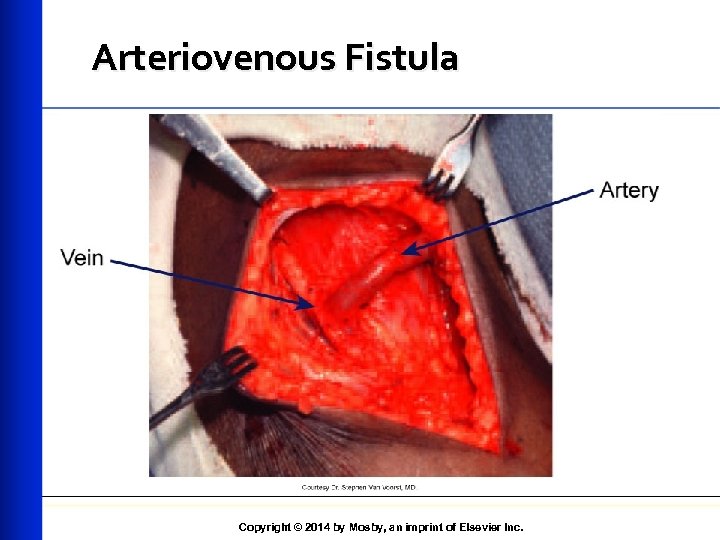
Arteriovenous Fistula Copyright © 2014 by Mosby, an imprint of Elsevier Inc.
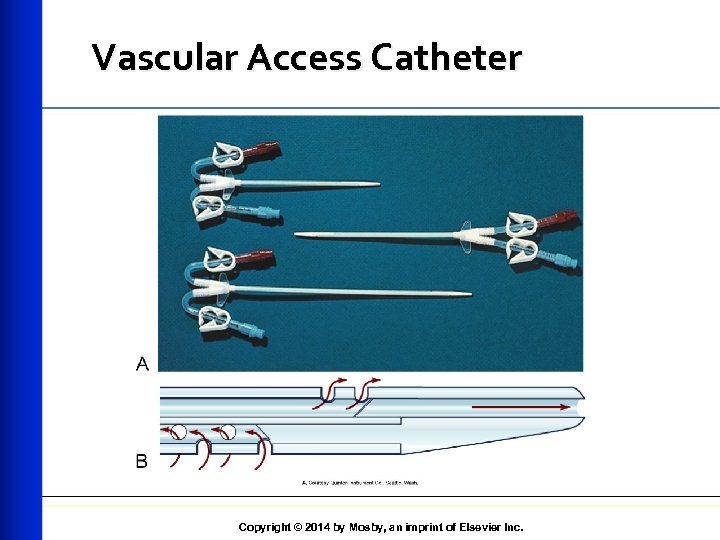
Vascular Access Catheter Copyright © 2014 by Mosby, an imprint of Elsevier Inc.
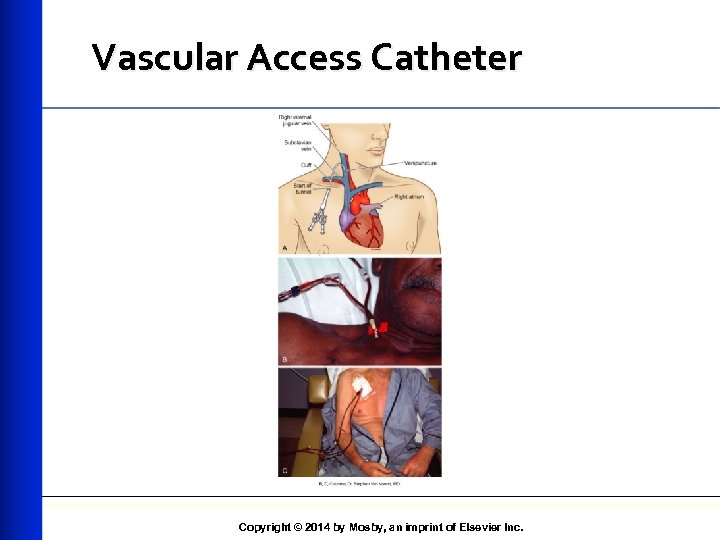
Vascular Access Catheter Copyright © 2014 by Mosby, an imprint of Elsevier Inc.
Hemodialysis Dialyzers § Long plastic cartridges that contain thousands of parallel hollow tubes or fibers § Fibers are semipermeable membranes Copyright © 2014 by Mosby, an imprint of Elsevier Inc.
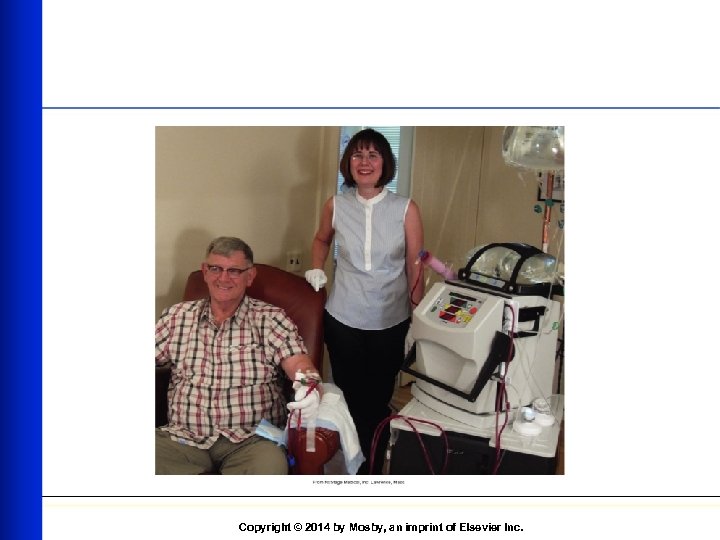
Hemodialysis Procedure § Two needles placed in fistula or graft § One needle is placed to pull blood from the circulation to the HD machine § The other needle is used to return the dialyzed blood to the patient Copyright © 2014 by Mosby, an imprint of Elsevier Inc.
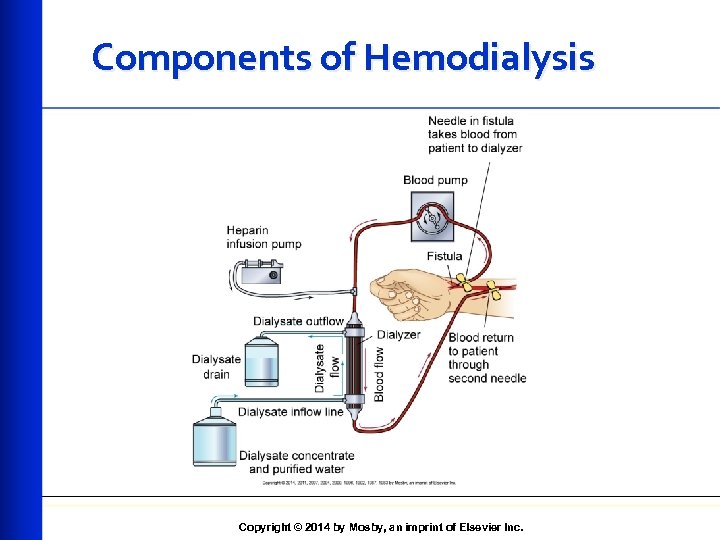
Components of Hemodialysis Copyright © 2014 by Mosby, an imprint of Elsevier Inc.
Hemodialysis Procedure § Dialyzer/blood lines primed with saline solution to eliminate air § Terminated by flushing dialyzer with saline to remove all blood § Needles removed and firm pressure applied Copyright © 2014 by Mosby, an imprint of Elsevier Inc.
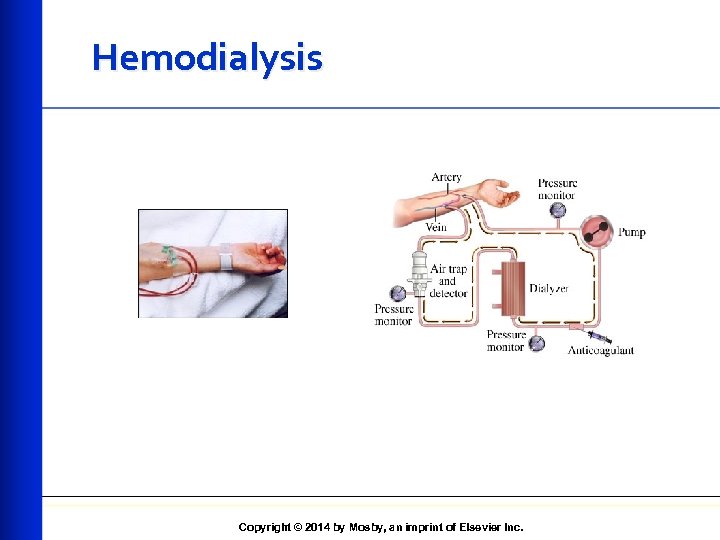
Hemodialysis Copyright © 2014 by Mosby, an imprint of Elsevier Inc.
Copyright © 2014 by Mosby, an imprint of Elsevier Inc.
Case Study Purestock/Thinkstock § K. W. has a left arteriovenous fistula placed. § After 1 month, he is ready to begin HD. § What assessment data should be obtained before a dialysis treatment is initiated? Copyright © 2014 by Mosby, an imprint of Elsevier Inc.
Hemodialysis Procedure § Before treatment, nurse should § Complete assessment of fluid status, condition of access, temperature, skin condition § During treatment, nurse should § Be alert to changes in condition § Measure vital signs every 30 to 60 minutes Copyright © 2014 by Mosby, an imprint of Elsevier Inc.
Hemodialysis Complications § Hypotension § Muscle cramps § Loss of blood § Hepatitis § Disequilibrium syndrome Copyright © 2014 by Mosby, an imprint of Elsevier Inc.
Hemodialysis Effectiveness and Adaptation § Cannot fully replace normal functions of kidneys § Can ease many of the symptoms § Can prevent certain complications Copyright © 2014 by Mosby, an imprint of Elsevier Inc.
Continual Renal Replacement Therapy (CRRT) § Alternative or adjunctive method for treating AKI § Means by which uremic toxins and fluids are removed § Acid-base status/electrolyte balance adjusted slowly and continuously Copyright © 2014 by Mosby, an imprint of Elsevier Inc.
Continual Renal Replacement Therapy (CRRT) § Can be used in conjunction with HD § Contraindication § Presence of manifestations of uremia that necessitate rapid resolution § Continued for 30 to 40 days Copyright © 2014 by Mosby, an imprint of Elsevier Inc.
Continual Renal Replacement Therapy (CRRT) § Hemofilter change every 24 to 48 hours § Ultrafiltrate should be clear yellow § Specimens may be obtained for evaluation Copyright © 2014 by Mosby, an imprint of Elsevier Inc.
Continual Renal Replacement Therapy (CRRT) § Two types of CRRT § Venous access § Arterial access Copyright © 2014 by Mosby, an imprint of Elsevier Inc.
Continual Renal Replacement Therapy (CRRT) § Most common approaches: venous § Continuous venous hemofiltration (CVVH) § Continuous venous hemodialysis (CVVHD) Copyright © 2014 by Mosby, an imprint of Elsevier Inc.
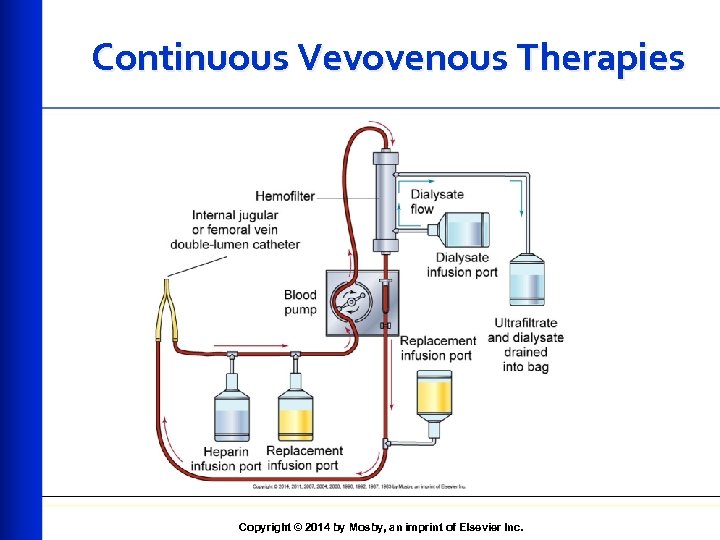
Continuous Vevovenous Therapies Copyright © 2014 by Mosby, an imprint of Elsevier Inc.
Continual Renal Replacement Therapy (CRRT) § Continuous venous hemofiltration (CVVH) § Large volumes fluid removed hourly, then replaced § Fluid replacement dependent on stability/individualized needs of patient Copyright © 2014 by Mosby, an imprint of Elsevier Inc.
Continual Renal Replacement Therapy (CRRT) § Continuous venous hemodialysis (CVVHD) § Uses dialysate § Dialysate bags attached to distal end of hemofilter Copyright © 2014 by Mosby, an imprint of Elsevier Inc.
Continual Renal Replacement Therapy (CRRT) § Continuous venous hemodialysis (CVVHD) § Fluid pumped countercurrent to blood flow § Ideal treatment for patient who needs fluid/solute control but cannot tolerate rapid fluid shifts with HD Copyright © 2014 by Mosby, an imprint of Elsevier Inc.
Continual Renal Replacement Therapy (CRRT) § Highly permeable, hollow fiber hemofilter § Double-lumen catheter placed in femoral, jugular, or subclavian vein § Removes plasma water and nonprotein solutes Copyright © 2014 by Mosby, an imprint of Elsevier Inc.
Continual Renal Replacement Therapy (CRRT) § CRRT versus HD § Continuous rather than intermittent § Solute removal by convection (no dialysate required) in addition to osmosis and diffusion § Less hemodynamic instability Copyright © 2014 by Mosby, an imprint of Elsevier Inc.
Continual Renal Replacement Therapy (CRRT) § CRRT versus HD § Does not require constant monitoring by HD nurse § Does not require complicated HD equipment Copyright © 2014 by Mosby, an imprint of Elsevier Inc.
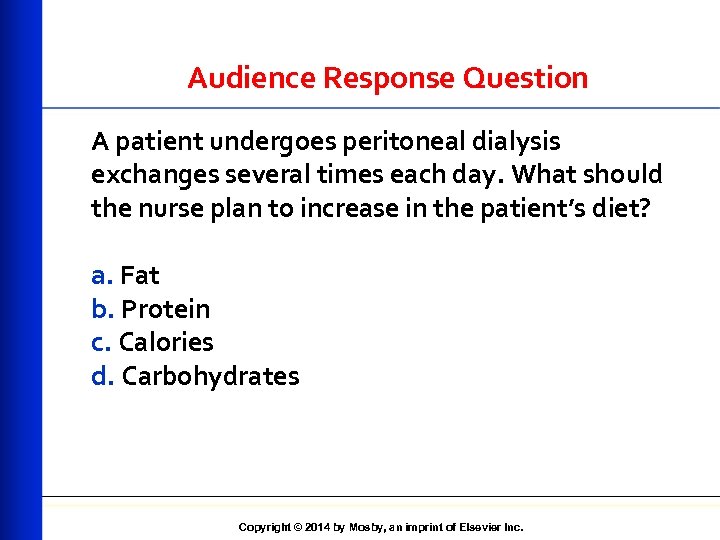
Audience Response Question A patient undergoes peritoneal dialysis exchanges several times each day. What should the nurse plan to increase in the patient’s diet? a. Fat b. Protein c. Calories d. Carbohydrates Copyright © 2014 by Mosby, an imprint of Elsevier Inc.
Скачать презентацию Dialysis Chapter 47 Copyright 2014 by Mosby
f4c9100d819cdc78aaf94f554751be3b.ppt