


 Скачать презентацию Dialogue continued Why do electronic conversations seem
3481bab1fe40db47170ae99301ef1305.ppt
- Количество слайдов: 52
 Dialogue (continued)
 Why do electronic conversations seem less polite? (w/ J. Ohaeri) Experiment: Collaborative Remembering 13 3 -person face-to-face groups (speaking) 13 3 -person electronic groups Task: Recall a scene from a movie together (typing)
 Politeness (Brown & Levinson) Politeness is about giving your partner options. The two sides of politeness: 1. Save your own face 2. Avoid threatening the face of others
 Hedges: Markers of provisionality Hedges may enable people to convey their alignment toward their utterances This may make it easier for a partner to disagree and still save face. This in turn may affect politeness. Hedging requires producing additional words
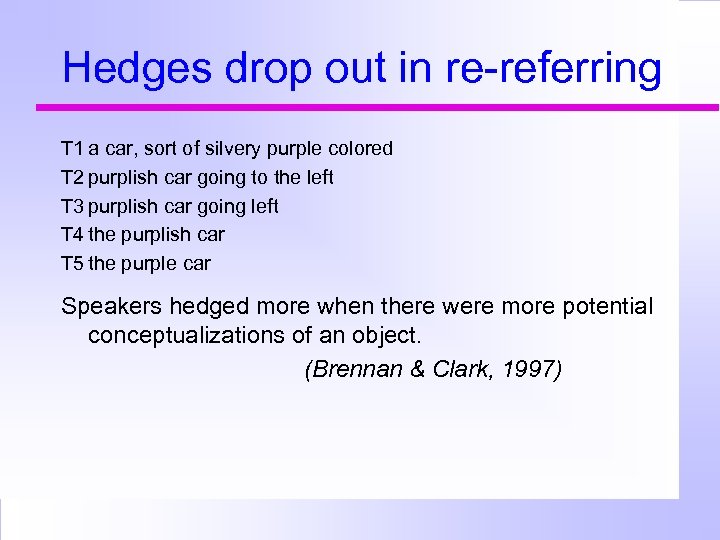 Hedges drop out in re-referring T 1 a car, sort of silvery purple colored T 2 purplish car going to the left T 3 purplish car going left T 4 the purplish car T 5 the purple car Speakers hedged more when there were more potential conceptualizations of an object. (Brennan & Clark, 1997)
 Questions: Another marker Syntactic questions Rising intonation or ? punctuation Tag questions: right? wasn’t it? Questions do not require producing additional words.
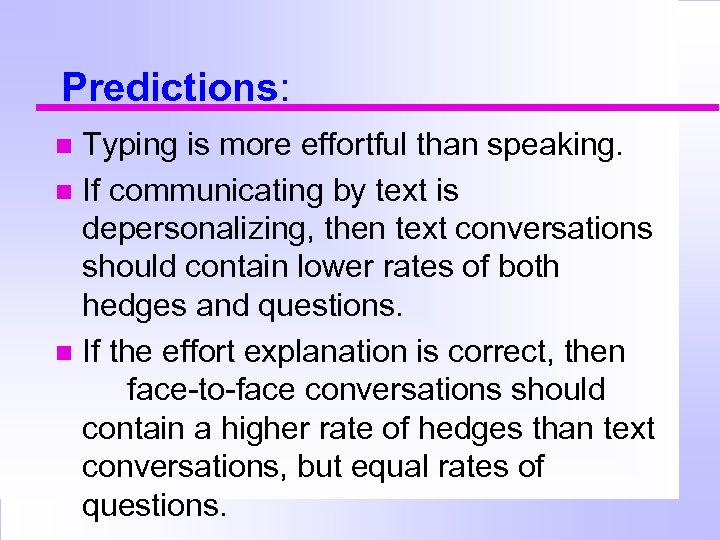 Predictions: Typing is more effortful than speaking. If communicating by text is depersonalizing, then text conversations should contain lower rates of both hedges and questions. If the effort explanation is correct, then face-to-face conversations should contain a higher rate of hedges than text conversations, but equal rates of questions.
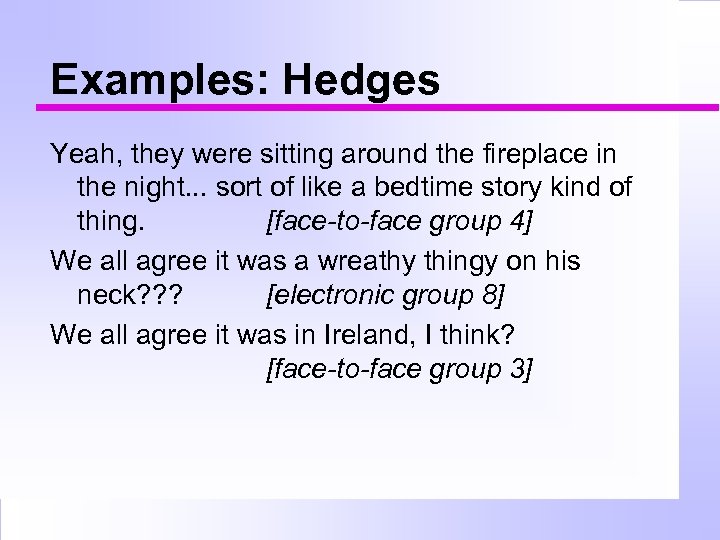 Examples: Hedges Yeah, they were sitting around the fireplace in the night. . . sort of like a bedtime story kind of thing. [face-to-face group 4] We all agree it was a wreathy thingy on his neck? ? ? [electronic group 8] We all agree it was in Ireland, I think? [face-to-face group 3]
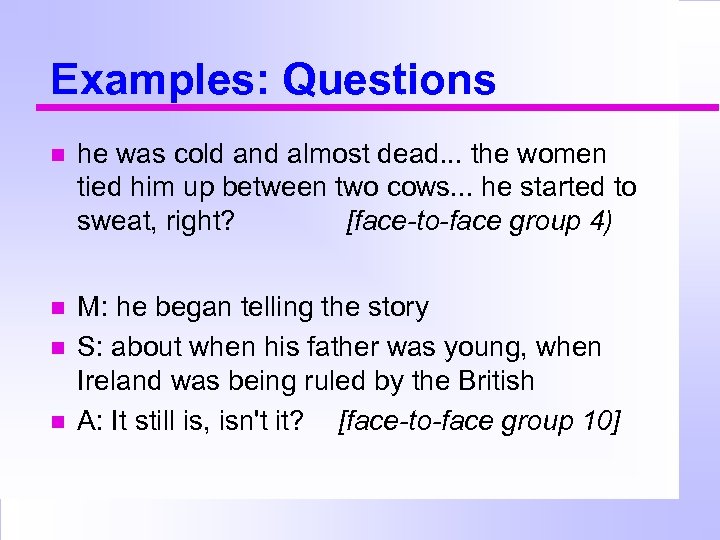 Examples: Questions he was cold and almost dead. . . the women tied him up between two cows. . . he started to sweat, right? [face-to-face group 4) M: he began telling the story S: about when his father was young, when Ireland was being ruled by the British A: It still is, isn't it? [face-to-face group 10]
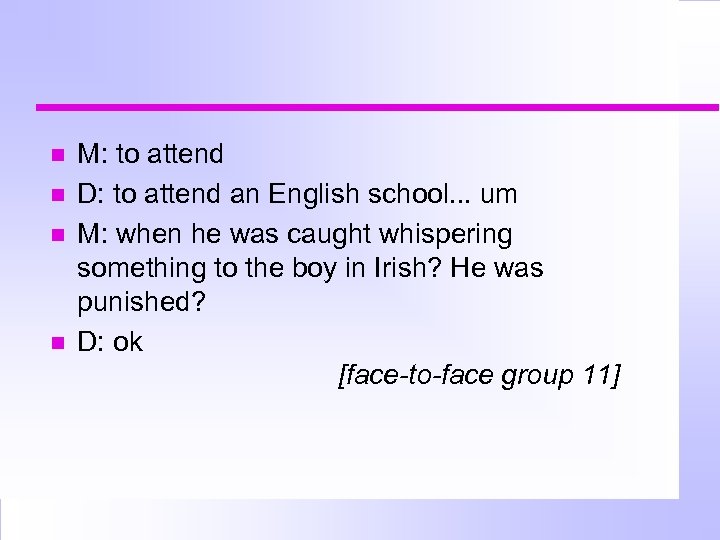 M: to attend D: to attend an English school. . . um M: when he was caught whispering something to the boy in Irish? He was punished? D: ok [face-to-face group 11]
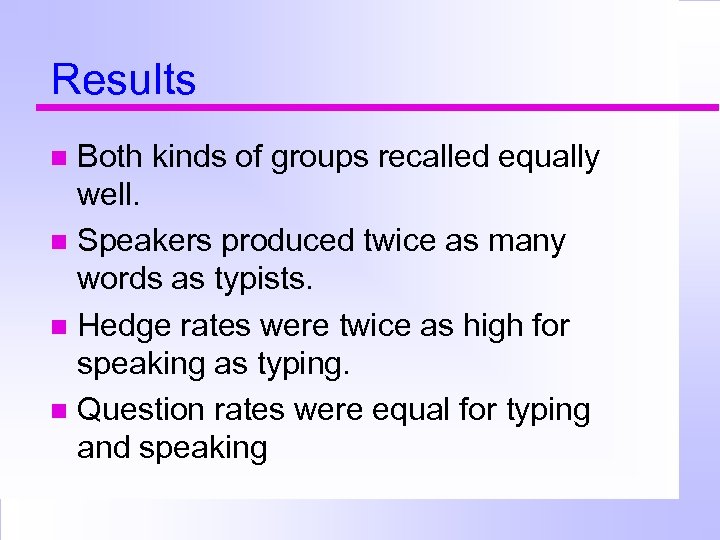 Results Both kinds of groups recalled equally well. Speakers produced twice as many words as typists. Hedge rates were twice as high for speaking as typing. Question rates were equal for typing and speaking
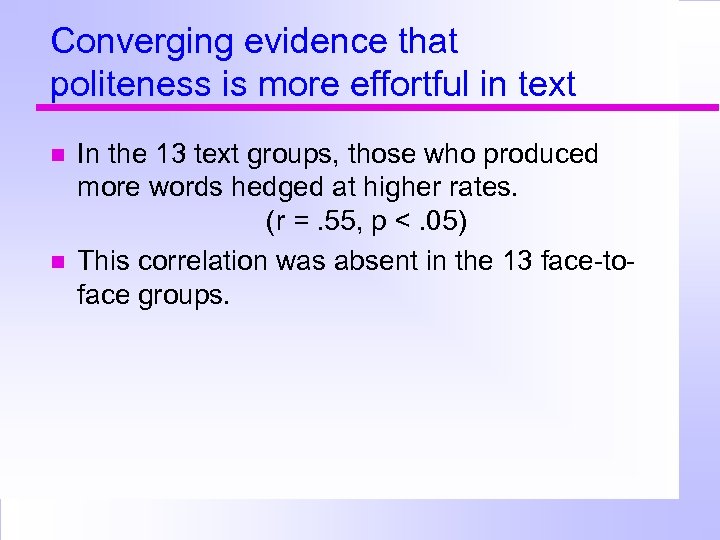 Converging evidence that politeness is more effortful in text In the 13 text groups, those who produced more words hedged at higher rates. (r =. 55, p <. 05) This correlation was absent in the 13 face-toface groups.
 Conclusions: politeness & effort Electronic conversations seem less polite not because speakers are “depersonalized”, but because it is harder for them to show their alignment toward their utterances. Politeness is not a style of interaction that emerges automatically, but results from speakers giving each other specific options.
 Conclusions: Mediated communication Conversation is shaped by its medium People adapt very rapidly One person’s behavior shapes the other’s.
 Read or review: CGB chapters so far Brennan chapter on grounding
 Pauses in conversations One turn often follows another after only 200 milliseconds (or less). People make attributions about the cause of a pause. Pauses of. 8 -1. 2 msec. tend to indicate problems (Jefferson). Longer pauses tend to occur only when people are also eating, driving, etc.
 Applications Cell phone safety Mediated communication - people don’t make the same attributions to pauses when they can see what their partners are doing! Survey interviews
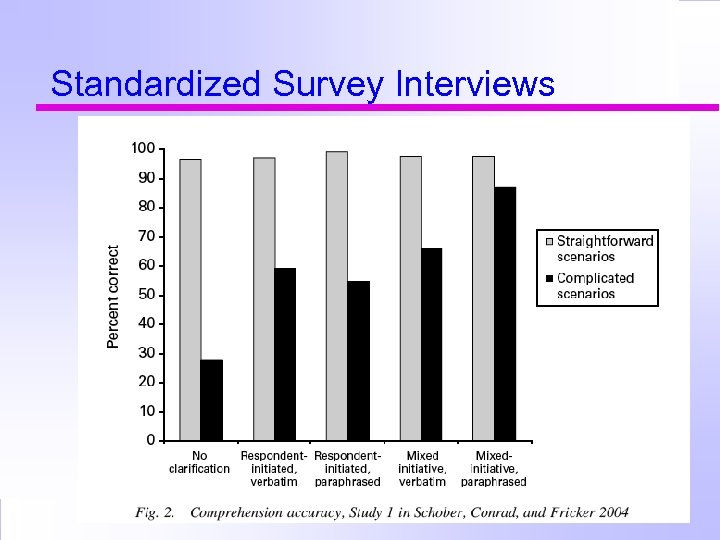
 Standardized Survey Interviews Bureau of Labor Statistics census People are bad at interpreting certain questions (How many bathrooms…? ) Displays of uncertainty can tip off the interviewer as to whether the respondent needs a clarification (Bloom & Schober, 1998)
 Standardized Survey Interviews Questions are usually assumed to be independent. But the first question(s) in a survey can anchor you in a way that taints your responses to the rest of the questions. Ex: “How much money do you earn? ” …. . “How much do you spend each year on travel? ”
 Standardized Survey Interviews Michael Schober, Fred Conrad, & colleagues have proposed that surveys should be more like conversations (since people treat them that way anyway).
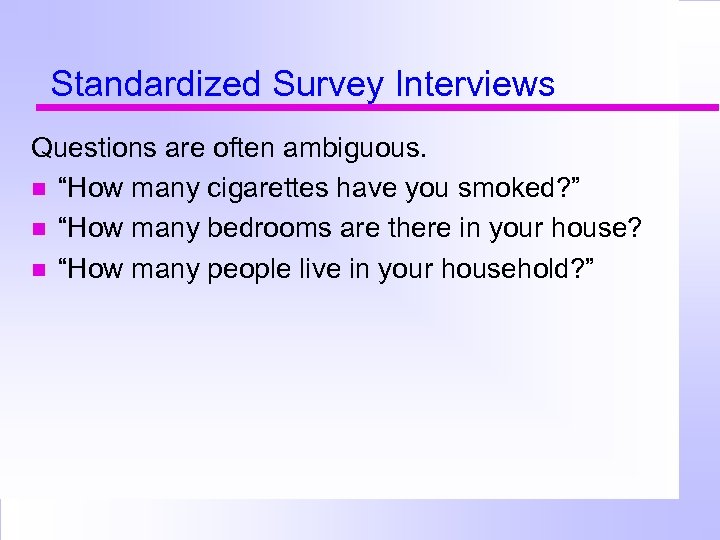 Standardized Survey Interviews Questions are often ambiguous. “How many cigarettes have you smoked? ” “How many bedrooms are there in your house? “How many people live in your household? ”
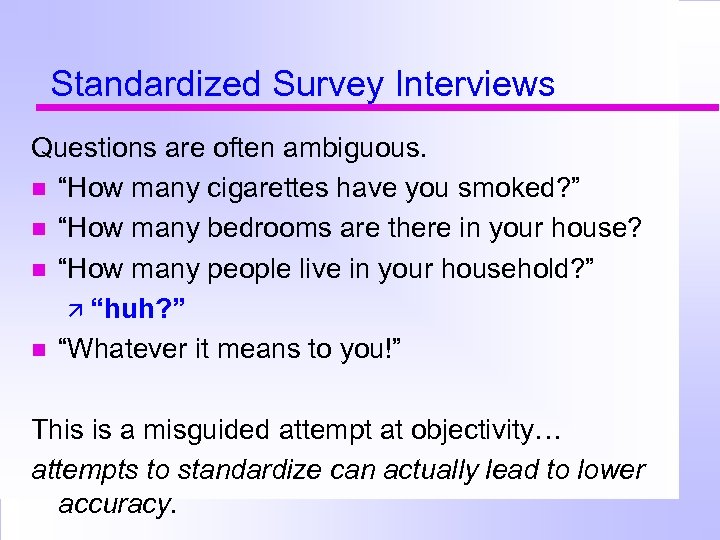 Standardized Survey Interviews Questions are often ambiguous. “How many cigarettes have you smoked? ” “How many bedrooms are there in your house? “How many people live in your household? ” “huh? ” “Whatever it means to you!” This is a misguided attempt at objectivity… attempts to standardize can actually lead to lower accuracy.
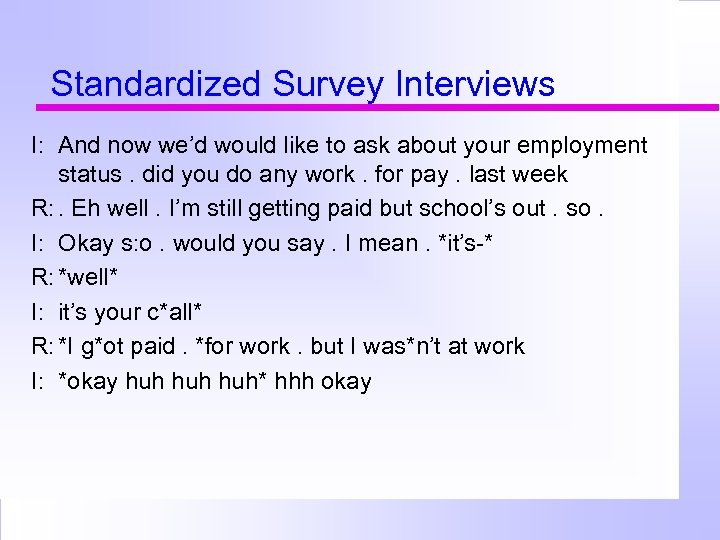 Standardized Survey Interviews I: And now we’d would like to ask about your employment status. did you do any work. for pay. last week R: . Eh well. I’m still getting paid but school’s out. so. I: Okay s: o. would you say. I mean. *it’s-* R: *well* I: it’s your c*all* R: *I g*ot paid. *for work. but I was*n’t at work I: *okay huh huh* hhh okay
 Standardized Survey Interviews
 Standardized Survey Interviews
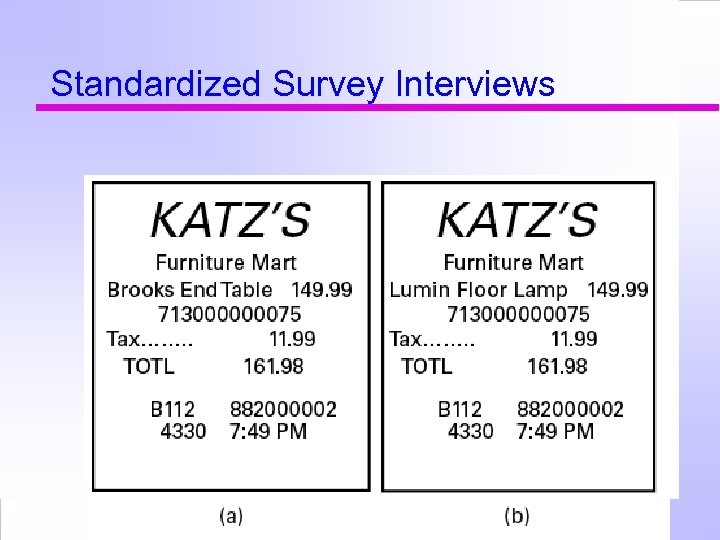
 Standardized Survey Interviews Complicated questions require clarification. But it’s not a simple matter of requesting clarification. Respondents must also be aware that clarification can be useful! Including a partial definition can be helpful, both in clarifying the intent behind the question and in letting the respondent know it’s a complicated mapping. Alignment is neither automatic nor guaranteed!
 Standardized Survey Interviews Replacing standardized interviews with “conversational interviews” improves accuracy. How much information or clarification to provide? (With a live survey, this can get costly…) People give meta-cognitive and non-verbal cues when they’re confused.
 Revisit: When is it a good idea to use a spoken dialogue interface?
 Speech gone wrong On the input side: For many years, speech recognition systems seemed to be trying to solve a problem that nobody had! After the novelty wears off, talking appliances are annoying. It turns out that nobody wants to talk to their VCR. On the output side: Nobody wants to listen to a long menu of options. This can be a problem with automated telephone systems in general, whether spoken or touch-tone.
 Speech gone wrong Noisy environments can be a problem Dependability can be a problem Recognition errors Repair mechanisms Bad dialog design can be a problem
 Speech for the right reasons Hands busy or disabled? Eyes busy? Repetitive task? Users mobile? Small screen (phone)? Blind users?
 Good examples of speech applications CAD on desktop Hands available for mouse & keyboard tasks Dictating text (e. g. , Dragon Dictates) For people with RSI or who can’t type Car’s GPS navigation system (both for output and input - entering destination) Telephone dialogue systems
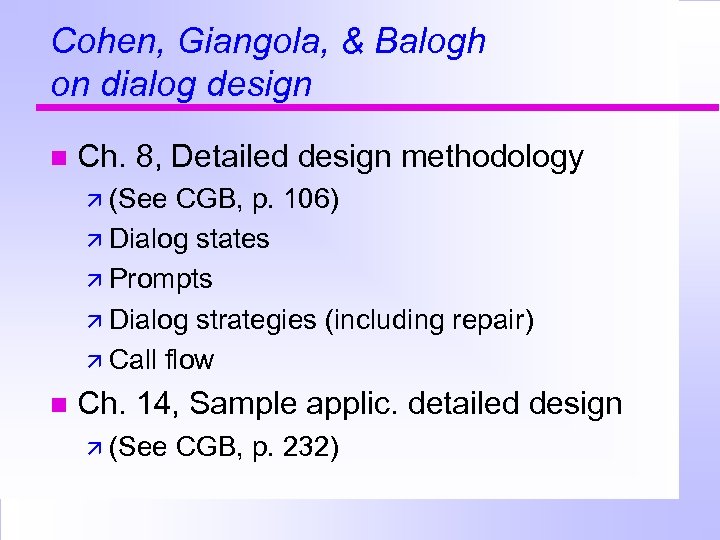 Cohen, Giangola, & Balogh on dialog design Ch. 8, Detailed design methodology (See CGB, p. 106) Dialog states Prompts Dialog strategies (including repair) Call flow Ch. 14, Sample applic. detailed design (See CGB, p. 232)
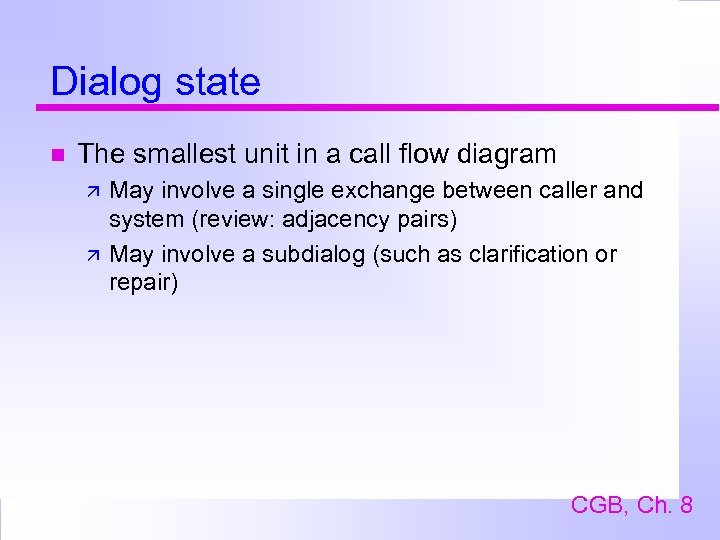 Dialog state The smallest unit in a call flow diagram May involve a single exchange between caller and system (review: adjacency pairs) May involve a subdialog (such as clarification or repair) CGB, Ch. 8
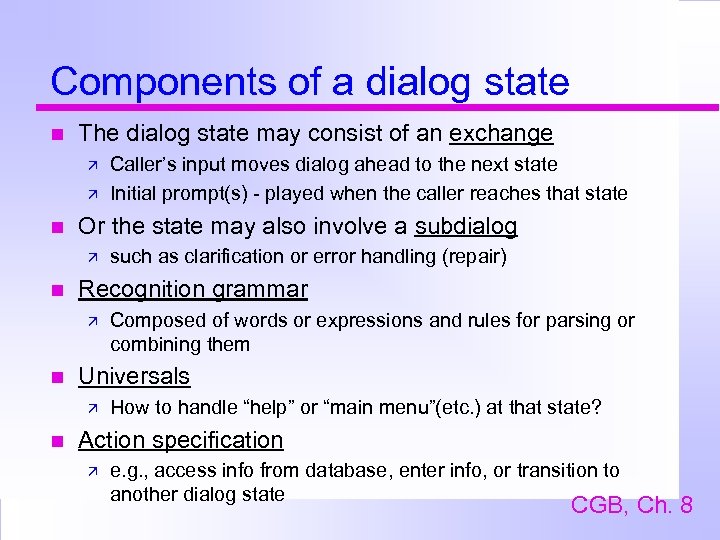 Components of a dialog state The dialog state may consist of an exchange Or the state may also involve a subdialog Composed of words or expressions and rules for parsing or combining them Universals such as clarification or error handling (repair) Recognition grammar Caller’s input moves dialog ahead to the next state Initial prompt(s) - played when the caller reaches that state How to handle “help” or “main menu”(etc. ) at that state? Action specification e. g. , access info from database, enter info, or transition to another dialog state CGB, Ch. 8
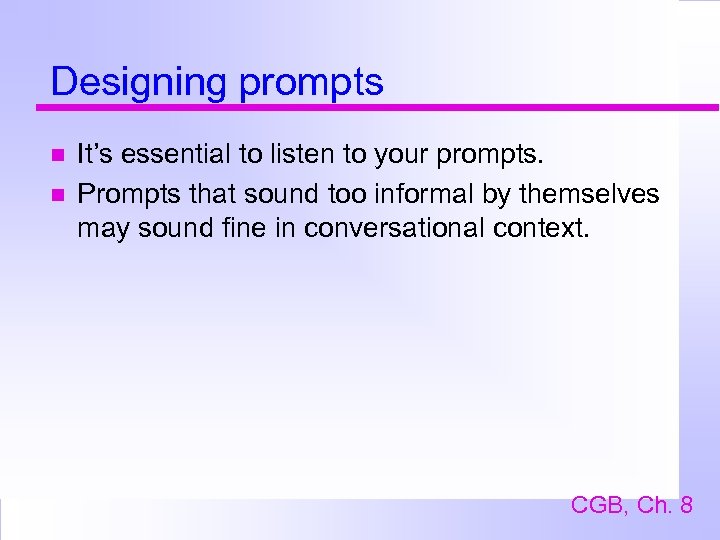 Designing prompts It’s essential to listen to your prompts. Prompts that sound too informal by themselves may sound fine in conversational context. CGB, Ch. 8
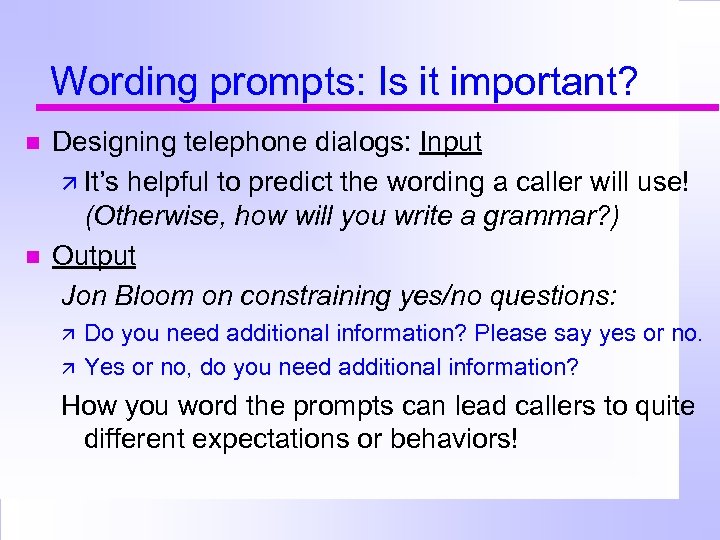 Wording prompts: Is it important? Designing telephone dialogs: Input It’s helpful to predict the wording a caller will use! (Otherwise, how will you write a grammar? ) Output Jon Bloom on constraining yes/no questions: Do you need additional information? Please say yes or no. Yes or no, do you need additional information? How you word the prompts can lead callers to quite different expectations or behaviors!
 Prompt design from CGB: http: //www. vuidesign. org/toc. htm
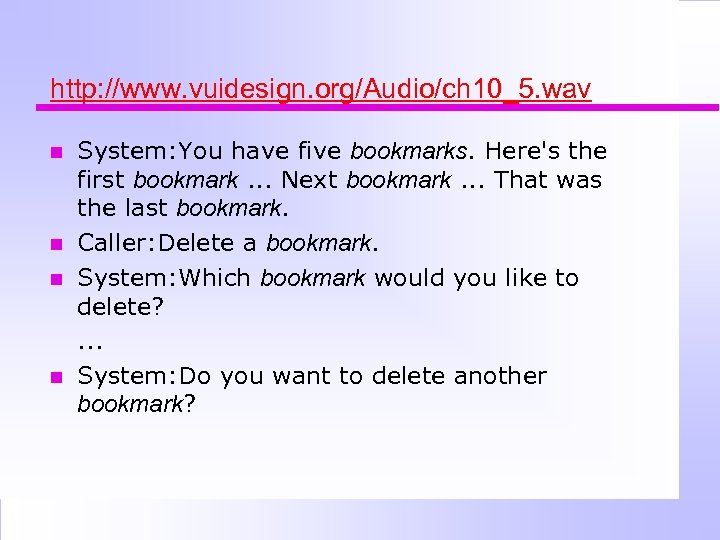 http: //www. vuidesign. org/Audio/ch 10_5. wav System: You have five bookmarks. Here's the first bookmark. . . Next bookmark. . . That was the last bookmark. Caller: Delete a bookmark. System: Which bookmark would you like to delete? . . . System: Do you want to delete another bookmark?
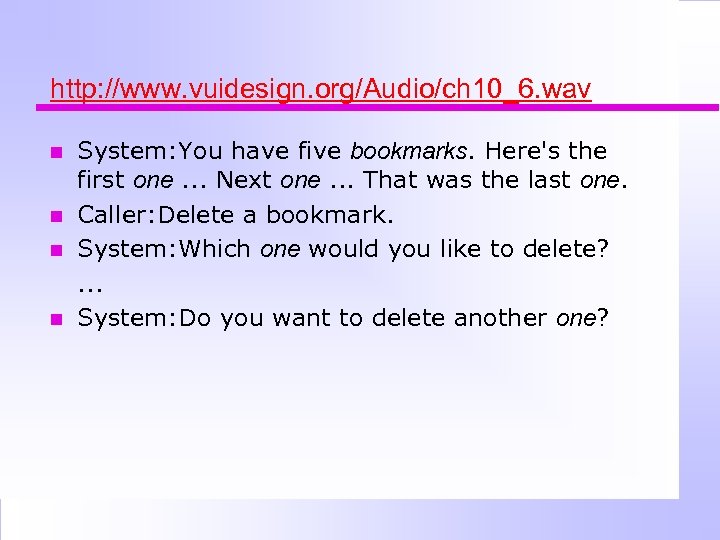 http: //www. vuidesign. org/Audio/ch 10_6. wav System: You have five bookmarks. Here's the first one. . . Next one. . . That was the last one. Caller: Delete a bookmark. System: Which one would you like to delete? . . . System: Do you want to delete another one?
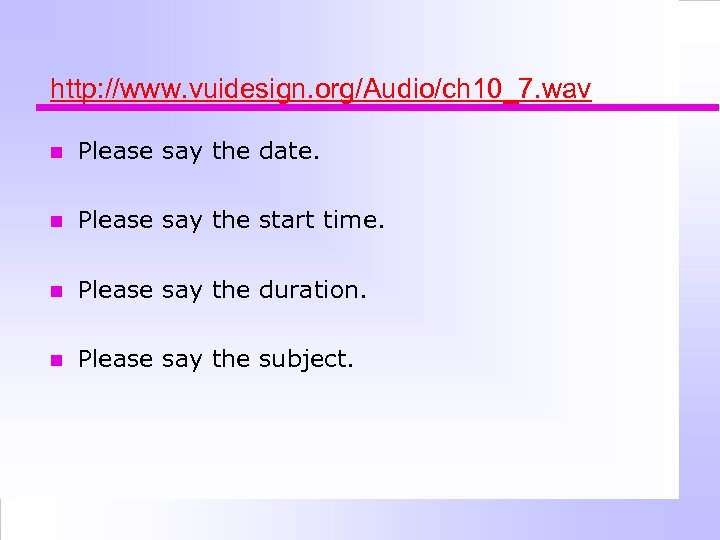 http: //www. vuidesign. org/Audio/ch 10_7. wav Please say the date. Please say the start time. Please say the duration. Please say the subject.
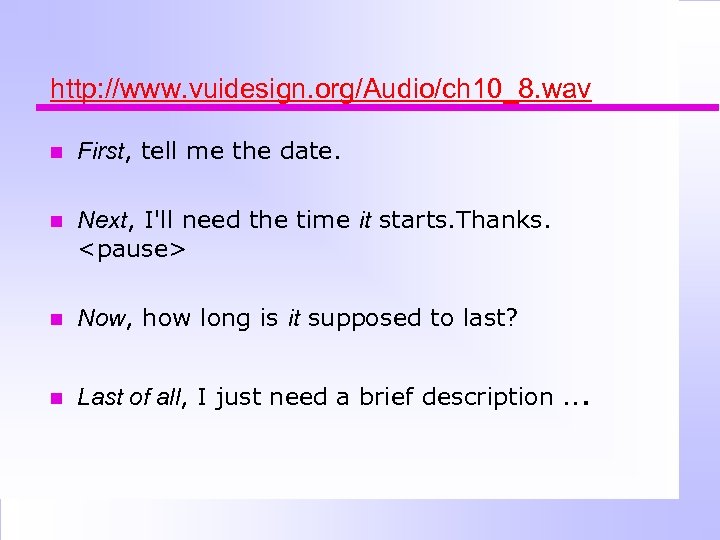 http: //www. vuidesign. org/Audio/ch 10_8. wav First, tell me the date. Next, I'll need the time it starts. Thanks.
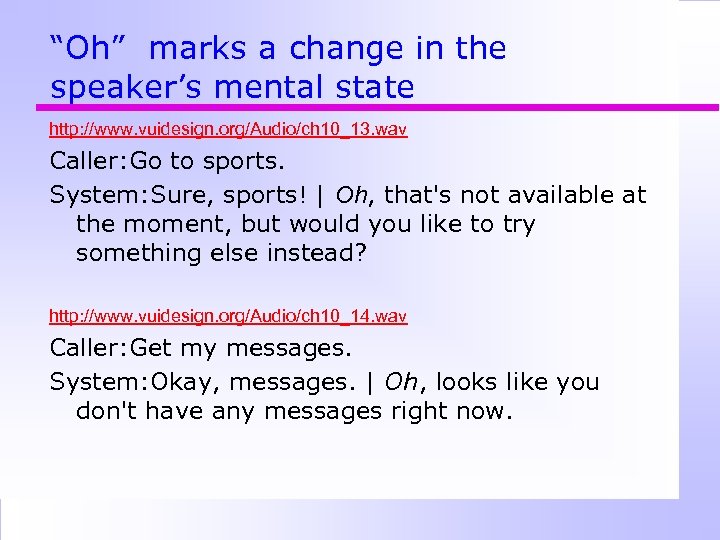 “Oh” marks a change in the speaker’s mental state http: //www. vuidesign. org/Audio/ch 10_13. wav Caller: Go to sports. System: Sure, sports! | Oh, that's not available at the moment, but would you like to try something else instead? http: //www. vuidesign. org/Audio/ch 10_14. wav Caller: Get my messages. System: Okay, messages. | Oh, looks like you don't have any messages right now.
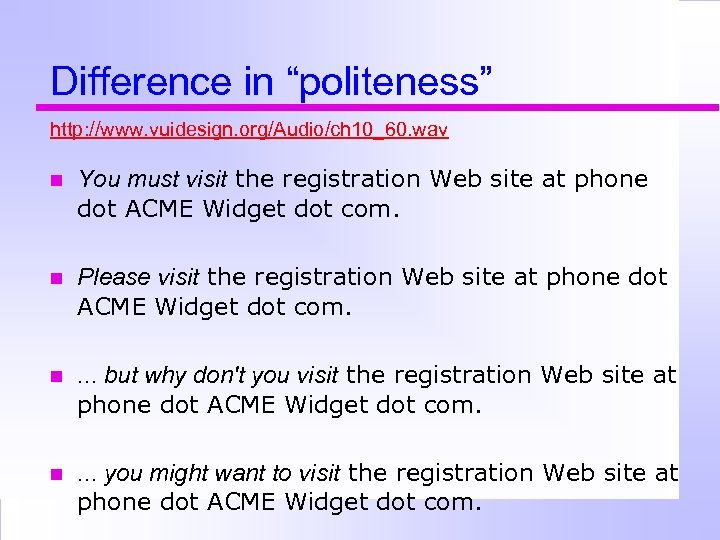 Difference in “politeness” http: //www. vuidesign. org/Audio/ch 10_60. wav You must visit the registration Web site at phone dot ACME Widget dot com. Please visit the registration Web site at phone dot ACME Widget dot com. . but why don't you visit the registration Web site at phone dot ACME Widget dot com. . you might want to visit the registration Web site at phone dot ACME Widget dot com.
 Pay attention to intonation http: //www. vuidesign. org/Audio/ch 11_0. wav System: The number you have dialed, Four? Four? is not in service. Please check the listing and dial again.
 Five Meanings of "I Should Go" http: //www. vuidesign. org/Audio/ch 11_Table 11 -1. wav PROSODY I should GO? I should go. I SHOULD go. MEANING Falling tone on stressed "go” Rising tone on "go” - Is that your advice? Falling tone on "I” - Not you! Falling tone on "should” - And I defy you to deny it! Rising-falling tone on "should”But I don't think I will.
 How to write a spec (speech only) Start with sample interactions: not comprehensive represent main paths validate “feel” Make audio version as well (Slide from Jon Bloom)
 How to write a spec (speech only) Flow chart (Slide from Jon Bloom) ETC. . .
 (Slide from Jon Bloom)
 How to represent call flow: Make a flow chart (call flow diagram) For assignment #6: we’re reverse-engineering a telephone dialogue (trying to derive the underlying flow chart from the dialogue we experience). When designing a dialogue, the underlying flow chart is used to generate the dialogue behavior.
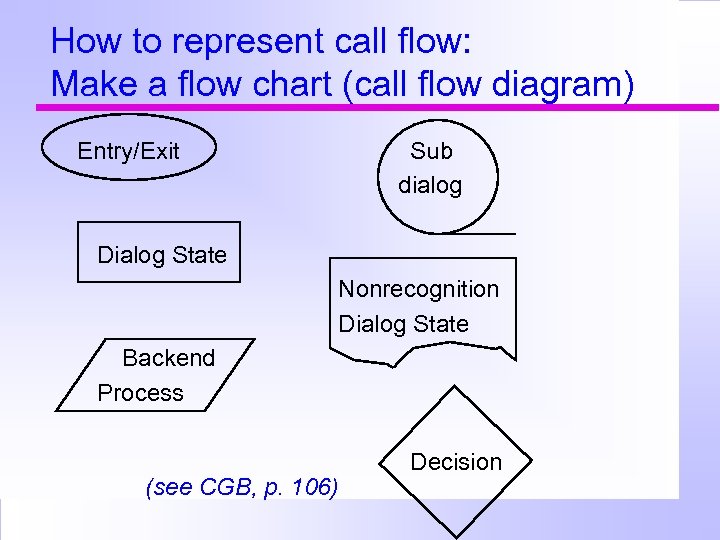 How to represent call flow: Make a flow chart (call flow diagram) Entry/Exit Sub dialog Dialog State Nonrecognition Dialog State Backend Process (see CGB, p. 106) Decision
 Call flow diagram (flow chart) for a login subdialog For Assignment #6, show numbered prompts to the side of your flow chart Be consistent. (see CGB, p. 232)