


 Скачать презентацию Dialect differences Grammar P Trudgill 1994 Dialects London
a527bfbc3f084ce5d8affd949d52f555.ppt
- Количество слайдов: 19
 Dialect differences: Grammar P Trudgill (1994) Dialects. London: Routledge. A Hughes et al. (2005) English accents and dialects (4 th ed). London: Hodder Arnold. Chapter 2 J Cheshire (1982) Variation in an English dialect. Cambridge: CUP.
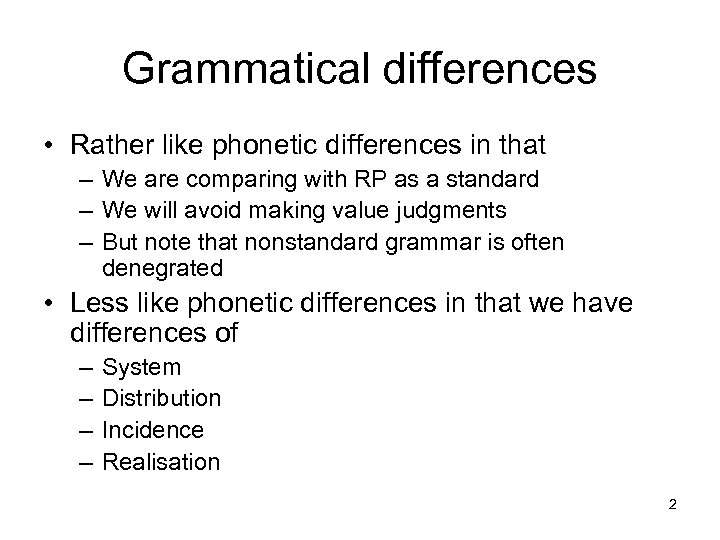 Grammatical differences • Rather like phonetic differences in that – We are comparing with RP as a standard – We will avoid making value judgments – But note that nonstandard grammar is often denegrated • Less like phonetic differences in that we have differences of – – System Distribution Incidence Realisation 2
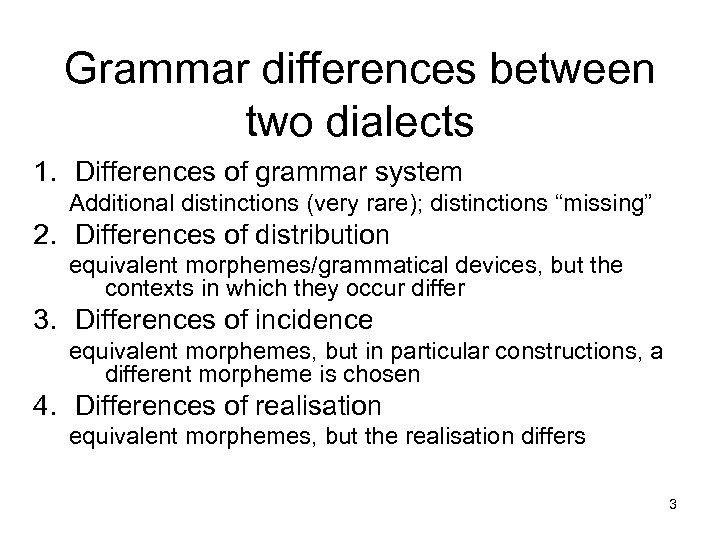 Grammar differences between two dialects 1. Differences of grammar system Additional distinctions (very rare); distinctions “missing” 2. Differences of distribution equivalent morphemes/grammatical devices, but the contexts in which they occur differ 3. Differences of incidence equivalent morphemes, but in particular constructions, a different morpheme is chosen 4. Differences of realisation equivalent morphemes, but the realisation differs 3
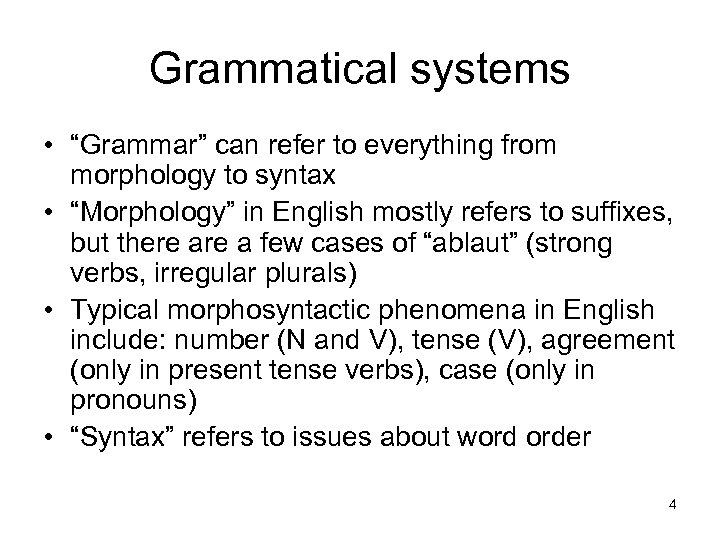 Grammatical systems • “Grammar” can refer to everything from morphology to syntax • “Morphology” in English mostly refers to suffixes, but there a few cases of “ablaut” (strong verbs, irregular plurals) • Typical morphosyntactic phenomena in English include: number (N and V), tense (V), agreement (only in present tense verbs), case (only in pronouns) • “Syntax” refers to issues about word order 4
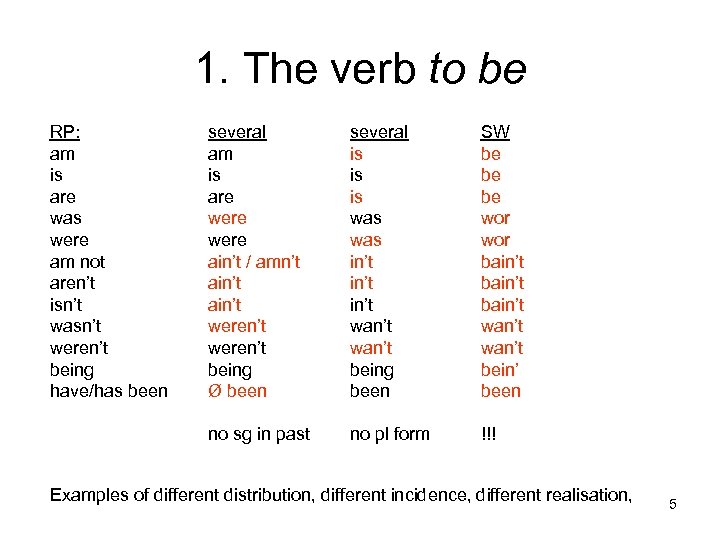 1. The verb to be RP: am is are was were am not aren’t isn’t wasn’t weren’t being have/has been several am is are were ain’t / amn’t ain’t weren’t being Ø been several is is is was in’t wan’t being been SW be be be wor bain’t wan’t bein’ been no sg in past no pl form !!! Examples of different distribution, different incidence, different realisation, 5
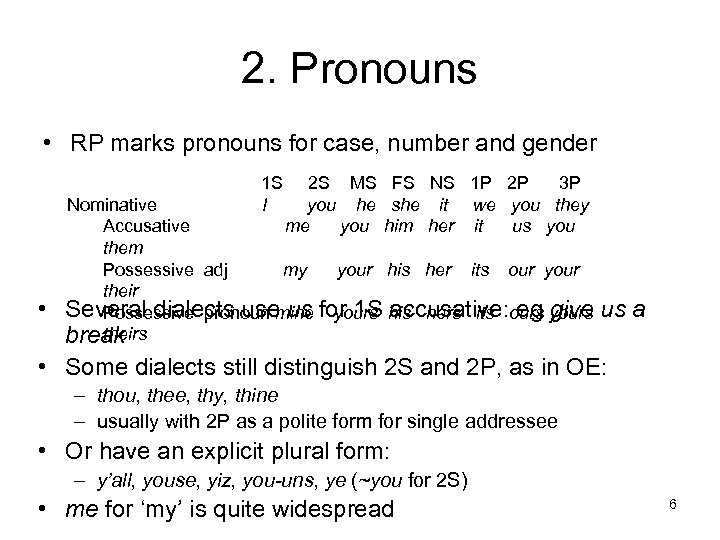 2. Pronouns • RP marks pronouns for case, number and gender 1 S I • 2 S MS FS NS 1 P 2 P 3 P you he she it we you they me you him her it us you Nominative Accusative them Possessive adj my your his her its our your their Several dialects use us for 1 S his hers its ours yours Possessive pronoun mine yours accusative: eg give theirs break us a • Some dialects still distinguish 2 S and 2 P, as in OE: – thou, thee, thy, thine – usually with 2 P as a polite form for single addressee • Or have an explicit plural form: – y’all, youse, yiz, you-uns, ye (~you for 2 S) • me for ‘my’ is quite widespread 6
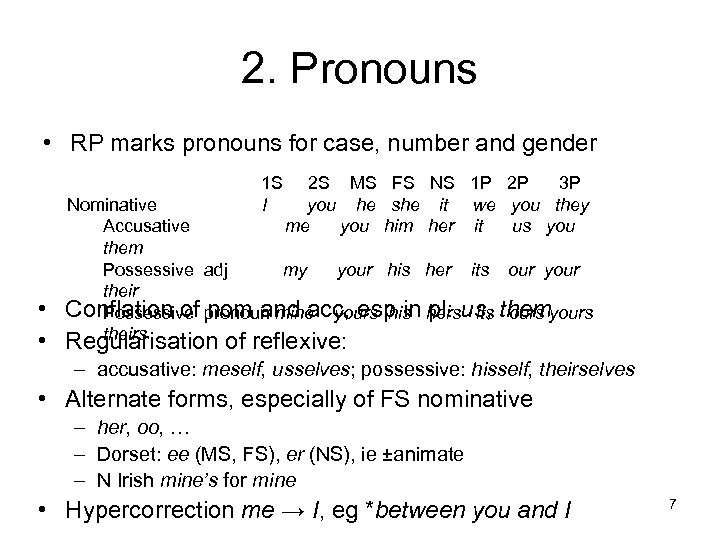 2. Pronouns • RP marks pronouns for case, number and gender 1 S I • • 2 S MS FS NS 1 P 2 P 3 P you he she it we you they me you him her it us you Nominative Accusative them Possessive adj my your his her its our your their Conflation of pronoun mine yours his hersus, themyours Possessive nom and acc, esp in pl: its ours theirs Regularisation of reflexive: – accusative: meself, usselves; possessive: hisself, theirselves • Alternate forms, especially of FS nominative – her, oo, … – Dorset: ee (MS, FS), er (NS), ie ±animate – N Irish mine’s for mine • Hypercorrection me → I, eg *between you and I 7
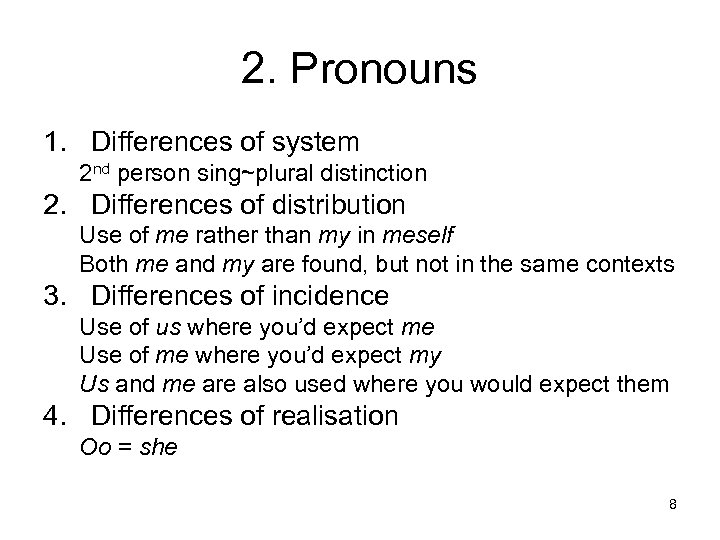 2. Pronouns 1. Differences of system 2 nd person sing~plural distinction 2. Differences of distribution Use of me rather than my in meself Both me and my are found, but not in the same contexts 3. Differences of incidence Use of us where you’d expect me Use of me where you’d expect my Us and me are also used where you would expect them 4. Differences of realisation Oo = she 8
 3. Past tense of strong verbs • Weak verbs have a single past-tense form used for both simple past and perfect (+ed) – I worked, I have worked • Strong verbs (mostly) have a different form for these two (vowel ablaut, sometimes +en) – swim/swam/swum, see/saw/seen, write/wrote/written – come/came/come, get/got, have/had, put/put • Mixed verbs (+t/d) in this case are like weak verbs – buy/bought, lose/lost, leave/left, find/found, feed/fed 9
 3. Past tense of strong verbs • In many dialects there is a strong tendency to bring the strong verbs into line with the weak by – collapsing the distinction between simple past and past participle – merging one with the other, in either direction • I seen him, I done it (using PP for simpe past) • I have wrote, I have went, I have saw (vice versa) – or using the present form, on the model of come, run • I see him yesterday, I give him what for – or using an anomalous variant form • writ, thunk – or using a form of “analogical levelling” • drawed – historical cases of this have found their way into RP • dived (was dove), got (was gotten), behoved (was behoove) 10
 4. Negation • Multiple negation is widely found in nonstandard dialects: – I didn’t have no dinner • “Double negative” is an inaccurate term; linguists prefer “negative concord” – She never told no one nothing. • Negative concord was part of standard dialect, but RP has diverged (not v. v. ) – cf other languages, eg French ne … pas 11
 4. Negation Other aspects of negation vary across dialects: • ain’t as negative form of all forms of both be and have – I ain’t coming, I ain’t seen him, they ain’t eaten • other idiosyncratic negative forms – divn’t, amn’t, bain’t • never as simple negative instead of not or didn’t – He said I skipped school but I never – Even though he was unmarked, he never hit the target – I put the key in the lock but it never turned • but restricted with non-past-tense verbs: – That’s never my brother – * I never smoke (≠ I don’t smoke) 12
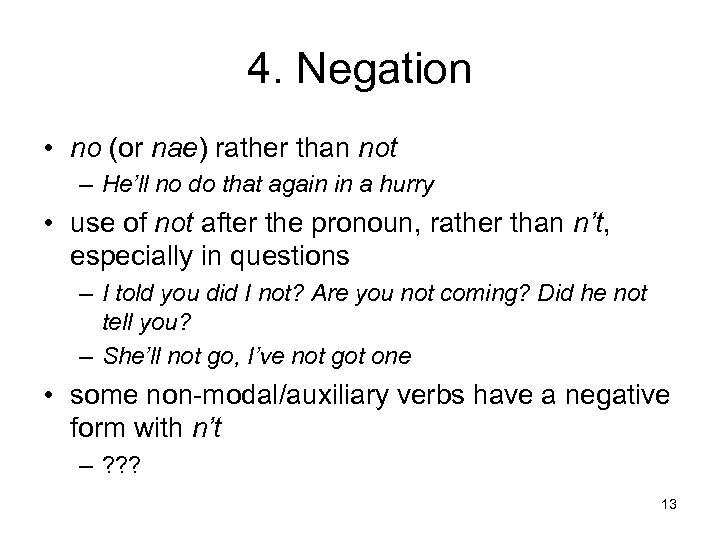 4. Negation • no (or nae) rather than not – He’ll no do that again in a hurry • use of not after the pronoun, rather than n’t, especially in questions – I told you did I not? Are you not coming? Did he not tell you? – She’ll not go, I’ve not got one • some non-modal/auxiliary verbs have a negative form with n’t – ? ? ? 13
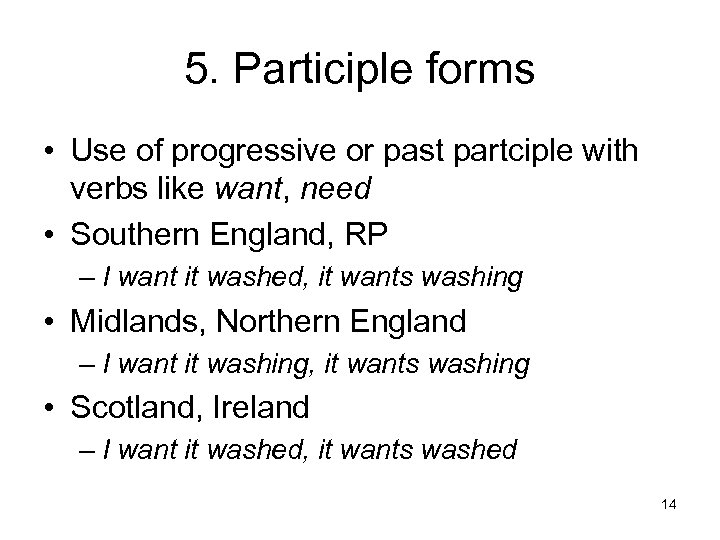 5. Participle forms • Use of progressive or past partciple with verbs like want, need • Southern England, RP – I want it washed, it wants washing • Midlands, Northern England – I want it washing, it wants washing • Scotland, Ireland – I want it washed, it wants washed 14
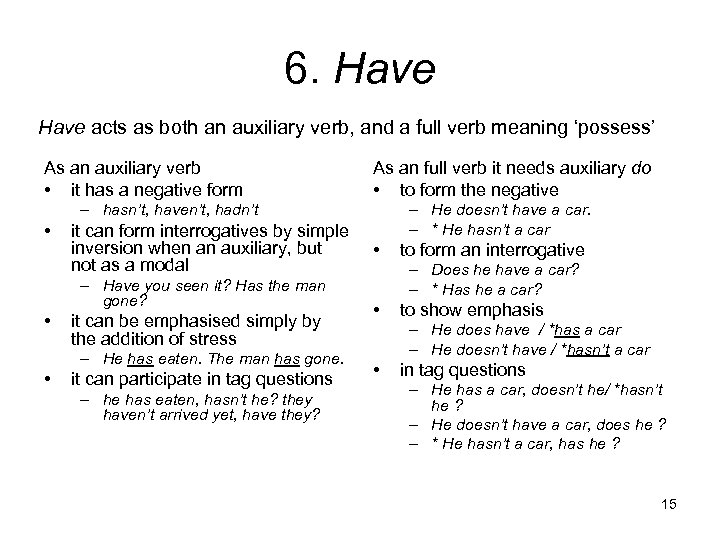 6. Have acts as both an auxiliary verb, and a full verb meaning ‘possess’ As an auxiliary verb • it has a negative form As an full verb it needs auxiliary do • to form the negative – hasn’t, haven’t, hadn’t • it can form interrogatives by simple inversion when an auxiliary, but not as a modal – Have you seen it? Has the man gone? • it can be emphasised simply by the addition of stress – He has eaten. The man has gone. • it can participate in tag questions – he has eaten, hasn’t he? they haven’t arrived yet, have they? – He doesn’t have a car. – * He hasn’t a car • to form an interrogative – Does he have a car? – * Has he a car? • to show emphasis – He does have / *has a car – He doesn’t have / *hasn’t a car • in tag questions – He has a car, doesn’t he/ *hasn’t he ? – He doesn’t have a car, does he ? – * He hasn’t a car, has he ? 15
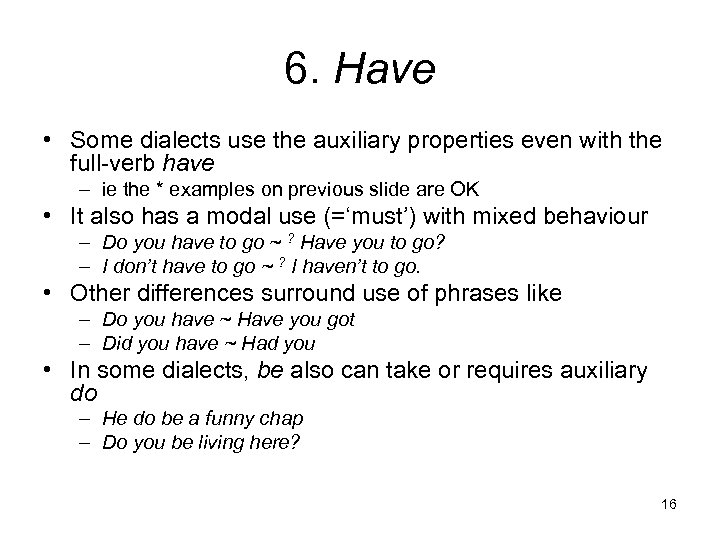 6. Have • Some dialects use the auxiliary properties even with the full-verb have – ie the * examples on previous slide are OK • It also has a modal use (=‘must’) with mixed behaviour – Do you have to go ~ ? Have you to go? – I don’t have to go ~ ? I haven’t to go. • Other differences surround use of phrases like – Do you have ~ Have you got – Did you have ~ Had you • In some dialects, be also can take or requires auxiliary do – He do be a funny chap – Do you be living here? 16
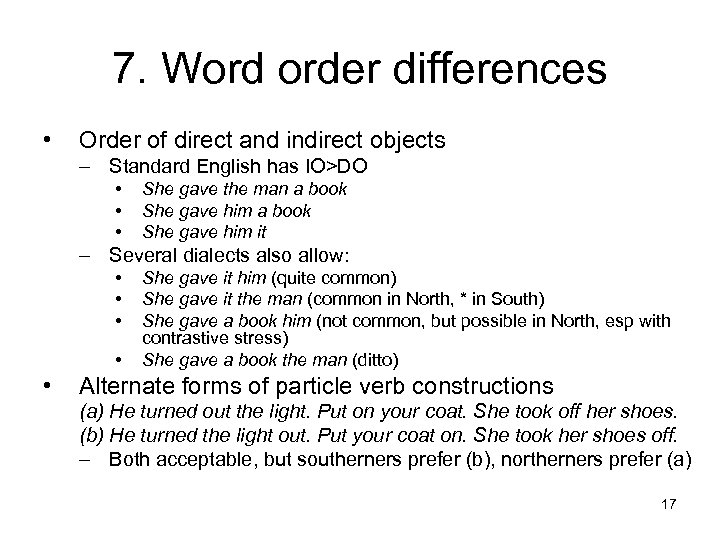 7. Word order differences • Order of direct and indirect objects – Standard English has IO>DO • • • She gave the man a book She gave him it – Several dialects also allow: • • • She gave it him (quite common) She gave it the man (common in North, * in South) She gave a book him (not common, but possible in North, esp with contrastive stress) She gave a book the man (ditto) Alternate forms of particle verb constructions (a) He turned out the light. Put on your coat. She took off her shoes. (b) He turned the light out. Put your coat on. She took her shoes off. – Both acceptable, but southerners prefer (b), northerners prefer (a) 17
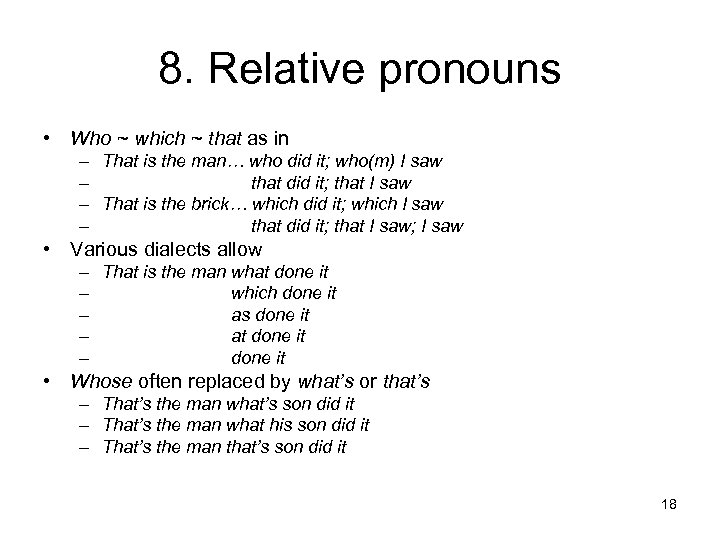 8. Relative pronouns • Who ~ which ~ that as in – That is the man… who did it; who(m) I saw – that did it; that I saw – That is the brick… which did it; which I saw – that did it; that I saw; I saw • Various dialects allow – That is the man what done it – which done it – as done it – at done it – done it • Whose often replaced by what’s or that’s – That’s the man what’s son did it – That’s the man what his son did it – That’s the man that’s son did it 18
 Conclusion • There are many other examples • Many nonstandard features are common to many dialects, though some other things are still very particular • Some could be analysed as lexical or even phonetic examples – no for not, ain’t for aren’t • “Grammar” covers everything from morphology to word order • Not quite so easy to categorise 19