 Скачать презентацию Diagram of disability and socio-economical burden Europe
MSCs for stroke treatment.pptx
- Количество слайдов: 15






§ Diagram of disability and socio-economical burden Europe, us, asia, Africa etc (comparison of countries worldwide map)

§ Thrombolytic therapy carries a small, but significant, risk of life-threatening hemorrhage. For this reason, it is important to carefully screen for exclusionary criteria prior to administering t-PA, including hemorrhage, large areas of infarction and patient presentation beyond the 3 -hour window for IV t-PA or possibly beyond 6 hours for IA TPA. § The chief benefit of thrombolysis is improved final functional outcome through reperfusion salvage of threatened tissue. The chief risk is intracerebral hemorrhage. § With intravenous thrombolysis, about 6% of patients have intracerebral hemorrhage associated with early worsening, [3, 11] and half of these patients have their final outcome altered as a result. [5] With intra-arterial thrombolysis, about 10% of patients have major early hemorrhage, but again many of these occur in already infarcted fields and do not clearly alter final outcome. Other less frequent complications of thrombolytics include systemic hemorrhage, angioedema, and allergic reactions. [7]
§ What they are, markers expressed(table) how derived, how cultured, how this affects them § MSCs exist in almost all tissues. They can be easily isolated from the bone marrow, adipose tissue, the umbilical cord, fetal liver, muscle, and lung and can be successfully expanded in vitro § Compared to ESCs and IPSCs mesenchymal stem cells (MSCs) are free of ethical concerns regarding their isolation and teratoma formation § mesenchymal stromal cells, are a subset of non-hematopoietic adult stem cells that originate from the mesoderm. § They possess self-renewal ability and multilineage differentiation into not only mesoderm lineages, such as chondrocytes, osteocytes and adipocytes, but also ectodermic cells (melanocytes, Schwann cells, neurons) and endodermic cells
§ Look at ricky’s pwp

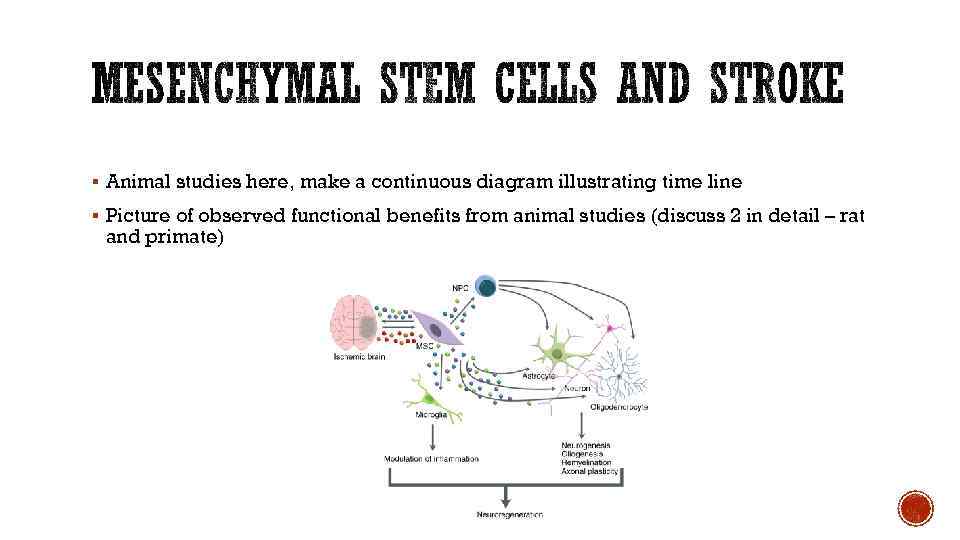
§ Animal studies here, make a continuous diagram illustrating time line § Picture of observed functional benefits from animal studies (discuss 2 in detail – rat and primate)

§ Important considerations to improve future MSC applications: § standardization of practices § full understanding of the potential uses in regenerative medicine is essential. § However, there are no standard isolation methods for MSCs and the harvested populations, which are themselves quite heterogeneous, vary depending on the donor (Phinney and Prockop, 2007). Despite the apparent need for standardization, MSCs are becoming increasingly important in the field of regenerative medicine, having great potential for tissue repair. Specifically, MSCs have properties that inhibit inflammation and immune responses, making them ideal for this field (Phinney and Prockop, 2007). As set protocols are put into place and the large family of MSCs continues to be better understood, MSCs hold the promise of being major players in the future world of regenerative medicine.



§ Wei X, Yang X, Han ZP, Qu FF, Shao L, Shi YF (2013) Mesenchymal stem cells: a new trend for cell therapy. Acta Pharmacol Sin 34: 747– 754
Скачать презентацию Diagram of disability and socio-economical burden Europe
MSCs for stroke treatment.pptx