


 Скачать презентацию Diagnostics of teaching DIAGNOSTICS OF TEACHING
25.11.2017 Diagnostic Teaching Lecture-9.ppt
- Количество слайдов: 22
 Diagnostics of teaching
 DIAGNOSTICS OF TEACHING • When teachers become skilled at managing the classroom and in providing motivating activities for students, we believe that they should then aspire to reach the next level: diagnostic teaching. Diagnostic teaching reflects the dual purposes for which the procedure is used: Diagnostic – allows the collection of additional information in order clarify and test hypothesis about what the reader needs. Instruction – provides opportunities to try out methods for working with a student.
 Diagnostic teaching is an imperative if we wish to attain lasting improvement of instruction. This process consists of four phases: determining individual needs, selecting goals, prescribing and guiding learning experiences, evaluation. Diagnostic teaching is a method that integrates assessment and instruction. The process of diagnostic teaching can be described in terms of three related tasks: a) planning b) executing c) evaluating
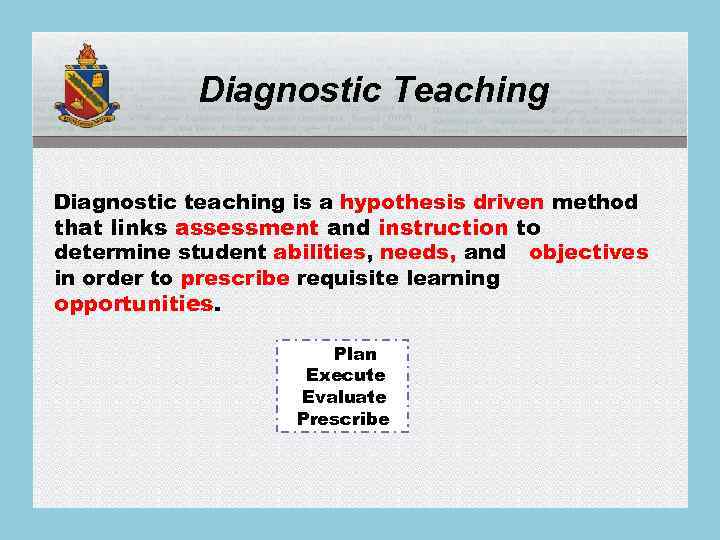 Diagnostic Teaching Diagnostic teaching is a hypothesis driven method that links assessment and instruction to determine student abilities, needs, and objectives in order to prescribe requisite learning opportunities. Plan Execute Evaluate Prescribe
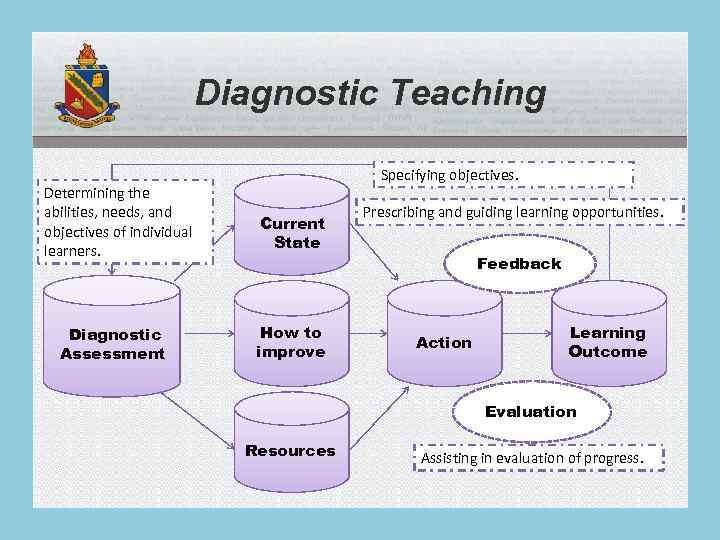 Diagnostic Teaching Determining the abilities, needs, and objectives of individual learners. Diagnostic Assessment Specifying objectives. Current State How to improve Prescribing and guiding learning opportunities. Feedback Action Learning Outcome Evaluation Resources Assisting in evaluation of progress.
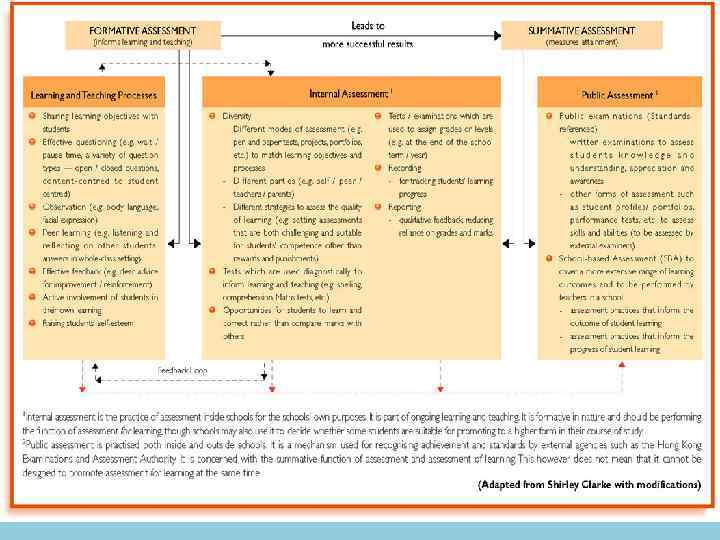
 Pedagogical measurements Assessment is an integral part of the curriculum, pedagogy and assessment cycle. It involves collecting evidence about student learning, interpreting information and making judgments about students’ performance with a view to providing feedback to students, teachers, schools, parents, other stakeholders and to the education system
 • The roles of assessment for different stakeholders can be summarized as follows: For students to • understand the learning objectives from a different perspective and how well they are progressing towards their objectives; • understand what they need to improve on the next stage of learning; and understand their strengths and weaknesses in learning and how to take steps to improve and to self-regulate their work. For teachers and schools to • understand the strengths and weaknesses of students in learning; • recognize the effectiveness of learning and teaching practices and make adjustment to their teaching; • monitor the standards and quality of the education they are providing and guide students towards appropriate future learning.
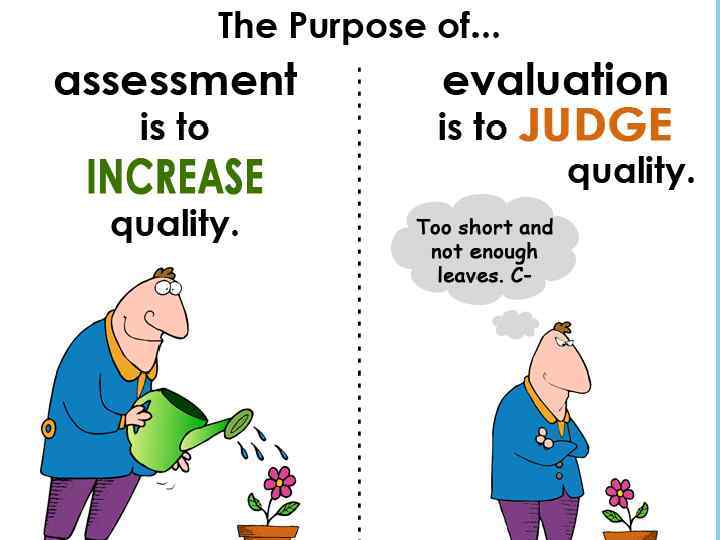
 • Why assessment? – helping students meet certain standards – using the assessment data to identify strengths and weaknesses in student performance, and to improve the quality of teaching and learning. - Assessment is the process of gathering data • 3 types of assessments: diagnostic, formative, and summative
 Formative assessment provides feedback and information during the instructional process, while learning is taking place, and while learning is occurring. Formative assessment is the act of collecting evidence of student learning (e. g. classroom observation, class activities, homework, quizzes) and providing feedback to promote better learning. Types of Formative Assessment Observations during in-class activities; of students non-verbal feedback during lecture Homework exercises as review for exams and class discussions) Reflections journals that are reviewed periodically during the semester Question and answer sessions, both formal—planned and informal—spontaneous Conferences between the instructor and student at various points in the semester In-class activities where students informally present their results Student feedback collected by periodically answering specific question about the instruction and their self-evaluation of performance and progress
 Summative assessment takes place after the learning has been completed and provides information and feedback that sums up the teaching and learning process. Summative assessment is usually carried out at the end of a teaching unit/ school term/ school year in order to sum up what students have learnt (e. g. end-of-unit test/ task). Types of Summative Assessment Examinations (major, high-stakes exams) Final examination (a truly summative assessment) Term papers (drafts submitted throughout the semester would be a formative assessment) Projects (project phases submitted at various completion points could be formatively assessed) Portfolios (could also be assessed during it’s development as a formative assessment) Performances Student evaluation of the course (teaching effectiveness) Instructor self-evaluation
 Diagnostic assessment can help you identify your students’ current knowledge of a subject, their skill sets and capabilities, and to clarify misconceptions before teaching takes place. Knowing students’ strengths and weaknesses can help you better plan what to teach and how to teach it. Types of Diagnostic Assessments Pre-tests (on content and abilities) Self-assessments (identifying skills and competencies) Discussion board responses (on content-specific prompts) Interviews (brief, private, 10 -minute interview of each student) Like formative assessment, diagnostic assessment is intended to improve the learner’s experience and their level of achievement
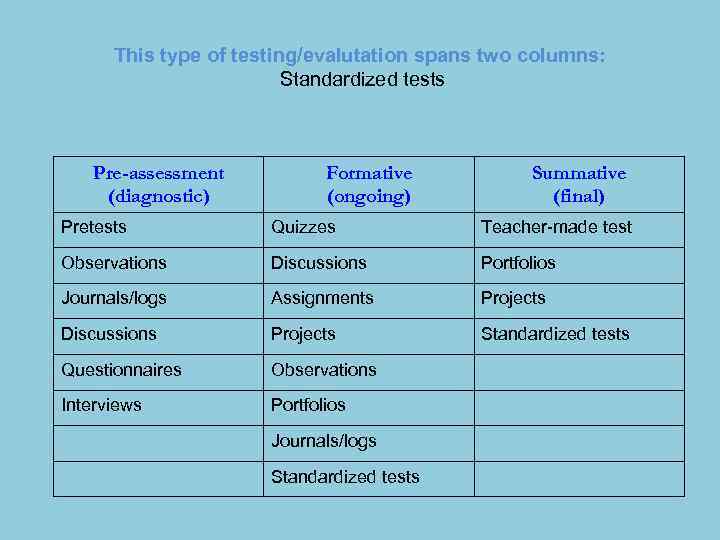 This type of testing/evalutation spans two columns: Standardized tests Pre-assessment (diagnostic) Formative (ongoing) Summative (final) Pretests Quizzes Teacher-made test Observations Discussions Portfolios Journals/logs Assignments Projects Discussions Projects Standardized tests Questionnaires Observations Interviews Portfolios Journals/logs Standardized tests
 Dynamic assessment measures what the student achieves when given some teaching in an unfamiliar topic or field. An example might be assessment of how much Swedish is learnt in a short block of teaching to students who have no prior knowledge of the language. One purpose of dynamic assessment is to determine if a student has the potential to learn a new skill. Assess child's current performance Dynamic assessment generally uses a repetitive process of pretest-teachretest. A pretest is given to discover what information the student already knows. A teaching time on the unknown material follows the pretest, and then another similar test is given.
 Synoptic assessment combines two or more modules of undergraduate study into a single assessment. The word ‘synoptic’ means ‘viewing together’. Such an assessment may help students to make connections between modules, increase the level of student engagement and provide teaching staff with the opportunity to adopt a holistic approach to delivering modules. The general aim of a synoptic assessment is the “undoing” of the increasing modularization of the curriculum. The importance of the process of learning as distinct from the outcome of learning is given more attention within this model. Synoptic assessment – is a form of assessment which requires a learner to demonstrate that they can identify an use skills, techniques, concepts, theories and knowledge across a whole vocational area
 Criterion referenced assessment Each student’s achievement is judged against specific criteria. In principle no account is taken of how other students have performed. In practice, normative thinking can affect judgements of whether or not a specific criterion has been met. Reliability and validity should be assured through processes such as moderation, trial marking, and the collation of exemplars. Evaluation that attempts to uncover the strengths and weakness of a student or trainee in terms of what he or she knows or doesn't know, understands or doesn't understand, or can do or cannot do, as measured against a benchmark or standard. To know specific skills which have achived. Also called content referenced assessment or criterion referenced test.
 • Ipsative assessment • This is assessment against the student’s own previous standards. It can measure how well a particular task has been undertaken against the student’s average attainment, against their best work, or against their most recent piece of work. • An individual’s performance is judged in comparison to her/his other performances, either in the same domain at different times or in different domains. Is a student’s own self-referenced assessment • An ipsative assessment compares current performance with a previous performance
 Quality feedback. Providing quality feedback has a positive impact on student achievement. This feedback can be in the form of oral advice or written comments, and may be incorporated in reports or portfolios. Feedback does not mean “praise” or “blame” and it is not the same as “guidance”. It should provide information on students’ performance with regard to the expected learning outcomes and enable students to take action to close any gap between their performance and the outcomes.
 • Seminar Tasks 1) Diagnostic Teaching 2) Assessment is the process of gathering data 3) Differences between testing, evaluation and assessment 4) Pedagogical measurements in Kazakhstan 5) Some issues on assessment techniques
 Project works 1. Diagnostic Teaching: assessment and instruction 2. General assessment tools 3. Specific techniques for diagnostic teaching 4. Classroom Questioning 5. Methods of examination of cognitive development, diagnostic training, qualitative and quantitative evaluation 6. Advances in teacher assessments and their use. 7. Improving longitudinal data on student achievement 8. The effect of school resources on student achievement
 • References 1. Gronlund, N. E. (2008). Assessment of Student Achievement. Boston: Allyn & Bacon. 2. Assessment Reform Group. (1999). Assessment for Learning: Beyond the Black Box. Cambridge: University of Cambridge School of Education. 3. Clarke, S. (2001). Recommendations for the development of formative assessment in Hong Kong: Education Department. 4. Ebel, R. L. (1979). Essentials of Educational Measurement. New Jersey: Prentice Hall.