 Скачать презентацию Diagnosing Low Back Pain Eden Wheeler M D
5877602a4eb859b83db255cd0aaacd79.ppt
- Количество слайдов: 53



Diagnosing Low Back Pain Eden Wheeler, M. D. Physical Medicine and Rehabilitation Rockhill Orthopaedics, P. C. 1

I. History: 2
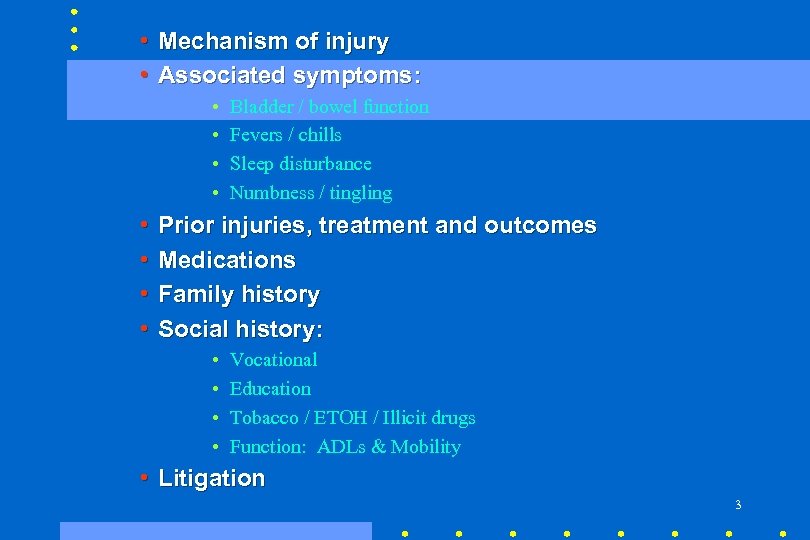
• Mechanism of injury • Associated symptoms: • • Bladder / bowel function Fevers / chills Sleep disturbance Numbness / tingling Prior injuries, treatment and outcomes Medications Family history Social history: • • Vocational Education Tobacco / ETOH / Illicit drugs Function: ADLs & Mobility • Litigation 3
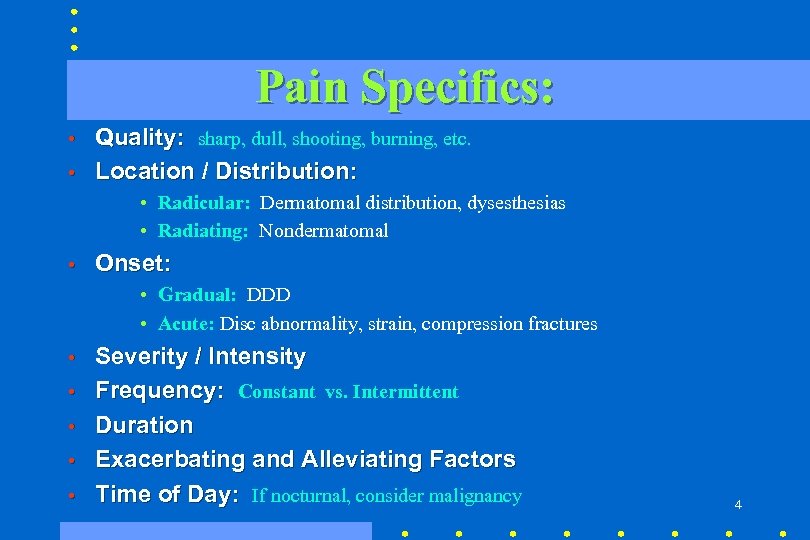
Pain Specifics: • • Quality: sharp, dull, shooting, burning, etc. Location / Distribution: • Radicular: Dermatomal distribution, dysesthesias • Radiating: Nondermatomal • Onset: • Gradual: DDD • Acute: Disc abnormality, strain, compression fractures • • • Severity / Intensity Frequency: Constant vs. Intermittent Duration Exacerbating and Alleviating Factors Time of Day: If nocturnal, consider malignancy 4
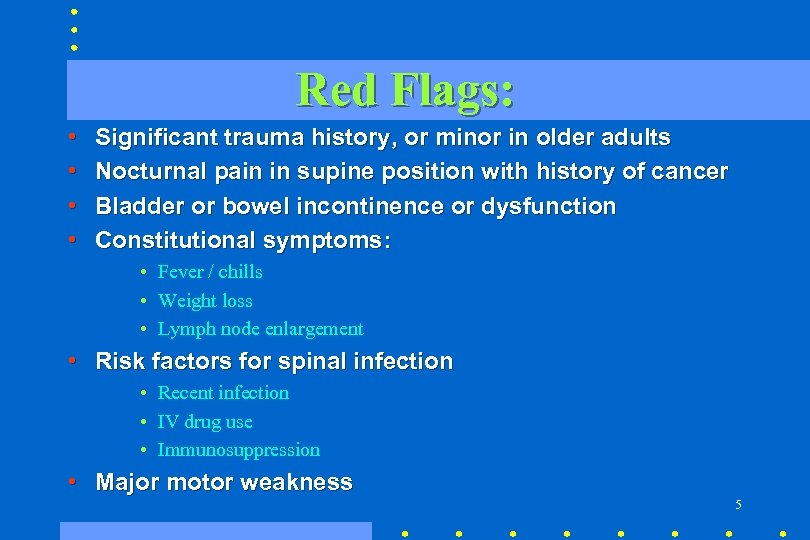
Red Flags: • • Significant trauma history, or minor in older adults Nocturnal pain in supine position with history of cancer Bladder or bowel incontinence or dysfunction Constitutional symptoms: • Fever / chills • Weight loss • Lymph node enlargement • Risk factors for spinal infection • Recent infection • IV drug use • Immunosuppression • Major motor weakness 5

II. Examination: 6
A. Physical: • Posture: • Splinting • Body language • Gait: • Antalgia • Heel / Toe pattern • Trendelenberg • Musculoskeletal: • • ROM Leg length Vascular Atrophy 7
• Abdomen: • Presence of masses • Back: • • Inspection Palpation ROM Scoliosis • Neurological: • Sensation • Motor • DTRs • Rectal if indicated: • Evaluation of sphincter tone 8
B. Symptom Magnification Examination: • Waddell signs: Presence of nonorganic signs suggesting symptom magnification and psychological distress – – – Superficial or nonanatomic distribution of tenderness Nonanatomic or regional disturbance of motor or sensory impairment Inconsistency on positional SLR Inappropriate/excessive verbalization of pain or gesturing Pain with axial loading or rotation of spine • Give-away weakness: Inconsistent effort on manual motor testing with “ratcheting” rather than smooth resistance 9
C. Pathological Examination: • Spurling’s maneuver: Lateral rotation and extension of spine resulting in neuroforaminal narrowing and nerve root encroachment, clinically reproducing extremity pain, usually in dermatomal distribution • Straight-leg raise (SLR): Elevation of lower extremity, seated or standing, resulting in neural tension at S 1 nerve root with extremity pain • Patrick’s maneuver: Crossed leg with unilateral pain indicative of sacro-iliac (SI) joint dysfunction • Femoral stretch: Hip extension stretch with heel pushed to buttock in lateral supine or prone position resulting in anterior thigh pain 10
III. Low Back Pain: 11
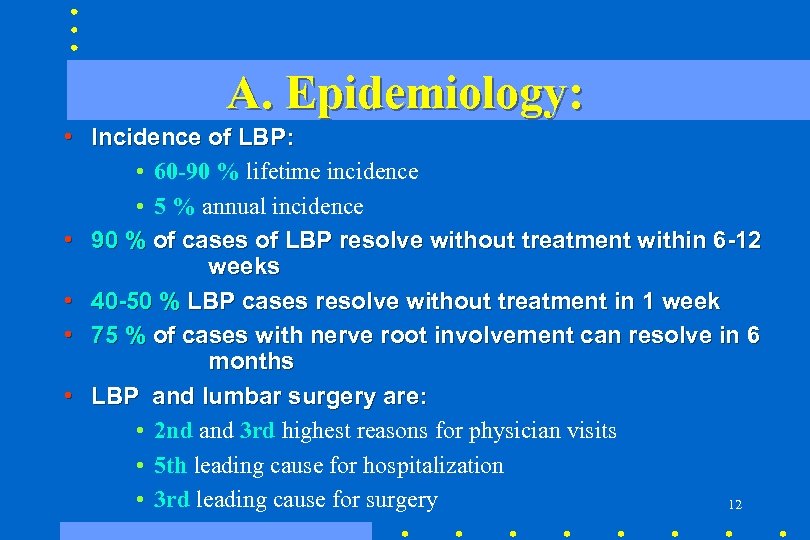
A. Epidemiology: • Incidence of LBP: • 60 -90 % lifetime incidence • 5 % annual incidence • 90 % of cases of LBP resolve without treatment within 6 -12 weeks • 40 -50 % LBP cases resolve without treatment in 1 week • 75 % of cases with nerve root involvement can resolve in 6 months • LBP and lumbar surgery are: • 2 nd and 3 rd highest reasons for physician visits • 5 th leading cause for hospitalization • 3 rd leading cause for surgery 12
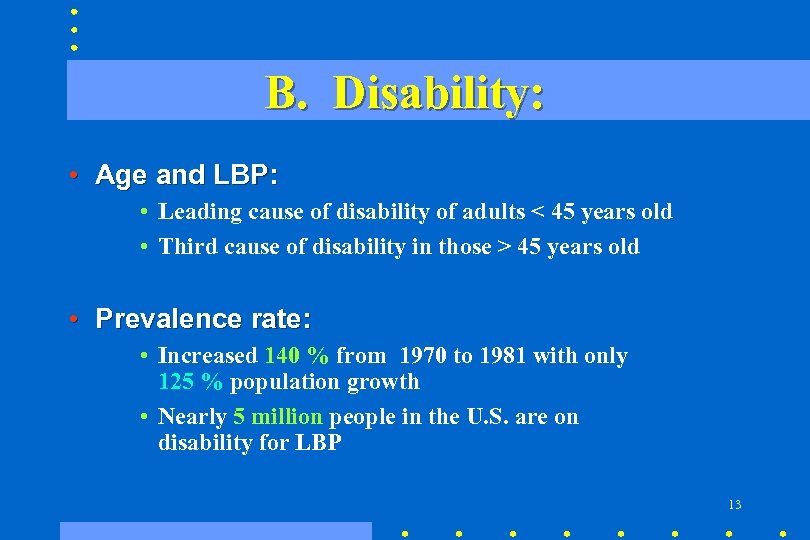
B. Disability: • Age and LBP: • Leading cause of disability of adults < 45 years old • Third cause of disability in those > 45 years old • Prevalence rate: • Increased 140 % from 1970 to 1981 with only 125 % population growth • Nearly 5 million people in the U. S. are on disability for LBP 13
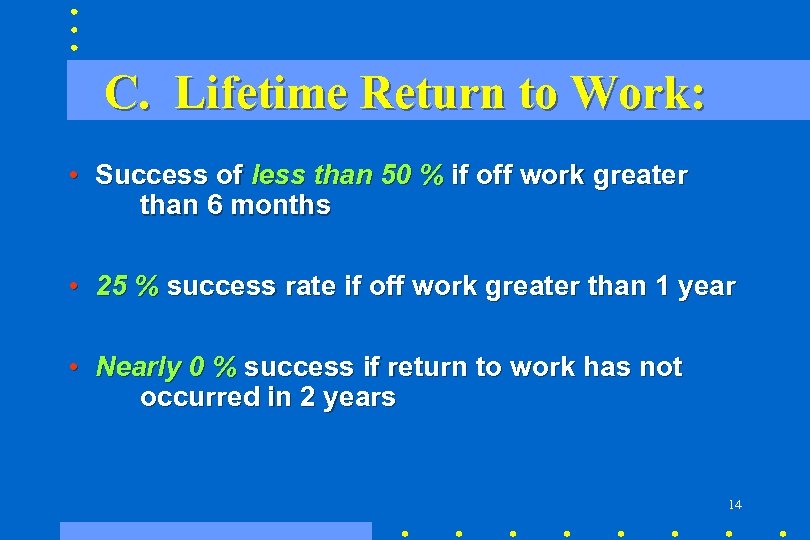
C. Lifetime Return to Work: • Success of less than 50 % if off work greater than 6 months • 25 % success rate if off work greater than 1 year • Nearly 0 % success if return to work has not occurred in 2 years 14
D. Occupational Risk Factors: • • • Low job satisfaction Monotonous or repetitious work Educational level Adverse employer-employee relations Recent employment Frequent lifting • Especially exceeding 25 pounds • Utilization of poor body mechanics in technique 15
E. Differential Diagnoses: • Lumbar strain • Disc bulge / protrusion / extrusion producing radiculopathy • Degenerative disc disease • Spinal stenosis • Spondyloarthropathy • Spondylosis • Spondylolisthesis • Sacro-iliac dysfunction 16
F. Diagnostic Tools: • 1. Laboratory: • Performed primarily to screen for other disease etiologies • Infection • Cancer • Spondyloarthropathies • No evidence to support value in first 7 weeks unless with red flags • Specifics: • WBC • ESR or CRP • HLA-B 27 • Tumor markers: Kidney Breast Lung Thyroid Prostate 17
• 2. Radiographs: • Pre-existing DJD is most common diagnosis • Usually 3 views adequate with obliques only if equivocal findings • Indications: • History of trauma with continued pain • Less than 20 years or greater than 55 years with severe or persistent pain • Noted spinal deformity on exam • Signs / symptoms suggestive of spondyloarthropathy • Suspicion for infection or tumor 18
• 3. EMG / NCV ( Electrodiagnostics): • Can demonstrate radiculopathy or peripheral nerve entrapment, but may not be positive in the extremities for the first 3 -6 weeks and paraspinals for the first 2 weeks • Would not be appropriate in clinically obvious radiculopathy • 4. Bone scan: • Very sensitive but nonspecific • Useful for: • Malignancy screening • Detection for early infection • Detection for early or occult fracture 19
• 5. Myelogram: • Procedure of injecting contrast material into the spinal canal with imaging via plain radiographs versus CT • In past, considered the gold standard for evaluation of the spinal canal and neurological compression • With potential complications, as well as advent of MRI and CT, is less utilized: • More common: Headache, nausea / vomiting • Less common: Seizure, pain, neurological change, anaphylaxis • Myelogram alone is rarely indicated • Hitselberger study 1968 Journal of Neurosurgery: • 24 % of asymptomatic subjects with defects 20
• 6. CT with myelogram: • Can demonstrate much better anatomical detail than myelogram alone • Utilized for: • Demonstrating anatomical detail in multi-level disease in preoperative state • Determining nerve root compression etiology of disc versus osteophyte • Surgical screening tool if equivocal MRI or CT 21
• 7. CT: • Best for bony changes of spinal or foraminal stenosis • Also best for bony detail to determine: • Fracture • DJD • Malignancy • SW Wiesel study 1984 Spine: • 36 % of asymptomatic subjects had “HNP” at L 4 -L 5 and L 5 -S 1 levels 22
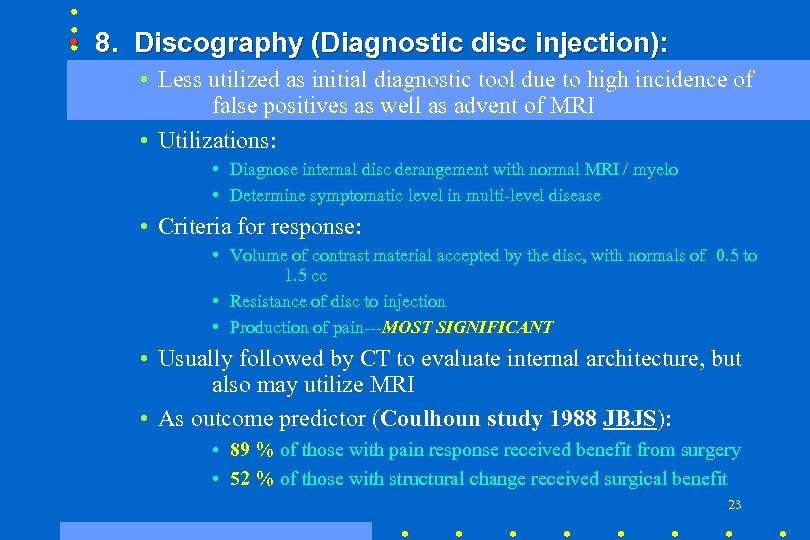
• 8. Discography (Diagnostic disc injection): • Less utilized as initial diagnostic tool due to high incidence of false positives as well as advent of MRI • Utilizations: • Diagnose internal disc derangement with normal MRI / myelo • Determine symptomatic level in multi-level disease • Criteria for response: • Volume of contrast material accepted by the disc, with normals of 0. 5 to 1. 5 cc • Resistance of disc to injection • Production of pain---MOST SIGNIFICANT • Usually followed by CT to evaluate internal architecture, but also may utilize MRI • As outcome predictor (Coulhoun study 1988 JBJS): • 89 % of those with pain response received benefit from surgery • 52 % of those with structural change received surgical benefit 23
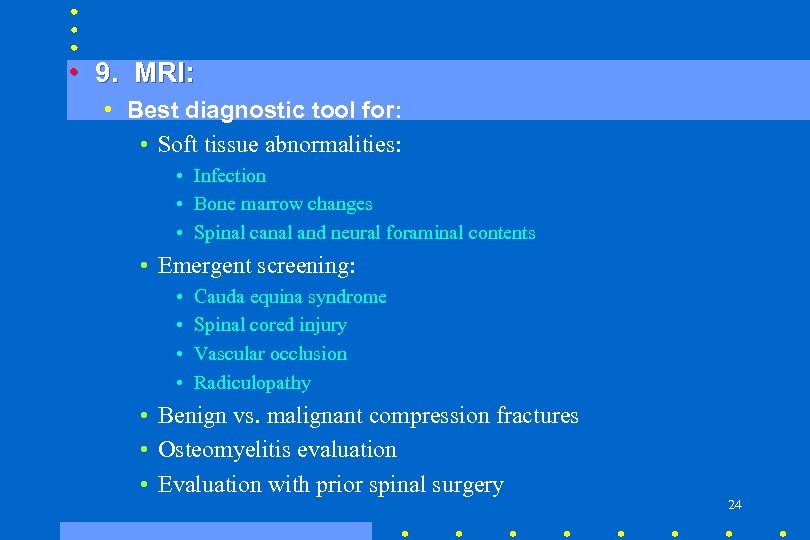
• 9. MRI: • Best diagnostic tool for: • Soft tissue abnormalities: • Infection • Bone marrow changes • Spinal canal and neural foraminal contents • Emergent screening: • • Cauda equina syndrome Spinal cored injury Vascular occlusion Radiculopathy • Benign vs. malignant compression fractures • Osteomyelitis evaluation • Evaluation with prior spinal surgery 24
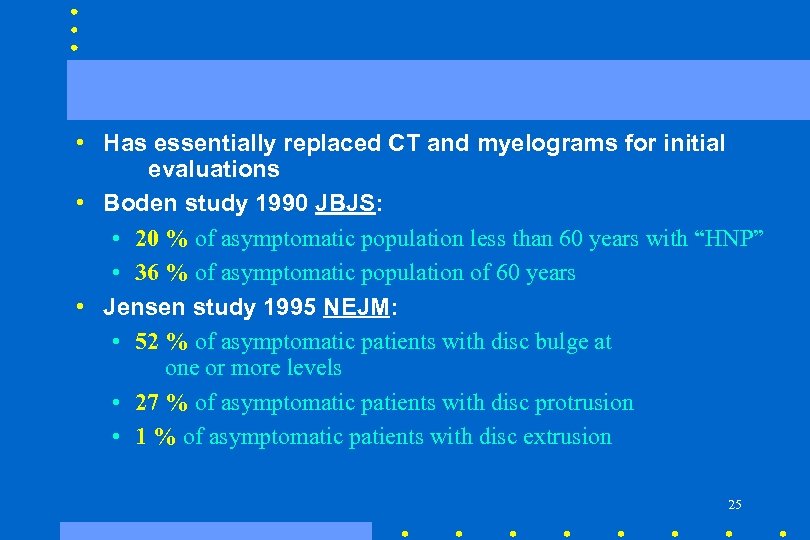
• Has essentially replaced CT and myelograms for initial evaluations • Boden study 1990 JBJS: • 20 % of asymptomatic population less than 60 years with “HNP” • 36 % of asymptomatic population of 60 years • Jensen study 1995 NEJM: • 52 % of asymptomatic patients with disc bulge at one or more levels • 27 % of asymptomatic patients with disc protrusion • 1 % of asymptomatic patients with disc extrusion 25
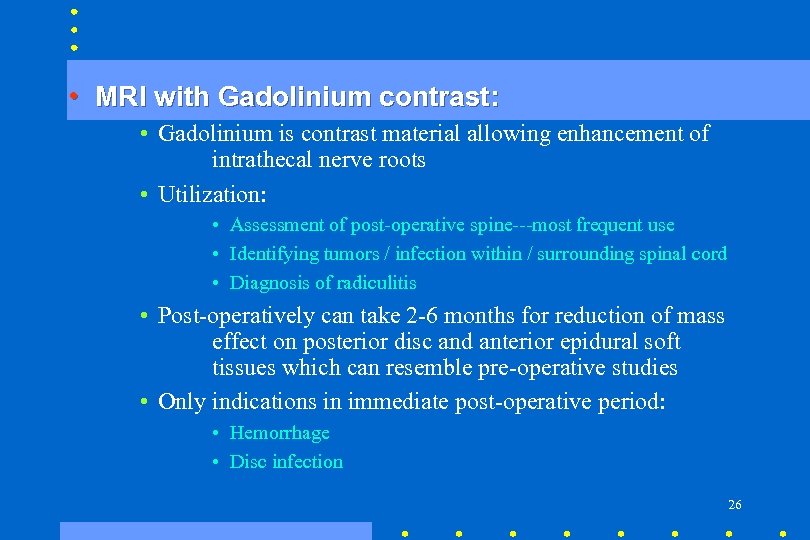
• MRI with Gadolinium contrast: • Gadolinium is contrast material allowing enhancement of intrathecal nerve roots • Utilization: • Assessment of post-operative spine---most frequent use • Identifying tumors / infection within / surrounding spinal cord • Diagnosis of radiculitis • Post-operatively can take 2 -6 months for reduction of mass effect on posterior disc and anterior epidural soft tissues which can resemble pre-operative studies • Only indications in immediate post-operative period: • Hemorrhage • Disc infection 26
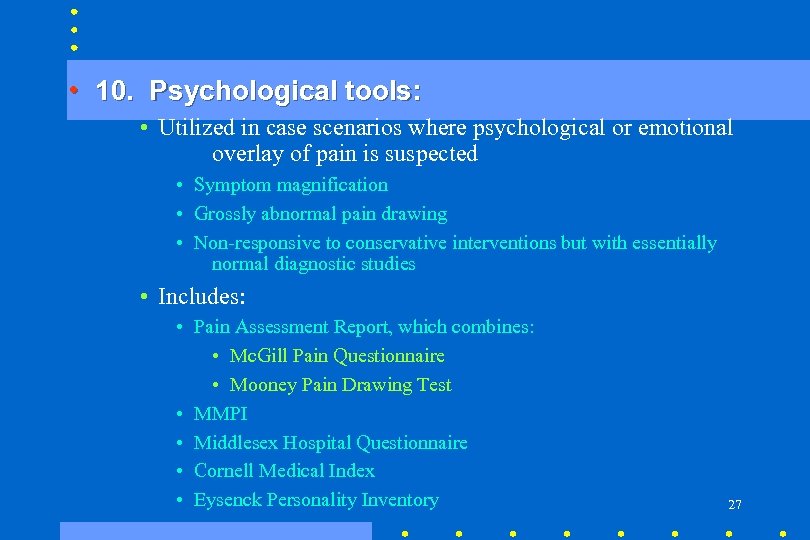
• 10. Psychological tools: • Utilized in case scenarios where psychological or emotional overlay of pain is suspected • Symptom magnification • Grossly abnormal pain drawing • Non-responsive to conservative interventions but with essentially normal diagnostic studies • Includes: • Pain Assessment Report, which combines: • Mc. Gill Pain Questionnaire • Mooney Pain Drawing Test • MMPI • Middlesex Hospital Questionnaire • Cornell Medical Index • Eysenck Personality Inventory 27
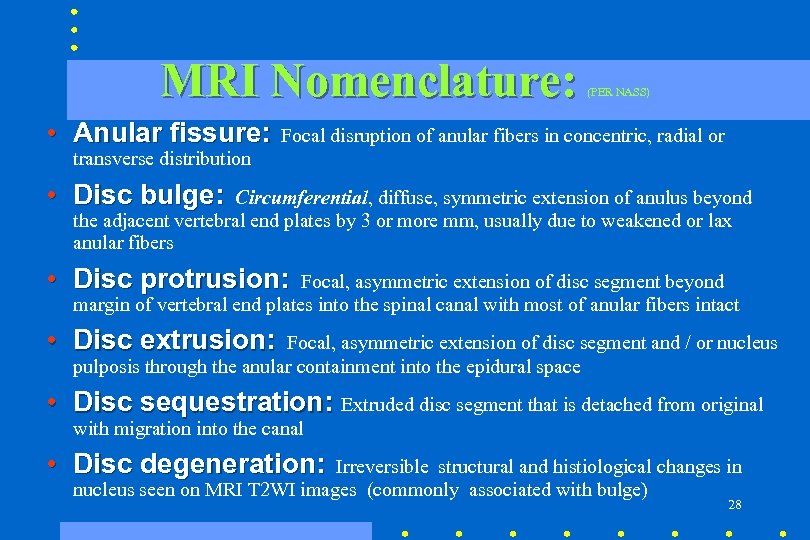
MRI Nomenclature: • Anular fissure: (PER NASS) Focal disruption of anular fibers in concentric, radial or transverse distribution • Disc bulge: Circumferential, diffuse, symmetric extension of anulus beyond the adjacent vertebral end plates by 3 or more mm, usually due to weakened or lax anular fibers • Disc protrusion: Focal, asymmetric extension of disc segment beyond margin of vertebral end plates into the spinal canal with most of anular fibers intact • Disc extrusion: Focal, asymmetric extension of disc segment and / or nucleus pulposis through the anular containment into the epidural space • Disc sequestration: Extruded disc segment that is detached from original with migration into the canal • Disc degeneration: Irreversible structural and histiological changes in nucleus seen on MRI T 2 WI images (commonly associated with bulge) 28
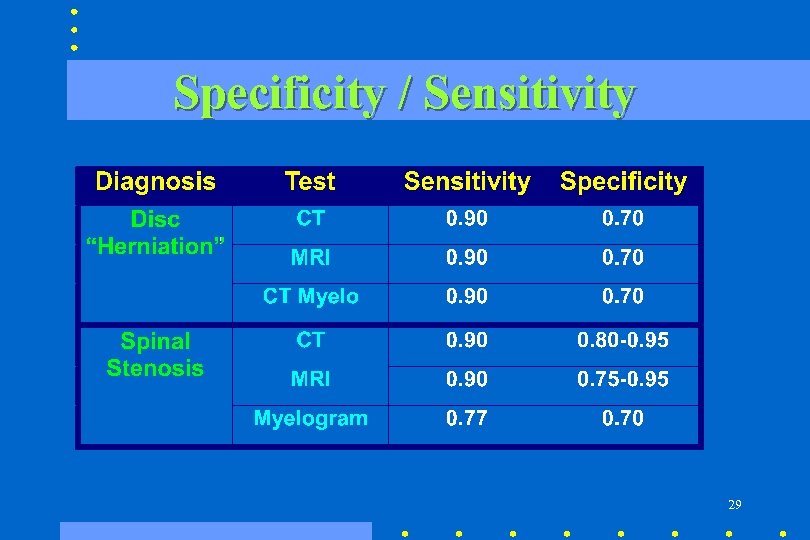
Specificity / Sensitivity 29
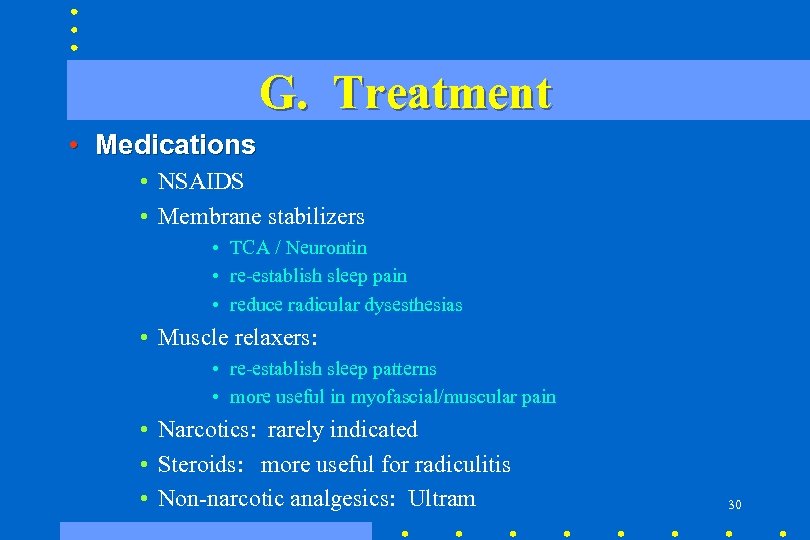
G. Treatment • Medications • NSAIDS • Membrane stabilizers • TCA / Neurontin • re-establish sleep pain • reduce radicular dysesthesias • Muscle relaxers: • re-establish sleep patterns • more useful in myofascial/muscular pain • Narcotics: rarely indicated • Steroids: more useful for radiculitis • Non-narcotic analgesics: Ultram 30
• Physical therapy • • Modalities electrical stimulation/TENS Postural education / body mechanics Massage / mobilization / myofascial release Stretching / body work Exercise / strengthening Traction Pre-conditioning / work-conditioning • Injections • • • Epidural blocks Facet blocks Trigger point SNRB SI joint 31
• Surgery: • • Laminectomy Fusion Discectomy Percutaneous Lumbar Discectomy – Success rate variable 50 -85 % – Low rate of complications: • Infection • Peripheral nerve injury – Benefits: • • • Outpatient procedure Minimal to no epidural scarring No general anesthesia Spine stability preservation Decreased cost 32
• Chemonucleolysis • IDET: Intradiscal Electrotherapy or Spine CATH • Alternative: • Chiropractic: • Clinical studies show benefit only in first 3 weeks of symptoms • Acupuncture • Biofeedback 33

IV. Specific Disorder Considerations 34
A. Sacroiliitis: • History: • • Trauma is very common Repetitive LS motion--lumbar rotation or axial loading No specific correlation with exacerbating activities Commonly have leg length discrepancy or condition contributing • Biomechanics: • Movement of the SIJ is involuntary, usually from muscle imbalances • Can occur at multiple levels: lower extremities, hip, LS spine • Motion is complex and not single-axis based 35
• Differential Diagnosis: a. Fracture • Traumatic • Insufficiency stress fractures: elderly patient with osteoporosis without history of trauma • Fatigue stress fractures: usually athletes / soldiers b. Infection • Hematogenous spread with predisposing history • Usually unilateral symptoms present c. d. e. Degenerative joint disease Metabolic disease Referred pain 36
f. Seronegative spondyloarthropathies • RA--usually not until late in course of disease • Ankylosing spondylitis • Psoriatic arthritis g. Primary SI tumor • Rare and usually synovial villoadenomas h. Iatrogenic instability • Via pelvic tumor resection or bone graft site i. Osteitis condensans ilii • Prevalence of 2. 2 %, primarily in multiparous women • Usually self-limiting and bilateral j. Reactive disease as sequellae of PID 37
• Diagnostic Tools: • X-rays: Up to 25 % of asymptomatic adults over 50 years can have abnormalities • MRI / CT: Only if looking for tumor • Bone scan: Good for fractures but less favorable for inflammation • Treatment: • Medications: NSAIDS • Physical therapy • Correct limb discrepancy • Injection: Fluoroscopy-guided vs. local • Surgical fusion: Few figures for efficacy 38
B. Cauda Equina Syndrome: • History: • Sudden, partial or complete loss of voluntary bladder function due to massive disc impingement on spinal nerves • Can include loss of sensation as well as sphincter tone • Treatment: • Urgent decompression is mandatory for prevention of irreparable / irreversible bladder damage • 12 hours is the maximum time prior to irreversible changes 39
C. DDD and Spondylosis: • Clinical: • Up to 75 % of involvement of the spine occurs at 2 levels: L 5 -S 1 and L 4 -L 5 • Possible factors that contribute to development: – Changes with maturation in: • Nutrition • Disc chemistry • Hormones – Occupational forces • Progression of disc narrowing leads to degenerative changes of bony structures, especially posterior components, leading to spondylosis 40
• Treatment: • Medications • Physical therapy • Lifestyle changes: • Smoking cessation • Weight loss • Vocational changes • Injections: • Less helpful if pain is limited to central low back only • Surgery: • Laminectomy • Fusion 41
D. Spinal Stenosis: • Clinical: • Results from narrowing of spinal canal and / or neural foramina (CONGENITAL OR DEGENERATIVE) • Most common complaint is leg pain limiting walking • Neurogenic / Pseudoclaudication = pain in lower extremities with gait • Relief can occur with: – stopping activity – sitting, stooping or bending forward • Common are complaints of weakness and numbness of extremities • Usually becomes symptomatic in 6 th decade 42
• Diagnosis: • CT and MRI may yield false-positive results, therefore EMG / NCV can be helpful to confirm diagnosis • Myelography also can be confirmatory and pre-surgical screening tool • Treatment: • • • Medications Physical therapy TENS Epidural injections Surgical decompression laminectomy 43
E. “HNP”: • Clinical: • Low back pain wit associated leg symptoms • Positions can induce radicular symptoms • Posterolateral disc pathology most common: • Area where anular fibers least protected by PLL • Greatest shear forces occur with forward or lateral bend • Central disc pathology: • Usually with LBP only without radicular symptoms, unless a large defect is present 44
• Treatment: • Conservative treatment: – Saul and Saul study 1989 Spine: • > 90 % success rate of symptom resolution with non-operative management – Bozzao study 1992 Radiology: • 69 patients with “HNP” studied longitudinally with MRI • 63 % with >30 % reduction with 48 % > 70 % reduction over time • • Medications Physical therapy Injections Surgery 45
F. Pars Interarticularis Defects: • Spondylolysis: • • Anatomic defect in the bony pars interarticularis within the lamina May uni- or bilateral Can be congenital or induced Usually without clinical symptoms with incidental findings on radiographs 46
• Spondylolisthesis • Progression of spondylolysis with separation • Grades assigned I-IV for level of translation • Most common levels are L 5 -S 1 (70 %) and L 4 -L 5 (25 %) • May be asymptomatic, but can result in • Spondylosis • DDD • Radiculopathy • Treatment: • • Medication Physical Therapy Injections Surgery 47
V. Chronic Pain Issues 48
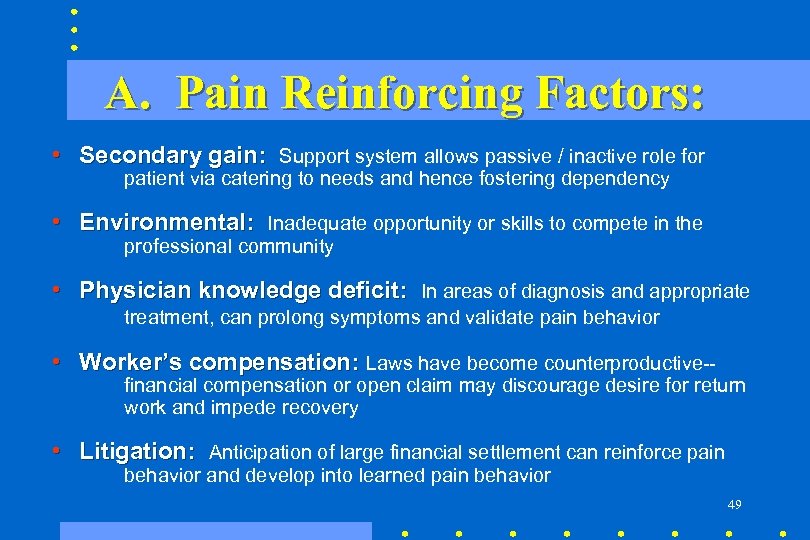
A. Pain Reinforcing Factors: • Secondary gain: Support system allows passive / inactive role for patient via catering to needs and hence fostering dependency • Environmental: Inadequate opportunity or skills to compete in the professional community • Physician knowledge deficit: In areas of diagnosis and appropriate treatment, can prolong symptoms and validate pain behavior • Worker’s compensation: Laws have become counterproductive-- financial compensation or open claim may discourage desire for return work and impede recovery • Litigation: Anticipation of large financial settlement can reinforce pain behavior and develop into learned pain behavior 49
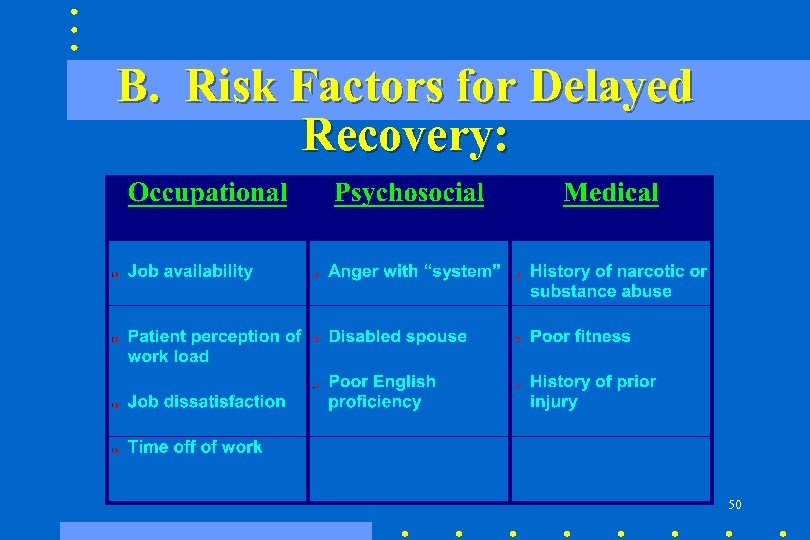
B. Risk Factors for Delayed Recovery: 50
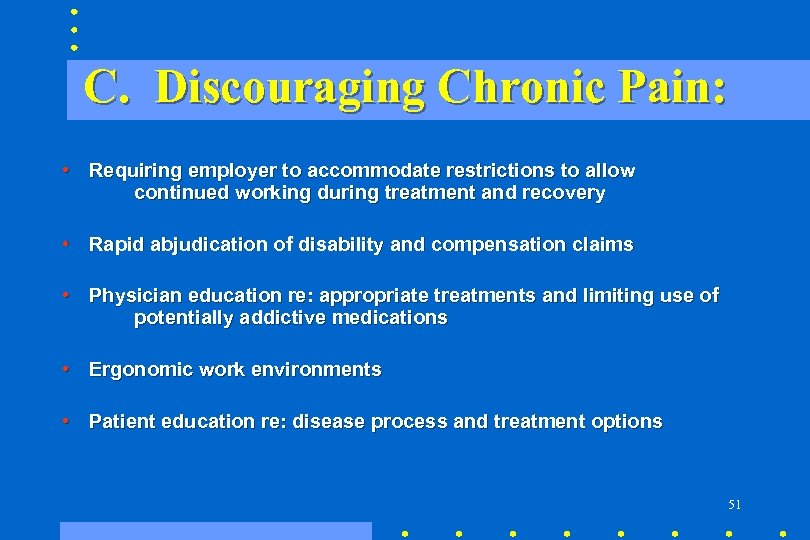
C. Discouraging Chronic Pain: • Requiring employer to accommodate restrictions to allow continued working during treatment and recovery • Rapid abjudication of disability and compensation claims • Physician education re: appropriate treatments and limiting use of potentially addictive medications • Ergonomic work environments • Patient education re: disease process and treatment options 51
D. Considerations of PM & R Treatment: • Physical therapy is initially usually one of modalities with progression into more active exercise • Pre-conditioning therapy is more functional with transition into Work Conditioning (Work Hardening) program • Always consider return to work, whether modified duty with restrictions or limiting hours worked • If patients poorly tolerate standard therapy, consider pool therapy intervention which allows elimination of gravity effects • Functional Capacity Evaluations utilized if patients are not progressing through therapy or if have reached a plateau and abilities as well as restrictions need to be assessed • Job site evaluations appropriate if concerns re: ergonomics 52
E. Final Thoughts: • It is the patient, not the diagnostic test, that is treated • 80 % of patients will recover from acute low back pain within 3 days to 3 weeks, with or without treatment, with up to 90 % resolved in 6 -12 weeks 53
Скачать презентацию Diagnosing Low Back Pain Eden Wheeler M D
5877602a4eb859b83db255cd0aaacd79.ppt