 Скачать презентацию Diabetes and Glucose Monitoring Kayla Walker What
5927f6f7a701dca787eda1e32ddcdb98.ppt
- Количество слайдов: 21



Diabetes and Glucose Monitoring Kayla Walker
What is Diabetes? a condition where the body is unable to regulate the amount of glucose in the blood due to lack of insulin or the body’s inability to produce insulin. a condition where there is too much glucose in the blood.
Types 1 Diabetes also known as “juvenile diabetes” or “insulin-dependent diabetes” usually develops in children or young adults an autoimmune disease where the immune system is destroying the cells of the pancreas the body does not produce enough insulin to control the amount of glucose in the blood. people with type 1 diabetes must take insulin daily
Type 2 Diabetes also known as “adult-onset diabetes” or “non-insulin dependent diabetes” usually an disease of adults however is becoming more common in obese children a genetic disorder a disorder where there is high blood glucose due to insulin resistance or deficiency the body is not producing enough insulin to control the glucose in the blood Based on diet, exercise and medicine type 2 diabetics may not need to take insulin daily
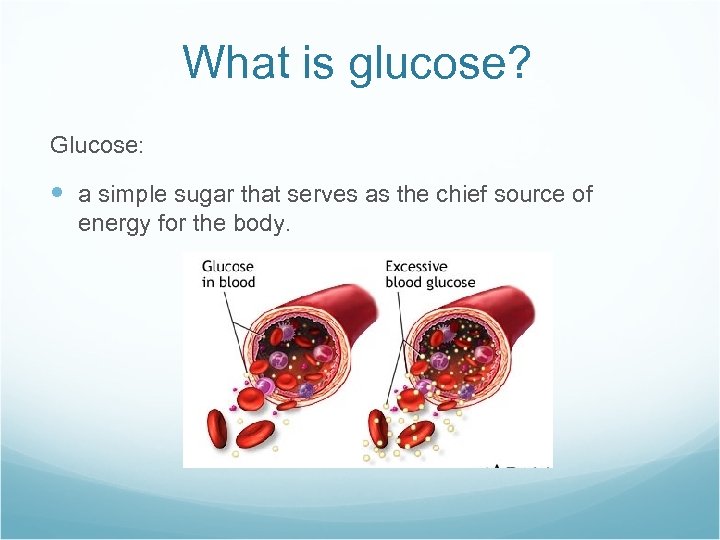
What is glucose? Glucose: a simple sugar that serves as the chief source of energy for the body.
Hypoglycemia vs. Hyperglycemia Hypoglycemia: Low blood sugar 60 mg/d. L or less Occurs mostly in Type 1 diabetes or in elderly Hyperglycemia: High blood sugar 240 mg/d. L or higher Can cause damage to eyes, kidneys, heart and nerves
Blood Glucose Monitoring What is it? Blood Glucose Monitoring is a way of checking the concentration of glucose in the blood using a glucometer. What is the purpose? Provides quick response to tell if the sugar is high or low indicating a change in diet, exercise or insulin. Over time, it reveals individual of blood glucose changes.
Why monitor blood glucose? Reduces risk of developing complications with diabetes. Allows diabetics to see if the insulin and other medications they are taking are working. Gives diabetics an idea as to how exercise and food affect their blood sugar. May prevent hypoglycemia or hyperglycemia
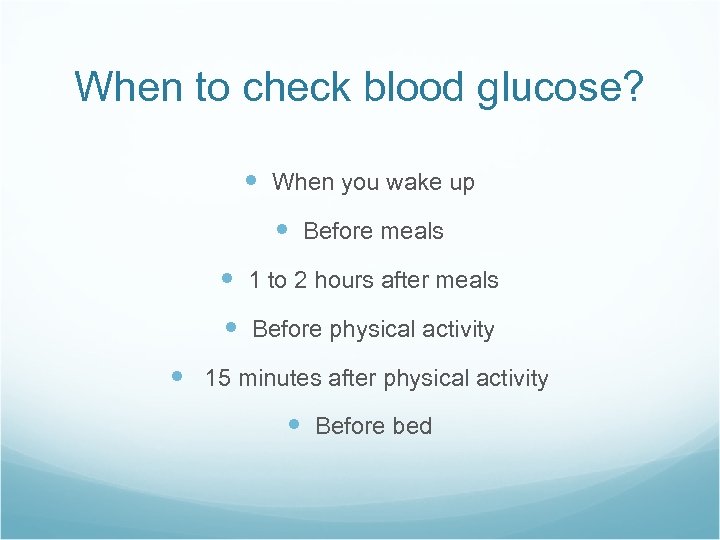
When to check blood glucose? When you wake up Before meals 1 to 2 hours after meals Before physical activity 15 minutes after physical activity Before bed
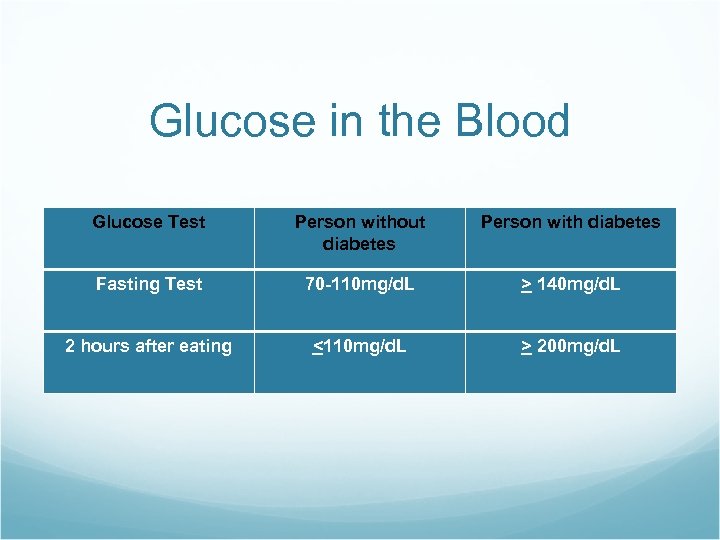
Glucose in the Blood Glucose Test Person without diabetes Person with diabetes Fasting Test 70 -110 mg/d. L > 140 mg/d. L 2 hours after eating <110 mg/d. L > 200 mg/d. L
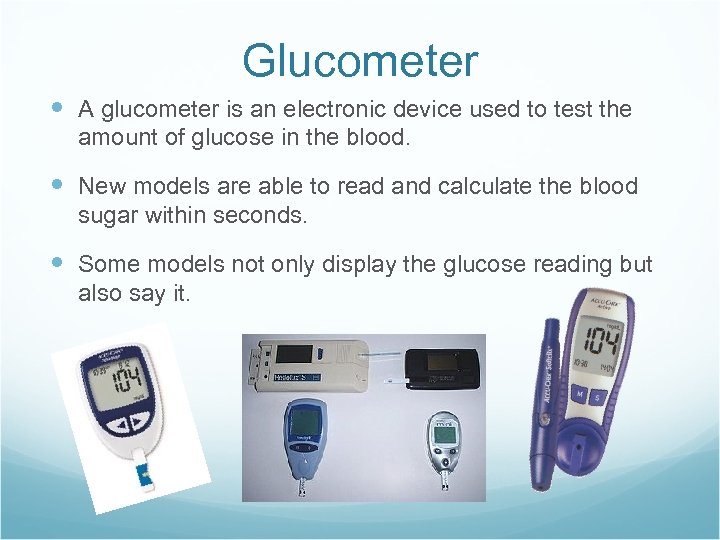
Glucometer A glucometer is an electronic device used to test the amount of glucose in the blood. New models are able to read and calculate the blood sugar within seconds. Some models not only display the glucose reading but also say it.
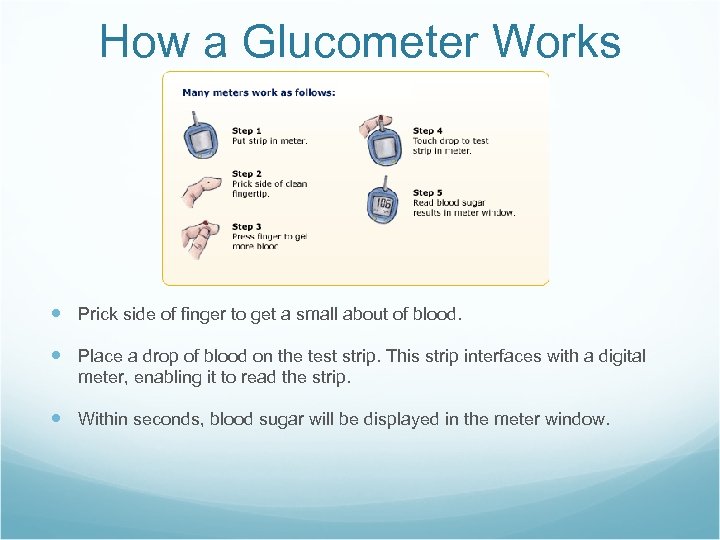
How a Glucometer Works Prick side of finger to get a small about of blood. Place a drop of blood on the test strip. This strip interfaces with a digital meter, enabling it to read the strip. Within seconds, blood sugar will be displayed in the meter window.
Advances in Blood Glucose Monitoring Alternate site-testing Continuous glucose monitors Non-Invasive Semi-Invasive Surgical Laser
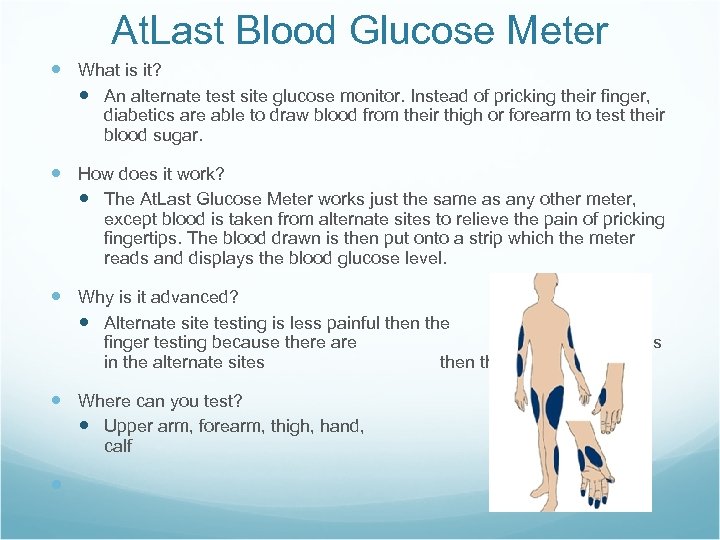
At. Last Blood Glucose Meter What is it? An alternate test site glucose monitor. Instead of pricking their finger, diabetics are able to draw blood from their thigh or forearm to test their blood sugar. How does it work? The At. Last Glucose Meter works just the same as any other meter, except blood is taken from alternate sites to relieve the pain of pricking fingertips. The blood drawn is then put onto a strip which the meter reads and displays the blood glucose level. Why is it advanced? Alternate site testing is less painful then the finger testing because there are in the alternate sites Where can you test? Upper arm, forearm, thigh, hand, calf traditional less nerve endings then the finger tips. palm &
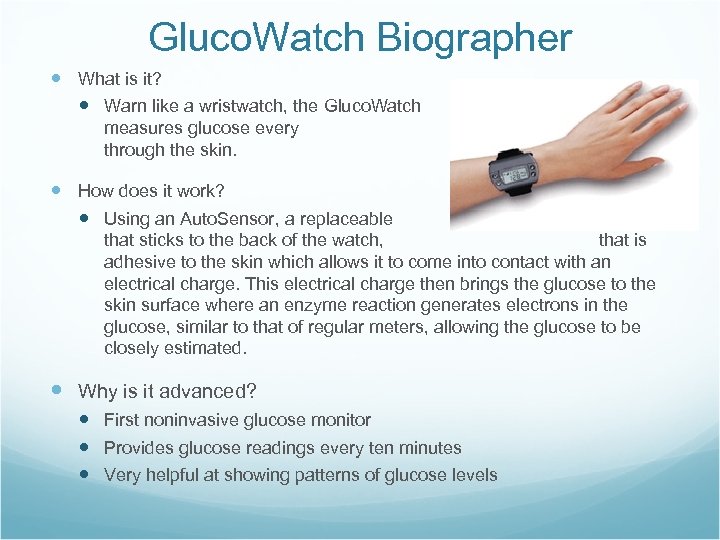
Gluco. Watch Biographer What is it? Warn like a wristwatch, the Gluco. Watch measures glucose every through the skin. How does it work? Using an Auto. Sensor, a replaceable Biographer ten minutes pa that sticks to the back of the watch, that is adhesive to the skin which allows it to come into contact with an electrical charge. This electrical charge then brings the glucose to the skin surface where an enzyme reaction generates electrons in the glucose, similar to that of regular meters, allowing the glucose to be closely estimated. Why is it advanced? First noninvasive glucose monitor Provides glucose readings every ten minutes Very helpful at showing patterns of glucose levels
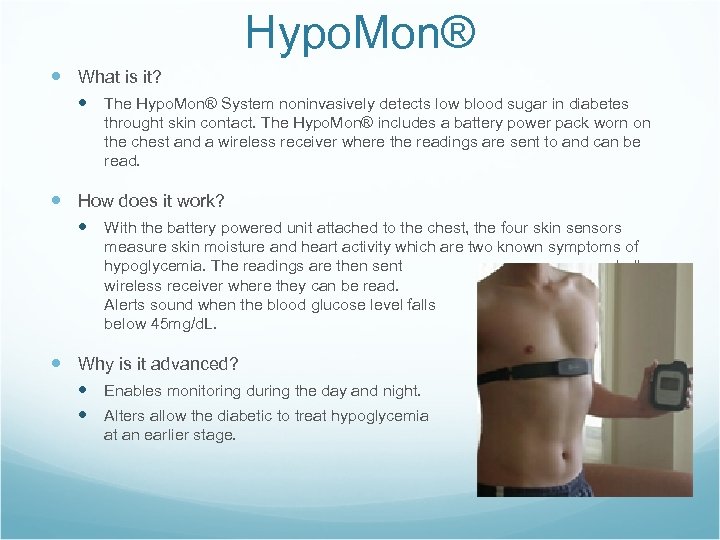
Hypo. Mon® What is it? The Hypo. Mon® System noninvasively detects low blood sugar in diabetes throught skin contact. The Hypo. Mon® includes a battery power pack worn on the chest and a wireless receiver where the readings are sent to and can be read. How does it work? With the battery powered unit attached to the chest, the four skin sensors measure skin moisture and heart activity which are two known symptoms of hypoglycemia. The readings are then sent to the wireless receiver where they can be read. Alerts sound when the blood glucose level falls below 45 mg/d. L. Why is it advanced? Enables monitoring during the day and night. Alters allow the diabetic to treat hypoglycemia at an earlier stage.
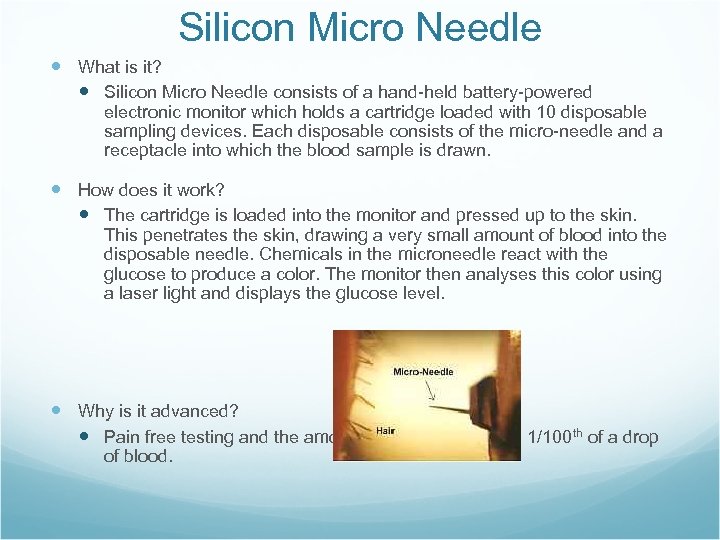
Silicon Micro Needle What is it? Silicon Micro Needle consists of a hand-held battery-powered electronic monitor which holds a cartridge loaded with 10 disposable sampling devices. Each disposable consists of the micro-needle and a receptacle into which the blood sample is drawn. How does it work? The cartridge is loaded into the monitor and pressed up to the skin. This penetrates the skin, drawing a very small amount of blood into the disposable needle. Chemicals in the microneedle react with the glucose to produce a color. The monitor then analyses this color using a laser light and displays the glucose level. Why is it advanced? Pain free testing and the amount of blood required is 1/100 th of a drop of blood.
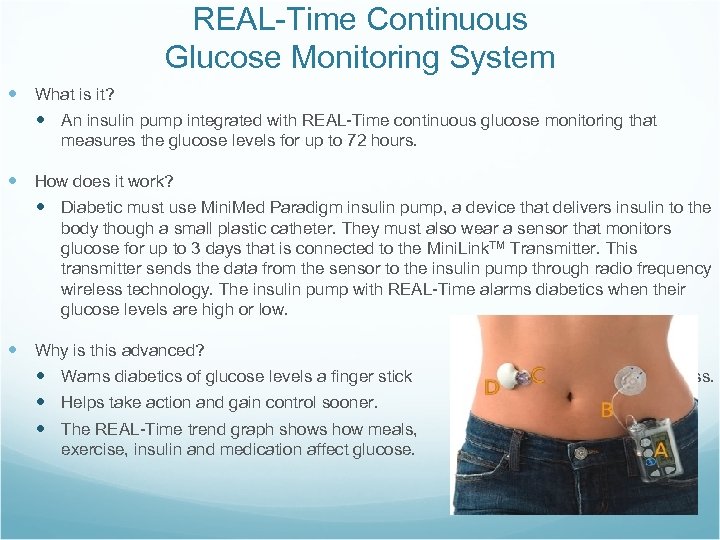
REAL-Time Continuous Glucose Monitoring System What is it? An insulin pump integrated with REAL-Time continuous glucose monitoring that measures the glucose levels for up to 72 hours. How does it work? Diabetic must use Mini. Med Paradigm insulin pump, a device that delivers insulin to the body though a small plastic catheter. They must also wear a sensor that monitors glucose for up to 3 days that is connected to the Mini. Link. TM Transmitter. This transmitter sends the data from the sensor to the insulin pump through radio frequency wireless technology. The insulin pump with REAL-Time alarms diabetics when their glucose levels are high or low. Why is this advanced? Warns diabetics of glucose levels a finger stick Helps take action and gain control sooner. The REAL-Time trend graph shows how meals, exercise, insulin and medication affect glucose. might miss.
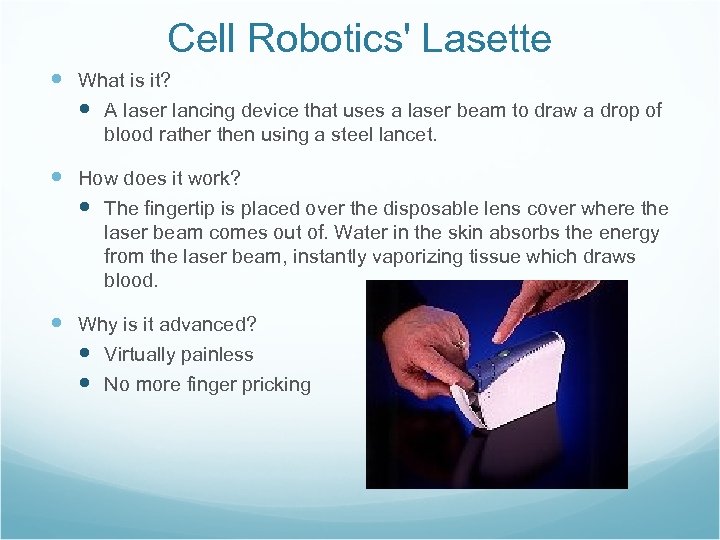
Cell Robotics' Lasette What is it? A laser lancing device that uses a laser beam to draw a drop of blood rather then using a steel lancet. How does it work? The fingertip is placed over the disposable lens cover where the laser beam comes out of. Water in the skin absorbs the energy from the laser beam, instantly vaporizing tissue which draws blood. Why is it advanced? Virtually painless No more finger pricking
Glucose Control Benefits Keeping blood glucose levels as close to normal as possible: Few or even no complications Normal life span Short term benefits of glucose control Feel better Stay healthy Have more energy Reduce risk of hyperglycemia and hypoglycemia Long term benefits of glucose control Lower chances of having eye, heart and kidney disease and nerve damage Enjoy a better quality of life
References "Diabetes and Blood Sugar Testing. " Web. MD Diabetes Center: Types, Causes, Symptoms, Tests, and Treatments. Web. 14 Mar. 2010. <http: //diabetes. webmd. com/guide/how-test-blood-glucose>. "Blood Glucose Monitoring. " Wikipedia. Web. 14 Mar. 2010. http: //en. wikipedia. org/wiki/Blood_glucose_monitoring "Blood Glucose Monitoring | The Importance of Self-Monitoring Your Blood Sugar. " Diabetes Care, Information & Support | Changing Life With Diabetes. Web. 14 Mar. 2010. <http: //www. changingdiabetesus. com/Managing. Diabetes/Monitoring/>. "Latest Developments in Insulin Delivery Technology. " Lifeclinic: Blood Pressure Monitors and Personal Health Management. Web. 14 Mar. 2010. <http: //www. lifeclinic. com/focus/diabetes/advances. asp>. "Sensors for Medicine and Science Is Woking on Flourescent Trechnology for the Measurement of Blood Glucose. " Diabetes. Net. com. Web. 14 Mar. 2010. <http: //www. diabetesnet. com/diabetes_technology/sms. php>. "Children with DIABETES - Personal Lasette. " Children with DIABETES Online Community. Web. 14 Mar. 2010. <http: //www. childrenwithdiabetes. com/d_06_2 ab. htm>.
Скачать презентацию Diabetes and Glucose Monitoring Kayla Walker What
5927f6f7a701dca787eda1e32ddcdb98.ppt