


 Скачать презентацию Ðì SA International Conference on the Millennium Development
1ffd21d8a6d990e940087c7e4b3872f9.ppt
- Количество слайдов: 35
 Ðì SA International Conference on the Millennium Development Goals Statistics National Statistical Service of the Republic of Armenia «Improvement of Data Availability for MDGs of Armenia» 1 -3 October 2007, Manila, Philippines
 General n n n The Statistical System of the Republic of Armenia is centralized and financed from the state budget. Mission: to compile and publish statistics for public use. Statistics Armenia is comprised of the Central Statistical Office and 11 Marz (regional) Agencies of Statistics. n n n The Supreme Body of Governance: State Council on Statistics consisting of 7 members and authorized to accept normative legal acts on statistics. Head: President of the National Statistical Service of RA, who at the same time holds the post of the Chairman of the State Council on Statistics. The Head and 6 members of the Council are appointed for 6 year terms by the RA President` s Decree.
 Main Functions n n n n n to collect, process, summarize, analyze and publish statistical data, to cooperate with state and local self-government bodies in collection of statistical information. to develop and improve statistical methodologies, to coordinate data collection according to international standards and classifications, to organize statistical surveys, to carry out population census every 10 years, to establish, maintain and update the business-register, to provide users with statistical information, to ensure the transparency and access to aggregated statistical information, to cooperate with international organizations and national statistical offices.
 Position within the Public Administration n Administrative position: the National Statistical Service of RA is a specialized state management body implementing functions aimed at the public interest that is independent from other state and local selfgovernment bodies. The Staff is united administrative institution consisting of functional and territorial units. Staff members are civil servants. The activity is based on the statistical work programs. Three-year state statistical work program is approved by the Parliament of RA as a Law, while the annual program – by the State Council on Statistics.
 International Classifications and Standards n n n n NACE Rev. 1 CPA, PRODCOM ISCO-88 ISCED HS/CN ICD-10 Armenia has become a subscriber to the IMF General Data Dissemination System (GDDS) since 29 March 2001. On November 7 the Republic of Armenia became the 54 th subscriber to the IMF Special Data Dissemination Standard (SDDS).
 MDGs n n It is not a secret that the Millennium Development Goals (MDGs) adopted by the UN in September 2000 are the most comprehensive and worldwide program of the 21 st Century. As articulated in the Millennium Development Declaration, the Millennium Development Goals are benchmarks for progress towards a vision of development, peace and human rights, guided by “certain fundamental values … essential to international relations in the twenty-first century”. To implement the program a serious role is also preserved for statisticians both at international and national levels.
 MDGs n In this respect, a big importance is attached to the program work of the National Statistical Offices of countries in the sphere of formation of accounting systems of the MDGs indicators, as well as exchange of statistical data and metadata with international organizations. It is extremely important to intensify a methodological coordination work by international organizations and to increase their status in this sphere. The work of countries statistical offices aimed at the formation and coordination of information sources of the MDGs indicators is essentially important at the national level.
 MDGs n The last task in transition and developing countries is still remaining sharp, conditioned by the fact that those countries have still not finished the processes of formation of administrative registers. In particular, for Armenia as a transition country the compilations of the MDGs indicators by regions is still a serious task, because of registers at the community level have still not been formed. The compilation of the MDGs indicators is mostly implemented at the national level. Data collection on those indicators is implemented by statistical work programs that are a basis for statistical activities within the country.
 MDGs and PRSP n n The MDGs indicators have also been reflected in the Poverty Reduction Strategy Program (PRSP) adopted by the Government of Armenia in 2003, the goals of which are also benchmarked for achievement by 2015. The MDG-based PRSP has been designed by the Government of Armenia with the support of international organizations and experts. NGOs have largely been involved in that work. There were largescale discussions on PRSP draft by the civil society. When defining the PRSP monitoring indicators, a numerous statistical indicators have been taken into account, particularly results of household surveys conducted by the National Statistical Service of the Republic of Armenia. The policy developed based on that monitoring enabled to reduce poverty from 56. 1% in 1999 to 29. 8% in 2005.
 The main goals are: 1. 2. 3. 4. 5. 6. 7. 8. Eradicate extreme poverty and hunger Achieve universal primary education Promote gender equality and empowerment of women Reduce child mortality Improve maternal health Combat HIV/AIDS, malaria and other diseases Ensure environmental sustainability Develop a global partnership for development.
 Status of the MDGs Indicators – 48 n Armenia MDGs Indicators for 2006 – 36, n n n out of which Compiled by administrative registers – 16 Compiled by the National Statistical Service - 20
 Data Collection Sources n n n ILCS – Integrated Living Conditions Survey DHS – Demographic and Health Survey LFS – Labour Force Survey 2001 Population Census NSS – National Statistical Service of the Republic of Armenia AR – Administrative Register
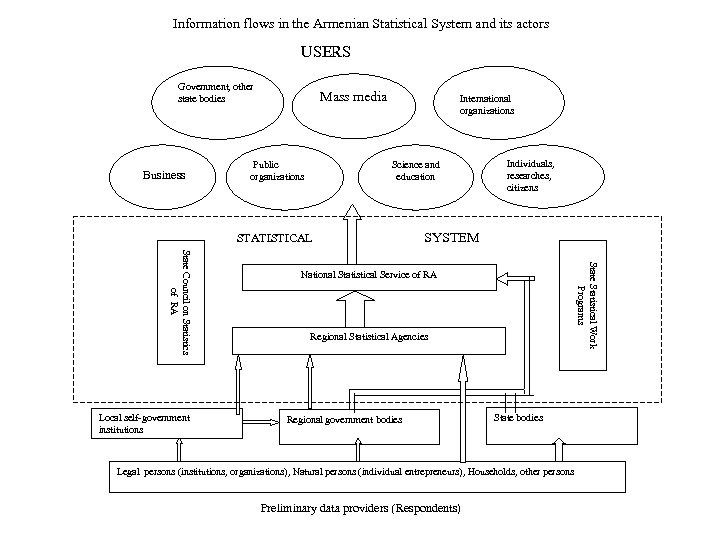 Information flows in the Armenian Statistical System and its actors USERS Government, other state bodies Business Mass media Public organizations International organizations Science and education Individuals, researches, citizens STATISTICAL SYSTEM State Statistical Work Programs State Council on Statistics of RA Local self-government institutions National Statistical Service of RA Regional Statistical Agencies Regional government bodies State bodies Legal persons (institutions, organizations), Natural persons (individual entrepreneurs), Households, other persons Preliminary data providers (Respondents)
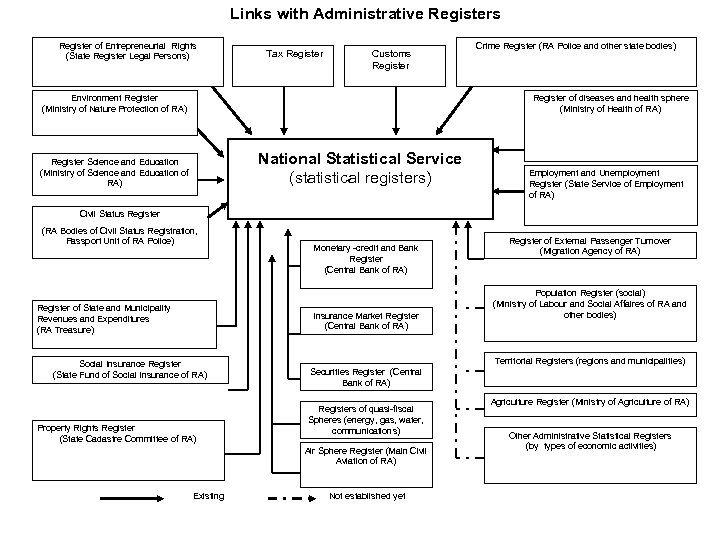 Links with Administrative Registers Register of Entrepreneurial Rights (State Register Legal Persons) Tax Register Customs Register Environment Register (Ministry of Nature Protection of RA) Crime Register (RA Police and other state bodies) Register of diseases and health sphere (Ministry of Health of RA) National Statistical Service (statistical registers) Register Science and Education (Ministry of Science and Education of RA) Employment and Unemployment Register (State Service of Employment of RA) Civil Status Register (RA Bodies of Civil Status Registration, Passport Unit of RA Police) Register of State and Municipality Revenues and Expenditures (RA Treasure) Monetary -credit and Bank Register (Central Bank of RA) Insurance Market Register (Central Bank of RA) Social Insurance Register (State Fund of Social Insurance of RA) Property Rights Register (State Cadastre Committee of RA) Population Register (social) (Ministry of Labour and Social Affaires of RA and other bodies) Territorial Registers (regions and municipalities) Securities Register (Central Bank of RA) Registers of quasi-fiscal Spheres (energy, gas, water, communications) Air Sphere Register (Main Civil Aviation of RA) Existing Register of External Passenger Turnover (Migration Agency of RA) Not established yet Agriculture Register (Ministry of Agriculture of RA) Other Administrative Statistical Registers (by types of economic activities)
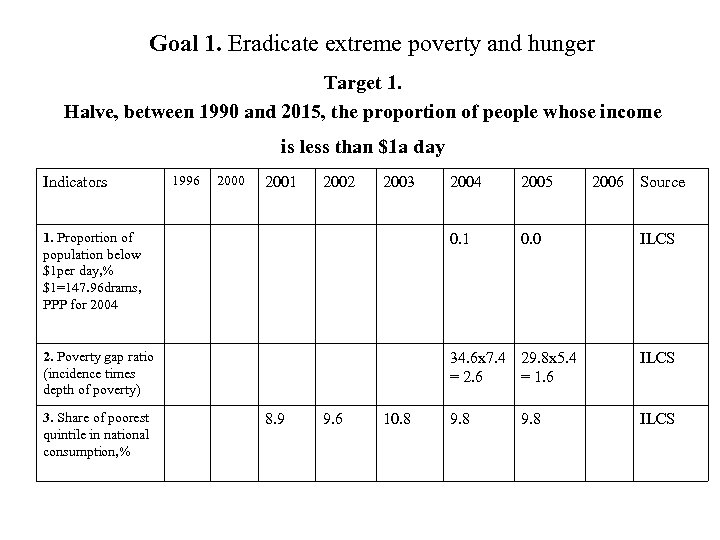 Goal 1. Eradicate extreme poverty and hunger Target 1. Halve, between 1990 and 2015, the proportion of people whose income is less than $1 a day Indicators 1996 2000 2004 2005 1. Proportion of population below $1 per day, % $1=147. 96 drams, PPP for 2004 0. 1 0. 0 2. Poverty gap ratio (incidence times depth of poverty) 34. 6 x 7. 4 29. 8 x 5. 4 = 2. 6 = 1. 6 ILCS 9. 8 ILCS 3. Share of poorest quintile in national consumption, % 2001 8. 9 2002 9. 6 2003 10. 8 9. 8 2006 Source ILCS
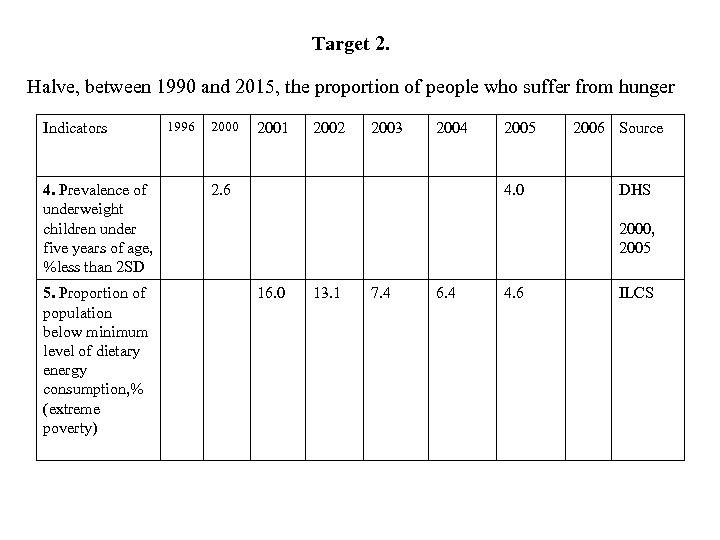 Target 2. Halve, between 1990 and 2015, the proportion of people who suffer from hunger Indicators 4. Prevalence of underweight children under five years of age, %less than 2 SD 5. Proportion of population below minimum level of dietary energy consumption, % (extreme poverty) 1996 2000 2001 2002 2003 2004 2. 6 2005 4. 0 2006 Source DHS 2000, 2005 16. 0 13. 1 7. 4 6. 4 4. 6 ILCS
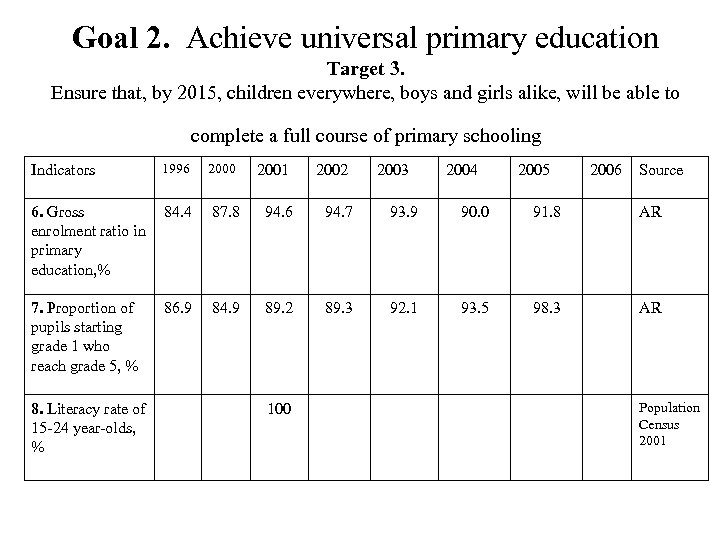 Goal 2. Achieve universal primary education Target 3. Ensure that, by 2015, children everywhere, boys and girls alike, will be able to complete a full course of primary schooling 1996 2000 2001 6. Gross 84. 4 enrolment ratio in primary education, % 87. 8 94. 6 94. 7 93. 9 90. 0 91. 8 AR 7. Proportion of pupils starting grade 1 who reach grade 5, % 84. 9 89. 2 89. 3 92. 1 93. 5 98. 3 AR Indicators 8. Literacy rate of 15 -24 year-olds, % 86. 9 100 2002 2003 2004 2005 2006 Source Population Census 2001
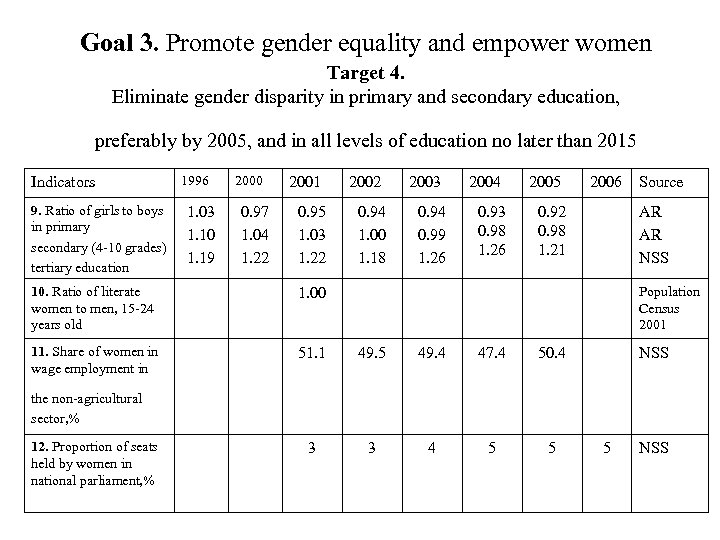 Goal 3. Promote gender equality and empower women Target 4. Eliminate gender disparity in primary and secondary education, preferably by 2005, and in all levels of education no later than 2015 1996 Indicators 9. Ratio of girls to boys in primary secondary (4 -10 grades) tertiary education 1. 03 1. 10 1. 19 2000 0. 97 1. 04 1. 22 2001 0. 95 1. 03 1. 22 2002 0. 94 1. 00 1. 18 2003 0. 94 0. 99 1. 26 2004 0. 93 0. 98 1. 26 2005 2006 0. 92 0. 98 1. 21 10. Ratio of literate women to men, 15 -24 years old 51. 1 49. 5 49. 4 47. 4 50. 4 3 3 4 5 5 the non-agricultural sector, % Source AR AR NSS 1. 00 11. Share of women in wage employment in Population Census 2001 NSS 12. Proportion of seats held by women in national parliament, % 5 NSS
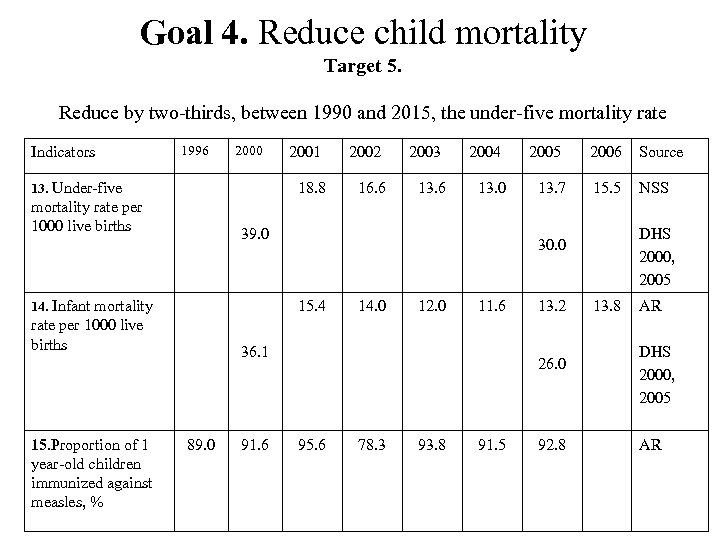 Goal 4. Reduce child mortality Target 5. Reduce by two-thirds, between 1990 and 2015, the under-five mortality rate Indicators 1996 2000 13. Under-five 18. 8 mortality rate per 1000 live births 2002 16. 6 2003 13. 6 2004 13. 0 39. 0 14. Infant mortality 14. 0 12. 0 11. 6 36. 1 89. 0 91. 6 2005 13. 7 2006 Source 15. 5 NSS DHS 2000, 2005 30. 0 15. 4 rate per 1000 live births 15. Proportion of 1 year-old children immunized against measles, % 2001 13. 2 26. 0 95. 6 78. 3 93. 8 91. 5 92. 8 13. 8 AR DHS 2000, 2005 AR
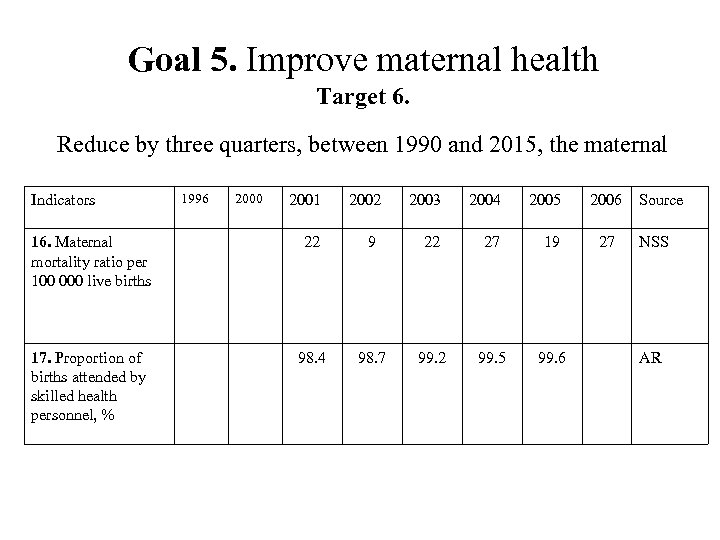 Goal 5. Improve maternal health Target 6. Reduce by three quarters, between 1990 and 2015, the maternal Indicators 1996 2000 2001 2002 2003 2004 2005 16. Maternal mortality ratio per 100 000 live births 22 9 22 27 19 17. Proportion of births attended by skilled health personnel, % 98. 4 98. 7 99. 2 99. 5 99. 6 2006 27 Source NSS AR
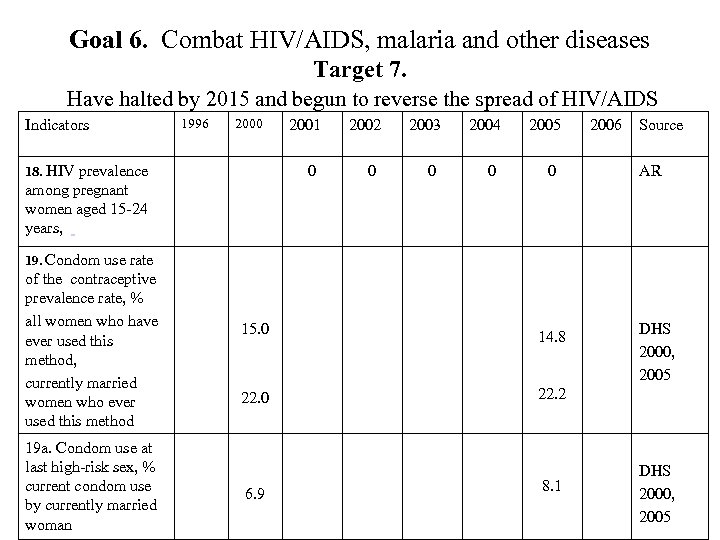 Goal 6. Combat HIV/AIDS, malaria and other diseases Target 7. Have halted by 2015 and begun to reverse the spread of HIV/AIDS Indicators 1996 2000 18. HIV prevalence 2001 0 2002 0 2003 0 2004 0 2005 0 2006 Source AR among pregnant women aged 15 -24 years, 19. Condom use rate of the contraceptive prevalence rate, % all women who have ever used this method, currently married women who ever used this method 19 a. Condom use at last high-risk sex, % current condom use by currently married woman 15. 0 14. 8 22. 0 22. 2 6. 9 8. 1 DHS 2000, 2005
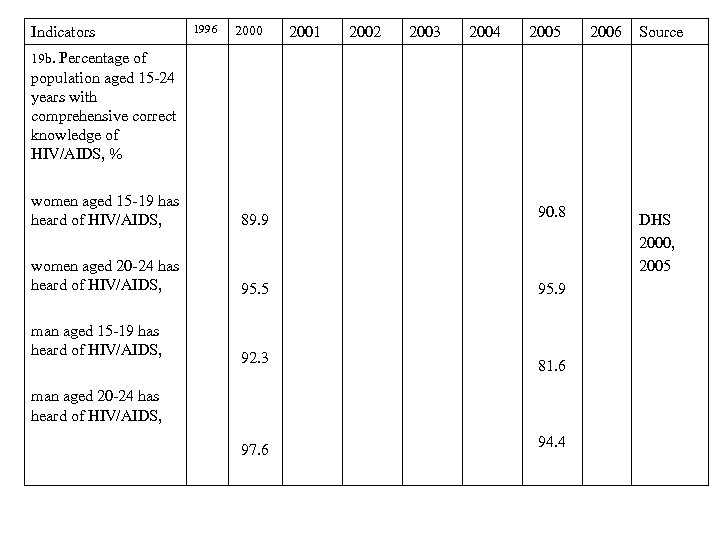 Indicators 1996 2000 2001 2002 2003 2004 2005 2006 Source 19 b. Percentage of population aged 15 -24 years with comprehensive correct knowledge of HIV/AIDS, % women aged 15 -19 has heard of HIV/AIDS, 89. 9 90. 8 women aged 20 -24 has heard of HIV/AIDS, 95. 5 95. 9 man aged 15 -19 has heard of HIV/AIDS, 92. 3 81. 6 97. 6 94. 4 man aged 20 -24 has heard of HIV/AIDS, DHS 2000, 2005
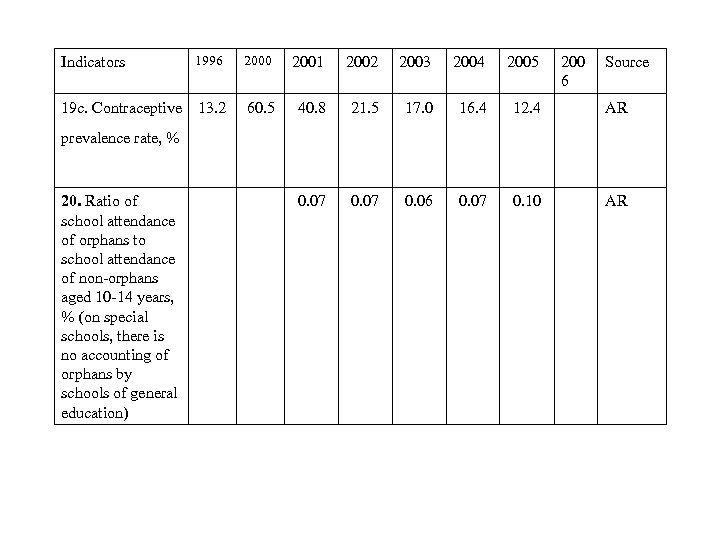 1996 2000 2001 2002 2003 2004 2005 19 c. Contraceptive 13. 2 60. 5 40. 8 21. 5 17. 0 16. 4 12. 4 AR 0. 07 0. 06 0. 07 0. 10 AR Indicators prevalence rate, % 200 6 Source 20. Ratio of school attendance of orphans to school attendance of non-orphans aged 10 -14 years, % (on special schools, there is no accounting of orphans by schools of general education)
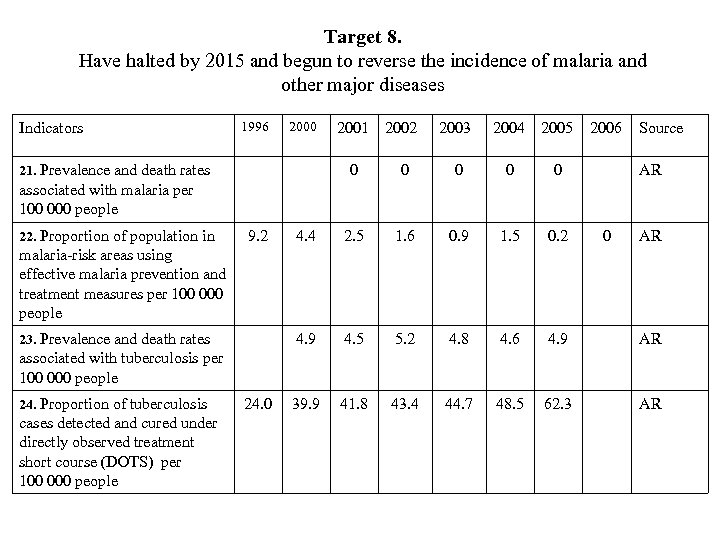 Target 8. Have halted by 2015 and begun to reverse the incidence of malaria and other major diseases Indicators 1996 2000 2001 2002 2003 2004 2005 0 0 0 4. 4 2. 5 1. 6 0. 9 1. 5 0. 2 4. 9 4. 5 5. 2 4. 8 4. 6 4. 9 AR 39. 9 41. 8 43. 4 44. 7 48. 5 62. 3 AR 21. Prevalence and death rates 2006 Source AR associated with malaria per 100 000 people 22. Proportion of population in 9. 2 0 AR malaria-risk areas using effective malaria prevention and treatment measures per 100 000 people 23. Prevalence and death rates associated with tuberculosis per 100 000 people 24. Proportion of tuberculosis cases detected and cured under directly observed treatment short course (DOTS) per 100 000 people 24. 0
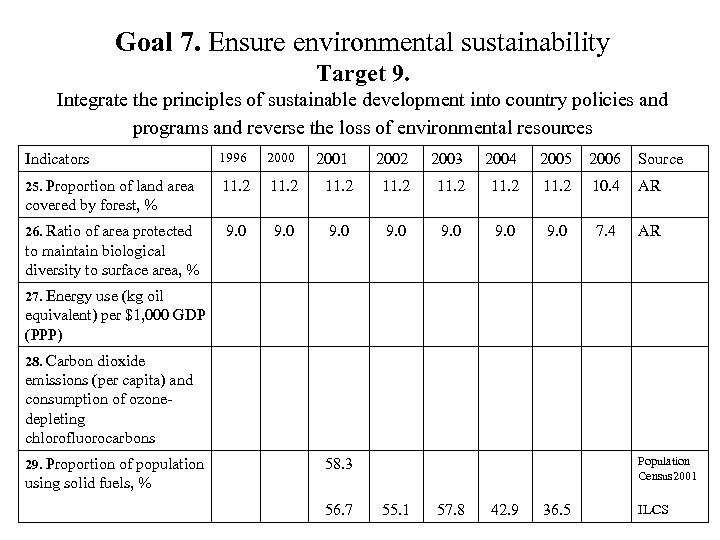 Goal 7. Ensure environmental sustainability Target 9. Integrate the principles of sustainable development into country policies and programs and reverse the loss of environmental resources Indicators 1996 2000 25. Proportion of land area 11. 2 9. 0 2001 2002 2003 2004 2005 2006 Source 11. 2 10. 4 AR 9. 0 9. 0 7. 4 AR covered by forest, % 26. Ratio of area protected to maintain biological diversity to surface area, % 27. Energy use (kg oil equivalent) per $1, 000 GDP (PPP) 28. Carbon dioxide emissions (per capita) and consumption of ozonedepleting chlorofluorocarbons 29. Proportion of population Population Census 2001 58. 3 using solid fuels, % 56. 7 55. 1 57. 8 42. 9 36. 5 ILCS
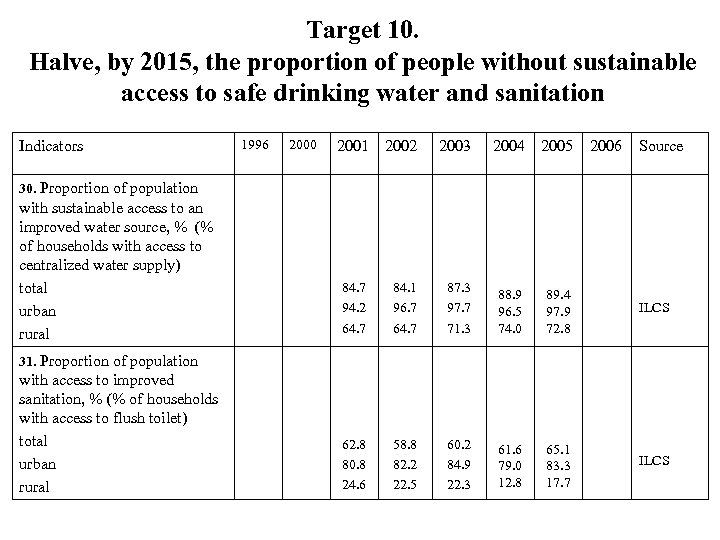 Target 10. Halve, by 2015, the proportion of people without sustainable access to safe drinking water and sanitation Indicators 1996 2000 2001 2002 2003 2004 2005 2006 Source 84. 7 94. 2 64. 7 84. 1 96. 7 64. 7 87. 3 97. 7 71. 3 88. 9 96. 5 74. 0 89. 4 97. 9 72. 8 ILCS 62. 8 80. 8 24. 6 58. 8 82. 2 22. 5 60. 2 84. 9 22. 3 61. 6 79. 0 12. 8 65. 1 83. 3 17. 7 ILCS 30. Proportion of population with sustainable access to an improved water source, % (% of households with access to centralized water supply) total urban rural 31. Proportion of population with access to improved sanitation, % (% of households with access to flush toilet) total urban rural
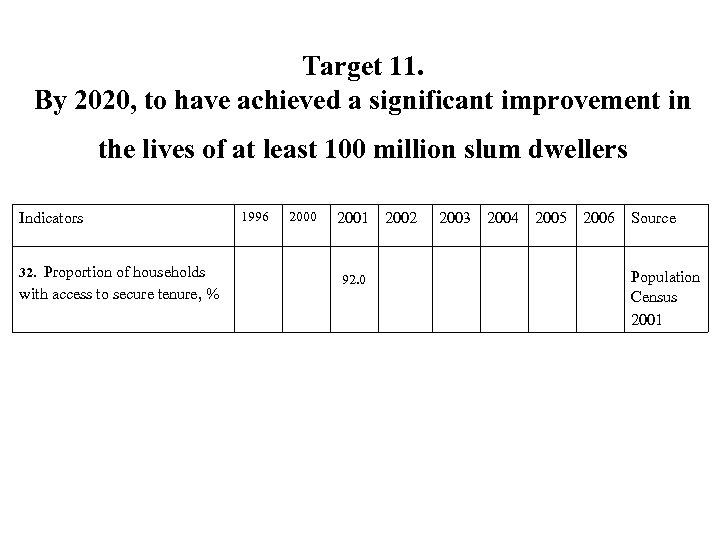 Target 11. By 2020, to have achieved a significant improvement in the lives of at least 100 million slum dwellers Indicators 32. Proportion of households with access to secure tenure, % 1996 2000 2001 92. 0 2002 2003 2004 2005 2006 Source Population Census 2001
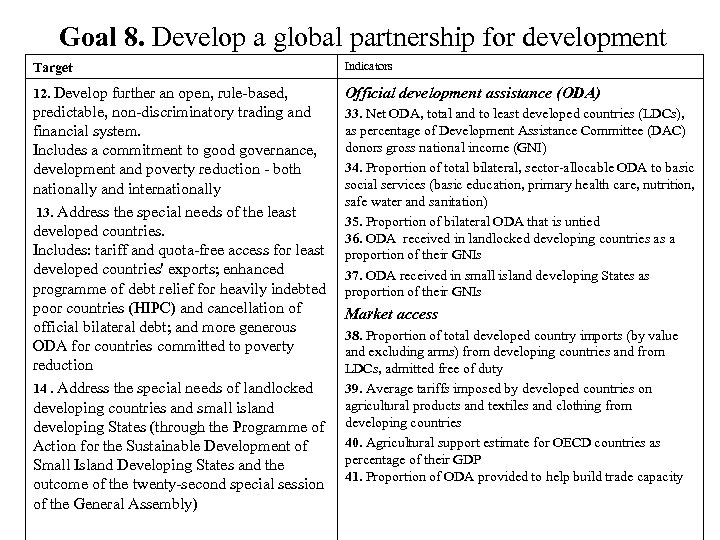 Goal 8. Develop a global partnership for development Target Indicators 12. Develop further an open, rule-based, Official development assistance (ODA) predictable, non-discriminatory trading and financial system. Includes a commitment to good governance, development and poverty reduction - both nationally and internationally 13. Address the special needs of the least developed countries. Includes: tariff and quota-free access for least developed countries' exports; enhanced programme of debt relief for heavily indebted poor countries (HIPC) and cancellation of official bilateral debt; and more generous ODA for countries committed to poverty reduction 14. Address the special needs of landlocked developing countries and small island developing States (through the Programme of Action for the Sustainable Development of Small Island Developing States and the outcome of the twenty-second special session of the General Assembly) 33. Net ODA, total and to least developed countries (LDCs), as percentage of Development Assistance Committee (DAC) donors gross national income (GNI) 34. Proportion of total bilateral, sector-allocable ODA to basic social services (basic education, primary health care, nutrition, safe water and sanitation) 35. Proportion of bilateral ODA that is untied 36. ODA received in landlocked developing countries as a proportion of their GNIs 37. ODA received in small island developing States as proportion of their GNIs Market access 38. Proportion of total developed country imports (by value and excluding arms) from developing countries and from LDCs, admitted free of duty 39. Average tariffs imposed by developed countries on agricultural products and textiles and clothing from developing countries 40. Agricultural support estimate for OECD countries as percentage of their GDP 41. Proportion of ODA provided to help build trade capacity
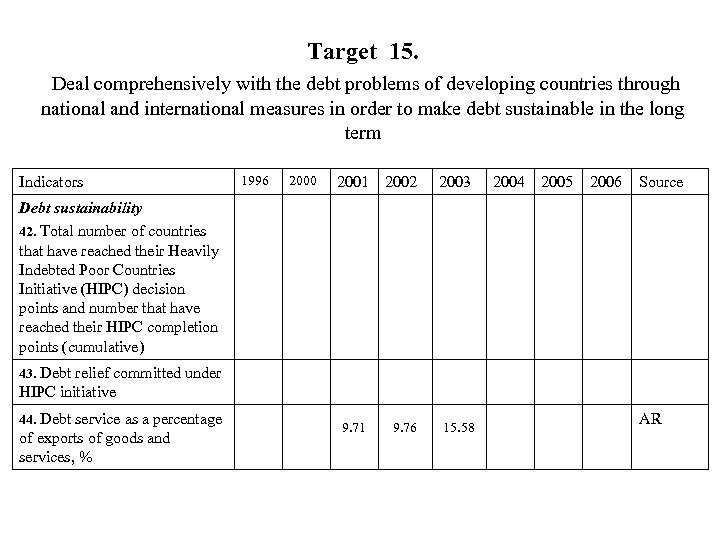 Target 15. Deal comprehensively with the debt problems of developing countries through national and international measures in order to make debt sustainable in the long term Indicators 1996 2000 2001 2002 2003 9. 71 9. 76 15. 58 2004 2005 2006 Source Debt sustainability 42. Total number of countries that have reached their Heavily Indebted Poor Countries Initiative (HIPC) decision points and number that have reached their HIPC completion points (cumulative) 43. Debt relief committed under HIPC initiative 44. Debt service as a percentage of exports of goods and services, % AR
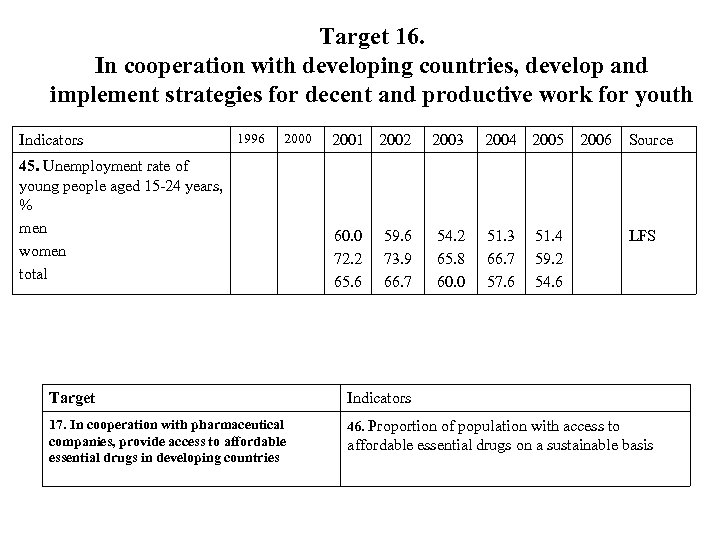 Target 16. In cooperation with developing countries, develop and implement strategies for decent and productive work for youth Indicators 1996 2000 45. Unemployment rate of young people aged 15 -24 years, % men women total 2001 2002 60. 0 72. 2 65. 6 59. 6 73. 9 66. 7 2003 54. 2 65. 8 60. 0 2004 2005 2006 Source 51. 3 66. 7 57. 6 LFS 51. 4 59. 2 54. 6 Target Indicators 17. In cooperation with pharmaceutical companies, provide access to affordable essential drugs in developing countries 46. Proportion of population with access to affordable essential drugs on a sustainable basis
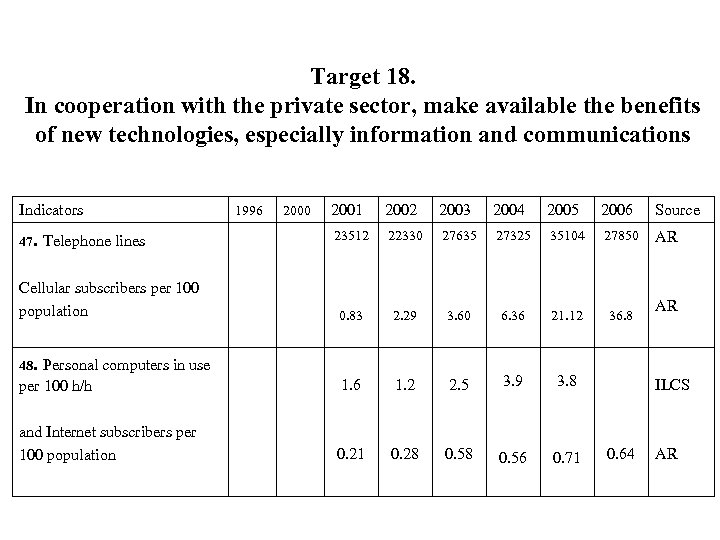 Target 18. In cooperation with the private sector, make available the benefits of new technologies, especially information and communications Indicators 2001 2002 2003 2004 2005 2006 Source 23512 22330 27635 27325 35104 27850 AR 0. 83 2. 29 3. 60 6. 36 21. 12 36. 8 per 100 h/h 1. 6 1. 2 2. 5 3. 9 3. 8 and Internet subscribers per 100 population 0. 21 0. 28 0. 56 0. 71 47. Telephone lines Cellular subscribers per 100 population 1996 2000 48. Personal computers in use AR ILCS 0. 64 AR
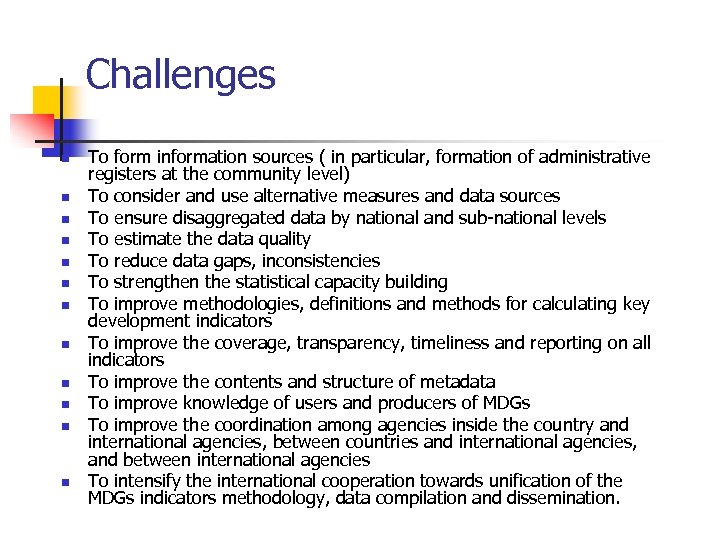 Challenges n n n To form information sources ( in particular, formation of administrative registers at the community level) To consider and use alternative measures and data sources To ensure disaggregated data by national and sub-national levels To estimate the data quality To reduce data gaps, inconsistencies To strengthen the statistical capacity building To improve methodologies, definitions and methods for calculating key development indicators To improve the coverage, transparency, timeliness and reporting on all indicators To improve the contents and structure of metadata To improve knowledge of users and producers of MDGs To improve the coordination among agencies inside the country and international agencies, between countries and international agencies, and between international agencies To intensify the international cooperation towards unification of the MDGs indicators methodology, data compilation and dissemination.
 NSS RA strategies n n n n n To develop a program for MDGs activity To increase a capacity to produce the data required for the MDG indicators To increase the NSSRA`s capacity for providing timely and accurate data for MDGs monitoring and reporting To include MDGs (tables/formats) in statistical reports on social and economic situation of the country to assist in monitoring MDGs To prepare and publish “The Millennium Development Goals” Statistical Report To post MDGs on the national statistics website To introduce software, in particular Devinfo To improve and make closer cooperation with administrative registers To implement activities to form other respondents.
 Library and Internet n The library is rich with all the statistical products of the NSS, statistical publications of other countries and international organizations, methodological handbooks, text-books, legal documents, etc. The statistics library is open to the general public. Library`s electronic catalogue is accessible from the Internet. n Internet: http: //www. armstat. am n n
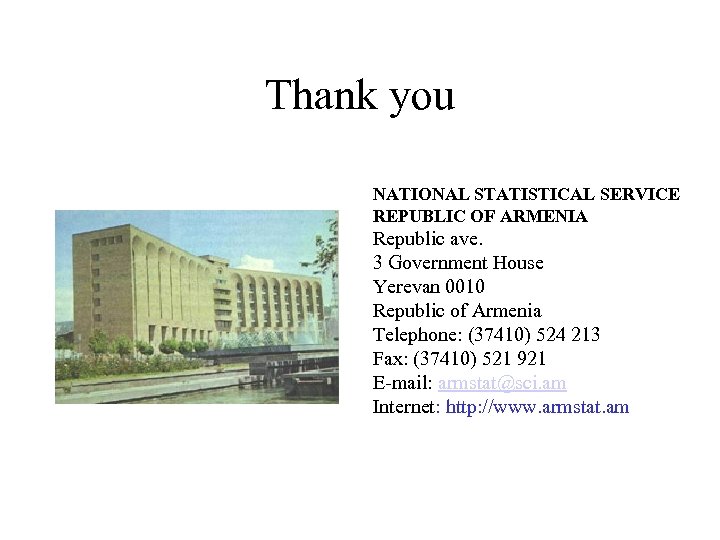 Thank you NATIONAL STATISTICAL SERVICE REPUBLIC OF ARMENIA Republic ave. 3 Government House Yerevan 0010 Republic of Armenia Telephone: (37410) 524 213 Fax: (37410) 521 921 E-mail: armstat@sci. am Internet: http: //www. armstat. am